Gastrointestinal Tract
Problems
Indigestion
Nausea and vomiting
Indigestion
• Indigestion (dyspepsia) is commonly presented in community
pharmacies and is often self-diagnosed by patients, who use the term
to include anything from pain in the chest and upper abdomen to
lower abdominal symptoms.
• Many patients use the terms indigestion and heartburn
interchangeably.
• The pharmacist must establish whether such a selfdiagnosis is correct
and exclude the possibility of serious disease.
Symptoms
• The symptoms of typical indigestion include poorly localised upper
abdominal (the area between the belly button and the breastbone)
discomfort, which may be brought on by
• particular foods,
• excess food,
• alcohol or medication (e.g. aspirin).
Age
• Indigestion is rare in children, who should be referred to the doctor.
• Abdominal pain, however, is a common symptom in children and is often associated with
an infection.
• OTC treatment is not appropriate for abdominal pain of unknown cause and referral to
the doctor would be advisable.
• Be cautious when dealing with first-time indigestion in patients aged 45 years or over
and refer them to the general practitioner (GP) for a diagnosis.
• Gastric cancer, while rare in young patients, is more likely to occur in those aged 50 years
and over.
Duration/previous history
• Indigestion that is persistent or recurrent should be referred to the
doctor, after considering the information gained from questioning.
• Any patient with a previous history of the symptom which has not
responded to treatment, or which has worsened, should be referred.
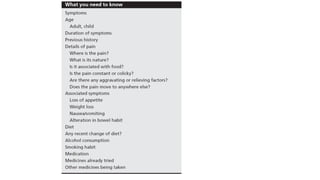
Details of pain/associated symptoms
• If the pharmacist can obtain a good description of the pain, then the
decision whether to advise treatment or referral is much easier.
• A few medical conditions that may present as indigestion but which
require referral are described below:
Ulcer
• Duodenal ulcers are more common and have different symptoms from gastric ulcers.
• Typically the pain of a duodenal ulcer is localised to the upper abdomen, slightly to the
right of the midline.
• It is often possible to point to the site of pain with a single finger.
• The pain is dull and is most likely to occur when the stomach is empty, especially at night.
• It is relieved by food (although it may be aggravated by fatty foods) and antacids.
• The pain of a gastric ulcer is in the same area but less well localised.
• It is often aggravated by food and may be associated with nausea and
vomiting.
• Appetite is usually reduced and the symptoms are persistent and
severe.
• Both types of ulcers are associated with H. pylori infection and may be
exacerbated or precipitated by smoking and NSAIDs.
Gallstones
• .The gall bladder stores bile.
• It periodically contracts to squirt bile through a narrow tube (bile duct) into the duodenum to aid
the digestion of food, especially fat.
• Stones can become temporarily stuck in the opening to the bile duct as the gall bladder contracts.
• This causes severe pain (biliary colic) in the upper abdomen below the right rib margin.
• Sometimes this pain can be confused with that of a duodenal ulcer.
• Biliary colic may be precipitated by a fatty meal.
Gastro-oesophageal reflux
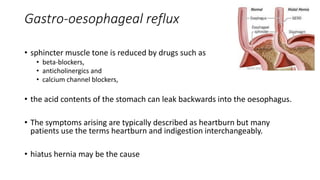
• sphincter muscle tone is reduced by drugs such as
• beta-blockers,
• anticholinergics and
• calcium channel blockers,
• the acid contents of the stomach can leak backwards into the oesophagus.
• The symptoms arising are typically described as heartburn but many
patients use the terms heartburn and indigestion interchangeably.
• hiatus hernia may be the cause
Irritable bowel syndrome
• Irritable bowel syndrome (IBS) is a common, non-serious, but troublesome, condition in which
symptoms are caused by colon spasm
• There is usually an alteration in bowel habit, often with alternating constipation and diarrhoea.
• The diarrhoea is typically worse first thing in the morning.
• Pain is usually present.
• It is often lower abdominal (below and to the right or left of the belly button) but it may be upper
abdominal and therefore confused with indigestion.
• Any persistent alteration in normal bowel habit is an indication for referral.
Atypical angina
• Angina is usually experienced as a tight, painful constricting band
across the middle of the chest.
• Atypical angina pain may be felt in the lower chest or upper
abdomen. It is likely to be precipitated by exercise or exertion.
• If this occurs, referral is necessary.
More serious disorders
• Persisting upper abdominal pain, especially when associated with
anorexia and unexplained weight loss, may herald an underlying
cancer of the stomach or pancreas.
• Ulcers sometimes start bleeding, which may present with blood in the
vomit (haematemesis) or in the stool (melaena).
• In the latter, the stool becomes tarry and black. Urgent referral is
necessary.
Diet
• Fatty foods and alcohol can cause
• indigestion,
• aggravate ulcers
• precipitate biliary colic.
Smoking habit
• Smoking predisposes to, and may cause, indigestion and ulcers.
• Ulcers heal more slowly and relapse more often during treatment in
smokers.
• The pharmacist is in a good position to offer advice on smoking
cessation, perhaps with a recommendation to use nicotine
replacement therapy.
Other medicines being taken
• Gastrointestinal (GI) side effects can be caused by many drugs, so it is important
for the pharmacist to ascertain any medication that the patient is taking.
• NSAIDs have been implicated in the causation of ulcers and bleeding ulcers, and
there are differences in toxicity related to increased doses and to the nature of
individual drugs.
• Sometimes these drugs cause indigestion. Elderly patients are particularly prone
to such problems, and pharmacists should bear this in mind.
• aspirin, ibuprofen and iron are among those that may produce symptoms of
indigestion.
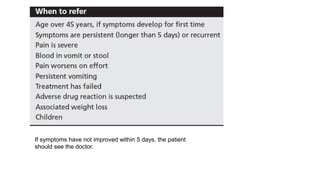
If symptoms have not improved within 5 days, the patient
should see the doctor.
Management
• Once the pharmacist has excluded serious disease, treatment of
dyspepsia with antacids or an H2 antagonist may be recommended
and is likely to be effective.
• The preparation should be selected on the basis of the individual
patient’s symptoms.
• Smoking, alcohol and fatty meals can all aggravate symptoms, so the
pharmacist can advise appropriately.
Dimeticone (dimethicone)
• Dimeticone is sometimes added to antacid formulations for its
defoaming properties. Theoretically, it reduces surface tension and
allows easier elimination of gas from the gut
• Evidence of benefit is uncertain.
Domperidone
• Domperidone 10 mg can be used for the treatment of postprandial
stomach symptoms of excessive fullness, nausea, epigastric bloating and
belching, occasionally accompanied by epigastric discomfort and
heartburn.
• It increases the rate of gastric emptying and transit time in the small
intestine, and also increases the strength of contraction of the oesophageal
sphincter.
• Domperidone can be used in patients aged 16 years and over. The
maximum dose is 10 mg and the maximum daily dose 40 mg.
Interactions with antacids
• Because they raise the gastric pH, antacids can interfere with enteric
coatings on tablets that are intended to release their contents further
along the GI tract.
• The consequences of this may be that release of the drug is unpredictable;
adverse effects may occur if the drug is in contact with the stomach.
• Alternatively, enteric coatings are sometimes used to protect a drug that
may be inactivated by the low pH in the stomach, so concurrent
administration of antacids may result in such inactivation.
• Taking the doses of antacids and other drugs at least 1 h apart should
minimise the interaction.
• Antacids may reduce the absorption of some antibiotics and
antifungals (tetracyclines, azithromycin, itraconazole, ketoconazole,
ciprofloxacin, norfloxacin, rifampicin).
• Absorption of (ACE) inhibitors, phenothiazines, gabapentin and
phenytoin, may also be reduced.
• Sodium bicarbonate may increase the excretion of lithium and lower the plasma level, so
a reduction in lithium’s therapeutic effect may occur.
• Antacids containing sodium bicarbonate should not therefore be recommended for any
patient on lithium therapy.
• The changes in pH that occur after antacid administration can result in a decrease in iron
absorption if iron is taken at the same time.
• The effect is caused by the formation of insoluble iron salts due to the changed pH.
• Taking iron and antacids at different times should prevent the problem.
Motion sickness
Motion sickness and its prevention
• Motion sickness is thought to be caused by a conflict of messages to
the brain, where the vomiting centre receives information from the
eyes, the GI tract and the vestibular system in the ear.
• Symptoms of motion sickness include nausea and sometimes
vomiting, pallor and cold sweats.
• Parents commonly seek advice about how to prevent motion sickness
in children, in whom the problem is most common.
• Any form of travel can produce symptoms, including air, sea and road.
• Effective prophylactic treatments are available OTC and can be
selected to match the patient’s needs.
Age
• Motion sickness is common in young children.
• The incidence of motion sickness seems to greatly reduce with age,
although some adults still experience symptoms.
• The minimum age at which products designed to prevent motion
sickness can be given varies, so for a family with several children
careful product selection can provide one medicine to treat all cases.
Mode of travel/length of journey
• Details of the journey to be undertaken are useful.
• The estimated length of time to be spent travelling will help the pharmacist in the
selection of prophylactic treatment, since the length of action of available drugs varies.
• Once vomiting starts there is little that can be done, so any medicine recommended by
the pharmacist must be taken in good time before the journey if it is to be effective.
• The fact that it is important that the symptoms are prevented before they can gain a hold
should be emphasised to the parents.
• If it is a long journey, it may be necessary to repeat the dose while travelling and the
recommended dosage interval should be stressed.
Management
• Prophylactic treatments for motion sickness, which can be bought
OTC, are effective and there is usually no need to refer patients to the
doctor.
• Anticholinergic activity is thought to prevent motion sickness and
forms the basis of treatment by anticholinergic agents (e.g. hyoscine)
and antihistamines, which have anticholinergic actions (e.g.
cinnarizine and promethazine).
Antihistamines
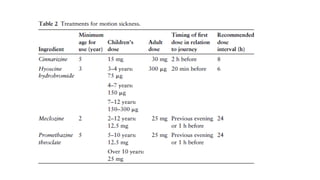
• Antihistamines include cinnarizine, meclozine and promethazine.
• Anticholinergic effects are thought to be responsible for the effectiveness of antihistamines in the
prophylaxis of motion sickness.
• All have the potential to cause drowsiness and promethazine appears to be the most sedative.
• Meclozine and promethazine theoclate have long durations of action and are useful for long journeys since
they need to be taken only once daily.
• Cinnarizine and promethazine theoclate are not recommended for children younger than 5 years, whereas
meclozine can be given to those over 2 years.
• The manufacturers of products containing these drugs advise that they are best avoided during pregnancy.
Anticholinergic agents
• The only anticholinergic used widely in the prevention of motion sickness is
hyoscine hydrobromide, which can be given to children over 3 years.
• Anticholinergic drugs can cause drowsiness, blurred vision, dry mouth,
constipation and urinary retention as side effects, although they are
probably unlikely to do so at the doses used in OTC formulations for motion
sickness.
• Children could be given sweets to suck to counteract any drying of the
mouth.
• Hyoscine has a short duration of action (from 1 h to 3 h). It is
therefore suitable for shorter journeys and should be given 20 min
before the start of the journey.
• Anticholinergic drugs and antihistamines with anticholinergic effects
are best avoided in patients with prostatic hypertrophy because of
the possibility of urinary retention and in glaucoma because the
intraocular pressure might be increased.
• Pharmacists should remember that side effects from anticholinergic
agents are additive and may be increased in patients already taking
drugs with anticholinergic effects, such as tricyclic antidepressants
(e.g. amitriptyline), butyrophenones (e.g. haloperidol) and
phenothiazines (e.g. chlorpromazine).
• It is therefore important for the pharmacist to determine the identity
of any medicines currently being taken by the patient.
Alternative approaches to motion sickness
• Ginger
• Ginger has been used for many years for travel sickness.
• Clinical trials have produced conflicting findings in travel sickness.
• No mechanism of action has been identified
• Ginger would be worth trying for a driver who suffered from motion
sickness, since it does not cause drowsiness, and might be worth
considering for use in pregnant women
Nausea and vomiting
Nausea and vomiting
• Nausea and vomiting are symptoms that have many possible causes.
• From the pharmacist’s point of view, while there are treatments
available to prevent nausea and vomiting, there is no effective OTC
treatment once vomiting is established.
• For that reason, this section will deal briefly with some of the causes
of these symptoms
Age
• The very young and the elderly are most at risk of dehydration as a
result of vomiting.
• Vomiting of milk in infants less than 1 year old may be due to
infection or feeding problems or, rarely, an obstruction such as pyloric
stenosis.
• Regurgitation sometimes occurs in babies, where it is known as
possetting and is a normal occurrence.
• When regurgitation occurs in adults, it is associated with oesophageal
disease with difficulty in swallowing and requires referral
Pregnancy
• Nausea and vomiting are very common in pregnancy, usually
beginning after the first missed period and occurring early in the
morning.
• Pregnancy should be considered as a possible cause of nausea and
vomiting in any woman of childbearing age who presents at the
pharmacy complaining of nausea and vomiting.
• Nausea and vomiting are more common in the first pregnancy than in
subsequent ones.
Duration
• Generally, adults should be referred to the doctor if vomiting has
been present for longer than 2 days.
• Children under 2 years are referred, whatever the duration, because
of the risks from dehydration.
• Anyone presenting with chronic vomiting should be referred to the
doctor since such symptoms may indicate the presence of a peptic
ulcer or gastric carcinoma.
Associated symptoms
• An acute infection (gastroenteritis) is often responsible for vomiting and, in
these cases, diarrhoea may also be present.
• In young children, the rotavirus is the most common cause of
gastroenteritis; this is highly infectious and so it is not unusual for more
than one child in the family to be affected.
• In such situations, there are usually associated cold symptoms.
• Vomiting without other symptoms, in the very young, can be caused by
serious infection such as meningitis, and is an indication for immediate
referral.
Alcohol intake
• People who drink large quantities of alcohol may vomit, often in the
morning.
• Alcoholic patients often feel nauseous and retch in the morning.
Medication
• Prescribed and OTC medicines may make patients feel sick and it is
therefore important to determine which medicines the patient is
currently taking.
• Aspirin and NSAIDs are common causes. Some antibiotics may cause
nausea and vomiting, for example, doxycycline.
• Oestrogens, steroids and narcotic analgesics may also produce these
symptoms.
• Symptoms can sometimes be improved by taking the medication with
food, but if they continue, the patient should see the doctor.
• Digoxin toxicity may show itself by producing nausea and vomiting,
and such symptoms in a patient who is taking digoxin
• Vomiting, with loss of fluids and possible electrolyte imbalances, may
cause problems in elderly people taking digoxin and diuretics.
Management
• Patients who are vomiting should be referred to the doctor, who will
be able to prescribe an anti-emetic if needed.
• The pharmacist can initiate rehydration therapy in the meantime.

OTC Medications - GIT problems 2

  • 1.
  • 2.
    Indigestion • Indigestion (dyspepsia)is commonly presented in community pharmacies and is often self-diagnosed by patients, who use the term to include anything from pain in the chest and upper abdomen to lower abdominal symptoms. • Many patients use the terms indigestion and heartburn interchangeably. • The pharmacist must establish whether such a selfdiagnosis is correct and exclude the possibility of serious disease.
  • 4.
    Symptoms • The symptomsof typical indigestion include poorly localised upper abdominal (the area between the belly button and the breastbone) discomfort, which may be brought on by • particular foods, • excess food, • alcohol or medication (e.g. aspirin).
  • 5.
    Age • Indigestion israre in children, who should be referred to the doctor. • Abdominal pain, however, is a common symptom in children and is often associated with an infection. • OTC treatment is not appropriate for abdominal pain of unknown cause and referral to the doctor would be advisable. • Be cautious when dealing with first-time indigestion in patients aged 45 years or over and refer them to the general practitioner (GP) for a diagnosis. • Gastric cancer, while rare in young patients, is more likely to occur in those aged 50 years and over.
  • 6.
    Duration/previous history • Indigestionthat is persistent or recurrent should be referred to the doctor, after considering the information gained from questioning. • Any patient with a previous history of the symptom which has not responded to treatment, or which has worsened, should be referred.
  • 7.
    Details of pain/associatedsymptoms • If the pharmacist can obtain a good description of the pain, then the decision whether to advise treatment or referral is much easier. • A few medical conditions that may present as indigestion but which require referral are described below:
  • 8.
    Ulcer • Duodenal ulcersare more common and have different symptoms from gastric ulcers. • Typically the pain of a duodenal ulcer is localised to the upper abdomen, slightly to the right of the midline. • It is often possible to point to the site of pain with a single finger. • The pain is dull and is most likely to occur when the stomach is empty, especially at night. • It is relieved by food (although it may be aggravated by fatty foods) and antacids.
  • 9.
    • The painof a gastric ulcer is in the same area but less well localised. • It is often aggravated by food and may be associated with nausea and vomiting. • Appetite is usually reduced and the symptoms are persistent and severe. • Both types of ulcers are associated with H. pylori infection and may be exacerbated or precipitated by smoking and NSAIDs.
  • 10.
    Gallstones • .The gallbladder stores bile. • It periodically contracts to squirt bile through a narrow tube (bile duct) into the duodenum to aid the digestion of food, especially fat. • Stones can become temporarily stuck in the opening to the bile duct as the gall bladder contracts. • This causes severe pain (biliary colic) in the upper abdomen below the right rib margin. • Sometimes this pain can be confused with that of a duodenal ulcer. • Biliary colic may be precipitated by a fatty meal.
  • 11.
    Gastro-oesophageal reflux • sphinctermuscle tone is reduced by drugs such as • beta-blockers, • anticholinergics and • calcium channel blockers, • the acid contents of the stomach can leak backwards into the oesophagus. • The symptoms arising are typically described as heartburn but many patients use the terms heartburn and indigestion interchangeably. • hiatus hernia may be the cause
  • 12.
    Irritable bowel syndrome •Irritable bowel syndrome (IBS) is a common, non-serious, but troublesome, condition in which symptoms are caused by colon spasm • There is usually an alteration in bowel habit, often with alternating constipation and diarrhoea. • The diarrhoea is typically worse first thing in the morning. • Pain is usually present. • It is often lower abdominal (below and to the right or left of the belly button) but it may be upper abdominal and therefore confused with indigestion. • Any persistent alteration in normal bowel habit is an indication for referral.
  • 13.
    Atypical angina • Anginais usually experienced as a tight, painful constricting band across the middle of the chest. • Atypical angina pain may be felt in the lower chest or upper abdomen. It is likely to be precipitated by exercise or exertion. • If this occurs, referral is necessary.
  • 14.
    More serious disorders •Persisting upper abdominal pain, especially when associated with anorexia and unexplained weight loss, may herald an underlying cancer of the stomach or pancreas. • Ulcers sometimes start bleeding, which may present with blood in the vomit (haematemesis) or in the stool (melaena). • In the latter, the stool becomes tarry and black. Urgent referral is necessary.
  • 15.
    Diet • Fatty foodsand alcohol can cause • indigestion, • aggravate ulcers • precipitate biliary colic.
  • 16.
    Smoking habit • Smokingpredisposes to, and may cause, indigestion and ulcers. • Ulcers heal more slowly and relapse more often during treatment in smokers. • The pharmacist is in a good position to offer advice on smoking cessation, perhaps with a recommendation to use nicotine replacement therapy.
  • 17.
    Other medicines beingtaken • Gastrointestinal (GI) side effects can be caused by many drugs, so it is important for the pharmacist to ascertain any medication that the patient is taking. • NSAIDs have been implicated in the causation of ulcers and bleeding ulcers, and there are differences in toxicity related to increased doses and to the nature of individual drugs. • Sometimes these drugs cause indigestion. Elderly patients are particularly prone to such problems, and pharmacists should bear this in mind. • aspirin, ibuprofen and iron are among those that may produce symptoms of indigestion.
  • 18.
    If symptoms havenot improved within 5 days, the patient should see the doctor.
  • 19.
    Management • Once thepharmacist has excluded serious disease, treatment of dyspepsia with antacids or an H2 antagonist may be recommended and is likely to be effective. • The preparation should be selected on the basis of the individual patient’s symptoms. • Smoking, alcohol and fatty meals can all aggravate symptoms, so the pharmacist can advise appropriately.
  • 20.
    Dimeticone (dimethicone) • Dimeticoneis sometimes added to antacid formulations for its defoaming properties. Theoretically, it reduces surface tension and allows easier elimination of gas from the gut • Evidence of benefit is uncertain.
  • 21.
    Domperidone • Domperidone 10mg can be used for the treatment of postprandial stomach symptoms of excessive fullness, nausea, epigastric bloating and belching, occasionally accompanied by epigastric discomfort and heartburn. • It increases the rate of gastric emptying and transit time in the small intestine, and also increases the strength of contraction of the oesophageal sphincter. • Domperidone can be used in patients aged 16 years and over. The maximum dose is 10 mg and the maximum daily dose 40 mg.
  • 22.
    Interactions with antacids •Because they raise the gastric pH, antacids can interfere with enteric coatings on tablets that are intended to release their contents further along the GI tract. • The consequences of this may be that release of the drug is unpredictable; adverse effects may occur if the drug is in contact with the stomach. • Alternatively, enteric coatings are sometimes used to protect a drug that may be inactivated by the low pH in the stomach, so concurrent administration of antacids may result in such inactivation.
  • 23.
    • Taking thedoses of antacids and other drugs at least 1 h apart should minimise the interaction. • Antacids may reduce the absorption of some antibiotics and antifungals (tetracyclines, azithromycin, itraconazole, ketoconazole, ciprofloxacin, norfloxacin, rifampicin). • Absorption of (ACE) inhibitors, phenothiazines, gabapentin and phenytoin, may also be reduced.
  • 24.
    • Sodium bicarbonatemay increase the excretion of lithium and lower the plasma level, so a reduction in lithium’s therapeutic effect may occur. • Antacids containing sodium bicarbonate should not therefore be recommended for any patient on lithium therapy. • The changes in pH that occur after antacid administration can result in a decrease in iron absorption if iron is taken at the same time. • The effect is caused by the formation of insoluble iron salts due to the changed pH. • Taking iron and antacids at different times should prevent the problem.
  • 25.
  • 26.
    Motion sickness andits prevention • Motion sickness is thought to be caused by a conflict of messages to the brain, where the vomiting centre receives information from the eyes, the GI tract and the vestibular system in the ear. • Symptoms of motion sickness include nausea and sometimes vomiting, pallor and cold sweats.
  • 27.
    • Parents commonlyseek advice about how to prevent motion sickness in children, in whom the problem is most common. • Any form of travel can produce symptoms, including air, sea and road. • Effective prophylactic treatments are available OTC and can be selected to match the patient’s needs.
  • 28.
    Age • Motion sicknessis common in young children. • The incidence of motion sickness seems to greatly reduce with age, although some adults still experience symptoms. • The minimum age at which products designed to prevent motion sickness can be given varies, so for a family with several children careful product selection can provide one medicine to treat all cases.
  • 29.
    Mode of travel/lengthof journey • Details of the journey to be undertaken are useful. • The estimated length of time to be spent travelling will help the pharmacist in the selection of prophylactic treatment, since the length of action of available drugs varies. • Once vomiting starts there is little that can be done, so any medicine recommended by the pharmacist must be taken in good time before the journey if it is to be effective. • The fact that it is important that the symptoms are prevented before they can gain a hold should be emphasised to the parents. • If it is a long journey, it may be necessary to repeat the dose while travelling and the recommended dosage interval should be stressed.
  • 30.
    Management • Prophylactic treatmentsfor motion sickness, which can be bought OTC, are effective and there is usually no need to refer patients to the doctor. • Anticholinergic activity is thought to prevent motion sickness and forms the basis of treatment by anticholinergic agents (e.g. hyoscine) and antihistamines, which have anticholinergic actions (e.g. cinnarizine and promethazine).
  • 31.
    Antihistamines • Antihistamines includecinnarizine, meclozine and promethazine. • Anticholinergic effects are thought to be responsible for the effectiveness of antihistamines in the prophylaxis of motion sickness. • All have the potential to cause drowsiness and promethazine appears to be the most sedative. • Meclozine and promethazine theoclate have long durations of action and are useful for long journeys since they need to be taken only once daily. • Cinnarizine and promethazine theoclate are not recommended for children younger than 5 years, whereas meclozine can be given to those over 2 years. • The manufacturers of products containing these drugs advise that they are best avoided during pregnancy.
  • 32.
    Anticholinergic agents • Theonly anticholinergic used widely in the prevention of motion sickness is hyoscine hydrobromide, which can be given to children over 3 years. • Anticholinergic drugs can cause drowsiness, blurred vision, dry mouth, constipation and urinary retention as side effects, although they are probably unlikely to do so at the doses used in OTC formulations for motion sickness. • Children could be given sweets to suck to counteract any drying of the mouth.
  • 33.
    • Hyoscine hasa short duration of action (from 1 h to 3 h). It is therefore suitable for shorter journeys and should be given 20 min before the start of the journey. • Anticholinergic drugs and antihistamines with anticholinergic effects are best avoided in patients with prostatic hypertrophy because of the possibility of urinary retention and in glaucoma because the intraocular pressure might be increased.
  • 34.
    • Pharmacists shouldremember that side effects from anticholinergic agents are additive and may be increased in patients already taking drugs with anticholinergic effects, such as tricyclic antidepressants (e.g. amitriptyline), butyrophenones (e.g. haloperidol) and phenothiazines (e.g. chlorpromazine). • It is therefore important for the pharmacist to determine the identity of any medicines currently being taken by the patient.
  • 36.
    Alternative approaches tomotion sickness • Ginger • Ginger has been used for many years for travel sickness. • Clinical trials have produced conflicting findings in travel sickness. • No mechanism of action has been identified • Ginger would be worth trying for a driver who suffered from motion sickness, since it does not cause drowsiness, and might be worth considering for use in pregnant women
  • 37.
  • 38.
    Nausea and vomiting •Nausea and vomiting are symptoms that have many possible causes. • From the pharmacist’s point of view, while there are treatments available to prevent nausea and vomiting, there is no effective OTC treatment once vomiting is established. • For that reason, this section will deal briefly with some of the causes of these symptoms
  • 39.
    Age • The veryyoung and the elderly are most at risk of dehydration as a result of vomiting. • Vomiting of milk in infants less than 1 year old may be due to infection or feeding problems or, rarely, an obstruction such as pyloric stenosis.
  • 40.
    • Regurgitation sometimesoccurs in babies, where it is known as possetting and is a normal occurrence. • When regurgitation occurs in adults, it is associated with oesophageal disease with difficulty in swallowing and requires referral
  • 41.
    Pregnancy • Nausea andvomiting are very common in pregnancy, usually beginning after the first missed period and occurring early in the morning. • Pregnancy should be considered as a possible cause of nausea and vomiting in any woman of childbearing age who presents at the pharmacy complaining of nausea and vomiting. • Nausea and vomiting are more common in the first pregnancy than in subsequent ones.
  • 42.
    Duration • Generally, adultsshould be referred to the doctor if vomiting has been present for longer than 2 days. • Children under 2 years are referred, whatever the duration, because of the risks from dehydration. • Anyone presenting with chronic vomiting should be referred to the doctor since such symptoms may indicate the presence of a peptic ulcer or gastric carcinoma.
  • 43.
    Associated symptoms • Anacute infection (gastroenteritis) is often responsible for vomiting and, in these cases, diarrhoea may also be present. • In young children, the rotavirus is the most common cause of gastroenteritis; this is highly infectious and so it is not unusual for more than one child in the family to be affected. • In such situations, there are usually associated cold symptoms. • Vomiting without other symptoms, in the very young, can be caused by serious infection such as meningitis, and is an indication for immediate referral.
  • 44.
    Alcohol intake • Peoplewho drink large quantities of alcohol may vomit, often in the morning. • Alcoholic patients often feel nauseous and retch in the morning.
  • 45.
    Medication • Prescribed andOTC medicines may make patients feel sick and it is therefore important to determine which medicines the patient is currently taking. • Aspirin and NSAIDs are common causes. Some antibiotics may cause nausea and vomiting, for example, doxycycline. • Oestrogens, steroids and narcotic analgesics may also produce these symptoms.
  • 46.
    • Symptoms cansometimes be improved by taking the medication with food, but if they continue, the patient should see the doctor. • Digoxin toxicity may show itself by producing nausea and vomiting, and such symptoms in a patient who is taking digoxin • Vomiting, with loss of fluids and possible electrolyte imbalances, may cause problems in elderly people taking digoxin and diuretics.
  • 47.
    Management • Patients whoare vomiting should be referred to the doctor, who will be able to prescribe an anti-emetic if needed. • The pharmacist can initiate rehydration therapy in the meantime.