Max Belcher


The core of this discussion is directed at section 6 of the Capabilities for Osteopathic
Practice http://www.osteopathiccouncil.org.nz/competency-standards



The discussion is concerned with the parameters which are related to
the' Osteopathic Business' as opposed to the ' business of Osteopathy‘



The former being the domain of “the business of running an Osteopathic Practice” and the
latter concerned with the “practice of Osteopathy” as a clinical modality.



This discussion by its very nature cannot deal with specifics but encompasses the general
areas where there are vagaries of understanding and variances of application.



There is a general need for every Practitioner to review the business aspect of their practice
and ensure that all the requirements are met.
(1) The principal purpose of this Act is to
protect the health and safety of members
of the public by providing for mechanisms to
ensure that health practitioners are
competent and fit to practise their
professions.
(i) to set standards of clinical competence, cultural
competence, and ethical conduct to be observed
by health practitioners of the profession
OCNZ has adopted the

Capabilitiesframeworkto ensure that wider

aspects of practice are acknowledged as having
an impact on patient safety.

Registrants are responsible for compliance with
other areas of law such as health and
safety, employment and immigration
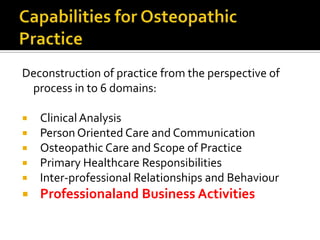
Deconstruction of practice from the perspective of
process in to 6 domains:






Clinical Analysis
Person Oriented Care and Communication
Osteopathic Care and Scope of Practice
Primary Healthcare Responsibilities
Inter-professional Relationships and Behaviour



Professionaland Business Activities
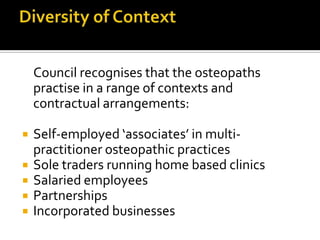
Council recognises that the osteopaths
practise in a range of contexts and
contractual arrangements:






Self-employed ‘associates’ in multipractitioner osteopathic practices
Sole traders running home based clinics
Salaried employees
Partnerships
Incorporated businesses


This presentation is intended to raise awareness
amongst registrants of Domain 6 0f the
Capabilities for Osteopathic Practice



It is intended to sign post registrants to
information resources



Council can not offer advice on specific matters
– you are advised to seek professional advice on
compliance as appropriate





Acceptable standards for areas of practice
covered by domain 6 will vary with context
The more complex your business
arrangements the greater the compliance
burden
All practitioners regardless of the practice
context need to be aware of their
responsibilities
Descriptor
This capability incorporates an osteopath’s
actions and responsibility relating to the
development of themselves and their
practice. It also incorporates their actions and
accountability in managing the
healthcare, regulatory and business systems
of practice life.
Elements
6.1. Ensures ethical conduct of self and others in provision of care and services
6.2. Provides for continuing professional learning for self and employees
6.3. Ensures care of self

6.4. Maintains an appropriate physical environment for privacy, comfort, and
confidentiality
6.5. Manages all aspects of practice to comply with legal and regulatory
requirements (as a sole operator or as an employer of others)
6.6. Manages risk effectively and responsibly in such a way that minimises
impact on all concerned.
6.7. Maintains currency of knowledge and skills according to changes in
regulatory and other ethico-legal requirements and practice environments
over time







If you operate a registered company then you
should, at the very least, have a look at this
act.
If you are selling a company in the future, or
run into solvency problems , then you need to
be aware of your obligations.
Clearly the provisions of the Companies Act
do not apply to sole traders and partnerships.
://www.legislation.govt.nz/act/public/1993/01
05/latest/whole.html#DLM320423


The role of a director comes with great responsibility. They can be held to
account for the actions of the company which is why those who are
offered directorships should not take them lightly as their personal
wealth and reputation are put on the line as a result.



One can only reflect on the outcome of the more prominent cases
involving Directors who were nominally persons held in highest
regard, being forced into accountability and subsequent reckoning
through failure to discharge the duties of Directorship in a full and
forthright manner.



Even though your company may be small, its turnover minuscule and its
influence minor, the accountability of the Director(s) is the same as if it
was a company of major significance.

https://www.iod.org.nz/FirstBoardsFirstDirectors/FirstBoards/Whatisgovernance/Directorresponsibility.aspx
What you need, when you need it…
Commercial insurance is complex and many
aspects of your business can be insured.
http://icnz.org.nz/for-consumers/commercial-insurance/


This area of Practice is generally treated very poorly
and it is only if an occurrence happens that reality hits
home.



Practitioners would be wise to engage the services of
an Insurance professional to talk them through the
types, differences and costs of Insurance which is part
of engaging in business as a Health Professional.



Failure to take into account the insurance aspect of a
business is tantamount to gross negligence (see
Directors responsibilities) in the case of
employers, and poor judgement in the case of others.


'Claims made' policies such as Professional Indemnity and Directors' and Officers' Liability policies
operate on the basis that cover is provided when a claim is made and notified within the period of
insurance regardless of when the claim originally occurred.



'Occurrence' policies, such as General Public & Products, Statutory Liability, Employment
Practices Liability and Bailees' Liability, provide cover when the event that gives rise to the
liability claims occurs within the current period of insurance.

General Public and Products Liability - ['Occurrence' trigger]

The most basic form of Liability Insurance is Public Liability that provides legal liability protection
from damage to third party property or bodily injury. This type of cover is important for anybody
who occupies or leases property in connection with their business, and/or provides a service away
from their premises.
Employers' Liability - ['Claims made' trigger]

Provides cover for personal injury to any employee of the insured. This includes any obligation for
which the insured may be held liable under the Injury Prevention, Rehabilitation and
Compensation Act 2001, or any similar or amending legislation. Cover includes defence costs.
Statutory Liability - ['Claims made' trigger]

Provides legal defence protection and cover for fines for some breaches of Statute such as
Resource Management Act, Financial Reporting Act, Building Act. Occupational Health and
Safety legislation prevents parties from insuring for OSH fines. Cover includes defence costs.
Employment Practice Liability - ['Occurrence' trigger]

Provides protection for legal defence and court awarded settlements for employment law
breaches. Cover includes defence costs.
Professional Indemnity - ['Claims made' trigger]

Provides protection against liability costs arising from the provision of incorrect or faulty
professional advice or design, as well as defamation. Cover includes defence costs.
Directors' and Officers' Liability - ['Claims made' trigger]

Provides protection for directors and officers for wrongful acts committed within their capacity as
a director or an officer. Cover includes defence costs.


These are just some of the liability insurance covers available. Terms and Conditions will vary.
Policy wordings need to be read. Seek advice from your insurance adviser



http://www.icnz.org.nz/consumer/commercial


Are your ‘associates’ employees?



Could your principal be liable for holiday pay and sick pay?



Immigration Fraud / Work Permit Conditions



There is always an ongoing discussion about what constitutes an
'independent contractor' as opposed to an employee.



The standard repost about the method of payment for services, etc
that most Practitioners trot out as being the defining issue, have no
bearing on the legal aspect of the employment, which can be better
defined as 'the relationship between the parties concerned'.



If things go wrong and legal recourse is engaged in then the
complexity of employment really starts to become
obvious, particularly if the findings go against the employer and
recourse for holidays and tax repayments have to be resolved.


Related to employment is the question of contracts or
agreements.



In a different universe, in a time long
ago, employment was settled by shaking hands.
Today a full employment contract is the bare
minimum that should be completed.



Do not short change yourself in any way by
attempting to produce this document by yourself. It is
a complex situation and requires legal advice for all
parties. Failure to do this leaves you wide open to
disasters on many fronts.
Employment agreements
Useful tool for developing employment contracts
http://www.dol.govt.nz/agreementbuilder/
 Good employment relationships begin with a
good recruitment process that ensures everyone
has clear expectations about the role, working
conditions and employment rights.
 A clearly written employment agreement can
help reduce the risk of misunderstandings.



There are several groups that exist to provide services to employers
(legal, contracts general advice etc) to assist employers to navigate the
complexity of modern business requirements and regulations.



If you are an employer then you should seriously consider being a member of one
of these groups. The services that are available are second to none and save you
both time and money.



Employees should seek the advice from their professional association or a
suitably qualified advisor

examples:



employers assistance limited
http://www.employers.co.nz/




employers and manufacturers association
https://www.ema.co.nz/services/advice/Pages/home.aspx


legal opinion



http://www.findlaw.com/12international/countries/nz/
articles/1224.html



The primary objective of the Employment Relations
Act 2000 (the "ERA") is to build productive
employment relationships. It promotes mutual trust
and confidence in the employment environment. The
"employment environment" encompasses all
participants, not just employers and employees.
While the ERA promotes productive
employment relationships, its protections
apply only to employees.
Independent contractors cannot use its
personal grievance procedures.
The ERA is no different to its predecessor, the
Employment Contracts Act 1991 (the "ECA"),
in this respect


Good employment relationships begin with a good recruitment process that
ensures everyone has clear expectations about the role, working conditions and
employment rights.



A clearly written employment agreement can help reduce the risk of
misunderstandings.



Every employee must have a written employment agreement. This can be
either an individual agreement or a collective agreement.



From 1 July 2011, employers are required to retain a signed copy of the
employment agreement or the current signed terms and conditions of
employment. The employer must retain the “intended agreement” even if
the employee has not signed it. Employees are entitled to a copy on request.



There are some provisions that must be included in employment agreements by
law, and there are also a number of minimum conditions that must be met
regardless of whether they are included in agreements. Employment law also
provides a framework for negotiating additional entitlements
The parties to an employment relationship are
usually not concerned with how their
relationship is described when they enter it. It is
only when things go wrong that it becomes
important.
Sometimes it can be difficult to decide whether
a person is (or was) an employee or a contractor.
This is partly due to the fact that anything that
can be done by an employee can also be done by
a contractor. It is usually up to the parties to
decide how their relationship is to operate.
Govt : employment types
http://www.dol.govt.nz/infozone/myfirstjob/employees/prior
/kinds-of-employment.asp




IRD take on employment types

http://www.ird.govt.nz/resources/2/3/23ffd3804bbe58f380a2
d0bc87554a30/ir336-apr09.pdf
Govt: individual agreements
http://www.lawaccess.govt.nz/Chapter/how-is-anemployee/58-Employment-Agreements/5-IndividualAgreements

NZ findlaw opinion:
http://findlaw.co.nz/articles/4269/am-i-an-employee-or-a-contractor.aspx

Main Indicators
The following table outlines some of the
main indicators that distinguish a contract of
service (employee)and a contract for
services(independent contractor).
The employer decides what will be
done, when, how, and by whom.
 The employer provides tools, equipment, and
material.
 Payments are automatically generated and paid
on a weekly, fortnightly, or monthly basis.
 Employer pays for public and annual
holidays, sick leave, etc.
 Employer deducts PAYE.
 Employee carries out work personally and may
not delegate or subcontract.

When, how, and by whom is decided by the
contractor.
 Tools, equipment, and materials are provided by the
contractor.
 Payment generated on presentation of account either
by progressive payment or on completion of the
contract.
 No payment for absence – payment only on
performance.
 Contractor is responsible for tax, insurance, and other
liabilities, but withholding tax may be deducted.
 Contractor may subcontract.

Where the Inland Revenue or courts and
tribunals get involved in disputes it is they
that decide the nature of the relationship.
They will apply ‘tests’ to determine the
nature of the relationship.
Where they deem it to be an employment
relationship the employer will then be liable
for tax and or holiday entitlements


The biggy that is the elephant in the room.



Failure in this area can devastate a business
as the Inspectors have the power to close a
premise down immediately, or make life an
abject misery for all concerned.

http://www.osh.govt.nz/services/enforcement.shtml


The object of the Health and Safety in Employment Act 1992 is to
promote the prevention of harm to all people at work, and others in, or in
the vicinity of, places of work.



The Act applies to all New Zealand workplaces and places duties on
employers, the self-employed, employees, principals and others who are
in a position to manage or control hazards.



The emphasis of the law is on the systematic management of Health
and safety at work.



It requires employers and others to maintain safe working
environments, and implement sound practice. It recognises that
successful health and safety management is best achieved through good
faith co-operation in the place of work and, in particular, through the
input of those doing the work.
The Department of Labour administers and enforces the HSE Act in most
workplaces


It should be noted that a paper trail and accountability feature high
on the list of things that OSH is looking for.
 These include:
 fire and disaster management procedures and policies
 electrical compliance certificates
 Air conditioning service records
 water filter service records
 accident/ incident recording policies and records
 building Wof
 disabled person provision compliance
 Remember that if you are a contractor working in a building it is
your responsibility to ensure that these requirements are in place.
 In the event of a situation developing, both the contractor and the
contracting person may both be liable
If you still aren't sure about going online, you need to have some serious discussions
with knowledgeable sources. An online presence for business is a powerful marketing
and communication tool, an incredible source of cost-efficiency, an environmentally
friendly way to work, a sign of professionalism and pretty much a requirement today.
Your customers are expecting to see your website address on your business cards and
promotional materials.
advantages of going online:











Powerful, fast and efficient marketing and communication tool and medium
Minimal start-up time & investment. Search engine optimized websites pay
themselves off very quickly as long as they provide patients with valuable products or
services information.
The most environmentally friendly way to run a business
Very inexpensive way to reach new markets and interact with them
Office & transportation cost savings
Unlimited possibilities for automation of your business. You can automate your order
and payment processes, patient management, your patient support tasks and more
Freedom to live and work where you like
Global presence 24/7
A sign of professionalism








NZ GPs have the second-highest rate of electronic patient
record use - second only to Denmark.
Practice management software is currently estimated to
be used in 95 percent of NZ medical general practices.
In New Zealand, 90 percent of primary care physicians and
100 percent of laboratories communicate via secure health
data networks every day.
82% of NZ physicians report receiving information back
for almost all patient referrals to other doctors and/or
specialists. This compares to 75 percent in the United
Kingdom and 37 percent in the United States.
New Zealand has had a fully specified National Health
Index (NHI) system for patients since 1992.
section 6 of the Capabilities for Osteopathic Practice which can be found on the OCNZ web site.
http://www.osteopathiccouncil.org.nz/competency-standards




Companies act web
sitehttp://www.legislation.govt.nz/act/public/1993/0105/latest/whole.html#DLM320423



Directors responsibilities
https://www.iod.org.nz/FirstBoardsFirstDirectors/FirstBoards/Whatisgovernance/Directorresponsibility.
aspx










Insurance
http://www.icnz.org.nz/consumer/commercial.php
Employment, contracts and the like
http://www.dol.govt.nz/agreementbuilder/
http://www.employers.co.nz/
https://www.ema.co.nz/services/advice/Pages/home.aspx
Employment Relations Act

http://www.findlaw.com/12international/countries/nz/articles/1224.html
Types of employment


Govt : employment typeshttp://www.dol.govt.nz/infozone/myfirstjob/employees/prior/kinds-ofemployment.asp



IRD take on employment types
http://www.ird.govt.nz/resources/2/3/23ffd3804bbe58f380a2d0bc87554a30/ir336-apr09.pdf



Govt: individual agreementshttp://www.lawaccess.govt.nz/Chapter/how-is-an-employee/58Employment-Agreements/5-Individual-Agreements
NZ findlaw opinion:
http://findlaw.co.nz/articles/4269/am-i-an-employee-or-a-contractor.aspx
Health and safety
http://www.osh.govt.nz/services/enforcement.shtml

2013 Osteopathic Capabilities Domain 6 COMPLIANCE OCNZ @OsteoRegulation

  • 1.
  • 2.
     The core ofthis discussion is directed at section 6 of the Capabilities for Osteopathic Practice http://www.osteopathiccouncil.org.nz/competency-standards  The discussion is concerned with the parameters which are related to the' Osteopathic Business' as opposed to the ' business of Osteopathy‘  The former being the domain of “the business of running an Osteopathic Practice” and the latter concerned with the “practice of Osteopathy” as a clinical modality.  This discussion by its very nature cannot deal with specifics but encompasses the general areas where there are vagaries of understanding and variances of application.  There is a general need for every Practitioner to review the business aspect of their practice and ensure that all the requirements are met.
  • 3.
    (1) The principalpurpose of this Act is to protect the health and safety of members of the public by providing for mechanisms to ensure that health practitioners are competent and fit to practise their professions.
  • 4.
    (i) to setstandards of clinical competence, cultural competence, and ethical conduct to be observed by health practitioners of the profession OCNZ has adopted the Capabilitiesframeworkto ensure that wider aspects of practice are acknowledged as having an impact on patient safety. Registrants are responsible for compliance with other areas of law such as health and safety, employment and immigration
  • 5.
    Deconstruction of practicefrom the perspective of process in to 6 domains:      Clinical Analysis Person Oriented Care and Communication Osteopathic Care and Scope of Practice Primary Healthcare Responsibilities Inter-professional Relationships and Behaviour  Professionaland Business Activities
  • 6.
    Council recognises thatthe osteopaths practise in a range of contexts and contractual arrangements:      Self-employed ‘associates’ in multipractitioner osteopathic practices Sole traders running home based clinics Salaried employees Partnerships Incorporated businesses
  • 7.
     This presentation isintended to raise awareness amongst registrants of Domain 6 0f the Capabilities for Osteopathic Practice  It is intended to sign post registrants to information resources  Council can not offer advice on specific matters – you are advised to seek professional advice on compliance as appropriate
  • 8.
       Acceptable standards forareas of practice covered by domain 6 will vary with context The more complex your business arrangements the greater the compliance burden All practitioners regardless of the practice context need to be aware of their responsibilities
  • 9.
    Descriptor This capability incorporatesan osteopath’s actions and responsibility relating to the development of themselves and their practice. It also incorporates their actions and accountability in managing the healthcare, regulatory and business systems of practice life.
  • 10.
    Elements 6.1. Ensures ethicalconduct of self and others in provision of care and services 6.2. Provides for continuing professional learning for self and employees 6.3. Ensures care of self 6.4. Maintains an appropriate physical environment for privacy, comfort, and confidentiality 6.5. Manages all aspects of practice to comply with legal and regulatory requirements (as a sole operator or as an employer of others) 6.6. Manages risk effectively and responsibly in such a way that minimises impact on all concerned. 6.7. Maintains currency of knowledge and skills according to changes in regulatory and other ethico-legal requirements and practice environments over time
  • 11.
        If you operatea registered company then you should, at the very least, have a look at this act. If you are selling a company in the future, or run into solvency problems , then you need to be aware of your obligations. Clearly the provisions of the Companies Act do not apply to sole traders and partnerships. ://www.legislation.govt.nz/act/public/1993/01 05/latest/whole.html#DLM320423
  • 12.
     The role ofa director comes with great responsibility. They can be held to account for the actions of the company which is why those who are offered directorships should not take them lightly as their personal wealth and reputation are put on the line as a result.  One can only reflect on the outcome of the more prominent cases involving Directors who were nominally persons held in highest regard, being forced into accountability and subsequent reckoning through failure to discharge the duties of Directorship in a full and forthright manner.  Even though your company may be small, its turnover minuscule and its influence minor, the accountability of the Director(s) is the same as if it was a company of major significance. https://www.iod.org.nz/FirstBoardsFirstDirectors/FirstBoards/Whatisgovernance/Directorresponsibility.aspx
  • 13.
    What you need,when you need it… Commercial insurance is complex and many aspects of your business can be insured. http://icnz.org.nz/for-consumers/commercial-insurance/
  • 14.
     This area ofPractice is generally treated very poorly and it is only if an occurrence happens that reality hits home.  Practitioners would be wise to engage the services of an Insurance professional to talk them through the types, differences and costs of Insurance which is part of engaging in business as a Health Professional.  Failure to take into account the insurance aspect of a business is tantamount to gross negligence (see Directors responsibilities) in the case of employers, and poor judgement in the case of others.
  • 15.
     'Claims made' policiessuch as Professional Indemnity and Directors' and Officers' Liability policies operate on the basis that cover is provided when a claim is made and notified within the period of insurance regardless of when the claim originally occurred.  'Occurrence' policies, such as General Public & Products, Statutory Liability, Employment Practices Liability and Bailees' Liability, provide cover when the event that gives rise to the liability claims occurs within the current period of insurance. General Public and Products Liability - ['Occurrence' trigger]  The most basic form of Liability Insurance is Public Liability that provides legal liability protection from damage to third party property or bodily injury. This type of cover is important for anybody who occupies or leases property in connection with their business, and/or provides a service away from their premises. Employers' Liability - ['Claims made' trigger]  Provides cover for personal injury to any employee of the insured. This includes any obligation for which the insured may be held liable under the Injury Prevention, Rehabilitation and Compensation Act 2001, or any similar or amending legislation. Cover includes defence costs.
  • 16.
    Statutory Liability -['Claims made' trigger]  Provides legal defence protection and cover for fines for some breaches of Statute such as Resource Management Act, Financial Reporting Act, Building Act. Occupational Health and Safety legislation prevents parties from insuring for OSH fines. Cover includes defence costs. Employment Practice Liability - ['Occurrence' trigger]  Provides protection for legal defence and court awarded settlements for employment law breaches. Cover includes defence costs. Professional Indemnity - ['Claims made' trigger]  Provides protection against liability costs arising from the provision of incorrect or faulty professional advice or design, as well as defamation. Cover includes defence costs. Directors' and Officers' Liability - ['Claims made' trigger]  Provides protection for directors and officers for wrongful acts committed within their capacity as a director or an officer. Cover includes defence costs.  These are just some of the liability insurance covers available. Terms and Conditions will vary. Policy wordings need to be read. Seek advice from your insurance adviser  http://www.icnz.org.nz/consumer/commercial
  • 17.
     Are your ‘associates’employees?  Could your principal be liable for holiday pay and sick pay?  Immigration Fraud / Work Permit Conditions  There is always an ongoing discussion about what constitutes an 'independent contractor' as opposed to an employee.  The standard repost about the method of payment for services, etc that most Practitioners trot out as being the defining issue, have no bearing on the legal aspect of the employment, which can be better defined as 'the relationship between the parties concerned'.  If things go wrong and legal recourse is engaged in then the complexity of employment really starts to become obvious, particularly if the findings go against the employer and recourse for holidays and tax repayments have to be resolved.
  • 18.
     Related to employmentis the question of contracts or agreements.  In a different universe, in a time long ago, employment was settled by shaking hands. Today a full employment contract is the bare minimum that should be completed.  Do not short change yourself in any way by attempting to produce this document by yourself. It is a complex situation and requires legal advice for all parties. Failure to do this leaves you wide open to disasters on many fronts.
  • 19.
    Employment agreements Useful toolfor developing employment contracts http://www.dol.govt.nz/agreementbuilder/  Good employment relationships begin with a good recruitment process that ensures everyone has clear expectations about the role, working conditions and employment rights.  A clearly written employment agreement can help reduce the risk of misunderstandings. 
  • 20.
     There are severalgroups that exist to provide services to employers (legal, contracts general advice etc) to assist employers to navigate the complexity of modern business requirements and regulations.  If you are an employer then you should seriously consider being a member of one of these groups. The services that are available are second to none and save you both time and money.  Employees should seek the advice from their professional association or a suitably qualified advisor examples:   employers assistance limited http://www.employers.co.nz/   employers and manufacturers association https://www.ema.co.nz/services/advice/Pages/home.aspx
  • 21.
     legal opinion  http://www.findlaw.com/12international/countries/nz/ articles/1224.html  The primaryobjective of the Employment Relations Act 2000 (the "ERA") is to build productive employment relationships. It promotes mutual trust and confidence in the employment environment. The "employment environment" encompasses all participants, not just employers and employees.
  • 22.
    While the ERApromotes productive employment relationships, its protections apply only to employees. Independent contractors cannot use its personal grievance procedures. The ERA is no different to its predecessor, the Employment Contracts Act 1991 (the "ECA"), in this respect
  • 23.
     Good employment relationshipsbegin with a good recruitment process that ensures everyone has clear expectations about the role, working conditions and employment rights.  A clearly written employment agreement can help reduce the risk of misunderstandings.  Every employee must have a written employment agreement. This can be either an individual agreement or a collective agreement.  From 1 July 2011, employers are required to retain a signed copy of the employment agreement or the current signed terms and conditions of employment. The employer must retain the “intended agreement” even if the employee has not signed it. Employees are entitled to a copy on request.  There are some provisions that must be included in employment agreements by law, and there are also a number of minimum conditions that must be met regardless of whether they are included in agreements. Employment law also provides a framework for negotiating additional entitlements
  • 24.
    The parties toan employment relationship are usually not concerned with how their relationship is described when they enter it. It is only when things go wrong that it becomes important. Sometimes it can be difficult to decide whether a person is (or was) an employee or a contractor. This is partly due to the fact that anything that can be done by an employee can also be done by a contractor. It is usually up to the parties to decide how their relationship is to operate.
  • 25.
    Govt : employmenttypes http://www.dol.govt.nz/infozone/myfirstjob/employees/prior /kinds-of-employment.asp   IRD take on employment types http://www.ird.govt.nz/resources/2/3/23ffd3804bbe58f380a2 d0bc87554a30/ir336-apr09.pdf Govt: individual agreements http://www.lawaccess.govt.nz/Chapter/how-is-anemployee/58-Employment-Agreements/5-IndividualAgreements 
  • 26.
    NZ findlaw opinion: http://findlaw.co.nz/articles/4269/am-i-an-employee-or-a-contractor.aspx MainIndicators The following table outlines some of the main indicators that distinguish a contract of service (employee)and a contract for services(independent contractor).
  • 27.
    The employer decideswhat will be done, when, how, and by whom.  The employer provides tools, equipment, and material.  Payments are automatically generated and paid on a weekly, fortnightly, or monthly basis.  Employer pays for public and annual holidays, sick leave, etc.  Employer deducts PAYE.  Employee carries out work personally and may not delegate or subcontract. 
  • 28.
    When, how, andby whom is decided by the contractor.  Tools, equipment, and materials are provided by the contractor.  Payment generated on presentation of account either by progressive payment or on completion of the contract.  No payment for absence – payment only on performance.  Contractor is responsible for tax, insurance, and other liabilities, but withholding tax may be deducted.  Contractor may subcontract. 
  • 29.
    Where the InlandRevenue or courts and tribunals get involved in disputes it is they that decide the nature of the relationship. They will apply ‘tests’ to determine the nature of the relationship. Where they deem it to be an employment relationship the employer will then be liable for tax and or holiday entitlements
  • 30.
     The biggy thatis the elephant in the room.  Failure in this area can devastate a business as the Inspectors have the power to close a premise down immediately, or make life an abject misery for all concerned. http://www.osh.govt.nz/services/enforcement.shtml
  • 31.
     The object ofthe Health and Safety in Employment Act 1992 is to promote the prevention of harm to all people at work, and others in, or in the vicinity of, places of work.  The Act applies to all New Zealand workplaces and places duties on employers, the self-employed, employees, principals and others who are in a position to manage or control hazards.  The emphasis of the law is on the systematic management of Health and safety at work.  It requires employers and others to maintain safe working environments, and implement sound practice. It recognises that successful health and safety management is best achieved through good faith co-operation in the place of work and, in particular, through the input of those doing the work. The Department of Labour administers and enforces the HSE Act in most workplaces 
  • 32.
    It should benoted that a paper trail and accountability feature high on the list of things that OSH is looking for.  These include:  fire and disaster management procedures and policies  electrical compliance certificates  Air conditioning service records  water filter service records  accident/ incident recording policies and records  building Wof  disabled person provision compliance  Remember that if you are a contractor working in a building it is your responsibility to ensure that these requirements are in place.  In the event of a situation developing, both the contractor and the contracting person may both be liable
  • 33.
    If you stillaren't sure about going online, you need to have some serious discussions with knowledgeable sources. An online presence for business is a powerful marketing and communication tool, an incredible source of cost-efficiency, an environmentally friendly way to work, a sign of professionalism and pretty much a requirement today. Your customers are expecting to see your website address on your business cards and promotional materials. advantages of going online:          Powerful, fast and efficient marketing and communication tool and medium Minimal start-up time & investment. Search engine optimized websites pay themselves off very quickly as long as they provide patients with valuable products or services information. The most environmentally friendly way to run a business Very inexpensive way to reach new markets and interact with them Office & transportation cost savings Unlimited possibilities for automation of your business. You can automate your order and payment processes, patient management, your patient support tasks and more Freedom to live and work where you like Global presence 24/7 A sign of professionalism
  • 34.
         NZ GPs havethe second-highest rate of electronic patient record use - second only to Denmark. Practice management software is currently estimated to be used in 95 percent of NZ medical general practices. In New Zealand, 90 percent of primary care physicians and 100 percent of laboratories communicate via secure health data networks every day. 82% of NZ physicians report receiving information back for almost all patient referrals to other doctors and/or specialists. This compares to 75 percent in the United Kingdom and 37 percent in the United States. New Zealand has had a fully specified National Health Index (NHI) system for patients since 1992.
  • 35.
    section 6 ofthe Capabilities for Osteopathic Practice which can be found on the OCNZ web site. http://www.osteopathiccouncil.org.nz/competency-standards   Companies act web sitehttp://www.legislation.govt.nz/act/public/1993/0105/latest/whole.html#DLM320423  Directors responsibilities https://www.iod.org.nz/FirstBoardsFirstDirectors/FirstBoards/Whatisgovernance/Directorresponsibility. aspx        Insurance http://www.icnz.org.nz/consumer/commercial.php Employment, contracts and the like http://www.dol.govt.nz/agreementbuilder/ http://www.employers.co.nz/ https://www.ema.co.nz/services/advice/Pages/home.aspx
  • 36.
    Employment Relations Act  http://www.findlaw.com/12international/countries/nz/articles/1224.html Typesof employment  Govt : employment typeshttp://www.dol.govt.nz/infozone/myfirstjob/employees/prior/kinds-ofemployment.asp  IRD take on employment types http://www.ird.govt.nz/resources/2/3/23ffd3804bbe58f380a2d0bc87554a30/ir336-apr09.pdf  Govt: individual agreementshttp://www.lawaccess.govt.nz/Chapter/how-is-an-employee/58Employment-Agreements/5-Individual-Agreements
  • 37.