Stiofán Mac Suibhne


Reflective Practitioner Model



e-Portfolio / PebblePad



Implementation
Reflective practice: ‘the capacity to reflect on
action so as to engage in a process of
continuous learning’ (Donald Schön 1930 –
1997).
Schön felt this was one of the defining
characteristics of professional practice.
Educationalist interested in the processes by
which professionals develop their knowledge
base and apply it to practice.


Conventional wisdom of Evidence based practice
applies theoretical knowledge to practice.



In reflective practice theory and practice are seen as
being reciprocally inter-related.



Professional identity / knowledge is complex and is not
merely assembled from discreet knowledge base.



Professional knowledge / identity arises from a
synthesis of natural and social sciences
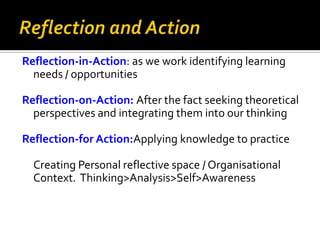
Reflection-in-Action: as we work identifying learning
needs / opportunities
Reflection-on-Action: After the fact seeking theoretical
perspectives and integrating them into our thinking
Reflection-for Action:Applying knowledge to practice

Creating Personal reflective space / Organisational
Context. Thinking>Analysis>Self>Awareness


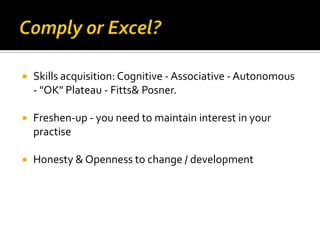
Skills acquisition: Cognitive - Associative - Autonomous
- "OK" Plateau - Fitts& Posner.



Freshen-up - you need to maintain interest in your
practise



Honesty & Openness to change / development
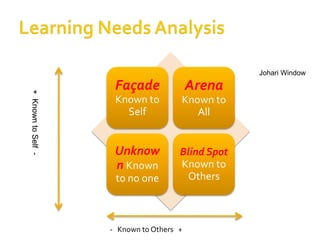
Johari Window

+ Known to Self -

Façade

Arena

Known to
Self

Known to
All

Unknow
n Known

Blind Spot
Known to
Others

to no one

- Known to Others +
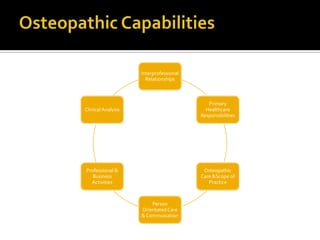
Interprofessional
Relationships

Clinical Analysis

Primary
Healthcare
Responsibilities

Professional &
Business
Activities

Osteopathic
Care &Scope of
Practice

Person
Orientated Care
& Commuication
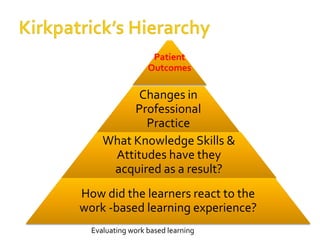
Patient
Outcomes

Changes in
Professional
Practice
What Knowledge Skills &
Attitudes have they
acquired as a result?
How did the learners react to the
work -based learning experience?
Evaluating work based learning
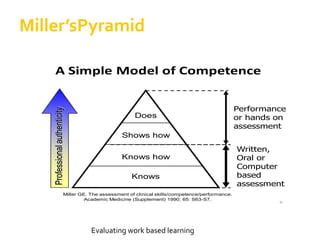
Miller’sPyramid

Professional authenticity

A Simple Model of Competence

Does

Performance
or hands on
assessment

Shows how
Knows how
Knows

Miller GE. The assessment of clinical skills/competence/performance.
Academic Medicine (Supplement) 1990; 65: S63-S7.

Evaluating work based learning

Written,
Oral or
Computer
based
assessment


Miller’s pyramid of competence indicates that assessment of ‘does’
reflects professional authenticity.



Whatever one ‘does’ in the assessment must reflect practice in order for
that assessment to be authentic.



The portfolio purpose is to guide learning and capture evidence



Portfolio was the Hoorah word of ‘90s



Evidenced Based Practice ’oos



e-Portfolio is current Hoorah!



Trial the e-Portfolio for the overseas assessment processes



Reference Group to look at applications for CPD / Recertification
Processes
There is still a great deal of debate about what an ‘ePortfolio’ actually
is and this debate is unlikely to ease because ePortfolios come in
many shapes, sizes and colours.
To add to the confusion, the term ‘ePortfolio’ means different things to
different people:
 a repository,
 a presentation,
 a system
 a private space,
 a social networking space
 or a combination of any of these.


There are now many tools available that profess to be an ‘ePortfolio’
and all look different, have different purposes, or target different
audiences.
While PebblePad has its origins in the university environment, its
design philosophy is one of learner ownership and control:







It is a space for personal learning that belongs to the learner not
the institution;
it is populated by the learner not their assessor / teacher / preceptor
it is primarily concerned with supporting learning not assessment
it is for life-long and life–wide learning not a single episode or a
single course
it allows learners to present multiple stories of learning rather
than being a simple aggregation of competencies
and, importantly, access to it is controlled by the learner who is
able to invite feedback to support personal growth and
understanding.
A ‘Personal Learning Space’ does all of the above AND
facilitates the process of life–long and life-wide
learning.
A personal learning space has inbuilt tools and
functions that generate learning as distinct from
simply recording and evidencing learning.
Internal wizards prompt the user to consider diverse
aspects of their experiences and facilitate the process
of making sense of, and learning from, these
experiences to a much deeper level.
Pedagogy – Teacher determines content / deliver /
learning goals and assessment
Andragogy – Self Directed Learning
Adult education and characterised by learner control
and self-responsibility in learning, learner definition
of learning objectives in relation to their relevance to
the learner, a problem-solving approach to
learning, self-directedness in how to learn, intrinsic
learner motivation, and incorporation of the learner
experience
Heutagogy (based on the Greek for “self”) was
defined by Hase and Kenyon in 2000 as the
study of self-determined learning.
Heutagogy applies a holistic approach to
developing learner capabilities, with learning
as an active and proactive process, and
learners serving as “the major agent in their
own learning, which occurs as a result of
personal experiences”
Personal Learning Space
.... is a personal learning space where individuals can plan, record and
demonstrate their independent learning wherever it occurs. A range of
inbuilt templates support users as they develop their learning abilities.
All templates are underpinned by a reflective structure to ensure users
create thoughtful, iterative and enduring records of learning and
experience. These records can be selected and collated into various types
of presentations which can be shared with different audiences for a

range of purposes including assessment, accreditation and
application.
Active Teaching, Learning and Assessment Space
 Institution space designed to support teaching and learning activities
and the whole assessment process
 Any type of digital file can be assessed in ATLAS, from an uploaded word
document to a rich, evidence based online portfolio.
 Features include:
- immediate tutor access to student work all in one place
- immediate student access to feedback and grades
- comment banks for streamlining feedback
- tutor group allocation to distribute students to tutors
- external access for moderators
- archiving for quality control purposes
[PLuS = Personal Learning Space]

[Active Teaching, Learning
and Assessment Space]
Cloud Based
Basic functions work on iPads
PebblePad
Webfolio
Folio
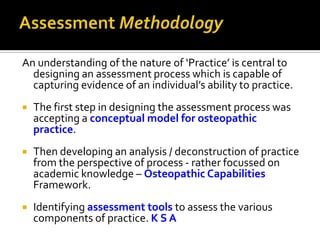
An understanding of the nature of ‘Practice’ is central to
designing an assessment process which is capable of
capturing evidence of an individual’s ability to practice.


The first step in designing the assessment process was
accepting a conceptual model for osteopathic
practice.



Then developing an analysis / deconstruction of practice
from the perspective of process - rather focussed on
academic knowledge – Osteopathic Capabilities
Framework.



Identifying assessment tools to assess the various
components of practice. K S A


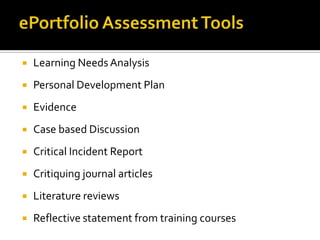
Learning Needs Analysis



Personal Development Plan



Evidence



Case based Discussion



Critical Incident Report



Critiquing journal articles



Literature reviews



Reflective statement from training courses








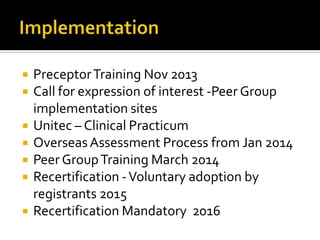
Preceptor Training Nov 2013
Call for expression of interest -Peer Group
implementation sites
Unitec – Clinical Practicum
Overseas Assessment Process from Jan 2014
Peer Group Training March 2014
Recertification - Voluntary adoption by
registrants 2015
Recertification Mandatory 2016

Implementation ePortfolio for NZ Osteopaths CPD 2013 OCNZ @OsteoRegulation

  • 1.
  • 3.
  • 4.
    Reflective practice: ‘thecapacity to reflect on action so as to engage in a process of continuous learning’ (Donald Schön 1930 – 1997). Schön felt this was one of the defining characteristics of professional practice. Educationalist interested in the processes by which professionals develop their knowledge base and apply it to practice.
  • 5.
     Conventional wisdom ofEvidence based practice applies theoretical knowledge to practice.  In reflective practice theory and practice are seen as being reciprocally inter-related.  Professional identity / knowledge is complex and is not merely assembled from discreet knowledge base.  Professional knowledge / identity arises from a synthesis of natural and social sciences
  • 7.
    Reflection-in-Action: as wework identifying learning needs / opportunities Reflection-on-Action: After the fact seeking theoretical perspectives and integrating them into our thinking Reflection-for Action:Applying knowledge to practice Creating Personal reflective space / Organisational Context. Thinking>Analysis>Self>Awareness
  • 8.
     Skills acquisition: Cognitive- Associative - Autonomous - "OK" Plateau - Fitts& Posner.  Freshen-up - you need to maintain interest in your practise  Honesty & Openness to change / development
  • 9.
    Johari Window + Knownto Self - Façade Arena Known to Self Known to All Unknow n Known Blind Spot Known to Others to no one - Known to Others +
  • 11.
  • 12.
    Patient Outcomes Changes in Professional Practice What KnowledgeSkills & Attitudes have they acquired as a result? How did the learners react to the work -based learning experience? Evaluating work based learning
  • 13.
    Miller’sPyramid Professional authenticity A SimpleModel of Competence Does Performance or hands on assessment Shows how Knows how Knows Miller GE. The assessment of clinical skills/competence/performance. Academic Medicine (Supplement) 1990; 65: S63-S7. Evaluating work based learning Written, Oral or Computer based assessment
  • 14.
     Miller’s pyramid ofcompetence indicates that assessment of ‘does’ reflects professional authenticity.  Whatever one ‘does’ in the assessment must reflect practice in order for that assessment to be authentic.  The portfolio purpose is to guide learning and capture evidence  Portfolio was the Hoorah word of ‘90s  Evidenced Based Practice ’oos  e-Portfolio is current Hoorah!  Trial the e-Portfolio for the overseas assessment processes  Reference Group to look at applications for CPD / Recertification Processes
  • 15.
    There is stilla great deal of debate about what an ‘ePortfolio’ actually is and this debate is unlikely to ease because ePortfolios come in many shapes, sizes and colours. To add to the confusion, the term ‘ePortfolio’ means different things to different people:  a repository,  a presentation,  a system  a private space,  a social networking space  or a combination of any of these.  There are now many tools available that profess to be an ‘ePortfolio’ and all look different, have different purposes, or target different audiences.
  • 16.
    While PebblePad hasits origins in the university environment, its design philosophy is one of learner ownership and control:       It is a space for personal learning that belongs to the learner not the institution; it is populated by the learner not their assessor / teacher / preceptor it is primarily concerned with supporting learning not assessment it is for life-long and life–wide learning not a single episode or a single course it allows learners to present multiple stories of learning rather than being a simple aggregation of competencies and, importantly, access to it is controlled by the learner who is able to invite feedback to support personal growth and understanding.
  • 17.
    A ‘Personal LearningSpace’ does all of the above AND facilitates the process of life–long and life-wide learning. A personal learning space has inbuilt tools and functions that generate learning as distinct from simply recording and evidencing learning. Internal wizards prompt the user to consider diverse aspects of their experiences and facilitate the process of making sense of, and learning from, these experiences to a much deeper level.
  • 18.
    Pedagogy – Teacherdetermines content / deliver / learning goals and assessment Andragogy – Self Directed Learning Adult education and characterised by learner control and self-responsibility in learning, learner definition of learning objectives in relation to their relevance to the learner, a problem-solving approach to learning, self-directedness in how to learn, intrinsic learner motivation, and incorporation of the learner experience
  • 19.
    Heutagogy (based onthe Greek for “self”) was defined by Hase and Kenyon in 2000 as the study of self-determined learning. Heutagogy applies a holistic approach to developing learner capabilities, with learning as an active and proactive process, and learners serving as “the major agent in their own learning, which occurs as a result of personal experiences”
  • 20.
    Personal Learning Space ....is a personal learning space where individuals can plan, record and demonstrate their independent learning wherever it occurs. A range of inbuilt templates support users as they develop their learning abilities. All templates are underpinned by a reflective structure to ensure users create thoughtful, iterative and enduring records of learning and experience. These records can be selected and collated into various types of presentations which can be shared with different audiences for a range of purposes including assessment, accreditation and application.
  • 21.
    Active Teaching, Learningand Assessment Space  Institution space designed to support teaching and learning activities and the whole assessment process  Any type of digital file can be assessed in ATLAS, from an uploaded word document to a rich, evidence based online portfolio.  Features include: - immediate tutor access to student work all in one place - immediate student access to feedback and grades - comment banks for streamlining feedback - tutor group allocation to distribute students to tutors - external access for moderators - archiving for quality control purposes
  • 22.
    [PLuS = PersonalLearning Space] [Active Teaching, Learning and Assessment Space]
  • 23.
    Cloud Based Basic functionswork on iPads PebblePad Webfolio Folio
  • 24.
    An understanding ofthe nature of ‘Practice’ is central to designing an assessment process which is capable of capturing evidence of an individual’s ability to practice.  The first step in designing the assessment process was accepting a conceptual model for osteopathic practice.  Then developing an analysis / deconstruction of practice from the perspective of process - rather focussed on academic knowledge – Osteopathic Capabilities Framework.  Identifying assessment tools to assess the various components of practice. K S A
  • 25.
     Learning Needs Analysis  PersonalDevelopment Plan  Evidence  Case based Discussion  Critical Incident Report  Critiquing journal articles  Literature reviews  Reflective statement from training courses
  • 26.
           Preceptor Training Nov2013 Call for expression of interest -Peer Group implementation sites Unitec – Clinical Practicum Overseas Assessment Process from Jan 2014 Peer Group Training March 2014 Recertification - Voluntary adoption by registrants 2015 Recertification Mandatory 2016

Editor's Notes

  • #12 Over the last 20 years the osteopathic profession in Australasia has undergone significant development.
  • #25 Over the last 20 years the osteopathic profession in Australasia has undergone significant development.
  • #26 Over the last 20 years the osteopathic profession in Australasia has undergone significant development.