
Dynamic routing in micro-
service oriented
architecture
Daniel Leon
Optymyze
[13th
of May 2017]
Content table
•Dynamic routing role
•Linkerd concepts
•Some exercises for computing a route with
Linkerd
•Demo
•Q&A
Why routing ?
•Why now?
•What is the real purpose ?
What is Linkerd
•Scalable service mesh for cloud-native
applications
•Built on top of Finagle
What Linkerd does ?
• Manages the difficult, error-prone parts of
cross-service communication:
− Latency-aware load balancing
− Connection pooling
− TLS
− Instrumentation etc
Linkerd simplified
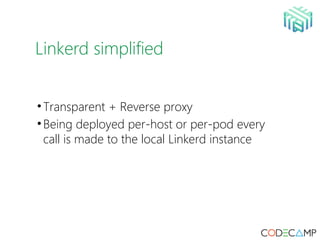
•Transparent + Reverse proxy
•Being deployed per-host or per-pod every
call is made to the local Linkerd instance
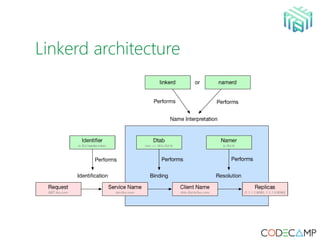
Linkerd architecture
Step 2 & 3
•Pluggable by configuring the interpreter
attribute in the router configuration
•Can be handled by a separate service called
namerd:
– Dynamic update of routing tables
– Minimal interaction with service discovery
endpoints
Step 1 - Identification
•Protocol specific (http 1.1, http 2, thrift,
thriftMux, Mux)
•Request → Service name/logical name
•The logical name maps with the Name
concept in Finagle
•Example for http 1.1 : GET
http://example/hello → /svc/example
•Is handled by a router configuration with the
identifier attribute
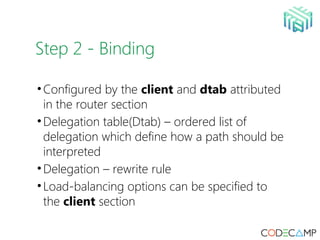
Step 2 - Binding
•Configured by the client and dtab attributed
in the router section
•Delegation table(Dtab) – ordered list of
delegation which define how a path should be
interpreted
•Delegation – rewrite rule
•Load-balancing options can be specified to
the client section
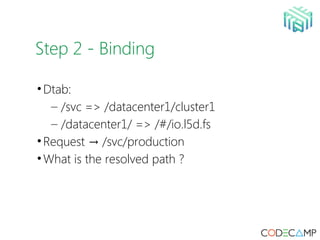
Step 2 - Binding
•Dtab:
– /svc => /datacenter1/cluster1
– /datacenter1/ => /#/io.l5d.fs
•Request → /svc/production
•What is the resolved path ?
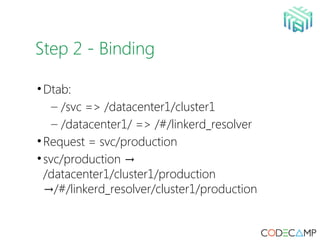
Step 2 - Binding
•Dtab:
– /svc => /datacenter1/cluster1
– /datacenter1/ => /#/linkerd_resolver
•Request = svc/production
•svc/production →
/datacenter1/cluster1/production
→/#/linkerd_resolver/cluster1/production
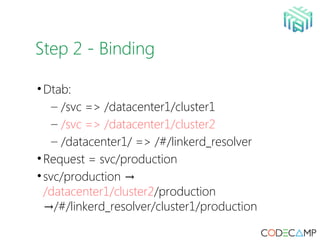
Step 2 - Binding
•Dtab:
– /svc => /datacenter1/cluster1
– /svc => /datacenter1/cluster2
– /datacenter1/ => /#/linkerd_resolver
•Request = svc/production
•svc/production →
/datacenter1/cluster2/production
→/#/linkerd_resolver/cluster1/production
Step 3 - Resolving
•Performed by the namer
•Called by the client of linkerd
•Further specifications in the ‘service’ attribute:
– responseClassifiers
– retries
Conclusions for Linkerd
•Easy to configure and maintain
•No code writing is needed
•Scalable and easy to integrate
•Helps developers focus on the actual code
instead on service availability, graceful
degradation or load-balancing
Q & A
Dynamic routing in microservice oriented architecture

Dynamic routing in microservice oriented architecture

  • 2.
    Dynamic routing inmicro- service oriented architecture Daniel Leon Optymyze [13th of May 2017]
  • 3.
    Content table •Dynamic routingrole •Linkerd concepts •Some exercises for computing a route with Linkerd •Demo •Q&A
  • 4.
    Why routing ? •Whynow? •What is the real purpose ?
  • 5.
    What is Linkerd •Scalableservice mesh for cloud-native applications •Built on top of Finagle
  • 6.
    What Linkerd does? • Manages the difficult, error-prone parts of cross-service communication: − Latency-aware load balancing − Connection pooling − TLS − Instrumentation etc
  • 7.
    Linkerd simplified •Transparent +Reverse proxy •Being deployed per-host or per-pod every call is made to the local Linkerd instance
  • 8.
  • 9.
    Step 2 &3 •Pluggable by configuring the interpreter attribute in the router configuration •Can be handled by a separate service called namerd: – Dynamic update of routing tables – Minimal interaction with service discovery endpoints
  • 10.
    Step 1 -Identification •Protocol specific (http 1.1, http 2, thrift, thriftMux, Mux) •Request → Service name/logical name •The logical name maps with the Name concept in Finagle •Example for http 1.1 : GET http://example/hello → /svc/example •Is handled by a router configuration with the identifier attribute
  • 11.
    Step 2 -Binding •Configured by the client and dtab attributed in the router section •Delegation table(Dtab) – ordered list of delegation which define how a path should be interpreted •Delegation – rewrite rule •Load-balancing options can be specified to the client section
  • 12.
    Step 2 -Binding •Dtab: – /svc => /datacenter1/cluster1 – /datacenter1/ => /#/io.l5d.fs •Request → /svc/production •What is the resolved path ?
  • 13.
    Step 2 -Binding •Dtab: – /svc => /datacenter1/cluster1 – /datacenter1/ => /#/linkerd_resolver •Request = svc/production •svc/production → /datacenter1/cluster1/production →/#/linkerd_resolver/cluster1/production
  • 14.
    Step 2 -Binding •Dtab: – /svc => /datacenter1/cluster1 – /svc => /datacenter1/cluster2 – /datacenter1/ => /#/linkerd_resolver •Request = svc/production •svc/production → /datacenter1/cluster2/production →/#/linkerd_resolver/cluster1/production
  • 15.
    Step 3 -Resolving •Performed by the namer •Called by the client of linkerd •Further specifications in the ‘service’ attribute: – responseClassifiers – retries
  • 17.
    Conclusions for Linkerd •Easyto configure and maintain •No code writing is needed •Scalable and easy to integrate •Helps developers focus on the actual code instead on service availability, graceful degradation or load-balancing
  • 18.