Digital Transformation through Open
Software Defined Infrastructure
Justin Dustzadeh, Vice President and Head of
Global Infrastructure Network Services, Visa
Digital Transformation Through !
Open Software-Defined
Infrastructure

Open Networking Summit 2017


Justin Dustzadeh
Vice President & Head of Global Infrastructure Network Services
Outline
§  Who Is Visa?
§  Transformation Vision, Drivers & Architectural Principles
§  Software-Defined Data Center & WAN
§  Migration Considerations
Who Is Visa?
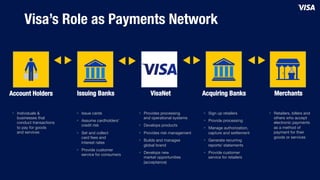
Visa’s Role as Payments Network
§  Provides processing 

and operational systems
§  Develops products
§  Provides risk management
§  Builds and manages 

global brand
§  Develops new 

market opportunities
(acceptance)
§  Issue cards
§  Assume cardholders’ 

credit risk
§  Set and collect 

card fees and 

interest rates
§  Provide customer 

service for consumers
§  Retailers, billers and
others who accept
electronic payments
as a method of
payment for their
goods or services
§  Individuals &
businesses that
conduct transactions
to pay for goods
and services
Account Holders
 Merchants
Issuing Banks
 VisaNet
§  Sign up retailers
§  Provide processing
§  Manage authorization,
capture and settlement
§  Generate recurring
reports/ statements
§  Provide customer 

service for retailers
Acquiring Banks
Visa By Numbers!
One of the World’s Largest Retail Electronic Payments Networks (1)
§  16,800 financial institution clients
§  44.0 million merchant locations
§  3.1 billion Visa cards 
§  US$8.2 trillion total volume (2)
§  US$5.8 trillion payments volume 
§  2.6 million ATMs (3)
§  129.1 billion total transactions (4)
§  65,000 transaction messages per
second (capacity)
§  176 currencies
Figures are rounded, include the Europe region, effective with the quarter ended September 30, 2016 unless otherwise noted. Figures from the latest operational
performance data except number of financial institutions and ATMs.
(1) Based on payments volume, total volume, number of transactions and number of cards in circulation.
(2) Includes payments and cash transactions.
(3) As reported by client financial institutions and therefore may be subject to change; includes ATMs in the Europe territory. As of June 30, 2016.
(4) Includes payments and cash transactions.
Continued Growth of Electronic Payments!
Driven by Technology, Innovation & Shift of Consumer Habits
§  E-commerce accelerated growth
§  Mobile payments
•  mVisa: mobile phone push payment
§  IoT (any connected device = potential point of sale)
•  Watch, ring, connected car, appliance, etc.
§  Tokenization
§  Blockchain
•  Visa B2B Connect
Transformation Vision,!
Drivers &!
Architectural Principles
Vision & Drivers
§  Make electronic payments accessible to everyone worldwide
§  Global infrastructure with highest security & availability for
billions of users and connected devices
§  From closed & physical infrastructure components to open &
software-based technologies
§  On-demand infrastructure & network 
§  Open digital platform to drive innovation for payments
Architectural Principles!
Highlights
§  Highest availability
•  “Zero-service-outage network resiliency”
•  No failure of a single network component should cause a service impact 
§  Separation of hardware & software
•  Commoditized/simplified hardware with minimal standard features
•  Open, standard interfaces & technologies for maximum vendor choice
§  Real-time end-to-end visibility independently of scale
•  Vendor-neutral monitoring, management & control capabilities
§  Maximize asset utilization
•  Network simplification & consolidation across WAN (simple core, smart edge) & datacenter
Software-Defined!
Data Center & WAN
Applications
Network Orchestration, Control & Monitoring
Network Switching & Virtualization
Example Open Software-Defined DC Network
Management Network
Data & Monitoring Network
Physical Network Fabric	
  
(Virtualized) Network
Functions	
  
Out-of-Band
Management Fabric	
  
Non-Virtualized!
Workloads	
  
Virtualized /
Containerized!
Workloads	
  
Network Automation &
Orchestration	
  
Security Monitoring	
  
DC Network Component
Users of DC Network
SDN Controller	
  
Packet Capture Fabric	
  
Network!
Virtualization	
  
SDN Control API
Open
Network
Monitoring	
  
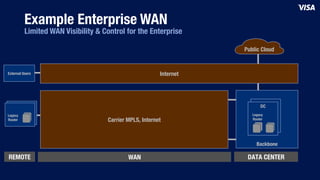
Example Enterprise WAN!
Limited WAN Visibility & Control for the Enterprise
Backbone	
  
Public Cloud
DATA CENTERWANREMOTE
External Users	
   Internet	
  
DC
Legacy!
Router
Legacy!
Router
 Carrier MPLS, Internet	
  
Backbone	
  
Carrier MPLS, Internet	
  
DC
Carrier SD-WAN (Virtual CPE Use Case) !
Simpler Operations through Software at the Edge
Public Cloud
REMOTE
External Users	
  
DATA CENTER
Carrier Edge
Controller	
  
vCPE
Internet	
  
WAN
Carrier Edge
Controller	
  
vCPE
Open
Backbone	
  
DC
Enterprise-Managed SD-WAN Overlay!
Enhanced Automation & Traffic Management
Public Cloud
WANREMOTE
External Users	
   Internet	
  
Carrier MPLS, Internet	
  
SD-WAN!
Router
Controller	
  
DATA CENTER
SD-WAN!
Router
Open
Enterprise Backbone	
  
DC
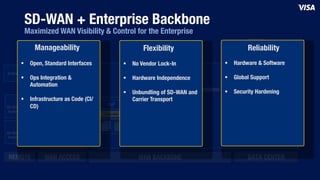
SD-WAN + Enterprise Backbone!
Maximized WAN Visibility & Control for the Enterprise
Public Cloud
REMOTE
External Users	
  
DATA CENTER
PoP
Controller	
  
Internet
Wireless
Carrier MPLS
WAN
WAN BACKBONEWAN ACCESS
SD-WAN!
Router
SD-WAN!
Router
Orchestration	
  
Open
Open
Enterprise Backbone	
  
DC
SD-WAN + Enterprise Backbone!
Maximized WAN Visibility & Control for the Enterprise
Public Cloud
REMOTE
External Users	
  
DATA CENTER
PoP
Controller	
  
Internet
Wireless
Carrier MPLS
WAN
WAN BACKBONEWAN ACCESS
SD-WAN!
Router
SD-WAN!
Router
Orchestration	
  
Manageability
§  Open, Standard Interfaces
§  Ops Integration &
Automation
§  Infrastructure as Code (CI/
CD)
Reliability
§  Hardware & Software
§  Global Support
§  Security Hardening
Flexibility
§  No Vendor Lock-In
§  Hardware Independence
§  Unbundling of SD-WAN and
Carrier Transport
Migration Considerations
Migration: Not Just for the Birds (*)
§  Assessment & Preparation
§  Pre-Migration Planning
§  Gap Analysis
§  Back-out Procedures
§  Feature Set Analysis
§  Post-Migration Validation
§  SLAs
§  Playbooks
§  Monitoring Tools
§  Provisioning Tools
§  Continuous Availability
§  Troubleshooting Tools
STARTING INFRASTRUCTURE	
   TARGET INFRASTRUCTURE	
  PHASED MIGRATION	
  
(*) Open Networking Foundation Blog!
https://www.opennetworking.org/?p=1099&option=com_wordpress&Itemid=248
Call for Action!
Accelerating Industry Adoption of Open Software-Defined Infrastructure
§  Help drive shift from hardware-centric to software-defined
§  Enable vendor-neutral / multi-vendor solutions
§  Support smooth integration with customer’s operational tools
§  Help drive innovation by offering developer APIs
§  Enable migration and coexistence with legacy environments
Digital Transformation Through !
Open Software-Defined
Infrastructure

Open Networking Summit 2017


Justin Dustzadeh
Vice President & Head of Global Infrastructure Network Services

Digital Transformation through Open Software Defined Infrastructure

  • 1.
    Digital Transformation throughOpen Software Defined Infrastructure Justin Dustzadeh, Vice President and Head of Global Infrastructure Network Services, Visa
  • 2.
    Digital Transformation Through! Open Software-Defined Infrastructure Open Networking Summit 2017 Justin Dustzadeh Vice President & Head of Global Infrastructure Network Services
  • 3.
    Outline §  Who IsVisa? §  Transformation Vision, Drivers & Architectural Principles §  Software-Defined Data Center & WAN §  Migration Considerations
  • 4.
  • 5.
    Visa’s Role asPayments Network §  Provides processing 
 and operational systems §  Develops products §  Provides risk management §  Builds and manages 
 global brand §  Develops new 
 market opportunities (acceptance) §  Issue cards §  Assume cardholders’ 
 credit risk §  Set and collect 
 card fees and 
 interest rates §  Provide customer 
 service for consumers §  Retailers, billers and others who accept electronic payments as a method of payment for their goods or services §  Individuals & businesses that conduct transactions to pay for goods and services Account Holders Merchants Issuing Banks VisaNet §  Sign up retailers §  Provide processing §  Manage authorization, capture and settlement §  Generate recurring reports/ statements §  Provide customer 
 service for retailers Acquiring Banks
  • 6.
    Visa By Numbers! Oneof the World’s Largest Retail Electronic Payments Networks (1) §  16,800 financial institution clients §  44.0 million merchant locations §  3.1 billion Visa cards §  US$8.2 trillion total volume (2) §  US$5.8 trillion payments volume §  2.6 million ATMs (3) §  129.1 billion total transactions (4) §  65,000 transaction messages per second (capacity) §  176 currencies Figures are rounded, include the Europe region, effective with the quarter ended September 30, 2016 unless otherwise noted. Figures from the latest operational performance data except number of financial institutions and ATMs. (1) Based on payments volume, total volume, number of transactions and number of cards in circulation. (2) Includes payments and cash transactions. (3) As reported by client financial institutions and therefore may be subject to change; includes ATMs in the Europe territory. As of June 30, 2016. (4) Includes payments and cash transactions.
  • 7.
    Continued Growth ofElectronic Payments! Driven by Technology, Innovation & Shift of Consumer Habits §  E-commerce accelerated growth §  Mobile payments •  mVisa: mobile phone push payment §  IoT (any connected device = potential point of sale) •  Watch, ring, connected car, appliance, etc. §  Tokenization §  Blockchain •  Visa B2B Connect
  • 8.
  • 9.
    Vision & Drivers § Make electronic payments accessible to everyone worldwide §  Global infrastructure with highest security & availability for billions of users and connected devices §  From closed & physical infrastructure components to open & software-based technologies §  On-demand infrastructure & network §  Open digital platform to drive innovation for payments
  • 10.
    Architectural Principles! Highlights §  Highestavailability •  “Zero-service-outage network resiliency” •  No failure of a single network component should cause a service impact §  Separation of hardware & software •  Commoditized/simplified hardware with minimal standard features •  Open, standard interfaces & technologies for maximum vendor choice §  Real-time end-to-end visibility independently of scale •  Vendor-neutral monitoring, management & control capabilities §  Maximize asset utilization •  Network simplification & consolidation across WAN (simple core, smart edge) & datacenter
  • 11.
  • 12.
    Applications Network Orchestration, Control& Monitoring Network Switching & Virtualization Example Open Software-Defined DC Network Management Network Data & Monitoring Network Physical Network Fabric   (Virtualized) Network Functions   Out-of-Band Management Fabric   Non-Virtualized! Workloads   Virtualized / Containerized! Workloads   Network Automation & Orchestration   Security Monitoring   DC Network Component Users of DC Network SDN Controller   Packet Capture Fabric   Network! Virtualization   SDN Control API Open Network Monitoring  
  • 13.
    Example Enterprise WAN! LimitedWAN Visibility & Control for the Enterprise Backbone   Public Cloud DATA CENTERWANREMOTE External Users   Internet   DC Legacy! Router Legacy! Router Carrier MPLS, Internet  
  • 14.
    Backbone   Carrier MPLS,Internet   DC Carrier SD-WAN (Virtual CPE Use Case) ! Simpler Operations through Software at the Edge Public Cloud REMOTE External Users   DATA CENTER Carrier Edge Controller   vCPE Internet   WAN Carrier Edge Controller   vCPE Open
  • 15.
    Backbone   DC Enterprise-Managed SD-WANOverlay! Enhanced Automation & Traffic Management Public Cloud WANREMOTE External Users   Internet   Carrier MPLS, Internet   SD-WAN! Router Controller   DATA CENTER SD-WAN! Router Open
  • 16.
    Enterprise Backbone   DC SD-WAN+ Enterprise Backbone! Maximized WAN Visibility & Control for the Enterprise Public Cloud REMOTE External Users   DATA CENTER PoP Controller   Internet Wireless Carrier MPLS WAN WAN BACKBONEWAN ACCESS SD-WAN! Router SD-WAN! Router Orchestration   Open Open
  • 17.
    Enterprise Backbone   DC SD-WAN+ Enterprise Backbone! Maximized WAN Visibility & Control for the Enterprise Public Cloud REMOTE External Users   DATA CENTER PoP Controller   Internet Wireless Carrier MPLS WAN WAN BACKBONEWAN ACCESS SD-WAN! Router SD-WAN! Router Orchestration   Manageability §  Open, Standard Interfaces §  Ops Integration & Automation §  Infrastructure as Code (CI/ CD) Reliability §  Hardware & Software §  Global Support §  Security Hardening Flexibility §  No Vendor Lock-In §  Hardware Independence §  Unbundling of SD-WAN and Carrier Transport
  • 18.
  • 19.
    Migration: Not Justfor the Birds (*) §  Assessment & Preparation §  Pre-Migration Planning §  Gap Analysis §  Back-out Procedures §  Feature Set Analysis §  Post-Migration Validation §  SLAs §  Playbooks §  Monitoring Tools §  Provisioning Tools §  Continuous Availability §  Troubleshooting Tools STARTING INFRASTRUCTURE   TARGET INFRASTRUCTURE  PHASED MIGRATION   (*) Open Networking Foundation Blog! https://www.opennetworking.org/?p=1099&option=com_wordpress&Itemid=248
  • 20.
    Call for Action! AcceleratingIndustry Adoption of Open Software-Defined Infrastructure §  Help drive shift from hardware-centric to software-defined §  Enable vendor-neutral / multi-vendor solutions §  Support smooth integration with customer’s operational tools §  Help drive innovation by offering developer APIs §  Enable migration and coexistence with legacy environments
  • 21.
    Digital Transformation Through! Open Software-Defined Infrastructure Open Networking Summit 2017 Justin Dustzadeh Vice President & Head of Global Infrastructure Network Services