CB102 Introduction to OSHA
Why is OSHA Important ?
 OSHA began because, until 1970, there were no
national laws for safety and health hazards.
 On average, 15 workers die every day from job
injuries.
 Over 5,600 Americans die from workplace
injuries annually.
 Over 4 million non-fatal workplace injuries and
illnesses are reported.
CB102 Introduction to OSHA
Discussion Questions
 When, during your work experience, did you first
hear about OSHA?
 What did you think about OSHA then?
 What do you think OSHA’s job is?
CB102 Introduction to OSHA
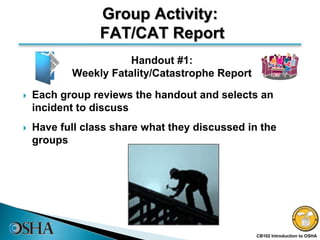
Group Activity:
FAT/CAT Report
Handout #1:
Weekly Fatality/Catastrophe Report
 Each group reviews the handout and selects an
incident to discuss
 Have full class share what they discussed in the
groups
CB102 Introduction to OSHA
History of OSHA
 OSHA stands for the
Occupational Safety and
Health Administration, an
agency of the U.S.
Department of Labor
 OSHA’s responsibility is
worker safety and health
protection
CB102 Introduction to OSHA
 On December 29, 1970, President Nixon signed the
OSH Act
 This Act created OSHA, the agency, which formally
came into being on April 28, 1971
OSHA Coverage Activity
CB102 Introduction to OSHA
Covered by
OSHA?
Worker
YES NO
1. Harry Adams, a miner at Below Ground
Inc.
YES NO
2. Adrian Smith, one of 3 employees of
ABC landscaping.
YES NO
3. Taylor Dell, an accountant in business
for herself.
YES NO
4. Rob Jones, one of 10 carpenters
working for Woody, Inc.
OSHA’s Mission
 The mission of OSHA is to save lives, prevent
injuries and protect the health of America’s
workers.
 Some of the things OSHA does to carry out its
mission are:
◦ developing job safety and health standards and
enforcing them through worksite inspections,
◦ maintaining a reporting and recordkeeping system to
keep track of job-related injuries and illnesses, and
◦ providing training programs to increase knowledge
about occupational safety and health.
CB102 Introduction to OSHA
 Why was OSHA necessary?
 What is OSHA’s mission?
 Why is this training important?
What Rights Do You
Have Under OSHA?
 You have the right to:
◦ A safe and healthful workplace
◦ Know about hazardous chemicals
◦ Information about injuries and illnesses in your workplace
◦ Complain or request hazard correction from employer
◦ Training
◦ Hazard exposure and medical records
◦ File a complaint with OSHA
◦ Participate in an OSHA inspection
◦ Be free from retaliation for exercising safety and health
rights
CB102 Introduction to OSHA
Worker Rights
Handout #2:
OSHA Poster
 Have you seen this poster at your place of
work?
 Creation of OSHA provided workers the right to
a safe and healthful workplace
CB102 Introduction to OSHA
 The creation of OSHA provided
workers the right to a safe and
healthful workplace.
Your Right to…
 Section 5(a)(1) of the OSH Act states:
“Each employer shall furnish to each of his
employees employment and a place of employment
which are free from recognized hazards that are
causing or are likely to cause death or serious
physical harm to his employees."
CB102 Introduction to OSHA
 Employers must have a written, complete hazard
communication program that includes
information on:
Your Right to…
o Container labeling,
o Material Safety Data Sheets (MSDSs), and
o Worker training. The training must include
the physical and health hazards of the
chemicals and how workers can protect
themselves; including specific procedures
the employer has implemented to protect
workers, such as work practices,
emergency procedures, and personal
protective equipment.
CB102 Introduction to OSHA
Handout #3:
MSDS Example
 What information does the MSDS provide?
 Has anyone seen an MSDS in their workplace?
 Were the instructions on the MSDS followed in
their workplace?
 Has anyone worked with hazardous substances
without an MSDS?
CB102 Introduction to OSHA
 OSHA’s Recordkeeping rule
requires most employers with
more than 10 workers to keep a
log of injuries and illnesses.
 Workers have the right to review
the current log, as well as the
logs stored for the past 5 years.
Your Right to…
 Workers also have the right to view the annually
posted summary of the injuries and illnesses
(OSHA 300A).
CB102 Introduction to OSHA
 Workers may bring up safety and health
concerns in the workplace to their employers
without fear of discharge or discrimination, as
long as the complaint is made in good faith.
 OSHA regulations [29CFR 1977.9(c)] protect
workers who complain to their employer about
unsafe or unhealthful conditions in the
workplace.
Your Right to…
 Workers have a right to
get training from
employers on a variety
of health and safety
hazards and standards
that employers must
follow.
CB102 Introduction to OSHA
Your Right to…
 Some required training covers topics such as,
lockout-tag out, blood borne pathogens, noise,
confined spaces, fall hazards in construction,
personal protective equipment, along with a
variety of other subjects.
CB102 Introduction to OSHA
 1910.1020: right to examine & copy records
 Examples of toxic substances and harmful
physical agents are:
◦ Metals and dusts, such as, lead, cadmium, and
silica.
◦ Biological agents, such as bacteria, viruses, and
fungi.
◦ Physical stress, such as noise, heat, cold,
vibration, repetitive motion, and ionizing and
non-ionizing radiation.
Your Right to…
CB102 Introduction to OSHA
 Workers may file a complaint with OSHA if
they believe a violation of a safety or health
standard, or an imminent danger situation,
exists in the workplace.
 Workers may request that their name not be
revealed to the employer.
 If a worker files a complaint, they have the
right to find out OSHA’s action on the
complaint and request a review if an
inspection is not made.
Your Right to…
CB102 Introduction to OSHA
 Employee representative can accompany OSHA
inspector
 Workers can talk to the inspector privately.
 Workers may point out hazards, describe injuries,
illnesses or near misses that resulted from those
hazards and describe any concern you have about a
safety or health issue.
 Workers can find out about inspection results,
abatement measures and may object to dates set for
violation to be corrected.
Your Right to…
CB102 Introduction to OSHA
 Workers have the right to be free from retaliation for
exercising safety and health rights.
 Workers have a right to seek safety and health on the
job without fear of punishment.
 This right is spelled out in Section 11(c) of the OSH
Act.
 Workers have 30 days to contact OSHA if they feel
they have been punished for exercising their safety
and health rights.
Your Right to…
CB102 Introduction to OSHA
 What does an MSDS tell you?
 What are some worker rights related to injury and
illness reporting?
 Name some standards or hazards where workers
must be trained.
CB102 Introduction to OSHA
 Provide a workplace free from recognized hazards and
comply with OSHA standards
 Provide training required by OSHA standards
 Keep records of injuries and illnesses
 Provide medical exams when required by OSHA standards
and provide workers access to their exposure and medical
records
 Not discriminate against workers who exercise their rights
under the Act (Section 11(c))
 Post OSHA citations and abatement verification notices
 Provide and pay for PPE
CB102 Introduction to OSHA
Employers are Required to:
KEEP RECORDS OF INJURIES AND ILLNESSES
REPORTING AND RECORDING CHECKLIST
Employers must:
 Report each worker death
 Report each incident that hospitalizes 3 or
more workers
 Maintain injury & illness records
 Inform workers how to report an injury or
illness to the employer
 Make records available to workers
 Allow OSHA access to records
 Post annual summary of injuries & illnesses
CB102 Introduction to OSHA
Handout #6:
OSHA 300 Log
 Number of workers that are getting injured or ill
 The types of injuries and illnesses reported
 The jobs and departments where the most severe
injuries or illnesses are occurring.
CB102 Introduction to OSHA
Employers are Required to:
Provide and Pay for PPE
Handout #7:
Employers Must
Provide and Pay for PPE
 Does anyone wear personal protective equipment on
their job?
 Employers are required to determine if PPE should
be used to protect their workers.
 Rule was effective on February 13, 2008 and
implemented by May 15, 2008.
CB102 Introduction to OSHA
 What are some of the responsibilities employers
have related to OSHA recordkeeping?
 Which section of the OSH Act prohibits employers
from discriminating against workers for exercising
their safety and health rights?
 What are some types of PPE that employers must
pay for?
What do the OSHA Standards Say?
 OSHA standards fall into four categories: General
Industry, Construction, Maritime, and Agriculture.
 OSHA issues standards for a wide variety of
workplace hazards.
 Where there are no specific OSHA standards,
employers must comply with The General Duty
Clause, Section 5(a)(1).
CB102 Introduction to OSHA
Most Frequently Cited Standards
Click: Most Frequently Cited (MFC) Standards
to view current data
To search MFC data on this webpage:
 “Select number of employees in
establishment,” select ALL or one of the
options listed
 “Federal or State Jurisdiction,” select
Federal or, from the dropdown menu, a
specific state
 “SIC,” select ALL for all Industry groups, C
for Construction, D for Manufacturing
(General Industry), or 373 and 449 for
Maritime
 Shown are search results for: All sizes of
establishments, in Federal jurisdiction,
with Construction SIC codes
CB102 Introduction to OSHA
Handout #8a:
General Industry
 What is the Subpart for Personal Protective
Equipment?
 What is the Subpart for Machinery and Machine
Guarding?
 What topic does 1910, Subpart H cover?
CB102 Introduction to OSHA
Handout #8b:
Construction
 What is the Subpart for Fall Protection?
 What is the Subpart for Fire Protection and
Prevention?
 What topic does 1926, Subpart K cover?
Handout #8c:
Maritime
 What is the 29 CFR 1915 Subpart for Tools and
Related Equipment?
 What is the 29 CFR 1917 Subpart for Personal
Protection?
 What topic does 29 CFR 1918, Subpart H cover?
CB102 Introduction to OSHA
 What are the OSHA Construction standards also
called?
 What are the General Industry standards also
called?
 What are 29 CFR Parts 1915, 1917 and 1918 referred
to as?
CB102 Introduction to OSHA
 The OSH Act authorizes OSHA compliance safety
and health officers (CSHOs) to conduct workplace
inspections at reasonable times.
 OSHA conducts inspections without advance notice,
except in rare circumstances (e.g. Imminent Danger)
 In fact, anyone who tells an employer about an
OSHA inspection in advance can receive fines and a
jail term.
CB102 Introduction to OSHA
Priority Category of Inspection
1st Imminent Danger:
Reasonable certainty an immediate danger exists
2nd Fatality/Catastrophe:
Reported to OSHA; inspected ASAP
3rd Complaints/Referrals:
Worker or worker representative can file a complaint
about a safety or health hazard
4th Programmed Inspections:
Cover industries and employers with high injury and
illness rates, specific hazards, or other exposures.
CB102 Introduction to OSHA
VIOLATION TYPE PENALTY
WILLFUL
A violation that the employer intentionally and knowingly
commits or a violation that the employer commits with
plain indifference to the law.
OSHA may propose penalties of up
to $70,000 for each willful violation,
with a minimum penalty of $5,000
for each willful violation.
SERIOUS
A violation where there is substantial probability that death
or serious physical harm could result and that the
employer knew, or should have known, of the hazard.
There is a mandatory penalty for
serious violations which may be up
to $7,000.
OTHER-THAN-SERIOUS
A violation that has a direct relationship to safety and
health, but probably would not cause death or serious
physical harm.
OSHA may propose a penalty of up
to $7,000 for each other-than-
serious violation.
REPEATED
A violation that is the same or similar to a previous
violation.
OSHA may propose penalties of up
to $70,000 for each repeated
violation.
CB102 Introduction to OSHA
 Give an example of a reason why OSHA would
conduct an inspection at your workplace.
 What are the types of OSHA violations?
CB102 Introduction to OSHA
 Sources within the workplace/worksite
 Sources outside the workplace/worksite
 How to file an OSHA complaint
 Employer or supervisor, co-workers and union
representatives
 Material Safety Data Sheet (MSDS) for information
on chemicals
 Labels and warning signs
 Employee orientation manuals or other training
materials
 Work tasks and procedures instruction
CB102 Introduction to OSHA
 OSHA website: http://www.osha.gov and OSHA
offices (you can call or write)
 Compliance Assistance Specialists in the area offices
 National Institute for Occupational Safety and Health
(NIOSH) – OSHA’s sister agency
 OSHA Training Institute Education Centers
 Doctors, nurses, other health care providers
 Public libraries
 Other local, community-based resources
CB102 Introduction to OSHA
Handout #11:
Identifying Safety and
Health Problems in the Workplace
 Review handout to become more aware of workplace
hazards
 Discuss if anyone has discovered safety and/or
health problems in the workplace/site.
CB102 Introduction to OSHA
 Download the OSHA-7 form from OSHA’s website
 File the complaint online
◦ Workers can file a complaint
◦ A worker representative can file a complaint
 Telephone or visit local regional or area offices to
discuss your concerns
 Complete the form – be specific and include
appropriate details
 OSHA determines if an inspection is necessary
 Workers do not have to reveal their name
CB102 Introduction to OSHA
Handout #12a:
General Industry
 Each group reviews the handout and discusses the
industry-specific scenario
 Groups need to determine what information would
be important to include in their complaint
 Have the class discuss the group’s results:
◦ What was included in the complaint?
◦ What was added to the complaint?
CB102 Introduction to OSHA
Handout #12b:
Construction
 Each group reviews the handout and discusses the
industry-specific scenario
 Groups need to determine what information would be
important to include in their complaint
 Have the class discuss the group’s results:
◦ What was included in the complaint?
◦ What was added to the complaint?
CB102 Introduction to OSHA
Handout #12c:
Maritime
 Each group reviews the handout and discusses the
industry-specific scenario
 Groups need to determine what information would
be important to include in their complaint
 Have the class discuss the group’s results:
◦ What was included in the complaint?
◦ What was added to the complaint?
CB102 Introduction to OSHA
 What are some resources inside the workplace that
will help you find information on safety and health
issues?
 What are some resources outside the workplace that
will help you find information on safety and health
issues?
CB102 Introduction to OSHA
This lesson covered:
 The importance of OSHA, including the history of
safety and health regulation leading to the creation
of OSHA and OSHA’s mission;
 Worker rights under OSHA;
 Employer responsibilities;
 OSHA standards;
 OSHA inspections; and
 Safety and health resources, including how to file a
complaint.
CB102 Introduction to OSHA
Questions?
 Photos shown in this presentation may depict situations that are not in compliance with applicable OSHA
requirements.
 It is not the intent of the content developers to provide compliance-based training in this presentation, the intent
is more to address hazard awareness in the construction industry, and to recognize the overlapping hazards
present in many construction workplaces.
 It should NOT be assumed that the suggestions, comments, or recommendations contained herein constitute a
thorough review of the applicable standards, nor should discussion of “issues” or “concerns” be construed as a
prioritization of hazards or possible controls. Where opinions (“best practices”) have been expressed, it is
important to remember that safety issues in general and construction jobsites specifically will require a great deal
of site - or hazard-specificity - a “one size fits all” approach is not recommended, nor will it likely be very effective.
 It is assumed that individuals using this presentation, or content, to augment their training programs will be
“qualified” to do so, and that said presenters will be otherwise prepared to answer questions, solve problems,
and discuss issues with their audiences.
 No representation is made as to the thoroughness of the presentation, nor to the exact methods of
recommendation to be taken. It is understood that site conditions vary constantly, and that the developers of this
content cannot be held responsible for safety problems they did not address or could not anticipate, nor those
which have been discussed herein or during physical presentation. It is the responsibility of each employer
contractor and their employees to comply with all pertinent rules and regulations in the jurisdiction in which they
work. Copies of all OSHA regulations are available form your local OSHA office. This presentation is intended to
discuss Federal Regulations only – your individual State requirements may be more stringent.
 As a presenter, you should be prepared to discuss all of the potential issues/concerns, or problems inherent in
those photos particularly.
CB102 Introduction to OSHA
Disclaimer/Usage Notes

osha ppt old.ppt

  • 1.
  • 2.
    Why is OSHAImportant ?  OSHA began because, until 1970, there were no national laws for safety and health hazards.  On average, 15 workers die every day from job injuries.  Over 5,600 Americans die from workplace injuries annually.  Over 4 million non-fatal workplace injuries and illnesses are reported. CB102 Introduction to OSHA
  • 3.
    Discussion Questions  When,during your work experience, did you first hear about OSHA?  What did you think about OSHA then?  What do you think OSHA’s job is? CB102 Introduction to OSHA
  • 4.
    Group Activity: FAT/CAT Report Handout#1: Weekly Fatality/Catastrophe Report  Each group reviews the handout and selects an incident to discuss  Have full class share what they discussed in the groups CB102 Introduction to OSHA
  • 5.
    History of OSHA OSHA stands for the Occupational Safety and Health Administration, an agency of the U.S. Department of Labor  OSHA’s responsibility is worker safety and health protection CB102 Introduction to OSHA  On December 29, 1970, President Nixon signed the OSH Act  This Act created OSHA, the agency, which formally came into being on April 28, 1971
  • 6.
    OSHA Coverage Activity CB102Introduction to OSHA Covered by OSHA? Worker YES NO 1. Harry Adams, a miner at Below Ground Inc. YES NO 2. Adrian Smith, one of 3 employees of ABC landscaping. YES NO 3. Taylor Dell, an accountant in business for herself. YES NO 4. Rob Jones, one of 10 carpenters working for Woody, Inc.
  • 7.
    OSHA’s Mission  Themission of OSHA is to save lives, prevent injuries and protect the health of America’s workers.  Some of the things OSHA does to carry out its mission are: ◦ developing job safety and health standards and enforcing them through worksite inspections, ◦ maintaining a reporting and recordkeeping system to keep track of job-related injuries and illnesses, and ◦ providing training programs to increase knowledge about occupational safety and health. CB102 Introduction to OSHA
  • 8.
    CB102 Introduction toOSHA  Why was OSHA necessary?  What is OSHA’s mission?  Why is this training important?
  • 9.
    What Rights DoYou Have Under OSHA?  You have the right to: ◦ A safe and healthful workplace ◦ Know about hazardous chemicals ◦ Information about injuries and illnesses in your workplace ◦ Complain or request hazard correction from employer ◦ Training ◦ Hazard exposure and medical records ◦ File a complaint with OSHA ◦ Participate in an OSHA inspection ◦ Be free from retaliation for exercising safety and health rights CB102 Introduction to OSHA
  • 10.
    CB102 Introduction toOSHA Worker Rights Handout #2: OSHA Poster  Have you seen this poster at your place of work?  Creation of OSHA provided workers the right to a safe and healthful workplace
  • 11.
    CB102 Introduction toOSHA  The creation of OSHA provided workers the right to a safe and healthful workplace. Your Right to…  Section 5(a)(1) of the OSH Act states: “Each employer shall furnish to each of his employees employment and a place of employment which are free from recognized hazards that are causing or are likely to cause death or serious physical harm to his employees."
  • 12.
    CB102 Introduction toOSHA  Employers must have a written, complete hazard communication program that includes information on: Your Right to… o Container labeling, o Material Safety Data Sheets (MSDSs), and o Worker training. The training must include the physical and health hazards of the chemicals and how workers can protect themselves; including specific procedures the employer has implemented to protect workers, such as work practices, emergency procedures, and personal protective equipment.
  • 13.
    CB102 Introduction toOSHA Handout #3: MSDS Example  What information does the MSDS provide?  Has anyone seen an MSDS in their workplace?  Were the instructions on the MSDS followed in their workplace?  Has anyone worked with hazardous substances without an MSDS?
  • 14.
    CB102 Introduction toOSHA  OSHA’s Recordkeeping rule requires most employers with more than 10 workers to keep a log of injuries and illnesses.  Workers have the right to review the current log, as well as the logs stored for the past 5 years. Your Right to…  Workers also have the right to view the annually posted summary of the injuries and illnesses (OSHA 300A).
  • 15.
    CB102 Introduction toOSHA  Workers may bring up safety and health concerns in the workplace to their employers without fear of discharge or discrimination, as long as the complaint is made in good faith.  OSHA regulations [29CFR 1977.9(c)] protect workers who complain to their employer about unsafe or unhealthful conditions in the workplace. Your Right to…
  • 16.
     Workers havea right to get training from employers on a variety of health and safety hazards and standards that employers must follow. CB102 Introduction to OSHA Your Right to…  Some required training covers topics such as, lockout-tag out, blood borne pathogens, noise, confined spaces, fall hazards in construction, personal protective equipment, along with a variety of other subjects.
  • 17.
    CB102 Introduction toOSHA  1910.1020: right to examine & copy records  Examples of toxic substances and harmful physical agents are: ◦ Metals and dusts, such as, lead, cadmium, and silica. ◦ Biological agents, such as bacteria, viruses, and fungi. ◦ Physical stress, such as noise, heat, cold, vibration, repetitive motion, and ionizing and non-ionizing radiation. Your Right to…
  • 18.
    CB102 Introduction toOSHA  Workers may file a complaint with OSHA if they believe a violation of a safety or health standard, or an imminent danger situation, exists in the workplace.  Workers may request that their name not be revealed to the employer.  If a worker files a complaint, they have the right to find out OSHA’s action on the complaint and request a review if an inspection is not made. Your Right to…
  • 19.
    CB102 Introduction toOSHA  Employee representative can accompany OSHA inspector  Workers can talk to the inspector privately.  Workers may point out hazards, describe injuries, illnesses or near misses that resulted from those hazards and describe any concern you have about a safety or health issue.  Workers can find out about inspection results, abatement measures and may object to dates set for violation to be corrected. Your Right to…
  • 20.
    CB102 Introduction toOSHA  Workers have the right to be free from retaliation for exercising safety and health rights.  Workers have a right to seek safety and health on the job without fear of punishment.  This right is spelled out in Section 11(c) of the OSH Act.  Workers have 30 days to contact OSHA if they feel they have been punished for exercising their safety and health rights. Your Right to…
  • 21.
    CB102 Introduction toOSHA  What does an MSDS tell you?  What are some worker rights related to injury and illness reporting?  Name some standards or hazards where workers must be trained.
  • 22.
    CB102 Introduction toOSHA  Provide a workplace free from recognized hazards and comply with OSHA standards  Provide training required by OSHA standards  Keep records of injuries and illnesses  Provide medical exams when required by OSHA standards and provide workers access to their exposure and medical records  Not discriminate against workers who exercise their rights under the Act (Section 11(c))  Post OSHA citations and abatement verification notices  Provide and pay for PPE
  • 23.
    CB102 Introduction toOSHA Employers are Required to: KEEP RECORDS OF INJURIES AND ILLNESSES REPORTING AND RECORDING CHECKLIST Employers must:  Report each worker death  Report each incident that hospitalizes 3 or more workers  Maintain injury & illness records  Inform workers how to report an injury or illness to the employer  Make records available to workers  Allow OSHA access to records  Post annual summary of injuries & illnesses
  • 24.
    CB102 Introduction toOSHA Handout #6: OSHA 300 Log  Number of workers that are getting injured or ill  The types of injuries and illnesses reported  The jobs and departments where the most severe injuries or illnesses are occurring.
  • 25.
    CB102 Introduction toOSHA Employers are Required to: Provide and Pay for PPE Handout #7: Employers Must Provide and Pay for PPE  Does anyone wear personal protective equipment on their job?  Employers are required to determine if PPE should be used to protect their workers.  Rule was effective on February 13, 2008 and implemented by May 15, 2008.
  • 26.
    CB102 Introduction toOSHA  What are some of the responsibilities employers have related to OSHA recordkeeping?  Which section of the OSH Act prohibits employers from discriminating against workers for exercising their safety and health rights?  What are some types of PPE that employers must pay for?
  • 27.
    What do theOSHA Standards Say?  OSHA standards fall into four categories: General Industry, Construction, Maritime, and Agriculture.  OSHA issues standards for a wide variety of workplace hazards.  Where there are no specific OSHA standards, employers must comply with The General Duty Clause, Section 5(a)(1). CB102 Introduction to OSHA
  • 28.
    Most Frequently CitedStandards Click: Most Frequently Cited (MFC) Standards to view current data To search MFC data on this webpage:  “Select number of employees in establishment,” select ALL or one of the options listed  “Federal or State Jurisdiction,” select Federal or, from the dropdown menu, a specific state  “SIC,” select ALL for all Industry groups, C for Construction, D for Manufacturing (General Industry), or 373 and 449 for Maritime  Shown are search results for: All sizes of establishments, in Federal jurisdiction, with Construction SIC codes CB102 Introduction to OSHA
  • 29.
    Handout #8a: General Industry What is the Subpart for Personal Protective Equipment?  What is the Subpart for Machinery and Machine Guarding?  What topic does 1910, Subpart H cover? CB102 Introduction to OSHA
  • 30.
    CB102 Introduction toOSHA Handout #8b: Construction  What is the Subpart for Fall Protection?  What is the Subpart for Fire Protection and Prevention?  What topic does 1926, Subpart K cover?
  • 31.
    Handout #8c: Maritime  Whatis the 29 CFR 1915 Subpart for Tools and Related Equipment?  What is the 29 CFR 1917 Subpart for Personal Protection?  What topic does 29 CFR 1918, Subpart H cover? CB102 Introduction to OSHA
  • 32.
    CB102 Introduction toOSHA  What are the OSHA Construction standards also called?  What are the General Industry standards also called?  What are 29 CFR Parts 1915, 1917 and 1918 referred to as?
  • 33.
    CB102 Introduction toOSHA  The OSH Act authorizes OSHA compliance safety and health officers (CSHOs) to conduct workplace inspections at reasonable times.  OSHA conducts inspections without advance notice, except in rare circumstances (e.g. Imminent Danger)  In fact, anyone who tells an employer about an OSHA inspection in advance can receive fines and a jail term.
  • 34.
    CB102 Introduction toOSHA Priority Category of Inspection 1st Imminent Danger: Reasonable certainty an immediate danger exists 2nd Fatality/Catastrophe: Reported to OSHA; inspected ASAP 3rd Complaints/Referrals: Worker or worker representative can file a complaint about a safety or health hazard 4th Programmed Inspections: Cover industries and employers with high injury and illness rates, specific hazards, or other exposures.
  • 35.
    CB102 Introduction toOSHA VIOLATION TYPE PENALTY WILLFUL A violation that the employer intentionally and knowingly commits or a violation that the employer commits with plain indifference to the law. OSHA may propose penalties of up to $70,000 for each willful violation, with a minimum penalty of $5,000 for each willful violation. SERIOUS A violation where there is substantial probability that death or serious physical harm could result and that the employer knew, or should have known, of the hazard. There is a mandatory penalty for serious violations which may be up to $7,000. OTHER-THAN-SERIOUS A violation that has a direct relationship to safety and health, but probably would not cause death or serious physical harm. OSHA may propose a penalty of up to $7,000 for each other-than- serious violation. REPEATED A violation that is the same or similar to a previous violation. OSHA may propose penalties of up to $70,000 for each repeated violation.
  • 36.
    CB102 Introduction toOSHA  Give an example of a reason why OSHA would conduct an inspection at your workplace.  What are the types of OSHA violations?
  • 37.
    CB102 Introduction toOSHA  Sources within the workplace/worksite  Sources outside the workplace/worksite  How to file an OSHA complaint
  • 38.
     Employer orsupervisor, co-workers and union representatives  Material Safety Data Sheet (MSDS) for information on chemicals  Labels and warning signs  Employee orientation manuals or other training materials  Work tasks and procedures instruction CB102 Introduction to OSHA
  • 39.
     OSHA website:http://www.osha.gov and OSHA offices (you can call or write)  Compliance Assistance Specialists in the area offices  National Institute for Occupational Safety and Health (NIOSH) – OSHA’s sister agency  OSHA Training Institute Education Centers  Doctors, nurses, other health care providers  Public libraries  Other local, community-based resources CB102 Introduction to OSHA
  • 40.
    CB102 Introduction toOSHA Handout #11: Identifying Safety and Health Problems in the Workplace  Review handout to become more aware of workplace hazards  Discuss if anyone has discovered safety and/or health problems in the workplace/site.
  • 41.
    CB102 Introduction toOSHA  Download the OSHA-7 form from OSHA’s website  File the complaint online ◦ Workers can file a complaint ◦ A worker representative can file a complaint  Telephone or visit local regional or area offices to discuss your concerns  Complete the form – be specific and include appropriate details  OSHA determines if an inspection is necessary  Workers do not have to reveal their name
  • 42.
    CB102 Introduction toOSHA Handout #12a: General Industry  Each group reviews the handout and discusses the industry-specific scenario  Groups need to determine what information would be important to include in their complaint  Have the class discuss the group’s results: ◦ What was included in the complaint? ◦ What was added to the complaint?
  • 43.
    CB102 Introduction toOSHA Handout #12b: Construction  Each group reviews the handout and discusses the industry-specific scenario  Groups need to determine what information would be important to include in their complaint  Have the class discuss the group’s results: ◦ What was included in the complaint? ◦ What was added to the complaint?
  • 44.
    CB102 Introduction toOSHA Handout #12c: Maritime  Each group reviews the handout and discusses the industry-specific scenario  Groups need to determine what information would be important to include in their complaint  Have the class discuss the group’s results: ◦ What was included in the complaint? ◦ What was added to the complaint?
  • 45.
    CB102 Introduction toOSHA  What are some resources inside the workplace that will help you find information on safety and health issues?  What are some resources outside the workplace that will help you find information on safety and health issues?
  • 46.
    CB102 Introduction toOSHA This lesson covered:  The importance of OSHA, including the history of safety and health regulation leading to the creation of OSHA and OSHA’s mission;  Worker rights under OSHA;  Employer responsibilities;  OSHA standards;  OSHA inspections; and  Safety and health resources, including how to file a complaint.
  • 47.
    CB102 Introduction toOSHA Questions?
  • 48.
     Photos shownin this presentation may depict situations that are not in compliance with applicable OSHA requirements.  It is not the intent of the content developers to provide compliance-based training in this presentation, the intent is more to address hazard awareness in the construction industry, and to recognize the overlapping hazards present in many construction workplaces.  It should NOT be assumed that the suggestions, comments, or recommendations contained herein constitute a thorough review of the applicable standards, nor should discussion of “issues” or “concerns” be construed as a prioritization of hazards or possible controls. Where opinions (“best practices”) have been expressed, it is important to remember that safety issues in general and construction jobsites specifically will require a great deal of site - or hazard-specificity - a “one size fits all” approach is not recommended, nor will it likely be very effective.  It is assumed that individuals using this presentation, or content, to augment their training programs will be “qualified” to do so, and that said presenters will be otherwise prepared to answer questions, solve problems, and discuss issues with their audiences.  No representation is made as to the thoroughness of the presentation, nor to the exact methods of recommendation to be taken. It is understood that site conditions vary constantly, and that the developers of this content cannot be held responsible for safety problems they did not address or could not anticipate, nor those which have been discussed herein or during physical presentation. It is the responsibility of each employer contractor and their employees to comply with all pertinent rules and regulations in the jurisdiction in which they work. Copies of all OSHA regulations are available form your local OSHA office. This presentation is intended to discuss Federal Regulations only – your individual State requirements may be more stringent.  As a presenter, you should be prepared to discuss all of the potential issues/concerns, or problems inherent in those photos particularly. CB102 Introduction to OSHA Disclaimer/Usage Notes

Editor's Notes