Deadlock
Deadlock
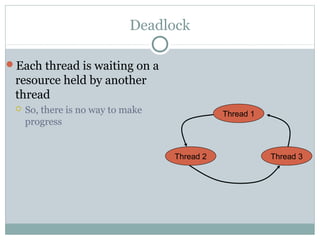
Each thread is waiting on a
resource held by another
thread
 So, there is no way to make
progress
Thread 1
Thread 2 Thread 3
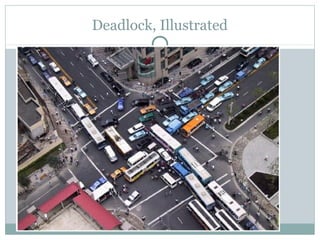
Deadlock, Illustrated
Necessary Conditions for Deadlock
Mutual exclusion
 Resources cannot be shared
 e.g., buffers, locks
Hold and wait (subset property)
 A thread must hold a subset of its resource needs
 And, the thread is waiting for more resources
No preemption
 Resources cannot be taken away
Circular wait
 A needs a resource that B has
 B has a resource that A has
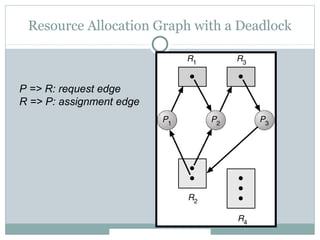
Resource Allocation Graph with a Deadlock
P => R: request edge
R => P: assignment edge
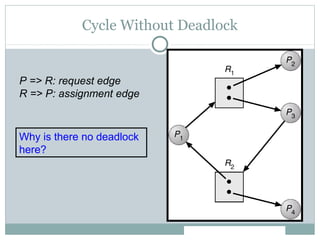
Cycle Without Deadlock
P => R: request edge
R => P: assignment edge
Why is there no deadlock
here?
Graph Reduction
A graph can be reduced by a thread if all of that
thread’s requests can be granted
 Eventually, all resources by the reduced thread will be freed
Miscellaneous theorems (Holt, Havender):
 There are no deadlocked threads iff the graph is completely
reducible
 The order of reductions is irrelevant
(Detail: resources with multiple units)
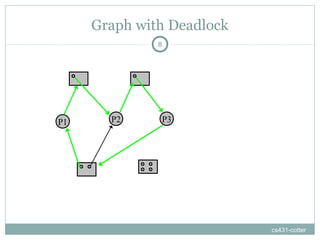
Graph with Deadlock
cs431-cotter
8
P1 P2 P3
Approaches to Deadlock
1. Avoid threads
2. Deadlock prevention
 Break up one of the four necessary conditions
1. Deadlock avoidance
 Stay live even in the presence of the four conditions
1. Detect and recover
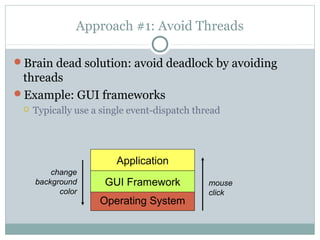
Approach #1: Avoid Threads
Brain dead solution: avoid deadlock by avoiding
threads
Example: GUI frameworks
 Typically use a single event-dispatch thread
Operating System
GUI Framework
Application
mouse
click
change
background
color
Approach #2: Prevention
Can we eliminate:
Mutual exclusion?
Hold and wait (subset property)?
No Preemption?
Circular waiting?
Lock Ordering
We can avoid circular waiting by acquiring resources
in a fixed order
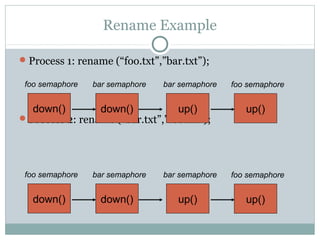
Example: Linux rename operation
 Each open file has a semaphore
 Both semaphores must be held during file operations
 Linux always uses the same order for down operations
 Semaphore at the lowest memory address goes first
Rename Example
Process 1: rename (“foo.txt”,”bar.txt”);
Process 2: rename (“bar.txt”,”foo.txt”);
down()
foo semaphore
down()
bar semaphore
up()
bar semaphore
up()
foo semaphore
down()
foo semaphore
down()
bar semaphore
up()
bar semaphore
up()
foo semaphore
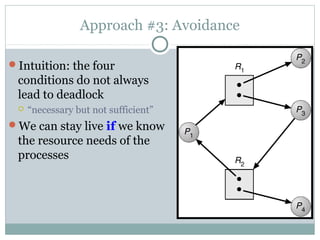
Approach #3: Avoidance
Intuition: the four
conditions do not always
lead to deadlock
 “necessary but not sufficient”
We can stay live if we know
the resource needs of the
processes
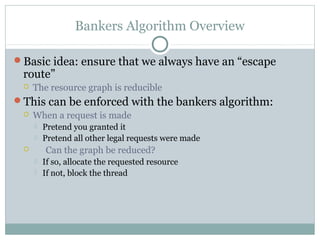
Bankers Algorithm Overview
Basic idea: ensure that we always have an “escape
route”
 The resource graph is reducible
This can be enforced with the bankers algorithm:
 When a request is made
 Pretend you granted it
 Pretend all other legal requests were made
 Can the graph be reduced?
 If so, allocate the requested resource
 If not, block the thread
Deadlock Avoidance in Practice
Static provisioning
 Ensure that each active process/thread can acquire some
minimum set of resources
 Use admission control to maintain this invariant
This is closely related to the idea of thrashing
 Each thread needs some minimum amount of resources to run
efficiently
Approach #4: Detection and Recovery
Not commonly used
 Detection is expensive
 Recovery is tricky
Possible exception: databases
Deadlock Detection
Detection algorithm (sketch)
 Keep track of who is waiting for resources
 Keep track of who holds resources
 Assume that all runnable processes release all their resources
 Does this unblock a waiting process?
 If yes, release that process’s resources
 If processes are still blocked, we are deadlocked
Os deadlock

Os deadlock

  • 1.
  • 2.
    Deadlock Each thread iswaiting on a resource held by another thread  So, there is no way to make progress Thread 1 Thread 2 Thread 3
  • 3.
  • 4.
    Necessary Conditions forDeadlock Mutual exclusion  Resources cannot be shared  e.g., buffers, locks Hold and wait (subset property)  A thread must hold a subset of its resource needs  And, the thread is waiting for more resources No preemption  Resources cannot be taken away Circular wait  A needs a resource that B has  B has a resource that A has
  • 5.
    Resource Allocation Graphwith a Deadlock P => R: request edge R => P: assignment edge
  • 6.
    Cycle Without Deadlock P=> R: request edge R => P: assignment edge Why is there no deadlock here?
  • 7.
    Graph Reduction A graphcan be reduced by a thread if all of that thread’s requests can be granted  Eventually, all resources by the reduced thread will be freed Miscellaneous theorems (Holt, Havender):  There are no deadlocked threads iff the graph is completely reducible  The order of reductions is irrelevant (Detail: resources with multiple units)
  • 8.
  • 9.
    Approaches to Deadlock 1.Avoid threads 2. Deadlock prevention  Break up one of the four necessary conditions 1. Deadlock avoidance  Stay live even in the presence of the four conditions 1. Detect and recover
  • 10.
    Approach #1: AvoidThreads Brain dead solution: avoid deadlock by avoiding threads Example: GUI frameworks  Typically use a single event-dispatch thread Operating System GUI Framework Application mouse click change background color
  • 11.
    Approach #2: Prevention Canwe eliminate: Mutual exclusion? Hold and wait (subset property)? No Preemption? Circular waiting?
  • 12.
    Lock Ordering We canavoid circular waiting by acquiring resources in a fixed order Example: Linux rename operation  Each open file has a semaphore  Both semaphores must be held during file operations  Linux always uses the same order for down operations  Semaphore at the lowest memory address goes first
  • 13.
    Rename Example Process 1:rename (“foo.txt”,”bar.txt”); Process 2: rename (“bar.txt”,”foo.txt”); down() foo semaphore down() bar semaphore up() bar semaphore up() foo semaphore down() foo semaphore down() bar semaphore up() bar semaphore up() foo semaphore
  • 14.
    Approach #3: Avoidance Intuition:the four conditions do not always lead to deadlock  “necessary but not sufficient” We can stay live if we know the resource needs of the processes
  • 15.
    Bankers Algorithm Overview Basicidea: ensure that we always have an “escape route”  The resource graph is reducible This can be enforced with the bankers algorithm:  When a request is made  Pretend you granted it  Pretend all other legal requests were made  Can the graph be reduced?  If so, allocate the requested resource  If not, block the thread
  • 16.
    Deadlock Avoidance inPractice Static provisioning  Ensure that each active process/thread can acquire some minimum set of resources  Use admission control to maintain this invariant This is closely related to the idea of thrashing  Each thread needs some minimum amount of resources to run efficiently
  • 17.
    Approach #4: Detectionand Recovery Not commonly used  Detection is expensive  Recovery is tricky Possible exception: databases
  • 18.
    Deadlock Detection Detection algorithm(sketch)  Keep track of who is waiting for resources  Keep track of who holds resources  Assume that all runnable processes release all their resources  Does this unblock a waiting process?  If yes, release that process’s resources  If processes are still blocked, we are deadlocked

Editor's Notes

  • #2 TODO: print handouts for AspectRatio
  • #5 Buffer pool: Buffers cannot be shared Each thread can allocate some (but not all) of its resource No way for resources to be taken away Thread A needs the buffers of thread B (and vice versa)
  • #7 Nope: this graph is reducible