SPINTS AND TRACTIONS
PRESENTED BY:-
DR.SHIVANI GOYAL(PT)
WHAT ARE SPINTS?
Splints are used for immobilizing fractures either temporary during
transportation or for definitive treatment .
They are also used in other orthopedic conditions like infection ,congenital
dislocation of hip etc.
TYPES OF SPLINTS
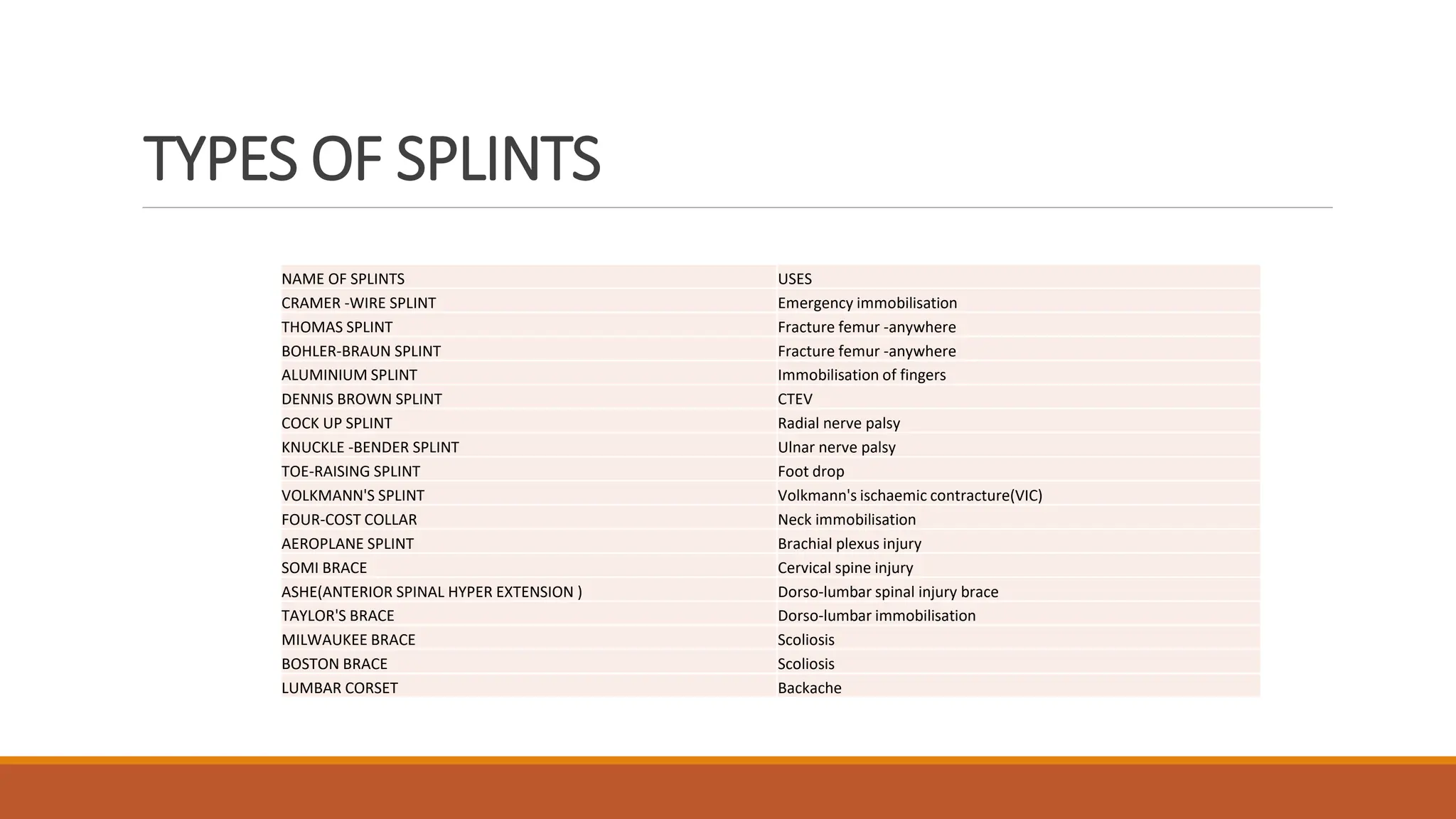
NAME OF SPLINTS USES
CRAMER -WIRE SPLINT Emergency immobilisation
THOMAS SPLINT Fracture femur -anywhere
BOHLER-BRAUN SPLINT Fracture femur -anywhere
ALUMINIUM SPLINT Immobilisation of fingers
DENNIS BROWN SPLINT CTEV
COCK UP SPLINT Radial nerve palsy
KNUCKLE -BENDER SPLINT Ulnar nerve palsy
TOE-RAISING SPLINT Foot drop
VOLKMANN'S SPLINT Volkmann's ischaemic contracture(VIC)
FOUR-COST COLLAR Neck immobilisation
AEROPLANE SPLINT Brachial plexus injury
SOMI BRACE Cervical spine injury
ASHE(ANTERIOR SPINAL HYPER EXTENSION ) Dorso-lumbar spinal injury brace
TAYLOR'S BRACE Dorso-lumbar immobilisation
MILWAUKEE BRACE Scoliosis
BOSTON BRACE Scoliosis
LUMBAR CORSET Backache
Common splints :-
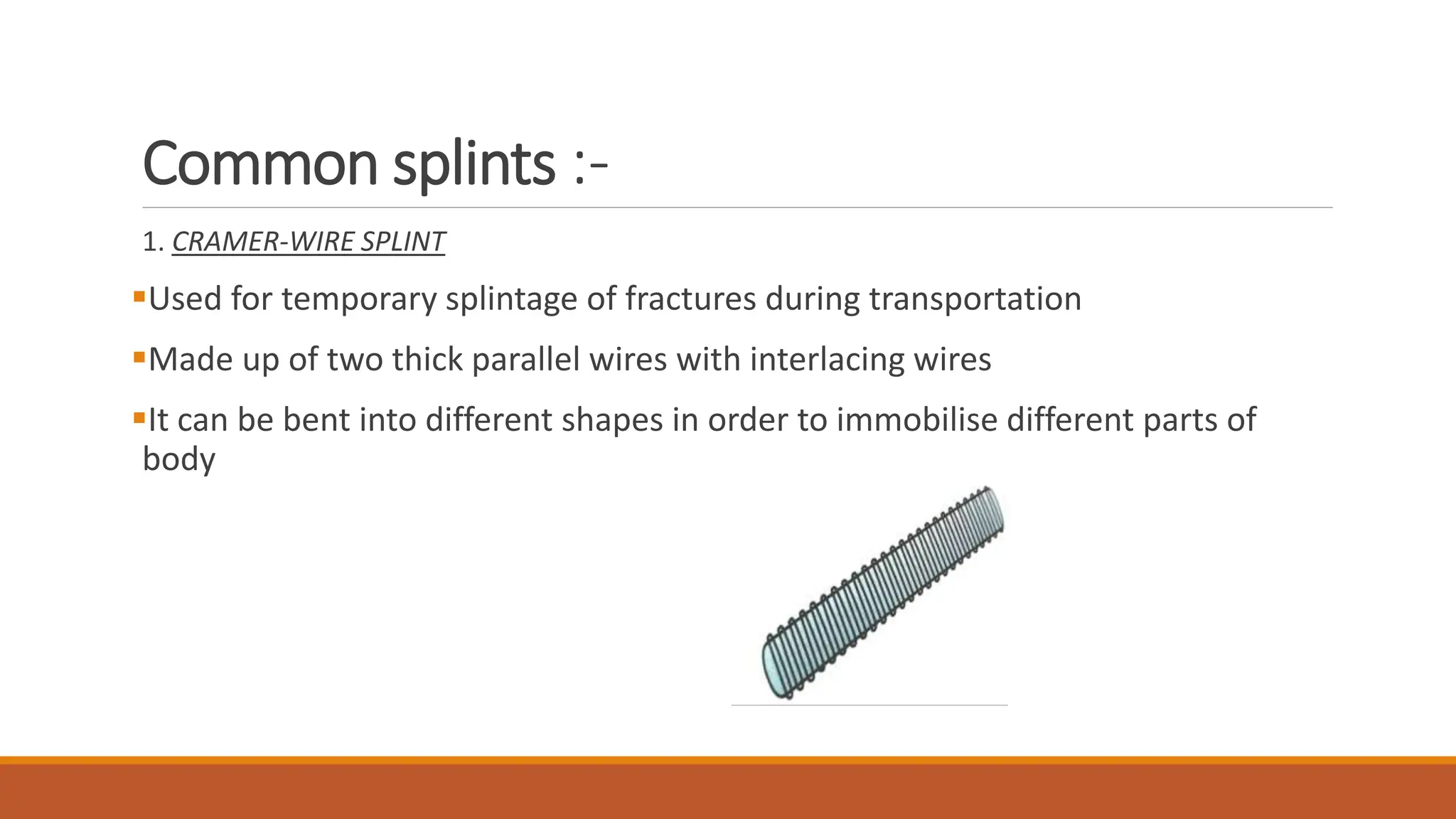
1. CRAMER-WIRE SPLINT
Used for temporary splintage of fractures during transportation
Made up of two thick parallel wires with interlacing wires
It can be bent into different shapes in order to immobilise different parts of
body
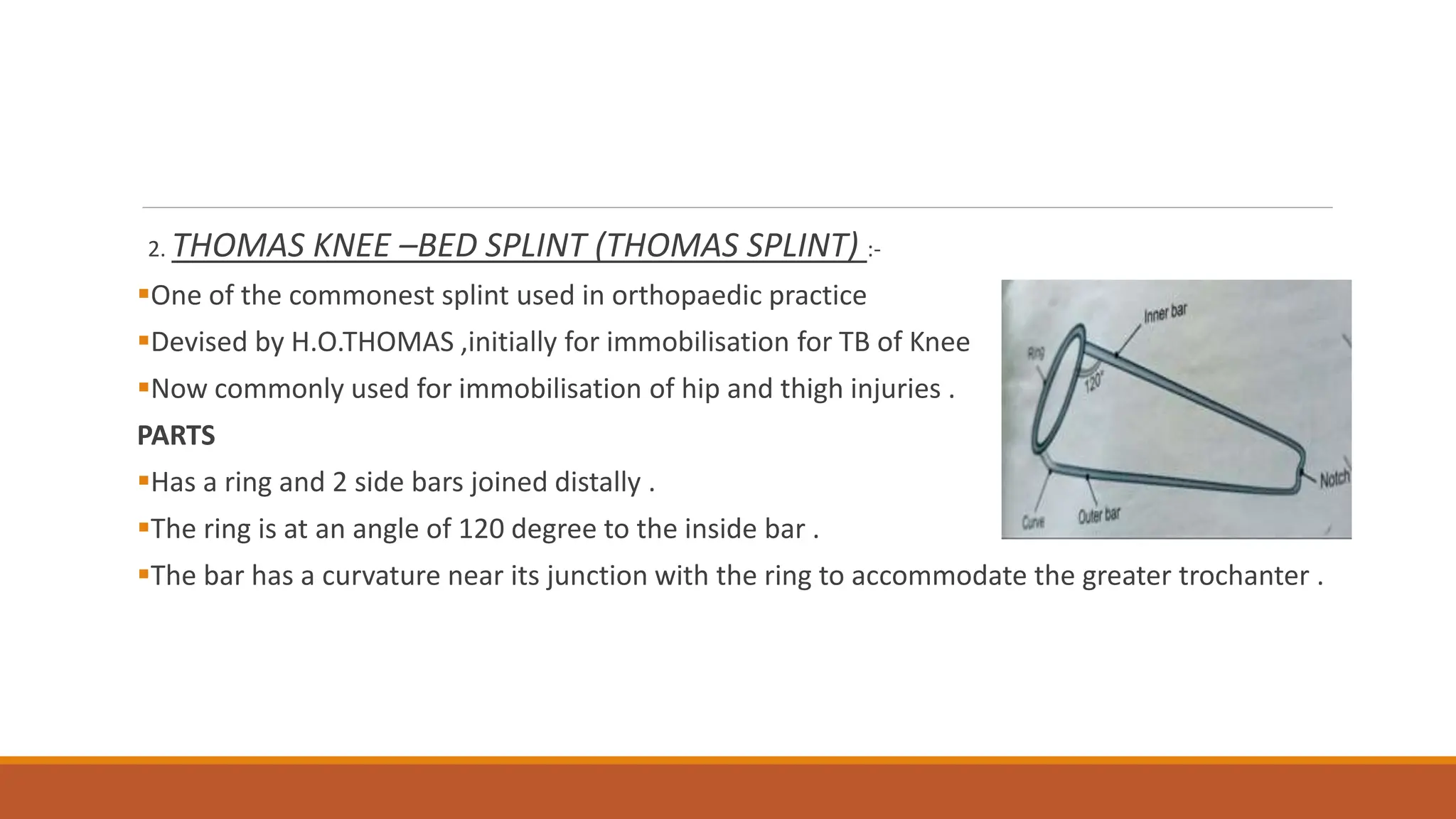
2. THOMAS KNEE –BED SPLINT (THOMAS SPLINT) :-
One of the commonest splint used in orthopaedic practice
Devised by H.O.THOMAS ,initially for immobilisation for TB of Knee
Now commonly used for immobilisation of hip and thigh injuries .
PARTS
Has a ring and 2 side bars joined distally .
The ring is at an angle of 120 degree to the inside bar .
The bar has a curvature near its junction with the ring to accommodate the greater trochanter .
SIZE OF THOMAS SPLINT
Measured by finding the ring size and length of splint
 Ring size is found by addition of 2 inch to the thigh circumference at the highest point of groin
 The length of Thomas splint is measurement from highest point on medial side of groin up to
the heel plus 6 inches.
USES OF THOMAS SPLINT :-
 For immobilization of lower limb
Care of Patient in a Splint
Splint should be properly applied ,well padded at bony prominences and at the fracture site.
The bandage of splint should not be too tight ,as it may produce sores ;nor to loose as it
becomes ineffective.
Patient should be encouraged to actively exercise the muscles and the joints inside the splint as
much as permitted .
Any compression of nerve or vessel ,usually due to too tight bandage or lack of adequate
padding should be detected early and managed accordingly .
Daily checking and adjustment if required should be made .
Regular portable X-rays may be taken to ensure good position of the fracture
Nowadays readymade braces are available for immobilizing different joints .Available in small to
extra large sizes. Example – knee immobilizer ,wrist immobilizer ,and ankle support .
TRACTION
Traction is used for :-
I. For reduction of fractures and dislocations and their maintenance.
II. For immobilizing a painful ,inflamed joint
III. For prevention of deformity by counteracting the muscle spasm associated with painful joint
IV. For correction of soft tissue contracture by stretching
TYPES OF TRACTION
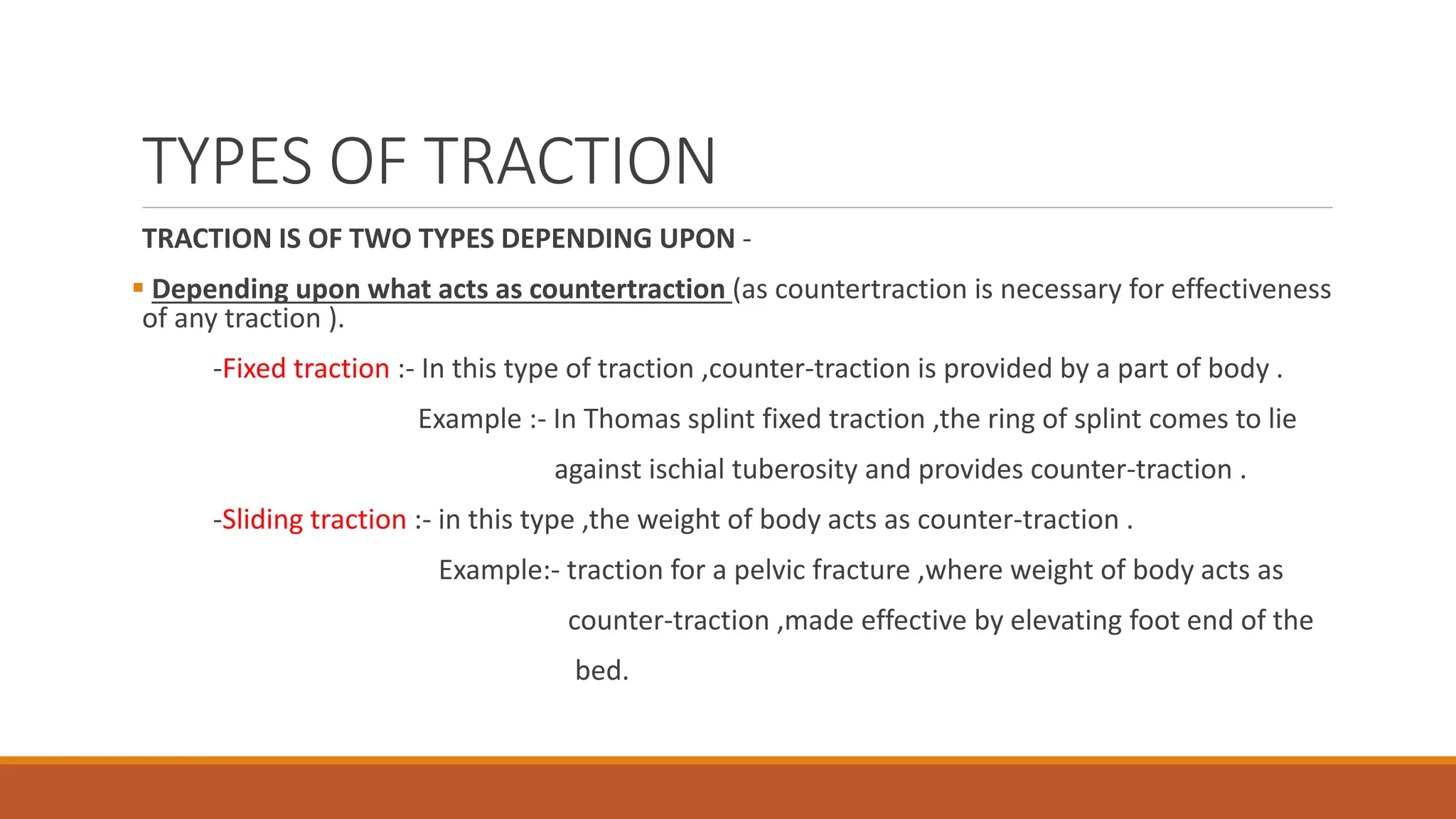
TRACTION IS OF TWO TYPES DEPENDING UPON -
 Depending upon what acts as countertraction (as countertraction is necessary for effectiveness
of any traction ).
-Fixed traction :- In this type of traction ,counter-traction is provided by a part of body .
Example :- In Thomas splint fixed traction ,the ring of splint comes to lie
against ischial tuberosity and provides counter-traction .
-Sliding traction :- in this type ,the weight of body acts as counter-traction .
Example:- traction for a pelvic fracture ,where weight of body acts as
counter-traction ,made effective by elevating foot end of the
bed.
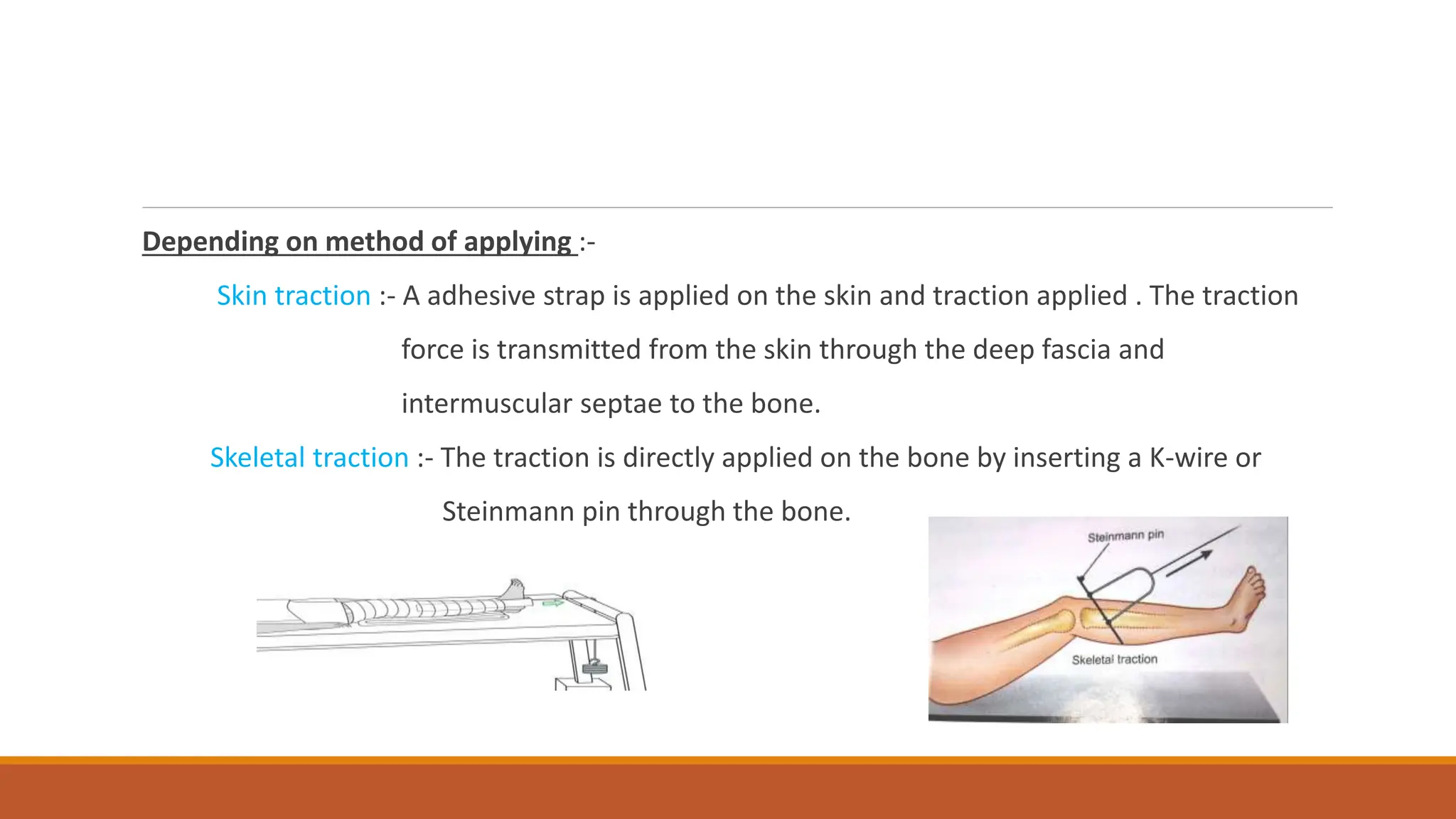
Depending on method of applying :-
Skin traction :- A adhesive strap is applied on the skin and traction applied . The traction
force is transmitted from the skin through the deep fascia and
intermuscular septae to the bone.
Skeletal traction :- The traction is directly applied on the bone by inserting a K-wire or
Steinmann pin through the bone.
Comparison between skin and skeletal
traction
POINTS SKIN TRACTION SKELETAL TRACTION
Required for mild to moderate force moderate to severe force
Age used for children adults
Applied with adhesive plaster Steinnmann pin , k-wire
Applied on skin through bone
Common site below knee upper tibial pin traction
Weight permitted upto 3-4kg upto 20kg
Used for short duration long duration
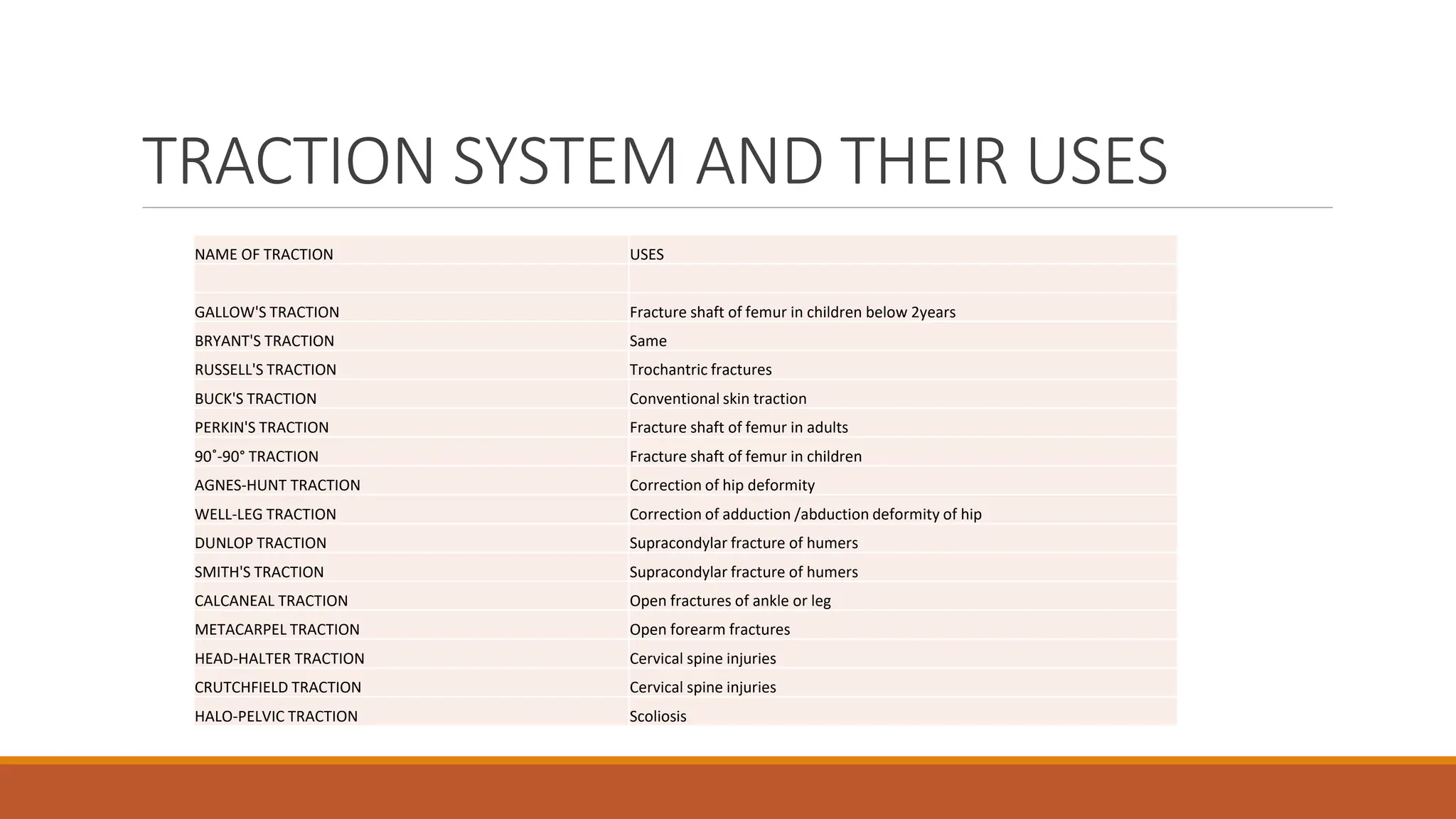
TRACTION SYSTEM AND THEIR USES
NAME OF TRACTION USES
GALLOW'S TRACTION Fracture shaft of femur in children below 2years
BRYANT'S TRACTION Same
RUSSELL'S TRACTION Trochantric fractures
BUCK'S TRACTION Conventional skin traction
PERKIN'S TRACTION Fracture shaft of femur in adults
90˚-90° TRACTION Fracture shaft of femur in children
AGNES-HUNT TRACTION Correction of hip deformity
WELL-LEG TRACTION Correction of adduction /abduction deformity of hip
DUNLOP TRACTION Supracondylar fracture of humers
SMITH'S TRACTION Supracondylar fracture of humers
CALCANEAL TRACTION Open fractures of ankle or leg
METACARPEL TRACTION Open forearm fractures
HEAD-HALTER TRACTION Cervical spine injuries
CRUTCHFIELD TRACTION Cervical spine injuries
HALO-PELVIC TRACTION Scoliosis
Care of a Patient in Traction
The traction should be as comfortable as possible .
Proper functioning of traction unit must be ensured.
Traction weights should not be touching the ground. See that ropes are in groove of
pulleys. The foot of patient or the end of traction device should not be touching the
pulley ,as it makes traction ineffective.
Ensure that terminal part of limb in traction (hand/foot)is warm and of normal color .
Sensations over toes and fingers should be normal . Any numbness or tingling may
point to a traction palsy of a nerve .
Any swelling over the fingers or toes may point to a light bandage or slipped skin
traction
A pin tract infection in skeletal traction can be detected early by eliciting pain on gentle
tapping at the site of pin insertion
The proper position of fracture should be ensured by taking check X-rays in traction
Physiotherapy of limb in traction should be continued to minimize muscle wasting
A watch must be kept on general complications oof recumbency like bed sores, chest congestion
, UTI , constipation etc.
Diversion therapy is important for any patient confined to bed for a long period of time . This
may be done by suggesting the patient to do things he likes –such as reading ,craft ,games
,watching television etc.

SPINTS AND TRACTIONS BY DR. SHIVANI GOYAL

  • 1.
    SPINTS AND TRACTIONS PRESENTEDBY:- DR.SHIVANI GOYAL(PT)
  • 2.
    WHAT ARE SPINTS? Splintsare used for immobilizing fractures either temporary during transportation or for definitive treatment . They are also used in other orthopedic conditions like infection ,congenital dislocation of hip etc.
  • 3.
    TYPES OF SPLINTS NAMEOF SPLINTS USES CRAMER -WIRE SPLINT Emergency immobilisation THOMAS SPLINT Fracture femur -anywhere BOHLER-BRAUN SPLINT Fracture femur -anywhere ALUMINIUM SPLINT Immobilisation of fingers DENNIS BROWN SPLINT CTEV COCK UP SPLINT Radial nerve palsy KNUCKLE -BENDER SPLINT Ulnar nerve palsy TOE-RAISING SPLINT Foot drop VOLKMANN'S SPLINT Volkmann's ischaemic contracture(VIC) FOUR-COST COLLAR Neck immobilisation AEROPLANE SPLINT Brachial plexus injury SOMI BRACE Cervical spine injury ASHE(ANTERIOR SPINAL HYPER EXTENSION ) Dorso-lumbar spinal injury brace TAYLOR'S BRACE Dorso-lumbar immobilisation MILWAUKEE BRACE Scoliosis BOSTON BRACE Scoliosis LUMBAR CORSET Backache
  • 4.
    Common splints :- 1.CRAMER-WIRE SPLINT Used for temporary splintage of fractures during transportation Made up of two thick parallel wires with interlacing wires It can be bent into different shapes in order to immobilise different parts of body
  • 5.
    2. THOMAS KNEE–BED SPLINT (THOMAS SPLINT) :- One of the commonest splint used in orthopaedic practice Devised by H.O.THOMAS ,initially for immobilisation for TB of Knee Now commonly used for immobilisation of hip and thigh injuries . PARTS Has a ring and 2 side bars joined distally . The ring is at an angle of 120 degree to the inside bar . The bar has a curvature near its junction with the ring to accommodate the greater trochanter .
  • 6.
    SIZE OF THOMASSPLINT Measured by finding the ring size and length of splint  Ring size is found by addition of 2 inch to the thigh circumference at the highest point of groin  The length of Thomas splint is measurement from highest point on medial side of groin up to the heel plus 6 inches. USES OF THOMAS SPLINT :-  For immobilization of lower limb
  • 7.
    Care of Patientin a Splint Splint should be properly applied ,well padded at bony prominences and at the fracture site. The bandage of splint should not be too tight ,as it may produce sores ;nor to loose as it becomes ineffective. Patient should be encouraged to actively exercise the muscles and the joints inside the splint as much as permitted . Any compression of nerve or vessel ,usually due to too tight bandage or lack of adequate padding should be detected early and managed accordingly . Daily checking and adjustment if required should be made . Regular portable X-rays may be taken to ensure good position of the fracture Nowadays readymade braces are available for immobilizing different joints .Available in small to extra large sizes. Example – knee immobilizer ,wrist immobilizer ,and ankle support .
  • 8.
    TRACTION Traction is usedfor :- I. For reduction of fractures and dislocations and their maintenance. II. For immobilizing a painful ,inflamed joint III. For prevention of deformity by counteracting the muscle spasm associated with painful joint IV. For correction of soft tissue contracture by stretching
  • 9.
    TYPES OF TRACTION TRACTIONIS OF TWO TYPES DEPENDING UPON -  Depending upon what acts as countertraction (as countertraction is necessary for effectiveness of any traction ). -Fixed traction :- In this type of traction ,counter-traction is provided by a part of body . Example :- In Thomas splint fixed traction ,the ring of splint comes to lie against ischial tuberosity and provides counter-traction . -Sliding traction :- in this type ,the weight of body acts as counter-traction . Example:- traction for a pelvic fracture ,where weight of body acts as counter-traction ,made effective by elevating foot end of the bed.
  • 10.
    Depending on methodof applying :- Skin traction :- A adhesive strap is applied on the skin and traction applied . The traction force is transmitted from the skin through the deep fascia and intermuscular septae to the bone. Skeletal traction :- The traction is directly applied on the bone by inserting a K-wire or Steinmann pin through the bone.
  • 11.
    Comparison between skinand skeletal traction POINTS SKIN TRACTION SKELETAL TRACTION Required for mild to moderate force moderate to severe force Age used for children adults Applied with adhesive plaster Steinnmann pin , k-wire Applied on skin through bone Common site below knee upper tibial pin traction Weight permitted upto 3-4kg upto 20kg Used for short duration long duration
  • 12.
    TRACTION SYSTEM ANDTHEIR USES NAME OF TRACTION USES GALLOW'S TRACTION Fracture shaft of femur in children below 2years BRYANT'S TRACTION Same RUSSELL'S TRACTION Trochantric fractures BUCK'S TRACTION Conventional skin traction PERKIN'S TRACTION Fracture shaft of femur in adults 90˚-90° TRACTION Fracture shaft of femur in children AGNES-HUNT TRACTION Correction of hip deformity WELL-LEG TRACTION Correction of adduction /abduction deformity of hip DUNLOP TRACTION Supracondylar fracture of humers SMITH'S TRACTION Supracondylar fracture of humers CALCANEAL TRACTION Open fractures of ankle or leg METACARPEL TRACTION Open forearm fractures HEAD-HALTER TRACTION Cervical spine injuries CRUTCHFIELD TRACTION Cervical spine injuries HALO-PELVIC TRACTION Scoliosis
  • 13.
    Care of aPatient in Traction The traction should be as comfortable as possible . Proper functioning of traction unit must be ensured. Traction weights should not be touching the ground. See that ropes are in groove of pulleys. The foot of patient or the end of traction device should not be touching the pulley ,as it makes traction ineffective. Ensure that terminal part of limb in traction (hand/foot)is warm and of normal color . Sensations over toes and fingers should be normal . Any numbness or tingling may point to a traction palsy of a nerve . Any swelling over the fingers or toes may point to a light bandage or slipped skin traction A pin tract infection in skeletal traction can be detected early by eliciting pain on gentle tapping at the site of pin insertion
  • 14.
    The proper positionof fracture should be ensured by taking check X-rays in traction Physiotherapy of limb in traction should be continued to minimize muscle wasting A watch must be kept on general complications oof recumbency like bed sores, chest congestion , UTI , constipation etc. Diversion therapy is important for any patient confined to bed for a long period of time . This may be done by suggesting the patient to do things he likes –such as reading ,craft ,games ,watching television etc.