SEMESTER - IV
AIHC & Arch-C-401: Ancient Indian Social Life and Institutions
Unit I : Varna-Āśrama System
2. Origin, development and
significance of Āśrama
Sachin Kr. Tiwary
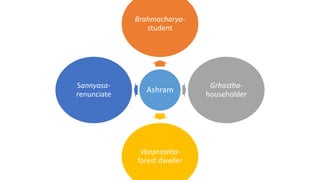
Ashram
Brahmacharya-
student
Grhastha-
householder
Vanprastha-
forest dweller
Sannyasa-
renunciate
Ashram or
stage
Age
(years)
Description
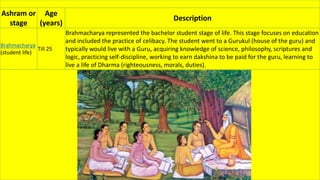
Brahmacharya
(student life)
Till 25
Brahmacharya represented the bachelor student stage of life. This stage focuses on education
and included the practice of celibacy. The student went to a Gurukul (house of the guru) and
typically would live with a Guru, acquiring knowledge of science, philosophy, scriptures and
logic, practicing self-discipline, working to earn dakshina to be paid for the guru, learning to
live a life of Dharma (righteousness, morals, duties).
Ashram or
stage
Age
(years)
Description
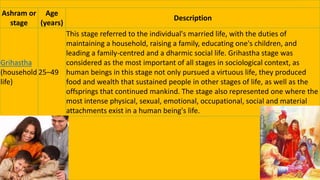
Grihastha
(household
life)
25–49
This stage referred to the individual's married life, with the duties of
maintaining a household, raising a family, educating one's children, and
leading a family-centred and a dharmic social life. Grihastha stage was
considered as the most important of all stages in sociological context, as
human beings in this stage not only pursued a virtuous life, they produced
food and wealth that sustained people in other stages of life, as well as the
offsprings that continued mankind. The stage also represented one where the
most intense physical, sexual, emotional, occupational, social and material
attachments exist in a human being's life.
Purushartha
joyful
four goals of life
Moksha
Artha
Kaam
Dharma
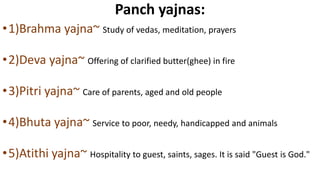
Panch yajnas:
•1)Brahma yajna~ Study of vedas, meditation, prayers
•2)Deva yajna~ Offering of clarified butter(ghee) in fire
•3)Pitri yajna~ Care of parents, aged and old people
•4)Bhuta yajna~ Service to poor, needy, handicapped and animals
•5)Atithi yajna~ Hospitality to guest, saints, sages. It is said "Guest is God."
Ashram or
stage
Age
(years)
Description
Vanaprastha
(retired life)
49–74
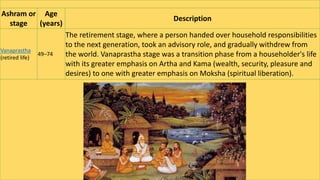
The retirement stage, where a person handed over household responsibilities
to the next generation, took an advisory role, and gradually withdrew from
the world. Vanaprastha stage was a transition phase from a householder's life
with its greater emphasis on Artha and Kama (wealth, security, pleasure and
desires) to one with greater emphasis on Moksha (spiritual liberation).
Ashram or
stage
Age
(years)
Description
Sannyasa
(renounced
life)
75+
(or
anytime)
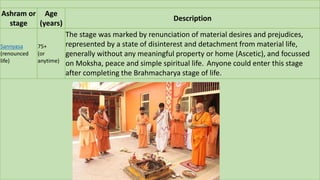
The stage was marked by renunciation of material desires and prejudices,
represented by a state of disinterest and detachment from material life,
generally without any meaningful property or home (Ascetic), and focussed
on Moksha, peace and simple spiritual life. Anyone could enter this stage
after completing the Brahmacharya stage of life.
Origin, development and significance of Ashram