

Vārta:
Meaning and
Significance
Dr. Virag Sontakke
Assistant Professor
Center for Advanced Studies
Department of A.I.H.C. & Archaeology,
Banaras Hindu University
Varta:
Meaning and Significance
Vārta
• Vārta (वाता$): refers to economics:
• Ancient thinkers used the word Varta to mean the science of national economy.
• Kauṭilya: Vārta is knowledge needed to run a state include
1. Agriculture,
2. Animal breeding, and
3. Trade.
• According to Mahabharata, Varta was the roof of the world, a thing which was
most essential for economic stability.
• It was necessary for the King to learn about the essentials of national economy
from scholars and specialists in order to discharge his functions successfully as
a ruler.
• Vārttā occupies a preeminent place in ancient Indian Economic Thought.
Term and Meaning
• The term Vārtā has been derived from the term Vṛtti (वृ#$)
implies livelihood and the branch of knowledge needed to earn
one’s living.
• Vārtā has been practised in India probably since the Indus
Valley Civilisation.
• Vedic texts have copious references of agriculture and animal
husbandry as well as a few to trade also.
• By the beginning of the Mauryan period Vārttā was recognised
as a branch of knowledge.
• Most texts consider Vārta to be one of the foremost
responsibilities of a king.
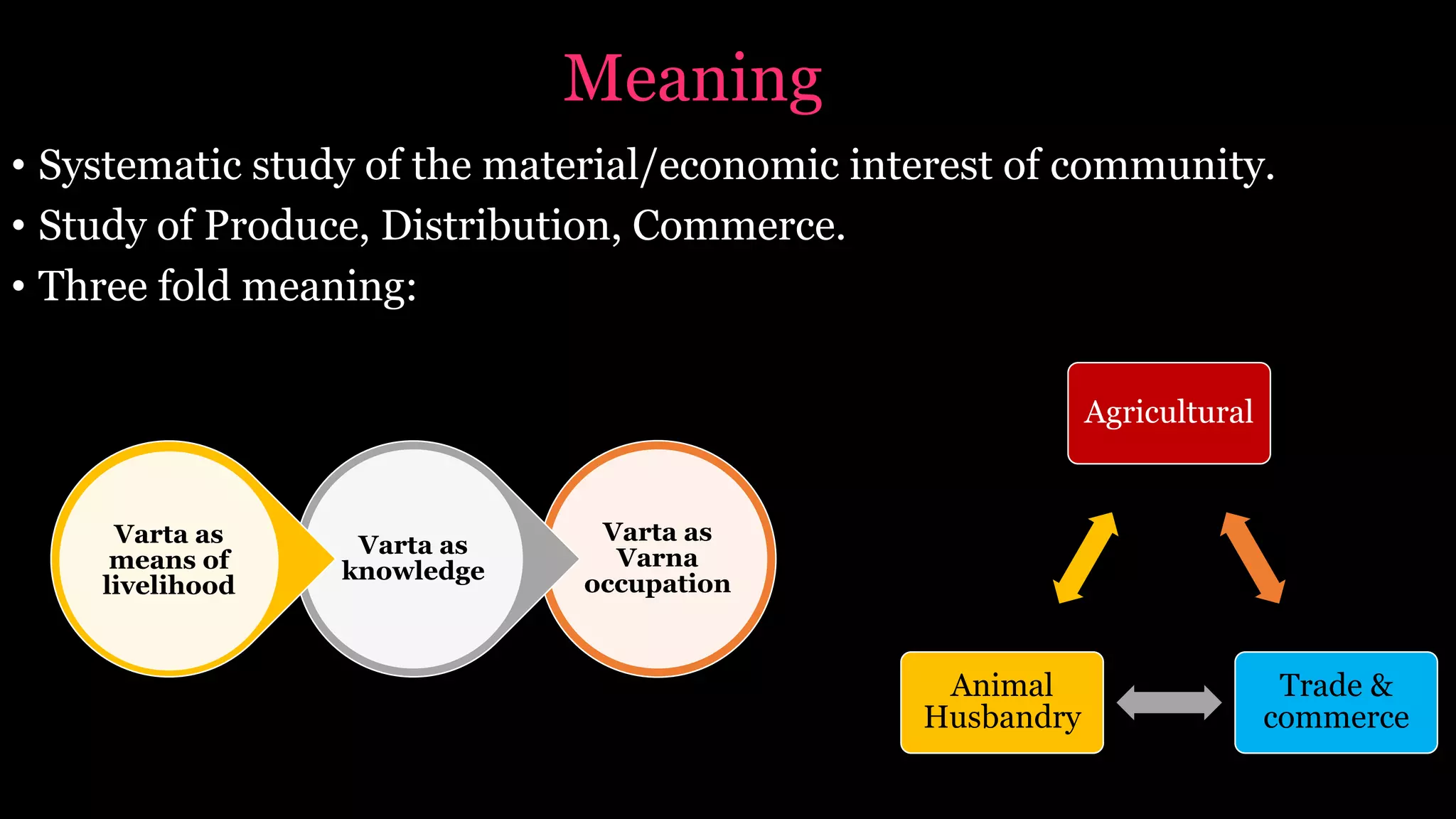
Meaning
• Systematic study of the material/economic interest of community.
• Study of Produce, Distribution, Commerce.
• Three fold meaning:
Varta as
Varna
occupation
Varta as
knowledge
Varta as
means of
livelihood
Agricultural
Trade &
commerce
Animal
Husbandry
Varta as Puruṣārthas
Manu Smṛti stated that all the three puruṣārthas of Dharma, Artha and
Kāma do good to human existence.
1. Dharm
2. Arth: Varta
3. Karm
4. Moksh
• Varta: important elements of economy
Varta as means of livelihood
•Initially, varta only included Agriculture, domestication
& commerce in its domain.
•Varta held different from Shilpa/Karukarma/Hast
kaushal
•Later karukarma = Shilpa was added to Varta.
•Mahabharata: Kashushilpa = a part of Varta.
Varta as knowledge
• Kautilya: 4 branches of Knowledge = Aanvikshiki (Philosophy), Trayi (Three Vedas), Varta,
Dandneeti (Politics).
• Shukraneeti: Varta is the science of Profit and Loss.
• Brahaspati : 2 branches of knowledge = Varta and Dandneeti.
• Devi Bhagvata Purana: Devi is known by 4 Vidyas which also include Varta
• Skandapurana, Vishnupurana, Agnipurana: Varta = one of the 4 branches
• Bhagvatpurana: Varta = Chaturvidya = Agriculture, commerce, cow security, interest taking.
• Gautam Dharamsutra + Matsya Purana + Manusmriti: Brahmans were supposed to teach Varta as
branch of knowledge.
• Kamandak’s Neetisaar + Shukraneeti + Yajnavalkya smriti: King should study Varta.
• A.N.Benerjee: Varta was the branch of learning that had wealth for its subjects.
Nature of Varta
• Kautilya + Manusmriti + Milindpanho + Kamandaka: Varta constitutes of
Agriculture, domestication & commerce.
• Arthashastra: Means of Varta are equivalent to philosophy & Purushartha
• Kalidasa: Varta included Agriculture and Domestication.
• Shukraneeti: Interest keeping (Kuseevad) and Commerce are parts of Varta.
• Devipurana: Varta also includes Karmanta = industries.
• Initially, works performed by shudras (Karukusila) were not included in Varta.
• Wilson on the basis of Vishnupurana: Varta also comprised of Crafts, Engineering,
Sculptural art, Ayurveda.
• Hemchandra: Varta is significant for Livelihood.
• Arthashastra: Varta = Mean to fill treasury
• Ramayana: Varta as mean to attain happiness.
Elements of Varta
क
ृ िष =
Agriculture
पशुपालन =
Domestication
वा,ण. =
Commerce
क
ु सीद = Interest
keeping
का2,श3 =
Crafts
Varta as Varna occupation
• Varta held different from Shilpa/Karukarma/Hast kaushal
• Varta: indicative of occupation of Vaishya varna initially.
• Later it included occupation of Shudras also
• Mahabharata: Trayi, Dandneeti & Varta are for Brahmans, Kshatriya &
Vaishyas.
• Kautilya : Three main occupations of Vaishyas- Agriculture, domestication,
commerce = Varta.
• Kamandak + Vishnupurana : Varta = occupation of Vaishyas.
• Bhagvata purana: Krishna studied Varta.
Antiquity of Varta
• Vayu & Brahmand Purana: Varta came into exixtence in Treta Yug.
• Matsya Purana: Varta arose to tackle the difficulties posed by heart, mind and
action.
• Numerous references in ancient literature.
1. Jain Kalpasutra: Rishabhdeva created 3 occupations = varta.
2. Mahabharata: Narad asks Yudhishthir ‘Are you keeping an eye on varta?’.
3. Ramayana: Ram inquires Bharata about people involved in Varta.
4. Arthashastra: Varta significant for development of State.
5. Manusmriti, Milindpanha: refer to Varta.
6. Amarkosha: Varta used as synonym for Livelihood.
7. Jain Kalpasutra: Rishabhdeva created 3 occupations = varta.
8. Puranas: Varta is axis for economic life.
• Probably Varta was conceived when arts and crafts weren’t held important in
society.
Importance of Varta
• Study of Varta as a branch of knowledge.
• Mahabharata: Till the rules for Varta are followed, society will
prosper.
• Arthashastra: King shall update & acquaint himself with main tenets
& developments in Varta in his kingdom.
• Other texts: If the postulates for Varta are not followed, societies will
decline.
Significance of Varta
• To support humans.
• To function as a source of income
• For material wellbeing
• For development of society, state & economy
• For economic prosperity & security
• Upholds social system & order
Significance of Varta
• Role of means of livelihood in sustenance of humans identified as varta.
• Due to the importance attributed to Varta, special attention for providing
facilities and implementing measures for its development.
• Led to the inclusion of study of occupational knowledge and tactics in
ancient education.
• Varta streamlined the occupational domain.
• Varta categorized economic activities to be carried by a special class.
Historiography
of Varta
Vārttā in Kauṭilya’s Arthśāstra
• Vārttā refers to livelihood and the science or vidyā to procure your livelihood.
• Vārttā has been accorded the status of vidyā or a systematic knowledge system
along with Ānvīkṣikī, Trayī and Daṇḍanīti.
• Further, in the opinion of Kauṭilya these four vidyās help a man to understand
dharma and artha.
• This vidyā has an interrelationship with the rest of the three vidyās and is like a
lamp that helps us understand better the other vidyās.
• The term vārtā according to Kauṭilya implies the occupations agriculture,
animal husbandry and trade
• Since Varta helps an individual to avail of grain, animals (mainly cattle), money,
forest produce this vidyā is very beneficial.
• The Vārta helps a king to control, with the help of his treasury and army, his
own as well as his enemy’s subjects.
• Kauṭilya strongly feels that a king who uses Varta in an optimum manner is
indeed eligible for respect.
Vārtā in the Kāmandakīya Nītisāra
• Some scholars consider this text as a summary of the Arthasāstra.
• The date of this work is believed to be before the 7th century CE.
• Vārtā has been mentioned as a branch of learning along with Ānvikṣikī,
Trayī and Daṇḍanīti.
• The text states that the king, after controlling his senses should
concentrate on ensuring the development of these Varta.
• It mentioned that only these four are the eternal branches of learning
and equates Vārtā with the branch of knowledge that concerns itself with
the gain and loss of wealth.
• Like the Arthaśāstra, this text too includes animal husbandry,
agriculture and trade in the definition of Vārtā
• It also considers these three to be the means of livelihood for the Vaiṣyas
Vārttā in the Rāmāyaṇa
• The subject of Vārttā in the Rāmāyaṇa has been dealt in the
hundredth sarga of the Ayodhyākāṇḍa.
• ShriRāma expects Bharata, as the administrator of the state to be aware of
the three vidyās namely the three Vedas, Vārtā and Daṇḍanīti.
• He asks Bharata whether the Brāhmaṇas, Kṣatriyas and Vaiṣyas are
absorbed in their respective duties.
• He wants to ensure that Vaiṣyas whose source of Vārtā is agriculture and
animal husbandry.
• He specially inquires about the welfare of the Vaiṣyas whose Vārtā is
sourced from trade, agriculture and cattle breeding.
Vārttā in the Mahābhārata
• The Mahābhārata in Śāntī Parva describes the respective duties of the
four varṇas.
• The dharma of a Vaiṣya includes giving dāna, studying the Vedas and
Śāstras, performing yajñas and earning wealth while maintaining his
purity.
• The Vaiṣyas were to engage in agriculture, animal husbandry and trade
i.e. Varta.
• Among these three occupations, the Mahābhārata considers animal
husbandry to be only the Vaiṣyas vocation and they had to look after
cattle like a father taking care of his children.
Vārttā in the Harivaṁśa
• The Harivaṁśa is the appendix text to the Mahābhārata.
• The date of the composition of this text generally fixed between the 1st-
3rd centuries CE.
• The sages told Pṛthus’s subjects that he will provide them with Vārttā or
livelihood.
• The people appealed to Pṛthu to grant them livelihood.
• This legend clearly indicates that the king was responsible to ensure that
his subjects had the proper means of livelihood.
• In the same text there is a mention of the term Vārtā when Kṛiṣṇa
explains to the gopas of Vraja about their pastoral subsistence.
• Shri Kṛṣṇa speaks about agriculture, cattle herding and trade being the
three main occupations of people and cattle herding being the chief
occupation of the gopas.
Vārttā in the Purāṇas
• The Bhāgavata Purāṇa briefly touches the subject of Vārttā.
• Narad mentions agriculture and trade as two forms of Vārttā which
cannot endow a man with the attainment of Bhagavat.
• Shri Kṛṣṇa, speaks about Vārtā is of four kinds: agriculture, trade, taking
care of cattle and money lending (kuśida).
• Among these, the gopas practice cattle protection.
• Here money lending being added to the categories of Vārtā as it may have
been a widely practised occupation in the early medieval period when the
Bhāgavata Purāṇa was being compiled.
• The Devi Bhāgavata Purāṇa adds karmānta or craftsmanship to the list of
professions coming under the concept of Vārttā.
Vārttā in the Dharmaśāstra Texts
1. Manu Smruti:
• The Manu Smṛti discusses the duties of a king .
• It is stated that a king must be trained in the four vidyās- Ānvikṣikī,
Trayi, Daṇḍanīti and Vārttā
• He should learn the Vārttā from the people.
2. Yājñavalkya Smṛti
• The Yājñavalkya Smṛti refers the king should be well versed in the four
vidyās i.e. Ānvikṣikī, Daṇḍnīti, Vārttā and Trayī
Discussion
• From the above overview we understand that most major texts have
incorporated the concept of Vārttā.
• The ancient Indian intellectuals had completely ascertained the role
Vārttā.
• Agriculture, animal husbandry and trade are the three fundamental
elements of economy was rightly identified as Varta.
• The king was assigned the charge to see to it that his subjects had a
proper source of livelihood.
• The vidyā of Vārttā practised through Dharma ensured the material well
being of not only individuals but also made sure that the economy
flourished.

Vārta

  • 1.
    Vārta: Meaning and Significance Dr. ViragSontakke Assistant Professor Center for Advanced Studies Department of A.I.H.C. & Archaeology, Banaras Hindu University
  • 2.
  • 3.
    Vārta • Vārta (वाता$):refers to economics: • Ancient thinkers used the word Varta to mean the science of national economy. • Kauṭilya: Vārta is knowledge needed to run a state include 1. Agriculture, 2. Animal breeding, and 3. Trade. • According to Mahabharata, Varta was the roof of the world, a thing which was most essential for economic stability. • It was necessary for the King to learn about the essentials of national economy from scholars and specialists in order to discharge his functions successfully as a ruler. • Vārttā occupies a preeminent place in ancient Indian Economic Thought.
  • 4.
    Term and Meaning •The term Vārtā has been derived from the term Vṛtti (वृ#$) implies livelihood and the branch of knowledge needed to earn one’s living. • Vārtā has been practised in India probably since the Indus Valley Civilisation. • Vedic texts have copious references of agriculture and animal husbandry as well as a few to trade also. • By the beginning of the Mauryan period Vārttā was recognised as a branch of knowledge. • Most texts consider Vārta to be one of the foremost responsibilities of a king.
  • 5.
    Meaning • Systematic studyof the material/economic interest of community. • Study of Produce, Distribution, Commerce. • Three fold meaning: Varta as Varna occupation Varta as knowledge Varta as means of livelihood Agricultural Trade & commerce Animal Husbandry
  • 6.
    Varta as Puruṣārthas ManuSmṛti stated that all the three puruṣārthas of Dharma, Artha and Kāma do good to human existence. 1. Dharm 2. Arth: Varta 3. Karm 4. Moksh • Varta: important elements of economy
  • 7.
    Varta as meansof livelihood •Initially, varta only included Agriculture, domestication & commerce in its domain. •Varta held different from Shilpa/Karukarma/Hast kaushal •Later karukarma = Shilpa was added to Varta. •Mahabharata: Kashushilpa = a part of Varta.
  • 8.
    Varta as knowledge •Kautilya: 4 branches of Knowledge = Aanvikshiki (Philosophy), Trayi (Three Vedas), Varta, Dandneeti (Politics). • Shukraneeti: Varta is the science of Profit and Loss. • Brahaspati : 2 branches of knowledge = Varta and Dandneeti. • Devi Bhagvata Purana: Devi is known by 4 Vidyas which also include Varta • Skandapurana, Vishnupurana, Agnipurana: Varta = one of the 4 branches • Bhagvatpurana: Varta = Chaturvidya = Agriculture, commerce, cow security, interest taking. • Gautam Dharamsutra + Matsya Purana + Manusmriti: Brahmans were supposed to teach Varta as branch of knowledge. • Kamandak’s Neetisaar + Shukraneeti + Yajnavalkya smriti: King should study Varta. • A.N.Benerjee: Varta was the branch of learning that had wealth for its subjects.
  • 9.
    Nature of Varta •Kautilya + Manusmriti + Milindpanho + Kamandaka: Varta constitutes of Agriculture, domestication & commerce. • Arthashastra: Means of Varta are equivalent to philosophy & Purushartha • Kalidasa: Varta included Agriculture and Domestication. • Shukraneeti: Interest keeping (Kuseevad) and Commerce are parts of Varta. • Devipurana: Varta also includes Karmanta = industries. • Initially, works performed by shudras (Karukusila) were not included in Varta. • Wilson on the basis of Vishnupurana: Varta also comprised of Crafts, Engineering, Sculptural art, Ayurveda. • Hemchandra: Varta is significant for Livelihood. • Arthashastra: Varta = Mean to fill treasury • Ramayana: Varta as mean to attain happiness.
  • 10.
    Elements of Varta क ृिष = Agriculture पशुपालन = Domestication वा,ण. = Commerce क ु सीद = Interest keeping का2,श3 = Crafts
  • 11.
    Varta as Varnaoccupation • Varta held different from Shilpa/Karukarma/Hast kaushal • Varta: indicative of occupation of Vaishya varna initially. • Later it included occupation of Shudras also • Mahabharata: Trayi, Dandneeti & Varta are for Brahmans, Kshatriya & Vaishyas. • Kautilya : Three main occupations of Vaishyas- Agriculture, domestication, commerce = Varta. • Kamandak + Vishnupurana : Varta = occupation of Vaishyas. • Bhagvata purana: Krishna studied Varta.
  • 12.
    Antiquity of Varta •Vayu & Brahmand Purana: Varta came into exixtence in Treta Yug. • Matsya Purana: Varta arose to tackle the difficulties posed by heart, mind and action. • Numerous references in ancient literature. 1. Jain Kalpasutra: Rishabhdeva created 3 occupations = varta. 2. Mahabharata: Narad asks Yudhishthir ‘Are you keeping an eye on varta?’. 3. Ramayana: Ram inquires Bharata about people involved in Varta. 4. Arthashastra: Varta significant for development of State. 5. Manusmriti, Milindpanha: refer to Varta. 6. Amarkosha: Varta used as synonym for Livelihood. 7. Jain Kalpasutra: Rishabhdeva created 3 occupations = varta. 8. Puranas: Varta is axis for economic life. • Probably Varta was conceived when arts and crafts weren’t held important in society.
  • 13.
    Importance of Varta •Study of Varta as a branch of knowledge. • Mahabharata: Till the rules for Varta are followed, society will prosper. • Arthashastra: King shall update & acquaint himself with main tenets & developments in Varta in his kingdom. • Other texts: If the postulates for Varta are not followed, societies will decline.
  • 14.
    Significance of Varta •To support humans. • To function as a source of income • For material wellbeing • For development of society, state & economy • For economic prosperity & security • Upholds social system & order
  • 15.
    Significance of Varta •Role of means of livelihood in sustenance of humans identified as varta. • Due to the importance attributed to Varta, special attention for providing facilities and implementing measures for its development. • Led to the inclusion of study of occupational knowledge and tactics in ancient education. • Varta streamlined the occupational domain. • Varta categorized economic activities to be carried by a special class.
  • 16.
  • 17.
    Vārttā in Kauṭilya’sArthśāstra • Vārttā refers to livelihood and the science or vidyā to procure your livelihood. • Vārttā has been accorded the status of vidyā or a systematic knowledge system along with Ānvīkṣikī, Trayī and Daṇḍanīti. • Further, in the opinion of Kauṭilya these four vidyās help a man to understand dharma and artha. • This vidyā has an interrelationship with the rest of the three vidyās and is like a lamp that helps us understand better the other vidyās. • The term vārtā according to Kauṭilya implies the occupations agriculture, animal husbandry and trade • Since Varta helps an individual to avail of grain, animals (mainly cattle), money, forest produce this vidyā is very beneficial. • The Vārta helps a king to control, with the help of his treasury and army, his own as well as his enemy’s subjects. • Kauṭilya strongly feels that a king who uses Varta in an optimum manner is indeed eligible for respect.
  • 18.
    Vārtā in theKāmandakīya Nītisāra • Some scholars consider this text as a summary of the Arthasāstra. • The date of this work is believed to be before the 7th century CE. • Vārtā has been mentioned as a branch of learning along with Ānvikṣikī, Trayī and Daṇḍanīti. • The text states that the king, after controlling his senses should concentrate on ensuring the development of these Varta. • It mentioned that only these four are the eternal branches of learning and equates Vārtā with the branch of knowledge that concerns itself with the gain and loss of wealth. • Like the Arthaśāstra, this text too includes animal husbandry, agriculture and trade in the definition of Vārtā • It also considers these three to be the means of livelihood for the Vaiṣyas
  • 19.
    Vārttā in theRāmāyaṇa • The subject of Vārttā in the Rāmāyaṇa has been dealt in the hundredth sarga of the Ayodhyākāṇḍa. • ShriRāma expects Bharata, as the administrator of the state to be aware of the three vidyās namely the three Vedas, Vārtā and Daṇḍanīti. • He asks Bharata whether the Brāhmaṇas, Kṣatriyas and Vaiṣyas are absorbed in their respective duties. • He wants to ensure that Vaiṣyas whose source of Vārtā is agriculture and animal husbandry. • He specially inquires about the welfare of the Vaiṣyas whose Vārtā is sourced from trade, agriculture and cattle breeding.
  • 20.
    Vārttā in theMahābhārata • The Mahābhārata in Śāntī Parva describes the respective duties of the four varṇas. • The dharma of a Vaiṣya includes giving dāna, studying the Vedas and Śāstras, performing yajñas and earning wealth while maintaining his purity. • The Vaiṣyas were to engage in agriculture, animal husbandry and trade i.e. Varta. • Among these three occupations, the Mahābhārata considers animal husbandry to be only the Vaiṣyas vocation and they had to look after cattle like a father taking care of his children.
  • 21.
    Vārttā in theHarivaṁśa • The Harivaṁśa is the appendix text to the Mahābhārata. • The date of the composition of this text generally fixed between the 1st- 3rd centuries CE. • The sages told Pṛthus’s subjects that he will provide them with Vārttā or livelihood. • The people appealed to Pṛthu to grant them livelihood. • This legend clearly indicates that the king was responsible to ensure that his subjects had the proper means of livelihood. • In the same text there is a mention of the term Vārtā when Kṛiṣṇa explains to the gopas of Vraja about their pastoral subsistence. • Shri Kṛṣṇa speaks about agriculture, cattle herding and trade being the three main occupations of people and cattle herding being the chief occupation of the gopas.
  • 22.
    Vārttā in thePurāṇas • The Bhāgavata Purāṇa briefly touches the subject of Vārttā. • Narad mentions agriculture and trade as two forms of Vārttā which cannot endow a man with the attainment of Bhagavat. • Shri Kṛṣṇa, speaks about Vārtā is of four kinds: agriculture, trade, taking care of cattle and money lending (kuśida). • Among these, the gopas practice cattle protection. • Here money lending being added to the categories of Vārtā as it may have been a widely practised occupation in the early medieval period when the Bhāgavata Purāṇa was being compiled. • The Devi Bhāgavata Purāṇa adds karmānta or craftsmanship to the list of professions coming under the concept of Vārttā.
  • 23.
    Vārttā in theDharmaśāstra Texts 1. Manu Smruti: • The Manu Smṛti discusses the duties of a king . • It is stated that a king must be trained in the four vidyās- Ānvikṣikī, Trayi, Daṇḍanīti and Vārttā • He should learn the Vārttā from the people. 2. Yājñavalkya Smṛti • The Yājñavalkya Smṛti refers the king should be well versed in the four vidyās i.e. Ānvikṣikī, Daṇḍnīti, Vārttā and Trayī
  • 24.
    Discussion • From theabove overview we understand that most major texts have incorporated the concept of Vārttā. • The ancient Indian intellectuals had completely ascertained the role Vārttā. • Agriculture, animal husbandry and trade are the three fundamental elements of economy was rightly identified as Varta. • The king was assigned the charge to see to it that his subjects had a proper source of livelihood. • The vidyā of Vārttā practised through Dharma ensured the material well being of not only individuals but also made sure that the economy flourished.