
Deceased organ donation
Waqas Ali
Objectives
• To have a basic idea of solid organ
transplantation
• To know about Organ sources and donor types
• To know about brain death concept and
controversies
Solid organ transplantation
• Definition:
– Autograft: The transfer of a tissue or organ from one part
of the body to another within the same person
– Allograft:The transfer of a tissue or organ from one
individual to another individual.
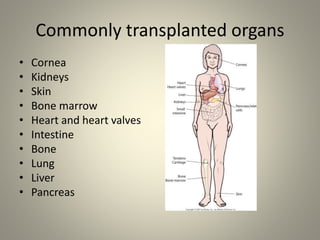
Commonly transplanted organs
• Cornea
• Kidneys
• Skin
• Bone marrow
• Heart and heart valves
• Intestine
• Bone
• Lung
• Liver
• Pancreas
Principles of transplantation
• Transplant immunology
The immune system recognizes graft from
someone else as foreign and triggers response
via immune cells or substances they produce -
cytokines and antibodies
• Responses are via; recognition, amplification
and memory
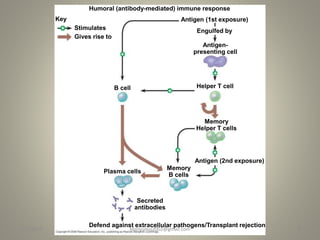
Key
Stimulates
Gives rise to
+
Memory
Helper T cells
Antigen-
presenting cell
Helper T cell
Engulfed by
Antigen (1st exposure)
+
+
+
+ +
+
Defend against extracellular pathogens/Transplant rejection
Memory
B cells
Antigen (2nd exposure)
Plasma cells
B cell
Secreted
antibodies
Humoral (antibody-mediated) immune response
1/25/2017 bbinyunus2002@gmail.com 6
Organ rejections
• Rejection of transplanted organs is a bigger challenge than the technical
expertise required to perform the surgery. It results mainly from HLA and
ABO incompatibility
• Hyperacute: with in seconds to minutes
• Acute: In first six months
• Chronic: After 6 months
• Rejection is controlled by immunosuppression given as
– Induction
– Maintainance
– Rescue agents
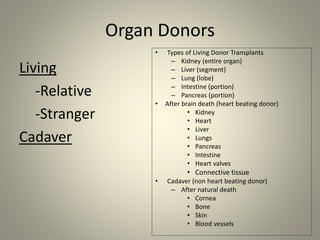
Organ Donors
Living
-Relative
-Stranger
Cadaver
• Types of Living Donor Transplants
– Kidney (entire organ)
– Liver (segment)
– Lung (lobe)
– Intestine (portion)
– Pancreas (portion)
• After brain death (heart beating donor)
• Kidney
• Heart
• Liver
• Lungs
• Pancreas
• Intestine
• Heart valves
• Connective tissue
• Cadaver (non heart beating donor)
– After natural death
• Cornea
• Bone
• Skin
• Blood vessels
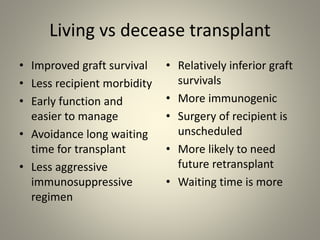
Living vs decease transplant
• Improved graft survival
• Less recipient morbidity
• Early function and
easier to manage
• Avoidance long waiting
time for transplant
• Less aggressive
immunosuppressive
regimen
• Relatively inferior graft
survivals
• More immunogenic
• Surgery of recipient is
unscheduled
• More likely to need
future retransplant
• Waiting time is more
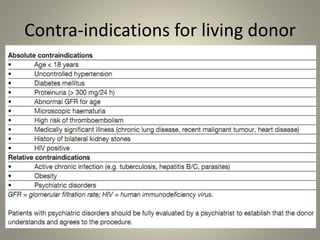
Contra-indications for living donor
– Mental disease
– Diseased organ
– Morbidity and mortality risk
– ABO incompatibility
– Cross matching incompatibility
– Transmissible disease
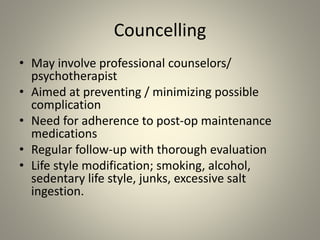
Councelling
• May involve professional counselors/
psychotherapist
• Aimed at preventing / minimizing possible
complication
• Need for adherence to post-op maintenance
medications
• Regular follow-up with thorough evaluation
• Life style modification; smoking, alcohol,
sedentary life style, junks, excessive salt
ingestion.
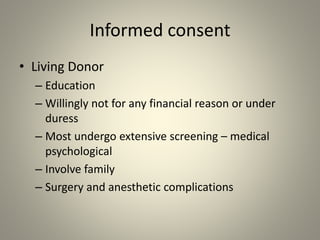
Informed consent
• Living Donor
– Education
– Willingly not for any financial reason or under
duress
– Most undergo extensive screening – medical
psychological
– Involve family
– Surgery and anesthetic complications
Informed consent
• Decease donor
– Some factors influencing refusal to consent by
relatives;
• non-acceptance of brain death.
• Superstitions relating to being reborn with a missing organ
• A delay in funeral
• Lack of consensus within family members
• Fear of social criticism
• Dissatisfaction with the hospital staff
• Religious believes
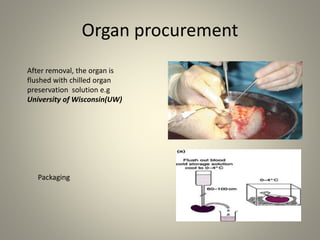
Organ procurement
After removal, the organ is
flushed with chilled organ
preservation solution e.g
University of Wisconsin(UW)
Packaging
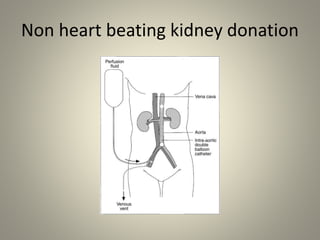
Non heart beating kidney donation
Ischemia duration
Warm ischemic time ; time an organ remains at
body temperature between which the blood
supply is cut off before cold perfusion. (within
30min)
Cold ischemic time ; the time between the
chilling of the organ, after blood supply has
been cut off and the time it is warmed by
reconnection
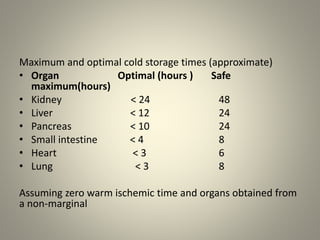
Maximum and optimal cold storage times (approximate)
• Organ Optimal (hours ) Safe
maximum(hours)
• Kidney < 24 48
• Liver < 12 24
• Pancreas < 10 24
• Small intestine < 4 8
• Heart < 3 6
• Lung < 3 8
Assuming zero warm ischemic time and organs obtained from
a non-marginal
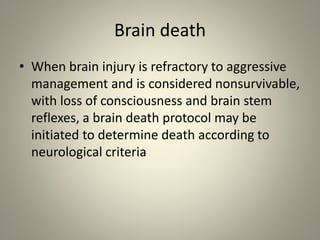
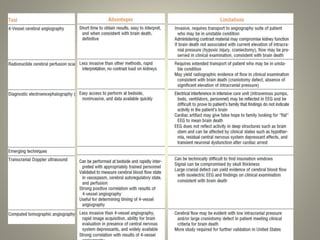
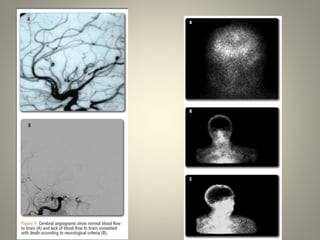
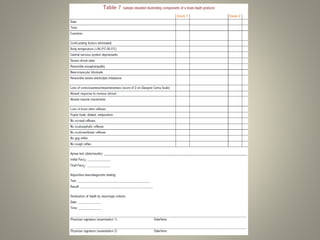
Brain death
• When brain injury is refractory to aggressive
management and is considered nonsurvivable,
with loss of consciousness and brain stem
reflexes, a brain death protocol may be
initiated to determine death according to
neurological criteria
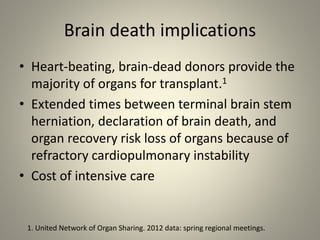
Brain death implications
• Heart-beating, brain-dead donors provide the
majority of organs for transplant.1
• Extended times between terminal brain stem
herniation, declaration of brain death, and
organ recovery risk loss of organs because of
refractory cardiopulmonary instability
• Cost of intensive care
1. United Network of Organ Sharing. 2012 data: spring regional meetings.
Lets watch a video
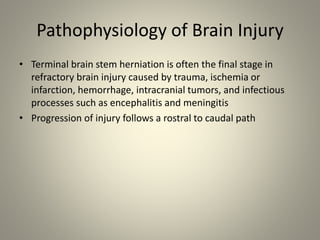
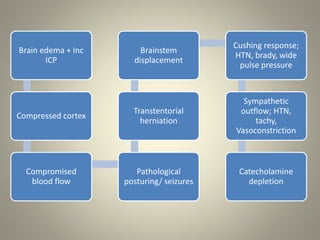
Pathophysiology of Brain Injury
• Terminal brain stem herniation is often the final stage in
refractory brain injury caused by trauma, ischemia or
infarction, hemorrhage, intracranial tumors, and infectious
processes such as encephalitis and meningitis
• Progression of injury follows a rostral to caudal path
Brain edema + Inc
ICP
Compressed cortex
Compromised
blood flow
Pathological
posturing/ seizures
Transtentorial
herniation
Brainstem
displacement
Cushing response;
HTN, brady, wide
pulse pressure
Sympathetic
outflow; HTN,
tachy,
Vasoconstriction
Catecholamine
depletion
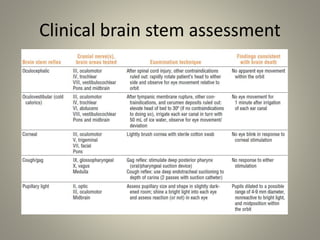
Clinical brain stem assessment
Confounding factors in brain death
• spinal cord injury,
• movements in brain death (complex spinal
reflexes, muscle fasciculations, ventilator
autotriggering),
• therapeutic hypothermia
• transient brain stem depression after
cardiopulmonary arrest
Ethical concerns
• The World Health Organization argues that
transplantations promote health, but the notion of
“transplantation tourism” has the potential to violate
human rights or exploit the poor
• There is also a powerful opposing view, that trade in
organs, if properly and effectively regulated to ensure
that the seller is fully informed of all the
consequences of donation, is a mutually beneficial
transaction between two consenting adults, and that
prohibiting it would itself be a violation of Articles 3
and 29 of the Universal Declaration of Human Rights.
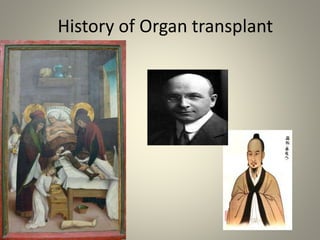
History of Organ transplant
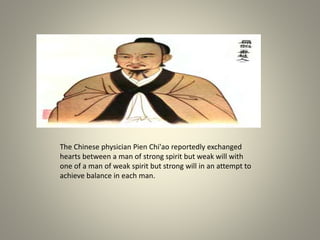
The Chinese physician Pien Chi'ao reportedly exchanged
hearts between a man of strong spirit but weak will with
one of a man of weak spirit but strong will in an attempt to
achieve balance in each man.
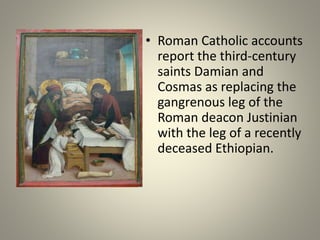
• Roman Catholic accounts
report the third-century
saints Damian and
Cosmas as replacing the
gangrenous leg of the
Roman deacon Justinian
with the leg of a recently
deceased Ethiopian.
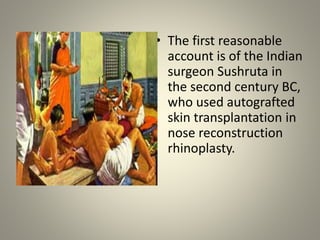
• The first reasonable
account is of the Indian
surgeon Sushruta in
the second century BC,
who used autografted
skin transplantation in
nose reconstruction
rhinoplasty.
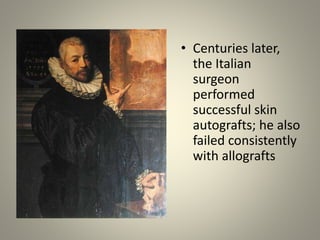
• Centuries later,
the Italian
surgeon
performed
successful skin
autografts; he also
failed consistently
with allografts
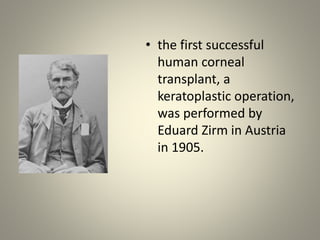
• the first successful
human corneal
transplant, a
keratoplastic operation,
was performed by
Eduard Zirm in Austria
in 1905.
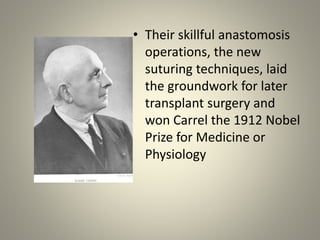
• Their skillful anastomosis
operations, the new
suturing techniques, laid
the groundwork for later
transplant surgery and
won Carrel the 1912 Nobel
Prize for Medicine or
Physiology
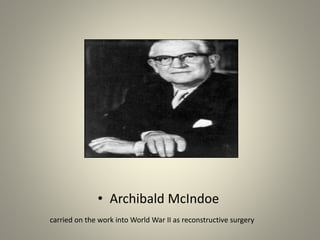
• Archibald McIndoe
carried on the work into World War II as reconstructive surgery
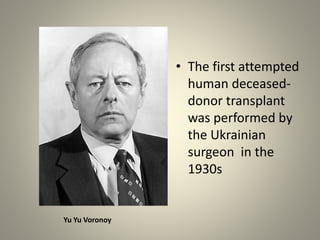
• The first attempted
human deceased-
donor transplant
was performed by
the Ukrainian
surgeon in the
1930s
Yu Yu Voronoy
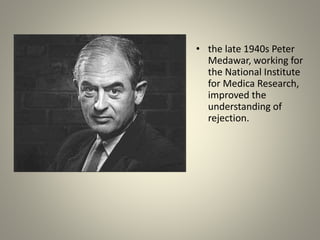
• the late 1940s Peter
Medawar, working for
the National Institute
for Medica Research,
improved the
understanding of
rejection.
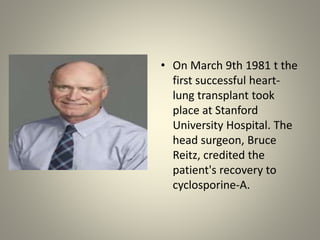
• On March 9th 1981 t the
first successful heart-
lung transplant took
place at Stanford
University Hospital. The
head surgeon, Bruce
Reitz, credited the
patient's recovery to
cyclosporine-A.
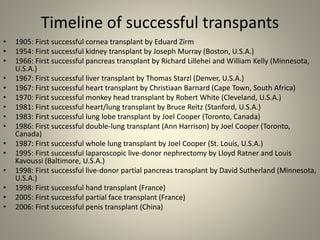
Timeline of successful transpants
• 1905: First successful cornea transplant by Eduard Zirm
• 1954: First successful kidney transplant by Joseph Murray (Boston, U.S.A.)
• 1966: First successful pancreas transplant by Richard Lillehei and William Kelly (Minnesota,
U.S.A.)
• 1967: First successful liver transplant by Thomas Starzl (Denver, U.S.A.)
• 1967: First successful heart transplant by Christiaan Barnard (Cape Town, South Africa)
• 1970: First successful monkey head transplant by Robert White (Cleveland, U.S.A.)
• 1981: First successful heart/lung transplant by Bruce Reitz (Stanford, U.S.A.)
• 1983: First successful lung lobe transplant by Joel Cooper (Toronto, Canada)
• 1986: First successful double-lung transplant (Ann Harrison) by Joel Cooper (Toronto,
Canada)
• 1987: First successful whole lung transplant by Joel Cooper (St. Louis, U.S.A.)
• 1995: First successful laparoscopic live-donor nephrectomy by Lloyd Ratner and Louis
Kavoussi (Baltimore, U.S.A.)
• 1998: First successful live-donor partial pancreas transplant by David Sutherland (Minnesota,
U.S.A.)
• 1998: First successful hand transplant (France)
• 2005: First successful partial face transplant (France)
• 2006: First successful penis transplant (China)
Thank you
• References
• Brain Death: Assessment, Controversy, and Confounding Factors
RICHARD B. ARBOUR, RN, MSN, CCRN, CNRN, CCNS
• LIVING DONOR KIDNEY TRANSPLANT
Kelli Willard West, MSSW, APSW Living Donation Outreach Educator
• PRINCIPLES INVOLVED IN ORGAN TRANSPLANT
DR BASHIR YUNUS SURGERY DEPT. AKTH 19/1/15
Wikipedia and google

Deceased organ donation

  • 1.
  • 2.
    Objectives • To havea basic idea of solid organ transplantation • To know about Organ sources and donor types • To know about brain death concept and controversies
  • 3.
    Solid organ transplantation •Definition: – Autograft: The transfer of a tissue or organ from one part of the body to another within the same person – Allograft:The transfer of a tissue or organ from one individual to another individual.
  • 4.
    Commonly transplanted organs •Cornea • Kidneys • Skin • Bone marrow • Heart and heart valves • Intestine • Bone • Lung • Liver • Pancreas
  • 5.
    Principles of transplantation •Transplant immunology The immune system recognizes graft from someone else as foreign and triggers response via immune cells or substances they produce - cytokines and antibodies • Responses are via; recognition, amplification and memory
  • 6.
    Key Stimulates Gives rise to + Memory HelperT cells Antigen- presenting cell Helper T cell Engulfed by Antigen (1st exposure) + + + + + + Defend against extracellular pathogens/Transplant rejection Memory B cells Antigen (2nd exposure) Plasma cells B cell Secreted antibodies Humoral (antibody-mediated) immune response 1/25/2017 bbinyunus2002@gmail.com 6
  • 7.
    Organ rejections • Rejectionof transplanted organs is a bigger challenge than the technical expertise required to perform the surgery. It results mainly from HLA and ABO incompatibility • Hyperacute: with in seconds to minutes • Acute: In first six months • Chronic: After 6 months • Rejection is controlled by immunosuppression given as – Induction – Maintainance – Rescue agents
  • 8.
    Organ Donors Living -Relative -Stranger Cadaver • Typesof Living Donor Transplants – Kidney (entire organ) – Liver (segment) – Lung (lobe) – Intestine (portion) – Pancreas (portion) • After brain death (heart beating donor) • Kidney • Heart • Liver • Lungs • Pancreas • Intestine • Heart valves • Connective tissue • Cadaver (non heart beating donor) – After natural death • Cornea • Bone • Skin • Blood vessels
  • 9.
    Living vs deceasetransplant • Improved graft survival • Less recipient morbidity • Early function and easier to manage • Avoidance long waiting time for transplant • Less aggressive immunosuppressive regimen • Relatively inferior graft survivals • More immunogenic • Surgery of recipient is unscheduled • More likely to need future retransplant • Waiting time is more
  • 10.
    Contra-indications for livingdonor – Mental disease – Diseased organ – Morbidity and mortality risk – ABO incompatibility – Cross matching incompatibility – Transmissible disease
  • 11.
    Councelling • May involveprofessional counselors/ psychotherapist • Aimed at preventing / minimizing possible complication • Need for adherence to post-op maintenance medications • Regular follow-up with thorough evaluation • Life style modification; smoking, alcohol, sedentary life style, junks, excessive salt ingestion.
  • 12.
    Informed consent • LivingDonor – Education – Willingly not for any financial reason or under duress – Most undergo extensive screening – medical psychological – Involve family – Surgery and anesthetic complications
  • 13.
    Informed consent • Deceasedonor – Some factors influencing refusal to consent by relatives; • non-acceptance of brain death. • Superstitions relating to being reborn with a missing organ • A delay in funeral • Lack of consensus within family members • Fear of social criticism • Dissatisfaction with the hospital staff • Religious believes
  • 14.
    Organ procurement After removal,the organ is flushed with chilled organ preservation solution e.g University of Wisconsin(UW) Packaging
  • 15.
    Non heart beatingkidney donation
  • 16.
    Ischemia duration Warm ischemictime ; time an organ remains at body temperature between which the blood supply is cut off before cold perfusion. (within 30min) Cold ischemic time ; the time between the chilling of the organ, after blood supply has been cut off and the time it is warmed by reconnection
  • 17.
    Maximum and optimalcold storage times (approximate) • Organ Optimal (hours ) Safe maximum(hours) • Kidney < 24 48 • Liver < 12 24 • Pancreas < 10 24 • Small intestine < 4 8 • Heart < 3 6 • Lung < 3 8 Assuming zero warm ischemic time and organs obtained from a non-marginal
  • 18.
    Brain death • Whenbrain injury is refractory to aggressive management and is considered nonsurvivable, with loss of consciousness and brain stem reflexes, a brain death protocol may be initiated to determine death according to neurological criteria
  • 19.
    Brain death implications •Heart-beating, brain-dead donors provide the majority of organs for transplant.1 • Extended times between terminal brain stem herniation, declaration of brain death, and organ recovery risk loss of organs because of refractory cardiopulmonary instability • Cost of intensive care 1. United Network of Organ Sharing. 2012 data: spring regional meetings.
  • 20.
  • 21.
    Pathophysiology of BrainInjury • Terminal brain stem herniation is often the final stage in refractory brain injury caused by trauma, ischemia or infarction, hemorrhage, intracranial tumors, and infectious processes such as encephalitis and meningitis • Progression of injury follows a rostral to caudal path
  • 22.
    Brain edema +Inc ICP Compressed cortex Compromised blood flow Pathological posturing/ seizures Transtentorial herniation Brainstem displacement Cushing response; HTN, brady, wide pulse pressure Sympathetic outflow; HTN, tachy, Vasoconstriction Catecholamine depletion
  • 23.
  • 26.
    Confounding factors inbrain death • spinal cord injury, • movements in brain death (complex spinal reflexes, muscle fasciculations, ventilator autotriggering), • therapeutic hypothermia • transient brain stem depression after cardiopulmonary arrest
  • 28.
    Ethical concerns • TheWorld Health Organization argues that transplantations promote health, but the notion of “transplantation tourism” has the potential to violate human rights or exploit the poor • There is also a powerful opposing view, that trade in organs, if properly and effectively regulated to ensure that the seller is fully informed of all the consequences of donation, is a mutually beneficial transaction between two consenting adults, and that prohibiting it would itself be a violation of Articles 3 and 29 of the Universal Declaration of Human Rights.
  • 29.
    History of Organtransplant
  • 30.
    The Chinese physicianPien Chi'ao reportedly exchanged hearts between a man of strong spirit but weak will with one of a man of weak spirit but strong will in an attempt to achieve balance in each man.
  • 31.
    • Roman Catholicaccounts report the third-century saints Damian and Cosmas as replacing the gangrenous leg of the Roman deacon Justinian with the leg of a recently deceased Ethiopian.
  • 32.
    • The firstreasonable account is of the Indian surgeon Sushruta in the second century BC, who used autografted skin transplantation in nose reconstruction rhinoplasty.
  • 33.
    • Centuries later, theItalian surgeon performed successful skin autografts; he also failed consistently with allografts
  • 34.
    • the firstsuccessful human corneal transplant, a keratoplastic operation, was performed by Eduard Zirm in Austria in 1905.
  • 35.
    • Their skillfulanastomosis operations, the new suturing techniques, laid the groundwork for later transplant surgery and won Carrel the 1912 Nobel Prize for Medicine or Physiology
  • 36.
    • Archibald McIndoe carriedon the work into World War II as reconstructive surgery
  • 37.
    • The firstattempted human deceased- donor transplant was performed by the Ukrainian surgeon in the 1930s Yu Yu Voronoy
  • 38.
    • the late1940s Peter Medawar, working for the National Institute for Medica Research, improved the understanding of rejection.
  • 39.
    • On March9th 1981 t the first successful heart- lung transplant took place at Stanford University Hospital. The head surgeon, Bruce Reitz, credited the patient's recovery to cyclosporine-A.
  • 40.
    Timeline of successfultranspants • 1905: First successful cornea transplant by Eduard Zirm • 1954: First successful kidney transplant by Joseph Murray (Boston, U.S.A.) • 1966: First successful pancreas transplant by Richard Lillehei and William Kelly (Minnesota, U.S.A.) • 1967: First successful liver transplant by Thomas Starzl (Denver, U.S.A.) • 1967: First successful heart transplant by Christiaan Barnard (Cape Town, South Africa) • 1970: First successful monkey head transplant by Robert White (Cleveland, U.S.A.) • 1981: First successful heart/lung transplant by Bruce Reitz (Stanford, U.S.A.) • 1983: First successful lung lobe transplant by Joel Cooper (Toronto, Canada) • 1986: First successful double-lung transplant (Ann Harrison) by Joel Cooper (Toronto, Canada) • 1987: First successful whole lung transplant by Joel Cooper (St. Louis, U.S.A.) • 1995: First successful laparoscopic live-donor nephrectomy by Lloyd Ratner and Louis Kavoussi (Baltimore, U.S.A.) • 1998: First successful live-donor partial pancreas transplant by David Sutherland (Minnesota, U.S.A.) • 1998: First successful hand transplant (France) • 2005: First successful partial face transplant (France) • 2006: First successful penis transplant (China)
  • 41.
    Thank you • References •Brain Death: Assessment, Controversy, and Confounding Factors RICHARD B. ARBOUR, RN, MSN, CCRN, CNRN, CCNS • LIVING DONOR KIDNEY TRANSPLANT Kelli Willard West, MSSW, APSW Living Donation Outreach Educator • PRINCIPLES INVOLVED IN ORGAN TRANSPLANT DR BASHIR YUNUS SURGERY DEPT. AKTH 19/1/15 Wikipedia and google