Managing for Ethical
Employee Behavior
Presented by:
Tasmia Choudhury, Thapanut Uvijitr, Neha Choudhary,
Nina Houston, Iaroslav Lutsenko, Sin Heang Lee,
Josephine Herrera-Rivera
Ethics in Theory
“Leadership should not go along to get along …. Leadership must
meet the moral challenge of the day”
Ethics refers to the principles of right conduct or a system of
moral values
Leaders are judged on the basis of a framework of values and not just in terms of
their effectiveness.
Gardner & Burns stressed the centrality and importance of the moral dimension of
leadership.
Burns even viewed ethically correct leadership behavior to demonstrate “true
leadership”
Ethics and trust go hand in hand
The 4 Leadership Qualities
that create Trust
Vision:
• Followers tend to trust a leader who create a compelling vision
Empathy:
• Understand the world as the followers see and experience it
Consistency:
• Leaders who are consistent are trustworthy
Integrity:
• Leaders with strong integrity are trusted by the followers
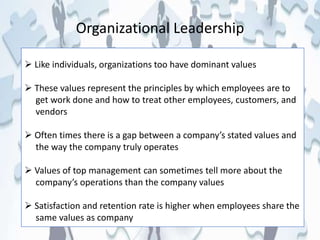
Organizational Leadership
 Like individuals, organizations too have dominant values
 These values represent the principles by which employees are to
get work done and how to treat other employees, customers, and
vendors
 Often times there is a gap between a company’s stated values and
the way the company truly operates
 Values of top management can sometimes tell more about the
company’s operations than the company values
 Satisfaction and retention rate is higher when employees share the
same values as company
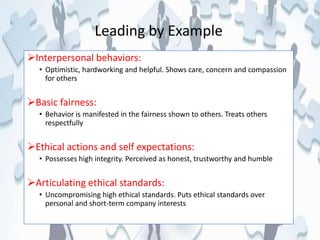
Leading by Example
Interpersonal behaviors:
• Optimistic, hardworking and helpful. Shows care, concern and compassion
for others
Basic fairness:
• Behavior is manifested in the fairness shown to others. Treats others
respectfully
Ethical actions and self expectations:
• Possesses high integrity. Perceived as honest, trustworthy and humble
Articulating ethical standards:
• Uncompromising high ethical standards. Puts ethical standards over
personal and short-term company interests
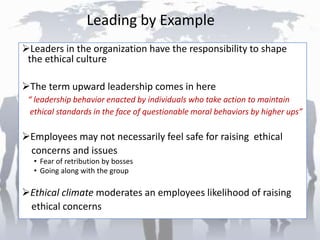
Leading by Example
Leaders in the organization have the responsibility to shape
the ethical culture
The term upward leadership comes in here
“ leadership behavior enacted by individuals who take action to maintain
ethical standards in the face of questionable moral behaviors by higher ups”
Employees may not necessarily feel safe for raising ethical
concerns and issues
• Fear of retribution by bosses
• Going along with the group
Ethical climate moderates an employees likelihood of raising
ethical concerns
Culture
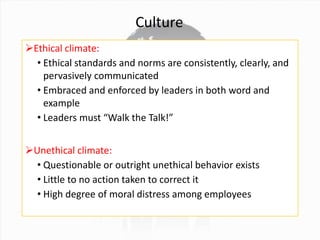
Ethical climate:
• Ethical standards and norms are consistently, clearly, and
pervasively communicated
• Embraced and enforced by leaders in both word and
example
• Leaders must “Walk the Talk!”
Unethical climate:
• Questionable or outright unethical behavior exists
• Little to no action taken to correct it
• High degree of moral distress among employees
Culture Video
Policies and Procedures
Formal statements of ethical standards and policies:
Organizations follow public and private policies and actions
• Companies have increased focus in written policies with Ethics
HRM System Example
Ethics Resource Center website
• Provides resources, research, services, standards, practices for
companies
Process Focus
Tangible Achievements:
Organizational
Individual
Team goals
Intangible Process:
 How goals are achieved
Organization’s can be designed to encourage higher ethical
performance and discourage unethical performance.
Hiring Practices
• Higher standards
• Leaders with integrity
Communicate, Communicate, Communicate!
• Meetings: daily weekly, monthly quarterly, annually
• Pamphlets/publications
• Emails
• Quarterly newsletters
Structural Reinforcement
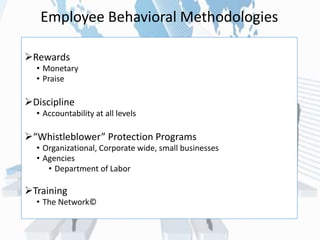
Employee Behavioral Methodologies
Rewards
• Monetary
• Praise
Discipline
• Accountability at all levels
“Whistleblower” Protection Programs
• Organizational, Corporate wide, small businesses
• Agencies
• Department of Labor
Training
• The Network©
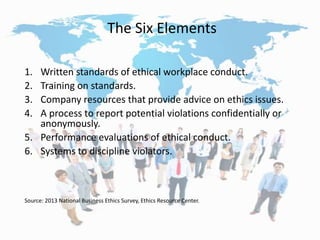
The Six Elements
1. Written standards of ethical workplace conduct.
2. Training on standards.
3. Company resources that provide advice on ethics issues.
4. A process to report potential violations confidentially or
anonymously.
5. Performance evaluations of ethical conduct.
6. Systems to discipline violators.
Source: 2013 National Business Ethics Survey, Ethics Resource Center.
Unethical Behavior
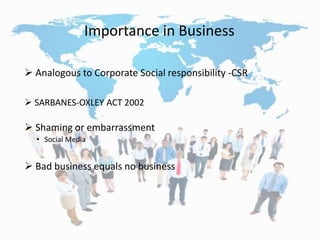
Importance in Business
 Analogous to Corporate Social responsibility -CSR
 SARBANES-OXLEY ACT 2002
 Shaming or embarrassment
• Social Media
 Bad business equals no business
Conclusion
Just Good for Business!
Good for overall moral!
Thank you!!!
Questions
?

FINAL PRESENTATION 042015

  • 1.
    Managing for Ethical EmployeeBehavior Presented by: Tasmia Choudhury, Thapanut Uvijitr, Neha Choudhary, Nina Houston, Iaroslav Lutsenko, Sin Heang Lee, Josephine Herrera-Rivera
  • 2.
    Ethics in Theory “Leadershipshould not go along to get along …. Leadership must meet the moral challenge of the day” Ethics refers to the principles of right conduct or a system of moral values Leaders are judged on the basis of a framework of values and not just in terms of their effectiveness. Gardner & Burns stressed the centrality and importance of the moral dimension of leadership. Burns even viewed ethically correct leadership behavior to demonstrate “true leadership” Ethics and trust go hand in hand
  • 3.
    The 4 LeadershipQualities that create Trust Vision: • Followers tend to trust a leader who create a compelling vision Empathy: • Understand the world as the followers see and experience it Consistency: • Leaders who are consistent are trustworthy Integrity: • Leaders with strong integrity are trusted by the followers
  • 4.
    Organizational Leadership  Likeindividuals, organizations too have dominant values  These values represent the principles by which employees are to get work done and how to treat other employees, customers, and vendors  Often times there is a gap between a company’s stated values and the way the company truly operates  Values of top management can sometimes tell more about the company’s operations than the company values  Satisfaction and retention rate is higher when employees share the same values as company
  • 6.
    Leading by Example Interpersonalbehaviors: • Optimistic, hardworking and helpful. Shows care, concern and compassion for others Basic fairness: • Behavior is manifested in the fairness shown to others. Treats others respectfully Ethical actions and self expectations: • Possesses high integrity. Perceived as honest, trustworthy and humble Articulating ethical standards: • Uncompromising high ethical standards. Puts ethical standards over personal and short-term company interests
  • 7.
    Leading by Example Leadersin the organization have the responsibility to shape the ethical culture The term upward leadership comes in here “ leadership behavior enacted by individuals who take action to maintain ethical standards in the face of questionable moral behaviors by higher ups” Employees may not necessarily feel safe for raising ethical concerns and issues • Fear of retribution by bosses • Going along with the group Ethical climate moderates an employees likelihood of raising ethical concerns
  • 8.
    Culture Ethical climate: • Ethicalstandards and norms are consistently, clearly, and pervasively communicated • Embraced and enforced by leaders in both word and example • Leaders must “Walk the Talk!” Unethical climate: • Questionable or outright unethical behavior exists • Little to no action taken to correct it • High degree of moral distress among employees
  • 9.
  • 10.
    Policies and Procedures Formalstatements of ethical standards and policies: Organizations follow public and private policies and actions • Companies have increased focus in written policies with Ethics HRM System Example Ethics Resource Center website • Provides resources, research, services, standards, practices for companies
  • 11.
    Process Focus Tangible Achievements: Organizational Individual Teamgoals Intangible Process:  How goals are achieved
  • 12.
    Organization’s can bedesigned to encourage higher ethical performance and discourage unethical performance. Hiring Practices • Higher standards • Leaders with integrity Communicate, Communicate, Communicate! • Meetings: daily weekly, monthly quarterly, annually • Pamphlets/publications • Emails • Quarterly newsletters Structural Reinforcement
  • 13.
    Employee Behavioral Methodologies Rewards •Monetary • Praise Discipline • Accountability at all levels “Whistleblower” Protection Programs • Organizational, Corporate wide, small businesses • Agencies • Department of Labor Training • The Network©
  • 14.
    The Six Elements 1.Written standards of ethical workplace conduct. 2. Training on standards. 3. Company resources that provide advice on ethics issues. 4. A process to report potential violations confidentially or anonymously. 5. Performance evaluations of ethical conduct. 6. Systems to discipline violators. Source: 2013 National Business Ethics Survey, Ethics Resource Center.
  • 15.
  • 16.
    Importance in Business Analogous to Corporate Social responsibility -CSR  SARBANES-OXLEY ACT 2002  Shaming or embarrassment • Social Media  Bad business equals no business
  • 17.
    Conclusion Just Good forBusiness! Good for overall moral! Thank you!!!
  • 18.

Editor's Notes

  • #2 Add names and color All should have note cards Introduction, then Transition Transitions should be smooth Tasmia to begin and will present slides 2-4.
  • #3 True leadership may be a vague term as it is hard to define what true is, however many may characterize by a high degree of trust between leader and follower * Managing ethics in a business environment has a lot to do with leadership behavior as it has a trickle down effect.
  • #4 Vision: Pull the organization’s employees and culture towards a common goal Empathy: demonstrates empathy with the employees Consistent: Does not refer to an unchanged position but that changes are understood as a process of evolution in light of relevant new evidence Integrity: commitment to higher principles through their actions
  • #5  Tasmia last slide to present
  • #6  GT to present slide 5
  • #7 Not all ethical role model exhibit the same qualities and it can be categorized as four general categories of attitudes and behaviors Neha to present slides 6 & 7
  • #8 Approach is to reject the notion that organizational leadership is synonymous with formal position or hierarchical power in the organization, and to embrace instead the idea that all organizational members have a role in organizational lea dership, including responsibility for ethical leadership in the organization. What happens when bosses are bad ethical role models?
  • #9  Nina to present slide 9 and intro Apple video clip *Insert Apple Video clip Next Slide---
  • #11  SLAVA to present slide 10
  • #12  Sin Heang to present slide 12
  • #13  Josie to present slide 13
  • #14  Josie to present slide 14
  • #15  . Josie to present slide 15
  • #17 CSR-For a number of reasons, companies are having to work harder to protect their reputation—and, by extension, the environment in which they do business. Scandals at Enron, WorldCom and elsewhere undermined trust in big business and led to heavy-handed government regulation. An ever-expanding army of non-governmental organizations (NGOs) stands ready to do battle with multinational companies at the slightest sign of misbehavior. This has been evolving and become analogous and synonymous with Corporate Social Responsibility. SARBANES-OXLEY ACT 2002 - (PUBLIC LAW 107–204—JULY 30, 2002)-To protect investors by improving the accuracy and reliability of corporate disclosures made pursuant to the securities laws, and for other purposes.=Corporate Responsibility!  SOX was created in response to the series of misleading and outright fraudulent activity of big business in the 1990s (Lasher, 2008, p. 187). Essentially, multiple publicly-traded businesses jacked up their stock prices by “publishing false or deceptive financial statements” (Lasher, 2008, p. 187). The most notable company to crash was Enron, followed by Global Crossing (parent of MCI,) and Xerox; later, almost one thousand publicly traded companies restated their financial statements (Lasher, 2008, p. 187). This resulted in almost $6 trillion of stock market value disappearing (Lasher, 2008, p. 187)! In response to these events, Congress drafted and passed the Sarbanes-Oxley Act (SOX) of 2002. Shaming-Many rankings, ratings and even social media put pressure on companies to report on their non-financial performance as well as on their financial results. And, more than ever, companies are being watched. Embarrassing news anywhere in the world—a child working on a piece of clothing with your company's brand on it, say—can be captured on camera and published everywhere in an instant, thanks to the internet. Neha and Josie to BOTH to present slide 16 Enron Video INSERT HERE*** Neha to present slide 17
  • #18  Need lots of graphics please
  • #19 Josie