PRESENTED TO: POONAM SHRIVASTAVA MA’AM
PRESENTED BY: AKASH KUMAR
ANSHUL TALREJA
ISHAN PETER VICENT
MANAS GUPTA
MOHIT SINGH PARIHAR
 Total number of employees
-But there are some questions on its viability like:
Full time or part time employee to be considered?
What if business is seasonal?
Optimum number e.g. 500 is large no. for a salon
while same 500 is very small no. for steel
manufacturing company.
Size is the organization’s magnitude as reflected in
the number of people in the organization.
Organization size has often been described as an
important variable that influences structural
design. Organization size (as defined by the
number of employees) has received substantial
attention from researchers and management.
To be successful, organizations must be designed and structured in a
way that enables them to achieve their goals. Learn about
organizational size and how it impacts the structure and design of an
organization, including work specialization, departmentalization, and
formalization.
How Size Affects Structure
When an architect plans a new building, the size of the building being
planned will have a considerable impact on how the building is
designed and the type of foundation that is used to support the
building. A small building typically requires a simple design with a
shallow foundation, and a larger building requires a more complex
design and a deeper foundation.
One factor of organizational structure that is impacted by
the size of an organization is work specialization, which
determines how tasks are subdivided into separate jobs.
The more a job is broken down into small tasks, the more
specialization is required by each individual worker. Small
organizations have fewer people to divide tasks among, so
the jobs in small organizations have a lower degree of work
specialization than the jobs in large organizations.
Another aspect of organizational structure that is affected
by the size of an organization is departmentalization,
which establishes how jobs are grouped together. Large
organizations use a high degree of departmentalization
when defining jobs since they need to provide their large
workforce with clearly defined tasks in order to keep the
organization running efficiently. Small organizations
require less departmentalization since there are a small
number of people available to achieve the organization's
goals, and departmental functions often overlap.
A third aspect of organizational structure that is affected by the
size of an organization is formalization, which determines to
what degree the jobs in the organization are standardized and to
what extent members of the organization are governed by rules
and regulations. Since large organizations have taller structures,
they have a longer and more structured chain of command,
which results in highly structured jobs that are governed by
many rules and regulations. Small organizations are less formal
and typically have fewer rules and regulations, since they are
less bureaucratic and simply do not have the manpower to
enforce a long list of rules and regulations for each and every
job.
It is obvious that it is not possible to
control large organization from top.
Thus we can say conclude that size
leads to decentralization.
But the counter argument to this is
relationship between size and
centralization is almost zero this may
happen because in owner based firm
owner are not ready to loose their
control.
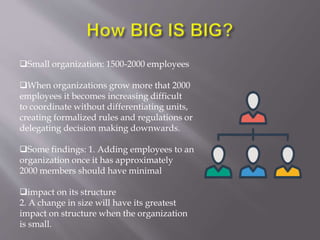
Small organization: 1500-2000 employees
When organizations grow more that 2000
employees it becomes increasing difficult
to coordinate without differentiating units,
creating formalized rules and regulations or
delegating decision making downwards.
Some findings: 1. Adding employees to an
organization once it has approximately
2000 members should have minimal
impact on its structure
2. A change in size will have its greatest
impact on structure when the organization
is small.
Issues of reduced importance:
The range of variation in small businesses is limited so
all the structural variables are of less importance.
They have minimal degree of horizontal ,vertical , and
spatial differentiation.
When specialized expertise is needed, It is purchased
from outside.
Example. Accountant or a lawyer.
Issues of reduced importance:
 Some issues of greater importance for small businesses include
control and accountability, efficiency and environmental
dependence.
 Control: Small business managers are strong advocates of
"management by walking around‘
 So they are often willing to settle for lesser monetary reward in
return for personal control and accountability.
 Resources: Efficiency is more important in small businesses due
to slack resources
 Small businesses are different from their
larger counterparts.
 They have different concerns and
priorities.
 Also they have limited set of structural
options.
ORGANIZATION SIZE

ORGANIZATION SIZE

  • 1.
    PRESENTED TO: POONAMSHRIVASTAVA MA’AM PRESENTED BY: AKASH KUMAR ANSHUL TALREJA ISHAN PETER VICENT MANAS GUPTA MOHIT SINGH PARIHAR
  • 2.
     Total numberof employees -But there are some questions on its viability like: Full time or part time employee to be considered? What if business is seasonal? Optimum number e.g. 500 is large no. for a salon while same 500 is very small no. for steel manufacturing company.
  • 3.
    Size is theorganization’s magnitude as reflected in the number of people in the organization. Organization size has often been described as an important variable that influences structural design. Organization size (as defined by the number of employees) has received substantial attention from researchers and management.
  • 4.
    To be successful,organizations must be designed and structured in a way that enables them to achieve their goals. Learn about organizational size and how it impacts the structure and design of an organization, including work specialization, departmentalization, and formalization. How Size Affects Structure When an architect plans a new building, the size of the building being planned will have a considerable impact on how the building is designed and the type of foundation that is used to support the building. A small building typically requires a simple design with a shallow foundation, and a larger building requires a more complex design and a deeper foundation.
  • 5.
    One factor oforganizational structure that is impacted by the size of an organization is work specialization, which determines how tasks are subdivided into separate jobs. The more a job is broken down into small tasks, the more specialization is required by each individual worker. Small organizations have fewer people to divide tasks among, so the jobs in small organizations have a lower degree of work specialization than the jobs in large organizations.
  • 6.
    Another aspect oforganizational structure that is affected by the size of an organization is departmentalization, which establishes how jobs are grouped together. Large organizations use a high degree of departmentalization when defining jobs since they need to provide their large workforce with clearly defined tasks in order to keep the organization running efficiently. Small organizations require less departmentalization since there are a small number of people available to achieve the organization's goals, and departmental functions often overlap.
  • 7.
    A third aspectof organizational structure that is affected by the size of an organization is formalization, which determines to what degree the jobs in the organization are standardized and to what extent members of the organization are governed by rules and regulations. Since large organizations have taller structures, they have a longer and more structured chain of command, which results in highly structured jobs that are governed by many rules and regulations. Small organizations are less formal and typically have fewer rules and regulations, since they are less bureaucratic and simply do not have the manpower to enforce a long list of rules and regulations for each and every job.
  • 8.
    It is obviousthat it is not possible to control large organization from top. Thus we can say conclude that size leads to decentralization. But the counter argument to this is relationship between size and centralization is almost zero this may happen because in owner based firm owner are not ready to loose their control.
  • 9.
    Small organization: 1500-2000employees When organizations grow more that 2000 employees it becomes increasing difficult to coordinate without differentiating units, creating formalized rules and regulations or delegating decision making downwards. Some findings: 1. Adding employees to an organization once it has approximately 2000 members should have minimal impact on its structure 2. A change in size will have its greatest impact on structure when the organization is small.
  • 10.
    Issues of reducedimportance: The range of variation in small businesses is limited so all the structural variables are of less importance. They have minimal degree of horizontal ,vertical , and spatial differentiation. When specialized expertise is needed, It is purchased from outside. Example. Accountant or a lawyer.
  • 11.
    Issues of reducedimportance:  Some issues of greater importance for small businesses include control and accountability, efficiency and environmental dependence.  Control: Small business managers are strong advocates of "management by walking around‘  So they are often willing to settle for lesser monetary reward in return for personal control and accountability.  Resources: Efficiency is more important in small businesses due to slack resources
  • 12.
     Small businessesare different from their larger counterparts.  They have different concerns and priorities.  Also they have limited set of structural options.