ORGANISATIONAL
STRUCTURE
SIGNIFICANCE AND DETERMINANTS
k
Organisational Structure defines the
relationship of individuals, authority and
responsibility relationships between the
various positions in the organisation, and how
tasks are allocated.
ORGANISATIONAL STRUCTURE
k
HINDUSTAN UNILEVER LIMITED
 Organisational Structure of Hindustan Unilever Ltd.
CHIEF EXECUTIVE
MANAGEMENT COMMITTEE
CFO ED SUPPLY CHAIN ED S & CC ED HR ED FOODS ED H & PC
CFO : chief financial officer
S & CC : sales and customer care
ED : executive director
HR : human resource
H & PC : home and personal care
Source: MANAGEMENT- theory and practice by C B Gupta
N
 Ensures achievement of goals.
 Permits division of work.
 Facilitates co-operation.
 Line of communication is fixed.
 Rules and regulations are created.
 Authority and responsibility to each position is
clearly defined.
FEATURES OF ORGNAISATIONAL STRUCTURE
 To determine standard operating procedures.
 To define employees participating areas.
 To state the authority and responsibility of each positions.
 To fix the line of communication.
 To create rules and regulations.
 To ensure the achievement of goals.
NEED FOR AN ORGANISATIONAL STRUCTURE
SIGNIFICANCE OF
ORGANISATIONAL STRUCTURE
“Every company has two
Organisational Structures: The
formal one is written on the charts;
The other is the everyday
relationship of the men and women
in the organization.”
HAROLD S GENEEN
American businessman
 FACILITATION OF ADMINISTRATION:
A properly designed Organisational
Structure facilitates proper division of
labour, delegation of authority and
authority relationships.
IMPORTANCE OF AN ORGANISATIONAL STRUCTURE
1
 FACILITATES GROWTH AND DIVERSIFICATION:
Through Organisational Structure the
management can understand the need for
change to facilitate growth and may suitably
adjust the organisational activities.
IMPORTANCE OF AN ORGANISATIONAL STRUCTURE
2
 PERMITS OPTIMUM USE OF TECHNOLOGICAL
IMPROVENMENTS:
A sound Organisational Structure is flexible
enough to adapt to the latest
technologies. This helps in the
optimum usage of technological
improvements and human
resources.
3
IMPORTANCE OF ORGANISATIONAL STRUCTURE
 ENCOURAGES THE USE OF HUMAN
CAPITAL:
Organisational Structure facilitates the
intense use of human capital by providing a
psychological satisfaction to the employees
which motivates them for better
contribution.
4
IMPORTANCE OF ORGANISATIONAL STRUCTURE
 STIMULATES CREATIVITY:
A sound Organisational Structure provides
well defined areas of work with provision
for development and improved ways of
doing things. This enhances the individual
enabling them to take advantage of their
accumulated knowledge.
IMPORTANCE OF ORGANISATIONAL STRUCTURE
5
 BETTER COMMUNICATION:
As an Organisational Structure defines
the line of communication clearly, it
facilitates the disciplined flow of
information from one person to
another.
IMPORTANCE OF ORGANISATIONAL STRUCTURE
6
 FOCUS ON SELECTED AREAS OF BUSINESS:
Organisational Structure helps in identifying
the key result areas of the business so that,
greater emphasis can be provided on certain
managerial functions.
IMPORTANCE OF ORGANISATIONAL STRUCTURE
7
DETERMINANTS OF
ORGANISATIONAL STRUCTURE
GOALS
STRATEGY
SIZE
PEOPLE
TECHNOLOGY
 GOALS:
An organisation is a goal oriented
system. Organisational Structure
should be designed in such a manner
that it facilitates the achievements
of organisational goals.
DETERMINANTS OF ORGANISATIONAL STRUCTURE
1
2
 STRATEGY:
Strategy is a contingent plan designed to
achieve the objectives. Strategy
determines the organisational tasks,
choice of technology, and the specific
environment within which the
organisation will operate.
2
DETERMINANTS OF ORGANISATIONAL STRUCTURE
ALFRED CHANDLER; STRATEGY AND STRUCTURE
ALFRED CHANDLER
American historian
SEARS ROEBUCK GENERAL MOTORS
Du PONT STANDARD OIL
Changes in corporate strategy leads
to changes in Organisational
Structure.
3
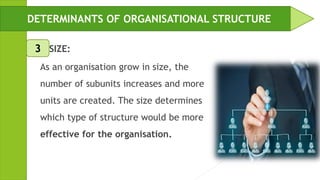
 SIZE:
As an organisation grow in size, the
number of subunits increases and more
units are created. The size determines
which type of structure would be more
effective for the organisation.
3
DETERMINANTS OF ORGANISATIONAL STRUCTURE
 PEOPLE:
People at different jobs posses the
required skill, knowledge and efficiency
to accomplish the given task. Organisational
Structure should be designed considering
the type of people employed in the
organisation.
DETERMINANTS OF ORGANISATIONAL STRUCTURE
4
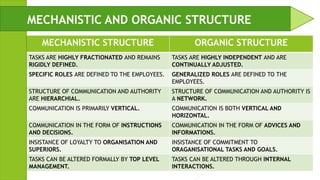
MECHANISTIC STRUCTURE ORGANIC STRUCTURE
TASKS ARE HIGHLY FRACTIONATED AND REMAINS
RIGIDLY DEFINED.
TASKS ARE HIGHLY INDEPENDENT AND ARE
CONTINUALLY ADJUSTED.
SPECIFIC ROLES ARE DEFINED TO THE EMPLOYEES. GENERALIZED ROLES ARE DEFINED TO THE
EMPLOYEES.
STRUCTURE OF COMMUNICATION AND AUTHORITY
ARE HIERARCHIAL.
STRUCTURE OF COMMUNICATION AND AUTHORITY IS
A NETWORK.
COMMUNICATION IS PRIMARILY VERTICAL. COMMUNICATION IS BOTH VERTICAL AND
HORIZONTAL.
COMMUNICATION IN THE FORM OF INSTRUCTIONS
AND DECISIONS.
COMMUNICATION IN THE FORM OF ADVICES AND
INFORMATIONS.
INSISTANCE OF LOYALTY TO ORGANISATION AND
SUPERIORS.
INSISTANCE OF COMMITMENT TO
ORAGANISATIONAL TASKS AND GOALS.
TASKS CAN BE ALTERED FORMALLY BY TOP LEVEL
MANAGEMENT.
TASKS CAN BE ALTERED THROUGH INTERNAL
INTERACTIONS.
MECHANISTIC AND ORGANIC STRUCTURE
 TECHNOLOGY:
The design of Organisational Structure
would depend upon whether the
technology is simple or complex.
Mechanistic Structure is beneficial in case
of firms who adopt simple technology and
in case of complex technology Organic
Structure is adopted.
5
DETERMINANTS OF ORGANISATIONAL STRUCTURE
THANK YOU

ORGANISATIONAL STRUCTURE ppt.pptx

  • 1.
  • 2.
    k Organisational Structure definesthe relationship of individuals, authority and responsibility relationships between the various positions in the organisation, and how tasks are allocated. ORGANISATIONAL STRUCTURE
  • 3.
    k HINDUSTAN UNILEVER LIMITED Organisational Structure of Hindustan Unilever Ltd. CHIEF EXECUTIVE MANAGEMENT COMMITTEE CFO ED SUPPLY CHAIN ED S & CC ED HR ED FOODS ED H & PC CFO : chief financial officer S & CC : sales and customer care ED : executive director HR : human resource H & PC : home and personal care Source: MANAGEMENT- theory and practice by C B Gupta
  • 4.
    N  Ensures achievementof goals.  Permits division of work.  Facilitates co-operation.  Line of communication is fixed.  Rules and regulations are created.  Authority and responsibility to each position is clearly defined. FEATURES OF ORGNAISATIONAL STRUCTURE
  • 5.
     To determinestandard operating procedures.  To define employees participating areas.  To state the authority and responsibility of each positions.  To fix the line of communication.  To create rules and regulations.  To ensure the achievement of goals. NEED FOR AN ORGANISATIONAL STRUCTURE
  • 6.
    SIGNIFICANCE OF ORGANISATIONAL STRUCTURE “Everycompany has two Organisational Structures: The formal one is written on the charts; The other is the everyday relationship of the men and women in the organization.” HAROLD S GENEEN American businessman
  • 7.
     FACILITATION OFADMINISTRATION: A properly designed Organisational Structure facilitates proper division of labour, delegation of authority and authority relationships. IMPORTANCE OF AN ORGANISATIONAL STRUCTURE 1
  • 8.
     FACILITATES GROWTHAND DIVERSIFICATION: Through Organisational Structure the management can understand the need for change to facilitate growth and may suitably adjust the organisational activities. IMPORTANCE OF AN ORGANISATIONAL STRUCTURE 2
  • 9.
     PERMITS OPTIMUMUSE OF TECHNOLOGICAL IMPROVENMENTS: A sound Organisational Structure is flexible enough to adapt to the latest technologies. This helps in the optimum usage of technological improvements and human resources. 3 IMPORTANCE OF ORGANISATIONAL STRUCTURE
  • 10.
     ENCOURAGES THEUSE OF HUMAN CAPITAL: Organisational Structure facilitates the intense use of human capital by providing a psychological satisfaction to the employees which motivates them for better contribution. 4 IMPORTANCE OF ORGANISATIONAL STRUCTURE
  • 11.
     STIMULATES CREATIVITY: Asound Organisational Structure provides well defined areas of work with provision for development and improved ways of doing things. This enhances the individual enabling them to take advantage of their accumulated knowledge. IMPORTANCE OF ORGANISATIONAL STRUCTURE 5
  • 12.
     BETTER COMMUNICATION: Asan Organisational Structure defines the line of communication clearly, it facilitates the disciplined flow of information from one person to another. IMPORTANCE OF ORGANISATIONAL STRUCTURE 6
  • 13.
     FOCUS ONSELECTED AREAS OF BUSINESS: Organisational Structure helps in identifying the key result areas of the business so that, greater emphasis can be provided on certain managerial functions. IMPORTANCE OF ORGANISATIONAL STRUCTURE 7
  • 14.
  • 15.
     GOALS: An organisationis a goal oriented system. Organisational Structure should be designed in such a manner that it facilitates the achievements of organisational goals. DETERMINANTS OF ORGANISATIONAL STRUCTURE 1
  • 16.
    2  STRATEGY: Strategy isa contingent plan designed to achieve the objectives. Strategy determines the organisational tasks, choice of technology, and the specific environment within which the organisation will operate. 2 DETERMINANTS OF ORGANISATIONAL STRUCTURE
  • 17.
    ALFRED CHANDLER; STRATEGYAND STRUCTURE ALFRED CHANDLER American historian SEARS ROEBUCK GENERAL MOTORS Du PONT STANDARD OIL Changes in corporate strategy leads to changes in Organisational Structure.
  • 18.
    3  SIZE: As anorganisation grow in size, the number of subunits increases and more units are created. The size determines which type of structure would be more effective for the organisation. 3 DETERMINANTS OF ORGANISATIONAL STRUCTURE
  • 19.
     PEOPLE: People atdifferent jobs posses the required skill, knowledge and efficiency to accomplish the given task. Organisational Structure should be designed considering the type of people employed in the organisation. DETERMINANTS OF ORGANISATIONAL STRUCTURE 4
  • 20.
    MECHANISTIC STRUCTURE ORGANICSTRUCTURE TASKS ARE HIGHLY FRACTIONATED AND REMAINS RIGIDLY DEFINED. TASKS ARE HIGHLY INDEPENDENT AND ARE CONTINUALLY ADJUSTED. SPECIFIC ROLES ARE DEFINED TO THE EMPLOYEES. GENERALIZED ROLES ARE DEFINED TO THE EMPLOYEES. STRUCTURE OF COMMUNICATION AND AUTHORITY ARE HIERARCHIAL. STRUCTURE OF COMMUNICATION AND AUTHORITY IS A NETWORK. COMMUNICATION IS PRIMARILY VERTICAL. COMMUNICATION IS BOTH VERTICAL AND HORIZONTAL. COMMUNICATION IN THE FORM OF INSTRUCTIONS AND DECISIONS. COMMUNICATION IN THE FORM OF ADVICES AND INFORMATIONS. INSISTANCE OF LOYALTY TO ORGANISATION AND SUPERIORS. INSISTANCE OF COMMITMENT TO ORAGANISATIONAL TASKS AND GOALS. TASKS CAN BE ALTERED FORMALLY BY TOP LEVEL MANAGEMENT. TASKS CAN BE ALTERED THROUGH INTERNAL INTERACTIONS. MECHANISTIC AND ORGANIC STRUCTURE
  • 21.
     TECHNOLOGY: The designof Organisational Structure would depend upon whether the technology is simple or complex. Mechanistic Structure is beneficial in case of firms who adopt simple technology and in case of complex technology Organic Structure is adopted. 5 DETERMINANTS OF ORGANISATIONAL STRUCTURE
  • 22.