PRSENTED BY,
S. TAHZEEB FATHIMA
1 – M. COM
Under the Guidance of
Sundar B.N.
Asst. prof .course co-ordinator of
Post graduation studies in commerce
G.F.G.C.W. Holenarasipura
Contents
Introduction
Meaning
Features
NPO’s in India
INTRODUCTION
The sole purpose of any business organization is to earn profit. In other
words, they work for self-interest. However, there are some
organizations whose basic aim is to serve the society i.e. they work
for the benefit of the society as a whole. These are called not-for-profit
organizations or nonprofit organizations.
They are formed for some idealistic purpose and provide
service to its members and the public in general. Their aim may be
educational, religious, charitable or social welfare of the people at
large.
Meaning of non-profit organization ?
A non-profit organisation (NPO), refers to those
organisations which are formed to render social service and not for
making profits such as promotion of education, health , arts &
culture, religion etc.
Examples: Hospitals, Schools and Colleges, Clubs, Libraries,
Charitable institutions.
These organisations are granted tax-exempt status and all
contributions made to them are tax deductible, as long as they are
properly registered.
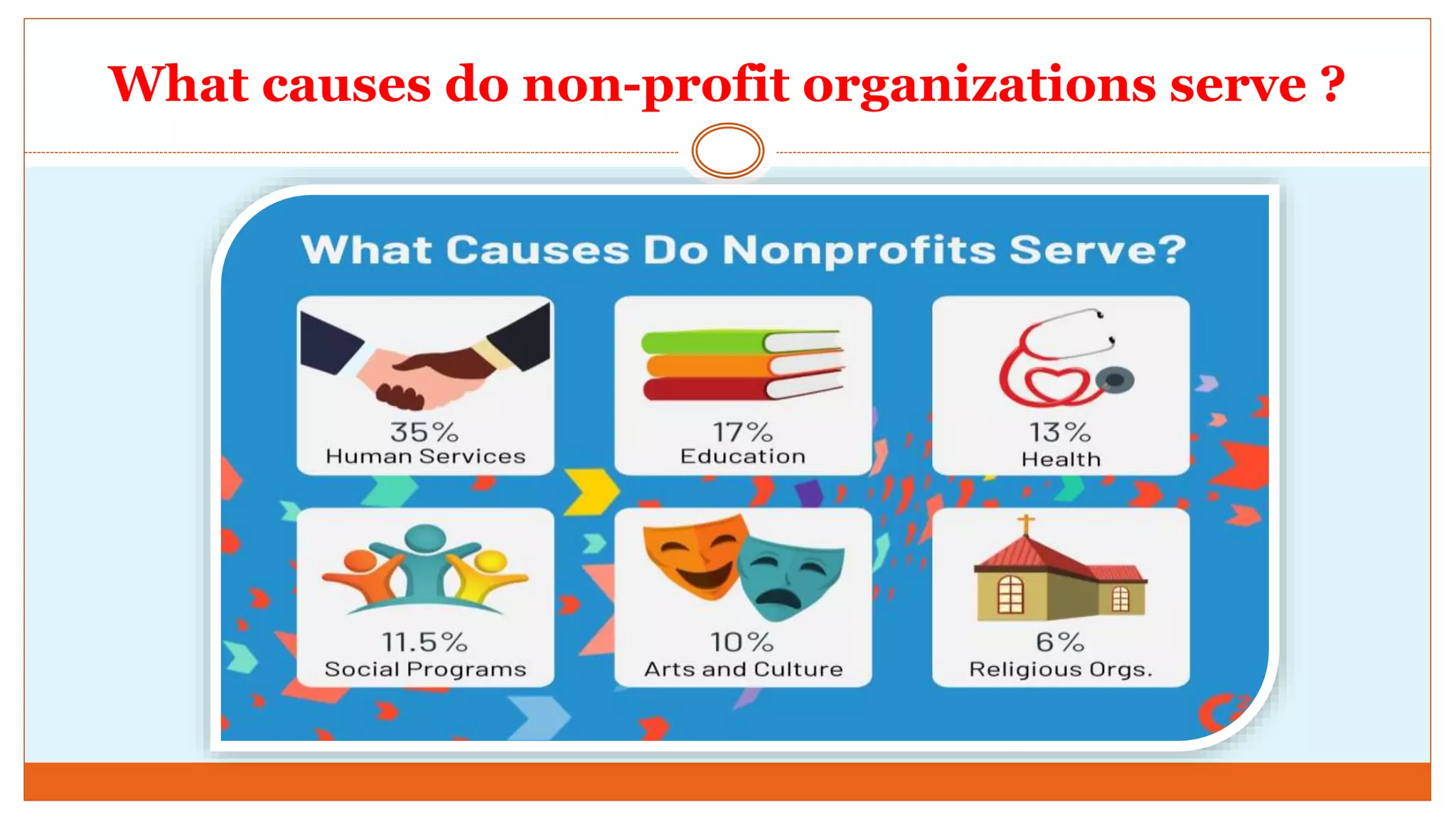
What causes do non-profit organizations serve ?
Features
1 .Main aim is service :
The basic aim of non-profit organizations is to serve the society.
They are working for the benefit of the society as a whole.
2. Profit is not the Criterion:
Non-profit organizations are formed for some idealistic purposes
such as religious, charitable or providing education etc.
Earning of profits can never be their aim.
Features
3. Surplus not Distributed among its Members:
Though earning profit is not the criterion for non-profit
organizations, yet there may be excess of income over expenditure or
excess of expenditure over income. The former is known as ‘surplus’
and latter is known as ‘deficit’. Unlike other business, surplus or
deficit of non-profit organizations is not distributed among its
members. They are adjusted in the capital fund of such organizations.
Features
4. Separate Entity:
The separate entity concept is equally applicable to non-
profit organizations. Such organizations are treated as a
separate entity distinct from its members
5. Unique Names Connoting their Working:
The names of non-profit organizations denote the nature
and style of their functioning. For example, JMD
Educational Society, Shri Sai Keertan Mandli, Shri
Sunder Dev Sports Club and Shri Sanatan Dharam
Ramlila Committee etc.
Features
6. Management by Elected Persons:
These organizations are run and managed by elected members.
7. Major Funds from Contributions and Donations
etc..
Usually, non-profit organizations are not self sufficient to run their
activities with the revenue generated from their own sources, so
they depend upon the subscriptions, donations and grants received
from various government departments.
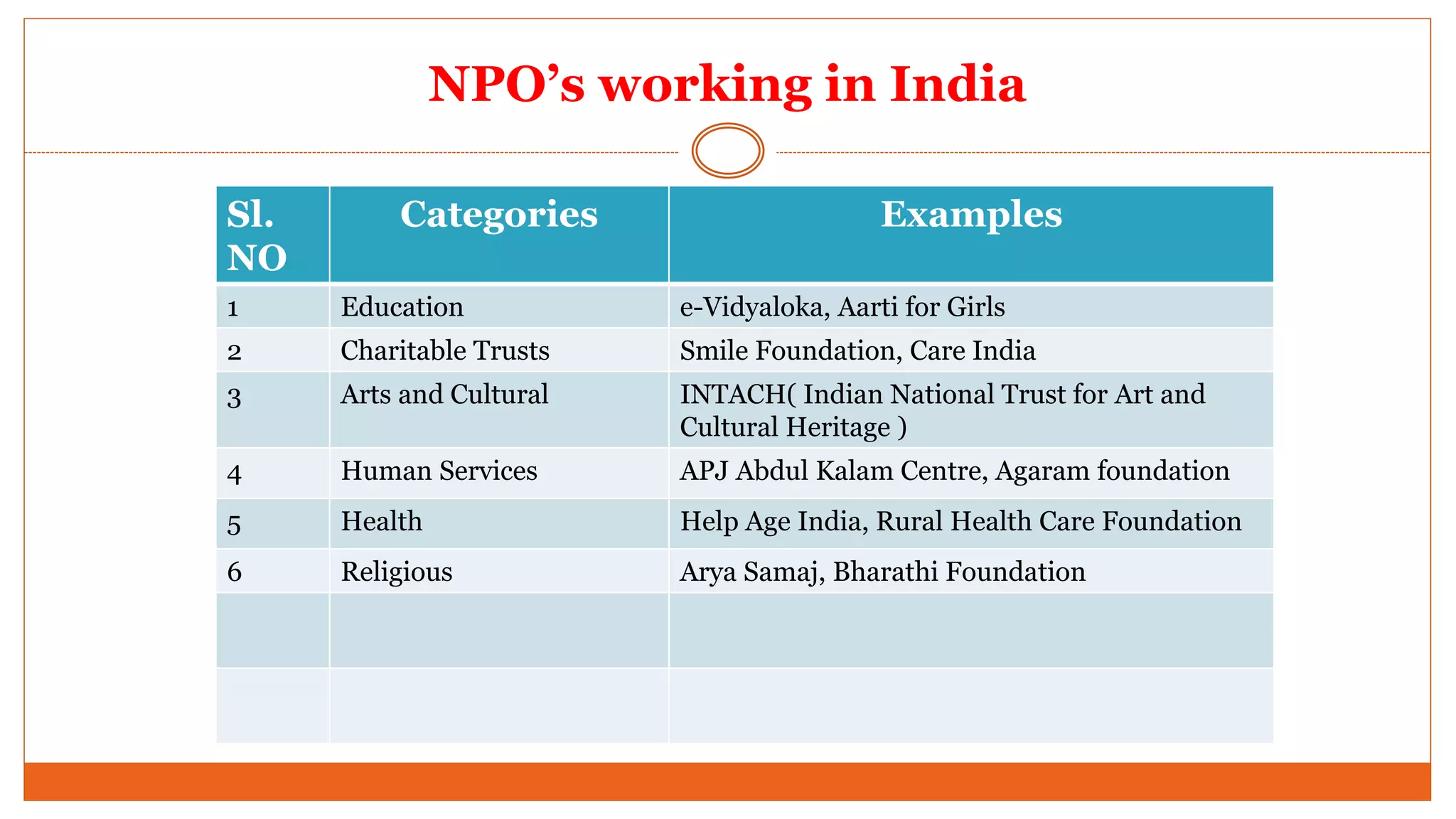
Sl.
NO
Categories Examples
1 Education e-Vidyaloka, Aarti for Girls
2 Charitable Trusts Smile Foundation, Care India
3 Arts and Cultural INTACH( Indian National Trust for Art and
Cultural Heritage )
4 Human Services APJ Abdul Kalam Centre, Agaram foundation
5 Health Help Age India, Rural Health Care Foundation
6 Religious Arya Samaj, Bharathi Foundation
NPO’s working in India
Reference
TOPIC : Non-profit organisations
Retreived from:
https://www.accountingnotes.net/organizations/not-for-profit-
organizations-meaning-objectives-and-features/4332
Time for quiz
1. Non - profit organizations work for the benefit of ____
a.Companies
b.Government
c.Financial institutions
d.Society
Ans: society
2. Non - profit organizations are ______
a. Taxable
b. Non taxable
c. Tax exempted
d. None of the above
Ans: Tax exempted
3. Which of the following is one of the example of non - profit organization?
a. Corporations
b. Audit firms
c.Insurance companies
d.Public hospitals
Ans: public hospitals
4.The main sources of their income are ______
a. Subscriptions
b. Donations
c. Government grants
d.All of the above
Ans: All of the above
5. Surplus or profits of Non- profit organizations are _____
a. Distributed among members
b. Maybe or may not be distributed among members
c. It is debited to the general fun
d. Not distributed among the members
Ans: Not distributed among the members
Non - Profit organization

Non - Profit organization

  • 1.
    PRSENTED BY, S. TAHZEEBFATHIMA 1 – M. COM Under the Guidance of Sundar B.N. Asst. prof .course co-ordinator of Post graduation studies in commerce G.F.G.C.W. Holenarasipura
  • 2.
  • 3.
    INTRODUCTION The sole purposeof any business organization is to earn profit. In other words, they work for self-interest. However, there are some organizations whose basic aim is to serve the society i.e. they work for the benefit of the society as a whole. These are called not-for-profit organizations or nonprofit organizations. They are formed for some idealistic purpose and provide service to its members and the public in general. Their aim may be educational, religious, charitable or social welfare of the people at large.
  • 4.
    Meaning of non-profitorganization ? A non-profit organisation (NPO), refers to those organisations which are formed to render social service and not for making profits such as promotion of education, health , arts & culture, religion etc. Examples: Hospitals, Schools and Colleges, Clubs, Libraries, Charitable institutions. These organisations are granted tax-exempt status and all contributions made to them are tax deductible, as long as they are properly registered.
  • 5.
    What causes donon-profit organizations serve ?
  • 6.
    Features 1 .Main aimis service : The basic aim of non-profit organizations is to serve the society. They are working for the benefit of the society as a whole. 2. Profit is not the Criterion: Non-profit organizations are formed for some idealistic purposes such as religious, charitable or providing education etc. Earning of profits can never be their aim.
  • 7.
    Features 3. Surplus notDistributed among its Members: Though earning profit is not the criterion for non-profit organizations, yet there may be excess of income over expenditure or excess of expenditure over income. The former is known as ‘surplus’ and latter is known as ‘deficit’. Unlike other business, surplus or deficit of non-profit organizations is not distributed among its members. They are adjusted in the capital fund of such organizations.
  • 8.
    Features 4. Separate Entity: Theseparate entity concept is equally applicable to non- profit organizations. Such organizations are treated as a separate entity distinct from its members 5. Unique Names Connoting their Working: The names of non-profit organizations denote the nature and style of their functioning. For example, JMD Educational Society, Shri Sai Keertan Mandli, Shri Sunder Dev Sports Club and Shri Sanatan Dharam Ramlila Committee etc.
  • 9.
    Features 6. Management byElected Persons: These organizations are run and managed by elected members. 7. Major Funds from Contributions and Donations etc.. Usually, non-profit organizations are not self sufficient to run their activities with the revenue generated from their own sources, so they depend upon the subscriptions, donations and grants received from various government departments.
  • 10.
    Sl. NO Categories Examples 1 Educatione-Vidyaloka, Aarti for Girls 2 Charitable Trusts Smile Foundation, Care India 3 Arts and Cultural INTACH( Indian National Trust for Art and Cultural Heritage ) 4 Human Services APJ Abdul Kalam Centre, Agaram foundation 5 Health Help Age India, Rural Health Care Foundation 6 Religious Arya Samaj, Bharathi Foundation NPO’s working in India
  • 11.
    Reference TOPIC : Non-profitorganisations Retreived from: https://www.accountingnotes.net/organizations/not-for-profit- organizations-meaning-objectives-and-features/4332
  • 12.
    Time for quiz 1.Non - profit organizations work for the benefit of ____ a.Companies b.Government c.Financial institutions d.Society Ans: society 2. Non - profit organizations are ______ a. Taxable b. Non taxable c. Tax exempted d. None of the above Ans: Tax exempted
  • 13.
    3. Which ofthe following is one of the example of non - profit organization? a. Corporations b. Audit firms c.Insurance companies d.Public hospitals Ans: public hospitals 4.The main sources of their income are ______ a. Subscriptions b. Donations c. Government grants d.All of the above Ans: All of the above
  • 14.
    5. Surplus orprofits of Non- profit organizations are _____ a. Distributed among members b. Maybe or may not be distributed among members c. It is debited to the general fun d. Not distributed among the members Ans: Not distributed among the members