(SOL 502)
SOIL FERTILITY
AND
FERTILIZER USE
Fertilizer/ Fertiliser
• Any substance which may be of either natural or synthetic origin (other
than liming materials) that is applied to soil or plant tissues (usually leaves)
to supply one or more plant nutrients essential for growth of plants is called
fertilizer.
• In other words, fertilizer may be defined as the materials having definite
chemical composition with a higher analytical value and capable of
supplying plant nutrients in available forms.
Manures
• the materials which are organic in origin, bulky and concentrated in nature
and capable of supplying plant nutrients and improving soil physical
environment having no definite chemical composition with low analytical
value produced from animal, plant and other organic wastes and by
products.
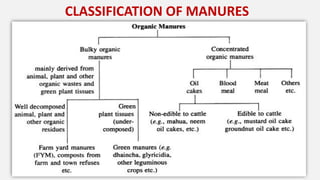
CLASSIFICATION OF MANURES
(A) BULKY ORGANIC MANURES
• contain small percentage of nutrients and they are applied in huge
quantities.
• Farmyard manure (FYM), compost, vermicompost and green
manures are the most important and widely used bulky organic
manures
• they supply plant nutrients including micronutrients,
• they improve soil physical properties like structure, water
holding capacity etc.,
• they increase the availability of nutrients,
• carbon dioxide released during decomposition acts as a CO2
fertilizer
• plant parasitic nematodes and fungi are controlled to some
extent by altering the balance of microorganisms in the soil.
ADVANTAGES OF BULKY ORGANIC MANURES
(a) Farmyard Manure (FYM)
• Decomposed mixture of dung and urine of farm animals along with
litter and left-over material from roughages or fodder fed to the cattle.
• On an average well-decomposed farmyard manure contains 0.5 % N,
0.2 % P2O5 an 0.5 % K2O.
• The present method of preparing farmyard manure by the farmers is
defective. Even during storage, nutrients are lost due to leaching and
volatilization.
• However, it is practically impossible to avoid losses altogether, but can
be reduced by following improved method of preparation of farmyard
manure.
(b) Compost
• A mass of rotted organic matter made from waste is called compost.
• The compost made from farm waste like sugarcane trash, paddy straw,
weeds and other plants and other waste is called farm compost.
• The average nutrient content of farm compost is 0.5 % N, 0.15 % P2O5 and
0.5 % K2O.
• The nutrient value of farm compost can be increased by application of
superphosphate or rock phosphate at 10 to 15 kg/t of raw material at the
initial stage of filling the compost pit.
• The compost made from town refuses like night soil, street sweepings and
dustbin refuse is called town compost.
• In general, it contains 1.4 % N, 1.0 % P2O5 and 1.4 % K2O.
(c) Vermicompost
• word ‘vermi’ is coined from Latin word which means worm
• so vermicompost is the compost mediated by the worm (earthworm).
• Earthworms convert farm waste and organic residues into high quality
compost.
• About half of the gums secreted by earthworm are in form of mucoproteins
that help stabilizing pore space distribution.
• The earthworm soil casts are richer in available plant nutrients (nitrate
nitrogen, exchangeable Ca, Mg, K and P) and organic matter.
• The earthworms through their casts and dead tissues supply about 60-90 kg
N to the soil.
• Eisenia foetida, Perionyx exacavatus, Eudrillus euginiae and Lumbrius
rubellusare are important species of earthworm for vermicomposting.
• These species can be cultured on organic wastes and dung.
• The technique of culturing them is called vermiculture and using these
for decomposing residue to make compost is called vermicomposting.
• About 1000 adult earthworms can convert 5 kg waste into compost per
day.
• The earthworm assimilates 5-10 % of the substrate and rest passes
through the alimentary canal and is excreted as cast.
• Earthworm cast contains nutrients, vitamins, hormones and antibiotics.
NUTRIENT CONTENT IN BASIC MANURES
NUTRIENT CONTENT OF VERMICOMPOST
(d) Green manures
• Green un-decomposed plant material used as manure is called green
manure.
• It is obtained in two ways: by growing green manure crops or by collecting
green leaf (along with twigs) from plants grown in wastelands, field bunds
and forest.
• Green manuring is the growing of plants usually belonging to leguminous
family and incorporating into the soil after sufficient growth, in the field.
• Collection of green leaves and twigs of trees, shrubs and herbs collected
from elsewhere and application to the main field is known as green-leaf
manuring.
• Forest tree leaves are the main sources for green-leaf manure.
Green manure crops may be of two types
1. Leguminous
eg. Mung bean, sunhemp, dhaincha, lathyrus, etc.
2. Non-leguminous
eg. Sorghum, maize, pearl millet, etc.
• Nitrogen fixation by leguminous green manure crops can be
increased by application of phosphatic fertilizers.
• This phosphorus is available to succeeding crop after
mineralization of the incorporated green manure crop.
Advantages of addition of green manures
• Organic matter and nitrogen are added to the soil.
• Growing deep rooted green-manure crops and their incorporation facilitates in
bringing nutrients to the top layer from deeper layers.
• Green manuring improves soil structure, increases water-holding capacity and
decreases soil loss by erosion.
• Nutrient availability increases due to production of carbon dioxide and organic
acids during decomposition.
• Growing of green-manure crops in the off season reduces weed proliferation
and weed growth.
• Green manuring helps in reclamation of alkaline soils.
• Root-knot nematodes can be controlled by green manuring.
Average nutrient content of green manures
and green leaf manures
Other types of bulky organic manures
(e) Sewage and Sludge
(f) Night soil
(g) Sheep and Goat Manure
(h) Poultry Manure
(B) CONCENTRATED ORGANIC MANURES
• have higher nutrient content than bulky organic manure.
• The important concentrated organic manures are oil cakes (edible
and non-edible), blood-meal, fish manure etc.
• These are also known as organic nitrogen fertilizer.
• Before their organic nitrogen is used by the crops, it is converted
through bacterial action into readily usable ammoniacal nitrogen
and nitrate nitrogen.
• Therefore, these organic fertilizers are, relatively slow acting, but
they supply available nitrogen for a longer period.
(a) Oil cakes:
• After oil is extracted from oilseeds, the remaining solid portion is dried as
cake which can be used as manure. The oil-cakes are of two types: edible and
non-edible
1. Edible oil-cakes:
• which can be safely fed to livestock
• e.g. groundnut cake, mustard cake, safflower cake (decorticated i.e. removal
of outer layer), cotton seed cake (decorticated), linseed cake etc.
2. Non-edible oil-cakes:
• which are not fit for feeding livestock
• e.g. castor cake, neem cake, safflower cake (un-decorticated i.e. not
removal of outer layer), cotton seed cake (un-decorticated), mahua cake
etc.,
• Both edible and non-edible oilcakes can be used as manures.
• However, edible oil cakes are fed to cattle and non-edible oil
cakes are used as manures especially for horticultural crops.
• Nutrients present in oil-cakes, after mineralization, are made
available to crops 7 to 10 days after application.
• Oilcakes need to be well powdered before application for even
distribution and quicker decomposition.
Average nutrient content of oil-cakes
(b) Blood meal, meat meal and other meals
• Blood-meal when dried and powdered can be used as manure.
• The meat of dead animals is dried and converted into meat-meal
which is a good source of nitrogen.
Average nutrient content of
animal based concentrated organic manure

Manures definition importance types examples

  • 1.
  • 2.
    Fertilizer/ Fertiliser • Anysubstance which may be of either natural or synthetic origin (other than liming materials) that is applied to soil or plant tissues (usually leaves) to supply one or more plant nutrients essential for growth of plants is called fertilizer. • In other words, fertilizer may be defined as the materials having definite chemical composition with a higher analytical value and capable of supplying plant nutrients in available forms. Manures • the materials which are organic in origin, bulky and concentrated in nature and capable of supplying plant nutrients and improving soil physical environment having no definite chemical composition with low analytical value produced from animal, plant and other organic wastes and by products.
  • 3.
  • 4.
    (A) BULKY ORGANICMANURES • contain small percentage of nutrients and they are applied in huge quantities. • Farmyard manure (FYM), compost, vermicompost and green manures are the most important and widely used bulky organic manures
  • 5.
    • they supplyplant nutrients including micronutrients, • they improve soil physical properties like structure, water holding capacity etc., • they increase the availability of nutrients, • carbon dioxide released during decomposition acts as a CO2 fertilizer • plant parasitic nematodes and fungi are controlled to some extent by altering the balance of microorganisms in the soil. ADVANTAGES OF BULKY ORGANIC MANURES
  • 6.
    (a) Farmyard Manure(FYM) • Decomposed mixture of dung and urine of farm animals along with litter and left-over material from roughages or fodder fed to the cattle. • On an average well-decomposed farmyard manure contains 0.5 % N, 0.2 % P2O5 an 0.5 % K2O. • The present method of preparing farmyard manure by the farmers is defective. Even during storage, nutrients are lost due to leaching and volatilization. • However, it is practically impossible to avoid losses altogether, but can be reduced by following improved method of preparation of farmyard manure.
  • 7.
    (b) Compost • Amass of rotted organic matter made from waste is called compost. • The compost made from farm waste like sugarcane trash, paddy straw, weeds and other plants and other waste is called farm compost. • The average nutrient content of farm compost is 0.5 % N, 0.15 % P2O5 and 0.5 % K2O. • The nutrient value of farm compost can be increased by application of superphosphate or rock phosphate at 10 to 15 kg/t of raw material at the initial stage of filling the compost pit. • The compost made from town refuses like night soil, street sweepings and dustbin refuse is called town compost. • In general, it contains 1.4 % N, 1.0 % P2O5 and 1.4 % K2O.
  • 8.
    (c) Vermicompost • word‘vermi’ is coined from Latin word which means worm • so vermicompost is the compost mediated by the worm (earthworm). • Earthworms convert farm waste and organic residues into high quality compost. • About half of the gums secreted by earthworm are in form of mucoproteins that help stabilizing pore space distribution. • The earthworm soil casts are richer in available plant nutrients (nitrate nitrogen, exchangeable Ca, Mg, K and P) and organic matter. • The earthworms through their casts and dead tissues supply about 60-90 kg N to the soil.
  • 9.
    • Eisenia foetida,Perionyx exacavatus, Eudrillus euginiae and Lumbrius rubellusare are important species of earthworm for vermicomposting. • These species can be cultured on organic wastes and dung. • The technique of culturing them is called vermiculture and using these for decomposing residue to make compost is called vermicomposting. • About 1000 adult earthworms can convert 5 kg waste into compost per day. • The earthworm assimilates 5-10 % of the substrate and rest passes through the alimentary canal and is excreted as cast. • Earthworm cast contains nutrients, vitamins, hormones and antibiotics.
  • 10.
    NUTRIENT CONTENT INBASIC MANURES
  • 11.
    NUTRIENT CONTENT OFVERMICOMPOST
  • 12.
    (d) Green manures •Green un-decomposed plant material used as manure is called green manure. • It is obtained in two ways: by growing green manure crops or by collecting green leaf (along with twigs) from plants grown in wastelands, field bunds and forest. • Green manuring is the growing of plants usually belonging to leguminous family and incorporating into the soil after sufficient growth, in the field. • Collection of green leaves and twigs of trees, shrubs and herbs collected from elsewhere and application to the main field is known as green-leaf manuring. • Forest tree leaves are the main sources for green-leaf manure.
  • 13.
    Green manure cropsmay be of two types 1. Leguminous eg. Mung bean, sunhemp, dhaincha, lathyrus, etc. 2. Non-leguminous eg. Sorghum, maize, pearl millet, etc. • Nitrogen fixation by leguminous green manure crops can be increased by application of phosphatic fertilizers. • This phosphorus is available to succeeding crop after mineralization of the incorporated green manure crop.
  • 14.
    Advantages of additionof green manures • Organic matter and nitrogen are added to the soil. • Growing deep rooted green-manure crops and their incorporation facilitates in bringing nutrients to the top layer from deeper layers. • Green manuring improves soil structure, increases water-holding capacity and decreases soil loss by erosion. • Nutrient availability increases due to production of carbon dioxide and organic acids during decomposition. • Growing of green-manure crops in the off season reduces weed proliferation and weed growth. • Green manuring helps in reclamation of alkaline soils. • Root-knot nematodes can be controlled by green manuring.
  • 15.
    Average nutrient contentof green manures and green leaf manures
  • 16.
    Other types ofbulky organic manures (e) Sewage and Sludge (f) Night soil (g) Sheep and Goat Manure (h) Poultry Manure
  • 17.
    (B) CONCENTRATED ORGANICMANURES • have higher nutrient content than bulky organic manure. • The important concentrated organic manures are oil cakes (edible and non-edible), blood-meal, fish manure etc. • These are also known as organic nitrogen fertilizer. • Before their organic nitrogen is used by the crops, it is converted through bacterial action into readily usable ammoniacal nitrogen and nitrate nitrogen. • Therefore, these organic fertilizers are, relatively slow acting, but they supply available nitrogen for a longer period.
  • 18.
    (a) Oil cakes: •After oil is extracted from oilseeds, the remaining solid portion is dried as cake which can be used as manure. The oil-cakes are of two types: edible and non-edible 1. Edible oil-cakes: • which can be safely fed to livestock • e.g. groundnut cake, mustard cake, safflower cake (decorticated i.e. removal of outer layer), cotton seed cake (decorticated), linseed cake etc. 2. Non-edible oil-cakes: • which are not fit for feeding livestock • e.g. castor cake, neem cake, safflower cake (un-decorticated i.e. not removal of outer layer), cotton seed cake (un-decorticated), mahua cake etc.,
  • 19.
    • Both edibleand non-edible oilcakes can be used as manures. • However, edible oil cakes are fed to cattle and non-edible oil cakes are used as manures especially for horticultural crops. • Nutrients present in oil-cakes, after mineralization, are made available to crops 7 to 10 days after application. • Oilcakes need to be well powdered before application for even distribution and quicker decomposition.
  • 20.
  • 21.
    (b) Blood meal,meat meal and other meals • Blood-meal when dried and powdered can be used as manure. • The meat of dead animals is dried and converted into meat-meal which is a good source of nitrogen. Average nutrient content of animal based concentrated organic manure