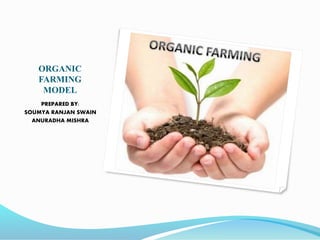
ORGANIC
FARMING
MODEL
PREPARED BY:
SOUMYA RANJAN SWAIN
ANURADHA MISHRA
ORGANIC FARMING
 Organic farming is defined as the holistic production
management system,which promotes and enhances
agro-ecosystem health,including
biodiversity,biological cycles and soil biological
activity.
 Father of modern organic agriculture- Sir Albert
Howard
 The term ‘organic farming’ was coined by Lord
Northbourne
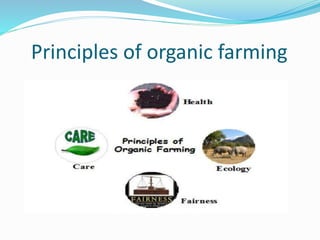
Principles of organic farming
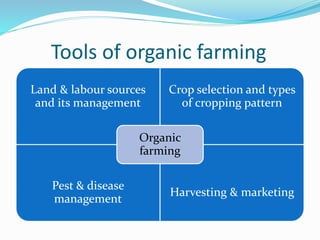
Tools of organic farming
Land & labour sources
and its management
Crop selection and types
of cropping pattern
Pest & disease
management
Harvesting & marketing
Organic
farming
Orissa economy(2016-17)
GSDP(in %)
agriculture
industry
service
Orissa Agricultural Scenario
 Agriculture shares 19.91% of GSDP where as national
scenario is 17.32%
 GDP growth of state is 7.94% where as national
average 7.1%
 Orissa is one of those states that publish a special
budget for agriculture.
 Allocation of 13181.89 cr for agriculture.
 60% work force of state depends on agriculture.
 35% of total geographical area is the net crop area.
Orissa soils and demography
 The tropical climate of Odisha is characterized by high
temperature, high humidity, medium to high rainfall
and mild winters. The normal annual rainfall is 1,451.2
mm of which the South-West monsoon contributes
about 80%
 On the basis of climate, soil, rainfall and topography,
the State has been delineated into ten Agro Climatic
Zones. The State’s Agriculture Sector suffers from
recurring natural calamities like cyclones, droughts
and flash floods which substantially affect the area,
production and productivity of agriculture.
Major soil groups of orissa
Deltaic
alluvial
soil
Laterite
soil
Red soil
Black
soil
Model organic farm(appx 7acre)
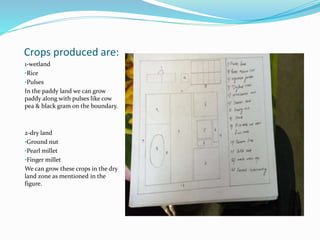
Crops produced are:
1-wetland
•Rice
•Pulses
In the paddy land we can grow
paddy along with pulses like cow
pea & black gram on the boundary.
2-dry land
•Ground nut
•Pearl millet
•Finger millet
We can grow these crops in the dry
land zone as mentioned in the
figure.
Crops grown:
3-garden land
•Tomato
•Brinjal
•Capsicum
•Chilly
•Cucumber
•Watermelon
•Gourds
•Radish
•Corn
•Beans
•Okra
•Corriander
•Sunflower
•Onion
If there is not adequate irrigation
system we can go for mulching in
case of vegetables that use residual
moisture to good effect.
Land & Labour management
 Land management:
->appx are in total=7 acre
->most area under dry land farming,rice and
pulse cultivation(2.5acre)
->area under vegetables(1.5 acre)
->comoposting,cow shed,poultry,green manure
and other miscellaneous(1acre)
->pond,fruits,banana,coconut(2acre)
Land & Labour management
 Labour management:
Generally more labour is required for cereal crops.if
adequate labour is not available then we can reduce the area under
cereals and use those area for cultivation of vegetables like
potato,sweet potato,chilly,tomato,beans,radish,carrot in kharif season
and in rabi season onion,cabbage,cauliflower,gourds etc.
Along with banana we can also grow papaya and
drum stick which provide additional income too in short time.
when there is availability of labour we can go for
cereals. considering the work force of orissa there shouldn’t be any
problem of labour as 60% work force depends on agri culture .
As per ASSOCHAM report entitled “organic
odisha:inching towards organic” organic farming in odisha can create
80 lakh jobs in odisha.
Soil fertility management
Green
manuring and
botanical cakes
Composting,bio
charcoal and
organic growth
promoter
Mulching and
crop rotation
Green manuring
Oil cakes
Organic growth promoter
Crop rotation
 Selection of crops:
In paddy land we
grow pulses on the bund so
that due to natural N2
fixation , we reduce
dependance on external
fertiliser source.
Pulses should be
follwed by non legume
crops like maize.
Rice can be followed
by green manure crops to
restore fertility.
Contd….
 In the vegetable land
across the bund we can
grow flower crops like
marigold that can also act
as trap crop for many pests.
 During zaid season we can
grow jute in some parts of
dry lad area as it requirs
less water too and also less
nutrient.
 Pearl millet and finger
millet are preferred in dry
land area as they are
drought resistant crops.
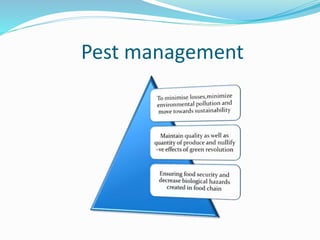
Pest management
What is pest management?
Cultural methods
Behavioral method
Biological control
Disease management
OUTLINE
Before planting
At planting
After planting
Some ITKs commonly used
 Ginger paste with cow urine for viral and bacterial
disease.
 Ash for powdery mildew and downy mildew and white
rust of mustard
 Ash with common salt for cuscuta
 Ash with castor oil for damping off of cotton
 Fallowing
 Flooding
 Earthing up
 Restrained irrigation to check aphids.
Biological control
 T.harzianum,T.viride and T.hamatum are commonly
used.
 Used against
1-club root of broccoli
2-pythium rot of seedling
3-fusarium wilt
4-bulb rot,damping off
 Used as seed treatment,mixed with compost and
applied on field.
Elements of organic farming
Contd…
Contd…
Harvesting
To prevent contamination of vegetables
on farm, organic product must be kept in a
dedicated storage area separate from
conventional product. Post harvest treatments and
packaging materials must comply with organic
standards. Where growers intend to value add
or process vegetables, compliance with organic
processing standards is required if the final product
is to be labelled as certified “Organic”
Marketing
 Problems in current market:
 In the current time the price of vegetables and
livestock products in Odisha is higher than national price. This
is due to importing foods from neighborhoods and cultivating
rice majorly in traditional inefficient manner. Our vegetable
deficit is 520,000 tonne/year.
 The main problem is lack of cold storage facilities, fertile seeds
and proper transportation to deficit market from rural
production areas.
 Example- Odisha produces enough tomato in three month of
winter in each year, when price of tomato is ₹1/kg. But without
the proper storage facility, we have to import tomato from
neighborhood states, when price is around ₹25/kg.
What can be the possible solution?
Challenges
• poor
infrastructure
• High cost and
difficulties for
certification
• Inavailability of
continuous
market for
organic produce
• Lack of proper
knowledge
Labour
management
Improper
implication of
govt projects
Low
consinstency
&
Lack of quality
standard
Practicability
&
Economic
viability
Strategies
Contd…
Recent initiatives by Orissa Govt.
 A State level task force on agriculture development and
rejuvenation was constituted under the Chairmanship of Chief
Secretary, Odisha by Agriculture Department as recommended
by NITI Aayog
 Odisha is among the few states in India that presents a separate
budget on agriculture since 2013-14, which is indicative of the
priority given to agriculture and allied sector.
 Since 2013-14 Agriculture budget is reflecting an increasing
trend. The State’s agriculture budget for 2013-14 was Rs. 7162.00
crore whereas the provision for 2015-16 and 2016-17 was Rs.
10903.62 crore and Rs.13181.89 crore respectively
Contd…
 The State has formed a separate “Agriculture Cabinet” for
farmer centric development
 State Potato Mission has been formed for making the State
self sufficient in production of Potato by the year 2017-18
 State has formulated “Odisha Fisheries Policy, 2015 and
intends to be a pioneer in Aquaculture Development.
 Bovine Breeding Policy and Poultry Policy are major
achievements of the State in 2015-16
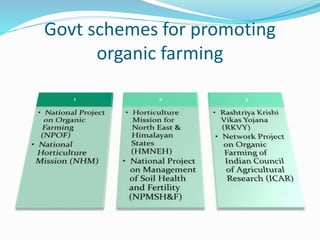
Govt schemes for promoting
organic farming
THANK YOU…
SOIL IS LIFE…
CONSERVE IT…

Organic farming model

  • 1.
  • 2.
    ORGANIC FARMING  Organicfarming is defined as the holistic production management system,which promotes and enhances agro-ecosystem health,including biodiversity,biological cycles and soil biological activity.  Father of modern organic agriculture- Sir Albert Howard  The term ‘organic farming’ was coined by Lord Northbourne
  • 3.
  • 4.
    Tools of organicfarming Land & labour sources and its management Crop selection and types of cropping pattern Pest & disease management Harvesting & marketing Organic farming
  • 5.
  • 6.
    Orissa Agricultural Scenario Agriculture shares 19.91% of GSDP where as national scenario is 17.32%  GDP growth of state is 7.94% where as national average 7.1%  Orissa is one of those states that publish a special budget for agriculture.  Allocation of 13181.89 cr for agriculture.  60% work force of state depends on agriculture.  35% of total geographical area is the net crop area.
  • 7.
    Orissa soils anddemography  The tropical climate of Odisha is characterized by high temperature, high humidity, medium to high rainfall and mild winters. The normal annual rainfall is 1,451.2 mm of which the South-West monsoon contributes about 80%  On the basis of climate, soil, rainfall and topography, the State has been delineated into ten Agro Climatic Zones. The State’s Agriculture Sector suffers from recurring natural calamities like cyclones, droughts and flash floods which substantially affect the area, production and productivity of agriculture.
  • 8.
    Major soil groupsof orissa Deltaic alluvial soil Laterite soil Red soil Black soil
  • 9.
  • 10.
    Crops produced are: 1-wetland •Rice •Pulses Inthe paddy land we can grow paddy along with pulses like cow pea & black gram on the boundary. 2-dry land •Ground nut •Pearl millet •Finger millet We can grow these crops in the dry land zone as mentioned in the figure.
  • 11.
    Crops grown: 3-garden land •Tomato •Brinjal •Capsicum •Chilly •Cucumber •Watermelon •Gourds •Radish •Corn •Beans •Okra •Corriander •Sunflower •Onion Ifthere is not adequate irrigation system we can go for mulching in case of vegetables that use residual moisture to good effect.
  • 12.
    Land & Labourmanagement  Land management: ->appx are in total=7 acre ->most area under dry land farming,rice and pulse cultivation(2.5acre) ->area under vegetables(1.5 acre) ->comoposting,cow shed,poultry,green manure and other miscellaneous(1acre) ->pond,fruits,banana,coconut(2acre)
  • 13.
    Land & Labourmanagement  Labour management: Generally more labour is required for cereal crops.if adequate labour is not available then we can reduce the area under cereals and use those area for cultivation of vegetables like potato,sweet potato,chilly,tomato,beans,radish,carrot in kharif season and in rabi season onion,cabbage,cauliflower,gourds etc. Along with banana we can also grow papaya and drum stick which provide additional income too in short time. when there is availability of labour we can go for cereals. considering the work force of orissa there shouldn’t be any problem of labour as 60% work force depends on agri culture . As per ASSOCHAM report entitled “organic odisha:inching towards organic” organic farming in odisha can create 80 lakh jobs in odisha.
  • 14.
    Soil fertility management Green manuringand botanical cakes Composting,bio charcoal and organic growth promoter Mulching and crop rotation
  • 15.
  • 16.
  • 17.
  • 18.
    Crop rotation  Selectionof crops: In paddy land we grow pulses on the bund so that due to natural N2 fixation , we reduce dependance on external fertiliser source. Pulses should be follwed by non legume crops like maize. Rice can be followed by green manure crops to restore fertility.
  • 19.
    Contd….  In thevegetable land across the bund we can grow flower crops like marigold that can also act as trap crop for many pests.  During zaid season we can grow jute in some parts of dry lad area as it requirs less water too and also less nutrient.  Pearl millet and finger millet are preferred in dry land area as they are drought resistant crops.
  • 20.
  • 21.
    What is pestmanagement?
  • 22.
  • 23.
  • 24.
  • 25.
  • 26.
  • 27.
  • 28.
  • 29.
  • 30.
    Some ITKs commonlyused  Ginger paste with cow urine for viral and bacterial disease.  Ash for powdery mildew and downy mildew and white rust of mustard  Ash with common salt for cuscuta  Ash with castor oil for damping off of cotton  Fallowing  Flooding  Earthing up  Restrained irrigation to check aphids.
  • 31.
    Biological control  T.harzianum,T.virideand T.hamatum are commonly used.  Used against 1-club root of broccoli 2-pythium rot of seedling 3-fusarium wilt 4-bulb rot,damping off  Used as seed treatment,mixed with compost and applied on field.
  • 32.
  • 33.
  • 34.
  • 35.
    Harvesting To prevent contaminationof vegetables on farm, organic product must be kept in a dedicated storage area separate from conventional product. Post harvest treatments and packaging materials must comply with organic standards. Where growers intend to value add or process vegetables, compliance with organic processing standards is required if the final product is to be labelled as certified “Organic”
  • 36.
    Marketing  Problems incurrent market:  In the current time the price of vegetables and livestock products in Odisha is higher than national price. This is due to importing foods from neighborhoods and cultivating rice majorly in traditional inefficient manner. Our vegetable deficit is 520,000 tonne/year.  The main problem is lack of cold storage facilities, fertile seeds and proper transportation to deficit market from rural production areas.  Example- Odisha produces enough tomato in three month of winter in each year, when price of tomato is ₹1/kg. But without the proper storage facility, we have to import tomato from neighborhood states, when price is around ₹25/kg.
  • 37.
    What can bethe possible solution?
  • 38.
    Challenges • poor infrastructure • Highcost and difficulties for certification • Inavailability of continuous market for organic produce • Lack of proper knowledge Labour management Improper implication of govt projects Low consinstency & Lack of quality standard Practicability & Economic viability
  • 39.
  • 40.
  • 41.
    Recent initiatives byOrissa Govt.  A State level task force on agriculture development and rejuvenation was constituted under the Chairmanship of Chief Secretary, Odisha by Agriculture Department as recommended by NITI Aayog  Odisha is among the few states in India that presents a separate budget on agriculture since 2013-14, which is indicative of the priority given to agriculture and allied sector.  Since 2013-14 Agriculture budget is reflecting an increasing trend. The State’s agriculture budget for 2013-14 was Rs. 7162.00 crore whereas the provision for 2015-16 and 2016-17 was Rs. 10903.62 crore and Rs.13181.89 crore respectively
  • 42.
    Contd…  The Statehas formed a separate “Agriculture Cabinet” for farmer centric development  State Potato Mission has been formed for making the State self sufficient in production of Potato by the year 2017-18  State has formulated “Odisha Fisheries Policy, 2015 and intends to be a pioneer in Aquaculture Development.  Bovine Breeding Policy and Poultry Policy are major achievements of the State in 2015-16
  • 43.
    Govt schemes forpromoting organic farming
  • 44.
    THANK YOU… SOIL ISLIFE… CONSERVE IT…