Sam Higginbottom Institute Of Agriculture,
Technology and Sciences
Topic : Organic Forming
PRESENTED BY,
Manoj.B.S
Junior M.Sc.
Ag.Biochemistry
JSBB, SHIATS.
CONTENTS
• Definition of Organic forming
• History
• Principle
• Organic manure
• Organic Pesticide and herbicide
• Advantages and disadvantages
• Reference
WHAT IS ORGANIC FARMING?
• It a techniques to achieve good crop yields
without harming the environment.
• Organic farming relies on techniques such as crop
rotation, green manure, compost, biological pest
control, and mechanical cultivation to maintain
soil productivity and control pests on a farm.
• It includes keeping and building a good soil
structure and soil fertility, as well as controlling
pests, diseases and weeds.
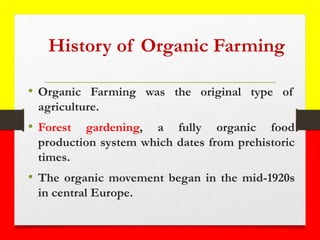
History of Organic Farming
• Organic Farming was the original type of
agriculture.
• Forest gardening, a fully organic food
production system which dates from prehistoric
times.
• The organic movement began in the mid-1920s
in central Europe.
 Protecting the long term fertility of soils by
maintaining organic matter levels
 Nitrogen self-sufficiency through the use of
legumes and biological nitrogen fixation,
 Weed, disease and pest control
CHARACTERISTICS ORGANIC FARMING
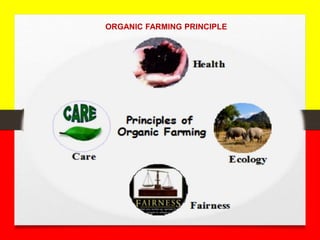
ORGANIC FARMING PRINCIPLE
1. Principle of health
• Organic Agriculture should sustain and enhance the
health of soil, plant, animal, human and planet as one
and indivisible
2. Principle of ecology
• Organic Agriculture should be based on living
ecological systems and cycles, Nourishment and well-
being are achieved through the ecology of the specific
production environment.
3. Principle of fairness
• It aims to produce a sufficient supply of good quality
food and other products. Natural and environmental
resources that are used for production and consumption
4. Principle of care
• Organic Agriculture should be managed in a
precautionary and responsible manner to protect the
health and well-being of current and future generations
and the environment.
1. Conversion of land from conventional management to organic
management
2. Management of the entire surrounding system to ensure
biodiversity and sustainability of the system
3. Crop production with the use of alternative sources of nutrients
such as crop rotation, residue management, organic manures and
biological inputs.
4. Management of weeds and pests by better management practices,
physical and cultural means and by biological control system
5. Maintenance of live stock in tandem with organic concept and
make them an integral part of the entire system
BASIC STEPS OF ORGANIC FARMING
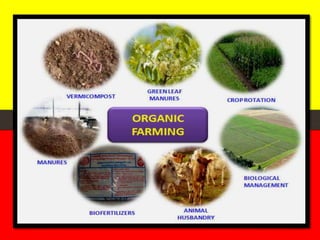
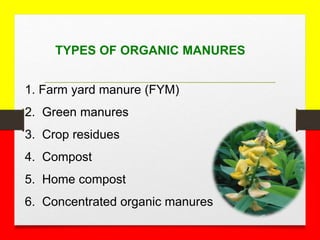
TYPES OF ORGANIC MANURES
1. Farm yard manure (FYM)
2. Green manures
3. Crop residues
4. Compost
5. Home compost
6. Concentrated organic manures
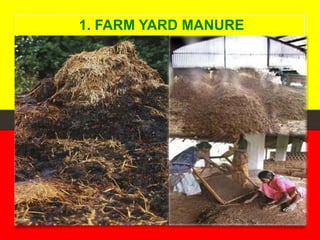
1. FARM YARD MANURE
 Farm yard Manure is prepared basically using cow
dung, cow urine, waste straw and other dairy wastes.
 It is highly useful and some of its properties are,
 FYM is rich in nutrients.When cow dung and urine are
mixed, a balanced nutrition is made available to the
plants.
 Availability of Potassium and Phosphorus from FYM is
similar to that from inorganic sources.
 Application of FYM improves soil fertility.
1. FARM YARD MANURE
2. Green Manures
• Green manure is a type of cover crop grown primarily
to add nutrients and organic matter to the soil.
• Green manures, in the case of legumes, fix nitrogen
and contribute to farm nitrogen needs.
• Green manure crops provide a habitat for pollinators
and other beneficial insects.
• They are grown for the purpose of plowing them, thus
increasing fertility through the incorporation of nutrients
and organic matter into the soil.
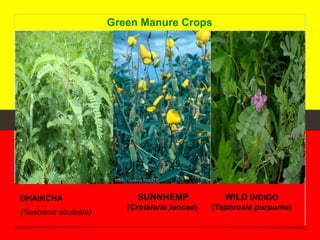
Green Manure Crops
DHAINCHA
(Sesbania aculeata)
SUNNHEMP
(Crotalaria juncea)
WILD INDIGO
(Tephrosia purpurea)
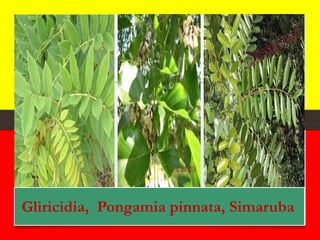
Gliricidia, Pongamia pinnata, Simaruba
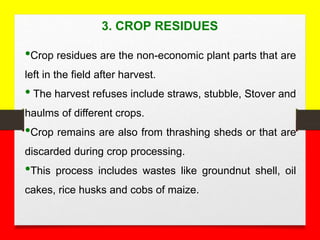
3. CROP RESIDUES
•Crop residues are the non-economic plant parts that are
left in the field after harvest.
• The harvest refuses include straws, stubble, Stover and
haulms of different crops.
•Crop remains are also from thrashing sheds or that are
discarded during crop processing.
•This process includes wastes like groundnut shell, oil
cakes, rice husks and cobs of maize.
CROP RESIDUES
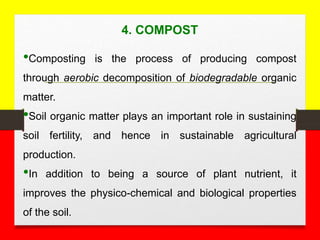
4. COMPOST
•Composting is the process of producing compost
through aerobic decomposition of biodegradable organic
matter.
•Soil organic matter plays an important role in sustaining
soil fertility, and hence in sustainable agricultural
production.
•In addition to being a source of plant nutrient, it
improves the physico-chemical and biological properties
of the soil.
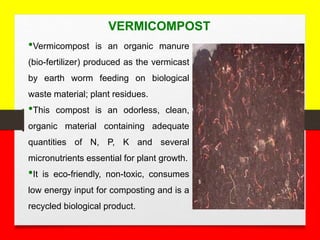
VERMICOMPOST
•Vermicompost is an organic manure
(bio-fertilizer) produced as the vermicast
by earth worm feeding on biological
waste material; plant residues.
•This compost is an odorless, clean,
organic material containing adequate
quantities of N, P, K and several
micronutrients essential for plant growth.
•It is eco-friendly, non-toxic, consumes
low energy input for composting and is a
recycled biological product.
5. HOME COMPOST
6. Concentrated Organic Manures
• Edible oil cakes which can be safely fed to livestock; e.g.:
Groundnut cake, Coconut cake etc.,
• Non edible oil cakes which are not fit for feeding livestock; e.g.:
Castor cake, Neem cake, Mahua cake etc.,
• Both edible and non-edible oil cakes can be used as manures.
• However, edible oil cakes are fed to cattle and non-edible oil
cakes are used as manures especially for horticultural crops.
• Nutrients present in oil cakes, after mineralization, are made
available to crops 7 to 10 days after application.
Oilcakes need to be well powdered before application for even
distribution and quicker decomposition.
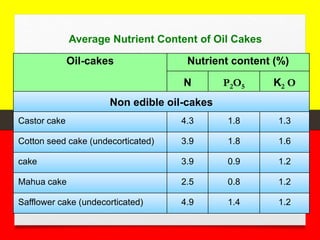
Average Nutrient Content of Oil Cakes
Oil-cakes Nutrient content (%)
N P2O5 K2 O
Non edible oil-cakes
Castor cake 4.3 1.8 1.3
Cotton seed cake (undecorticated) 3.9 1.8 1.6
cake 3.9 0.9 1.2
Mahua cake 2.5 0.8 1.2
Safflower cake (undecorticated) 4.9 1.4 1.2
Oil-cakes Nutrient content (%)
N P2O5 K2O
Edible oil-cakes
Coconut cake 3.0 1.9 1.8
Cotton seed cake (decorticated) 6.4 2.9 2.2
Groundnut cake 7.3 1.5 1.3
Linseed cake 4.9 1.4 1.3
cake 4.7 1.8 1.3
Rape seed cake 5.2 1.8 1.2
Safflower cake (decorticated) 7.9 2.2 1.9
Seamus cake 6.2 2.0 1.2
USE OF ORGANIC FARMING
• Increase long-term fertility of the soil and also help in
reducing soil erosion
• Control pest and diseases without harming the
environment
• Ensure that water stays clean and safe
• Food produced are nutritious and are of a high quality
which can be sold for a good price
• It is a type of farming in which farmers can save
money without any kind of chemical fertilizations it
helps farmers to reduce the effect of weeds by using
garlic, clove oil etc
• It produces only pure crops without any toxic
materials which are harmful for the human life and
this increases the profit also.
PROBLEMS OF ORGANIC FARMING
• Dependency on fertilizers. Greater amount are needed
every year to produce the same yields of crops
• Pests and diseases may turn more difficult to control as
they become resistant to artificial pesticides
• Farming with organic methods gives smaller crops as
compared to artificial farming.
• Organic farming gives low productivity of vegetables
such as potatoes in the same areas where the
conventional farming produces more.
Organic forming.

Organic forming.

  • 2.
    Sam Higginbottom InstituteOf Agriculture, Technology and Sciences Topic : Organic Forming PRESENTED BY, Manoj.B.S Junior M.Sc. Ag.Biochemistry JSBB, SHIATS.
  • 3.
    CONTENTS • Definition ofOrganic forming • History • Principle • Organic manure • Organic Pesticide and herbicide • Advantages and disadvantages • Reference
  • 4.
    WHAT IS ORGANICFARMING? • It a techniques to achieve good crop yields without harming the environment. • Organic farming relies on techniques such as crop rotation, green manure, compost, biological pest control, and mechanical cultivation to maintain soil productivity and control pests on a farm. • It includes keeping and building a good soil structure and soil fertility, as well as controlling pests, diseases and weeds.
  • 5.
    History of OrganicFarming • Organic Farming was the original type of agriculture. • Forest gardening, a fully organic food production system which dates from prehistoric times. • The organic movement began in the mid-1920s in central Europe.
  • 6.
     Protecting thelong term fertility of soils by maintaining organic matter levels  Nitrogen self-sufficiency through the use of legumes and biological nitrogen fixation,  Weed, disease and pest control CHARACTERISTICS ORGANIC FARMING
  • 7.
  • 8.
    1. Principle ofhealth • Organic Agriculture should sustain and enhance the health of soil, plant, animal, human and planet as one and indivisible 2. Principle of ecology • Organic Agriculture should be based on living ecological systems and cycles, Nourishment and well- being are achieved through the ecology of the specific production environment.
  • 9.
    3. Principle offairness • It aims to produce a sufficient supply of good quality food and other products. Natural and environmental resources that are used for production and consumption 4. Principle of care • Organic Agriculture should be managed in a precautionary and responsible manner to protect the health and well-being of current and future generations and the environment.
  • 10.
    1. Conversion ofland from conventional management to organic management 2. Management of the entire surrounding system to ensure biodiversity and sustainability of the system 3. Crop production with the use of alternative sources of nutrients such as crop rotation, residue management, organic manures and biological inputs. 4. Management of weeds and pests by better management practices, physical and cultural means and by biological control system 5. Maintenance of live stock in tandem with organic concept and make them an integral part of the entire system BASIC STEPS OF ORGANIC FARMING
  • 12.
    TYPES OF ORGANICMANURES 1. Farm yard manure (FYM) 2. Green manures 3. Crop residues 4. Compost 5. Home compost 6. Concentrated organic manures
  • 13.
    1. FARM YARDMANURE  Farm yard Manure is prepared basically using cow dung, cow urine, waste straw and other dairy wastes.  It is highly useful and some of its properties are,  FYM is rich in nutrients.When cow dung and urine are mixed, a balanced nutrition is made available to the plants.  Availability of Potassium and Phosphorus from FYM is similar to that from inorganic sources.  Application of FYM improves soil fertility.
  • 14.
  • 15.
    2. Green Manures •Green manure is a type of cover crop grown primarily to add nutrients and organic matter to the soil. • Green manures, in the case of legumes, fix nitrogen and contribute to farm nitrogen needs. • Green manure crops provide a habitat for pollinators and other beneficial insects. • They are grown for the purpose of plowing them, thus increasing fertility through the incorporation of nutrients and organic matter into the soil.
  • 16.
    Green Manure Crops DHAINCHA (Sesbaniaaculeata) SUNNHEMP (Crotalaria juncea) WILD INDIGO (Tephrosia purpurea)
  • 17.
  • 18.
    3. CROP RESIDUES •Cropresidues are the non-economic plant parts that are left in the field after harvest. • The harvest refuses include straws, stubble, Stover and haulms of different crops. •Crop remains are also from thrashing sheds or that are discarded during crop processing. •This process includes wastes like groundnut shell, oil cakes, rice husks and cobs of maize.
  • 19.
  • 20.
    4. COMPOST •Composting isthe process of producing compost through aerobic decomposition of biodegradable organic matter. •Soil organic matter plays an important role in sustaining soil fertility, and hence in sustainable agricultural production. •In addition to being a source of plant nutrient, it improves the physico-chemical and biological properties of the soil.
  • 21.
    VERMICOMPOST •Vermicompost is anorganic manure (bio-fertilizer) produced as the vermicast by earth worm feeding on biological waste material; plant residues. •This compost is an odorless, clean, organic material containing adequate quantities of N, P, K and several micronutrients essential for plant growth. •It is eco-friendly, non-toxic, consumes low energy input for composting and is a recycled biological product.
  • 22.
  • 23.
    6. Concentrated OrganicManures • Edible oil cakes which can be safely fed to livestock; e.g.: Groundnut cake, Coconut cake etc., • Non edible oil cakes which are not fit for feeding livestock; e.g.: Castor cake, Neem cake, Mahua cake etc., • Both edible and non-edible oil cakes can be used as manures. • However, edible oil cakes are fed to cattle and non-edible oil cakes are used as manures especially for horticultural crops. • Nutrients present in oil cakes, after mineralization, are made available to crops 7 to 10 days after application.
  • 24.
    Oilcakes need tobe well powdered before application for even distribution and quicker decomposition.
  • 25.
    Average Nutrient Contentof Oil Cakes Oil-cakes Nutrient content (%) N P2O5 K2 O Non edible oil-cakes Castor cake 4.3 1.8 1.3 Cotton seed cake (undecorticated) 3.9 1.8 1.6 cake 3.9 0.9 1.2 Mahua cake 2.5 0.8 1.2 Safflower cake (undecorticated) 4.9 1.4 1.2
  • 26.
    Oil-cakes Nutrient content(%) N P2O5 K2O Edible oil-cakes Coconut cake 3.0 1.9 1.8 Cotton seed cake (decorticated) 6.4 2.9 2.2 Groundnut cake 7.3 1.5 1.3 Linseed cake 4.9 1.4 1.3 cake 4.7 1.8 1.3 Rape seed cake 5.2 1.8 1.2 Safflower cake (decorticated) 7.9 2.2 1.9 Seamus cake 6.2 2.0 1.2
  • 27.
    USE OF ORGANICFARMING • Increase long-term fertility of the soil and also help in reducing soil erosion • Control pest and diseases without harming the environment • Ensure that water stays clean and safe • Food produced are nutritious and are of a high quality which can be sold for a good price • It is a type of farming in which farmers can save money without any kind of chemical fertilizations it helps farmers to reduce the effect of weeds by using garlic, clove oil etc • It produces only pure crops without any toxic materials which are harmful for the human life and this increases the profit also.
  • 28.
    PROBLEMS OF ORGANICFARMING • Dependency on fertilizers. Greater amount are needed every year to produce the same yields of crops • Pests and diseases may turn more difficult to control as they become resistant to artificial pesticides • Farming with organic methods gives smaller crops as compared to artificial farming. • Organic farming gives low productivity of vegetables such as potatoes in the same areas where the conventional farming produces more.

Editor's Notes

  • #5 It excludes or strictly limits the use of synthetic fertilizers and synthetic pesticides, plant growth regulators, livestock antibiotics, food additives, and genetically modified organisms. crop rotation It helps to control the pest resistence
  • #6 Forest gardening is a low maintance sustainable plant based on woodland ecosystem incorporating fruit, nut trees,herbs shrubs, parenial veg….etc
  • #7  1.as well as effective recycling of organic materials including crop residues and livestock manures. 2.relying primarily on crop rotations, natural predators, diversity, organic manuring, resistant varieties and limited (preferably minimal) thermal, biological and chemical intervention.
  • #9 Healthy soils produce healthy crops that foster the health of animals and people.
  • #13 Organic manures are natural products used by farmers to enhanced sustainable crop production.
  • #15 Dig a pit (4×6×10) near cattle shed above the level of soil. Spread the excavated soil on the surface. Fill the pit with grass and other material of cake shed and soil upto 10-15cm. Spread cow dung manure up to 15-20 cm leave it for one to two month.
  • #21 Final weight of compost is very less. Composting temperature kill pathogen, weed seeds and seeds. Saleable product Improves manure  handling Reduces the risk of pollution