From Silicon Valley to Wall Street To Foggy Bottom


                     FERC MARKET PULL
                   MECHANISMS FOR MHK
                      AND OTHER SMALL
                           RENEWABLES

                                  Presented by Carolyn Elefant
Sponsored by The Ocean           Law Offices of Carolyn Elefant,
Renewable Energy Coalition                      Washington DC
October 23, 2012:
FACT: FERC Order 679
 resulted in proposed

$23 billion
of transmission investment
 between 2008 and 2012
What is the
   potential
  impact of
FERC policies
      on
investment in
 renewables
   markets?
OVERVIEW

•Market push v. market pull
•FERC’s role in “market pull”
•Specific FERC policies
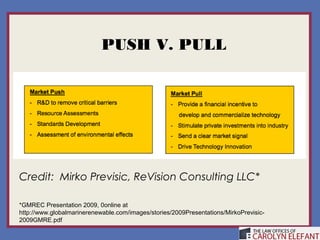
PUSH V. PULL


Credit: Mirko Previsic, ReVision Consulting LLC*

*GMREC Presentation 2009, 0online at
http://www.globalmarinerenewable.com/images/stories/2009Presentations/MirkoPrevisic-
2009GMRE.pdf
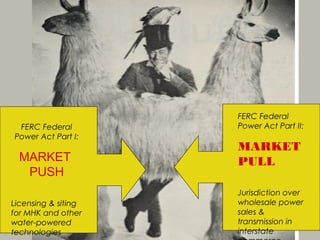
FERC Federal
 FERC Federal        Power Act Part II:
Power Act Part I:
                     MARKET
  MARKET             PULL
   PUSH
                     Jurisdiction over
Licensing & siting   wholesale power
for MHK and other    sales &
water-powered        transmission in
technologies         interstate
FEDERAL POWER ACT
                      PART II
•Jurisdiction over rates and contracts for wholesale power
sales in interstate commerce
•Jurisdiction over rates and contracts for transmission (and
ancillary services), including interconnection to
transmission or distribution facilities serving transmission
functions and QF interconnection where QFs serve 3rd
parties
•Jurisdiction over enforcement of PURPA and parameters
for avoided cost rates
•Jurisdiction over demand response in wholesale markets
•Generally, NO jurisdiction over net-metering or distributed
generation sales; limited jurisdiction in Alaska and Hawaii
due to lack of interstate grid
RELATIONSHIP OF MHK
        TO FPA PART II
•MHK (and other small renewables) eligible for QF
certification under PURPA and FERC rules
•MHK sale of power to utility = wholesale transaction
(unless QF sale)
•Some MHK interconnection may be to distribution
qua transmission
•MHK providers potentially provide storage or
ancillary services that support transmission
•Merger policy (investment in renewables =
potential hedge on market power)
•Transmission policy - Order No. 1000 to allow
transmission for “public policy” - Atlantic Grid
Connection
SPECIFIC FERC POLICIES
•PURPA and QF avoided cost rates/mandatory
purchase obligations
•VERS (integration of variable energy resources into
the grid)
•FERC ruling on net metering
•Order No. 1000 and transmission for “public policy,”
Order No. 679 (green transmission incentives)
•NOPR Re: ancillary services and storage
PURPA
•Public Utilities Regulatory Policies Act of 1978
   •Creates category of QF (qualifying facility) -
   small power (CHP, renewables) and cogen
   •Mandatory purchase of renewables
   •Avoided cost rates (I.e., cost of power from
   alternatives avoided by QF purchase)
From Silicon Valley to Wall Street To Foggy Bottom


                       FERC MARKET PULL
                      MECHANIMS FOR MHK
                        AND OTHER SMALL
                             RENEWABLES

                                  Presented by Carolyn Elefant
Sponsored by The Ocean           Law Offices of Carolyn Elefant,
Renewable Energy Coalition                      Washington DC
October 23, 2012:
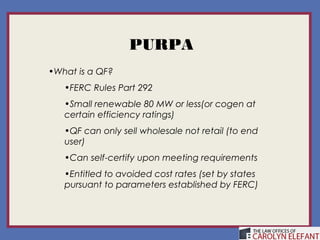
PURPA
•What is a QF?
   •FERC Rules Part 292
   •Small renewable 80 MW or less(or cogen at
   certain efficiency ratings)
   •QF can only sell wholesale not retail (to end
   user)
   •Can self-certify upon meeting requirements
   •Entitled to avoided cost rates (set by states
   pursuant to parameters established by FERC)
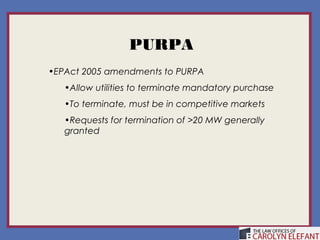
PURPA
•EPAct 2005 amendments to PURPA
   •Allow utilities to terminate mandatory purchase
   •To terminate, must be in competitive markets
   •Requests for termination of >20 MW generally
   granted
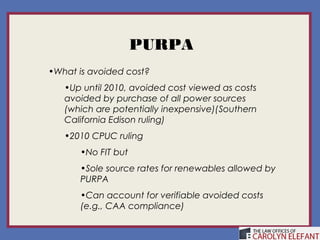
PURPA
•What is avoided cost?
   •Up until 2010, avoided cost viewed as costs
   avoided by purchase of all power sources
   (which are potentially inexpensive)(Southern
   California Edison ruling)
   •2010 CPUC ruling
      •No FIT but
      •Sole source rates for renewables allowed by
      PURPA
      •Can account for verifiable avoided costs
      (e.g., CAA compliance)
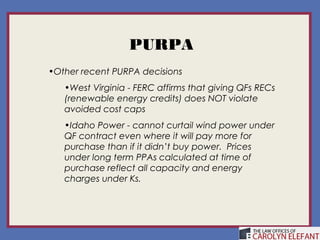
PURPA
•Other recent PURPA decisions
   •West Virginia - FERC affirms that giving QFs RECs
   (renewable energy credits) does NOT violate
   avoided cost caps
   •Idaho Power - cannot curtail wind power under
   QF contract even where it will pay more for
   purchase than if it didn’t buy power. Prices
   under long term PPAs calculated at time of
   purchase reflect all capacity and energy
   charges under Ks.
PURPA
•Summary: Impact of PURPA for MHK and small
renewables
   •Potential avenue for FIT-type rates;
   opportunities with CAA compliance costs rising
   •Long term Ks with renewables under PURPA can
   hedge against volatile gas prices
   •Mandatory purchases still available for small
   renewables
   •Negotiating REC ownership for QFs increases
   value of rates
NET METERING
•What is net metering?
    •Power sales back to the grid by retail owners
•FERC Ruling July 2010 - net metering not subject to PURPA
•Impact: states can set any charges to encourage net-
metering and are not bound by avoided cost caps
•Net metering/DG incentives are driving small solar.
Potential opportunities for MHK (irrigation and other)
INTEGRATION OF VERS
•Problem: intermittent nature of variable energy
resources (VERS) can potentially complicate grid
integration
•Solution: FERC rOrder 764 ule on VERS (July 2012)
   •15 minute intra-hour scheduling
   •Generators interconnecting under LGIA (large
   generator interconnection rule) must provide
   meteorologic and forced outage data to
   transmission provider if necessary to support
   forecasting
•More modest than initial proposal but creates
certainty re: interconnection. Lays the foundation for
when MHK grows up
SMALL
INTERCONNECTION RULES
 •FERC small interconnection rules
 •Applicable to
    •Up to 20 MWgenerators connected to transmission or
    distribution facilities that support tmission functions
    (FERC has 7-part test) [*note - not applicable to non-
    juris muni utilities or AL/Hawaii]
    •QFs selling excess power to third party (I.e., nonhost)
    utilities)
    •More simplified process for 10 kw-2 MW (fast track, no
    system impact studies) and special process for10 kw
    inverter systems
    •FERC to consider new small interconnect rules
    following series of technical conferences - should
    further facilitate interconnection
ANCILLARY SERVICES AND
                STORAGE
 •FERC RM11-24 Ancillary services and storage
 rulemaking
 •Anciallary services support transmission (regulation
 and frequency, imbalance, etc…)
 •Proposed rule would allow market rates for
 frequency and regulation services (correct for
 variation w/additonal tmission)
    •Possible market for MHK since it doesn’t require
    ramping.
ANCILLARY SERVICES AND
                 STORAGE
 •Rulemaking also proposes methodology for
 classifying storage functions so that utilities can
 recover investment
     •Storage has transmission and generation
     components - should be accounted for based
     on function provided and be transparent
 •MHK and other small facilities can provide storage
 (battery power, etc…) Depending upon function
 can qualify for cost of service, market rates or even
 trmission incentive
Transmission Policy
•Transmission incentives (Order 679) - incentive for
investment for certain tmission including “green”
trmission functions (some battery technologies
qualify for incentives)
•Order No. 1000
   •Tmission providers must consider “public policy”
   in making tmission decisions
   •Atlantic Grid connection is potential
   beneficiary
   •Other innovative tmission to support MHK?
Where to Find US ONLINE


                             www.oceanrenewable.com


                                @oceanrenewable
carolyn@carolynelefant.com
                                 http://www.facebook.com/pages/Ocean-
                                 Renewable-Energy-Coalition/102294079850780


                               JOIN OREC TODAY!

OREC Webinar: From Silicon Valley to Wall Street to Foggy Bottom:

  • 1.
    From Silicon Valleyto Wall Street To Foggy Bottom FERC MARKET PULL MECHANISMS FOR MHK AND OTHER SMALL RENEWABLES Presented by Carolyn Elefant Sponsored by The Ocean Law Offices of Carolyn Elefant, Renewable Energy Coalition Washington DC October 23, 2012:
  • 2.
    FACT: FERC Order679 resulted in proposed $23 billion of transmission investment between 2008 and 2012
  • 3.
    What is the potential impact of FERC policies on investment in renewables markets?
  • 4.
    OVERVIEW •Market push v.market pull •FERC’s role in “market pull” •Specific FERC policies
  • 5.
    PUSH V. PULL Credit:Mirko Previsic, ReVision Consulting LLC* *GMREC Presentation 2009, 0online at http://www.globalmarinerenewable.com/images/stories/2009Presentations/MirkoPrevisic- 2009GMRE.pdf
  • 6.
    FERC Federal FERCFederal Power Act Part II: Power Act Part I: MARKET MARKET PULL PUSH Jurisdiction over Licensing & siting wholesale power for MHK and other sales & water-powered transmission in technologies interstate
  • 7.
    FEDERAL POWER ACT PART II •Jurisdiction over rates and contracts for wholesale power sales in interstate commerce •Jurisdiction over rates and contracts for transmission (and ancillary services), including interconnection to transmission or distribution facilities serving transmission functions and QF interconnection where QFs serve 3rd parties •Jurisdiction over enforcement of PURPA and parameters for avoided cost rates •Jurisdiction over demand response in wholesale markets •Generally, NO jurisdiction over net-metering or distributed generation sales; limited jurisdiction in Alaska and Hawaii due to lack of interstate grid
  • 8.
    RELATIONSHIP OF MHK TO FPA PART II •MHK (and other small renewables) eligible for QF certification under PURPA and FERC rules •MHK sale of power to utility = wholesale transaction (unless QF sale) •Some MHK interconnection may be to distribution qua transmission •MHK providers potentially provide storage or ancillary services that support transmission •Merger policy (investment in renewables = potential hedge on market power) •Transmission policy - Order No. 1000 to allow transmission for “public policy” - Atlantic Grid Connection
  • 9.
    SPECIFIC FERC POLICIES •PURPAand QF avoided cost rates/mandatory purchase obligations •VERS (integration of variable energy resources into the grid) •FERC ruling on net metering •Order No. 1000 and transmission for “public policy,” Order No. 679 (green transmission incentives) •NOPR Re: ancillary services and storage
  • 10.
    PURPA •Public Utilities RegulatoryPolicies Act of 1978 •Creates category of QF (qualifying facility) - small power (CHP, renewables) and cogen •Mandatory purchase of renewables •Avoided cost rates (I.e., cost of power from alternatives avoided by QF purchase)
  • 11.
    From Silicon Valleyto Wall Street To Foggy Bottom FERC MARKET PULL MECHANIMS FOR MHK AND OTHER SMALL RENEWABLES Presented by Carolyn Elefant Sponsored by The Ocean Law Offices of Carolyn Elefant, Renewable Energy Coalition Washington DC October 23, 2012:
  • 12.
    PURPA •What is aQF? •FERC Rules Part 292 •Small renewable 80 MW or less(or cogen at certain efficiency ratings) •QF can only sell wholesale not retail (to end user) •Can self-certify upon meeting requirements •Entitled to avoided cost rates (set by states pursuant to parameters established by FERC)
  • 13.
    PURPA •EPAct 2005 amendmentsto PURPA •Allow utilities to terminate mandatory purchase •To terminate, must be in competitive markets •Requests for termination of >20 MW generally granted
  • 14.
    PURPA •What is avoidedcost? •Up until 2010, avoided cost viewed as costs avoided by purchase of all power sources (which are potentially inexpensive)(Southern California Edison ruling) •2010 CPUC ruling •No FIT but •Sole source rates for renewables allowed by PURPA •Can account for verifiable avoided costs (e.g., CAA compliance)
  • 15.
    PURPA •Other recent PURPAdecisions •West Virginia - FERC affirms that giving QFs RECs (renewable energy credits) does NOT violate avoided cost caps •Idaho Power - cannot curtail wind power under QF contract even where it will pay more for purchase than if it didn’t buy power. Prices under long term PPAs calculated at time of purchase reflect all capacity and energy charges under Ks.
  • 16.
    PURPA •Summary: Impact ofPURPA for MHK and small renewables •Potential avenue for FIT-type rates; opportunities with CAA compliance costs rising •Long term Ks with renewables under PURPA can hedge against volatile gas prices •Mandatory purchases still available for small renewables •Negotiating REC ownership for QFs increases value of rates
  • 17.
    NET METERING •What isnet metering? •Power sales back to the grid by retail owners •FERC Ruling July 2010 - net metering not subject to PURPA •Impact: states can set any charges to encourage net- metering and are not bound by avoided cost caps •Net metering/DG incentives are driving small solar. Potential opportunities for MHK (irrigation and other)
  • 18.
    INTEGRATION OF VERS •Problem:intermittent nature of variable energy resources (VERS) can potentially complicate grid integration •Solution: FERC rOrder 764 ule on VERS (July 2012) •15 minute intra-hour scheduling •Generators interconnecting under LGIA (large generator interconnection rule) must provide meteorologic and forced outage data to transmission provider if necessary to support forecasting •More modest than initial proposal but creates certainty re: interconnection. Lays the foundation for when MHK grows up
  • 19.
    SMALL INTERCONNECTION RULES •FERCsmall interconnection rules •Applicable to •Up to 20 MWgenerators connected to transmission or distribution facilities that support tmission functions (FERC has 7-part test) [*note - not applicable to non- juris muni utilities or AL/Hawaii] •QFs selling excess power to third party (I.e., nonhost) utilities) •More simplified process for 10 kw-2 MW (fast track, no system impact studies) and special process for10 kw inverter systems •FERC to consider new small interconnect rules following series of technical conferences - should further facilitate interconnection
  • 20.
    ANCILLARY SERVICES AND STORAGE •FERC RM11-24 Ancillary services and storage rulemaking •Anciallary services support transmission (regulation and frequency, imbalance, etc…) •Proposed rule would allow market rates for frequency and regulation services (correct for variation w/additonal tmission) •Possible market for MHK since it doesn’t require ramping.
  • 21.
    ANCILLARY SERVICES AND STORAGE •Rulemaking also proposes methodology for classifying storage functions so that utilities can recover investment •Storage has transmission and generation components - should be accounted for based on function provided and be transparent •MHK and other small facilities can provide storage (battery power, etc…) Depending upon function can qualify for cost of service, market rates or even trmission incentive
  • 22.
    Transmission Policy •Transmission incentives(Order 679) - incentive for investment for certain tmission including “green” trmission functions (some battery technologies qualify for incentives) •Order No. 1000 •Tmission providers must consider “public policy” in making tmission decisions •Atlantic Grid connection is potential beneficiary •Other innovative tmission to support MHK?
  • 23.
    Where to FindUS ONLINE www.oceanrenewable.com @oceanrenewable carolyn@carolynelefant.com http://www.facebook.com/pages/Ocean- Renewable-Energy-Coalition/102294079850780 JOIN OREC TODAY!