Module 2 –
OralLore from
Pre-Colonial Times
(--1564)
Presented by:
Abela, Michael John L.
Abad, Andrew Marvin B.
Baloca, Vincent Jay C.
Ayong, Crizel Aira M.
4.
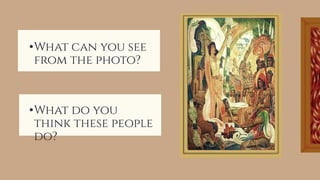
•What can yousee
from the photo?
•What do you
think these people
do?
5.
PHILIPPINE
LITERATURE
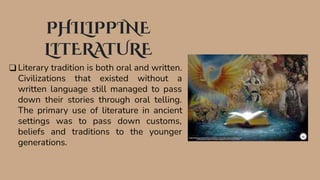
❑ Literary traditionis both oral and written.
Civilizations that existed without a
written language still managed to pass
down their stories through oral telling.
The primary use of literature in ancient
settings was to pass down customs,
beliefs and traditions to the younger
generations.
6.
DEFINITION OF
Oral lore
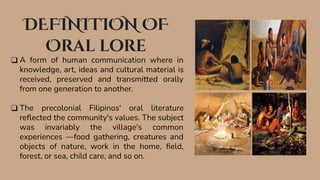
❑A form of human communication where in
knowledge, art, ideas and cultural material is
received, preserved and transmitted orally
from one generation to another.
❑ The precolonial Filipinos' oral literature
reflected the community's values. The subject
was invariably the village's common
experiences —food gathering, creatures and
objects of nature, work in the home, field,
forest, or sea, child care, and so on.
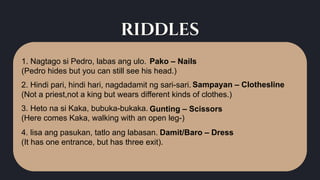
riddles
1. Nagtago siPedro, labas ang ulo.
(Pedro hides but you can still see his head.)
3. Heto na si Kaka, bubuka-bukaka.
(Here comes Kaka, walking with an open leg-)
4. lisa ang pasukan, tatlo ang labasan.
(It has one entrance, but has three exit).
2. Hindi pari, hindi hari, nagdadamit ng sari-sari.
(Not a priest,not a king but wears different kinds of clothes.)
Pako – Nails
Damit/Baro – Dress
Gunting – Scissors
Sampayan – Clothesline
11.
riddles
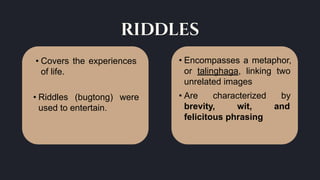
• Encompasses ametaphor,
or talinghaga, linking two
unrelated images
• Are characterized by
brevity, wit, and
felicitous phrasing
• Covers the experiences
of life.
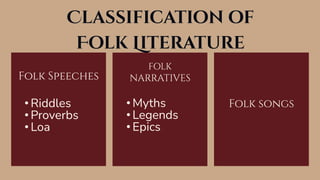
• Riddles (bugtong) were
used to entertain.
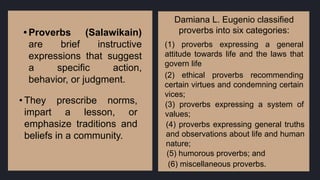
• Proverbs (Salawikain)
arebrief instructive
expressions that suggest
a specific action,
behavior, or judgment.
• They prescribe norms,
impart a lesson, or
emphasize traditions and
beliefs in a community.
Damiana L. Eugenio classified
proverbs into six categories:
(1) proverbs expressing a general
attitude towards life and the laws that
govern life
(2) ethical proverbs recommending
certain virtues and condemning certain
vices;
(3) proverbs expressing a system of
values;
(4) proverbs expressing general truths
and observations about life and human
nature;
(5) humorous proverbs; and
(6) miscellaneous proverbs.
14.
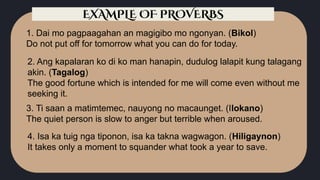
1. Dai mopagpaagahan an magigibo mo ngonyan. (Bikol)
Do not put off for tomorrow what you can do for today.
2. Ang kapalaran ko di ko man hanapin, dudulog lalapit kung talagang
akin. (Tagalog)
The good fortune which is intended for me will come even without me
seeking it.
3. Ti saan a matimtemec, nauyong no macaunget. (Ilokano)
The quiet person is slow to anger but terrible when aroused.
4. Isa ka tuig nga tiponon, isa ka takna wagwagon. (Hiligaynon)
It takes only a moment to squander what took a year to save.
EXAMPLE OF PROVERBS
15.
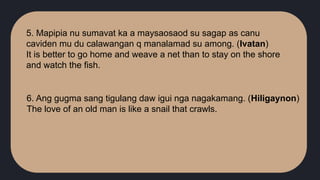
5. Mapipia nusumavat ka a maysaosaod su sagap as canu
caviden mu du calawangan q manalamad su among. (Ivatan)
It is better to go home and weave a net than to stay on the shore
and watch the fish.
6. Ang gugma sang tigulang daw igui nga nagakamang. (Hiligaynon)
The love of an old man is like a snail that crawls.
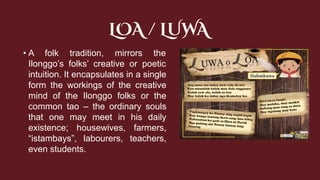
LOA / LUWA
•A folk tradition, mirrors the
Ilonggo’s folks’ creative or poetic
intuition. It encapsulates in a single
form the workings of the creative
mind of the Ilonggo folks or the
common tao – the ordinary souls
that one may meet in his daily
existence; housewives, farmers,
“istambays”, labourers, teachers,
even students.
18.
DID YOU KNOW?
•Luwa is Ilonggo's version of tanaga of the Tagalogs
and haiku of the Japanese folks.
• It is usually made up of four rhyming lines with every
line having 5, 7, 9 or 11 syllables.
19.
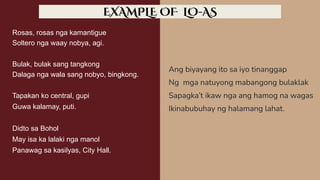
Rosas, rosas ngakamantigue
Soltero nga waay nobya, agi.
Bulak, bulak sang tangkong
Dalaga nga wala sang nobyo, bingkong.
Tapakan ko central, gupi
Guwa kalamay, puti.
Didto sa Bohol
May isa ka lalaki nga manol
Panawag sa kasilyas, City Hall.
Ang biyayang ito sa iyo tinanggap
Ng mga natuyong mabangong bulaklak
Sapagka’t ikaw nga ang hamog na wagas
Ikinabubuhay ng halamang lahat.
EXAMPLE OF LO-AS
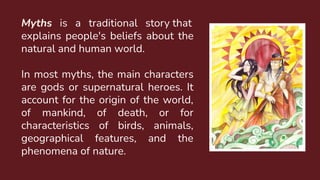
Myths is atraditional story that
explains people's beliefs about the
natural and human world.
In most myths, the main characters
are gods or supernatural heroes. It
account for the origin of the world,
of mankind, of death, or for
characteristics of birds, animals,
geographical features, and the
phenomena of nature.
22.
Th
e Philippine Mythsare classified
under th
e following h
eadings:
1) The Gods: their Activities and Relationships;
2) Cosmology and Cosmogony;
3) Topographical Features of the Earth (water and land features);
4) World Calamities (The Great Flood);
5) Establishment of the Natural Order;
6) Creation and Ordering of Human Life;
7) Origin of Animal Life and Characteristics; and
8) Origin of Plant Life and Characteristics.
23.
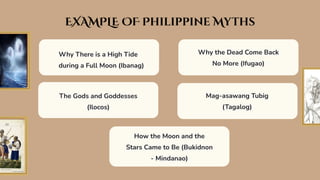
Why There isa High Tide
during a Full Moon (Ibanag)
EXAMPLE OF Philippine Myths
The Gods and Goddesses
(Ilocos)
Why the Dead Come Back
No More (Ifugao)
Mag-asawang Tubig
(Tagalog)
How the Moon and the
Stars Came to Be (Bukidnon
- Mindanao)
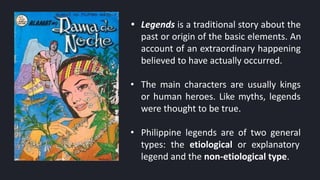
• Legends isa traditional story about the
past or origin of the basic elements. An
account of an extraordinary happening
believed to have actually occurred.
• The main characters are usually kings
or human heroes. Like myths, legends
were thought to be true.
• Philippine legends are of two general
types: the etiological or explanatory
legend and the non-etiological type.
26.
five types oflegends in th
e Philippines:
• Heroic/historical legends
• Religious legends
• Legends narrating encounters with supernatural
beings
• Miscellaneous legends
• place name legends.
27.
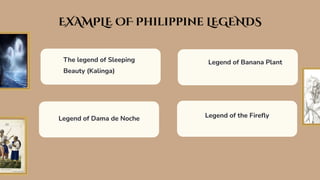
The legend ofSleeping
Beauty (Kalinga)
EXAMPLE OF Philippine LEGENDS
Legend of Dama de Noche
Legend of Banana Plant
Legend of the Firefly
Establishing Context
[defining folk-epic]
•narratives of sustained length,
• based on oral tradition,
• revolving around supernatural events or heroic deeds,
• in the form of verse,
• which is either chanted or sung, and;
• with a certain seriousness of purpose, embodying or validating the
beliefs, customs, ideals, or life values of the people
The oral formsof Philippine literature are the spontaneous
expression of people, encasing their feelings and vision in
words crafted by the poets and storytellers of the
community. Transmitted and preserved orally, these early
forms of literature are not “primitive” in the sense of being
rough and inchoate, but in the sense of being the product
of tradition and folk practice rather than of education and
artistic training, works of the bard rather than of the artist.
36.
Yet, they aregenuine artistic expressions proper to the
context and the time, and represent the ethos of the
people before it was tampered with by colonization or
transformed by other external influences. His pre-colonial
literature shows the Filipino as being rooted in the
Southeast Asian cultural tradition.This Asian dimension
later served as a filter for the Western culture brought by
colonization.
37.
We have theextraordinary stories of myths and
legends that teaches life-defining lessons, epics that
will thrill, entertain, and inspire you to be even braver
in facing life, the proverbs that will challenge your
philosophy, as well as the riddles and lo-as that will
provide you insightful meanings in life through humor,
drama, and religious pilgrimage.
POINTS TO PONDER:
ACTIVITY: #LetusSpreadFilipinoProverbsChallenge
The groupwill do the challenge online
(Facebook). Each member of the group will post
their favorite Filipino Proverb (Proverbs that
inspire them) in photo/poster format. Then,
he/she will tag/nominate a friend on Facebook to
join the challenge.
.
41.
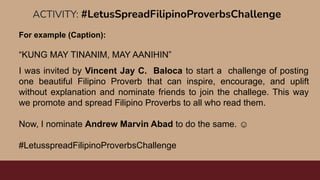
ACTIVITY: #LetusSpreadFilipinoProverbsChallenge
For example(Caption):
“KUNG MAY TINANIM, MAY AANIHIN”
I was invited by Vincent Jay C. Baloca to start a challenge of posting
one beautiful Filipino Proverb that can inspire, encourage, and uplift
without explanation and nominate friends to join the challege. This way
we promote and spread Filipino Proverbs to all who read them.
Now, I nominate Andrew Marvin Abad to do the same. ☺
#LetusspreadFilipinoProverbsChallenge
42.
ACTIVITY: BUGTONG-BUGTONG
The groupwill do this online as well. Each
member of the group will post 3 riddles on their
timeline (the riddles chosen/posted of one
member must be different from other members.
43.
ACTIVITY: BUGTONG-BUGTONG
Then, theywill let their friends guess what's the
answer of the Bugtong on the comment section
(Minimum of 5 friends who give their answer,
before the member who posted the Bugtong will
reveal the answer on the comment section).
44.
ACTIVITY: BUGTONG-BUGTONG
This isa great way to bring back the fun of
answering the riddles and reminding our
Facebook friends that we can still play riddles in
our leisure time.
45.
ACTIVITY: GEN ZREADING LO-A
Each member of the group will upload on his/her
Facebook timeline and stories a video clip of him/her
reciting a LO-A using TikTok Application with
emotions, expressions, and background music.
They can make their own LO-A or ask some
examples from the reporters.
46.
ACTIVITY: TARA SAMAHANNIYO KAMI:
Exploring Philippine Myths and Legends
The group will explore 3 Philippine Myths or Legends
they are interested in by responding to the questions
below.
a) Who are the characters? What is the setting?
Briefly explain what happens.
b) Who is the intended audience? What is the
myth/legend telling the audience?
47.
ACTIVITY: TARA SAMAHANNIYO KAMI:
Exploring Philippine Myths and Legends
c.) What is the purpose of this myth/legend for the
people it was created by?
d.) Is the myth or legend true or not? Discuss.
e.) Discuss how this myth has been passed down
through the generations.
48.
ACTIVITY: TARA SAMAHANNIYO KAMI:
Exploring Philippine Myths and Legends
Then, all of the members will post those
information's on their personal Facebook timeline
(attached the photo or covers of myth/legend if
available)
49.
ACTIVITY: BAGANI: PHILIPPINEEPIC HEROES
APPRECIATION
Look for 4 Epic Heroes from the Philippines. It may
be their picture, a painting, or a sculpture, or a cover
of the book. Then, each member will create their own
version of it. Write the original name of the hero and
make your own name of your appropriated/imitated
images of the epic hero. Afterwards, all members will
upload it on Facebook.


![Establishing Context
[defining folk-epic]
• narratives of sustained length,
• based on oral tradition,
• revolving around supernatural events or heroic deeds,
• in the form of verse,
• which is either chanted or sung, and;
• with a certain seriousness of purpose, embodying or validating the
beliefs, customs, ideals, or life values of the people](https://image.slidesharecdn.com/oral-lore-report-final-240123140136-93ebc246/85/Oral-Lore-report-powerpoint-presentation-30-320.jpg)
![Establishing Context
[Structure of folk-epic]
•Introduction
•Rising Action
•Climax
•Falling Action
•Resolution
•Denouement](https://image.slidesharecdn.com/oral-lore-report-final-240123140136-93ebc246/85/Oral-Lore-report-powerpoint-presentation-31-320.jpg)