LITERARY CRITICISM
Prepared by:
Jenalyn L. Bayawa, LPT,MEd-RLL
Purposes and benefits of
literature studies
 1. Cultural understanding: Literature provides a window into
different cultures, time periods, and ways of life, helping readers
to gain a better understanding of the world and the people
around them.
 2. Emotional growth: Literature can evoke strong emotions in
readers, helping them to understand and process their own
feelings and experiences.
 3. Personal development: Literature can provide readers with new
perspectives, ideas and challenges, and can inspire personal
growth and self-discovery.
 4. Language development: Reading literature can
help to improve vocabulary, grammar, and
comprehension skills.
 5. Critical thinking: Literature encourages readers to
think critically about the themes and ideas presented
in the text, to analyze characters and plot, and to
consider the author's purpose and message.
 6. Entertainment: Literature can be a source of
pleasure and enjoyment, providing readers with an
escape from the daily routine, and a way to relax and
unwind.
Literature studies also provide an opportunity to
develop analytical, interpretive and creative skills.
Through the study of literature, one will learn how
to think critically, creatively, and independently. It
will also develop an appreciation for the art of
writing and storytelling. Furthermore, it is a way
of exploring and understanding different aspects
of human experiences and emotions.
Literary Genres
1. Fiction: Narratives that are not based on real events, including
novels, short stories, and novellas.
2. Non-fiction: Narratives that are based on real events, including
biographies, memoirs, and history books.
3. Poetry: Literature that uses rhythm, imagery, and figurative
language to convey meaning.
4. Drama: Literature that is meant to be performed on stage,
including plays, musicals, and operas.
5. Science fiction: Literature that explores the possibilities of
science, technology, and space.
 6. Fantasy: Literature that includes elements of magic and
the supernatural.
 7. Mystery: Literature that focuses on the solving of a
crime or puzzle.
 8. Romance: Literature that focuses on the romantic
relationships between characters.
 9. Horror: Literature that aims to elicit fear and terror in
the reader.
 10.Novel: A long prose narrative that tells a story of
human experience through the use of connected
characters, events, and themes.
 11. Short story: a brief work of fiction that typically
focuses on a single incident or character.
Literary Techniques
 1. Symbolism: The use of symbols to represent ideas or concepts.
 2. Imagery: The use of descriptive language to create vivid mental
images.
 3. Metaphor: A figure of speech in which a word or phrase is
applied to an object or action to which it is not literally applicable.
 4. Simile: A figure of speech in which two unlike things are explicitly
compared, often in a phrase introduced by "like" or "as".
 5. Personification: The attribution of human characteristics to non-
human entities.
 6. Irony: The use of words or situations to convey a meaning that is the
opposite of its literal meaning.
 7. Hyperbole: An exaggeration used for emphasis or effect.
 8. Allusion: An indirect reference to a person, place, or event from
history or literature.
 9. Foreshadowing: The use of hints or clues to suggest what will
happen later in a story.
 10. Flashback: A scene or event from the past that interrupts the normal
chronological order of a story
 11. Stream of consciousness: a narrative mode that seeks to portray an
individual's point of view by giving the written equivalent of the
character's thought processes, either in a loose interior monologue, or
in connection to his or her sensory feelings.
What is literary criticism?
 It is the study, evaluation and interpretation of
literature.
 It aims to understand the various aspects of literature
such as:
meaning, structure, style, context
- Literary criticism can be applied to any literary work
including poetry, fiction, drama, songs and non-fiction
Purposes and benefits of
literary criticism
 Its purpose is to understand the literary work
on a deeper level, including its meaning,
context and literary technique used.
 The benefits of literary criticism include a
better understanding and appreciation of the
literary works as well as the insights into the
author’s intentions, themes, and the cultural
and historical context in which the work was
written
 It can also help to improve critical reading and
writing skills, and can inform the creation of
new literature.
Literary discussion vs. Literary
analysis vs. Literary interpretation
Literary discussion – a general
conversation or exchange of ideas about
a literary work.
It can involve sharing opinions and
personal reactions to the work, as well as
discussing the work’s theme, characters
and literary techniques
Literary analysis – a more in-depth and
systematic examination of a literary piece.
It involves breaking down the work to
understand its various components, such as its
structure, style and symbolism
The goal is to understand how the various
elements of the work contribute to its overall
meaning and effect.
 Literary interpretation – the process of explaining the
meaning of a literary work, based on the analysis of its
various elements.
This can include identifying the themes, symbols and
motifs present in the work.
Helps in understanding the historical and cultural
context in which it was written.
Provides a deeper understanding of the work and its
significance.
Literary discussion ----------------- casual conversation
about a literary piece.
Literary analysis -------------------- structured examination
of a literary piece
Literary interpretation ----------------- in-depth
understanding of the literary piece; provides explanation of
its meaning
Periods and Movements in
Literature
 1. The Ancient World: This period includes literature from
ancient civilizations such as Greece and Rome. Works from
this period often focus on mythological stories and epic
poems, such as Homer's "Iliad" and "Odyssey.“
 2. The Middle Ages: This period, also known as the
Medieval period, covers the time between the fall of the
Roman Empire and the beginning of the Renaissance.
Literature from this period is often religious in nature, such
as the stories of King Arthur, and often written in the form
of epic poetry or romance.
3. The Renaissance: The Renaissance was a
time of great cultural and artistic revival,
and literature from this period reflects the
new ideas and perspectives of the time.
Works from this period often focus on
humanism and individualism, and are
marked by a renewed interest in classical
literature and culture. Shakespeare's plays
are a prominent example of this period.
 4. The Baroque: This period, which is usually considered as the
late 16th century to the early 18th century, is marked by
grandiose and ornate literary style, rich in metaphor and
allusion, and often with a religious or mythological theme.
Milton's "Paradise Lost" is a well-known example of baroque
literature.
 5. The Enlightenment: This period, also known as the Age of
Reason, covers the 18th century and is characterized by a focus
on reason, science, and individual rights. Literature from this
period often reflects the ideas of the Enlightenment, such as
Voltaire's "Candide," which satirizes the idea of a perfect world.
 6. The Romantic Period: This period covers the late
18th and early 19th centuries and is characterized by a
focus on emotion, nature, and the individual. Poetry
from this period, such as Keats' poetry, often
emphasizes the power of the imagination and the
beauty of nature.
 7. The Victorian Period: The Victorian period covers
the reign of Queen Victoria, from 1837 to 1901.
Literature from this period often reflects the social and
moral values of the time, such as Dickens' "Oliver
Twist," which highlights the plight of the poor in
Victorian society.
 8. The Modernist Movement: The Modernist movement covers
the early 20th century and is characterized by a rejection of
traditional forms and a focus on experimentation and
fragmentation. Joyce's "Ulysses" is a prominent example of
modernist literature.
 9. The Postmodern Movement: This movement, which began
in the mid-20th century, is characterized by a rejection of the
grand narratives and ideologies of modernism, and an emphasis
on self- referentiality, irony, and pastiche. Pynchon's "Gravity's
Rainbow" is a well-known example of postmodern literature.
 10. The Gothic Movement: This movement, which began in
the late 18th century and continued into the 19th century, is
characterized by dark and mysterious themes, such as the
supernatural, horror, and the macabre. Works such as Edgar
Allan Poe's stories and Bram Stoker's "Dracula" are examples of
Gothic literature.
 11. The Realist Movement: This movement, which began in
the mid-19th century, is characterized by a focus on the
accurate portrayal of everyday life and society. Works such as
Gustave Flaubert's "Madame Bovary" and Leo Tolstoy's "Anna
Karenina" are examples of Realist literature.
12. The Naturalist Movement: This movement, which
began in the late 19th century, is characterized by a
focus on the scientific study of humanity and society.
Works such as Emile Zola's "Germinal" and Stephen
Crane's "The Red Badge of Courage" are examples of
Naturalist literature.
13. The Surrealist Movement: This movement, which
began in the 1920s, is characterized by the use of
irrational imagery and the subconscious in literature.
Works such as Andre Breton's "Surrealist Manifesto"
and Salvador Dalí's "The Persistence of Memory" are
examples of Surrealist literature.
 14. The Beat Movement: This movement, which began in the
1950s, is characterized by a focus on personal freedom, non-
conformity, and the rejection of mainstream culture. Works such
as Jack Kerouac's "On the Road" and Allen Ginsberg's "Howl"
are examples of Beat literature.
 15. The Feminist Movement: This movement, which began in
the 1960s, is characterized by a focus on women's rights and
the representation of women in literature. Works such as
Simone de Beauvoir's "The Second Sex" and Virginia Woolf's "A
Room of One's Own" are examples of feminist literature.
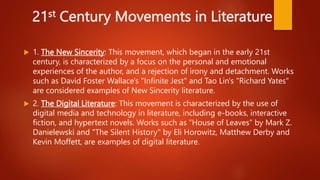
21st Century Movements in Literature
 1. The New Sincerity: This movement, which began in the early 21st
century, is characterized by a focus on the personal and emotional
experiences of the author, and a rejection of irony and detachment. Works
such as David Foster Wallace's "Infinite Jest" and Tao Lin's "Richard Yates"
are considered examples of New Sincerity literature.
 2. The Digital Literature: This movement is characterized by the use of
digital media and technology in literature, including e-books, interactive
fiction, and hypertext novels. Works such as "House of Leaves" by Mark Z.
Danielewski and "The Silent History" by Eli Horowitz, Matthew Derby and
Kevin Moffett, are examples of digital literature.
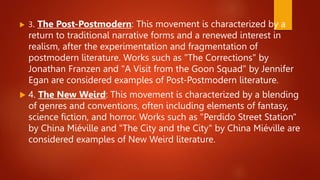
 3. The Post-Postmodern: This movement is characterized by a
return to traditional narrative forms and a renewed interest in
realism, after the experimentation and fragmentation of
postmodern literature. Works such as "The Corrections" by
Jonathan Franzen and "A Visit from the Goon Squad" by Jennifer
Egan are considered examples of Post-Postmodern literature.
 4. The New Weird: This movement is characterized by a blending
of genres and conventions, often including elements of fantasy,
science fiction, and horror. Works such as "Perdido Street Station"
by China Miéville and "The City and the City" by China Miéville are
considered examples of New Weird literature.
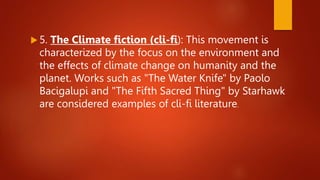
 5. The Climate fiction (cli-fi): This movement is
characterized by the focus on the environment and
the effects of climate change on humanity and the
planet. Works such as "The Water Knife" by Paolo
Bacigalupi and "The Fifth Sacred Thing" by Starhawk
are considered examples of cli-fi literature.

LITERARY-CRITICISM.pptx

  • 1.
  • 2.
    Purposes and benefitsof literature studies  1. Cultural understanding: Literature provides a window into different cultures, time periods, and ways of life, helping readers to gain a better understanding of the world and the people around them.  2. Emotional growth: Literature can evoke strong emotions in readers, helping them to understand and process their own feelings and experiences.  3. Personal development: Literature can provide readers with new perspectives, ideas and challenges, and can inspire personal growth and self-discovery.
  • 3.
     4. Languagedevelopment: Reading literature can help to improve vocabulary, grammar, and comprehension skills.  5. Critical thinking: Literature encourages readers to think critically about the themes and ideas presented in the text, to analyze characters and plot, and to consider the author's purpose and message.  6. Entertainment: Literature can be a source of pleasure and enjoyment, providing readers with an escape from the daily routine, and a way to relax and unwind.
  • 4.
    Literature studies alsoprovide an opportunity to develop analytical, interpretive and creative skills. Through the study of literature, one will learn how to think critically, creatively, and independently. It will also develop an appreciation for the art of writing and storytelling. Furthermore, it is a way of exploring and understanding different aspects of human experiences and emotions.
  • 5.
    Literary Genres 1. Fiction:Narratives that are not based on real events, including novels, short stories, and novellas. 2. Non-fiction: Narratives that are based on real events, including biographies, memoirs, and history books. 3. Poetry: Literature that uses rhythm, imagery, and figurative language to convey meaning. 4. Drama: Literature that is meant to be performed on stage, including plays, musicals, and operas. 5. Science fiction: Literature that explores the possibilities of science, technology, and space.
  • 6.
     6. Fantasy:Literature that includes elements of magic and the supernatural.  7. Mystery: Literature that focuses on the solving of a crime or puzzle.  8. Romance: Literature that focuses on the romantic relationships between characters.  9. Horror: Literature that aims to elicit fear and terror in the reader.  10.Novel: A long prose narrative that tells a story of human experience through the use of connected characters, events, and themes.  11. Short story: a brief work of fiction that typically focuses on a single incident or character.
  • 7.
    Literary Techniques  1.Symbolism: The use of symbols to represent ideas or concepts.  2. Imagery: The use of descriptive language to create vivid mental images.  3. Metaphor: A figure of speech in which a word or phrase is applied to an object or action to which it is not literally applicable.  4. Simile: A figure of speech in which two unlike things are explicitly compared, often in a phrase introduced by "like" or "as".  5. Personification: The attribution of human characteristics to non- human entities.
  • 8.
     6. Irony:The use of words or situations to convey a meaning that is the opposite of its literal meaning.  7. Hyperbole: An exaggeration used for emphasis or effect.  8. Allusion: An indirect reference to a person, place, or event from history or literature.  9. Foreshadowing: The use of hints or clues to suggest what will happen later in a story.  10. Flashback: A scene or event from the past that interrupts the normal chronological order of a story  11. Stream of consciousness: a narrative mode that seeks to portray an individual's point of view by giving the written equivalent of the character's thought processes, either in a loose interior monologue, or in connection to his or her sensory feelings.
  • 9.
    What is literarycriticism?  It is the study, evaluation and interpretation of literature.  It aims to understand the various aspects of literature such as: meaning, structure, style, context - Literary criticism can be applied to any literary work including poetry, fiction, drama, songs and non-fiction
  • 10.
    Purposes and benefitsof literary criticism
  • 11.
     Its purposeis to understand the literary work on a deeper level, including its meaning, context and literary technique used.  The benefits of literary criticism include a better understanding and appreciation of the literary works as well as the insights into the author’s intentions, themes, and the cultural and historical context in which the work was written  It can also help to improve critical reading and writing skills, and can inform the creation of new literature.
  • 12.
    Literary discussion vs.Literary analysis vs. Literary interpretation Literary discussion – a general conversation or exchange of ideas about a literary work. It can involve sharing opinions and personal reactions to the work, as well as discussing the work’s theme, characters and literary techniques
  • 13.
    Literary analysis –a more in-depth and systematic examination of a literary piece. It involves breaking down the work to understand its various components, such as its structure, style and symbolism The goal is to understand how the various elements of the work contribute to its overall meaning and effect.
  • 14.
     Literary interpretation– the process of explaining the meaning of a literary work, based on the analysis of its various elements. This can include identifying the themes, symbols and motifs present in the work. Helps in understanding the historical and cultural context in which it was written. Provides a deeper understanding of the work and its significance.
  • 15.
    Literary discussion -----------------casual conversation about a literary piece. Literary analysis -------------------- structured examination of a literary piece Literary interpretation ----------------- in-depth understanding of the literary piece; provides explanation of its meaning
  • 16.
    Periods and Movementsin Literature
  • 17.
     1. TheAncient World: This period includes literature from ancient civilizations such as Greece and Rome. Works from this period often focus on mythological stories and epic poems, such as Homer's "Iliad" and "Odyssey.“  2. The Middle Ages: This period, also known as the Medieval period, covers the time between the fall of the Roman Empire and the beginning of the Renaissance. Literature from this period is often religious in nature, such as the stories of King Arthur, and often written in the form of epic poetry or romance.
  • 18.
    3. The Renaissance:The Renaissance was a time of great cultural and artistic revival, and literature from this period reflects the new ideas and perspectives of the time. Works from this period often focus on humanism and individualism, and are marked by a renewed interest in classical literature and culture. Shakespeare's plays are a prominent example of this period.
  • 19.
     4. TheBaroque: This period, which is usually considered as the late 16th century to the early 18th century, is marked by grandiose and ornate literary style, rich in metaphor and allusion, and often with a religious or mythological theme. Milton's "Paradise Lost" is a well-known example of baroque literature.  5. The Enlightenment: This period, also known as the Age of Reason, covers the 18th century and is characterized by a focus on reason, science, and individual rights. Literature from this period often reflects the ideas of the Enlightenment, such as Voltaire's "Candide," which satirizes the idea of a perfect world.
  • 20.
     6. TheRomantic Period: This period covers the late 18th and early 19th centuries and is characterized by a focus on emotion, nature, and the individual. Poetry from this period, such as Keats' poetry, often emphasizes the power of the imagination and the beauty of nature.  7. The Victorian Period: The Victorian period covers the reign of Queen Victoria, from 1837 to 1901. Literature from this period often reflects the social and moral values of the time, such as Dickens' "Oliver Twist," which highlights the plight of the poor in Victorian society.
  • 21.
     8. TheModernist Movement: The Modernist movement covers the early 20th century and is characterized by a rejection of traditional forms and a focus on experimentation and fragmentation. Joyce's "Ulysses" is a prominent example of modernist literature.  9. The Postmodern Movement: This movement, which began in the mid-20th century, is characterized by a rejection of the grand narratives and ideologies of modernism, and an emphasis on self- referentiality, irony, and pastiche. Pynchon's "Gravity's Rainbow" is a well-known example of postmodern literature.
  • 22.
     10. TheGothic Movement: This movement, which began in the late 18th century and continued into the 19th century, is characterized by dark and mysterious themes, such as the supernatural, horror, and the macabre. Works such as Edgar Allan Poe's stories and Bram Stoker's "Dracula" are examples of Gothic literature.  11. The Realist Movement: This movement, which began in the mid-19th century, is characterized by a focus on the accurate portrayal of everyday life and society. Works such as Gustave Flaubert's "Madame Bovary" and Leo Tolstoy's "Anna Karenina" are examples of Realist literature.
  • 23.
    12. The NaturalistMovement: This movement, which began in the late 19th century, is characterized by a focus on the scientific study of humanity and society. Works such as Emile Zola's "Germinal" and Stephen Crane's "The Red Badge of Courage" are examples of Naturalist literature. 13. The Surrealist Movement: This movement, which began in the 1920s, is characterized by the use of irrational imagery and the subconscious in literature. Works such as Andre Breton's "Surrealist Manifesto" and Salvador Dalí's "The Persistence of Memory" are examples of Surrealist literature.
  • 24.
     14. TheBeat Movement: This movement, which began in the 1950s, is characterized by a focus on personal freedom, non- conformity, and the rejection of mainstream culture. Works such as Jack Kerouac's "On the Road" and Allen Ginsberg's "Howl" are examples of Beat literature.  15. The Feminist Movement: This movement, which began in the 1960s, is characterized by a focus on women's rights and the representation of women in literature. Works such as Simone de Beauvoir's "The Second Sex" and Virginia Woolf's "A Room of One's Own" are examples of feminist literature.
  • 25.
    21st Century Movementsin Literature  1. The New Sincerity: This movement, which began in the early 21st century, is characterized by a focus on the personal and emotional experiences of the author, and a rejection of irony and detachment. Works such as David Foster Wallace's "Infinite Jest" and Tao Lin's "Richard Yates" are considered examples of New Sincerity literature.  2. The Digital Literature: This movement is characterized by the use of digital media and technology in literature, including e-books, interactive fiction, and hypertext novels. Works such as "House of Leaves" by Mark Z. Danielewski and "The Silent History" by Eli Horowitz, Matthew Derby and Kevin Moffett, are examples of digital literature.
  • 26.
     3. ThePost-Postmodern: This movement is characterized by a return to traditional narrative forms and a renewed interest in realism, after the experimentation and fragmentation of postmodern literature. Works such as "The Corrections" by Jonathan Franzen and "A Visit from the Goon Squad" by Jennifer Egan are considered examples of Post-Postmodern literature.  4. The New Weird: This movement is characterized by a blending of genres and conventions, often including elements of fantasy, science fiction, and horror. Works such as "Perdido Street Station" by China Miéville and "The City and the City" by China Miéville are considered examples of New Weird literature.
  • 27.
     5. TheClimate fiction (cli-fi): This movement is characterized by the focus on the environment and the effects of climate change on humanity and the planet. Works such as "The Water Knife" by Paolo Bacigalupi and "The Fifth Sacred Thing" by Starhawk are considered examples of cli-fi literature.