Tips on using my ppt.
1. You can freely download, edit, modify and put your
name etc.
2. Don’t be concerned about number of slides. Half the
slides are blanks except for the title.
3. First show the blank slides (eg. Aetiology ) > Ask
students what they already know about ethology of
today's topic. > Then show next slide which enumerates
aetiologies.
4. At the end rerun the show – show blank> ask questions >
show next slide.
5. This will be an ACTIVE LEARNING SESSION x
three revisions.
6. Good for self study also.
7. See notes for bibliography.
Learning Objectives
Learning Objectives
1. Introduction & History
2. Relevant Anatomy, Physiology
3. Aetiology
4. Pathophysiology
5. Pathology
6. Classification
7. Clinical Features
8. Investigations
9. Management
10. Prevention
11. Guidelines
12. Take home messages
Introduction & History.
•
Introduction & History.
• Aka. OSCC Oral Squamous Cell
Carcinoma.
• Mouth (oral) cancer is a major neoplasm
worldwide and accounts for most head and
neck cancers.
• It theoretically should be largely
preventable or detectable at an early stage
but it is not.
• Approximately 90% of oral cancers are
SCC,
Introduction & History.
• Seen typically on the lateral border of the
tongue, oropharynx, and floor of the mouth,
• as a red lesion (erythroplakia), white lesion
(leukoplakia), or a mix of the two
(erythroleukoplakia) with an ulcer.
Aetiology
Aetiology
• Idiopathic
• Congenital/ Genetic
• Nutritional Deficiency/excess
• Traumatic
• Infections /Infestation
• Autoimmune
• Neoplastic (Benign/Malignant)
• Degenerative / lifestyle
• Iatrogenic
• Psychosomatic
• Poisoning/ Toxins/ Drug induced
Aetiology
• Idiopathic
• Congenital/Genetic
• Traumatic
• Infections /Infestation
• Autoimmune
• Neoplastic (Benign/Malignant)
• Degenerative
• Iatrogenic
Aetiology
• Multifactorial and strongly related to
lifestyle, mostly habits and diet (particularly
tobacco alone or in combination with betel,
and alcohol use.
• Ca. oropharynx, possible due to human
papillomavirus (HPV).
• Immune defects or immunosuppression,
defects of carcinogen metabolism, or
defects in DNA-repair enzymes underlie
some cases of SCC.
• Sunlight exposure predisposes to lip cancer.
Aetiology
• Tobacco and alcohol use
• Betel-quid chewing and oral snuff
• diet low in fresh vegetables and fruits
• human papillomaviruses (HPVs)
• Cigarette smoking:
• Oral health
• Mouthwash use: The effect of the alcohol in
mouthwash appears to be similar to that of
alcohol used for drinking,
Aetiology
• oral submucous fibrosis
• oral lichen planus
• lupus erythematosus
• dyskeratosis congenita
• Fanconi anemia).
Pathophysiology
Pathophysiology
• The genetic aberrations involving
chromosomes 9, 3, 17, 13, and 11.
• Inactivated TSGs (Tumor Supressor Genes)
especially P16, and TP53 in western
countries
• Overexpressed oncogenes,
especially PRAD1 and Harvey ras (H-ras).
In Indians.
• Defective Carcinogen-metabolizing
enzymes
Pathophysiology
• Defective Carcinogen-metabolizing enzymes –
– alcohol dehydrogenase type 3 genotypes
– Cytochrome P450
– GSTM1 has a decreased capacity to detoxify
tobacco carcinogens.
– N-acetyl transferase NAT1*10 genotypes.
• Defective DNA repair genes has also been found
to underlie some OSCCs.
• An immune deficiency state may predispose one
to a higher risk of developing OSCC, especially
lip cancer.
Pathology
•
Pathology
• nests and islands of squamous cells invading the
underlying connective tissue.
• aberrant keratinization, forming whorls of keratin
within
• Poorly differentiated OSCC consists of sheets of
cells showing extreme pleomorphism, giant
nuclei, and multiple and bizarre mitoses difficult
to distinguish from other malignancies,
particularly poorly differentiated lymphoma or
melanoma.
• mmunocytochemical markers such as keratins,
common leukocyte antigen, and melanoma-
specific antibodies
Clinical Features
•
Clinical Features
• Demography
• Symptoms
• Signs
• Prognosis
• Complications
Demography
Demography
• The oral cavity is one of the 10 most
frequent sites of cancer internationally.
• OSCC is particularly common in the
developing world, mostly in older males.
• In parts of India, oral cancer can represent
more than 50% of all cancers.
• The prevalence of lip cancer appears to be
decreasing, but the prevalence of intraoral
cancer appears to be rising in many
countries, especially in younger people and
women.
Demography
• Race -higher (by approximately 50%) in
blacks compared with whites.
• More in males but equalising.
• occurs in middle-aged and older persons.
However, in recent years, an increase in
younger patients
7Warning Signs of Cancer
.
7Warning Signs of Cancer
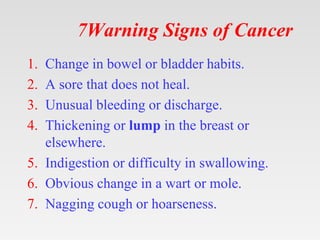
1. Change in bowel or bladder habits.
2. A sore that does not heal.
3. Unusual bleeding or discharge.
4. Thickening or lump in the breast or
elsewhere.
5. Indigestion or difficulty in swallowing.
6. Obvious change in a wart or mole.
7. Nagging cough or hoarseness.
History
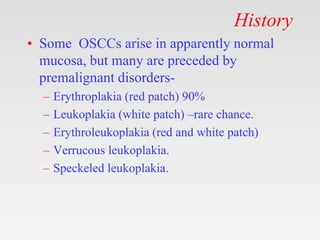
• Some OSCCs arise in apparently normal
mucosa, but many are preceded by
premalignant disorders-
– Erythroplakia (red patch) 90%
– Leukoplakia (white patch) –rare chance.
– Erythroleukoplakia (red and white patch)
– Verrucous leukoplakia.
– Speckeled leukoplakia.
Symptoms
Symptoms
• A red lesion (erythroplakia)
• A granular ulcer with fissuring or raised
exophytic margins
• A white or mixed white and red lesion
• An indurated lump/ulcer (ie, a firm
infiltration beneath the mucosa)
• A nonhealing extraction socket
• A lesion fixed to deeper tissues or to
overlying skin or mucosa
• Cervical lymph node enlargement,
Symptoms
• Early carcinomas may not be painful
• later, they may cause pain and difficulty
with speech and swallowing.
Signs
Signs
• The most common sites tongue, mainly the
lateral and ventrolateral aspects, and the
floor of the mouth.
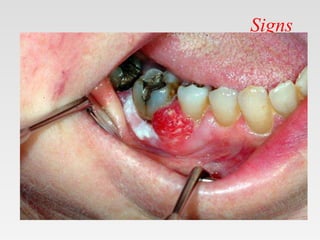
• Ulcers, red or white areas, lumps, or
fissures.
• Red oral lesions usually are more dangerous
than white oral lesions.
• Erythroplakia is a red and often velvety
lesion, which, unlike leukoplakias, may not
form a plaque but is level with or depressed
below the surrounding mucosa
Signs
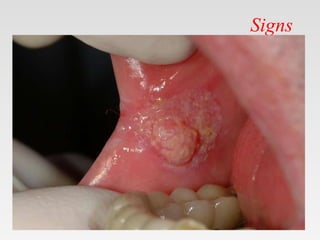
• Lesions always must be palpated after
inspection to detect induration and fixation
to deeper tissues.
• Some OSCC can also appear as a white
patch.
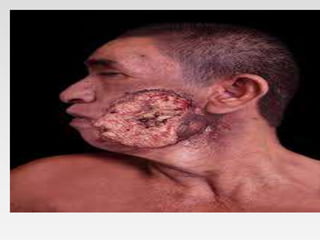
• Late OSCC may manifest as an exophytic
lesion or an area of ulceration with
induration
• A typical malignant ulcer is hard with
heaped-up and often everted or rolled edges
and a granular floor,
Signs
• RULE Any single lesion that persists more
than 3 weeks, especially if red, ulcerated, or
a lump, especially with induration (ie, the
RULE mnemonic) should be regarded with
suspicion and a histopathological diagnosis
established.
Signs
•
Signs
•
Signs
•
Signs
• Second primary tumors are additional
primary carcinomas (synchronous tumors)
present in as many as 10-15% .
• From 30-80% of patients with oral cancer
have metastases in the cervical lymph nodes
at presentation.
• Later, dissemination to the lungs, liver, or
bones may occur.
Prognosis
Prognosis
• Depends on stage.
• 5-year survival rate for oral and pharyngeal
cancers is approximately 66%.
• Lip carcinomas generally has the best 5-
year survival rate (88%)
• floor of mouth has the worst (54%).
• HPV-positive tumors tend to respond better
to chemotherapy and/or radiation therapy
compared with those with HPV-negative
tumors
Prognosis
• When OSCC is fatal, it almost always is
either because of failure to control the
primary tumor or because of nodal
metastases. Death resulting from distant
metastasis is unusual.
Investigations
Investigations
• Laboratory Studies
– Routine
– Special
• Imaging Studies
• Tissue diagnosis
– Cytology
• FNAC
– Histology
– Germ line Testing and Molecular Analysis
• Diagnostic Laparotomy.
Investigations
• Laboratory Studies
– Routine
– Special
• Imaging Studies
• Tissue diagnosis
– Cytology
• FNAC
– Histology
Investigations in Malignancy
•
Investigations in Malignancy
• For diagnosis
• For staging
• For Screening
• For Monitoring
Diagnostic Studies
Imaging Studies
Diagnostic Studies
Imaging Studies
• X-Ray
• USG
• CT
• Angiography
• MRI
• Endoscopy
• Nuclear scan PET CT Scan.
Diagnostic Studies
Imaging Studies
• Photography for monitoring the clinical
state and site of premalignant lesions.
• Chest radiography and endoscopy
synchronous second primary tumors
• Jaw radiography (often rotating
pantomography) may show invasion
• USG Abd.
• CT Chest
• PET scan
Diagnostic Studies
Histopathology
• Punch biopsy Avoid excisional biopsy
• Always take a biopsy specimen of the red
lesions if both red and white lesions are
present
• Guided biopsy by vital staining-
– Staining with toluidine blue followed by a rinse

with 1% acetic acid and then saline
– Various light sources are becoming available to
help delineate areas for biopsy
Differential Diagnosis
• Actinic Keratosis
• Erythroplasia
• Lichen Planus
• Lichenoid lesions
• Mucosal Candidiasis
• Traumatic lesion
TNM Classification
• .
TNM Classification
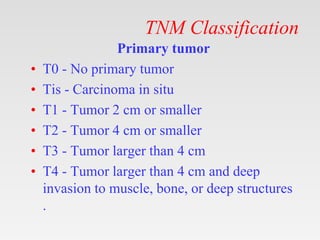
Primary tumor
• T0 - No primary tumor
• Tis - Carcinoma in situ
• T1 - Tumor 2 cm or smaller
• T2 - Tumor 4 cm or smaller
• T3 - Tumor larger than 4 cm
• T4 - Tumor larger than 4 cm and deep
invasion to muscle, bone, or deep structures
.
TNM Classification
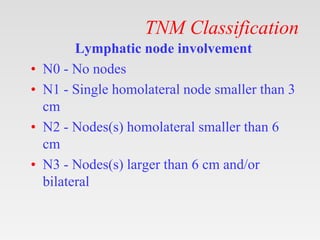
Lymphatic node involvement
• N0 - No nodes
• N1 - Single homolateral node smaller than 3
cm
• N2 - Nodes(s) homolateral smaller than 6
cm
• N3 - Nodes(s) larger than 6 cm and/or
bilateral
TNM Classification
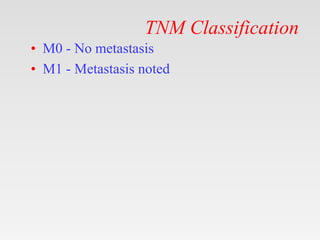
• M0 - No metastasis
• M1 - Metastasis noted
TNM Classification
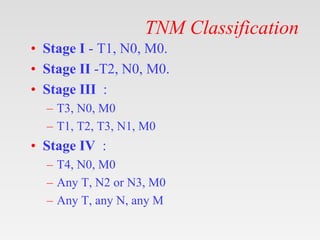
• Stage I - T1, N0, M0.
• Stage II -T2, N0, M0.
• Stage III :
– T3, N0, M0
– T1, T2, T3, N1, M0
• Stage IV :
– T4, N0, M0
– Any T, N2 or N3, M0
– Any T, any N, any M
Management
Management
• Surgery
• Radiotherapy
• Chemotherapy
• Targeted therapy
Management
• Oral squamous cell carcinoma (OSCC)
currently is treated largely by surgery
and/or irradiation.
• Photodynamic therapy and chemotherapy
have occasional applications
• There is an increased use of chemotherapy
including targeted therapy
Operative Therapy
Operative Therapy
• The goal of surgery for oral squamous cell
carcinoma (OSCC) is to remove the primary
tumor together with a margin of clinically
normal tissue.
• If at least one node has clinical signs of
invasion, a reasonable presumption is that
others may be involved and must be
removed by traditional radical neck
dissection.
• Reconstruction.
Operative Therapy
Advantages-
• Surgery provides complete tumor and
lymph node excision.
• A full histologic examination can be
performed for staging purposes and to help
predict prognosis and the need for adjuvant
radiotherapy.
• Surgery also provides another option of
treatment for radiotherapy-resistant tumors.
Operative Therapy
Disadvantages-
• Perioperative mortality and morbidity.
• aesthetic and functional defects.
Radiotherapy
Radiotherapy
• Advantages of radiotherapy
1. Normal anatomy and function are
maintained
2. General anesthesia is not needed.
• Disadvantages
1. adverse effects are common
2. Cure is uncommon, especially for large
tumors
3. Subsequent surgery is more difficult and
hazardous and survival is reduced further.
Radiotherapy:Adverse effects
• Short term complication- Oral mucositis
invariable
• Longer-term complications
1. dry mouth (xerostomia)
2. loss of taste
3. osteoradionecrosis (ORN) .of mandible.
Radiotherapy
1. External beam radiation (teletherapy),
which is commonly accompanied by
adverse effects,
2. Interstitial therapy
Interstitial therapy
1. Brachytherapy- intrralesional
2. Plesiotherapy – Surface therapy
• causes fewer complications but is suitable
only for tumors that are smaller than 2 cm
and located in selected sites.
Targeted therapy
• Cetuximab and panitumumab.
• Cetuximab
• Erlotinib and gefitinib
• Lapatinib
cancer-prevention tips.
• Don't use tobacco
• Avoid Alcohol
• Eat a healthy diet. ...
• Maintain a healthy weight and be physically
active. ...
• Protect yourself from the sun. ...
• Get vaccinated. ...
• Avoid risky behaviors. ...
• Get regular medical care.
• .
Prevention
Prevention
• Screening
• Risk reduction
Prevention
• Diet richer in vegetables and fruits
• Avoid Tobacco
• Avoid Betel nut, Paan, Gutkha
• Avoid alcohol consumption.
• Self examination.
• Good oral hygiene.
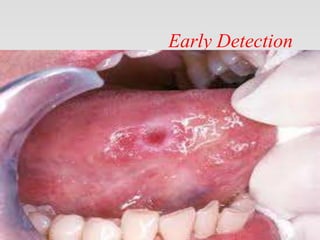
Early Detection
Early Detection
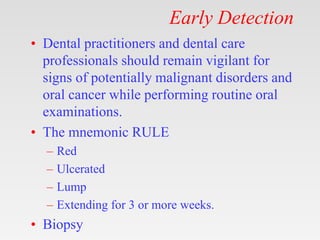
• Dental practitioners and dental care
professionals should remain vigilant for
signs of potentially malignant disorders and
oral cancer while performing routine oral
examinations.
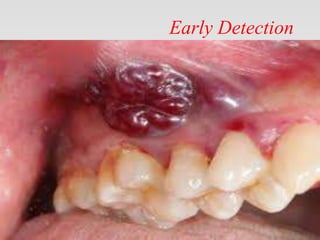
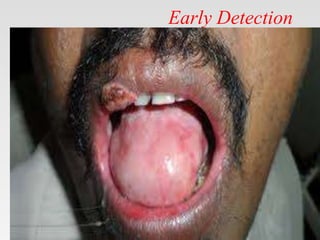
• The mnemonic RULE
– Red
– Ulcerated
– Lump
– Extending for 3 or more weeks.
• Biopsy
Early Detection
Early Detection
Early Detection
Get this ppt in mobile
1. Download Microsoft
PowerPoint from play
store.
2. Open Google assistant
3. Open Google lens.
4. Scan qr code from
next slide.
Get this ppt in mobile
Get my ppt collection
• https://www.slideshare.net/drpradeeppande/
edit_my_uploads
• https://www.dropbox.com/sh/x600md3cvj8
5woy/AACVMHuQtvHvl_K8ehc3ltkEa?dl
=0
• https://www.facebook.com/doctorpradeeppa
nde/?ref=pages_you_manage

Ca. Oral Cavity.pptx

  • 1.
    Tips on usingmy ppt. 1. You can freely download, edit, modify and put your name etc. 2. Don’t be concerned about number of slides. Half the slides are blanks except for the title. 3. First show the blank slides (eg. Aetiology ) > Ask students what they already know about ethology of today's topic. > Then show next slide which enumerates aetiologies. 4. At the end rerun the show – show blank> ask questions > show next slide. 5. This will be an ACTIVE LEARNING SESSION x three revisions. 6. Good for self study also. 7. See notes for bibliography.
  • 2.
  • 3.
    Learning Objectives 1. Introduction& History 2. Relevant Anatomy, Physiology 3. Aetiology 4. Pathophysiology 5. Pathology 6. Classification 7. Clinical Features 8. Investigations 9. Management 10. Prevention 11. Guidelines 12. Take home messages
  • 4.
  • 5.
    Introduction & History. •Aka. OSCC Oral Squamous Cell Carcinoma. • Mouth (oral) cancer is a major neoplasm worldwide and accounts for most head and neck cancers. • It theoretically should be largely preventable or detectable at an early stage but it is not. • Approximately 90% of oral cancers are SCC,
  • 6.
    Introduction & History. •Seen typically on the lateral border of the tongue, oropharynx, and floor of the mouth, • as a red lesion (erythroplakia), white lesion (leukoplakia), or a mix of the two (erythroleukoplakia) with an ulcer.
  • 7.
  • 8.
    Aetiology • Idiopathic • Congenital/Genetic • Nutritional Deficiency/excess • Traumatic • Infections /Infestation • Autoimmune • Neoplastic (Benign/Malignant) • Degenerative / lifestyle • Iatrogenic • Psychosomatic • Poisoning/ Toxins/ Drug induced
  • 9.
    Aetiology • Idiopathic • Congenital/Genetic •Traumatic • Infections /Infestation • Autoimmune • Neoplastic (Benign/Malignant) • Degenerative • Iatrogenic
  • 10.
    Aetiology • Multifactorial andstrongly related to lifestyle, mostly habits and diet (particularly tobacco alone or in combination with betel, and alcohol use. • Ca. oropharynx, possible due to human papillomavirus (HPV). • Immune defects or immunosuppression, defects of carcinogen metabolism, or defects in DNA-repair enzymes underlie some cases of SCC. • Sunlight exposure predisposes to lip cancer.
  • 11.
    Aetiology • Tobacco andalcohol use • Betel-quid chewing and oral snuff • diet low in fresh vegetables and fruits • human papillomaviruses (HPVs) • Cigarette smoking: • Oral health • Mouthwash use: The effect of the alcohol in mouthwash appears to be similar to that of alcohol used for drinking,
  • 12.
    Aetiology • oral submucousfibrosis • oral lichen planus • lupus erythematosus • dyskeratosis congenita • Fanconi anemia).
  • 13.
  • 14.
    Pathophysiology • The geneticaberrations involving chromosomes 9, 3, 17, 13, and 11. • Inactivated TSGs (Tumor Supressor Genes) especially P16, and TP53 in western countries • Overexpressed oncogenes, especially PRAD1 and Harvey ras (H-ras). In Indians. • Defective Carcinogen-metabolizing enzymes
  • 15.
    Pathophysiology • Defective Carcinogen-metabolizingenzymes – – alcohol dehydrogenase type 3 genotypes – Cytochrome P450 – GSTM1 has a decreased capacity to detoxify tobacco carcinogens. – N-acetyl transferase NAT1*10 genotypes. • Defective DNA repair genes has also been found to underlie some OSCCs. • An immune deficiency state may predispose one to a higher risk of developing OSCC, especially lip cancer.
  • 16.
  • 17.
    Pathology • nests andislands of squamous cells invading the underlying connective tissue. • aberrant keratinization, forming whorls of keratin within • Poorly differentiated OSCC consists of sheets of cells showing extreme pleomorphism, giant nuclei, and multiple and bizarre mitoses difficult to distinguish from other malignancies, particularly poorly differentiated lymphoma or melanoma. • mmunocytochemical markers such as keratins, common leukocyte antigen, and melanoma- specific antibodies
  • 18.
  • 19.
    Clinical Features • Demography •Symptoms • Signs • Prognosis • Complications
  • 20.
  • 21.
    Demography • The oralcavity is one of the 10 most frequent sites of cancer internationally. • OSCC is particularly common in the developing world, mostly in older males. • In parts of India, oral cancer can represent more than 50% of all cancers. • The prevalence of lip cancer appears to be decreasing, but the prevalence of intraoral cancer appears to be rising in many countries, especially in younger people and women.
  • 22.
    Demography • Race -higher(by approximately 50%) in blacks compared with whites. • More in males but equalising. • occurs in middle-aged and older persons. However, in recent years, an increase in younger patients
  • 23.
  • 24.
    7Warning Signs ofCancer 1. Change in bowel or bladder habits. 2. A sore that does not heal. 3. Unusual bleeding or discharge. 4. Thickening or lump in the breast or elsewhere. 5. Indigestion or difficulty in swallowing. 6. Obvious change in a wart or mole. 7. Nagging cough or hoarseness.
  • 25.
    History • Some OSCCsarise in apparently normal mucosa, but many are preceded by premalignant disorders- – Erythroplakia (red patch) 90% – Leukoplakia (white patch) –rare chance. – Erythroleukoplakia (red and white patch) – Verrucous leukoplakia. – Speckeled leukoplakia.
  • 26.
  • 27.
    Symptoms • A redlesion (erythroplakia) • A granular ulcer with fissuring or raised exophytic margins • A white or mixed white and red lesion • An indurated lump/ulcer (ie, a firm infiltration beneath the mucosa) • A nonhealing extraction socket • A lesion fixed to deeper tissues or to overlying skin or mucosa • Cervical lymph node enlargement,
  • 28.
    Symptoms • Early carcinomasmay not be painful • later, they may cause pain and difficulty with speech and swallowing.
  • 29.
  • 30.
    Signs • The mostcommon sites tongue, mainly the lateral and ventrolateral aspects, and the floor of the mouth. • Ulcers, red or white areas, lumps, or fissures. • Red oral lesions usually are more dangerous than white oral lesions. • Erythroplakia is a red and often velvety lesion, which, unlike leukoplakias, may not form a plaque but is level with or depressed below the surrounding mucosa
  • 31.
    Signs • Lesions alwaysmust be palpated after inspection to detect induration and fixation to deeper tissues. • Some OSCC can also appear as a white patch. • Late OSCC may manifest as an exophytic lesion or an area of ulceration with induration • A typical malignant ulcer is hard with heaped-up and often everted or rolled edges and a granular floor,
  • 32.
    Signs • RULE Anysingle lesion that persists more than 3 weeks, especially if red, ulcerated, or a lump, especially with induration (ie, the RULE mnemonic) should be regarded with suspicion and a histopathological diagnosis established.
  • 33.
  • 34.
  • 35.
  • 37.
    Signs • Second primarytumors are additional primary carcinomas (synchronous tumors) present in as many as 10-15% . • From 30-80% of patients with oral cancer have metastases in the cervical lymph nodes at presentation. • Later, dissemination to the lungs, liver, or bones may occur.
  • 38.
  • 39.
    Prognosis • Depends onstage. • 5-year survival rate for oral and pharyngeal cancers is approximately 66%. • Lip carcinomas generally has the best 5- year survival rate (88%) • floor of mouth has the worst (54%). • HPV-positive tumors tend to respond better to chemotherapy and/or radiation therapy compared with those with HPV-negative tumors
  • 40.
    Prognosis • When OSCCis fatal, it almost always is either because of failure to control the primary tumor or because of nodal metastases. Death resulting from distant metastasis is unusual.
  • 41.
  • 42.
    Investigations • Laboratory Studies –Routine – Special • Imaging Studies • Tissue diagnosis – Cytology • FNAC – Histology – Germ line Testing and Molecular Analysis • Diagnostic Laparotomy.
  • 43.
    Investigations • Laboratory Studies –Routine – Special • Imaging Studies • Tissue diagnosis – Cytology • FNAC – Histology
  • 44.
  • 45.
    Investigations in Malignancy •For diagnosis • For staging • For Screening • For Monitoring
  • 46.
  • 47.
    Diagnostic Studies Imaging Studies •X-Ray • USG • CT • Angiography • MRI • Endoscopy • Nuclear scan PET CT Scan.
  • 48.
    Diagnostic Studies Imaging Studies •Photography for monitoring the clinical state and site of premalignant lesions. • Chest radiography and endoscopy synchronous second primary tumors • Jaw radiography (often rotating pantomography) may show invasion • USG Abd. • CT Chest • PET scan
  • 49.
    Diagnostic Studies Histopathology • Punchbiopsy Avoid excisional biopsy • Always take a biopsy specimen of the red lesions if both red and white lesions are present • Guided biopsy by vital staining- – Staining with toluidine blue followed by a rinse with 1% acetic acid and then saline – Various light sources are becoming available to help delineate areas for biopsy
  • 50.
  • 51.
    Differential Diagnosis • ActinicKeratosis • Erythroplasia • Lichen Planus • Lichenoid lesions • Mucosal Candidiasis • Traumatic lesion
  • 52.
  • 53.
    TNM Classification Primary tumor •T0 - No primary tumor • Tis - Carcinoma in situ • T1 - Tumor 2 cm or smaller • T2 - Tumor 4 cm or smaller • T3 - Tumor larger than 4 cm • T4 - Tumor larger than 4 cm and deep invasion to muscle, bone, or deep structures .
  • 54.
    TNM Classification Lymphatic nodeinvolvement • N0 - No nodes • N1 - Single homolateral node smaller than 3 cm • N2 - Nodes(s) homolateral smaller than 6 cm • N3 - Nodes(s) larger than 6 cm and/or bilateral
  • 55.
    TNM Classification • M0- No metastasis • M1 - Metastasis noted
  • 56.
    TNM Classification • StageI - T1, N0, M0. • Stage II -T2, N0, M0. • Stage III : – T3, N0, M0 – T1, T2, T3, N1, M0 • Stage IV : – T4, N0, M0 – Any T, N2 or N3, M0 – Any T, any N, any M
  • 57.
  • 58.
    Management • Surgery • Radiotherapy •Chemotherapy • Targeted therapy
  • 59.
    Management • Oral squamouscell carcinoma (OSCC) currently is treated largely by surgery and/or irradiation. • Photodynamic therapy and chemotherapy have occasional applications • There is an increased use of chemotherapy including targeted therapy
  • 60.
  • 61.
    Operative Therapy • Thegoal of surgery for oral squamous cell carcinoma (OSCC) is to remove the primary tumor together with a margin of clinically normal tissue. • If at least one node has clinical signs of invasion, a reasonable presumption is that others may be involved and must be removed by traditional radical neck dissection. • Reconstruction.
  • 62.
    Operative Therapy Advantages- • Surgeryprovides complete tumor and lymph node excision. • A full histologic examination can be performed for staging purposes and to help predict prognosis and the need for adjuvant radiotherapy. • Surgery also provides another option of treatment for radiotherapy-resistant tumors.
  • 63.
    Operative Therapy Disadvantages- • Perioperativemortality and morbidity. • aesthetic and functional defects.
  • 64.
  • 65.
    Radiotherapy • Advantages ofradiotherapy 1. Normal anatomy and function are maintained 2. General anesthesia is not needed. • Disadvantages 1. adverse effects are common 2. Cure is uncommon, especially for large tumors 3. Subsequent surgery is more difficult and hazardous and survival is reduced further.
  • 66.
    Radiotherapy:Adverse effects • Shortterm complication- Oral mucositis invariable • Longer-term complications 1. dry mouth (xerostomia) 2. loss of taste 3. osteoradionecrosis (ORN) .of mandible.
  • 67.
    Radiotherapy 1. External beamradiation (teletherapy), which is commonly accompanied by adverse effects, 2. Interstitial therapy
  • 68.
  • 69.
    Interstitial therapy 1. Brachytherapy-intrralesional 2. Plesiotherapy – Surface therapy • causes fewer complications but is suitable only for tumors that are smaller than 2 cm and located in selected sites.
  • 70.
    Targeted therapy • Cetuximaband panitumumab. • Cetuximab • Erlotinib and gefitinib • Lapatinib
  • 71.
  • 72.
    cancer-prevention tips. • Don'tuse tobacco • Avoid Alcohol • Eat a healthy diet. ... • Maintain a healthy weight and be physically active. ... • Protect yourself from the sun. ... • Get vaccinated. ... • Avoid risky behaviors. ... • Get regular medical care. • .
  • 73.
  • 74.
  • 75.
    Prevention • Diet richerin vegetables and fruits • Avoid Tobacco • Avoid Betel nut, Paan, Gutkha • Avoid alcohol consumption. • Self examination. • Good oral hygiene.
  • 76.
  • 77.
    Early Detection • Dentalpractitioners and dental care professionals should remain vigilant for signs of potentially malignant disorders and oral cancer while performing routine oral examinations. • The mnemonic RULE – Red – Ulcerated – Lump – Extending for 3 or more weeks. • Biopsy
  • 78.
  • 79.
  • 80.
  • 81.
    Get this pptin mobile 1. Download Microsoft PowerPoint from play store. 2. Open Google assistant 3. Open Google lens. 4. Scan qr code from next slide.
  • 82.
    Get this pptin mobile
  • 83.
    Get my pptcollection • https://www.slideshare.net/drpradeeppande/ edit_my_uploads • https://www.dropbox.com/sh/x600md3cvj8 5woy/AACVMHuQtvHvl_K8ehc3ltkEa?dl =0 • https://www.facebook.com/doctorpradeeppa nde/?ref=pages_you_manage

Editor's Notes

  • #2 drpradeeppande@gmail.com 7697305442
  • #6  https://emedicine.medscape.com/article/1075729-overview
  • #18 ker·a·tin·i·za·tion. noun. The process by which vertebrate epithelial cells become filled with keratin protein filaments, die, and form tough, resistant structures such as skin, nails, and feathers