SAGE Computing Services
Customised Oracle Training Workshops and Consulting
‘n’ methods to improve Apex performance
Why stop at 10?
Scott Wesley
Systems Consultant & Trainer
who_am_i;
http://strategy2c.wordpress.com/2009/01/10/strategy-for-goldfish-funny-illustration-by-frits/
Agenda
• Introduction
• Prevention
• Fluff
• Diagnosis
• Fluff
• Time Management
• Fluff
• Conclusion
• Drinks
Larry Lessig?
the law is strangling creativity
http://www.ted.com/talks/larry_lessig_says_the_law_is_strangling_creativity.html
http://presentationzen.blogs.com/presentationzen/2005/10/the_lessig_meth.html
This presentation
what you can
explore
prevention - innovate
time management - educate
diagnosis - interact
not just Apex - maximise
prevention - innovate
time management - educate
diagnosis - interact
not just Apex - maximise
example
checkboxes
begin
<< chk >>
for i in 1.. apex_application.g_f20.count loop
update resources set deleted = 'Y'
where code = apex_application.g_f20(i);
end loop chk;
end;
begin
forall i in indices of apex_application.g_f20
update resources set deleted = 'Y'
where code = apex_application.g_f20(i);
end;
http://www.perthnow.com.au/sport/fremantle-defender-chris-tarrant-in-doubt-for-afl-
finals/story-e6frg1wu-1225899762230
move away from Oracle Forms (to Apex)
authentication
LDAP
FUNCTION return_ldap_groups
RETURN t_ldap_group PIPELINED;
CREATE OR REPLACE TYPE
r_ldap_group
AS OBJECT
(username VARCHAR2(100)
,group_name VARCHAR2(100))
/
CREATE OR REPLACE TYPE
t_ldap_group
AS TABLE OF r_ldap_group;
/
CREATE MATERIALIZED VIEW
mv_ldap_groups
REFRESH COMPLETE
START WITH SYSDATE
NEXT TRUNC(SYSDATE) + 1
AS
SELECT username, group_name
FROM TABLE(return_ldap_groups);
http://www.amazon.com/Pro-Oracle-Application-Express-ebook/dp/B001U0PFCC
authorisation
-- To populate application item
F_ADMIN_SCHEME
-- (preferably via perhaps
app_auth_pkg.post_authentication_process
app_auth_pkg.fn_admin_scheme(:APP_USER)
;
:F_ADMIN_SCHEME = 'Y'
conditions
pagination style
ajax methods
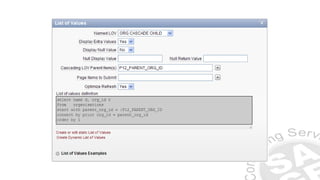
SELECT name d, org_id r
FROM organisations
START WITH parent_org_id =
:P12_PARENT_ORG_ID
CONNECT BY PRIOR org_id =
parent_org_id
ORDER BY 1
function getEmail(pUser) {
var get = new htmldb_Get(null,$v('pFlowId'),
'APPLICATION_PROCESS=GET_EMAIL',0);
get.addParam('x01',pUser);
gReturn = get.get();
json_SetItems(gReturn);
}
http://www.itworkedyesterday.com/blog/2010/2/23/apex_util-ready-set-json.html
post calculation computation
post query
REPLACE(:P1_EMAIL_LIST, ':', '<br>')
my_pkg.get_description(:P1_CODE)
bulk collects
<< email_loop >>
FOR r_rec IN
(SELECT email
FROM employees) LOOP
lc_emails := lc_emails
||r_rec.email
||',';
END LOOP email_loop;
lc_emails := RTRIM(lc_emails,',');
SELECT DISTINCT email
BULK COLLECT
INTO lt_emails
FROM employees;
lc_emails := apex_util.table_to_string
(p_table => lt_emails
,p_string => ',');
validation sequence
Apex_application.g_inline_validation_error_cnt = 0
CSS in SQL
SELECT emp_id
,'<b>'||ename||'</b>'
,salary
FROM emp
network traffic
-- Is the current page a help/contact popup/login
-- these pages don't need jquery, cancel page
calculations.
FUNCTION is_popup_page
RETURN BOOLEAN IS
BEGIN
RETURN wwv_flow.get_page_alias IN
('ITEMHELP' -- help popup
,'LOGIN' -- not a popup, but doesn't need dates
,'CONTACTS' -- contact manager popup
,'FINDSPP' -- SPP lookup
,'EMAIL' -- not worth cancelling to and doesn't need
jquery
,'EMAILSENT' -- closes in a few seconds
);
END is_popup_page;
javascript validation
#TIMING#
cache
http://forums.oracle.com/forums/thread.jspa?threadID=486516
deterministic functions
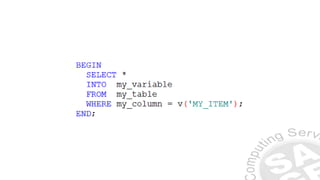
SELECT *
FROM my_table
WHERE my_column = v('MY_ITEM')
SELECT *
FROM my_table
WHERE my_column = :MY_ITEM
SELECT *
FROM my_table
WHERE my_column =
my_own_function(another_column)
SELECT *
FROM my_table
WHERE my_column = v('MY_ITEM')
SELECT *
FROM my_table
WHERE my_column = v('MY_ITEM')
From 10gR2
Pre Apex3.x
ie - Oracle XEpre-patch
CREATE OR REPLACE FUNCTION V
( p_item IN VARCHAR2
, p_flow IN NUMBER := NULL
, p_scope IN VARCHAR2 := 'SESSION_AND_USER'
, p_escape IN VARCHAR2 := 'N'
)
RETURN VARCHAR2 DETERMINISTIC
--==============================================================================
-- Wraps the existing APEX V function and adds the DETERMINISTIC optimizer hint
-- so that the function isn't called for each row the query engine is verifying.
-- See /2006/11/caution-when-using-plsql-functions-in.html
-- for details.
--==============================================================================
IS
BEGIN
RETURN FLOWS_020200.V
( p_item => p_item
, p_flow => p_flow
, p_scope => p_scope
, p_escape => p_escape
);
END V;
/
http://www.inside-oracle-apex.com/drop-in-replacement-for-v-and-nv-function/
SELECT *
FROM my_table
-- scalar subquery caching
WHERE my_column = (SELECT v('MY_ITEM') FROM DUAL)
http://www.oratechinfo.co.uk/scalar_subqueries.html
scalar subquery caching
implicit vs explicit conversion
To ensure your program does exactly what you expect, use explicit conversions wherever
possible.
create or replace function nv (
p_item in varchar2)
return number
-- Copyright (c) Oracle Corporation 1999. All
Rights Reserved.
--
-- DESCRIPTION
-- Function to return a numeric flow value.
V stands for value.
--
-- SECURITY
--
-- NOTES
--
is
begin
return to_number(v(p_item));
end nv;
/
select *
from organisations
where name = 123;
sequences
BEGIN
INSERT INTO my_table
(my_pk, ...
VALUES
(my_seq.NEXTVAL, ...);
END;
/
prevention – innovate
time management – educate
diagnosis - interact
not just Apex - maximise
PL/SQL APIs
create or replace package "PARTIES_API" is
--------------------------------------------------------------
-- create procedure for table "PARTIES"
procedure "INS_PARTIES" (...
--------------------------------------------------------------
-- update procedure for table "PARTIES"
procedure "UPD_PARTIES" (...
--------------------------------------------------------------
-- delete procedure for table "PARTIES"
procedure "DEL_PARTIES" (...
--------------------------------------------------------------
-- get procedure for table "PARTIES"
procedure "GET_PARTIES" (...
--------------------------------------------------------------
-- get procedure for table "PARTIES" including MD5
procedure "GET_PARTIES" (...
--------------------------------------------------------------
-- build MD5 function for table "PARTIES"
function "BUILD_PARTIES_MD5" (...
) return varchar2;
end "PARTIES_API";
merge vs insert/update
multi-table insert
BEGIN
INSERT INTO my_table
(my_pk, ...
VALUES
(my_seq.NEXTVAL, ...);
END;
/
BEGIN
INSERT INTO my_table
(my_pk, ...
VALUES
(fn_get_my_seq, ...);
END;
/
CREATE OR REPLACE TRIGGER
my_table_br_trg
BEFORE INSERT OR UPDATE ON
sage.my_table
FOR EACH ROW
BEGIN
IF :NEW.my_id IS NULL THEN
SELECT my_seq.NEXTVAL
INTO :NEW.my_id
FROM dual;
-- :NEW.my_id := my_seq.NEXTVAL ->
11g
END IF;
END;
/
re-use
shared components
page zero
copy object
ui defaults
subscriptions pl/sql packages
-- apex_application.g_inline_validation_error_cnt = 0
return my_pkg.run_validation
prevention - innovate
time management – educate
diagnosis – interact
not just Apex - maximise
apex_dml_lock_wait_time
debug mode
wwv_flow.debug('my debug information');
firebug
tracing
http://download.oracle.com/docs/cd/E14373_01/appdev.32/e11838/debug.htm#BABGDGEH
http:/.../f?p=100:1&p_trace=YES
http://www.talkapex.com/2010/10/oracle-xe-and-apex-where-is-my-trace.html
show parameter USER_DUMP_DEST
jmeter
http://sagecomputing.com.au/presentations_sage_computing_services.html
http://one-size-doesnt-fit-all.blogspot.com/2010/05/configuring-apache-jmeter-for-apex.html
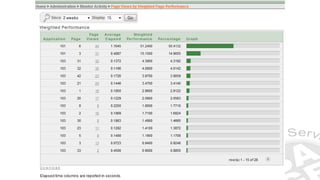
page performance
monitor activity
prevention - innovate
time management - educate
diagnosis - interact
not just Apex - maximise
short circuit evaluation
SELECT NVL(a_column
,expensive_fn(b_column)) my_column
FROM a_table;
SELECT COALESCE(a_column
,expensive_fn(b_column)) my_column
FROM a_table;
IF a != b
OR (a IS NULL AND b IS NOT NULL )
OR( a IS NOT NULL AND b IS NULL )
IF (COALESCE(a,-1) != COALESCE(b,-2))
IF NVL(a,-1) != NVL(b,-1)
queries
SELECT name, TO_CHAR(dt,'DD-MM-YYYY') dt, amt,
cum_amt -- Model results
FROM (
SELECT name, TRUNC(dt, 'MM') dt, SUM(amt) amt
FROM customer
GROUP BY name, TRUNC(dt, 'MM')
)
MODEL
PARTITION BY (name)
DIMENSION BY (dt)
MEASURES (amt, cast(NULL AS NUMBER) cum_amt) --
Define calculated col
IGNORE NAV
RULES SEQUENTIAL ORDER(
amt[FOR dt FROM TO_DATE('01-01-2007', 'DD-MM-
YYYY')
TO TO_DATE('01-12-2007', 'DD-MM-
YYYY')
INCREMENT NUMTOYMINTERVAL(1, 'MONTH')
] = amt[CV(dt)] -- Apply amt for given date,
if found
,cum_amt[ANY] = SUM(amt)[dt <= CV(dt)] --
Calculate cumulative
)
ORDER BY name, dt
/
remote database queries
small_table big_table
SELECT st.info, sum(bt.measure) total
FROM small_table st
JOIN big_table@remote_db bt
ON st.id = bt.id
SELECT /*+ DRIVING_SITE(bt) */
st.info, sum(bt.measure) total
FROM small_table st
JOIN big_table@remote_db bt
ON st.id = bt.id
experiment
database version
hardware
table size
statistics
phase of the moon
load
data distribution
SAGE Computing Services
Customised Oracle Training Workshops and Consulting
Question time
Presentations are available from our website:
http://www.sagecomputing.com.au
enquiries@sagecomputing.com.au
scott.wesley@sagecomputing.com.au
http://triangle-circle-square.blogspot.com

Oracle APEX Performance

Editor's Notes

  • #3 Scott from Sage – Consultant &amp; TrainerWorking with Apex for the last few years
  • #4 Scott from Sage – Consultant &amp; TrainerWorking with Apex for the last few years
  • #5 Scott from Sage – Consultant &amp; TrainerWorking with Apex for the last few years
  • #6 Scott from Sage – Consultant &amp; TrainerWorking with Apex for the last few years
  • #8 The ubiquitous slide – not today
  • #9 Who’s style was pretty much innovated by LarryWho’s heard of him?
  • #12 This is the general breakdown of my presentation
  • #13 Starting with prevention – it’s better than a cure, right?
  • #14 Start with simple example
  • #16 We always see this example
  • #17 Why not do it like this? Use bulk binding
  • #18 There’s going to be no massive winsWait – what’s the problem with this picture, isn’t parsec a measurement of distance? Damn pop culture
  • #23 If you defer security group membership to an LDAP server, you may wish to consider
  • #24 ... Creating a pipelined function returning information from LDAP about your groups
  • #25 Which would be based on database types such as these
  • #26 Then you could create a snapshot based on your LDAP information – instead of a manual PL/SQL synching processA guide to this concept is documented in this book by my namesakes – John Edward Scott &amp; Scott Spendolini
  • #28 Consider if you need to evaluate membership for each page, or just once
  • #29 Perhaps (particularly if you have multiple schemes) populate application items during post authentication
  • #30 And refer to this item in your conditions – makes things more consistent
  • #32 Do you really need conditions that run SQL?Is your SQL efficient?
  • #38 In addition to PPR, where in your app might it be useful to avoid entire page submission?Apex 4 makes cascading LOVs easy
  • #40 Or maybe try some forms style item validation
  • #42 Remember this evil?
  • #43 While we eliminate network lag because we’re all on the db, you may still want to question behaviour. This is acceptable
  • #44 You may wish to consider an key-preserved / updateable view if things like this get out of control
  • #50 Put the more efficient validations first – maybe don’t do expensive ones if fundament errors found
  • #52 This can increase number of hard parses
  • #53 It’s what they’re designed for, utilise your CSS classesFrom managing your development, wrapping your head around CSS concepts will save you time in future anyway
  • #55 Does your application / page need this?
  • #56 Does every page need your custom widgets?
  • #57 This is where you can really utilise page zero to turn components on &amp; off
  • #58 I put this sort of thing in the condition
  • #59 Speed of responseReduce server loadSend only valid dataReduce network traffic
  • #60 There are plenty of APIs to help you out
  • #67 First of all, you shouldn’t really need to do this
  • #68 You should be doing this
  • #69 But if you’re referring to your own function, regardless of complexity
  • #70 Or you do have this...
  • #71 More likely within PL/SQL package
  • #72 Deterministic functions optimised from
  • #73 But if you are working with
  • #74 Such as basic install
  • #75 Then you may wishto consider this
  • #76 Or the most simplistic works on all versions from 9i – check out a great outline hereCould talk for hours just about this, but I won’t.
  • #77 Remember this term
  • #78 I can’t go by without mentioning I’m always hammering trainees about this
  • #79 Straight from PL/SQL Users guide and reference
  • #80 Don’t forget about this function
  • #81 Because oracle might make some weird decisions if you leave data-type conversions up to it
  • #84 Which is a segue onto the next topic
  • #85 Best practices for apex developers, help reduce coding/maintenance time
  • #90 You may also like to consider
  • #91 One movement is always better
  • #92 So APIs could facilitate this usage
  • #93 Don’t over accessorise
  • #94 At least do it via a trigger, in Apex environment – it’s only as fast as user can click anyway
  • #95 Opportunities for re-use all around
  • #96 Something everyone can do in even the simplest of applications – put your code in packages!Centralising code can say yourself time in the long run
  • #97 You’ve come across something nasty, what do you do?
  • #98 First of all, there may not be a problem – “my app is hanging”
  • #99 Don’t let you’re user wait. Apex uses optimistic locking, this says how many seconds the user should wait instead of the default – infinitumThis also removes a potential security issue (DOS)
  • #102 In apex 4 debug got a whole load prettier
  • #103 Perhaps you’d like to add your own debug information
  • #107 Be aware of the options you have to turn on tracinghttp:/.../f?p=100:1&amp;p_trace=YES
  • #108 and how to find your trace file, then tkprof itshow parameter USER_DUMP_DESTtkprof filename1 filename2 [waits=yes|no] [sort=option] [print=n] [aggregate=yes|no] [insert=filename3] [sys=yes|no] [table=schema.table] [explain=user/password] [record=filename4] [width=n]
  • #110 Performance testing tool over many server types.Visit Chris tomorrow and have a chat to him about it.Or come by the Sage booth
  • #112 Find which pages are the most expensive to runWeighted – don’t care about random page opened once a month, consider page views
  • #113 Application level more granular
  • #115 Or you could look at page/session level to find outliers, errors
  • #117 Performance solutions aren’t just Apex related features, database level
  • #122 Check to see you’re queries are tuned – may not be apex’s fault. (nothing wrong with this one – just looks scary ;-)
  • #127 It can really depend… how long is a piece of string
  • #128 I counted 32 tips…