Stop The Guessing! Using Time-Based
Analysis to Improve Oracle Performance
By Craig Shallahamer
President & Founder, OraPub
© 2014 SOLARWINDS WORLDWIDE, LLC. ALL RIGHTS RESERVED.
Transform
your
analysis
Relevant background info...
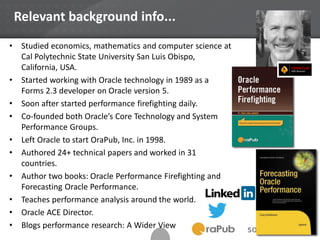
• Studied economics, mathematics and computer science at
Cal Polytechnic State University San Luis Obispo,
California, USA.
• Started working with Oracle technology in 1989 as a
Forms 2.3 developer on Oracle version 5.
• Soon after started performance firefighting daily.
• Co-founded both Oracle’s Core Technology and System
Performance Groups.
• Left Oracle to start OraPub, Inc. in 1998.
• Authored 24+ technical papers and worked in 31
countries.
• Author two books: Oracle Performance Firefighting and
Forecasting Oracle Performance.
• Teaches performance analysis around the world.
• Oracle ACE Director.
• Blogs performance research: A Wider View
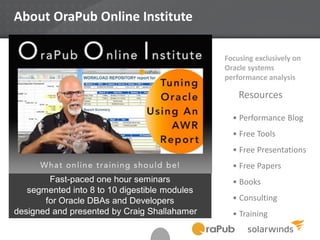
About OraPub Online Institute
Focusing exclusively on
Oracle systems
performance analysis
• Performance Blog
• Free Tools
• Free Presentations
• Free Papers
• Books
• Consulting
• Training
Resources
Fast-paced one hour seminars
segmented into 8 to 10 digestible modules
for Oracle DBAs and Developers
designed and presented by Craig Shallahamer
© 2014 SOLARWINDS WORLDWIDE, LLC. ALL RIGHTS RESERVED.
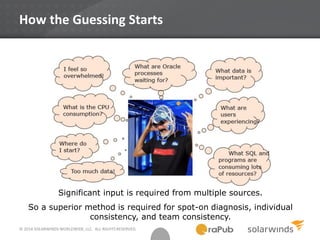
How the Guessing Starts
Significant input is required from multiple sources.
So a superior method is required for spot-on diagnosis, individual
consistency, and team consistency.
© 2014 SOLARWINDS WORLDWIDE, LLC. ALL RIGHTS RESERVED.
Always remember these four
things?
I wish someone told me this years ago...
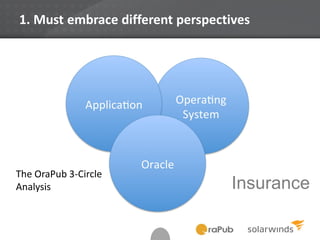
Insurance
1. Must embrace different perspectives
The OraPub 3-Circle
Analysis
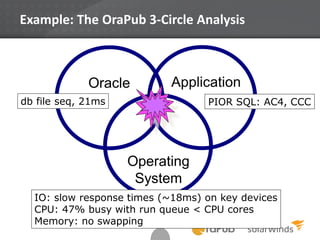
Example: The OraPub 3-Circle Analysis
Operating
System
ApplicationOracle
db file seq, 21ms
IO: slow response times (~18ms) on key devices
CPU: 47% busy with run queue < CPU cores
Memory: no swapping
PIOR SQL: AC4, CCC
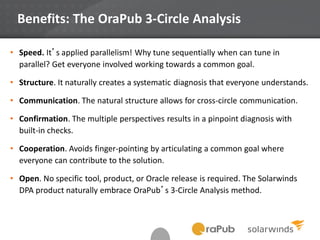
Benefits: The OraPub 3-Circle Analysis
• Speed. It’s applied parallelism! Why tune sequentially when can tune in
parallel? Get everyone involved working towards a common goal.
• Structure. It naturally creates a systematic diagnosis that everyone understands.
• Communication. The natural structure allows for cross-circle communication.
• Confirmation. The multiple perspectives results in a pinpoint diagnosis with
built-in checks.
• Cooperation. Avoids finger-pointing by articulating a common goal where
everyone can contribute to the solution.
• Open. No specific tool, product, or Oracle release is required. The Solarwinds
DPA product naturally embrace OraPub’s 3-Circle Analysis method.
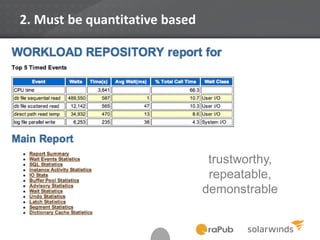
trustworthy,
repeatable,
demonstrable
2. Must be quantitative based
Suppose I need to process 100
pieces of work. Each piece takes
1 second to process. How long
will take take to process all 100
pieces?
3. Understand that ________ is death!
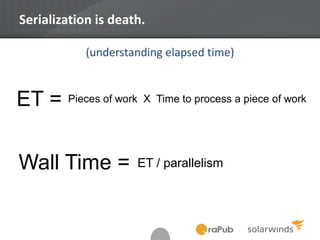
Serialization is death.
ET = Pieces of work X Time to process a piece of work
(understanding elapsed time)
Wall Time = ET / parallelism
© 2014 SOLARWINDS WORLDWIDE, LLC. ALL RIGHTS RESERVED.
4. Tell a compelling story... for your audience
© 2014 SOLARWINDS WORLDWIDE, LLC. ALL RIGHTS RESERVED.
Always remember what four
things?
© 2014 SOLARWINDS WORLDWIDE, LLC. ALL RIGHTS RESERVED.
Gathering the diagnostic data
We need correct and trustworthy data before
we can build our framework.
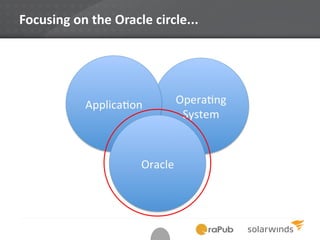
Focusing on the Oracle circle...
The world of Time Based Analysis
» User feel time: OLTP-centric users want snappy response time and
batch-centric users want short duration jobs. Therefore, our
analysis and methods of communication will be more effective
when time based.
» Time Based Analysis:
 Combines wait time and CPU consumption
 Classifies time to better understand, diagnose, and communicate the
performance situation
 Allows us to create a quantitative link between the our analysis and the
user experience... better understanding the user experience.
 Moves us into Unit of Work Time Based Analysis (UOWTBA)
» Keep in mind the relationship between time and work.
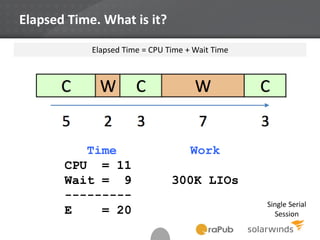
Elapsed Time. What is it?
Elapsed Time = CPU Time + Wait Time
Single Serial
Session
Time
CPU = 11
Wait = 9
---------
E = 20
Work
300K LIOs
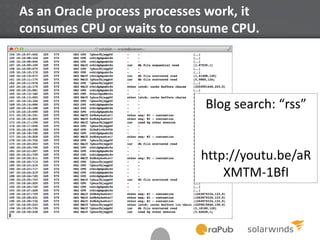
As an Oracle process processes work, it
consumes CPU or waits to consume CPU.
Blog search: “rss”
http://youtu.be/aR
XMTM-1BfI
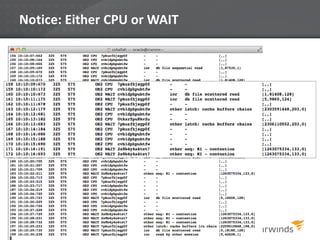
Notice: Either CPU or WAIT
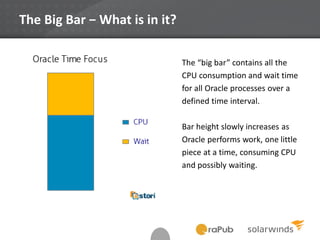
The Big Bar − What is in it?
The “big bar” contains all the
CPU consumption and wait time
for all Oracle processes over a
defined time interval.
Bar height slowly increases as
Oracle performs work, one little
piece at a time, consuming CPU
and possibly waiting.
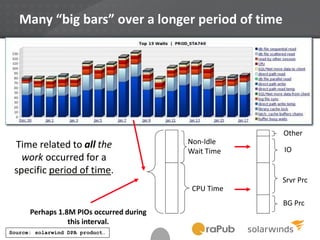
Non-Idle
Wait Time
CPU Time
Other
IO
Srvr Prc
BG Prc
Time related to all the
work occurred for a
specific period of time.
Source: solarwind DPA product.
Perhaps 1.8M PIOs occurred during
this interval.
Many “big bars” over a longer period of time
© 2014 SOLARWINDS WORLDWIDE, LLC. ALL RIGHTS RESERVED.
Oracle Process CPU Consumption
An active Oracle process wants to burn CPU!
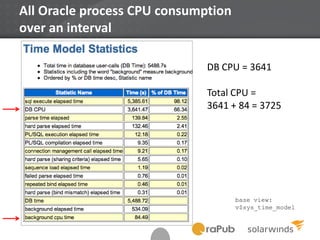
All Oracle process CPU consumption
over an interval
base view:
v$sys_time_model
DB CPU = 3641
Total CPU =
3641 + 84 = 3725
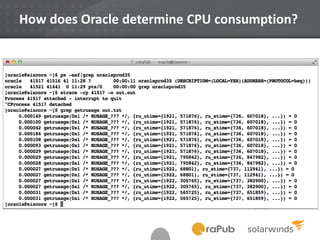
How does Oracle determine CPU consumption?
© 2014 SOLARWINDS WORLDWIDE, LLC. ALL RIGHTS RESERVED.
Oracle “Wait Time”
When an active process cannot consume CPU, it must wait.
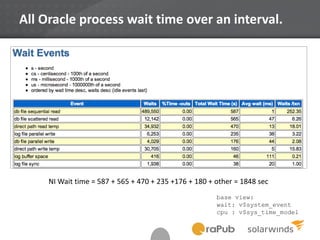
All Oracle process wait time over an interval.
base view:
wait: v$system_event
cpu : v$sys_time_model
NI Wait time = 587 + 565 + 470 + 235 +176 + 180 + other = 1848 sec
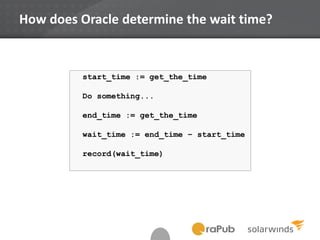
How does Oracle determine the wait time?
start_time := get_the_time
Do something...
end_time := get_the_time
wait_time := end_time – start_time
record(wait_time)
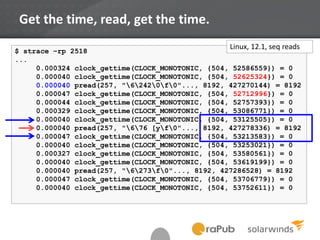
Get the time, read, get the time.
start_time := get_the_time
D something...
end_time := get_the_time
wait_time := end_time – start_time
record(wait_time)
$ strace –rp 2518
...
0.000324 clock_gettime(CLOCK_MONOTONIC, {504, 52586559}) = 0
0.000040 clock_gettime(CLOCK_MONOTONIC, {504, 52625324}) = 0
0.000040 pread(257, "62420f0"..., 8192, 427270144) = 8192
0.000047 clock_gettime(CLOCK_MONOTONIC, {504, 52712996}) = 0
0.000044 clock_gettime(CLOCK_MONOTONIC, {504, 52757393}) = 0
0.000329 clock_gettime(CLOCK_MONOTONIC, {504, 53086771}) = 0
0.000040 clock_gettime(CLOCK_MONOTONIC, {504, 53125505}) = 0
0.000040 pread(257, "676 [yf0"..., 8192, 427278336) = 8192
0.000047 clock_gettime(CLOCK_MONOTONIC, {504, 53213583}) = 0
0.000040 clock_gettime(CLOCK_MONOTONIC, {504, 53253021}) = 0
0.000327 clock_gettime(CLOCK_MONOTONIC, {504, 53580561}) = 0
0.000040 clock_gettime(CLOCK_MONOTONIC, {504, 53619199}) = 0
0.000040 pread(257, "6273f0"..., 8192, 427286528) = 8192
0.000047 clock_gettime(CLOCK_MONOTONIC, {504, 53706779}) = 0
0.000040 clock_gettime(CLOCK_MONOTONIC, {504, 53752611}) = 0
Linux, 12.1, seq reads
© 2014 SOLARWINDS WORLDWIDE, LLC. ALL RIGHTS RESERVED.
Building A Diagnostic/Troubleshooting
Framework
We need a framework providing consistency, quantitative analysis
capabilities with performance improving possibility exposure.
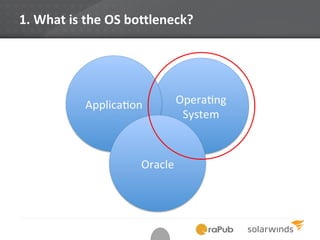
1. What is the OS bottleneck?
© 2014 SOLARWINDS WORLDWIDE, LLC. ALL RIGHTS RESERVED.
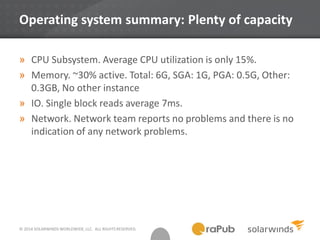
Operating system summary: Plenty of capacity
» CPU Subsystem. Average CPU utilization is only 15%.
» Memory. ~30% active. Total: 6G, SGA: 1G, PGA: 0.5G, Other:
0.3GB, No other instance
» IO. Single block reads average 7ms.
» Network. Network team reports no problems and there is no
indication of any network problems.
© 2014 SOLARWINDS WORLDWIDE, LLC. ALL RIGHTS RESERVED.
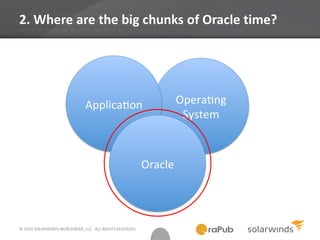
2. Where are the big chunks of Oracle time?
© 2014 SOLARWINDS WORLDWIDE, LLC. ALL RIGHTS RESERVED.
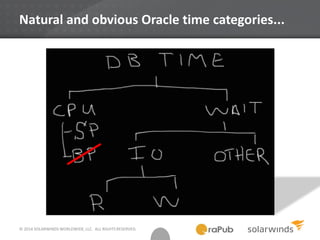
Natural and obvious Oracle time categories...
© 2014 SOLARWINDS WORLDWIDE, LLC. ALL RIGHTS RESERVED.
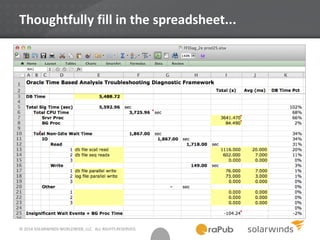
Thoughtfully fill in the spreadsheet...
© 2014 SOLARWINDS WORLDWIDE, LLC. ALL RIGHTS RESERVED.
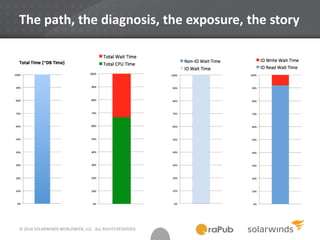
The path, the diagnosis, the exposure, the story
© 2014 SOLARWINDS WORLDWIDE, LLC. ALL RIGHTS RESERVED.
Oracle focused opportunities.
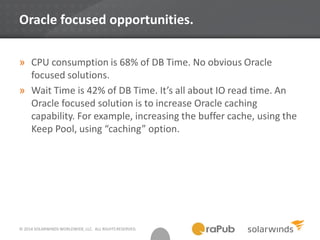
» CPU consumption is 68% of DB Time. No obvious Oracle
focused solutions.
» Wait Time is 42% of DB Time. It’s all about IO read time. An
Oracle focused solution is to increase Oracle caching
capability. For example, increasing the buffer cache, using the
Keep Pool, using “caching” option.
© 2014 SOLARWINDS WORLDWIDE, LLC. ALL RIGHTS RESERVED.
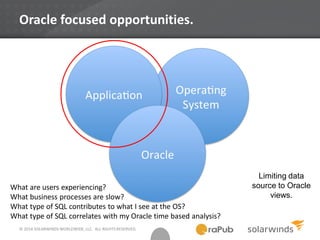
Oracle focused opportunities.
Limiting data
source to Oracle
views.
What are users experiencing?
What business processes are slow?
What type of SQL contributes to what I see at the OS?
What type of SQL correlates with my Oracle time based analysis?
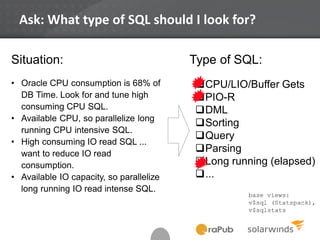
Ask: What type of SQL should I look for?
Situation:
• Oracle CPU consumption is 68% of
DB Time. Look for and tune high
consuming CPU SQL.
• Available CPU, so parallelize long
running CPU intensive SQL.
• High consuming IO read SQL ...
want to reduce IO read
consumption.
• Available IO capacity, so parallelize
long running IO read intense SQL.
CPU/LIO/Buffer Gets
PIO-R
DML
Sorting
Query
Parsing
Long running (elapsed)
...
base views:
v$sql (Statspack),
v$sqlstats
Type of SQL:
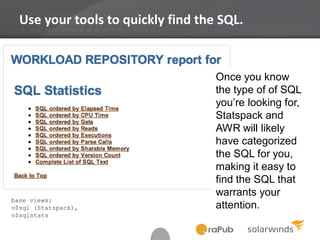
Use your tools to quickly find the SQL.
base views:
v$sql (Statspack),
v$sqlstats
Once you know
the type of of SQL
you’re looking for,
Statspack and
AWR will likely
have categorized
the SQL for you,
making it easy to
find the SQL that
warrants your
attention.
© 2014 SOLARWINDS WORLDWIDE, LLC. ALL RIGHTS RESERVED.
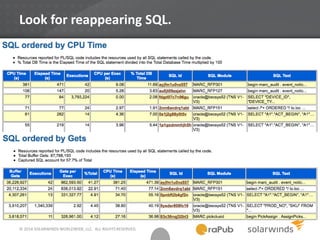
Look for reappearing SQL.
© 2014 SOLARWINDS WORLDWIDE, LLC. ALL RIGHTS RESERVED.
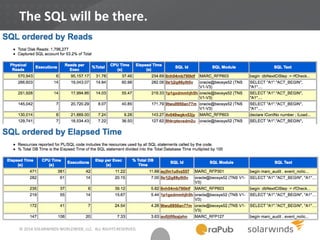
The SQL will be there.
© 2014 SOLARWINDS WORLDWIDE, LLC. ALL RIGHTS RESERVED.
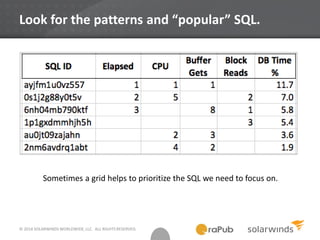
Look for the patterns and “popular” SQL.
Sometimes a grid helps to prioritize the SQL we need to focus on.
© 2014 SOLARWINDS WORLDWIDE, LLC. ALL RIGHTS RESERVED.
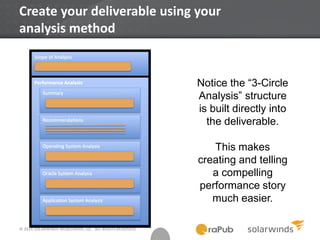
Create your deliverable using your
analysis method
Notice the “3-Circle
Analysis” structure
is built directly into
the deliverable.
This makes
creating and telling
a compelling
performance story
much easier.
© 2014 SOLARWINDS WORLDWIDE, LLC. ALL RIGHTS RESERVED.
Resource listing
» Presentations: OraPub search, “time analysis”
» Craig’s Blog – Search “time analysis”
» Training from OraPub
 Oracle Performance Firefighting (I)
 Adv Oracle Performance Analysis (II)
 Super Seminars: One day Super Saturdays
» OraPub Online Institute – Any [Device, Time, Location]
 Tuning Oracle Using An AWR Report
 Utilization On Steroids
» Tools at www.orapub.com
 OSM Toolkit. OP search, “OSM”.
» Books
 Oracle Performance Firefighting.
 Forecasting Oracle Performance.
San Jose, CA USA
December 8-12
© 2014 SOLARWINDS WORLDWIDE, LLC. ALL RIGHTS RESERVED.
Special Discount for Solarwinds Webinar
Attendees!
GOSOLAR90
90% Off Coupon
First 50 registrations
OOI seminar:
Tuning Oracle Using An AWR Report
Part 1
Email: craig@orapub.com
Twitter: @CShallahamer
OraPub.Com: Everything starts here!
LinkedIn: Connect and network with Craig
and the OraPub Group.
Connect with Craig and OraPub.
© 2014 SOLARWINDS WORLDWIDE, LLC. ALL RIGHTS RESERVED.
Using Solarwinds Database
Performance Analyzer for Time-based
Analysis
Janis Griffin
Database Performance Evangelist, Solarwinds
© 2014 SOLARWINDS WORLDWIDE, LLC. ALL RIGHTS RESERVED.
Resolve performance issues quickly—free trial
» Try Database Performance Analyzer FREE for 14 days
» Improve root cause of slow performance
 Quickly identify root cause of issues that impact end-user response
time
 See historical trends over days, months, and years
 Understand impact of VMware® performance
 Agentless architecture with no dependence on Oracle Packs, installs in
minutes
www.solarwinds.com/dpa-download/
Questions?
© 2014 SOLARWINDS WORLDWIDE, LLC. ALL RIGHTS RESERVED.
Thank You!
The SOLARWINDS and SOLARWINDS & Design marks are the exclusive
property of SolarWinds Worldwide, LLC, are registered with the U.S.
Patent and Trademark Office, and may be registered or pending
registration in other countries. All other SolarWinds trademarks, service
marks, and logos may be common law marks, registered or pending
registration in the United States or in other countries. All other
trademarks mentioned herein are used for identification purposes only
and may be or are trademarks or registered trademarks of their respective
companies.

How to find what is making your Oracle database slow

  • 1.
    Stop The Guessing!Using Time-Based Analysis to Improve Oracle Performance By Craig Shallahamer President & Founder, OraPub © 2014 SOLARWINDS WORLDWIDE, LLC. ALL RIGHTS RESERVED. Transform your analysis
  • 2.
    Relevant background info... •Studied economics, mathematics and computer science at Cal Polytechnic State University San Luis Obispo, California, USA. • Started working with Oracle technology in 1989 as a Forms 2.3 developer on Oracle version 5. • Soon after started performance firefighting daily. • Co-founded both Oracle’s Core Technology and System Performance Groups. • Left Oracle to start OraPub, Inc. in 1998. • Authored 24+ technical papers and worked in 31 countries. • Author two books: Oracle Performance Firefighting and Forecasting Oracle Performance. • Teaches performance analysis around the world. • Oracle ACE Director. • Blogs performance research: A Wider View
  • 3.
    About OraPub OnlineInstitute Focusing exclusively on Oracle systems performance analysis • Performance Blog • Free Tools • Free Presentations • Free Papers • Books • Consulting • Training Resources Fast-paced one hour seminars segmented into 8 to 10 digestible modules for Oracle DBAs and Developers designed and presented by Craig Shallahamer
  • 4.
    © 2014 SOLARWINDSWORLDWIDE, LLC. ALL RIGHTS RESERVED. How the Guessing Starts Significant input is required from multiple sources. So a superior method is required for spot-on diagnosis, individual consistency, and team consistency.
  • 5.
    © 2014 SOLARWINDSWORLDWIDE, LLC. ALL RIGHTS RESERVED. Always remember these four things? I wish someone told me this years ago...
  • 6.
    Insurance 1. Must embracedifferent perspectives The OraPub 3-Circle Analysis
  • 7.
    Example: The OraPub3-Circle Analysis Operating System ApplicationOracle db file seq, 21ms IO: slow response times (~18ms) on key devices CPU: 47% busy with run queue < CPU cores Memory: no swapping PIOR SQL: AC4, CCC
  • 8.
    Benefits: The OraPub3-Circle Analysis • Speed. It’s applied parallelism! Why tune sequentially when can tune in parallel? Get everyone involved working towards a common goal. • Structure. It naturally creates a systematic diagnosis that everyone understands. • Communication. The natural structure allows for cross-circle communication. • Confirmation. The multiple perspectives results in a pinpoint diagnosis with built-in checks. • Cooperation. Avoids finger-pointing by articulating a common goal where everyone can contribute to the solution. • Open. No specific tool, product, or Oracle release is required. The Solarwinds DPA product naturally embrace OraPub’s 3-Circle Analysis method.
  • 9.
  • 10.
    Suppose I needto process 100 pieces of work. Each piece takes 1 second to process. How long will take take to process all 100 pieces? 3. Understand that ________ is death!
  • 11.
    Serialization is death. ET= Pieces of work X Time to process a piece of work (understanding elapsed time) Wall Time = ET / parallelism
  • 12.
    © 2014 SOLARWINDSWORLDWIDE, LLC. ALL RIGHTS RESERVED. 4. Tell a compelling story... for your audience
  • 13.
    © 2014 SOLARWINDSWORLDWIDE, LLC. ALL RIGHTS RESERVED. Always remember what four things?
  • 14.
    © 2014 SOLARWINDSWORLDWIDE, LLC. ALL RIGHTS RESERVED. Gathering the diagnostic data We need correct and trustworthy data before we can build our framework.
  • 15.
    Focusing on theOracle circle...
  • 16.
    The world ofTime Based Analysis » User feel time: OLTP-centric users want snappy response time and batch-centric users want short duration jobs. Therefore, our analysis and methods of communication will be more effective when time based. » Time Based Analysis:  Combines wait time and CPU consumption  Classifies time to better understand, diagnose, and communicate the performance situation  Allows us to create a quantitative link between the our analysis and the user experience... better understanding the user experience.  Moves us into Unit of Work Time Based Analysis (UOWTBA) » Keep in mind the relationship between time and work.
  • 17.
    Elapsed Time. Whatis it? Elapsed Time = CPU Time + Wait Time Single Serial Session Time CPU = 11 Wait = 9 --------- E = 20 Work 300K LIOs
  • 18.
    As an Oracleprocess processes work, it consumes CPU or waits to consume CPU. Blog search: “rss” http://youtu.be/aR XMTM-1BfI
  • 19.
  • 20.
    The Big Bar− What is in it? The “big bar” contains all the CPU consumption and wait time for all Oracle processes over a defined time interval. Bar height slowly increases as Oracle performs work, one little piece at a time, consuming CPU and possibly waiting.
  • 21.
    Non-Idle Wait Time CPU Time Other IO SrvrPrc BG Prc Time related to all the work occurred for a specific period of time. Source: solarwind DPA product. Perhaps 1.8M PIOs occurred during this interval. Many “big bars” over a longer period of time
  • 22.
    © 2014 SOLARWINDSWORLDWIDE, LLC. ALL RIGHTS RESERVED. Oracle Process CPU Consumption An active Oracle process wants to burn CPU!
  • 23.
    All Oracle processCPU consumption over an interval base view: v$sys_time_model DB CPU = 3641 Total CPU = 3641 + 84 = 3725
  • 24.
    How does Oracledetermine CPU consumption?
  • 25.
    © 2014 SOLARWINDSWORLDWIDE, LLC. ALL RIGHTS RESERVED. Oracle “Wait Time” When an active process cannot consume CPU, it must wait.
  • 26.
    All Oracle processwait time over an interval. base view: wait: v$system_event cpu : v$sys_time_model NI Wait time = 587 + 565 + 470 + 235 +176 + 180 + other = 1848 sec
  • 27.
    How does Oracledetermine the wait time? start_time := get_the_time Do something... end_time := get_the_time wait_time := end_time – start_time record(wait_time)
  • 28.
    Get the time,read, get the time. start_time := get_the_time D something... end_time := get_the_time wait_time := end_time – start_time record(wait_time) $ strace –rp 2518 ... 0.000324 clock_gettime(CLOCK_MONOTONIC, {504, 52586559}) = 0 0.000040 clock_gettime(CLOCK_MONOTONIC, {504, 52625324}) = 0 0.000040 pread(257, "62420f0"..., 8192, 427270144) = 8192 0.000047 clock_gettime(CLOCK_MONOTONIC, {504, 52712996}) = 0 0.000044 clock_gettime(CLOCK_MONOTONIC, {504, 52757393}) = 0 0.000329 clock_gettime(CLOCK_MONOTONIC, {504, 53086771}) = 0 0.000040 clock_gettime(CLOCK_MONOTONIC, {504, 53125505}) = 0 0.000040 pread(257, "676 [yf0"..., 8192, 427278336) = 8192 0.000047 clock_gettime(CLOCK_MONOTONIC, {504, 53213583}) = 0 0.000040 clock_gettime(CLOCK_MONOTONIC, {504, 53253021}) = 0 0.000327 clock_gettime(CLOCK_MONOTONIC, {504, 53580561}) = 0 0.000040 clock_gettime(CLOCK_MONOTONIC, {504, 53619199}) = 0 0.000040 pread(257, "6273f0"..., 8192, 427286528) = 8192 0.000047 clock_gettime(CLOCK_MONOTONIC, {504, 53706779}) = 0 0.000040 clock_gettime(CLOCK_MONOTONIC, {504, 53752611}) = 0 Linux, 12.1, seq reads
  • 29.
    © 2014 SOLARWINDSWORLDWIDE, LLC. ALL RIGHTS RESERVED. Building A Diagnostic/Troubleshooting Framework We need a framework providing consistency, quantitative analysis capabilities with performance improving possibility exposure.
  • 30.
    1. What isthe OS bottleneck?
  • 31.
    © 2014 SOLARWINDSWORLDWIDE, LLC. ALL RIGHTS RESERVED. Operating system summary: Plenty of capacity » CPU Subsystem. Average CPU utilization is only 15%. » Memory. ~30% active. Total: 6G, SGA: 1G, PGA: 0.5G, Other: 0.3GB, No other instance » IO. Single block reads average 7ms. » Network. Network team reports no problems and there is no indication of any network problems.
  • 32.
    © 2014 SOLARWINDSWORLDWIDE, LLC. ALL RIGHTS RESERVED. 2. Where are the big chunks of Oracle time?
  • 33.
    © 2014 SOLARWINDSWORLDWIDE, LLC. ALL RIGHTS RESERVED. Natural and obvious Oracle time categories...
  • 34.
    © 2014 SOLARWINDSWORLDWIDE, LLC. ALL RIGHTS RESERVED. Thoughtfully fill in the spreadsheet...
  • 35.
    © 2014 SOLARWINDSWORLDWIDE, LLC. ALL RIGHTS RESERVED. The path, the diagnosis, the exposure, the story
  • 36.
    © 2014 SOLARWINDSWORLDWIDE, LLC. ALL RIGHTS RESERVED. Oracle focused opportunities. » CPU consumption is 68% of DB Time. No obvious Oracle focused solutions. » Wait Time is 42% of DB Time. It’s all about IO read time. An Oracle focused solution is to increase Oracle caching capability. For example, increasing the buffer cache, using the Keep Pool, using “caching” option.
  • 37.
    © 2014 SOLARWINDSWORLDWIDE, LLC. ALL RIGHTS RESERVED. Oracle focused opportunities. Limiting data source to Oracle views. What are users experiencing? What business processes are slow? What type of SQL contributes to what I see at the OS? What type of SQL correlates with my Oracle time based analysis?
  • 38.
    Ask: What typeof SQL should I look for? Situation: • Oracle CPU consumption is 68% of DB Time. Look for and tune high consuming CPU SQL. • Available CPU, so parallelize long running CPU intensive SQL. • High consuming IO read SQL ... want to reduce IO read consumption. • Available IO capacity, so parallelize long running IO read intense SQL. CPU/LIO/Buffer Gets PIO-R DML Sorting Query Parsing Long running (elapsed) ... base views: v$sql (Statspack), v$sqlstats Type of SQL:
  • 39.
    Use your toolsto quickly find the SQL. base views: v$sql (Statspack), v$sqlstats Once you know the type of of SQL you’re looking for, Statspack and AWR will likely have categorized the SQL for you, making it easy to find the SQL that warrants your attention.
  • 40.
    © 2014 SOLARWINDSWORLDWIDE, LLC. ALL RIGHTS RESERVED. Look for reappearing SQL.
  • 41.
    © 2014 SOLARWINDSWORLDWIDE, LLC. ALL RIGHTS RESERVED. The SQL will be there.
  • 42.
    © 2014 SOLARWINDSWORLDWIDE, LLC. ALL RIGHTS RESERVED. Look for the patterns and “popular” SQL. Sometimes a grid helps to prioritize the SQL we need to focus on.
  • 43.
    © 2014 SOLARWINDSWORLDWIDE, LLC. ALL RIGHTS RESERVED. Create your deliverable using your analysis method Notice the “3-Circle Analysis” structure is built directly into the deliverable. This makes creating and telling a compelling performance story much easier.
  • 44.
    © 2014 SOLARWINDSWORLDWIDE, LLC. ALL RIGHTS RESERVED. Resource listing » Presentations: OraPub search, “time analysis” » Craig’s Blog – Search “time analysis” » Training from OraPub  Oracle Performance Firefighting (I)  Adv Oracle Performance Analysis (II)  Super Seminars: One day Super Saturdays » OraPub Online Institute – Any [Device, Time, Location]  Tuning Oracle Using An AWR Report  Utilization On Steroids » Tools at www.orapub.com  OSM Toolkit. OP search, “OSM”. » Books  Oracle Performance Firefighting.  Forecasting Oracle Performance. San Jose, CA USA December 8-12
  • 45.
    © 2014 SOLARWINDSWORLDWIDE, LLC. ALL RIGHTS RESERVED. Special Discount for Solarwinds Webinar Attendees! GOSOLAR90 90% Off Coupon First 50 registrations OOI seminar: Tuning Oracle Using An AWR Report Part 1
  • 46.
    Email: craig@orapub.com Twitter: @CShallahamer OraPub.Com:Everything starts here! LinkedIn: Connect and network with Craig and the OraPub Group. Connect with Craig and OraPub.
  • 47.
    © 2014 SOLARWINDSWORLDWIDE, LLC. ALL RIGHTS RESERVED. Using Solarwinds Database Performance Analyzer for Time-based Analysis Janis Griffin Database Performance Evangelist, Solarwinds
  • 48.
    © 2014 SOLARWINDSWORLDWIDE, LLC. ALL RIGHTS RESERVED. Resolve performance issues quickly—free trial » Try Database Performance Analyzer FREE for 14 days » Improve root cause of slow performance  Quickly identify root cause of issues that impact end-user response time  See historical trends over days, months, and years  Understand impact of VMware® performance  Agentless architecture with no dependence on Oracle Packs, installs in minutes www.solarwinds.com/dpa-download/
  • 49.
    Questions? © 2014 SOLARWINDSWORLDWIDE, LLC. ALL RIGHTS RESERVED.
  • 50.
    © 2014 SOLARWINDSWORLDWIDE, LLC. ALL RIGHTS RESERVED. Thank You! The SOLARWINDS and SOLARWINDS & Design marks are the exclusive property of SolarWinds Worldwide, LLC, are registered with the U.S. Patent and Trademark Office, and may be registered or pending registration in other countries. All other SolarWinds trademarks, service marks, and logos may be common law marks, registered or pending registration in the United States or in other countries. All other trademarks mentioned herein are used for identification purposes only and may be or are trademarks or registered trademarks of their respective companies.