
Vinay Kumar, ORACLE ACE
@vinaykuma201
SPOUG18-Madrid
1
2
• O RACL E ACE
• Enterp ris e Arch itect
• Au th o r of B ook “ B egin n in g Oracle
Web Center portal 12c”
• O racle certified p ro fes s io n al
• B lo g ger-http ://w w w.tech artifact. com/b logs
• So ftware Co n s u ltant
3
• Un der st an din g RES T
• ORDS in t rodu ct ion
• ORDS Arch itect u re
• ORDS Con n ect ion Poolin g
• Man agemen t of t h e RES T defin it ion s wit h S QL Developer an d t h e AP I
• ORDS B est P ract ices
• Web Application Arch itectu re
• Addit ion al Readin g
4
Understanding REST
5
Representational State Transfer -
6
https://en.wikipedia.org/wiki/Representaional_state_transfer
Why should we care for REST web services?
7
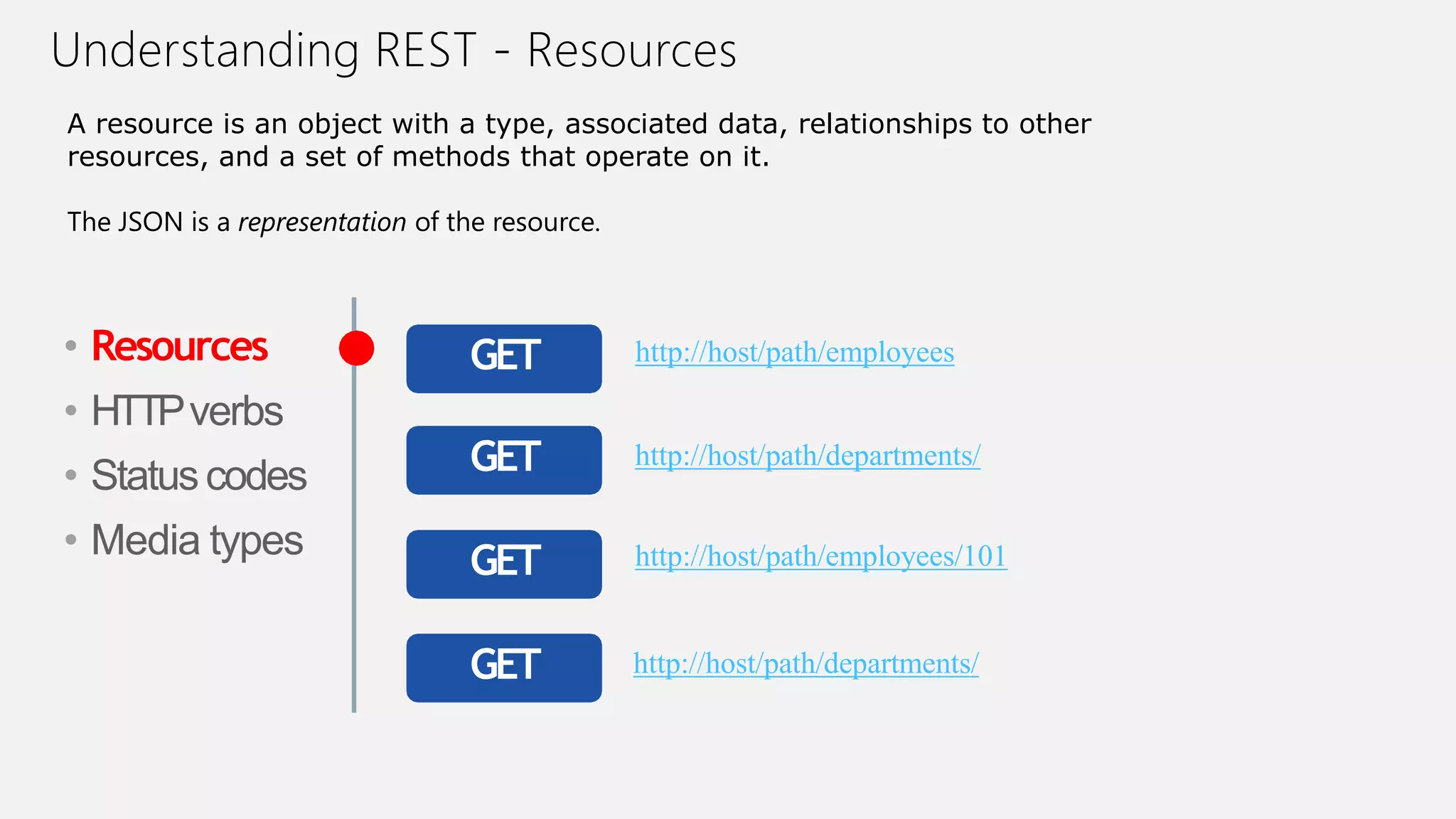
Understanding REST - Resources
• Resources
• HTTPverbs
• Statuscodes
• Media types
http://host/path/employeesGET
http://host/path/departments/GET
http://host/path/employees/101GET
http://host/path/departments/GET
A resource is an object with a type, associated data, relationships to other
resources, and a set of methods that operate on it.
The JSON is a representation of the resource.
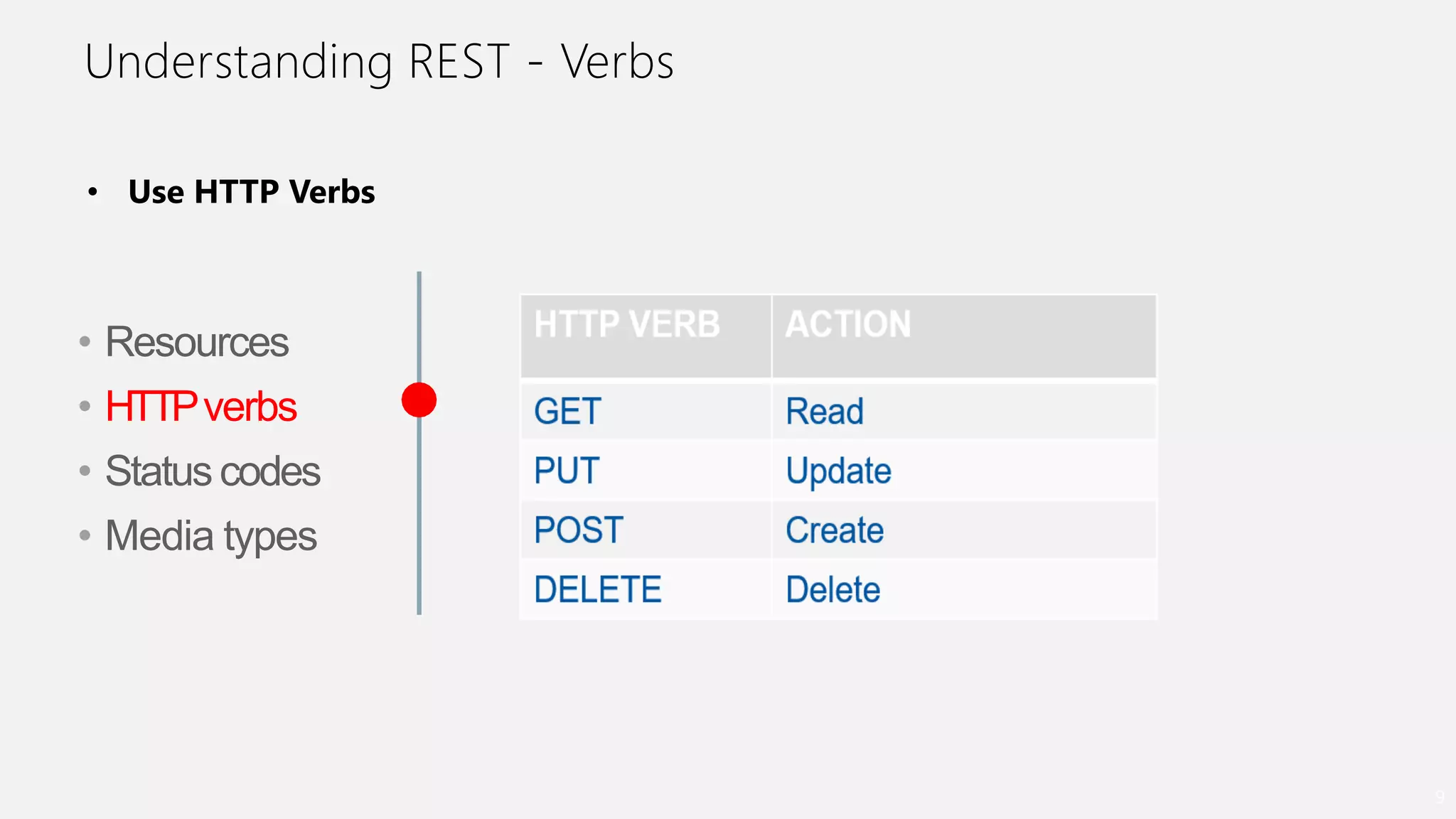
Understanding REST - Verbs
9
• Use HTTP Verbs
• Resources
• HTTPverbs
• Statuscodes
• Media types
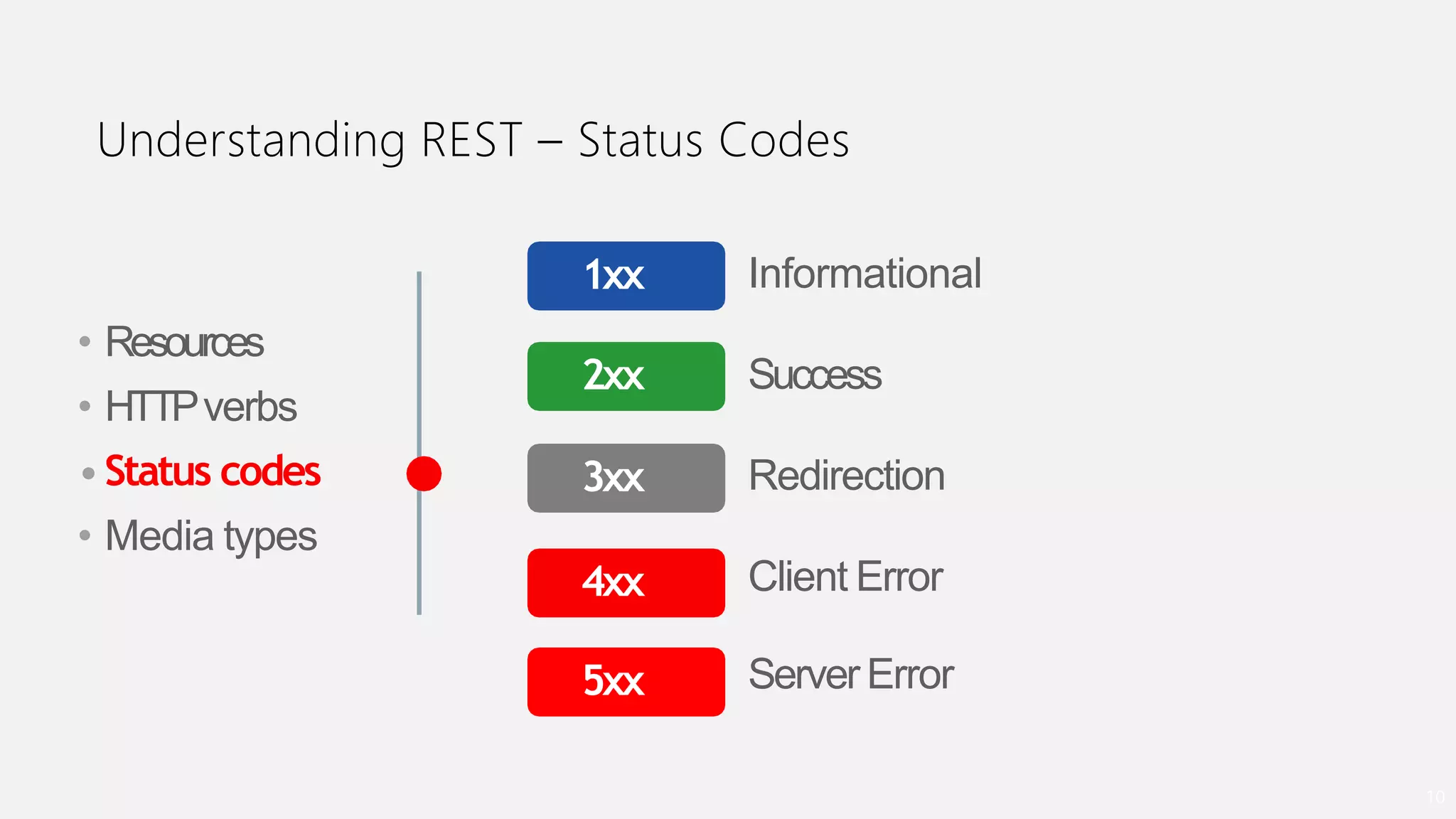
Understanding REST – Status Codes
10
• Resources
• HTTPverbs
•Status codes
• Media types
Informational
Success
Redirection
Client Error
ServerError
4xx
3xx
5xx
1xx
2xx
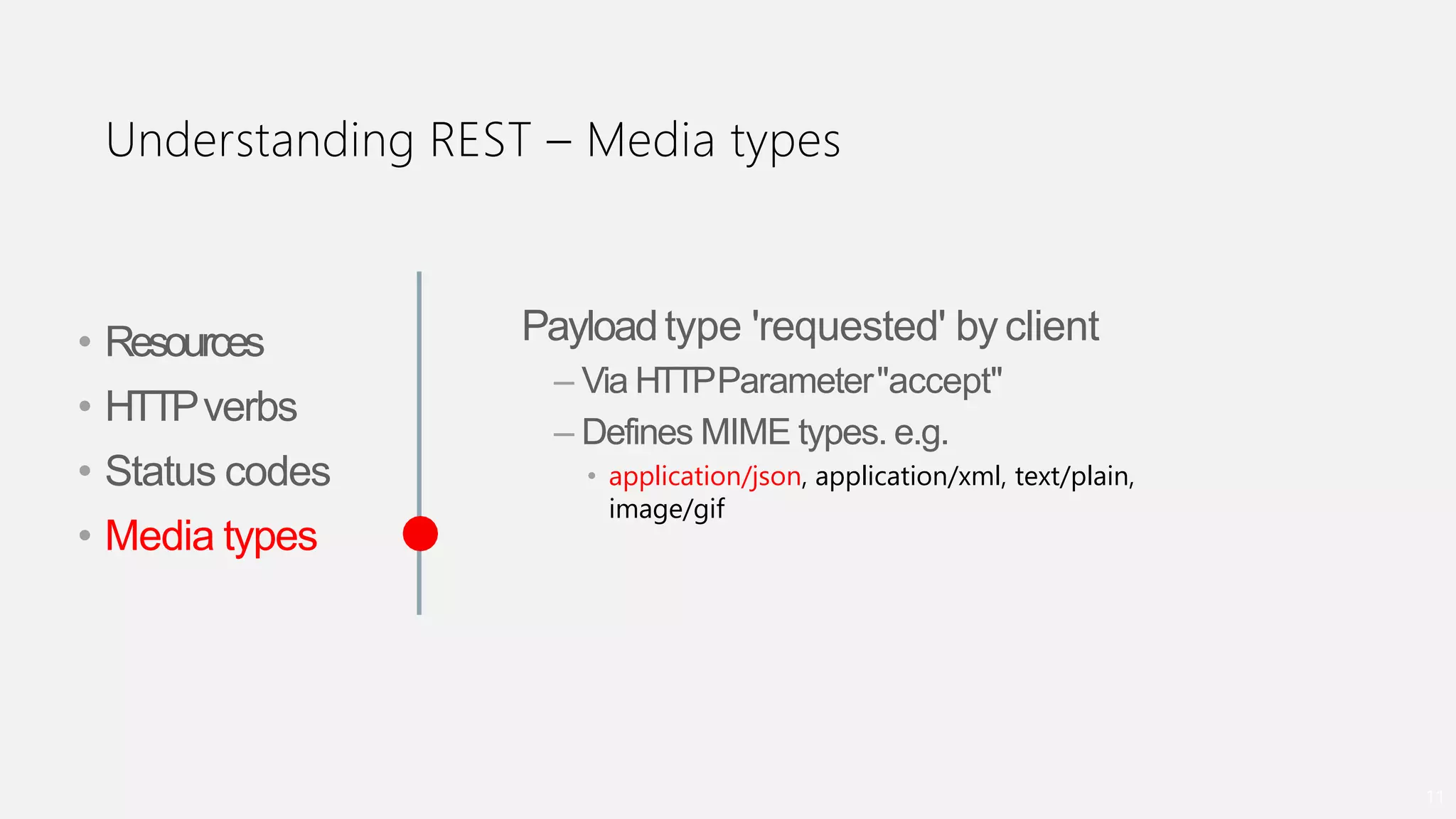
Understanding REST – Media types
11
• Resources
• HTTPverbs
• Status codes
• Media types
Payloadtype 'requested' byclient
– Via HTTPParameter"accept"
– Defines MIME types. e.g.
• application/json, application/xml, text/plain,
image/gif
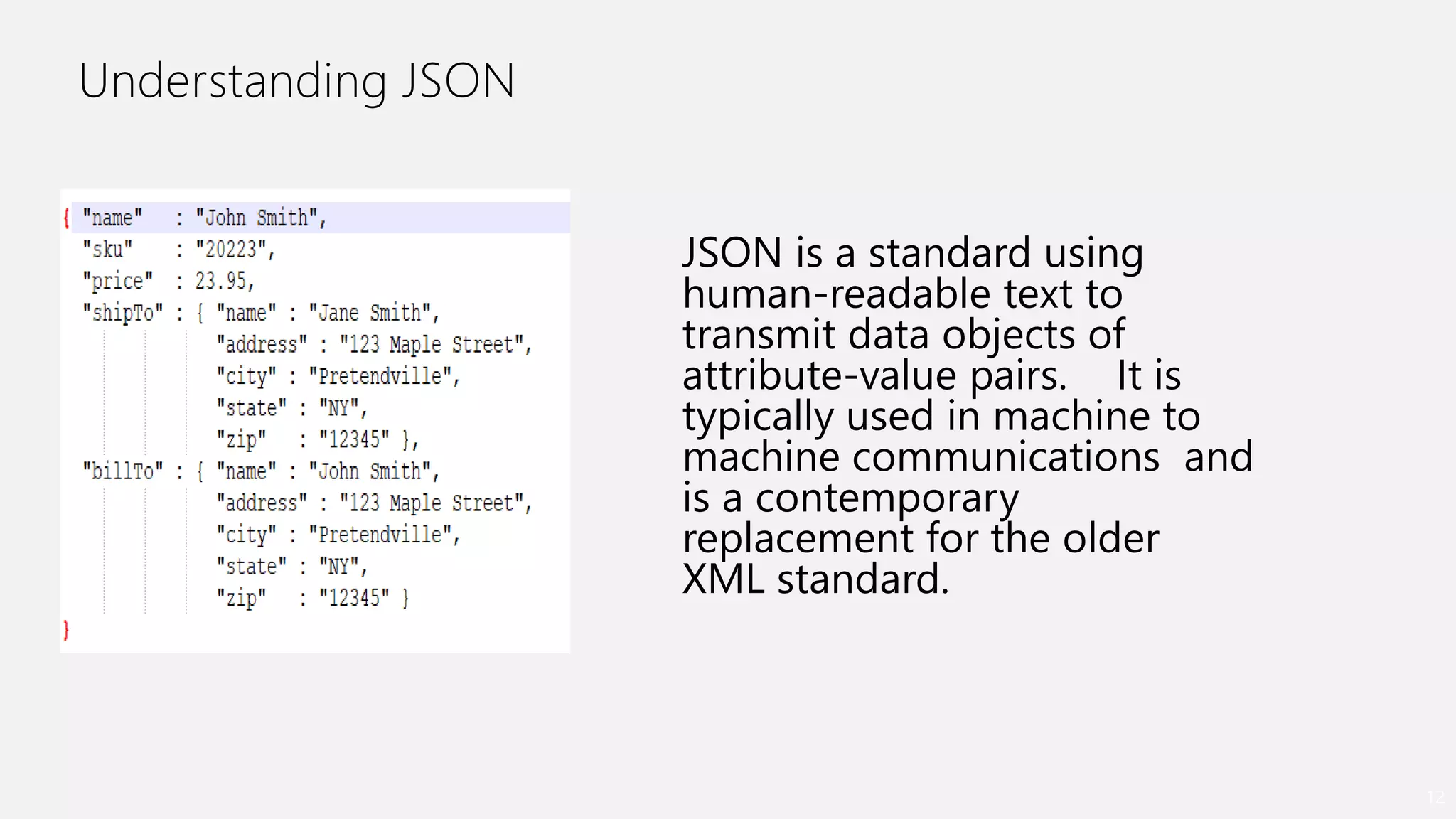
Understanding JSON
12
JSON is a standard using
human-readable text to
transmit data objects of
attribute-value pairs. It is
typically used in machine to
machine communications and
is a contemporary
replacement for the older
XML standard.
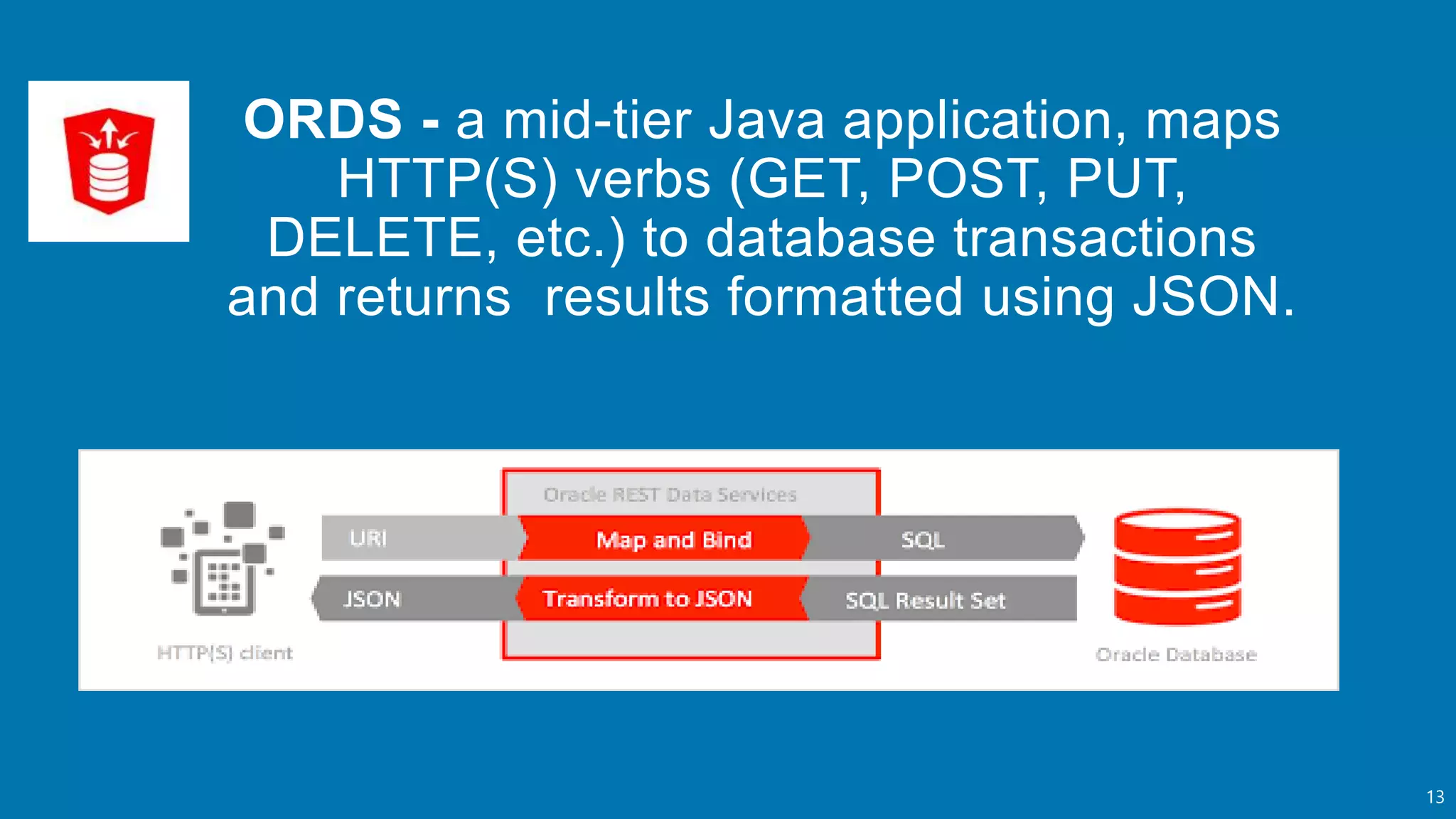
ORDS - a mid-tier Java application, maps
HTTP(S) verbs (GET, POST, PUT,
DELETE, etc.) to database transactions
and returns results formatted using JSON.
13
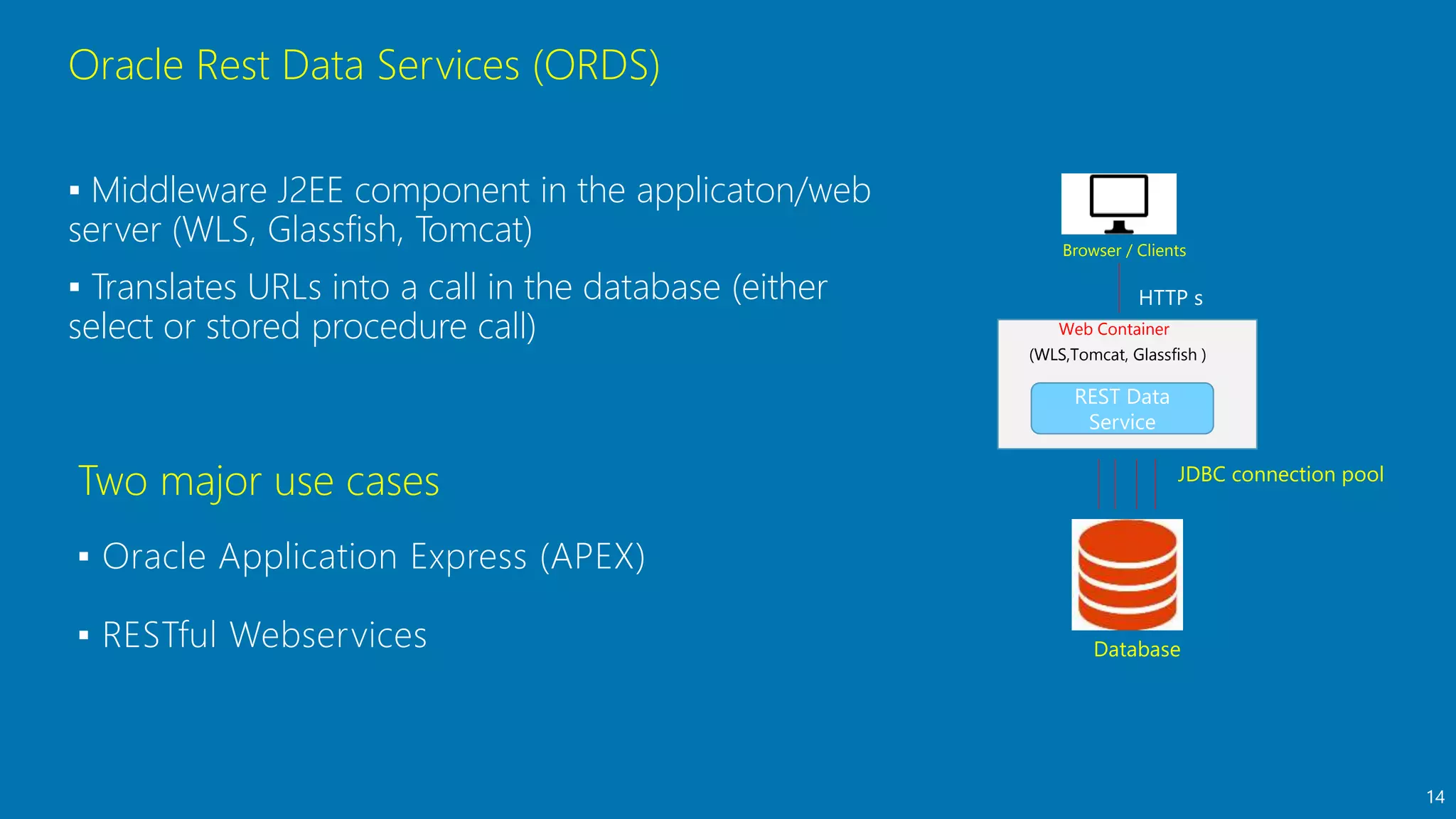
Oracle Rest Data Services (ORDS)
▪ Middleware J2EE component in the applicaton/web
server (WLS, Glassfish, Tomcat)
▪ Translates URLs into a call in the database (either
select or stored procedure call)
Two major use cases
▪ Oracle Application Express (APEX)
▪ RESTful Webservices
14
Web Container
REST Data
Service
(WLS,Tomcat, Glassfish )
HTTP s
Browser / Clients
Database
JDBC connection pool
15
ORDS Architecture
16
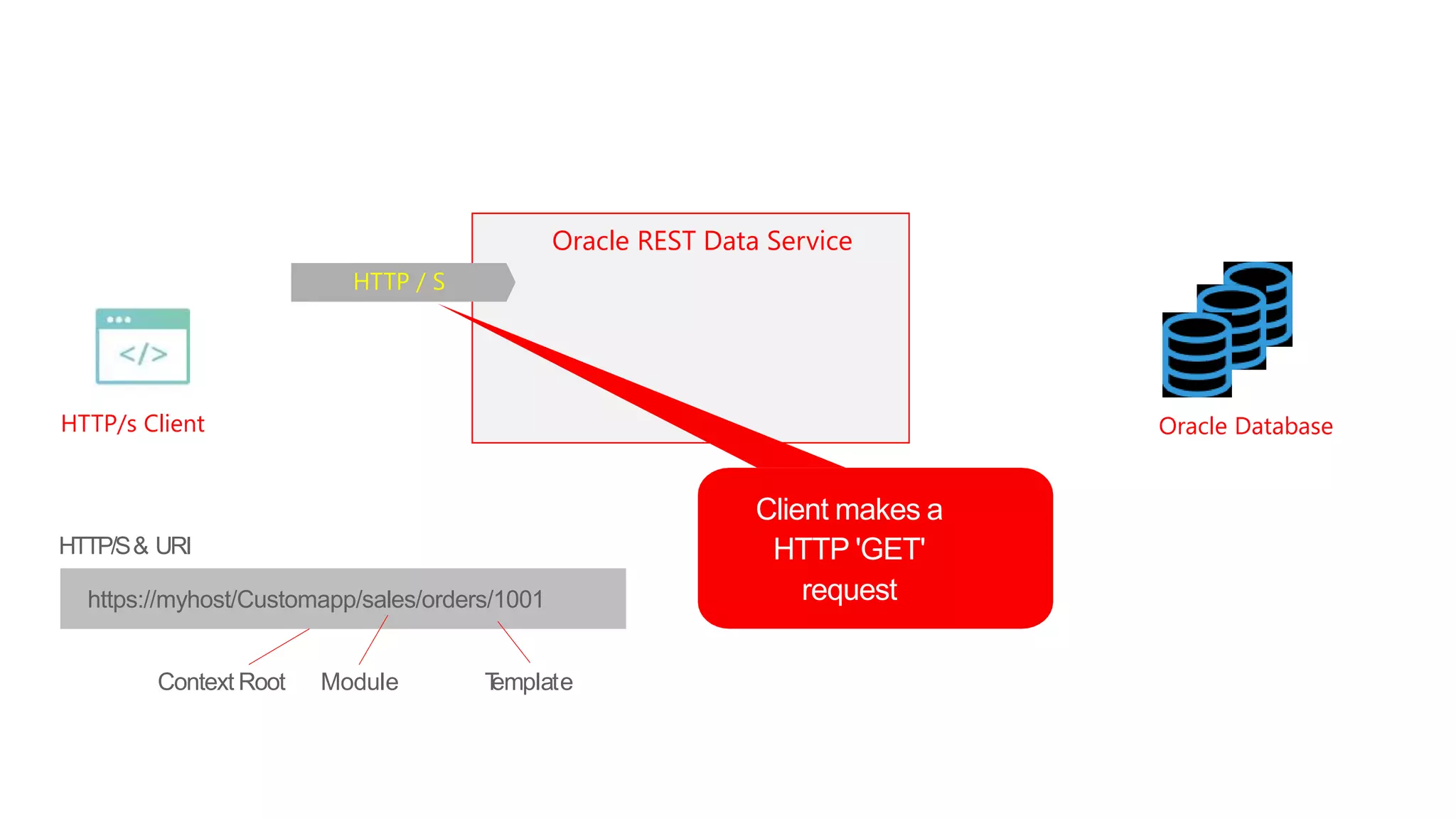
HTTP/s Client Oracle Database
Oracle REST Data Service
HTTP / S
Client makes a
HTTP 'GET'
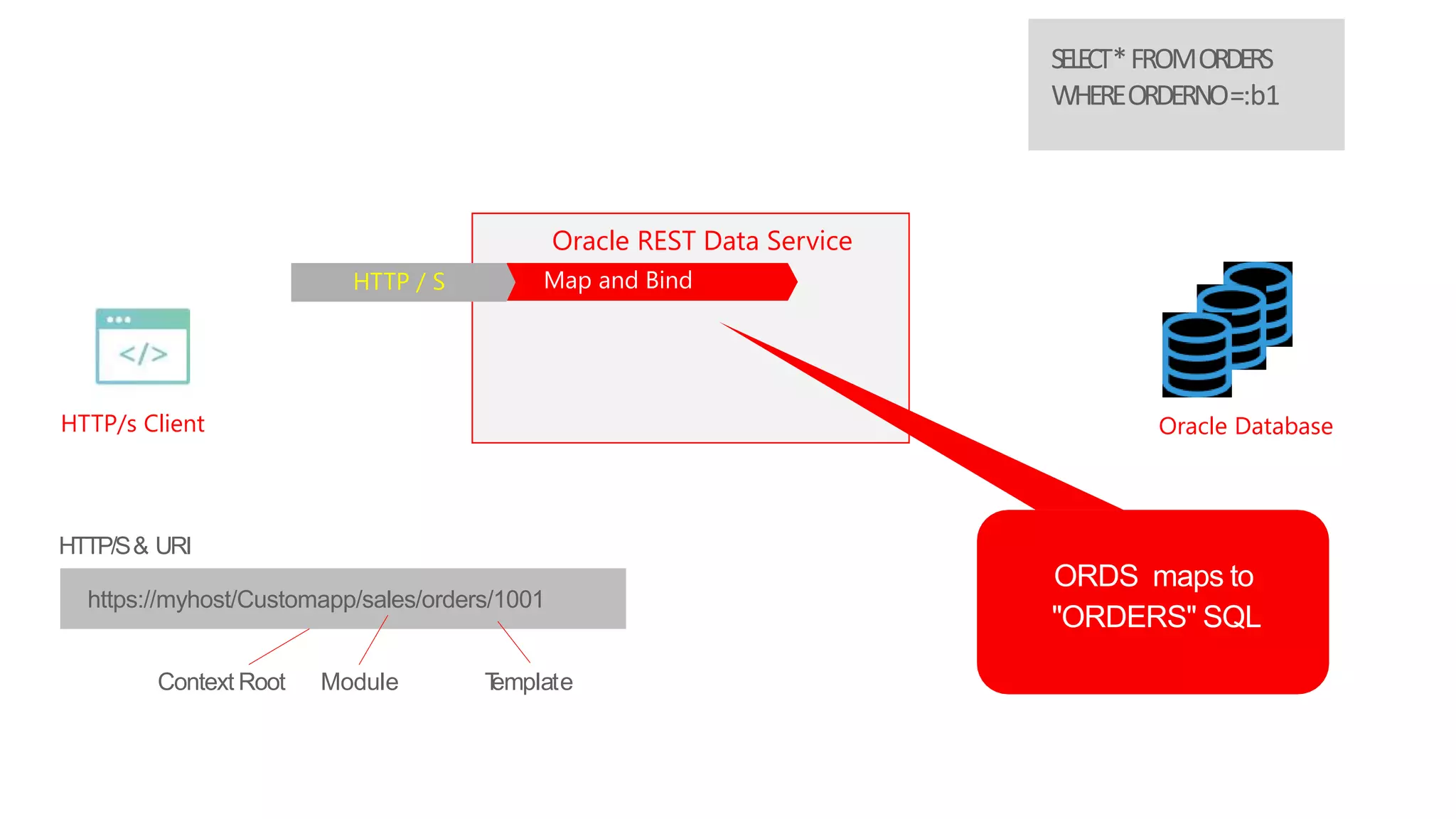
requesthttps://myhost/Customapp/sales/orders/1001
HTTP/S& URI
Module TemplateContext Root
17
HTTP/s Client Oracle Database
Oracle REST Data Service
Client makes a
HTTP 'GET'
requesthttps://myhost/Customapp/sales/orders/1001
HTTP/S& URI
Module TemplateContext Root
ORDS maps to
"ORDERS" SQL
SELECT*FROMORDERS
WHEREORDERNO=:b1
HTTP / S Map and Bind
18
HTTP/s Client Oracle Database
Oracle REST Data Service
Client makes a
HTTP 'GET'
requesthttps://myhost/Customapp/sales/orders/1001
HTTP/S& URI
Module TemplateContext Root
ORDSmapsto
"ORDERS"SQL
SELECT*FROM
ORDERSWHERE
ORDERNO=:b1
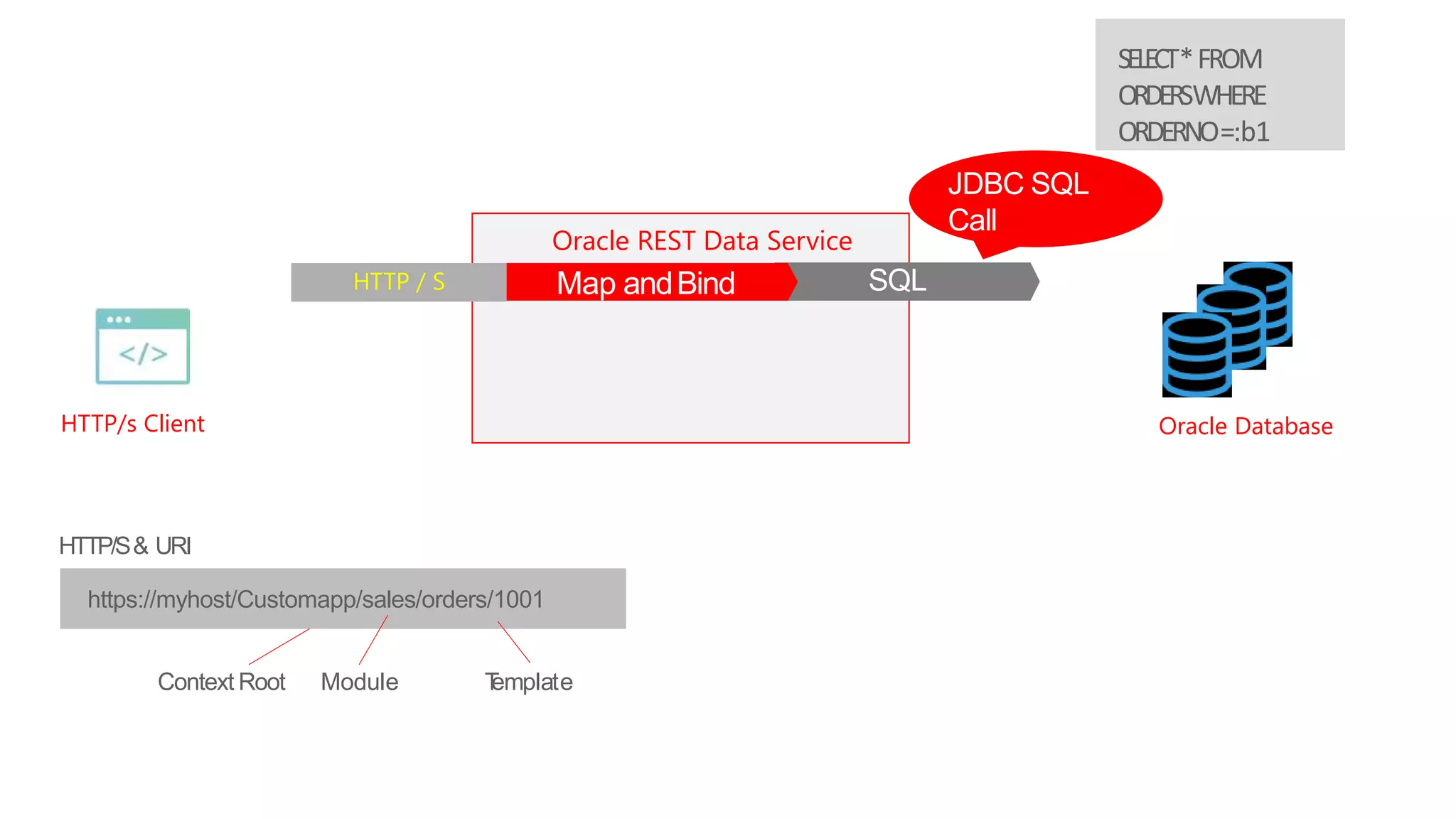
HTTP / S Map and BindMap andBind SQL
JDBC SQL
Call
19
HTTP/s Client Oracle Database
Oracle REST Data Service
Client makes a
HTTP 'GET'
requesthttps://myhost/Customapp/sales/orders/1001
HTTP/S& URI
Module TemplateContext Root
ORDSmapsto
"ORDERS"SQL
SELECT*FROM
ORDERSWHERE
ORDERNO=:b1
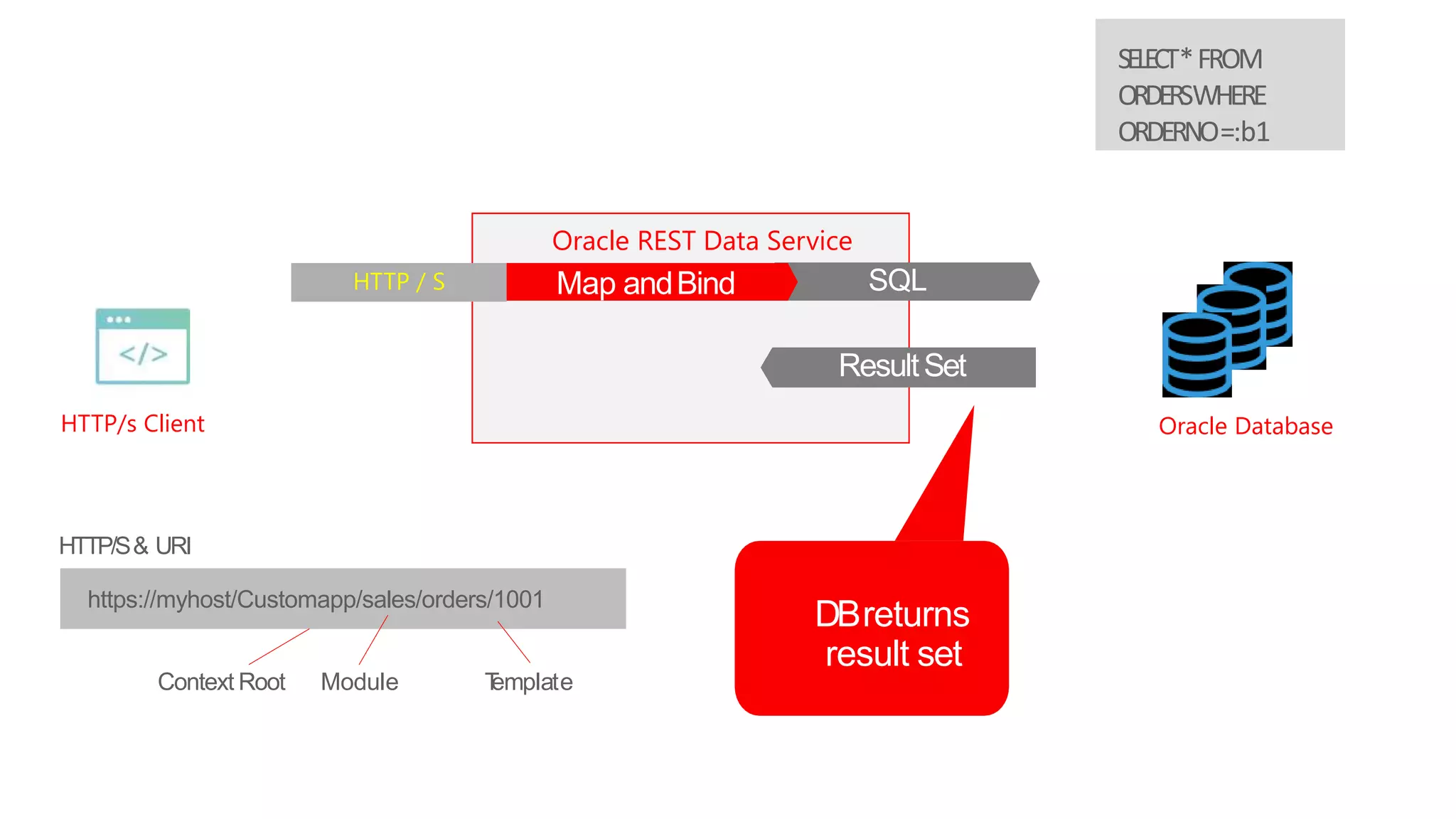
HTTP / S Map and BindMap andBind SQL
ResultSet
DBreturns
result set
20
HTTP/s Client Oracle Database
Oracle REST Data Service
Client makes a
HTTP 'GET'
requesthttps://myhost/Customapp/sales/orders/1001
HTTP/S& URI
Module TemplateContext Root
ORDSmapsto
"ORDERS"SQL
SELECT*FROM
ORDERSWHERE
ORDERNO=:b1
HTTP / S Map and BindMap andBind SQL
DBreturns
result set
{"orderno": 1001,
"name": "ScottKing",
"address": "500 Main street,
Innovation CA", "items": [{
"itemno": 404,"quantity":7,
"status": "in process"},
{"itemno": 303,"quantity": 32,
"status": "closed"} ]}
Transform to JSON,
CSV, Excel or Binary
ResultSetTransform
21
HTTP/s Client
Oracle Database
Oracle REST Data Service
Client makes a
HTTP 'GET'
request
https://myhost/Customapp/sales/orders/1001
HTTP/S& URI
Module TemplateContext Root
ORDSmapsto
"ORDERS"SQL
SELECT*FROM
ORDERSWHERE
ORDERNO=:b1
HTTP / S Map and BindMap andBind SQL
DBreturns
result set
{"orderno": 1001,
"name": "ScottKing",
"address": "500 Main street,
Innovation CA", "items": [{
"itemno": 404,"quantity":7,
"status": "in process"},
{"itemno": 303,"quantity": 32,
"status": "closed"} ]}
JSON
Response to HTTP
request
Transform ResultSet
22
HTTP/s Client
Oracle Database
Oracle REST Data Service
Client makes a
HTTP 'GET'
request ORDSmapsto
"ORDERS"SQL
HTTP / S Map and BindMap andBind SQL
DBreturns
result set
JSON Transform ResultSet
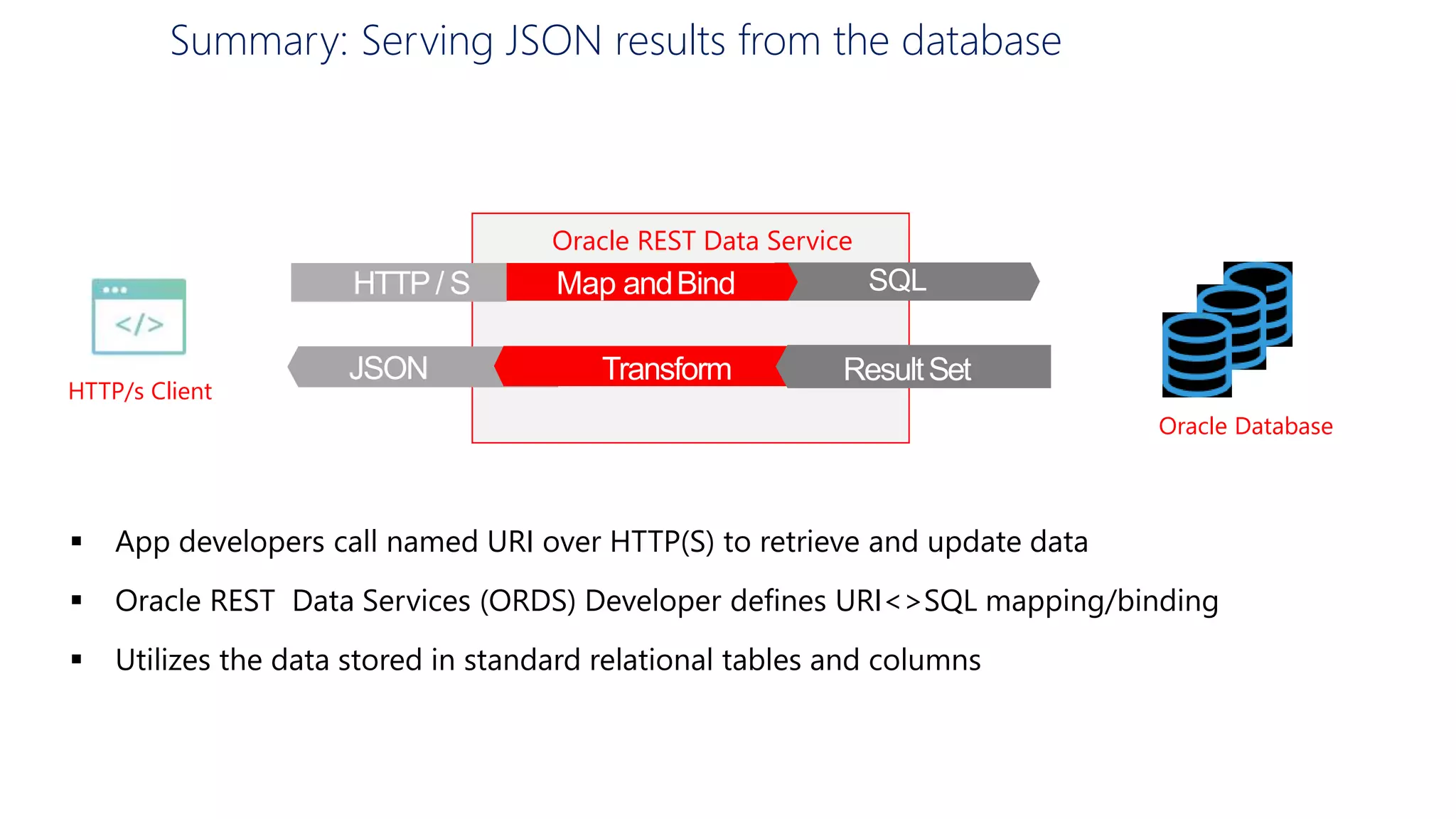
Summary: Serving JSON results from the database
 App developers call named URI over HTTP(S) to retrieve and update data
 Oracle REST Data Services (ORDS) Developer defines URI<>SQL mapping/binding
 Utilizes the data stored in standard relational tables and columns
23
Client makes a
HTTP 'GET'
request
V
ORDSmapsto
"ORDERS"SQL
Map and Bind SQL
DBreturns
result set
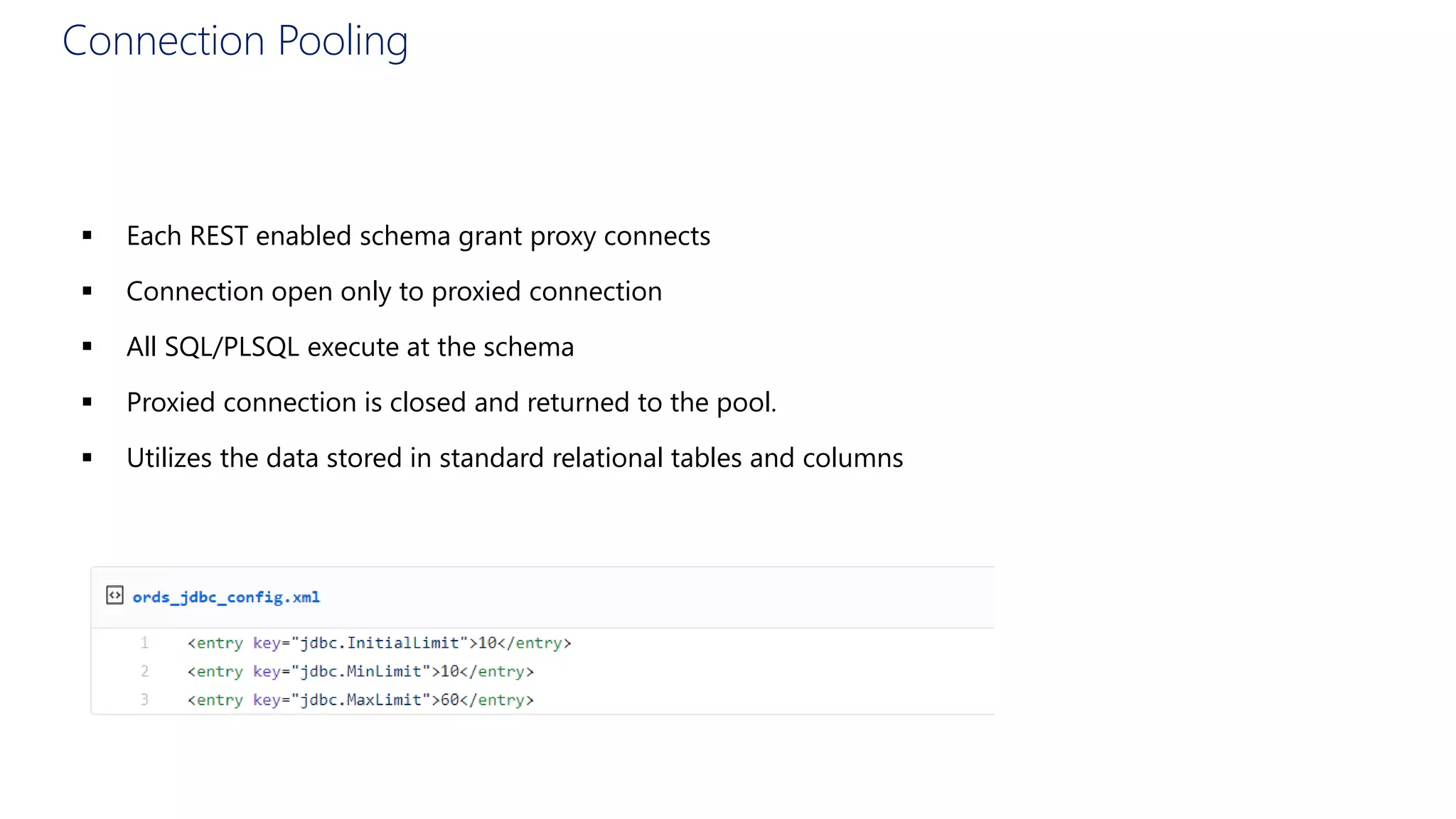
Connection Pooling
 Each REST enabled schema grant proxy connects
 Connection open only to proxied connection
 All SQL/PLSQL execute at the schema
 Proxied connection is closed and returned to the pool.
 Utilizes the data stored in standard relational tables and columns
24
Client makes a
HTTP 'GET'
request ORDSmapsto
"ORDERS"SQL
Map and Bind
DBreturns
result set
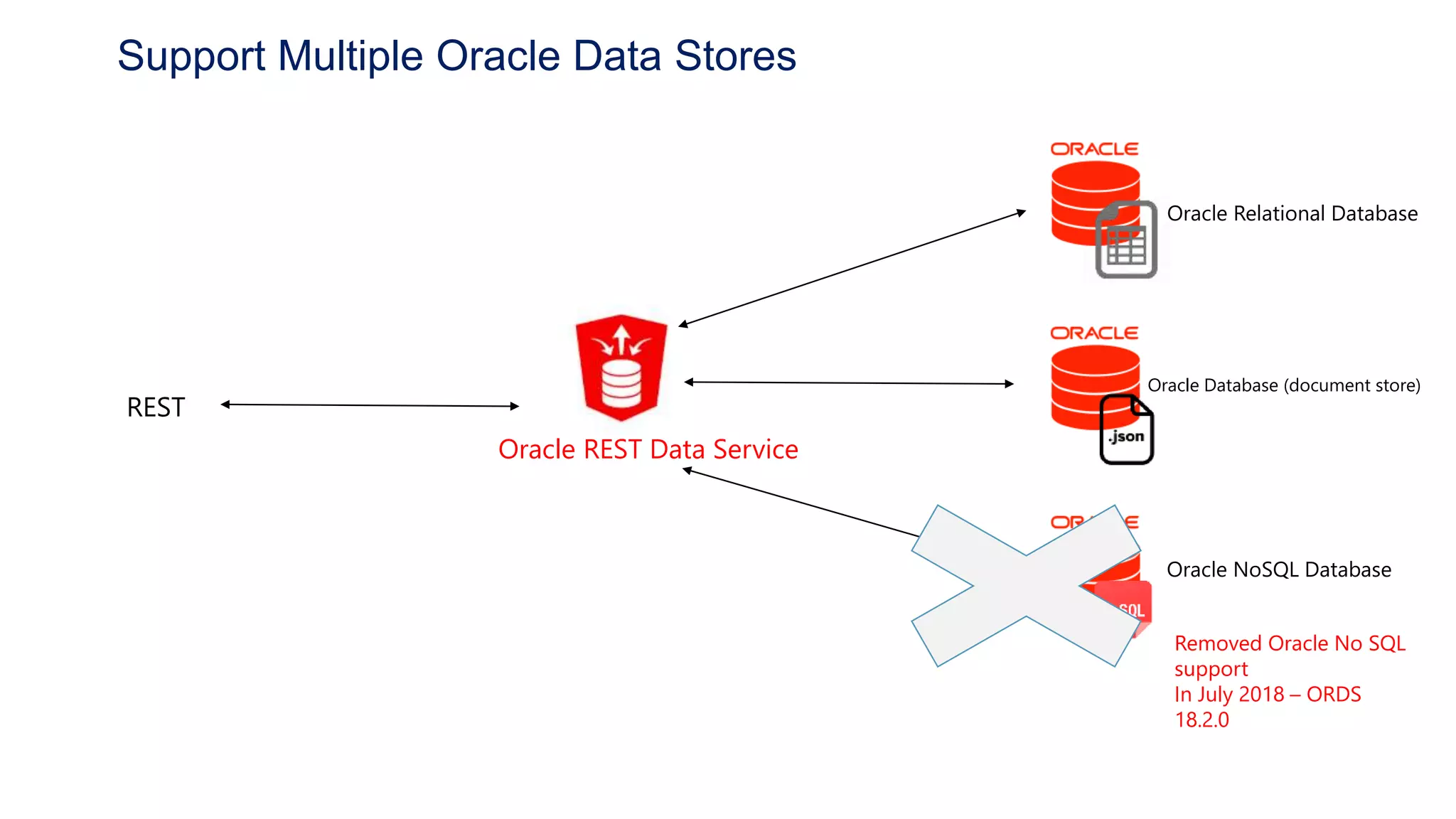
Support Multiple Oracle Data Stores
REST
Oracle REST Data Service
Oracle Relational Database
Oracle Database (document store)
Oracle NoSQL Database
Removed Oracle No SQL
support
In July 2018 – ORDS
18.2.0
Oracle REST Data Service
25
- Provide data access in modern application development
• Its a mid tier application.
• It is JavaScript friendly and highly scalable.
• Can declartive return result in JSON format.
• It map Http (s) request into the SQL
• Provides mapping between pl/sql to JSON.
- Services & Features
• Formally known as Oracle APEX Listener.
• Access to relational database to the http(s) with jdbc/odbc driver.
• Oracle JSON collection based schema-less access.
• It map Http (s) request into the SQL
• Provides mapping between pl/sql to JSON.
• Support HTTP Basic dynamic authentication for PL/SQL Gateway calls
• Open API (aka Swagger) support for metadata catalog
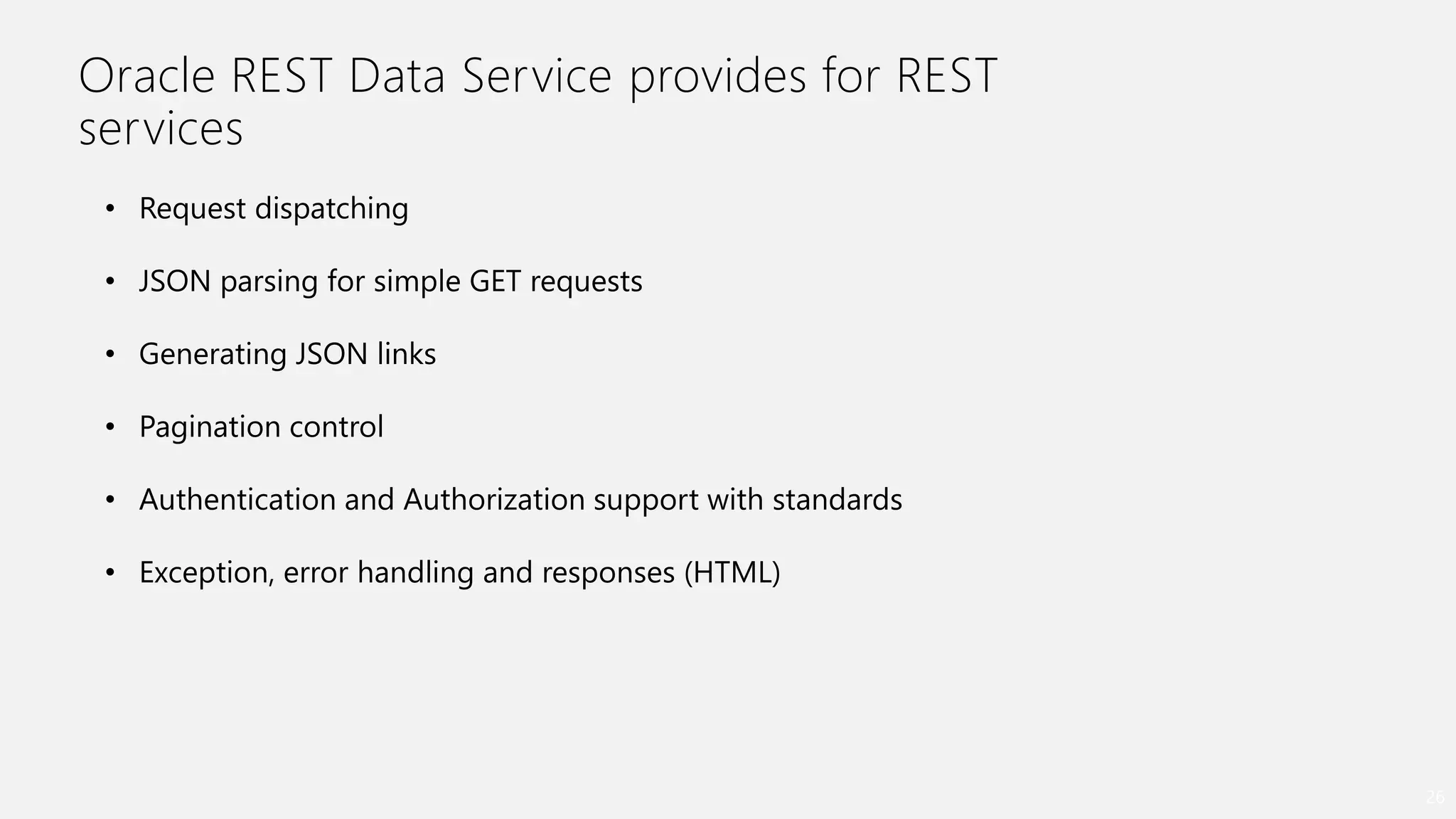
Oracle REST Data Service provides for REST
services
26
• Request dispatching
• JSON parsing for simple GET requests
• Generating JSON links
• Pagination control
• Authentication and Authorization support with standards
• Exception, error handling and responses (HTML)
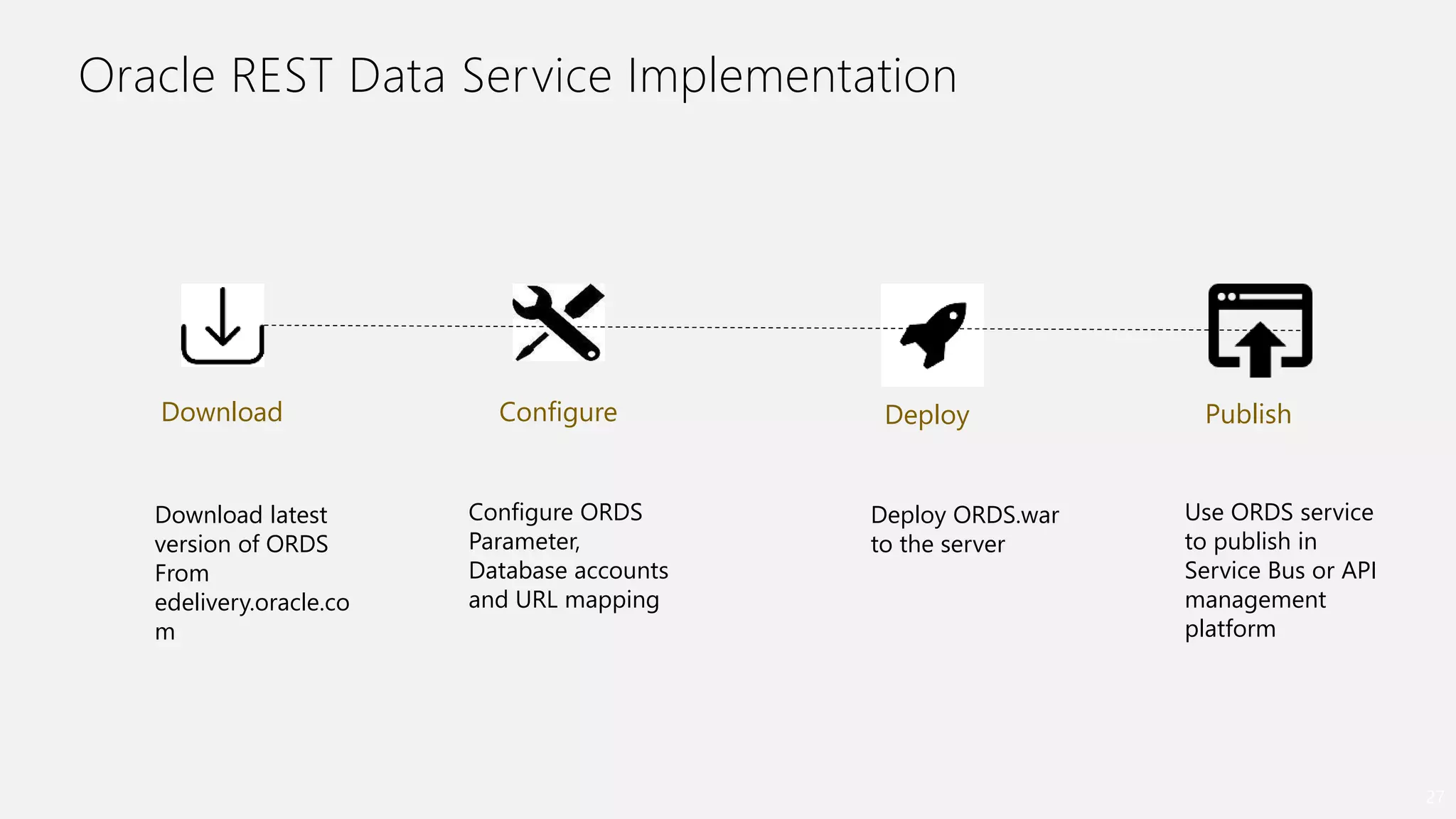
Oracle REST Data Service Implementation
27
Download DeployConfigure Publish
Download latest
version of ORDS
From
edelivery.oracle.co
m
Configure ORDS
Parameter,
Database accounts
and URL mapping
Deploy ORDS.war
to the server
Use ORDS service
to publish in
Service Bus or API
management
platform
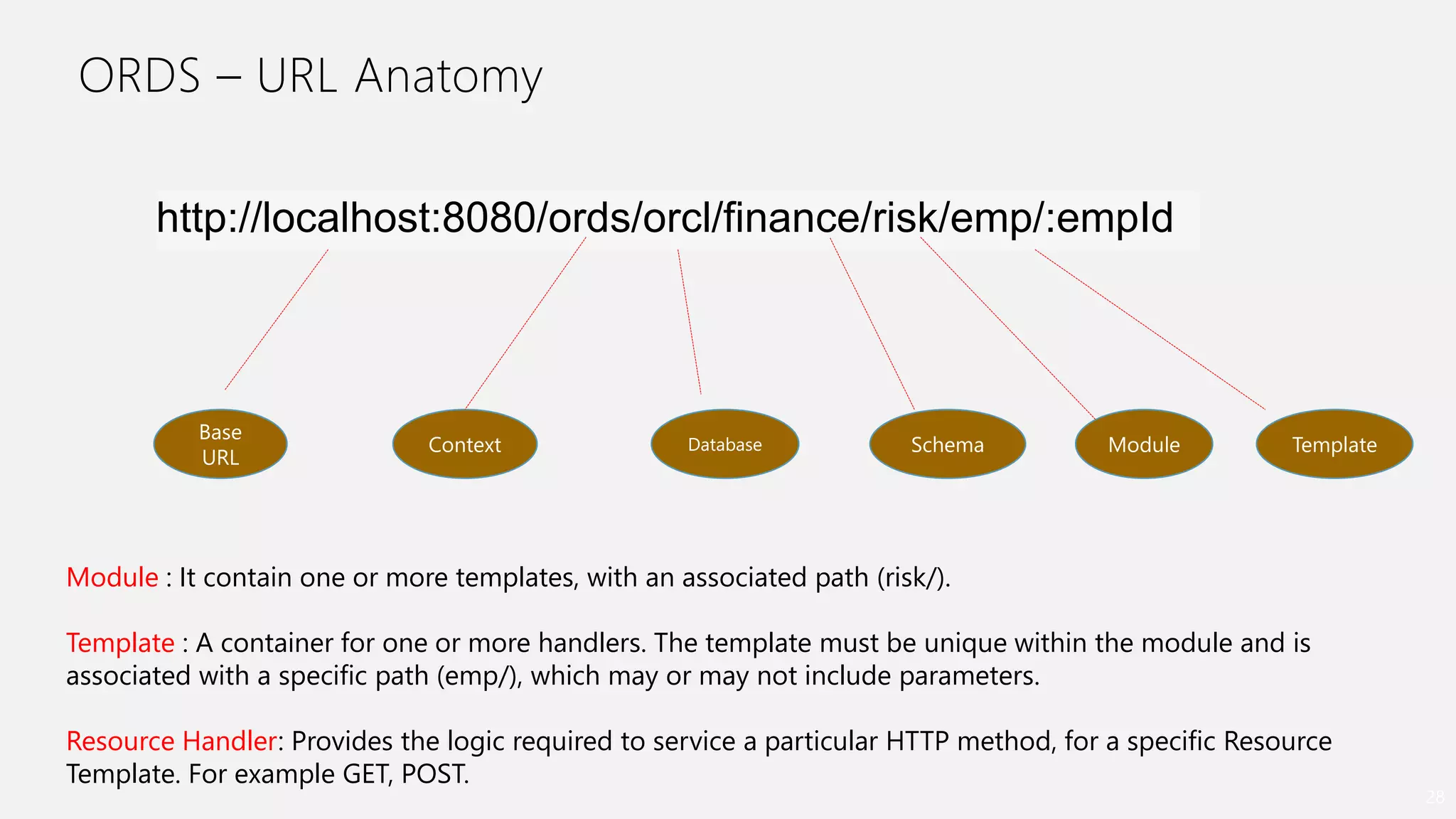
ORDS – URL Anatomy
28
http://localhost:8080/ords/orcl/finance/risk/emp/:empId
Base
URL
Context SchemaDatabase Module Template
Module : It contain one or more templates, with an associated path (risk/).
Template : A container for one or more handlers. The template must be unique within the module and is
associated with a specific path (emp/), which may or may not include parameters.
Resource Handler: Provides the logic required to service a particular HTTP method, for a specific Resource
Template. For example GET, POST.
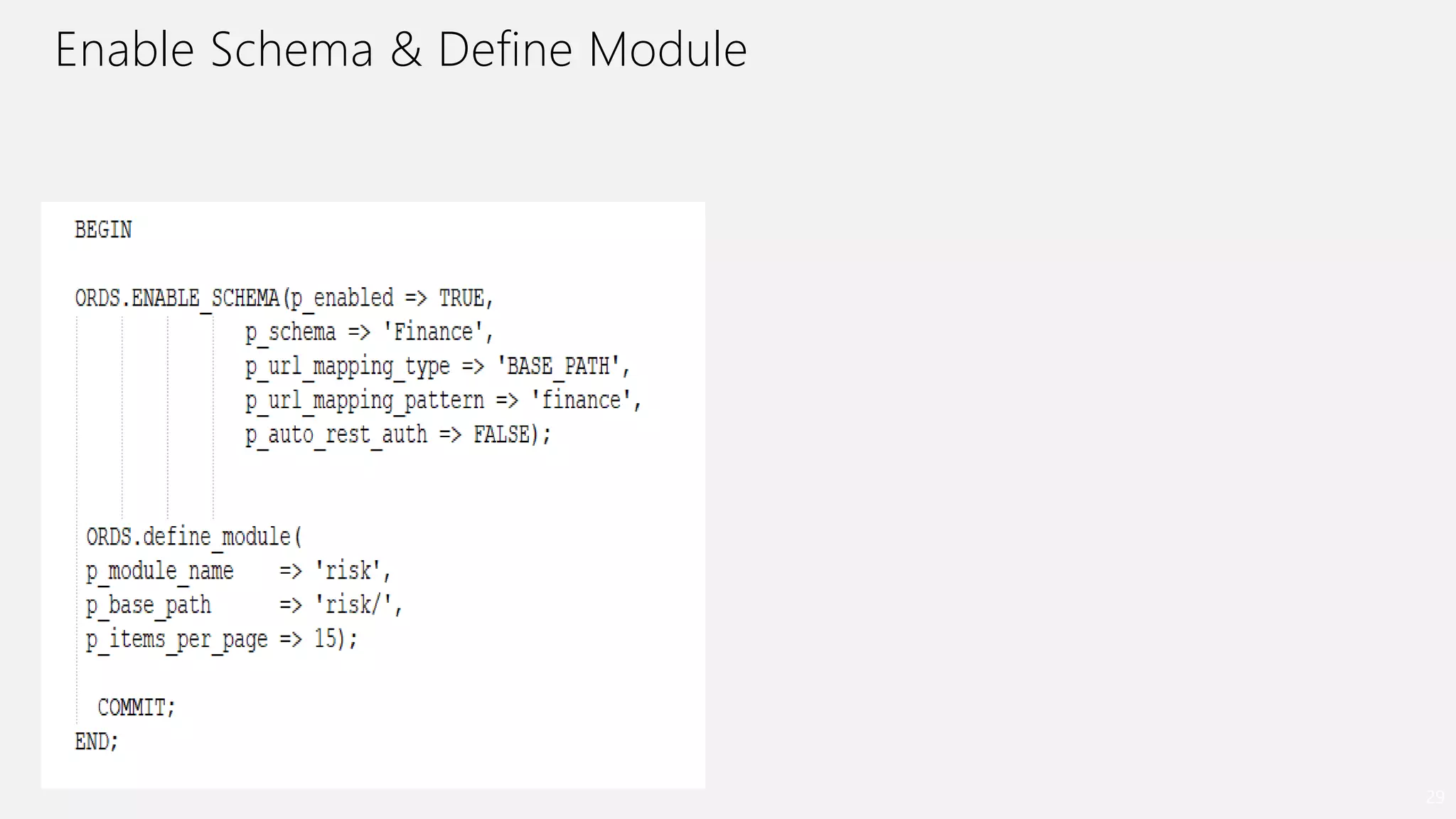
Enable Schema & Define Module
29
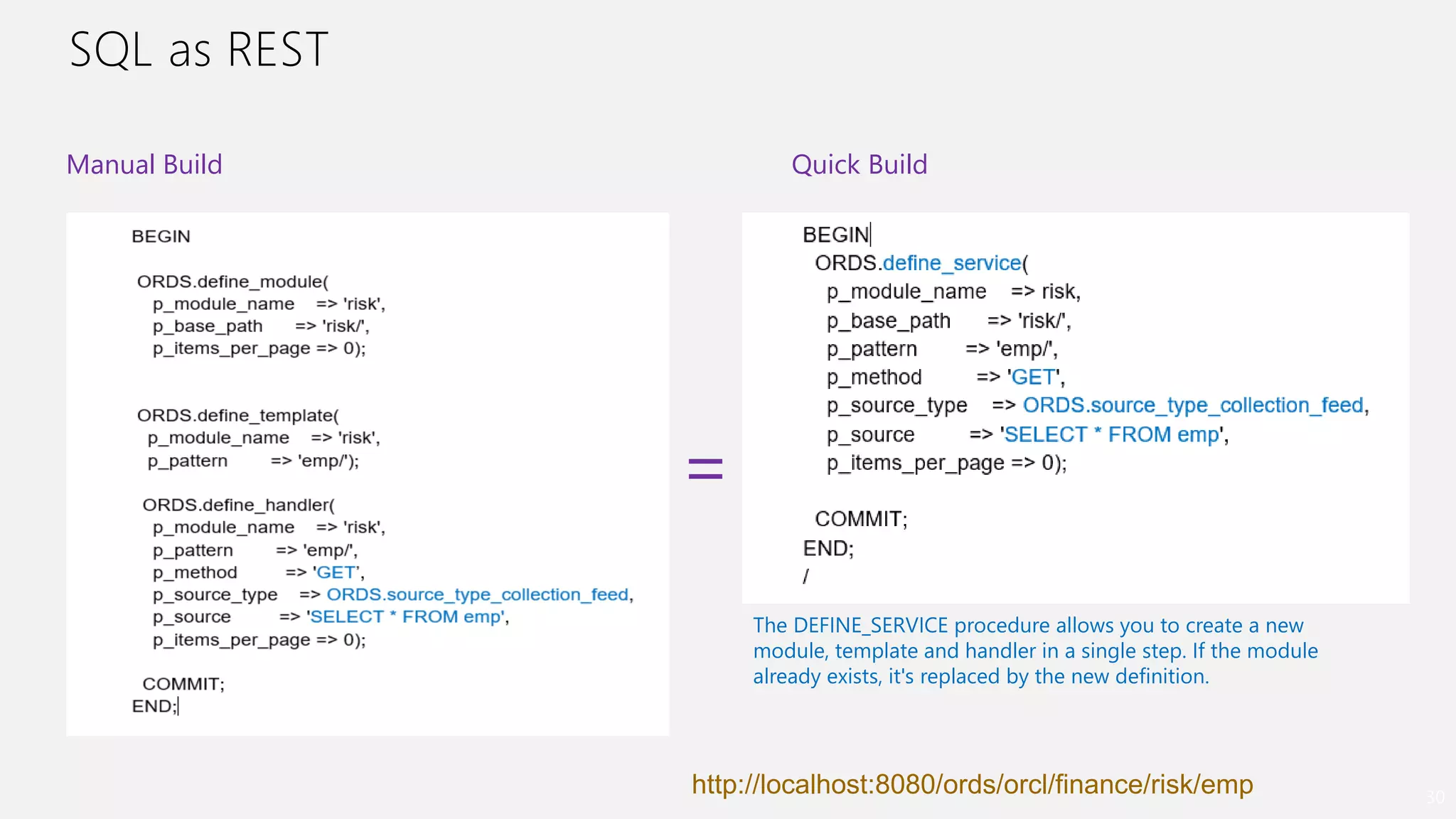
SQL as REST
30
The DEFINE_SERVICE procedure allows you to create a new
module, template and handler in a single step. If the module
already exists, it's replaced by the new definition.
Quick BuildManual Build
=
http://localhost:8080/ords/orcl/finance/risk/emp
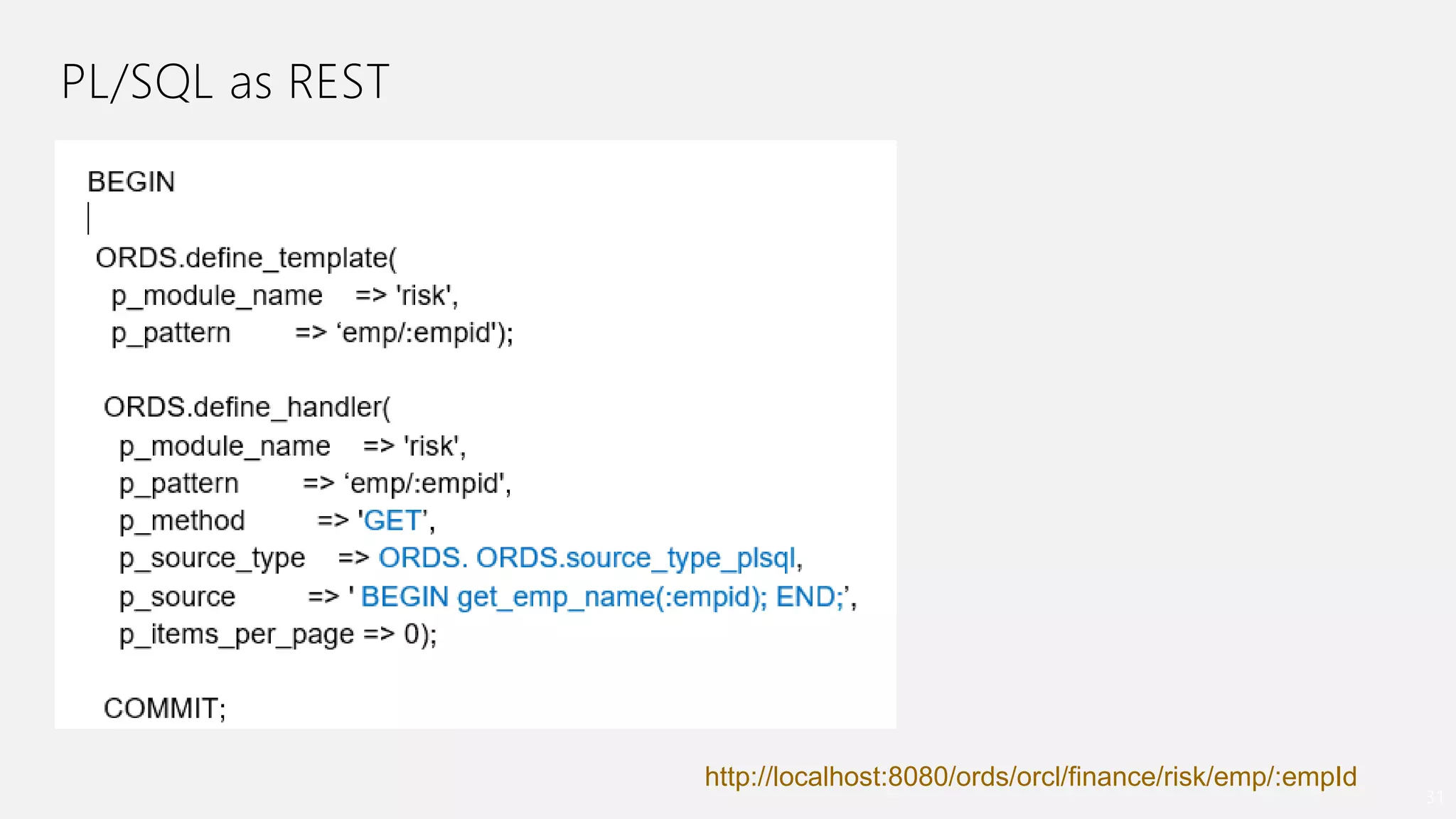
PL/SQL as REST
31
http://localhost:8080/ords/orcl/finance/risk/emp/:empId
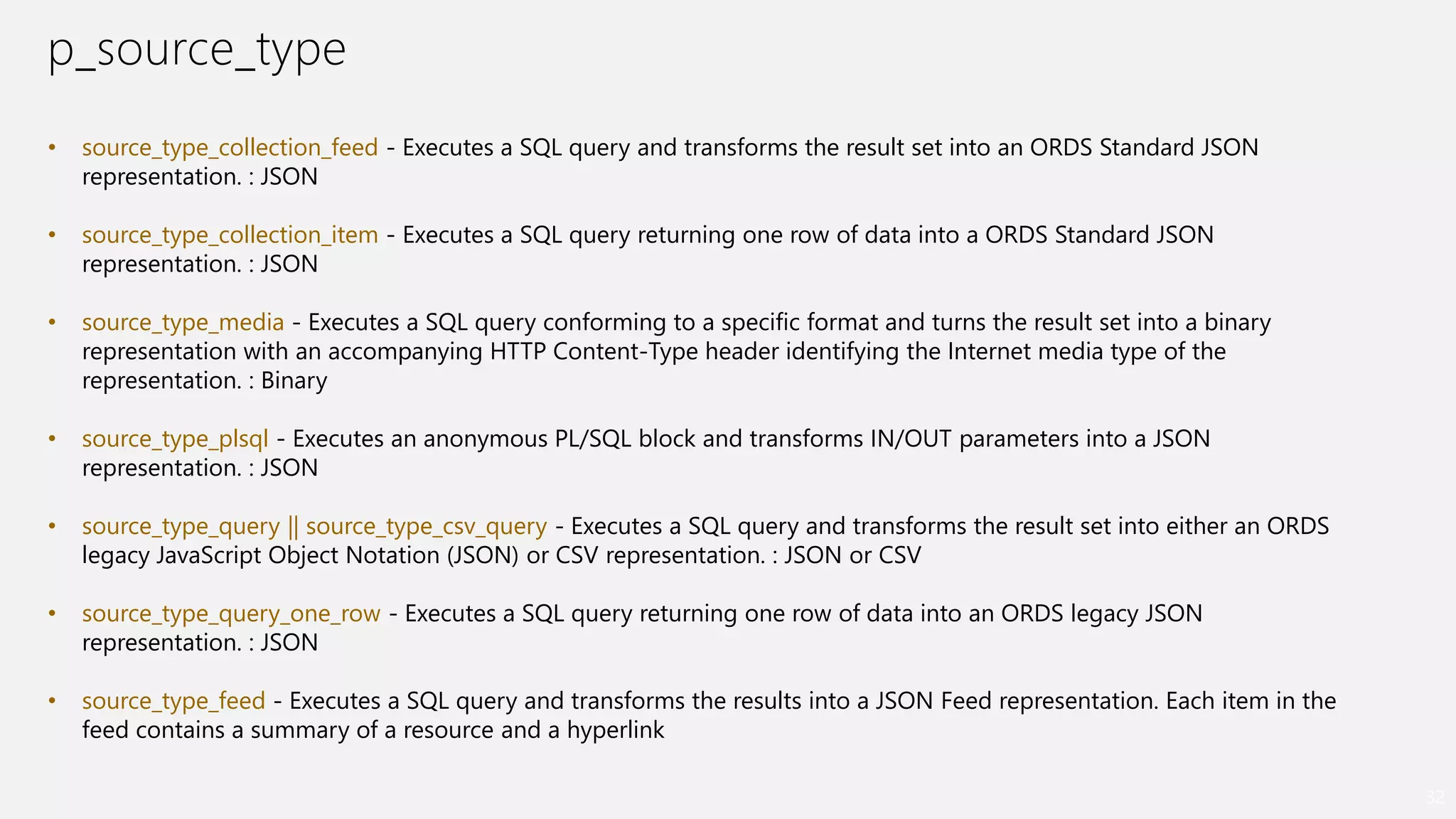
p_source_type
32
• source_type_collection_feed - Executes a SQL query and transforms the result set into an ORDS Standard JSON
representation. : JSON
• source_type_collection_item - Executes a SQL query returning one row of data into a ORDS Standard JSON
representation. : JSON
• source_type_media - Executes a SQL query conforming to a specific format and turns the result set into a binary
representation with an accompanying HTTP Content-Type header identifying the Internet media type of the
representation. : Binary
• source_type_plsql - Executes an anonymous PL/SQL block and transforms IN/OUT parameters into a JSON
representation. : JSON
• source_type_query || source_type_csv_query - Executes a SQL query and transforms the result set into either an ORDS
legacy JavaScript Object Notation (JSON) or CSV representation. : JSON or CSV
• source_type_query_one_row - Executes a SQL query returning one row of data into an ORDS legacy JSON
representation. : JSON
• source_type_feed - Executes a SQL query and transforms the results into a JSON Feed representation. Each item in the
feed contains a summary of a resource and a hyperlink
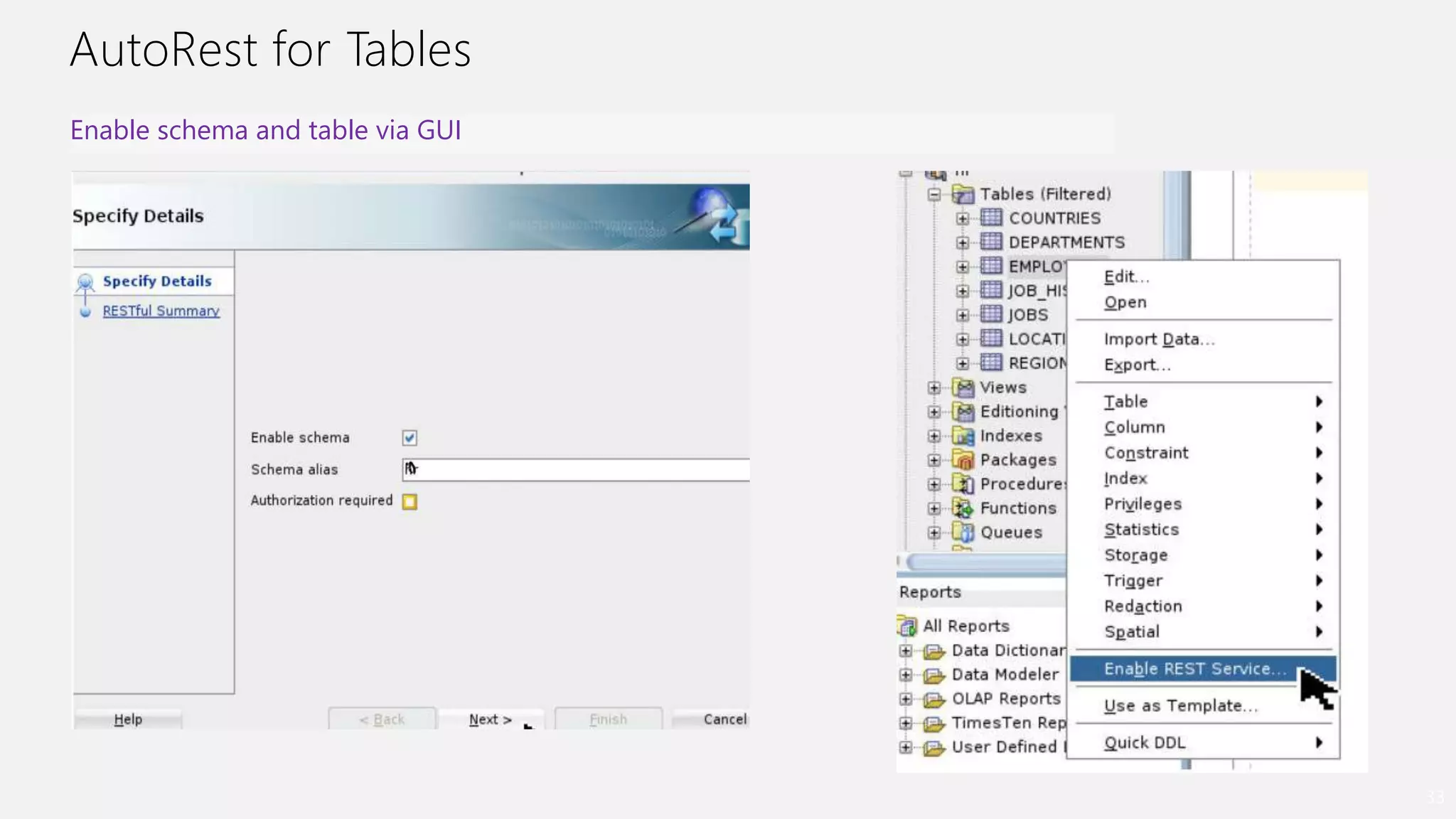
AutoRest for Tables
33
Enable schema and table via GUI
AutoRest- SQL operation
34
• Select
* Method : GET
http://localhost:8080/ords/orcl/finance/risk/emp/
http://localhost:8080/ords/orcl/finance/risk/emp/122/
http://localhost:8080/ords/orcl/finance/risk/emp/?q={"sal":{"$gte":1000}}
• Insert
* Method : POST
http://localhost:8080/ords/orcl/finance/risk/emp
Payload :
AutoRest- SQL operation
35
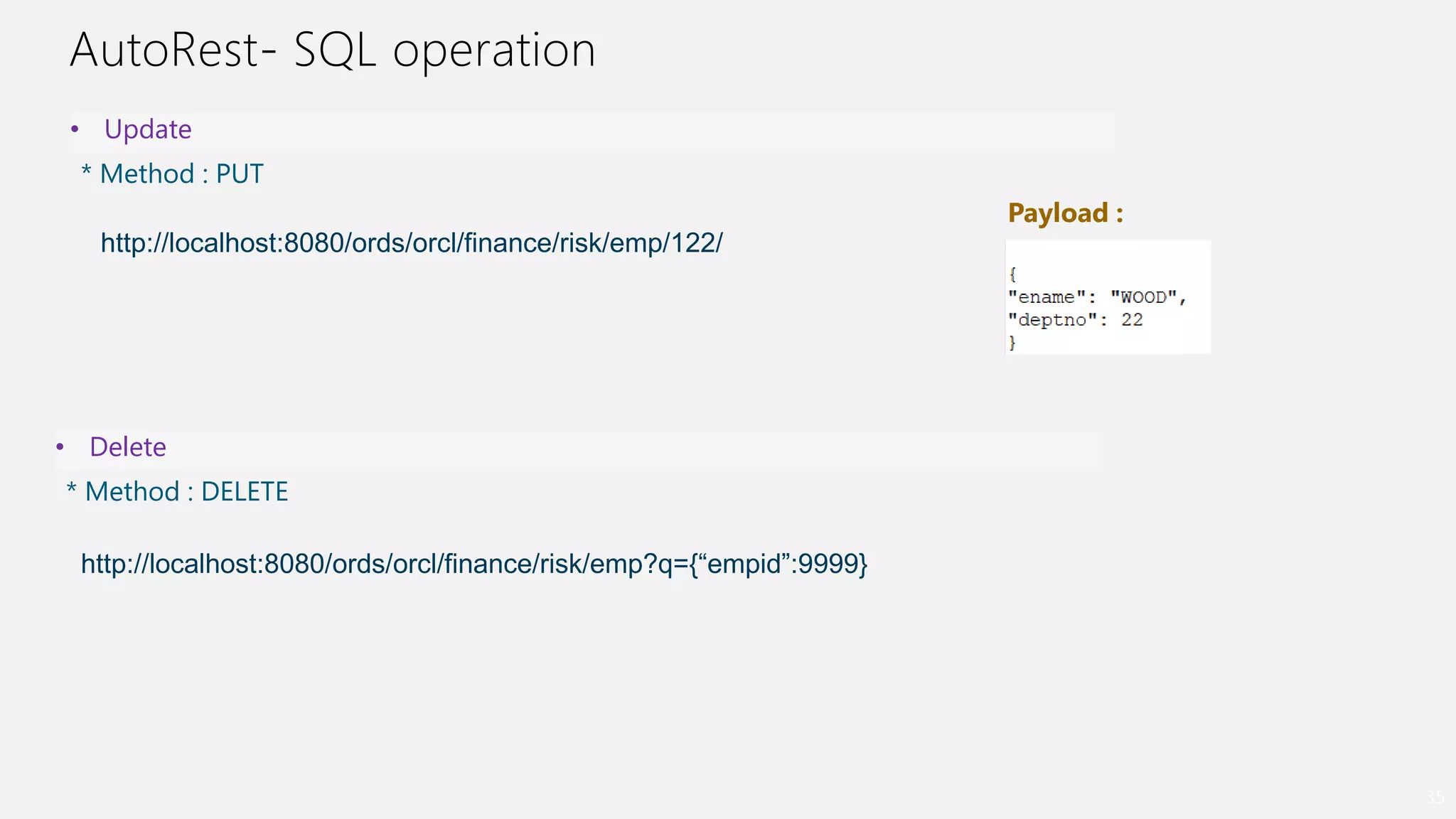
• Update
* Method : PUT
http://localhost:8080/ords/orcl/finance/risk/emp/122/
• Delete
* Method : DELETE
http://localhost:8080/ords/orcl/finance/risk/emp?q={“empid”:9999}
Payload :
AutoRest- BatchLoad
36
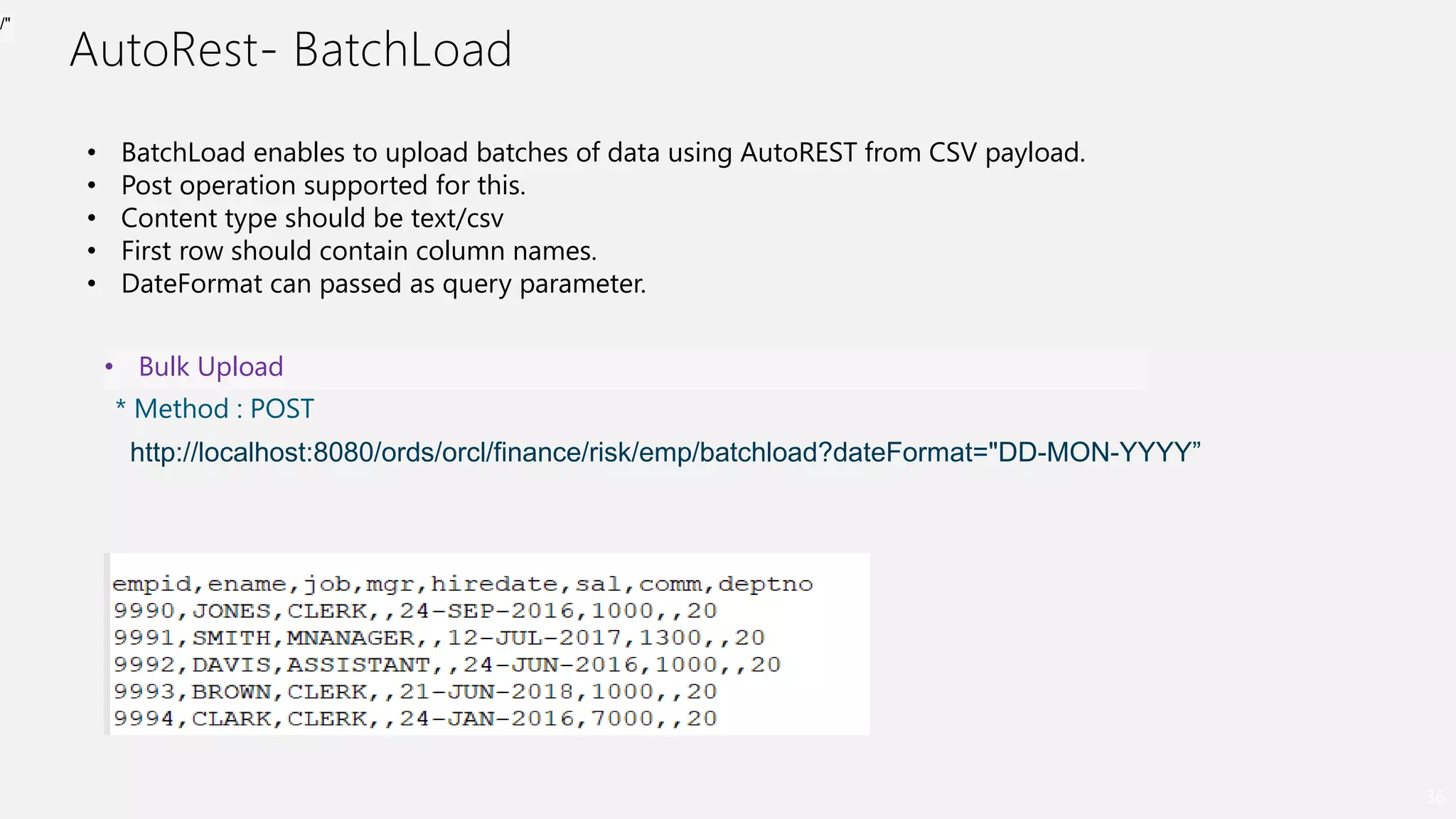
• BatchLoad enables to upload batches of data using AutoREST from CSV payload.
• Post operation supported for this.
• Content type should be text/csv
• First row should contain column names.
• DateFormat can passed as query parameter.
• Bulk Upload
* Method : POST
http://localhost:8080/ords/orcl/finance/risk/emp/batchload?dateFormat="DD-MON-YYYY”
/"
OPEN API 2.0 (Swagger) support for API documentation
37
• ORDS exposes the metadata
of specific web services in
Open API 2.0 format.
• REST API inventory
• Test via Curl
• API Description
• Examples.
http://localhost:8080/ords/orcl/finance/metadata-catalog/
http://localhost:8080/ords/orcl/finance/open-api-catalog/ - Open API URL catalog
http://localhost:8080/ords/orcl/finance/open-api-catalog/risk/ - Output for a specific service is in the
Open API 2.0 format.
38
Securing REST APIs
Oracle REST Data Services (ORDS) : Authentication
39
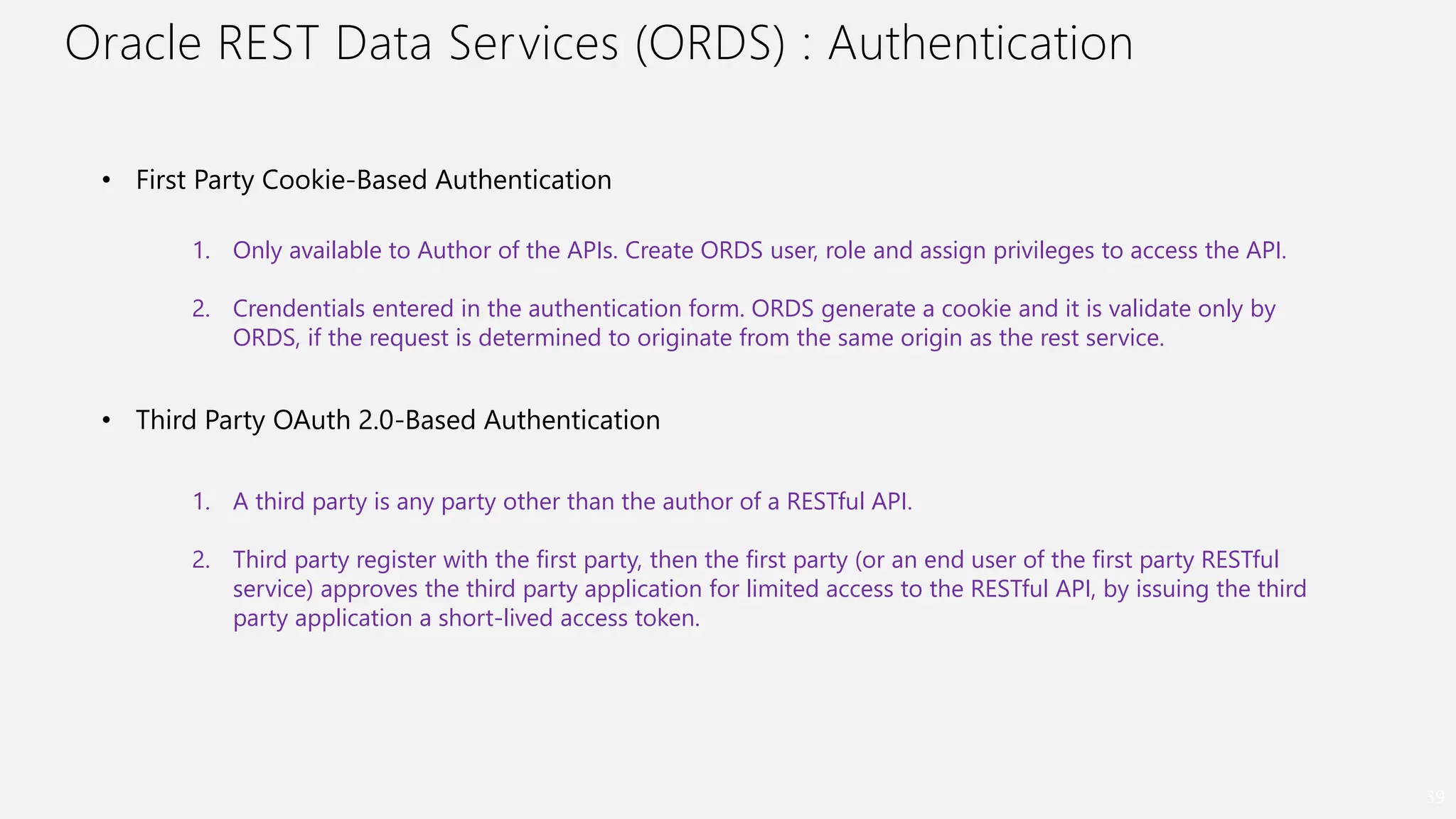
• First Party Cookie-Based Authentication
1. Only available to Author of the APIs. Create ORDS user, role and assign privileges to access the API.
2. Crendentials entered in the authentication form. ORDS generate a cookie and it is validate only by
ORDS, if the request is determined to originate from the same origin as the rest service.
• Third Party OAuth 2.0-Based Authentication
1. A third party is any party other than the author of a RESTful API.
2. Third party register with the first party, then the first party (or an end user of the first party RESTful
service) approves the third party application for limited access to the RESTful API, by issuing the third
party application a short-lived access token.
Oracle REST Data Services (ORDS) : Authentication
40
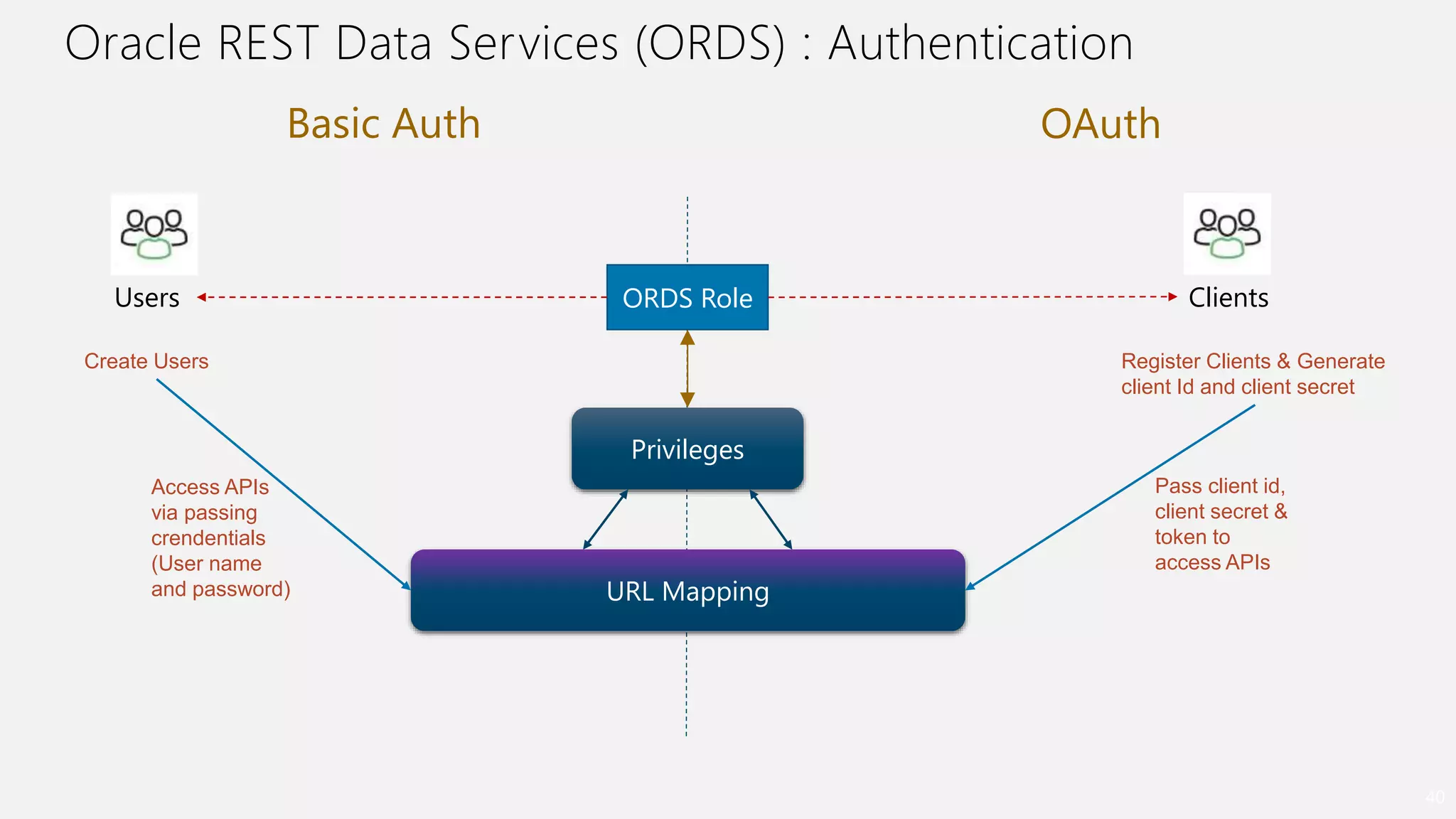
Basic Auth OAuth
ORDS Role
Privileges
Users Clients
URL Mapping
Create Users Register Clients & Generate
client Id and client secret
Access APIs
via passing
crendentials
(User name
and password)
Pass client id,
client secret &
token to
access APIs
Oracle REST Data Services (ORDS) : Authentication
41
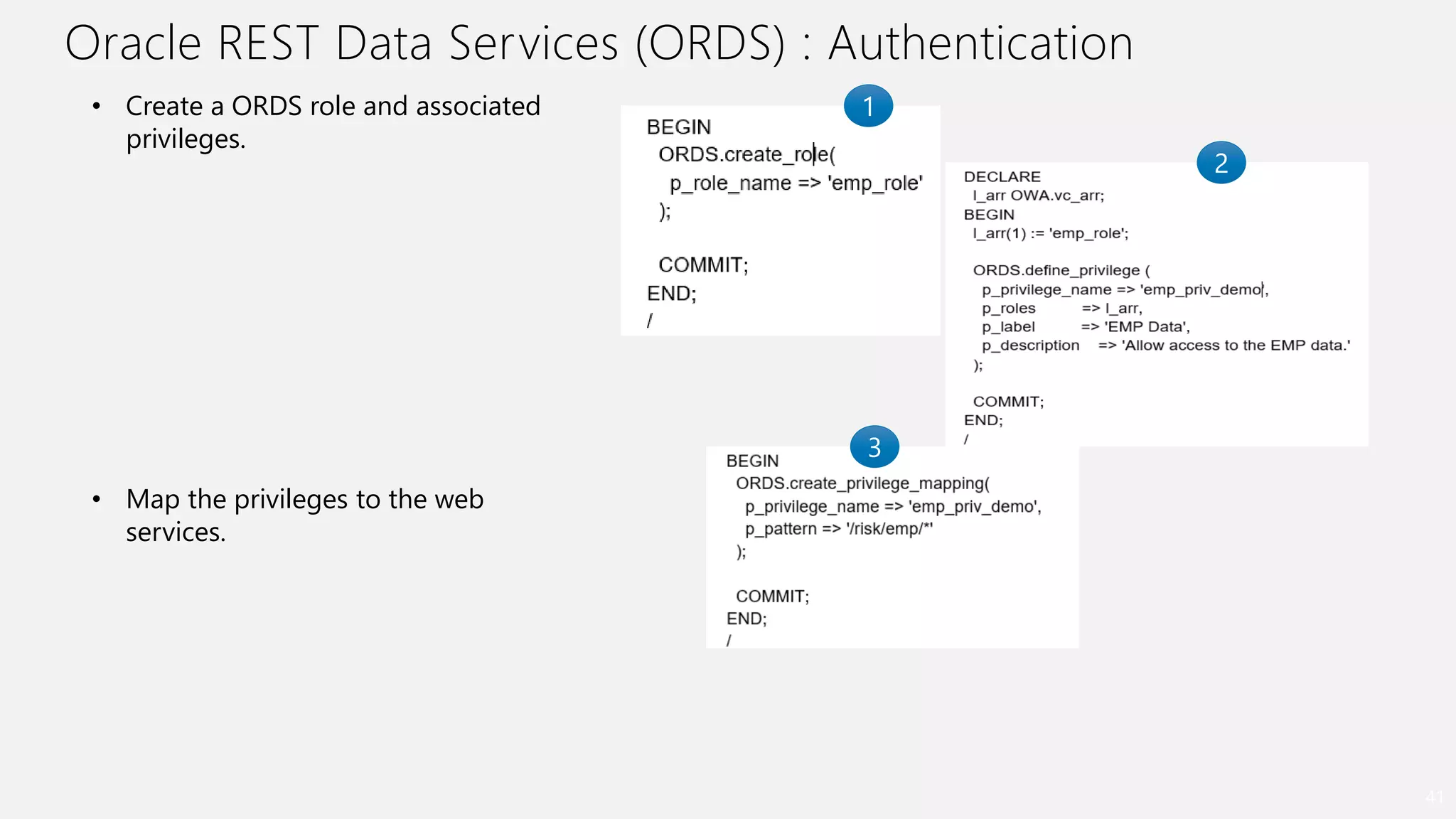
• Create a ORDS role and associated
privileges.
• Map the privileges to the web
services.
1
2
3
Oracle REST Data Services (ORDS) : Authentication - OAUTH
42
1. Client Credentials
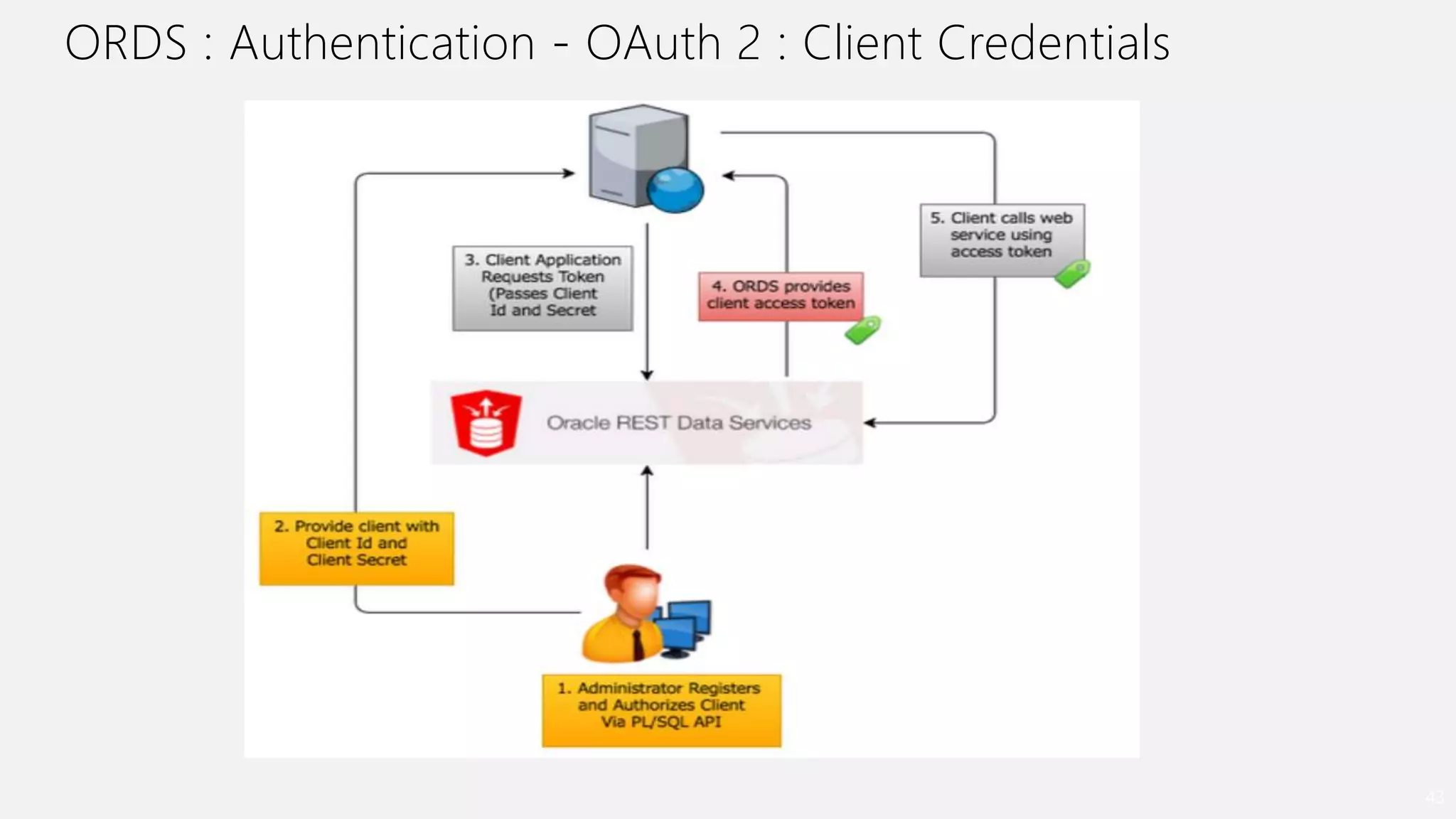
'Two-legged' process. OAuth involves two parties, the party calling the RESTful API (the third party application), and the
party providing the RESTful API. Two legged flows are typically used in server to server interactions where the calling
server can securely store the credentials required to access the service. In OAuth 2.0 this flow is called the client
credentials flow. It is most typically used in business to business scenarios.
2. Authorization Code
'Three-legged' Process .OAuth involves three parties, the party calling the RESTful API, the party providing the RESTful API,
and an end-user party, who owns/manages the data that the RESTful API provides access to. Three legged flows are used in
client to server interactions where an end-user must approve access to the RESTful API. In OAuth 2.0 the authorization code
flow and the implicit flow are three legged flows. These flows are typically used in business to consumer scenarios.
3. Implict
'Two-legged' process. The user accesses a URL in a browser, which prompts for credentials. Once authenticated, the
browser is redirected to a specified page with an access token as one of the parameters in the URL. That access token is
used to authenticate calls to protected resources.
ORDS : Authentication - OAuth 2 : Client Credentials
43
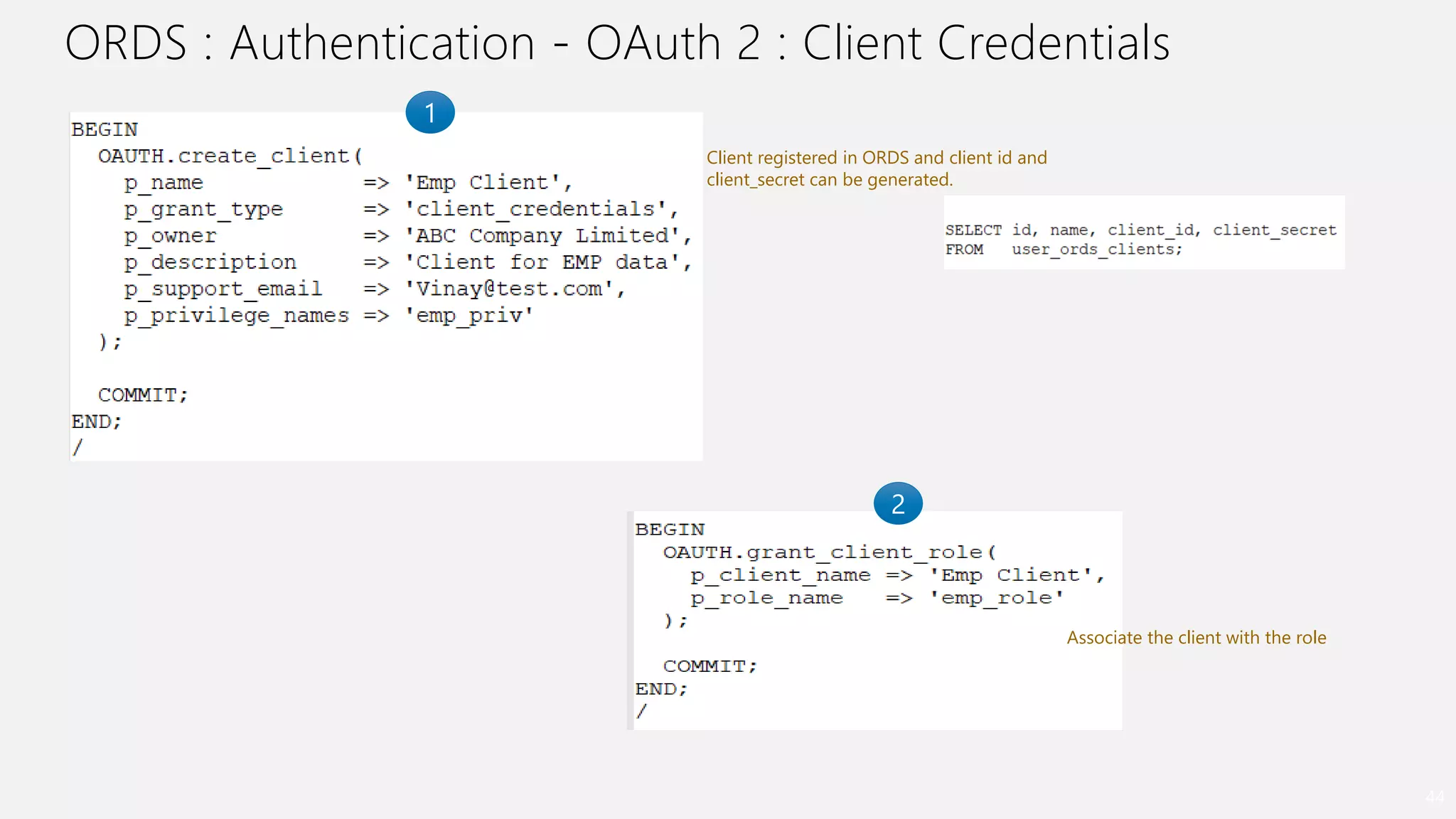
ORDS : Authentication - OAuth 2 : Client Credentials
44
1
Client registered in ORDS and client id and
client_secret can be generated.
2
Associate the client with the role
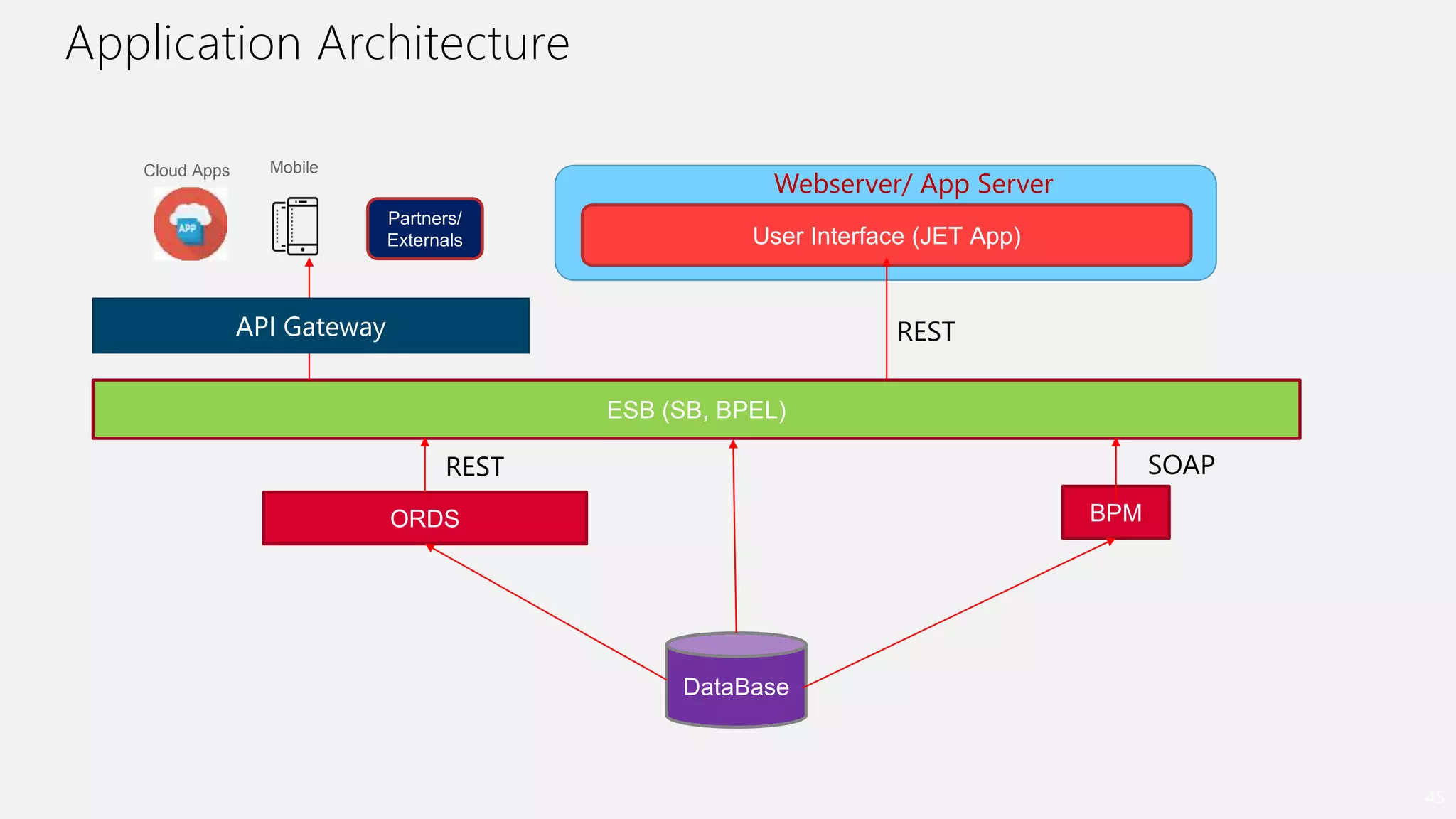
Application Architecture
45
User Interface (JET App)
ESB (SB, BPEL)
DataBase
ORDS
Partners/
Externals
MobileCloud Apps
API Gateway
BPM
Webserver/ App Server
SOAPREST
REST
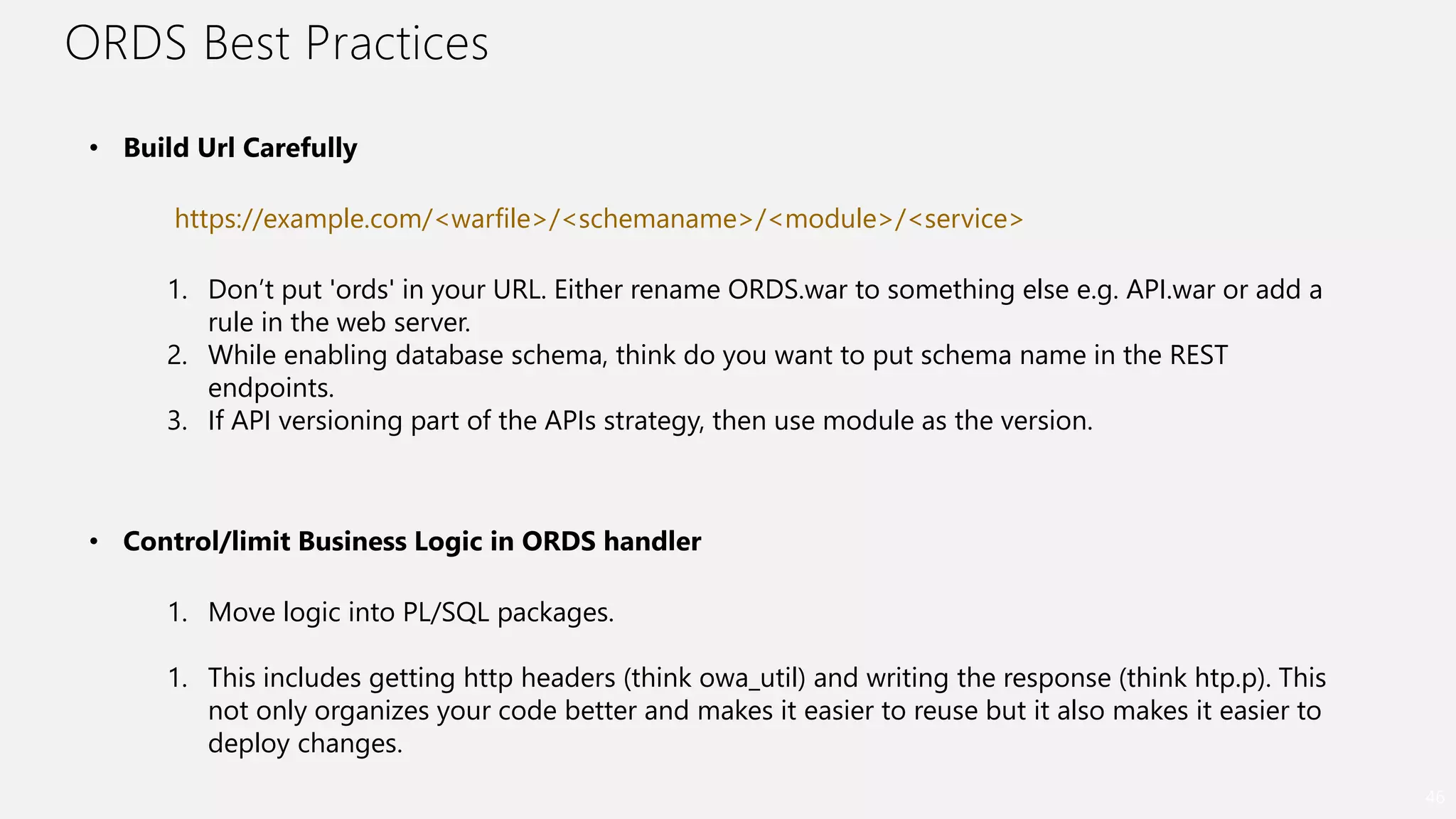
ORDS Best Practices
46
• Build Url Carefully
https://example.com/<warfile>/<schemaname>/<module>/<service>
1. Don’t put 'ords' in your URL. Either rename ORDS.war to something else e.g. API.war or add a
rule in the web server.
2. While enabling database schema, think do you want to put schema name in the REST
endpoints.
3. If API versioning part of the APIs strategy, then use module as the version.
• Control/limit Business Logic in ORDS handler
1. Move logic into PL/SQL packages.
1. This includes getting http headers (think owa_util) and writing the response (think htp.p). This
not only organizes your code better and makes it easier to reuse but it also makes it easier to
deploy changes.
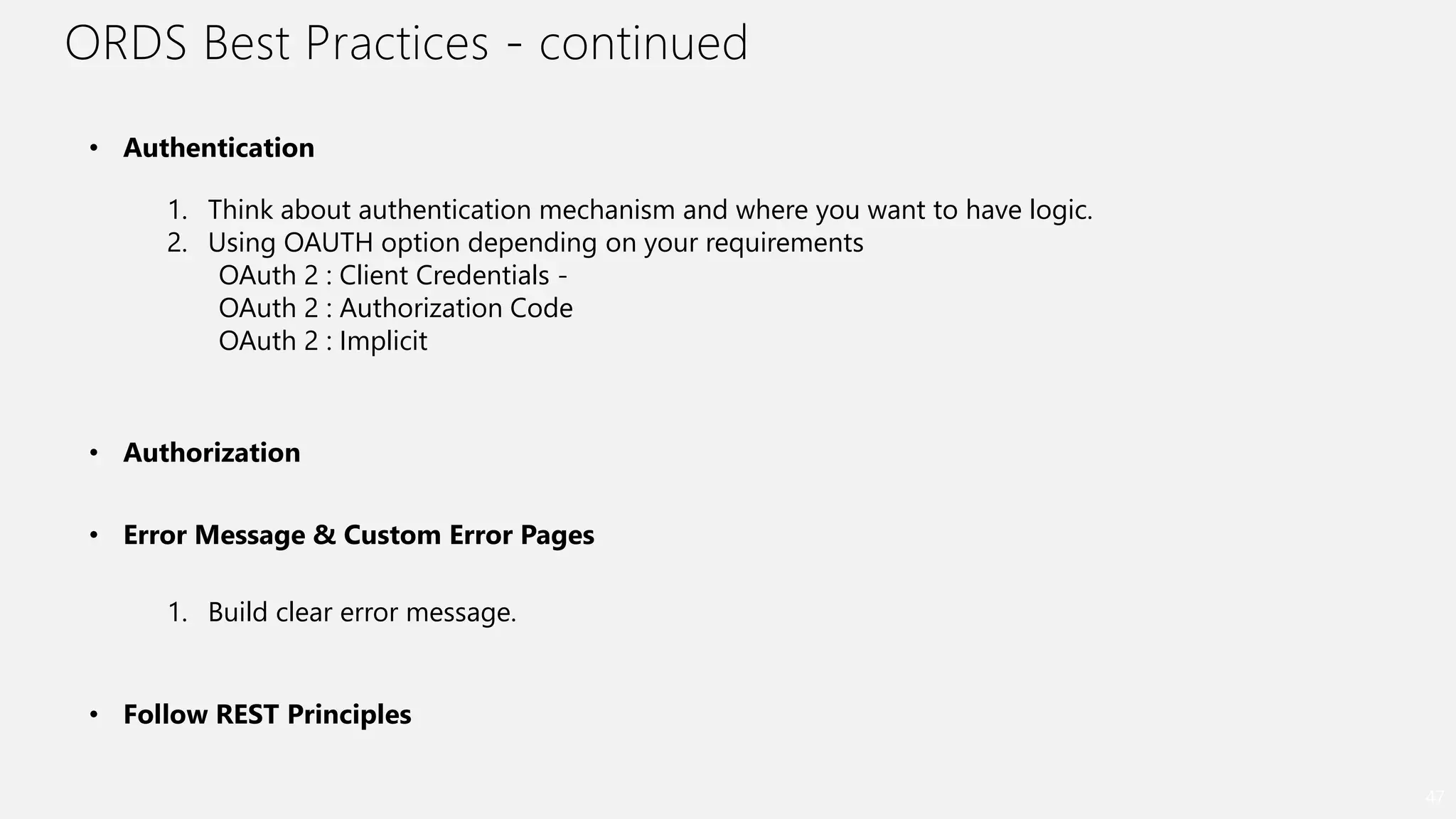
ORDS Best Practices - continued
47
• Authentication
1. Think about authentication mechanism and where you want to have logic.
2. Using OAUTH option depending on your requirements
OAuth 2 : Client Credentials -
OAuth 2 : Authorization Code
OAuth 2 : Implicit
• Error Message & Custom Error Pages
1. Build clear error message.
• Authorization
• Follow REST Principles
Additional Reading
48
• The REST API Design Handbook by George Reese & Christian Reilly
• SOA with REST by Thomas Erl
• https://docs.oracle.com/en/database/oracle/oracle-rest-data-services/18.2/index.html
• https://oracle-base.com/articles/misc/articles-misc#ords
• https://stormpath.com/blog/secure-your-rest-api-right-way
49
Neal Creative | click & Learn moreNeal Creative ©
THANK YOU
Vinay Kumar
@Vinaykuma201
mail2vinayku@gmail.com
www.techartifact.com/blogs

Expose your data as an api is with oracle rest data services -spoug Madrid

  • 1.
    Vinay Kumar, ORACLEACE @vinaykuma201 SPOUG18-Madrid 1
  • 2.
    2 • O RACLE ACE • Enterp ris e Arch itect • Au th o r of B ook “ B egin n in g Oracle Web Center portal 12c” • O racle certified p ro fes s io n al • B lo g ger-http ://w w w.tech artifact. com/b logs • So ftware Co n s u ltant
  • 3.
    3 • Un derst an din g RES T • ORDS in t rodu ct ion • ORDS Arch itect u re • ORDS Con n ect ion Poolin g • Man agemen t of t h e RES T defin it ion s wit h S QL Developer an d t h e AP I • ORDS B est P ract ices • Web Application Arch itectu re • Addit ion al Readin g
  • 4.
  • 5.
  • 6.
    Representational State Transfer- 6 https://en.wikipedia.org/wiki/Representaional_state_transfer
  • 7.
    Why should wecare for REST web services? 7
  • 8.
    Understanding REST -Resources • Resources • HTTPverbs • Statuscodes • Media types http://host/path/employeesGET http://host/path/departments/GET http://host/path/employees/101GET http://host/path/departments/GET A resource is an object with a type, associated data, relationships to other resources, and a set of methods that operate on it. The JSON is a representation of the resource.
  • 9.
    Understanding REST -Verbs 9 • Use HTTP Verbs • Resources • HTTPverbs • Statuscodes • Media types
  • 10.
    Understanding REST –Status Codes 10 • Resources • HTTPverbs •Status codes • Media types Informational Success Redirection Client Error ServerError 4xx 3xx 5xx 1xx 2xx
  • 11.
    Understanding REST –Media types 11 • Resources • HTTPverbs • Status codes • Media types Payloadtype 'requested' byclient – Via HTTPParameter"accept" – Defines MIME types. e.g. • application/json, application/xml, text/plain, image/gif
  • 12.
    Understanding JSON 12 JSON isa standard using human-readable text to transmit data objects of attribute-value pairs. It is typically used in machine to machine communications and is a contemporary replacement for the older XML standard.
  • 13.
    ORDS - amid-tier Java application, maps HTTP(S) verbs (GET, POST, PUT, DELETE, etc.) to database transactions and returns results formatted using JSON. 13
  • 14.
    Oracle Rest DataServices (ORDS) ▪ Middleware J2EE component in the applicaton/web server (WLS, Glassfish, Tomcat) ▪ Translates URLs into a call in the database (either select or stored procedure call) Two major use cases ▪ Oracle Application Express (APEX) ▪ RESTful Webservices 14 Web Container REST Data Service (WLS,Tomcat, Glassfish ) HTTP s Browser / Clients Database JDBC connection pool
  • 15.
  • 16.
    16 HTTP/s Client OracleDatabase Oracle REST Data Service HTTP / S Client makes a HTTP 'GET' requesthttps://myhost/Customapp/sales/orders/1001 HTTP/S& URI Module TemplateContext Root
  • 17.
    17 HTTP/s Client OracleDatabase Oracle REST Data Service Client makes a HTTP 'GET' requesthttps://myhost/Customapp/sales/orders/1001 HTTP/S& URI Module TemplateContext Root ORDS maps to "ORDERS" SQL SELECT*FROMORDERS WHEREORDERNO=:b1 HTTP / S Map and Bind
  • 18.
    18 HTTP/s Client OracleDatabase Oracle REST Data Service Client makes a HTTP 'GET' requesthttps://myhost/Customapp/sales/orders/1001 HTTP/S& URI Module TemplateContext Root ORDSmapsto "ORDERS"SQL SELECT*FROM ORDERSWHERE ORDERNO=:b1 HTTP / S Map and BindMap andBind SQL JDBC SQL Call
  • 19.
    19 HTTP/s Client OracleDatabase Oracle REST Data Service Client makes a HTTP 'GET' requesthttps://myhost/Customapp/sales/orders/1001 HTTP/S& URI Module TemplateContext Root ORDSmapsto "ORDERS"SQL SELECT*FROM ORDERSWHERE ORDERNO=:b1 HTTP / S Map and BindMap andBind SQL ResultSet DBreturns result set
  • 20.
    20 HTTP/s Client OracleDatabase Oracle REST Data Service Client makes a HTTP 'GET' requesthttps://myhost/Customapp/sales/orders/1001 HTTP/S& URI Module TemplateContext Root ORDSmapsto "ORDERS"SQL SELECT*FROM ORDERSWHERE ORDERNO=:b1 HTTP / S Map and BindMap andBind SQL DBreturns result set {"orderno": 1001, "name": "ScottKing", "address": "500 Main street, Innovation CA", "items": [{ "itemno": 404,"quantity":7, "status": "in process"}, {"itemno": 303,"quantity": 32, "status": "closed"} ]} Transform to JSON, CSV, Excel or Binary ResultSetTransform
  • 21.
    21 HTTP/s Client Oracle Database OracleREST Data Service Client makes a HTTP 'GET' request https://myhost/Customapp/sales/orders/1001 HTTP/S& URI Module TemplateContext Root ORDSmapsto "ORDERS"SQL SELECT*FROM ORDERSWHERE ORDERNO=:b1 HTTP / S Map and BindMap andBind SQL DBreturns result set {"orderno": 1001, "name": "ScottKing", "address": "500 Main street, Innovation CA", "items": [{ "itemno": 404,"quantity":7, "status": "in process"}, {"itemno": 303,"quantity": 32, "status": "closed"} ]} JSON Response to HTTP request Transform ResultSet
  • 22.
    22 HTTP/s Client Oracle Database OracleREST Data Service Client makes a HTTP 'GET' request ORDSmapsto "ORDERS"SQL HTTP / S Map and BindMap andBind SQL DBreturns result set JSON Transform ResultSet Summary: Serving JSON results from the database  App developers call named URI over HTTP(S) to retrieve and update data  Oracle REST Data Services (ORDS) Developer defines URI<>SQL mapping/binding  Utilizes the data stored in standard relational tables and columns
  • 23.
    23 Client makes a HTTP'GET' request V ORDSmapsto "ORDERS"SQL Map and Bind SQL DBreturns result set Connection Pooling  Each REST enabled schema grant proxy connects  Connection open only to proxied connection  All SQL/PLSQL execute at the schema  Proxied connection is closed and returned to the pool.  Utilizes the data stored in standard relational tables and columns
  • 24.
    24 Client makes a HTTP'GET' request ORDSmapsto "ORDERS"SQL Map and Bind DBreturns result set Support Multiple Oracle Data Stores REST Oracle REST Data Service Oracle Relational Database Oracle Database (document store) Oracle NoSQL Database Removed Oracle No SQL support In July 2018 – ORDS 18.2.0
  • 25.
    Oracle REST DataService 25 - Provide data access in modern application development • Its a mid tier application. • It is JavaScript friendly and highly scalable. • Can declartive return result in JSON format. • It map Http (s) request into the SQL • Provides mapping between pl/sql to JSON. - Services & Features • Formally known as Oracle APEX Listener. • Access to relational database to the http(s) with jdbc/odbc driver. • Oracle JSON collection based schema-less access. • It map Http (s) request into the SQL • Provides mapping between pl/sql to JSON. • Support HTTP Basic dynamic authentication for PL/SQL Gateway calls • Open API (aka Swagger) support for metadata catalog
  • 26.
    Oracle REST DataService provides for REST services 26 • Request dispatching • JSON parsing for simple GET requests • Generating JSON links • Pagination control • Authentication and Authorization support with standards • Exception, error handling and responses (HTML)
  • 27.
    Oracle REST DataService Implementation 27 Download DeployConfigure Publish Download latest version of ORDS From edelivery.oracle.co m Configure ORDS Parameter, Database accounts and URL mapping Deploy ORDS.war to the server Use ORDS service to publish in Service Bus or API management platform
  • 28.
    ORDS – URLAnatomy 28 http://localhost:8080/ords/orcl/finance/risk/emp/:empId Base URL Context SchemaDatabase Module Template Module : It contain one or more templates, with an associated path (risk/). Template : A container for one or more handlers. The template must be unique within the module and is associated with a specific path (emp/), which may or may not include parameters. Resource Handler: Provides the logic required to service a particular HTTP method, for a specific Resource Template. For example GET, POST.
  • 29.
    Enable Schema &Define Module 29
  • 30.
    SQL as REST 30 TheDEFINE_SERVICE procedure allows you to create a new module, template and handler in a single step. If the module already exists, it's replaced by the new definition. Quick BuildManual Build = http://localhost:8080/ords/orcl/finance/risk/emp
  • 31.
  • 32.
    p_source_type 32 • source_type_collection_feed -Executes a SQL query and transforms the result set into an ORDS Standard JSON representation. : JSON • source_type_collection_item - Executes a SQL query returning one row of data into a ORDS Standard JSON representation. : JSON • source_type_media - Executes a SQL query conforming to a specific format and turns the result set into a binary representation with an accompanying HTTP Content-Type header identifying the Internet media type of the representation. : Binary • source_type_plsql - Executes an anonymous PL/SQL block and transforms IN/OUT parameters into a JSON representation. : JSON • source_type_query || source_type_csv_query - Executes a SQL query and transforms the result set into either an ORDS legacy JavaScript Object Notation (JSON) or CSV representation. : JSON or CSV • source_type_query_one_row - Executes a SQL query returning one row of data into an ORDS legacy JSON representation. : JSON • source_type_feed - Executes a SQL query and transforms the results into a JSON Feed representation. Each item in the feed contains a summary of a resource and a hyperlink
  • 33.
    AutoRest for Tables 33 Enableschema and table via GUI
  • 34.
    AutoRest- SQL operation 34 •Select * Method : GET http://localhost:8080/ords/orcl/finance/risk/emp/ http://localhost:8080/ords/orcl/finance/risk/emp/122/ http://localhost:8080/ords/orcl/finance/risk/emp/?q={"sal":{"$gte":1000}} • Insert * Method : POST http://localhost:8080/ords/orcl/finance/risk/emp Payload :
  • 35.
    AutoRest- SQL operation 35 •Update * Method : PUT http://localhost:8080/ords/orcl/finance/risk/emp/122/ • Delete * Method : DELETE http://localhost:8080/ords/orcl/finance/risk/emp?q={“empid”:9999} Payload :
  • 36.
    AutoRest- BatchLoad 36 • BatchLoadenables to upload batches of data using AutoREST from CSV payload. • Post operation supported for this. • Content type should be text/csv • First row should contain column names. • DateFormat can passed as query parameter. • Bulk Upload * Method : POST http://localhost:8080/ords/orcl/finance/risk/emp/batchload?dateFormat="DD-MON-YYYY” /"
  • 37.
    OPEN API 2.0(Swagger) support for API documentation 37 • ORDS exposes the metadata of specific web services in Open API 2.0 format. • REST API inventory • Test via Curl • API Description • Examples. http://localhost:8080/ords/orcl/finance/metadata-catalog/ http://localhost:8080/ords/orcl/finance/open-api-catalog/ - Open API URL catalog http://localhost:8080/ords/orcl/finance/open-api-catalog/risk/ - Output for a specific service is in the Open API 2.0 format.
  • 38.
  • 39.
    Oracle REST DataServices (ORDS) : Authentication 39 • First Party Cookie-Based Authentication 1. Only available to Author of the APIs. Create ORDS user, role and assign privileges to access the API. 2. Crendentials entered in the authentication form. ORDS generate a cookie and it is validate only by ORDS, if the request is determined to originate from the same origin as the rest service. • Third Party OAuth 2.0-Based Authentication 1. A third party is any party other than the author of a RESTful API. 2. Third party register with the first party, then the first party (or an end user of the first party RESTful service) approves the third party application for limited access to the RESTful API, by issuing the third party application a short-lived access token.
  • 40.
    Oracle REST DataServices (ORDS) : Authentication 40 Basic Auth OAuth ORDS Role Privileges Users Clients URL Mapping Create Users Register Clients & Generate client Id and client secret Access APIs via passing crendentials (User name and password) Pass client id, client secret & token to access APIs
  • 41.
    Oracle REST DataServices (ORDS) : Authentication 41 • Create a ORDS role and associated privileges. • Map the privileges to the web services. 1 2 3
  • 42.
    Oracle REST DataServices (ORDS) : Authentication - OAUTH 42 1. Client Credentials 'Two-legged' process. OAuth involves two parties, the party calling the RESTful API (the third party application), and the party providing the RESTful API. Two legged flows are typically used in server to server interactions where the calling server can securely store the credentials required to access the service. In OAuth 2.0 this flow is called the client credentials flow. It is most typically used in business to business scenarios. 2. Authorization Code 'Three-legged' Process .OAuth involves three parties, the party calling the RESTful API, the party providing the RESTful API, and an end-user party, who owns/manages the data that the RESTful API provides access to. Three legged flows are used in client to server interactions where an end-user must approve access to the RESTful API. In OAuth 2.0 the authorization code flow and the implicit flow are three legged flows. These flows are typically used in business to consumer scenarios. 3. Implict 'Two-legged' process. The user accesses a URL in a browser, which prompts for credentials. Once authenticated, the browser is redirected to a specified page with an access token as one of the parameters in the URL. That access token is used to authenticate calls to protected resources.
  • 43.
    ORDS : Authentication- OAuth 2 : Client Credentials 43
  • 44.
    ORDS : Authentication- OAuth 2 : Client Credentials 44 1 Client registered in ORDS and client id and client_secret can be generated. 2 Associate the client with the role
  • 45.
    Application Architecture 45 User Interface(JET App) ESB (SB, BPEL) DataBase ORDS Partners/ Externals MobileCloud Apps API Gateway BPM Webserver/ App Server SOAPREST REST
  • 46.
    ORDS Best Practices 46 •Build Url Carefully https://example.com/<warfile>/<schemaname>/<module>/<service> 1. Don’t put 'ords' in your URL. Either rename ORDS.war to something else e.g. API.war or add a rule in the web server. 2. While enabling database schema, think do you want to put schema name in the REST endpoints. 3. If API versioning part of the APIs strategy, then use module as the version. • Control/limit Business Logic in ORDS handler 1. Move logic into PL/SQL packages. 1. This includes getting http headers (think owa_util) and writing the response (think htp.p). This not only organizes your code better and makes it easier to reuse but it also makes it easier to deploy changes.
  • 47.
    ORDS Best Practices- continued 47 • Authentication 1. Think about authentication mechanism and where you want to have logic. 2. Using OAUTH option depending on your requirements OAuth 2 : Client Credentials - OAuth 2 : Authorization Code OAuth 2 : Implicit • Error Message & Custom Error Pages 1. Build clear error message. • Authorization • Follow REST Principles
  • 48.
    Additional Reading 48 • TheREST API Design Handbook by George Reese & Christian Reilly • SOA with REST by Thomas Erl • https://docs.oracle.com/en/database/oracle/oracle-rest-data-services/18.2/index.html • https://oracle-base.com/articles/misc/articles-misc#ords • https://stormpath.com/blog/secure-your-rest-api-right-way
  • 49.
  • 50.
    Neal Creative |click & Learn moreNeal Creative © THANK YOU Vinay Kumar @Vinaykuma201 mail2vinayku@gmail.com www.techartifact.com/blogs

Editor's Notes

  • #2 To use this title animation slide with a new image simply 1) move the top semi-transparent shape to the side, 2) delete placeholder image, 3) click on the picture icon to add a new picture, 4) Move semi-transparent shape back to original position, 5) Update text on slide.
  • #4 Why we need rest
  • #6 REST is an architectural style, or design pattern, for APIs. REST was defined by Roy Fielding, a computer scientist. He presented the REST principles in his PhD dissertation in 2000.
  • #7 It means when a RESTful API is called, the server will transfer to the client a representation of the state of the requested resource. For example, when a developer calls Instagram API to fetch a specific user (the resource), the API will return the state of that user, including their name, the number of posts that user posted on Instagram so far, how many followers they have, and more. Highly scalable. Lightweight standard RESTful APIs, because REST is an architectural style, unlike SOAP which is a protocol. REST is simple and lightweight, but also language and platform independent Client-server Stateless Cacheable Layered Optional code on demand Uniform interface
  • #8 Highly scalable. Lightweight standard RESTful APIs, because REST is an architectural style, unlike SOAP which is a protocol. REST is simple and lightweight, but also language and platform independent Client-server Stateless Cacheable Layered Optional code on demand Uniform interface Single purpose and multipuropose
  • #10 The PATCH method is a request method supported by the HTTP protocol for making partial changes to an existing resource. The PATCH method provides an entity containing a list of changes to be applied to the resource requested using theHTTP URI. The list of changes are supplied in the form of a PATCH document. GET- READ and rest all write method The PUT method is idempotent. An idempotent method means that the result of a successful performed request is independent of the number of times it is executed. An idempotent HTTP method is an HTTP method that can be called many times without different outcomes. It would not matter if the method is called only once, or ten times over. The result should be the same. It essentially means that the result of a successfully performed request is independent of the number of times it is executed. For example, in arithmetic, adding zero to a number is idempotent operation. GET, PUT, DELETE, HEAD, OPTIONS and TRACE are idempotent. PUT vs. POST in REST. In other words, POST is used to create. The PUT method requests that the enclosed entity be stored under the supplied Request-URI . If the Request-URI refers to an already existing resource, the enclosed entity SHOULD be considered as a modified version of the one residing on the origin serve
  • #13 SON is short for JavaScript Object Notation, and is a way to store information in an organized, easy-to-access manner. In a nutshell, it gives us a human-readable collection of data that we can access in a really logical manner.
  • #15 Oracle REST Data Services (ORDS) is a Java EE-based alternative for Oracle HTTP Server (OHS) and mod_plsql. ▪ The Java EE implementation offers increased functionality including command line based configuration, enhanced security, file caching and RESTful Web Services. ▪ Oracle REST Data Services also provides increased flexibility by supporting deployments using Oracle WebLogic Server, Oracle Glassfish Server, Apache Tomcat, and a standalone mode. ORDS doesn’t require APEX, and you can run APEX without ORDS. My posts here concentrate on core ORDS features, generally REST enabling your Oracle Database.  ORDS is our middle tier JAVA application that allows you to access your Oracle Database resources via REST. In the tiniest and simplest of nutshells, GET|POST|PUT|DELETE|HEAD /db_stuff/ – ORDS maps a URI to something in your Oracle Database (a query, an object, an anonymous block, etc.), runs the appropriate SQL/PLSQL, and returns any output as JSON.
  • #23 ORDS doesn’t require APEX, and you can run APEX without ORDS. My posts here concentrate on core ORDS features, generally REST enabling your Oracle Database.  ORDS is our middle tier JAVA application that allows you to access your Oracle Database resources via REST. In the tiniest and simplest of nutshells, GET|POST|PUT|DELETE|HEAD /db_stuff/ – ORDS maps a URI to something in your Oracle Database (a query, an object, an anonymous block, etc.), runs the appropriate SQL/PLSQL, and returns any output as JSON. By using a stateless protocol and standard operations, REST resources are created to optimize for fast performance, reliability, portability, and growth. This is achieved by creating reusable underlying components that can be managed and updated without affecting the system, even while REST is running.  RESTful services, is divided into two sections: Consuming RESTful services and Providing RESTful services.  While consuming RESTful Services uses the standard HTTP operations, processing the data returned through a RESTful service is different. Oracle Application Express 18.1 provides a comprehensive set of components to make consuming RESTful services easier. MANAGE ORDS FROM YOUR TERMINAL, VIA PL/SQL APIS, OR OUR GUI IN SQL DEVELOPER.
  • #24 A common problem users may experience when they start running ORDS in production environments or under load in test mode is to have poor performance because there are too few database connections. ORDS uses the Oracle Universal Connection Pool (UCP). The ORDS defaults for initial number of connections created and the maximum number of connections allowed is 3 and 10 respectively, which may be low for active environments. Increase these by setting the jdbc.InitialLimit and jdbc.MaxLimit configuration file parameters to higher values. See section A.5 Understanding Configurable Parameters of the Oracle REST Data Services Installation, Configuration, and Development Guide.
  • #26  The PL/SQL Gateway provides support for building PL/SQL-based applications on the Web. PL/SQL stored procedures can retrieve data from a database and generate HTTP responses containing data and code to display in a Web browser. Dynamic Authentication provides context to approve or reject a login, or terminate a user session. It examines all possible risks rather than just the obvious ones, such as a mismatch between an IP address and a stated geographic region. Using ORDS 17.4 onward the top-level metadata-catalog output includes both the original metadata-catalog and open-api-catalog URLs of all relevant objects in an ORDS enabled schema. The metadata-catalog output for a specific object is presented in the original format, while the open-api-catalog output is in Open API (Swagger) 2.0 format, which makes it really simple to generate documentation and an example of the calling code in several programming languages.
  • #27  The PL/SQL Gateway provides support for building PL/SQL-based applications on the Web. PL/SQL stored procedures can retrieve data from a database and generate HTTP responses containing data and code to display in a Web browser. Dynamic Authentication provides context to approve or reject a login, or terminate a user session. It examines all possible risks rather than just the obvious ones, such as a mismatch between an IP address and a stated geographic region. Using ORDS 17.4 onward the top-level metadata-catalog output includes both the original metadata-catalog and open-api-catalog URLs of all relevant objects in an ORDS enabled schema. The metadata-catalog output for a specific object is presented in the original format, while the open-api-catalog output is in Open API (Swagger) 2.0 format, which makes it really simple to generate documentation and an example of the calling code in several programming languages.
  • #28  The PL/SQL Gateway provides support for building PL/SQL-based applications on the Web. PL/SQL stored procedures can retrieve data from a database and generate HTTP responses containing data and code to display in a Web browser. Dynamic Authentication provides context to approve or reject a login, or terminate a user session. It examines all possible risks rather than just the obvious ones, such as a mismatch between an IP address and a stated geographic region. Using ORDS 17.4 onward the top-level metadata-catalog output includes both the original metadata-catalog and open-api-catalog URLs of all relevant objects in an ORDS enabled schema. The metadata-catalog output for a specific object is presented in the original format, while the open-api-catalog output is in Open API (Swagger) 2.0 format, which makes it really simple to generate documentation and an example of the calling code in several programming languages.
  • #29 Module : A container for one or more templates, with an associated path (testmodule1/). Template : A container for one or more handlers. The template must be unique within the module and is associated with a specific path (emp/), which may or may not include parameters. Handler : A link to the actual work that is done. Typical handler methods include GET, POST, PUT, DELETE, which are passed in the HTTP header, rather than the URL. Each handler is associated with a specific source (or action), which can be of several types.
  • #31 source_type_collection_feed. Executes a SQL query and transforms the result set into an ORDS Standard JSON representation. Available when the HTTP method is GET. Result Format: JSON source_type_collection_item. Executes a SQL query returning one row of data into a ORDS Standard JSON representation. Available when the HTTP method is GET. Result Format: JSON source_type_media. Executes a SQL query conforming to a specific format and turns the result set into a binary representation with an accompanying HTTP Content-Type header identifying the Internet media type of the representation. Result Format: Binary source_type_plsql. Executes an anonymous PL/SQL block and transforms any OUT or IN/OUT parameters into a JSON representation. Available only when the HTTP method is DELETE, PUT, or POST. Result Format: JSON source_type_query || source_type_csv_query. Executes a SQL query and transforms the result set into either an ORDS legacy JavaScript Object Notation (JSON) or CSV representation, depending on the format selected. Available when the HTTP method is GET. Result Format: JSON or CSV source_type_query_one_row. Executes a SQL query returning one row of data into an ORDS legacy JSON representation. Available when the HTTP method is GET. Result Format: JSON
  • #32 source_type_collection_feed. Executes a SQL query and transforms the result set into an ORDS Standard JSON representation. Available when the HTTP method is GET. Result Format: JSON source_type_collection_item. Executes a SQL query returning one row of data into a ORDS Standard JSON representation. Available when the HTTP method is GET. Result Format: JSON source_type_media. Executes a SQL query conforming to a specific format and turns the result set into a binary representation with an accompanying HTTP Content-Type header identifying the Internet media type of the representation. Result Format: Binary source_type_plsql. Executes an anonymous PL/SQL block and transforms any OUT or IN/OUT parameters into a JSON representation. Available only when the HTTP method is DELETE, PUT, or POST. Result Format: JSON source_type_query || source_type_csv_query. Executes a SQL query and transforms the result set into either an ORDS legacy JavaScript Object Notation (JSON) or CSV representation, depending on the format selected. Available when the HTTP method is GET. Result Format: JSON or CSV source_type_query_one_row. Executes a SQL query returning one row of data into an ORDS legacy JSON representation. Available when the HTTP method is GET. Result Format: JSON
  • #33 source_type_collection_feed. Executes a SQL query and transforms the result set into an ORDS Standard JSON representation. Available when the HTTP method is GET. Result Format: JSON source_type_collection_item. Executes a SQL query returning one row of data into a ORDS Standard JSON representation. Available when the HTTP method is GET. Result Format: JSON source_type_media. Executes a SQL query conforming to a specific format and turns the result set into a binary representation with an accompanying HTTP Content-Type header identifying the Internet media type of the representation. Result Format: Binary source_type_plsql. Executes an anonymous PL/SQL block and transforms any OUT or IN/OUT parameters into a JSON representation. Available only when the HTTP method is DELETE, PUT, or POST. Result Format: JSON source_type_query || source_type_csv_query. Executes a SQL query and transforms the result set into either an ORDS legacy JavaScript Object Notation (JSON) or CSV representation, depending on the format selected. Available when the HTTP method is GET. Result Format: JSON or CSV source_type_query_one_row. Executes a SQL query returning one row of data into an ORDS legacy JSON representation. Available when the HTTP method is GET. Result Format: JSON
  • #40 A first party is the author of a RESTful API. A first party application is a web application deployed on the same web origin as the RESTful API. A first party application is able to authenticate and authorize itself to the RESTful API using the same cookie session that the web application is using. The first party application has full access to the RESTful API. A third party is any party other than the author of a RESTful API. A third party application cannot be trusted in the same way as a first party application; therefore, there must be a mediated means to selectively grant the third party application limited access to the RESTful API. Two-legged OAuth flows involve two parties: the party calling the RESTful API (the third party application), and the party providing the RESTful API. Two-legged flows are used in server to server interactions where an end user does not need to approve access to the RESTful API. In OAuth 2.0 this flow is called the client credentials flow. It is most typically used in business to business scenarios. Three-legged OAuth flows involve three parties: the party calling the RESTful API, the party providing the RESTful API, and an end user party that owns or manages the data to which the RESTful API provides access. Three-legged flows are used in client to server interactions where an end user must approve access to the RESTful API. In OAuth 2.0 the authorization code flow and the implicit flow are three-legged flows. These flows are typically used in business to consumer scenarios.
  • #41 A first party is the author of a RESTful API. A first party application is a web application deployed on the same web origin as the RESTful API. A first party application is able to authenticate and authorize itself to the RESTful API using the same cookie session that the web application is using. The first party application has full access to the RESTful API. A third party is any party other than the author of a RESTful API. A third party application cannot be trusted in the same way as a first party application; therefore, there must be a mediated means to selectively grant the third party application limited access to the RESTful API. Two-legged OAuth flows involve two parties: the party calling the RESTful API (the third party application), and the party providing the RESTful API. Two-legged flows are used in server to server interactions where an end user does not need to approve access to the RESTful API. In OAuth 2.0 this flow is called the client credentials flow. It is most typically used in business to business scenarios. Three-legged OAuth flows involve three parties: the party calling the RESTful API, the party providing the RESTful API, and an end user party that owns or manages the data to which the RESTful API provides access. Three-legged flows are used in client to server interactions where an end user must approve access to the RESTful API. In OAuth 2.0 the authorization code flow and the implicit flow are three-legged flows. These flows are typically used in business to consumer scenarios.
  • #42 A first party is the author of a RESTful API. A first party application is a web application deployed on the same web origin as the RESTful API. A first party application is able to authenticate and authorize itself to the RESTful API using the same cookie session that the web application is using. The first party application has full access to the RESTful API. A third party is any party other than the author of a RESTful API. A third party application cannot be trusted in the same way as a first party application; therefore, there must be a mediated means to selectively grant the third party application limited access to the RESTful API. Two-legged OAuth flows involve two parties: the party calling the RESTful API (the third party application), and the party providing the RESTful API. Two-legged flows are used in server to server interactions where an end user does not need to approve access to the RESTful API. In OAuth 2.0 this flow is called the client credentials flow. It is most typically used in business to business scenarios. Three-legged OAuth flows involve three parties: the party calling the RESTful API, the party providing the RESTful API, and an end user party that owns or manages the data to which the RESTful API provides access. Three-legged flows are used in client to server interactions where an end user must approve access to the RESTful API. In OAuth 2.0 the authorization code flow and the implicit flow are three-legged flows. These flows are typically used in business to consumer scenarios.
  • #43 A first party is the author of a RESTful API. A first party application is a web application deployed on the same web origin as the RESTful API. A first party application is able to authenticate and authorize itself to the RESTful API using the same cookie session that the web application is using. The first party application has full access to the RESTful API. A third party is any party other than the author of a RESTful API. A third party application cannot be trusted in the same way as a first party application; therefore, there must be a mediated means to selectively grant the third party application limited access to the RESTful API. Two-legged OAuth flows involve two parties: the party calling the RESTful API (the third party application), and the party providing the RESTful API. Two-legged flows are used in server to server interactions where an end user does not need to approve access to the RESTful API. In OAuth 2.0 this flow is called the client credentials flow. It is most typically used in business to business scenarios. Three-legged OAuth flows involve three parties: the party calling the RESTful API, the party providing the RESTful API, and an end user party that owns or manages the data to which the RESTful API provides access. Three-legged flows are used in client to server interactions where an end user must approve access to the RESTful API. In OAuth 2.0 the authorization code flow and the implicit flow are three-legged flows. These flows are typically used in business to consumer scenarios.
  • #44 A first party is the author of a RESTful API. A first party application is a web application deployed on the same web origin as the RESTful API. A first party application is able to authenticate and authorize itself to the RESTful API using the same cookie session that the web application is using. The first party application has full access to the RESTful API. A third party is any party other than the author of a RESTful API. A third party application cannot be trusted in the same way as a first party application; therefore, there must be a mediated means to selectively grant the third party application limited access to the RESTful API. Two-legged OAuth flows involve two parties: the party calling the RESTful API (the third party application), and the party providing the RESTful API. Two-legged flows are used in server to server interactions where an end user does not need to approve access to the RESTful API. In OAuth 2.0 this flow is called the client credentials flow. It is most typically used in business to business scenarios. Three-legged OAuth flows involve three parties: the party calling the RESTful API, the party providing the RESTful API, and an end user party that owns or manages the data to which the RESTful API provides access. Three-legged flows are used in client to server interactions where an end user must approve access to the RESTful API. In OAuth 2.0 the authorization code flow and the implicit flow are three-legged flows. These flows are typically used in business to consumer scenarios.
  • #45 A first party is the author of a RESTful API. A first party application is a web application deployed on the same web origin as the RESTful API. A first party application is able to authenticate and authorize itself to the RESTful API using the same cookie session that the web application is using. The first party application has full access to the RESTful API. A third party is any party other than the author of a RESTful API. A third party application cannot be trusted in the same way as a first party application; therefore, there must be a mediated means to selectively grant the third party application limited access to the RESTful API. Two-legged OAuth flows involve two parties: the party calling the RESTful API (the third party application), and the party providing the RESTful API. Two-legged flows are used in server to server interactions where an end user does not need to approve access to the RESTful API. In OAuth 2.0 this flow is called the client credentials flow. It is most typically used in business to business scenarios. Three-legged OAuth flows involve three parties: the party calling the RESTful API, the party providing the RESTful API, and an end user party that owns or manages the data to which the RESTful API provides access. Three-legged flows are used in client to server interactions where an end user must approve access to the RESTful API. In OAuth 2.0 the authorization code flow and the implicit flow are three-legged flows. These flows are typically used in business to consumer scenarios.
  • #46 A first party is the author of a RESTful API. A first party application is a web application deployed on the same web origin as the RESTful API. A first party application is able to authenticate and authorize itself to the RESTful API using the same cookie session that the web application is using. The first party application has full access to the RESTful API. A third party is any party other than the author of a RESTful API. A third party application cannot be trusted in the same way as a first party application; therefore, there must be a mediated means to selectively grant the third party application limited access to the RESTful API. Two-legged OAuth flows involve two parties: the party calling the RESTful API (the third party application), and the party providing the RESTful API. Two-legged flows are used in server to server interactions where an end user does not need to approve access to the RESTful API. In OAuth 2.0 this flow is called the client credentials flow. It is most typically used in business to business scenarios. Three-legged OAuth flows involve three parties: the party calling the RESTful API, the party providing the RESTful API, and an end user party that owns or manages the data to which the RESTful API provides access. Three-legged flows are used in client to server interactions where an end user must approve access to the RESTful API. In OAuth 2.0 the authorization code flow and the implicit flow are three-legged flows. These flows are typically used in business to consumer scenarios.
  • #47 A first party is the author of a RESTful API. A first party application is a web application deployed on the same web origin as the RESTful API. A first party application is able to authenticate and authorize itself to the RESTful API using the same cookie session that the web application is using. The first party application has full access to the RESTful API. A third party is any party other than the author of a RESTful API. A third party application cannot be trusted in the same way as a first party application; therefore, there must be a mediated means to selectively grant the third party application limited access to the RESTful API. Two-legged OAuth flows involve two parties: the party calling the RESTful API (the third party application), and the party providing the RESTful API. Two-legged flows are used in server to server interactions where an end user does not need to approve access to the RESTful API. In OAuth 2.0 this flow is called the client credentials flow. It is most typically used in business to business scenarios. Three-legged OAuth flows involve three parties: the party calling the RESTful API, the party providing the RESTful API, and an end user party that owns or manages the data to which the RESTful API provides access. Three-legged flows are used in client to server interactions where an end user must approve access to the RESTful API. In OAuth 2.0 the authorization code flow and the implicit flow are three-legged flows. These flows are typically used in business to consumer scenarios.
  • #48 Don't forget authorization, just because someone has access to your API does not mean they should see all the data. You can use the ORDS metadata to query the client and then decide what data that client should have access to. Two-legged OAuth flows involve two parties: the party calling the RESTful API (the third party application), and the party providing the RESTful API. Two-legged flows are used in server to server interactions where an end user does not need to approve access to the RESTful API. In OAuth 2.0 this flow is called the client credentials flow. It is most typically used in business to business scenarios. Three-legged OAuth flows involve three parties: the party calling the RESTful API, the party providing the RESTful API, and an end user party that owns or manages the data to which the RESTful API provides access. Three-legged flows are used in client to server interactions where an end user must approve access to the RESTful API. In OAuth 2.0 the authorization code flow and the implicit flow are three-legged flows. These flows are typically used in business to consumer scenarios. The implicit flow is a two-legged process that requires user interaction. The user accesses a URL in a browser, which prompts for credentials. Once authenticated, the browser is redirected to a specified page with an access token as one of the parameters in the URL. That access token is used to authenticate calls to protected resources. The example steps through the individual calls, but in reality everything but the user interaction would be automated by the application.
  • #49 Don't forget authorization, just because someone has access to your API does not mean they should see all the data. You can use the ORDS metadata to query the client and then decide what data that client should have access to. Two-legged OAuth flows involve two parties: the party calling the RESTful API (the third party application), and the party providing the RESTful API. Two-legged flows are used in server to server interactions where an end user does not need to approve access to the RESTful API. In OAuth 2.0 this flow is called the client credentials flow. It is most typically used in business to business scenarios. Three-legged OAuth flows involve three parties: the party calling the RESTful API, the party providing the RESTful API, and an end user party that owns or manages the data to which the RESTful API provides access. Three-legged flows are used in client to server interactions where an end user must approve access to the RESTful API. In OAuth 2.0 the authorization code flow and the implicit flow are three-legged flows. These flows are typically used in business to consumer scenarios. The implicit flow is a two-legged process that requires user interaction. The user accesses a URL in a browser, which prompts for credentials. Once authenticated, the browser is redirected to a specified page with an access token as one of the parameters in the URL. That access token is used to authenticate calls to protected resources. The example steps through the individual calls, but in reality everything but the user interaction would be automated by the application.