



IS THE GCC AN OPTIMAL CURRENCY
              AREA?
                       By
               Adnan Ahmed Qatinah
          Mohammed Ghiath HASAN AGHA
                 Husam Al Dakak
                  Ala'a Mohamed


ECONOMIC CHANGE IN THE ARAB REGION
• Introduction
• The theory of Optimum Currency Area
    • Definition of Optimum Currency Area
    • Potential Benefits and cost of Optimum Currency Area
    • Criteria of an Optimal Currency Area (OCA)
• GCC Countries and the Optimality Criteria for OCA
    • Overview of the economic cooperation in GCC
    • Overview of GCC economics
    • Benefits and Costs for GCC to have OCA
    • Does GCC meet the criteria of an Optimum Currency Area?
• Conclusion
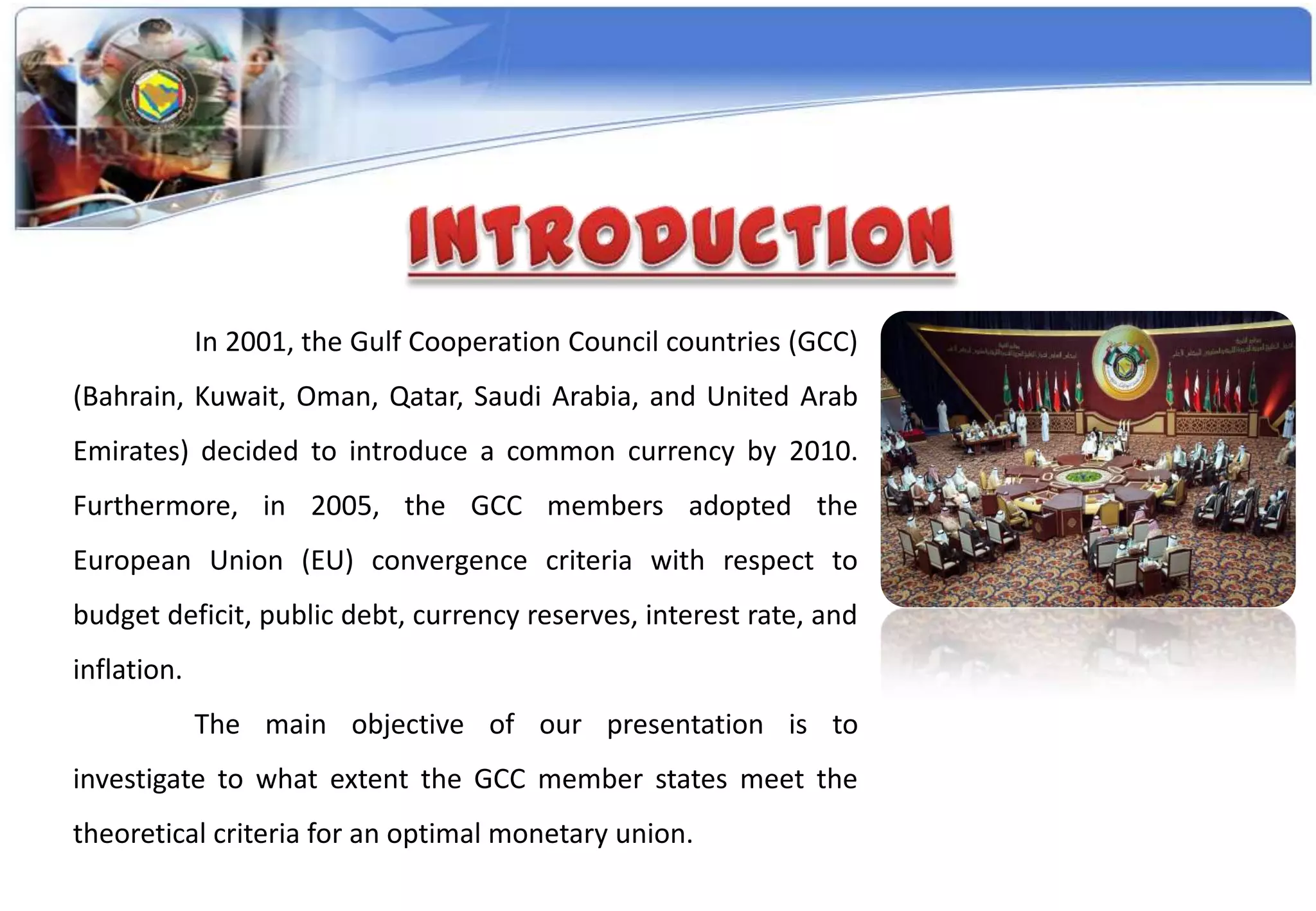
In 2001, the Gulf Cooperation Council countries (GCC)
(Bahrain, Kuwait, Oman, Qatar, Saudi Arabia, and United Arab
Emirates) decided to introduce a common currency by 2010.
Furthermore, in 2005, the GCC members adopted the
European Union (EU) convergence criteria with respect to
budget deficit, public debt, currency reserves, interest rate, and
inflation.
             The main objective of our presentation is to
investigate to what extent the GCC member states meet the
theoretical criteria for an optimal monetary union.
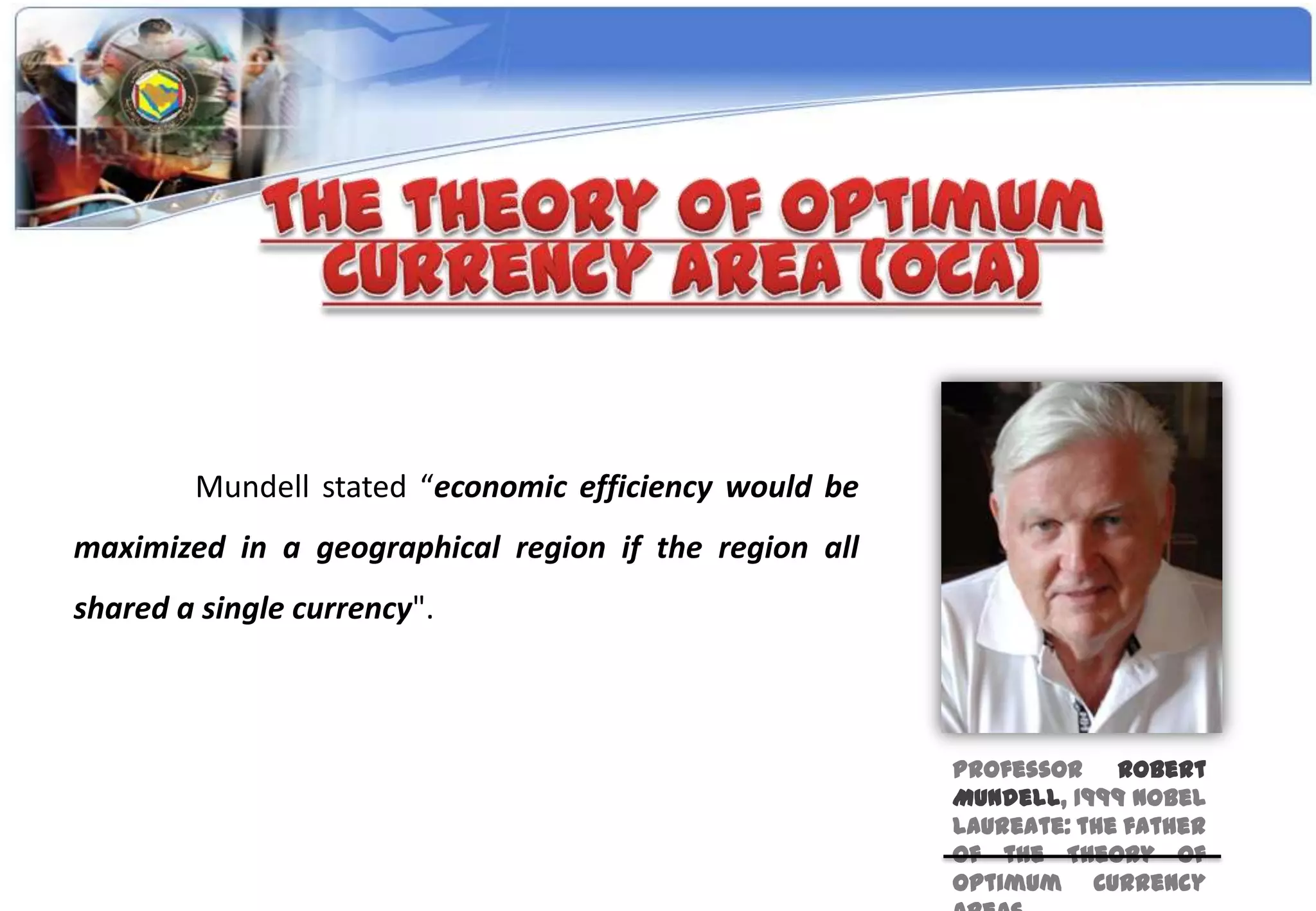
Mundell stated “economic efficiency would be
maximized in a geographical region if the region all
shared a single currency".


                                                       Professor Robert
                                                       Mundell, 1999 Nobel
                                                       Laureate: the father
                                                       of the Theory of
                                                       Optimum Currency
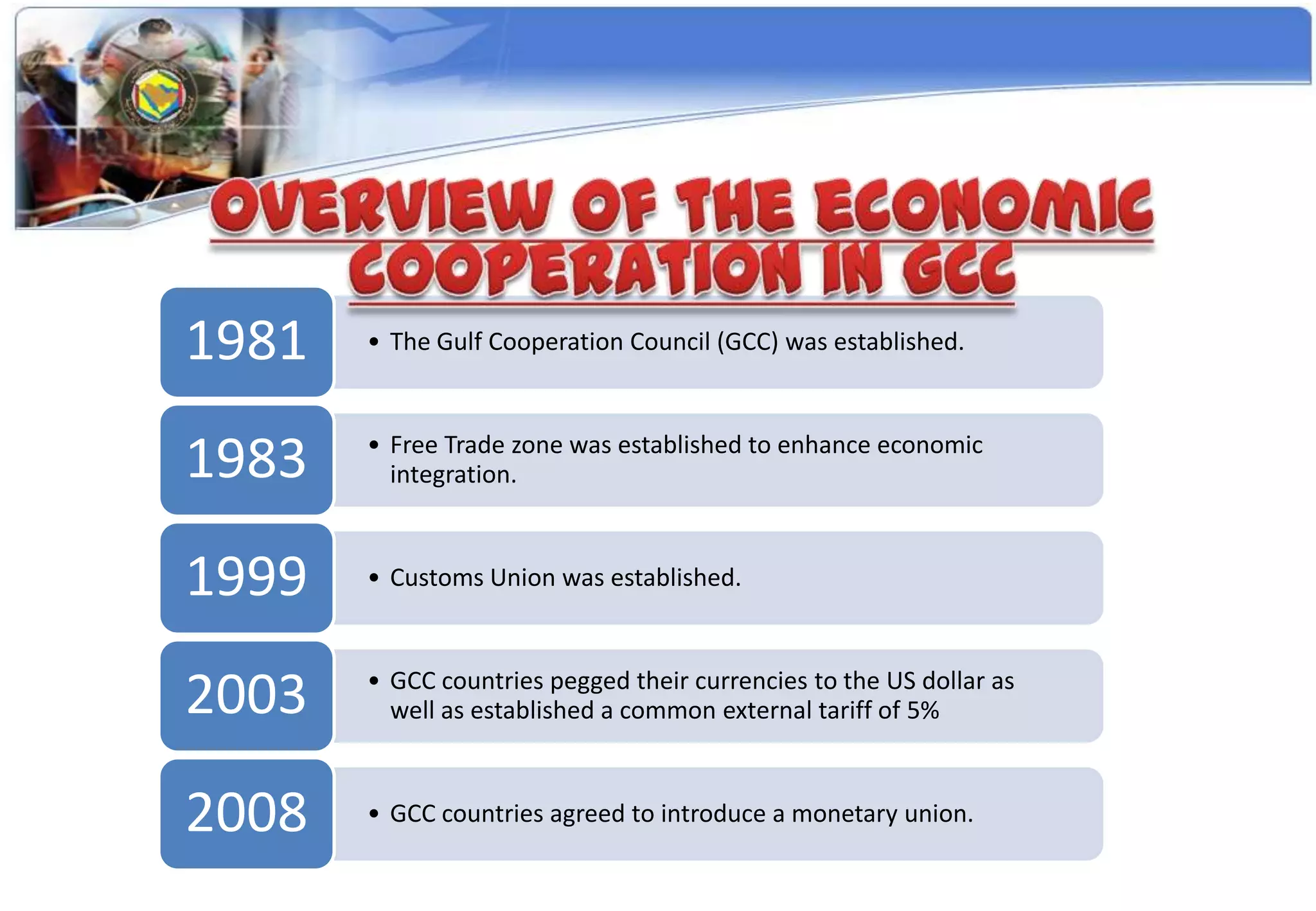
1981   • The Gulf Cooperation Council (GCC) was established.


1983   • Free Trade zone was established to enhance economic
         integration.


1999   • Customs Union was established.


2003   • GCC countries pegged their currencies to the US dollar as
         well as established a common external tariff of 5%


2008   • GCC countries agreed to introduce a monetary union.
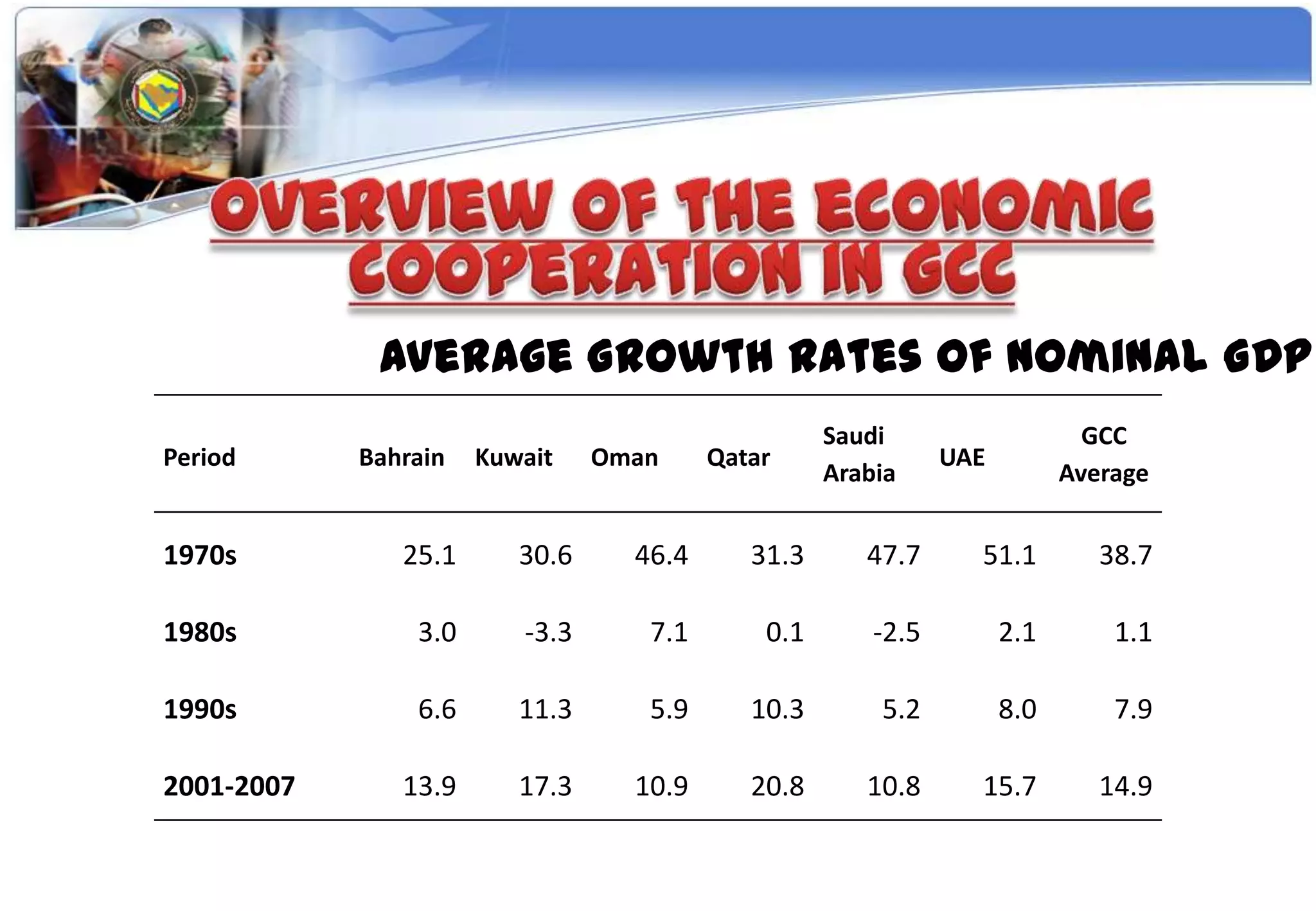
Average Growth Rates of Nominal GDP
                                                   Saudi                    GCC
Period      Bahrain   Kuwait    Oman     Qatar                UAE
                                                   Arabia                 Average


1970s          25.1      30.6     46.4      31.3      47.7      51.1         38.7

1980s           3.0      -3.3      7.1       0.1       -2.5         2.1       1.1

1990s           6.6      11.3      5.9      10.3       5.2          8.0       7.9

2001-2007      13.9      17.3     10.9      20.8      10.8      15.7         14.9
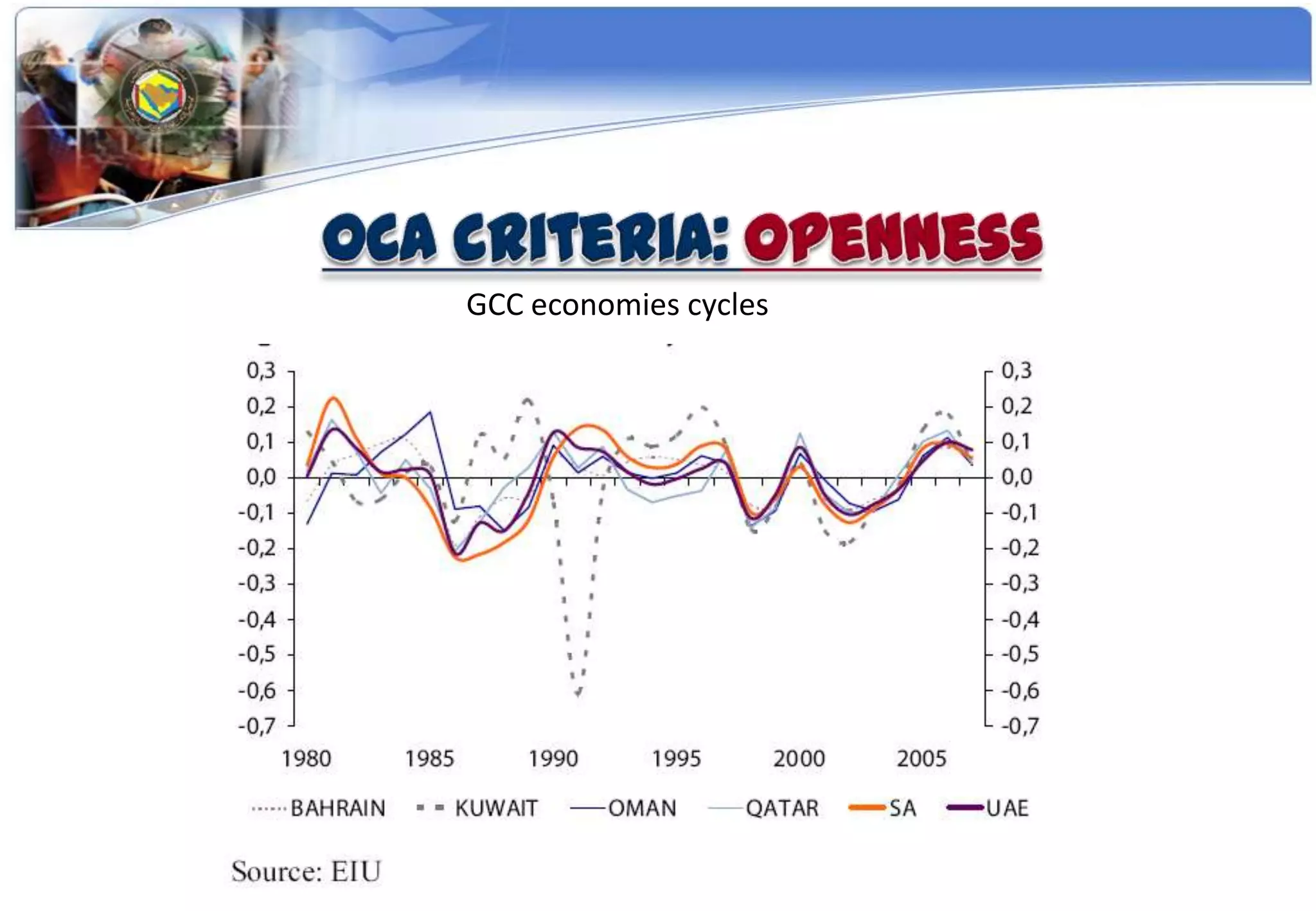
GCC economies cycles
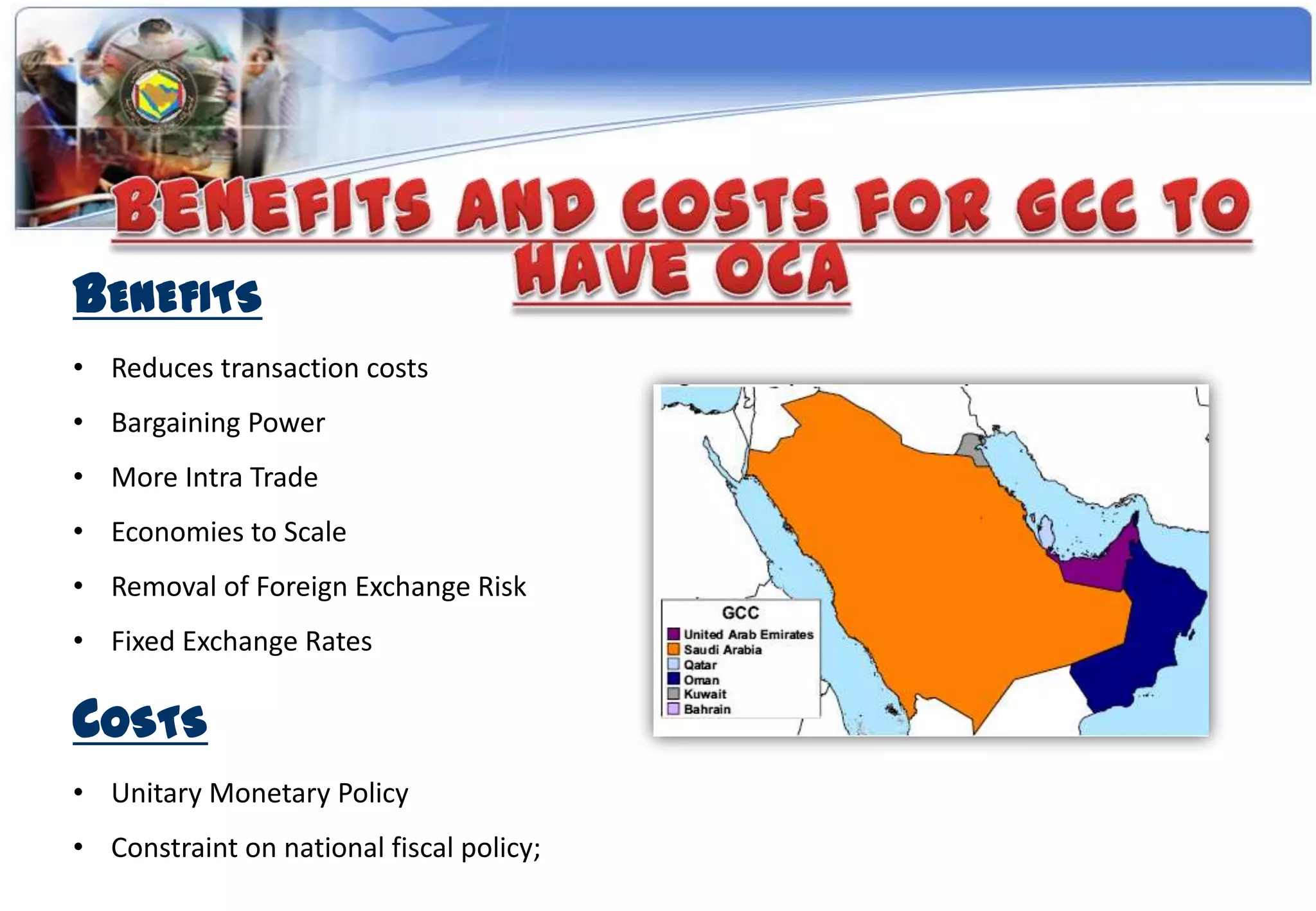
BENEFITS
• Reduces transaction costs
• Bargaining Power
• More Intra Trade
• Economies to Scale
• Removal of Foreign Exchange Risk
• Fixed Exchange Rates

COSTS
• Unitary Monetary Policy
• Constraint on national fiscal policy;
• Openness
• Diverse Production
• Mobile Labor
• Transfer Criterion
• Homogeneity of preferences
• Solidarity vs. nationalism
• McKinnon suggests that countries
 with a small open economy, which
 trades intensively with the world,
 would be good for them to join an
 optimum currency area.                    Ronald
                                          McKinnon
                                      Source:
                                      http://www.stanford.edu/~mck
                                      innon/
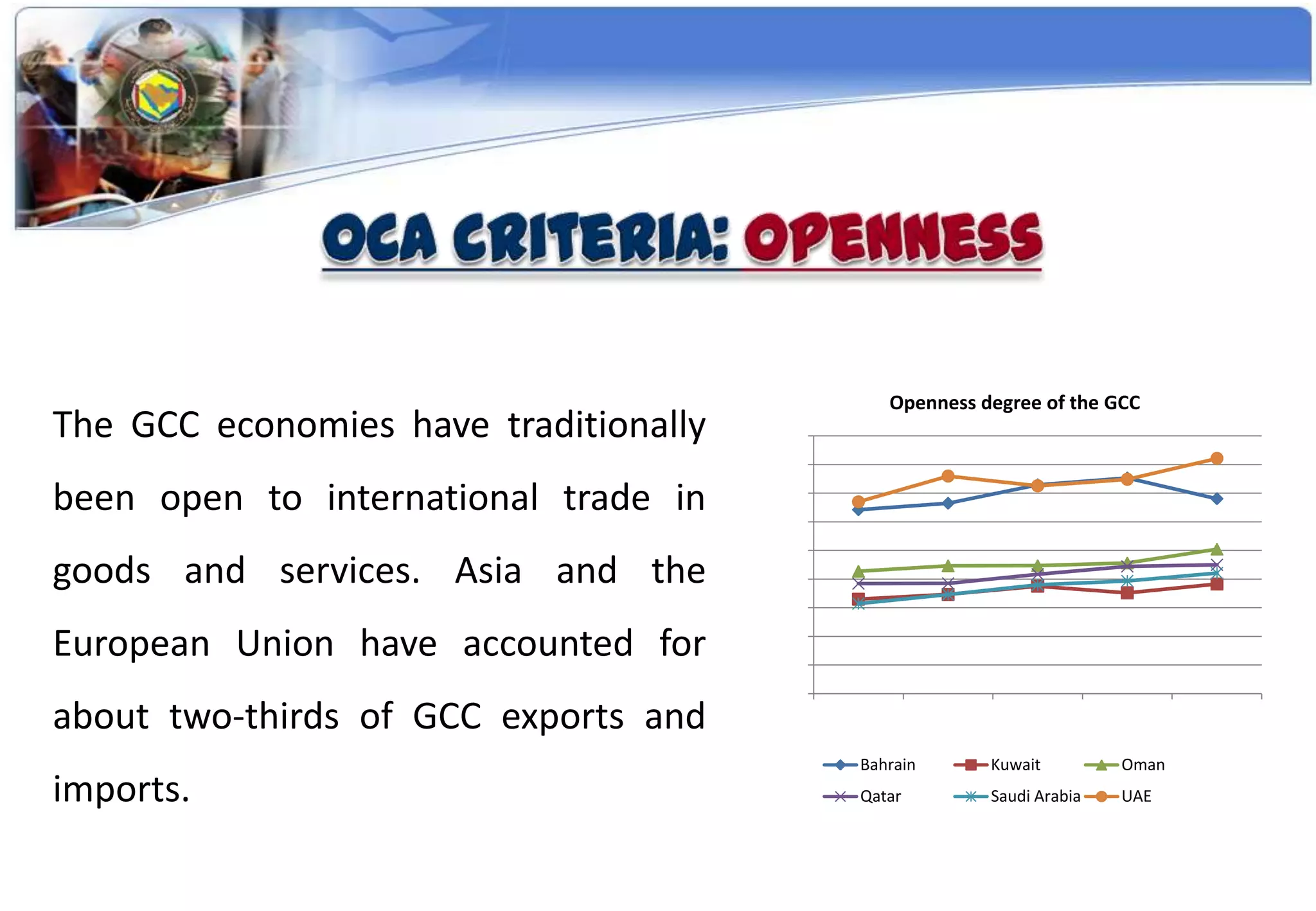
Openness degree of the GCC
The GCC economies have traditionally
been open to international trade in
goods and services. Asia and the
European Union have accounted for
about two-thirds of GCC exports and
                                       Bahrain      Kuwait         Oman
imports.                               Qatar        Saudi Arabia   UAE
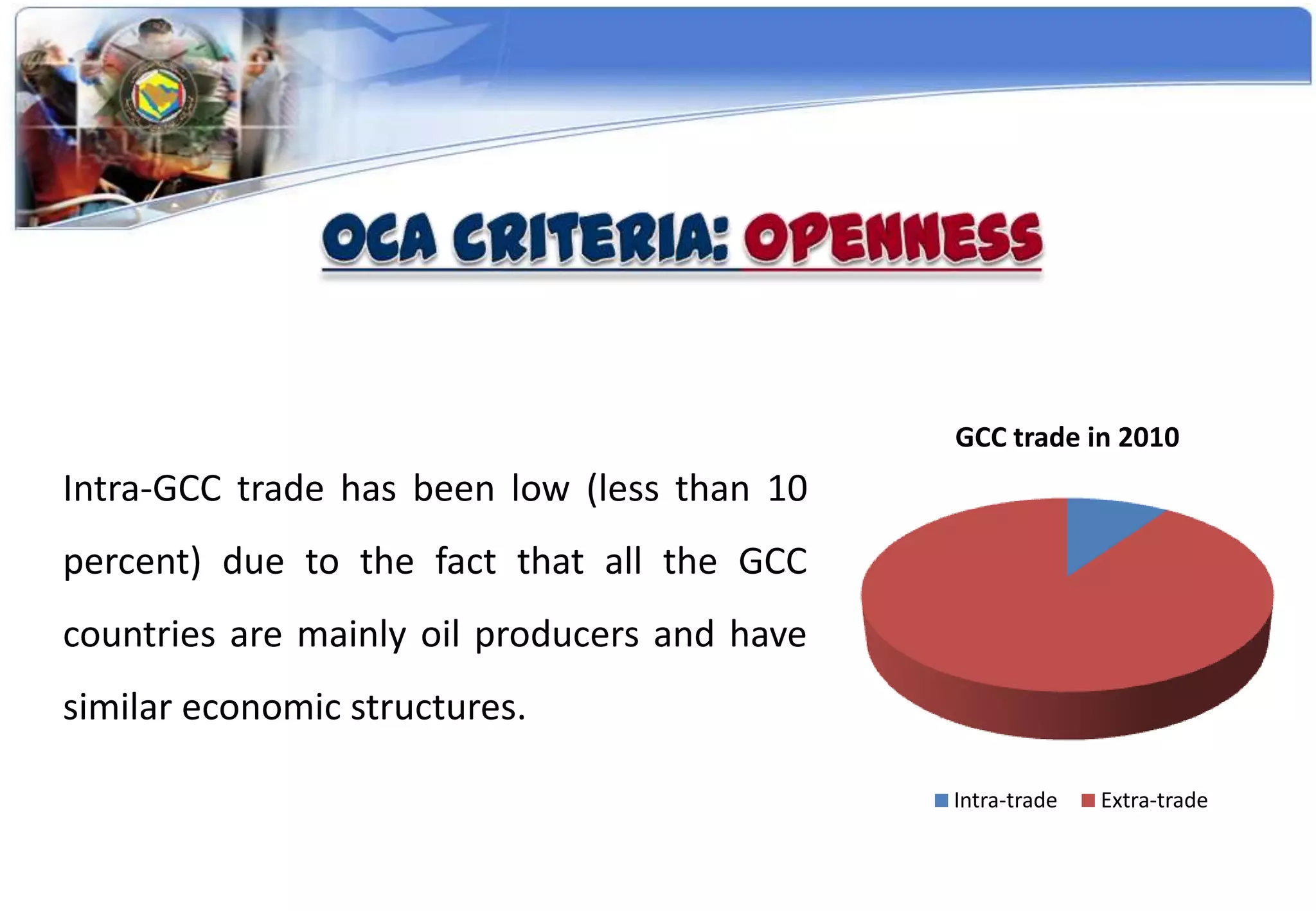
GCC trade in 2010
Intra-GCC trade has been low (less than 10
percent) due to the fact that all the GCC
countries are mainly oil producers and have
similar economic structures.

                                              Intra-trade   Extra-trade
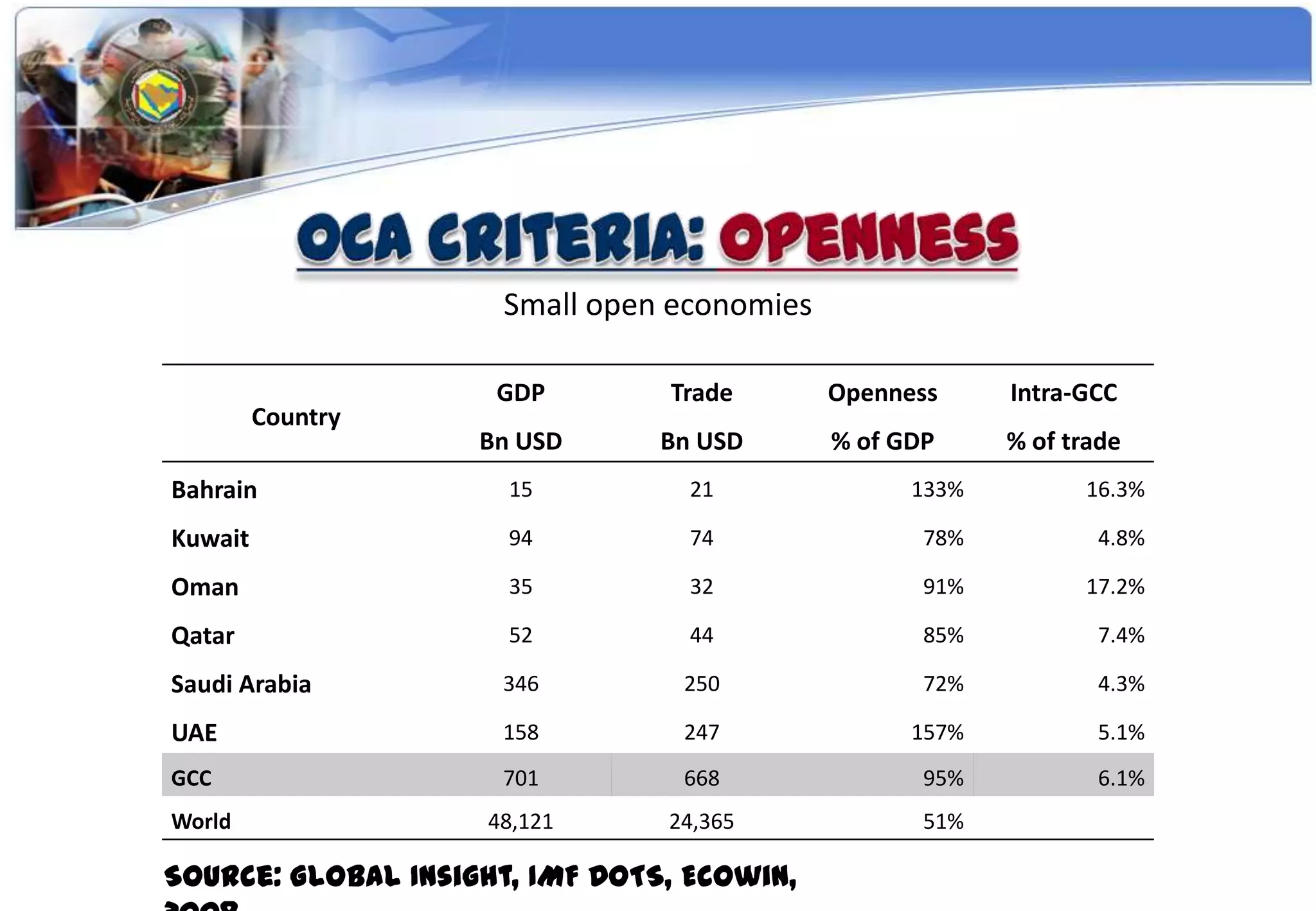
Small open economies

                     GDP        Trade        Openness     Intra-GCC
         Country
                    Bn USD      Bn USD       % of GDP     % of trade
Bahrain               15          21               133%         16.3%

Kuwait                94          74                78%           4.8%

Oman                  35          32                91%         17.2%

Qatar                 52          44                85%           7.4%

Saudi Arabia         346         250                72%           4.3%

UAE                  158         247               157%           5.1%
GCC                  701         668                95%           6.1%
World               48,121      24,365              51%

Source: Global Insight, IMF DOTS, Ecowin,
As far as the Mckinnon criterion is
concerned, most of GCC economies
qualify for joining a monetary union.
They are very open, they may will not
face asymmetric shocks.
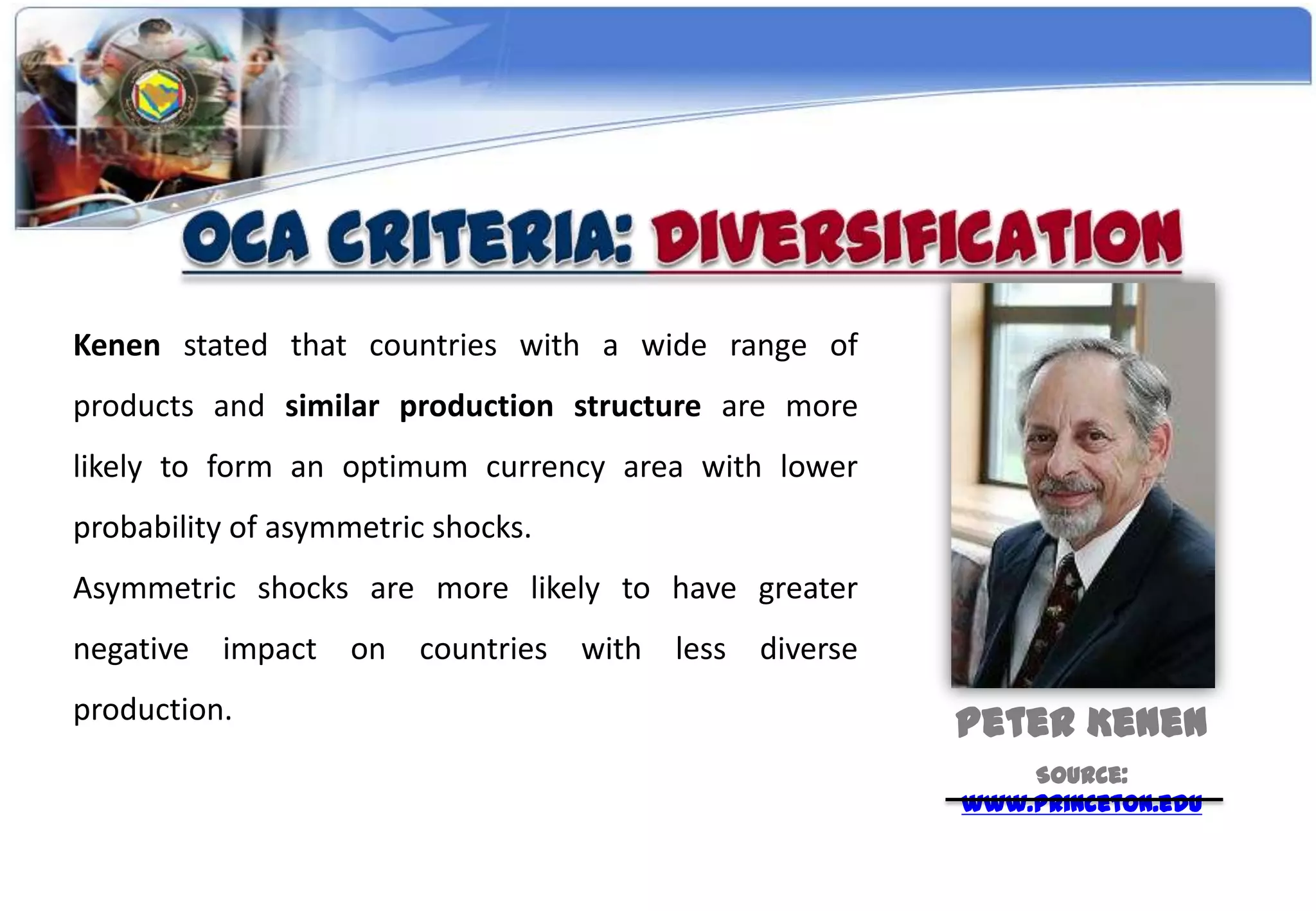
Kenen stated that countries with a wide range of
products and similar production structure are more
likely to form an optimum currency area with lower
probability of asymmetric shocks.
Asymmetric shocks are more likely to have greater
negative impact on countries with less diverse
production.                                          Peter Kenen
                                                         Source:
                                                     www.princeton.edu
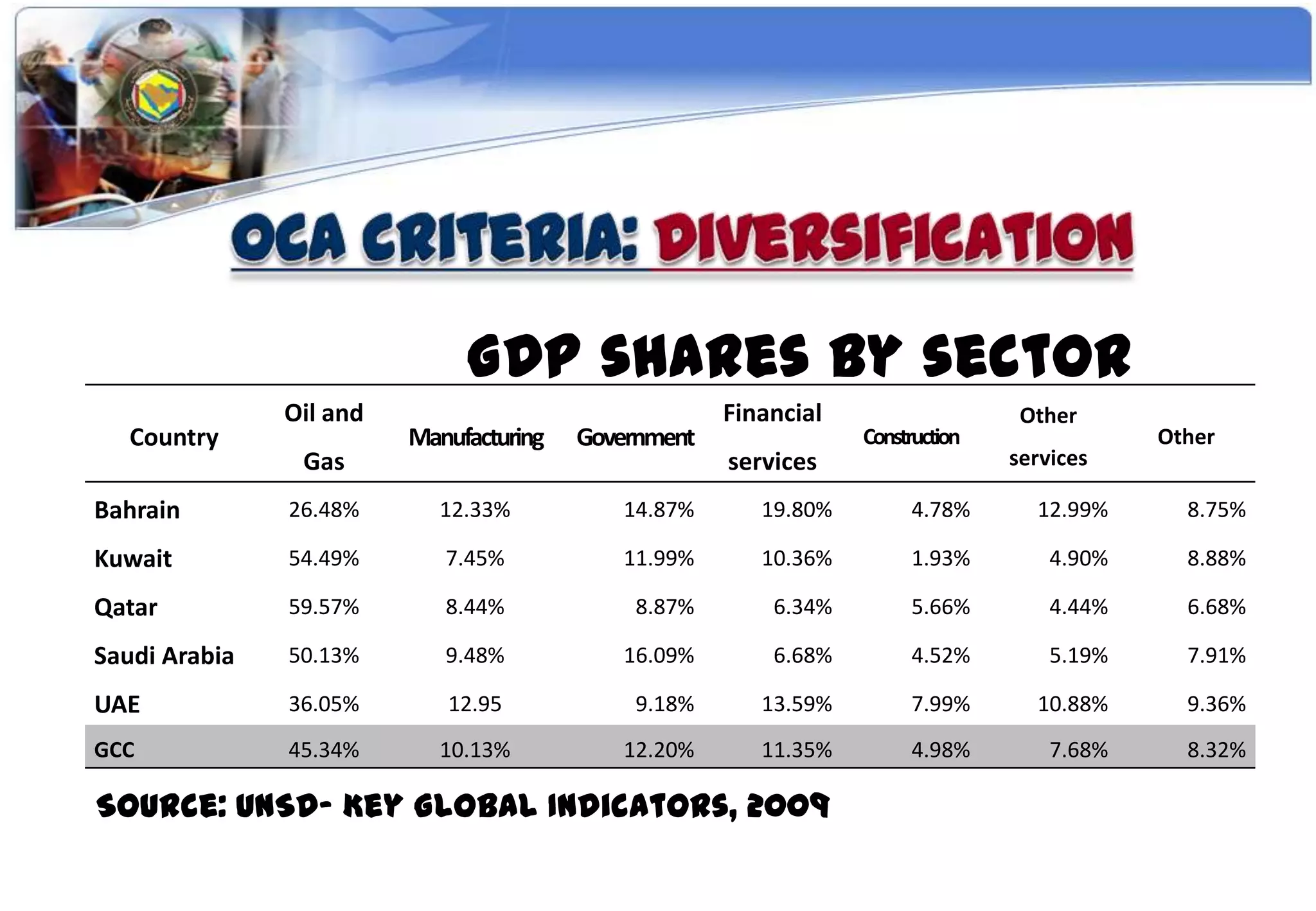
Despite the efforts to diversify their
economies, GCC countries remain heavily
dependent on oil. Since 1991 oil and gas
income constituted, in average, 35 percent
of the GDP, 77 percent of total exports and
74 percent of government revenues.
GDP shares by sector
               Oil and                                Financial                   Other
   Country               Manufacturing   Government               Construction               Other
                Gas                                   services                   services

Bahrain        26.48%      12.33%           14.87%       19.80%        4.78%       12.99%      8.75%

Kuwait         54.49%       7.45%           11.99%       10.36%        1.93%         4.90%     8.88%

Qatar          59.57%       8.44%            8.87%        6.34%        5.66%         4.44%     6.68%

Saudi Arabia   50.13%       9.48%           16.09%        6.68%        4.52%         5.19%     7.91%

UAE            36.05%       12.95            9.18%       13.59%        7.99%       10.88%      9.36%
GCC            45.34%      10.13%           12.20%       11.35%        4.98%         7.68%     8.32%

Source: UNSD- Key Global Indicators, 2009
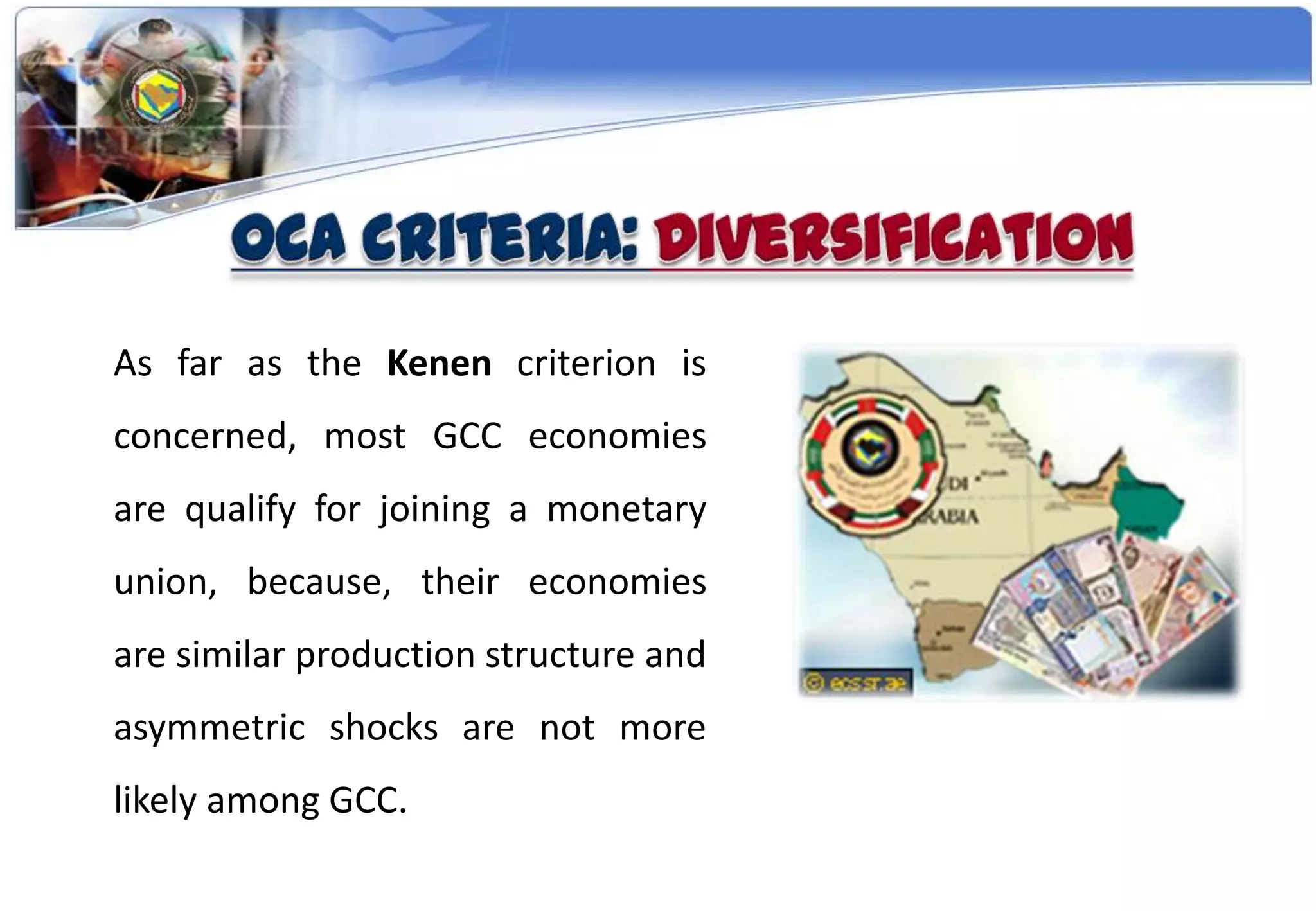
As far as the Kenen criterion is
concerned, most GCC economies
are qualify for joining a monetary
union, because, their economies
are similar production structure and
asymmetric shocks are not more
likely among GCC.
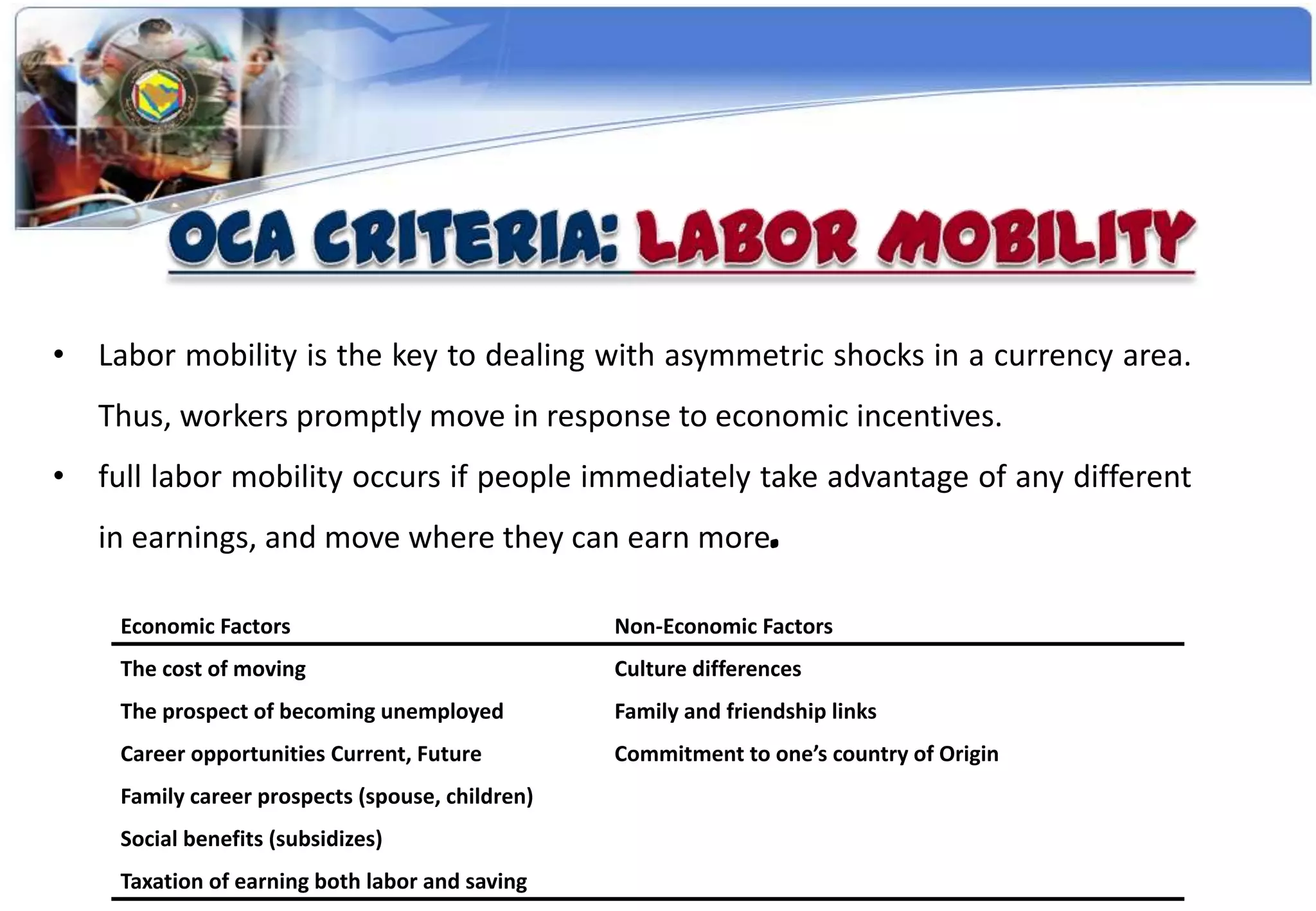
• Labor mobility is the key to dealing with asymmetric shocks in a currency area.
   Thus, workers promptly move in response to economic incentives.
• full labor mobility occurs if people immediately take advantage of any different
   in earnings, and move where they can earn more.

    Economic Factors                             Non-Economic Factors
    The cost of moving                           Culture differences
    The prospect of becoming unemployed          Family and friendship links
    Career opportunities Current, Future         Commitment to one’s country of Origin
    Family career prospects (spouse, children)
    Social benefits (subsidizes)
    Taxation of earning both labor and saving
• Articles within the GCC Charter, in both the original Unified
   Economic Agreement of 1981 as well as the new Economic
   Agreement of 2001 contain specific provisions allowing full and
   complete freedom of movement for citizenry.
• The GCC documents demonstrate a fairly liberal interpretation
   of free movement rights, allowing citizens to move across the
   six states’ borders for a variety of purposes, including residence
   and employment, and to gain access to a host of social security
   benefits in any of the member-states
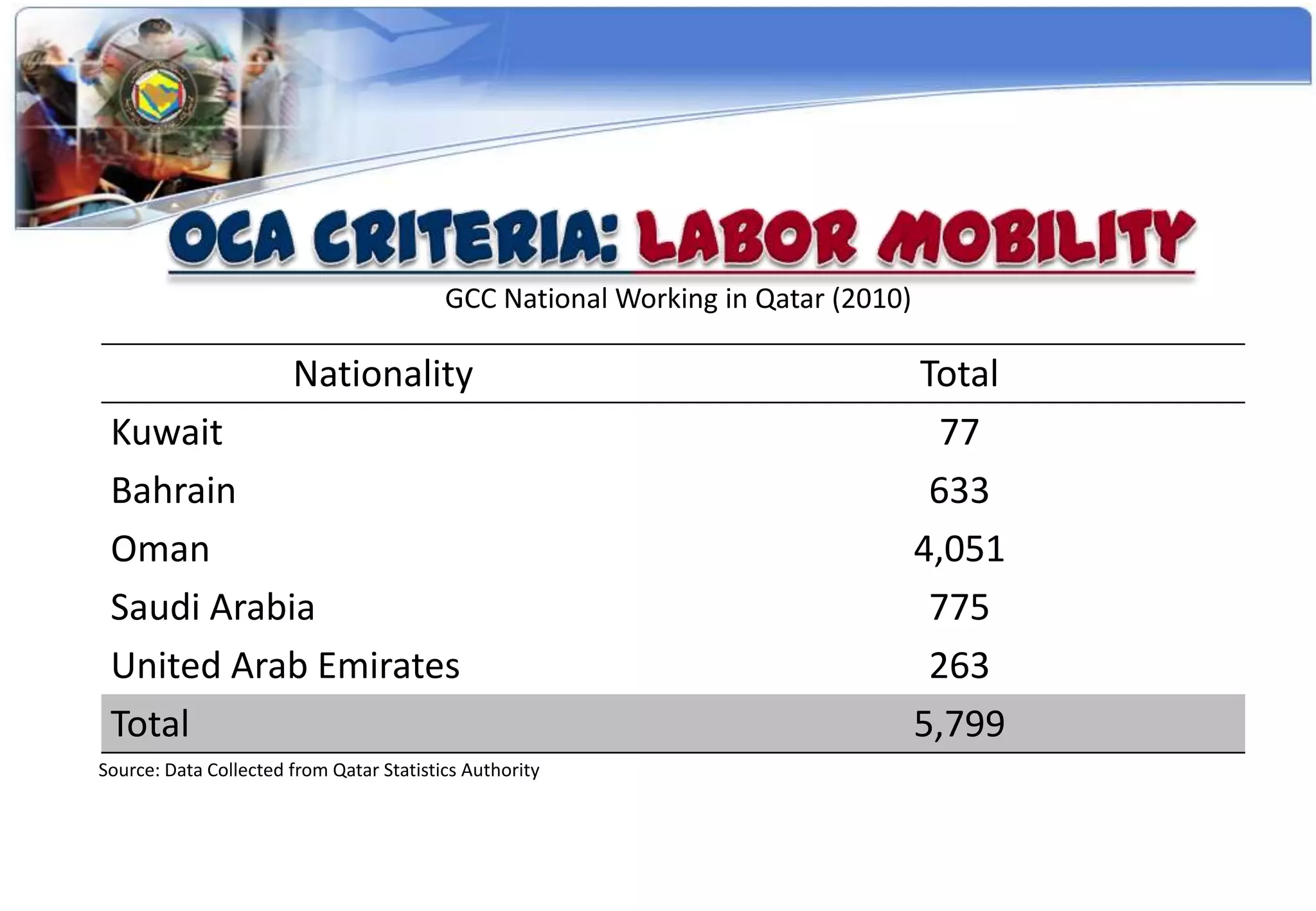
GCC National Working in Qatar (2010)

                       Nationality                                               Total
 Kuwait                                                                            77
 Bahrain                                                                          633
 Oman                                                                            4,051
 Saudi Arabia                                                                     775
 United Arab Emirates                                                             263
 Total                                                                           5,799
Source: Data Collected from Qatar Statistics Authority
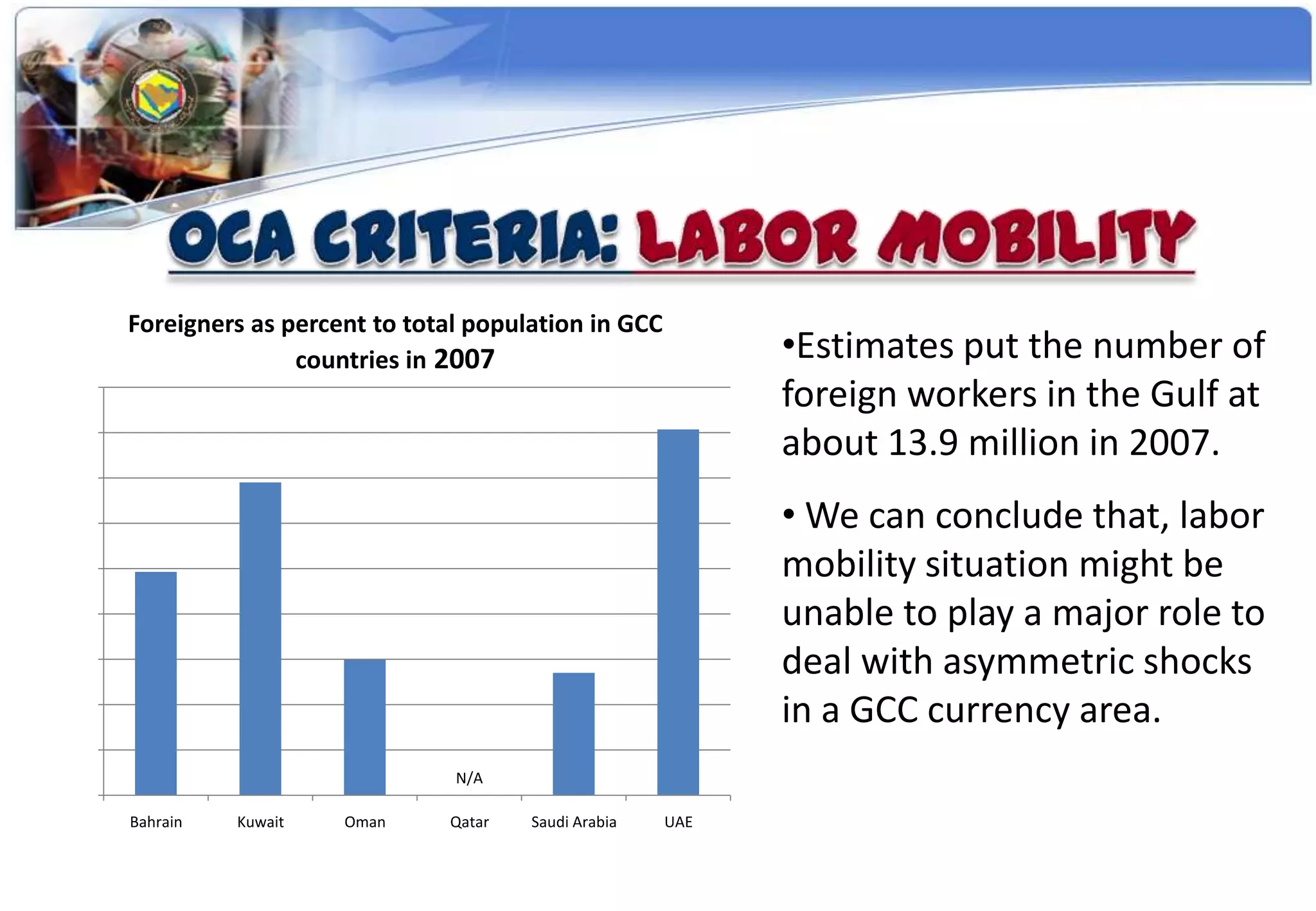
Foreigners as percent to total population in GCC
               countries in 2007                         •Estimates put the number of
                                                         foreign workers in the Gulf at
                                                         about 13.9 million in 2007.
                                                         • We can conclude that, labor
                                                         mobility situation might be
                                                         unable to play a major role to
                                                         deal with asymmetric shocks
                                                         in a GCC currency area.
                             N/A

Bahrain   Kuwait   Oman     Qatar   Saudi Arabia   UAE
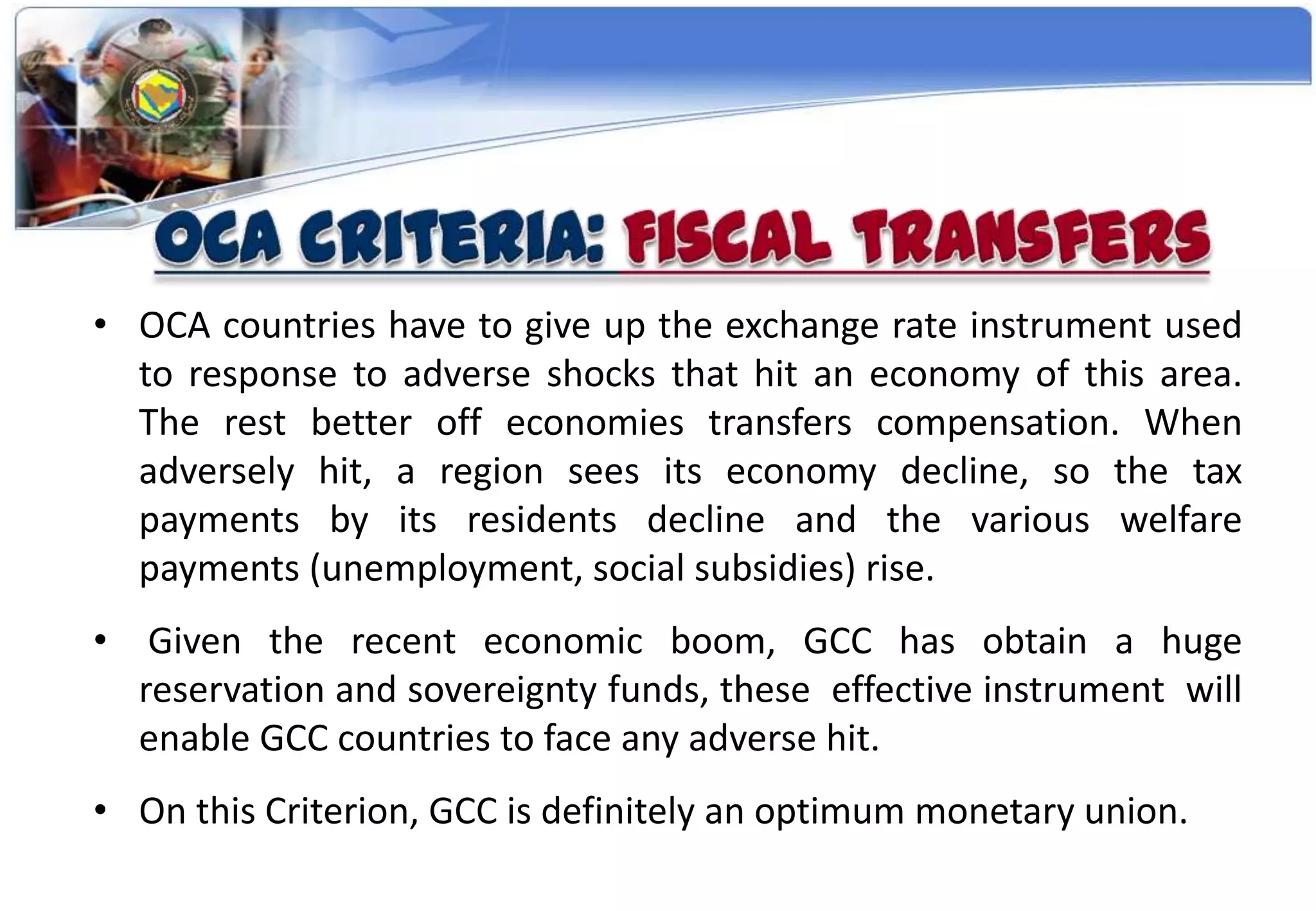
• OCA countries have to give up the exchange rate instrument used
  to response to adverse shocks that hit an economy of this area.
  The rest better off economies transfers compensation. When
  adversely hit, a region sees its economy decline, so the tax
  payments by its residents decline and the various welfare
  payments (unemployment, social subsidies) rise.
•    Given the recent economic boom, GCC has obtain a huge
    reservation and sovereignty funds, these effective instrument will
    enable GCC countries to face any adverse hit.
• On this Criterion, GCC is definitely an optimum monetary union.
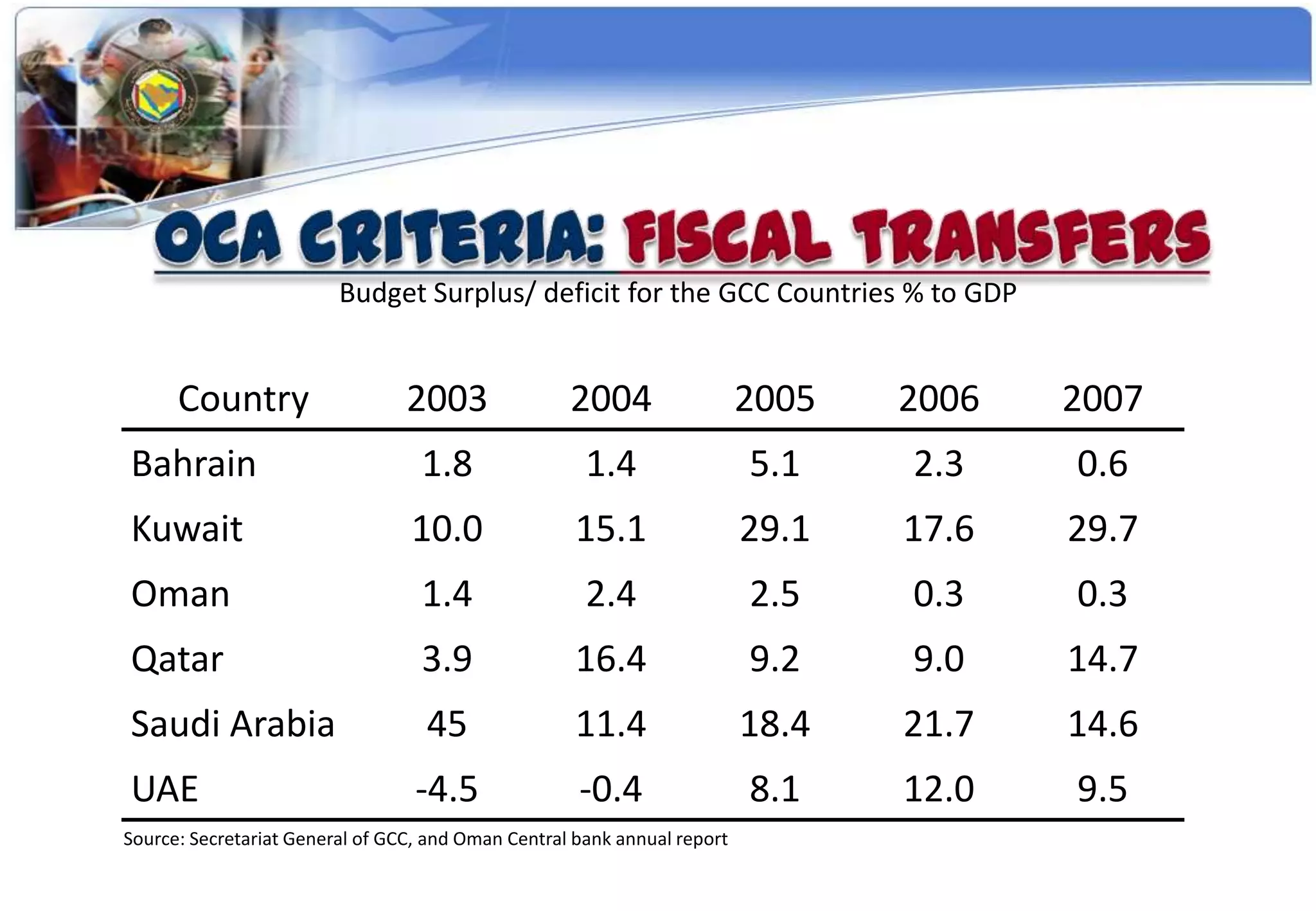
Budget Surplus/ deficit for the GCC Countries % to GDP


      Country                    2003               2004                  2005   2006   2007
Bahrain                            1.8                1.4                 5.1    2.3    0.6
Kuwait                           10.0                15.1                 29.1   17.6   29.7
Oman                               1.4                2.4                 2.5    0.3    0.3
Qatar                              3.9               16.4                 9.2    9.0    14.7
Saudi Arabia                       45                11.4                 18.4   21.7   14.6
UAE                               -4.5               -0.4                 8.1    12.0   9.5
Source: Secretariat General of GCC, and Oman Central bank annual report
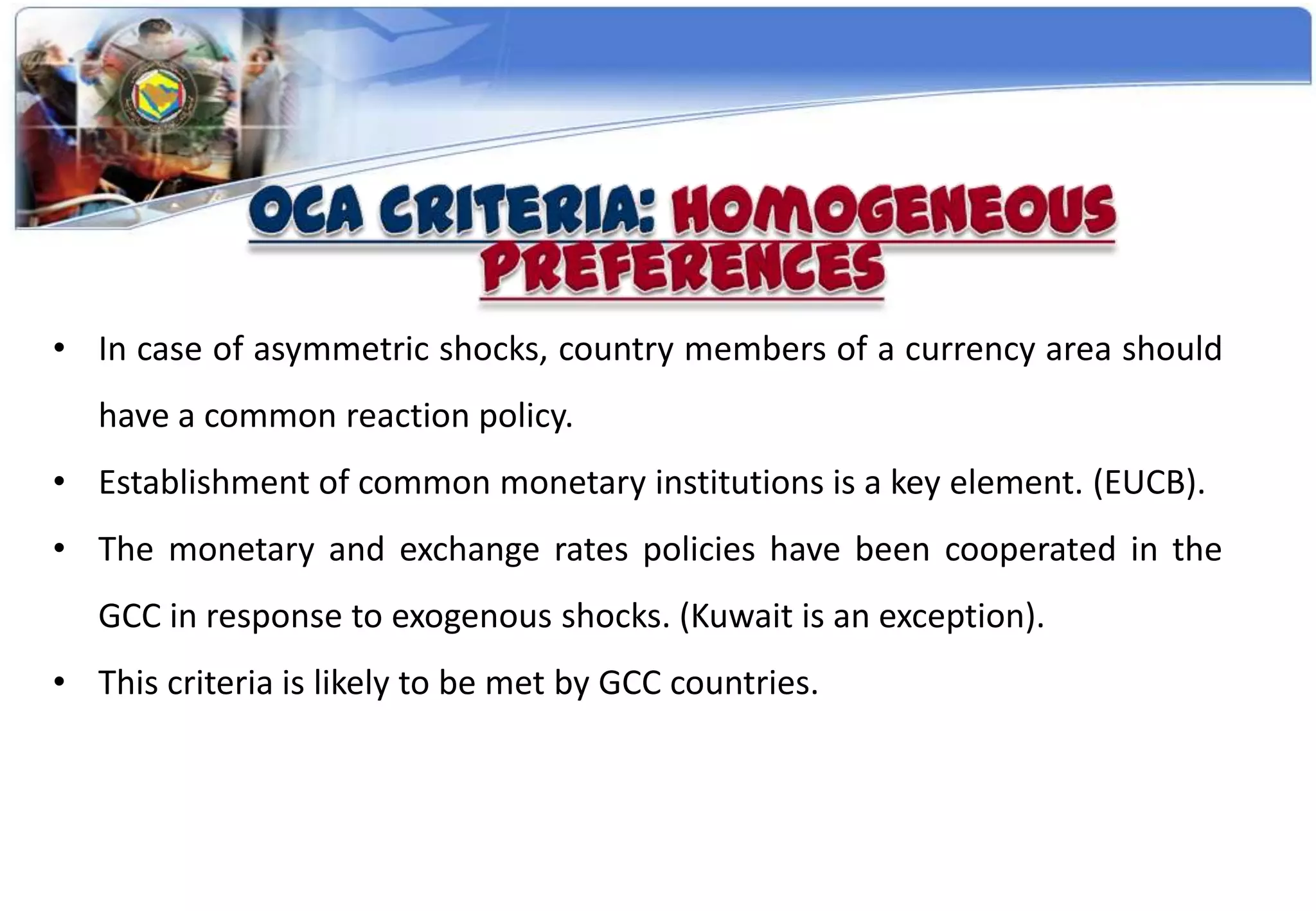
• In case of asymmetric shocks, country members of a currency area should
   have a common reaction policy.
• Establishment of common monetary institutions is a key element. (EUCB).
• The monetary and exchange rates policies have been cooperated in the
   GCC in response to exogenous shocks. (Kuwait is an exception).
• This criteria is likely to be met by GCC countries.
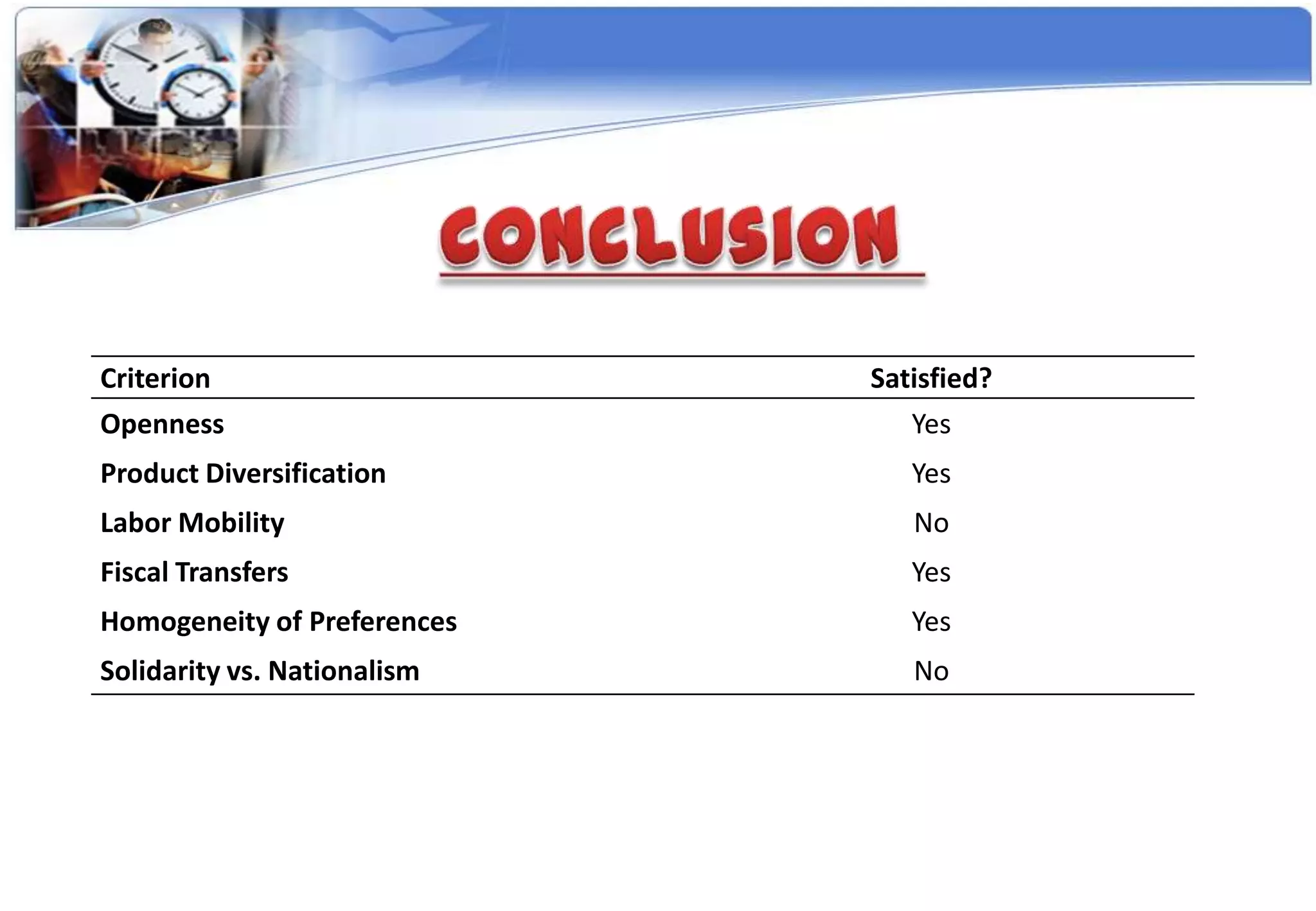
Criterion                    Satisfied?
Openness                        Yes
Product Diversification         Yes
Labor Mobility                  No
Fiscal Transfers                Yes
Homogeneity of Preferences      Yes
Solidarity vs. Nationalism      No
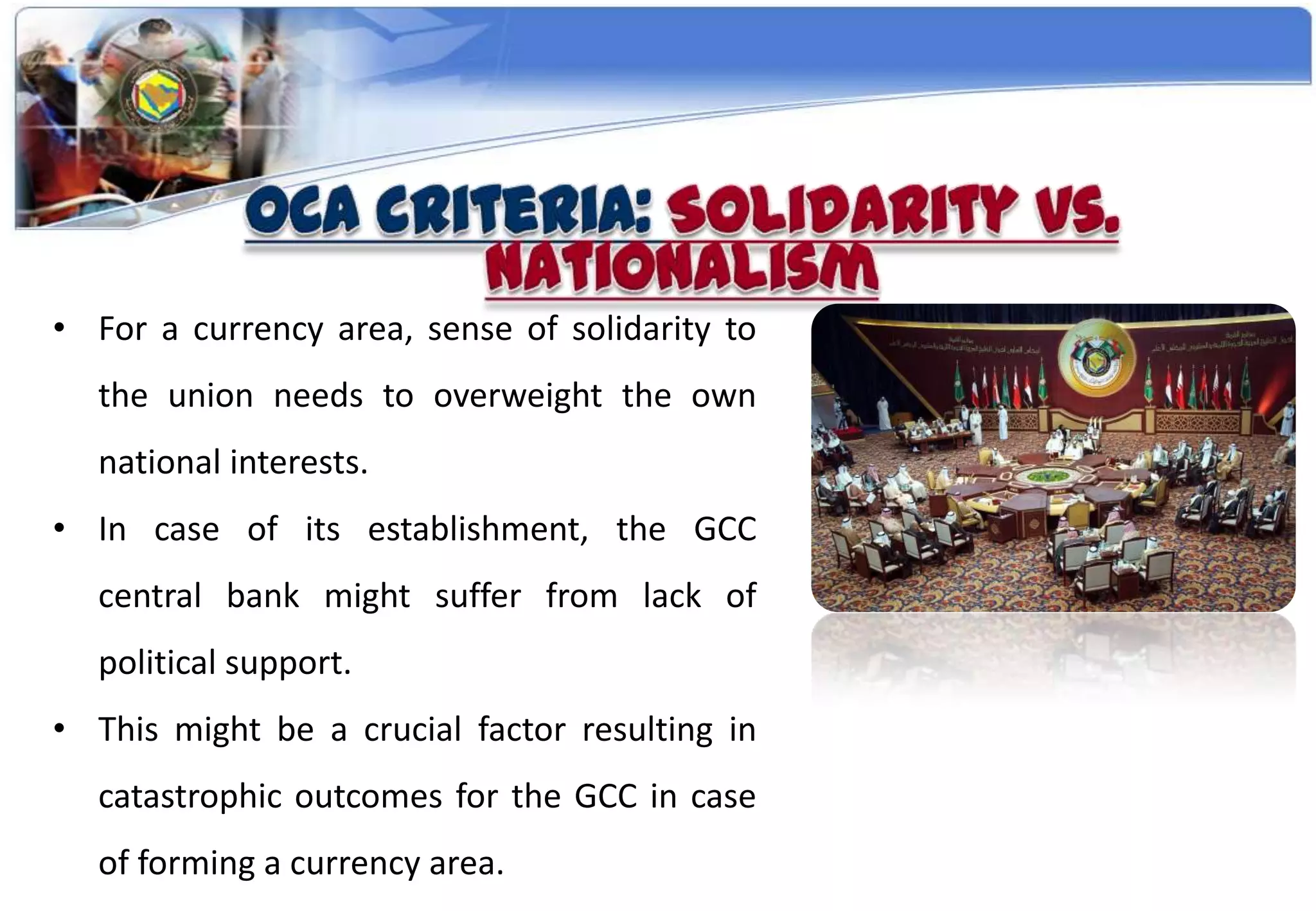
• For a currency area, sense of solidarity to
  the union needs to overweight the own
  national interests.
• In case of its establishment, the GCC
  central bank might suffer from lack of
  political support.
• This might be a crucial factor resulting in
  catastrophic outcomes for the GCC in case
  of forming a currency area.
Is gcc an optimum currency area

Is gcc an optimum currency area

  • 1.
    IS THE GCCAN OPTIMAL CURRENCY AREA? By Adnan Ahmed Qatinah Mohammed Ghiath HASAN AGHA Husam Al Dakak Ala'a Mohamed ECONOMIC CHANGE IN THE ARAB REGION
  • 2.
    • Introduction • Thetheory of Optimum Currency Area • Definition of Optimum Currency Area • Potential Benefits and cost of Optimum Currency Area • Criteria of an Optimal Currency Area (OCA) • GCC Countries and the Optimality Criteria for OCA • Overview of the economic cooperation in GCC • Overview of GCC economics • Benefits and Costs for GCC to have OCA • Does GCC meet the criteria of an Optimum Currency Area? • Conclusion
  • 3.
    In 2001, theGulf Cooperation Council countries (GCC) (Bahrain, Kuwait, Oman, Qatar, Saudi Arabia, and United Arab Emirates) decided to introduce a common currency by 2010. Furthermore, in 2005, the GCC members adopted the European Union (EU) convergence criteria with respect to budget deficit, public debt, currency reserves, interest rate, and inflation. The main objective of our presentation is to investigate to what extent the GCC member states meet the theoretical criteria for an optimal monetary union.
  • 4.
    Mundell stated “economicefficiency would be maximized in a geographical region if the region all shared a single currency". Professor Robert Mundell, 1999 Nobel Laureate: the father of the Theory of Optimum Currency
  • 5.
    1981 • The Gulf Cooperation Council (GCC) was established. 1983 • Free Trade zone was established to enhance economic integration. 1999 • Customs Union was established. 2003 • GCC countries pegged their currencies to the US dollar as well as established a common external tariff of 5% 2008 • GCC countries agreed to introduce a monetary union.
  • 6.
    Average Growth Ratesof Nominal GDP Saudi GCC Period Bahrain Kuwait Oman Qatar UAE Arabia Average 1970s 25.1 30.6 46.4 31.3 47.7 51.1 38.7 1980s 3.0 -3.3 7.1 0.1 -2.5 2.1 1.1 1990s 6.6 11.3 5.9 10.3 5.2 8.0 7.9 2001-2007 13.9 17.3 10.9 20.8 10.8 15.7 14.9
  • 7.
  • 8.
    BENEFITS • Reduces transactioncosts • Bargaining Power • More Intra Trade • Economies to Scale • Removal of Foreign Exchange Risk • Fixed Exchange Rates COSTS • Unitary Monetary Policy • Constraint on national fiscal policy;
  • 9.
    • Openness • DiverseProduction • Mobile Labor • Transfer Criterion • Homogeneity of preferences • Solidarity vs. nationalism
  • 10.
    • McKinnon suggeststhat countries with a small open economy, which trades intensively with the world, would be good for them to join an optimum currency area. Ronald McKinnon Source: http://www.stanford.edu/~mck innon/
  • 11.
    Openness degree ofthe GCC The GCC economies have traditionally been open to international trade in goods and services. Asia and the European Union have accounted for about two-thirds of GCC exports and Bahrain Kuwait Oman imports. Qatar Saudi Arabia UAE
  • 12.
    GCC trade in2010 Intra-GCC trade has been low (less than 10 percent) due to the fact that all the GCC countries are mainly oil producers and have similar economic structures. Intra-trade Extra-trade
  • 13.
    Small open economies GDP Trade Openness Intra-GCC Country Bn USD Bn USD % of GDP % of trade Bahrain 15 21 133% 16.3% Kuwait 94 74 78% 4.8% Oman 35 32 91% 17.2% Qatar 52 44 85% 7.4% Saudi Arabia 346 250 72% 4.3% UAE 158 247 157% 5.1% GCC 701 668 95% 6.1% World 48,121 24,365 51% Source: Global Insight, IMF DOTS, Ecowin,
  • 14.
    As far asthe Mckinnon criterion is concerned, most of GCC economies qualify for joining a monetary union. They are very open, they may will not face asymmetric shocks.
  • 15.
    Kenen stated thatcountries with a wide range of products and similar production structure are more likely to form an optimum currency area with lower probability of asymmetric shocks. Asymmetric shocks are more likely to have greater negative impact on countries with less diverse production. Peter Kenen Source: www.princeton.edu
  • 16.
    Despite the effortsto diversify their economies, GCC countries remain heavily dependent on oil. Since 1991 oil and gas income constituted, in average, 35 percent of the GDP, 77 percent of total exports and 74 percent of government revenues.
  • 17.
    GDP shares bysector Oil and Financial Other Country Manufacturing Government Construction Other Gas services services Bahrain 26.48% 12.33% 14.87% 19.80% 4.78% 12.99% 8.75% Kuwait 54.49% 7.45% 11.99% 10.36% 1.93% 4.90% 8.88% Qatar 59.57% 8.44% 8.87% 6.34% 5.66% 4.44% 6.68% Saudi Arabia 50.13% 9.48% 16.09% 6.68% 4.52% 5.19% 7.91% UAE 36.05% 12.95 9.18% 13.59% 7.99% 10.88% 9.36% GCC 45.34% 10.13% 12.20% 11.35% 4.98% 7.68% 8.32% Source: UNSD- Key Global Indicators, 2009
  • 18.
    As far asthe Kenen criterion is concerned, most GCC economies are qualify for joining a monetary union, because, their economies are similar production structure and asymmetric shocks are not more likely among GCC.
  • 19.
    • Labor mobilityis the key to dealing with asymmetric shocks in a currency area. Thus, workers promptly move in response to economic incentives. • full labor mobility occurs if people immediately take advantage of any different in earnings, and move where they can earn more. Economic Factors Non-Economic Factors The cost of moving Culture differences The prospect of becoming unemployed Family and friendship links Career opportunities Current, Future Commitment to one’s country of Origin Family career prospects (spouse, children) Social benefits (subsidizes) Taxation of earning both labor and saving
  • 20.
    • Articles withinthe GCC Charter, in both the original Unified Economic Agreement of 1981 as well as the new Economic Agreement of 2001 contain specific provisions allowing full and complete freedom of movement for citizenry. • The GCC documents demonstrate a fairly liberal interpretation of free movement rights, allowing citizens to move across the six states’ borders for a variety of purposes, including residence and employment, and to gain access to a host of social security benefits in any of the member-states
  • 21.
    GCC National Workingin Qatar (2010) Nationality Total Kuwait 77 Bahrain 633 Oman 4,051 Saudi Arabia 775 United Arab Emirates 263 Total 5,799 Source: Data Collected from Qatar Statistics Authority
  • 22.
    Foreigners as percentto total population in GCC countries in 2007 •Estimates put the number of foreign workers in the Gulf at about 13.9 million in 2007. • We can conclude that, labor mobility situation might be unable to play a major role to deal with asymmetric shocks in a GCC currency area. N/A Bahrain Kuwait Oman Qatar Saudi Arabia UAE
  • 23.
    • OCA countrieshave to give up the exchange rate instrument used to response to adverse shocks that hit an economy of this area. The rest better off economies transfers compensation. When adversely hit, a region sees its economy decline, so the tax payments by its residents decline and the various welfare payments (unemployment, social subsidies) rise. • Given the recent economic boom, GCC has obtain a huge reservation and sovereignty funds, these effective instrument will enable GCC countries to face any adverse hit. • On this Criterion, GCC is definitely an optimum monetary union.
  • 24.
    Budget Surplus/ deficitfor the GCC Countries % to GDP Country 2003 2004 2005 2006 2007 Bahrain 1.8 1.4 5.1 2.3 0.6 Kuwait 10.0 15.1 29.1 17.6 29.7 Oman 1.4 2.4 2.5 0.3 0.3 Qatar 3.9 16.4 9.2 9.0 14.7 Saudi Arabia 45 11.4 18.4 21.7 14.6 UAE -4.5 -0.4 8.1 12.0 9.5 Source: Secretariat General of GCC, and Oman Central bank annual report
  • 25.
    • In caseof asymmetric shocks, country members of a currency area should have a common reaction policy. • Establishment of common monetary institutions is a key element. (EUCB). • The monetary and exchange rates policies have been cooperated in the GCC in response to exogenous shocks. (Kuwait is an exception). • This criteria is likely to be met by GCC countries.
  • 26.
    Criterion Satisfied? Openness Yes Product Diversification Yes Labor Mobility No Fiscal Transfers Yes Homogeneity of Preferences Yes Solidarity vs. Nationalism No
  • 27.
    • For acurrency area, sense of solidarity to the union needs to overweight the own national interests. • In case of its establishment, the GCC central bank might suffer from lack of political support. • This might be a crucial factor resulting in catastrophic outcomes for the GCC in case of forming a currency area.