www.bsc.es
ECMWF, Reading, UK, 31 October 2014
George S. Markomanolis, Jesus Labarta, Oriol Jorba
Optimizing an Earth Science
Atmospheric Application with the
OmpSs Programming Model
Workshop on High performance computing in meteorology
2
Outline
Introduction to NMMB/BSC-CTM
Performance overview of NMMB/BSC-CTM
Experiences with OmpSs
Future work
Severo-Ochoa Earth Sciences Application
Development of a Unified Meteorology/Air Quality/Climate model
• Towards a global high-resolution system for global to local
assessments
International collaborations:
Meteorology Climate
Global aerosols Air Quality
Uni. of California
Irvine
Goddard Institute Space Studies
National Centers for
Environmental Predictions
Extending NMMB/BSC-CTM
from coarse regional scales to
global high-resolution
configurations
Coupling with a Data
Assimilation System for
Aerosols
Where do we solve the primitive equations? Grid
discretization
High performance computing resources:
If we plan to solve small scale features
we need higher resolution in the mesh
and so more HPC resources are required.
We need to be able to run this models in Multi-core
architectures.
Model domain is decomposed in patches
Patch: portion of the model domain allocated to a
distributed/shared memory node.
5
ParallelizingAtmospheric Models
MPI Communication with
neighbours
Patch
6
NMMB/BSC-CTM
NMMB/BSC-CTM is used operationally for the dust forecast
center in Barcelona
NMMB is the operational model of NCEP
The general purpose is to improve its scalability and the
simulation resolution
7
MarenoStrum III
3,056 compute nodes
2x Intel SandyBridge-EP E5-2670 2.6 GHz
32 GB memory per node
Infiniband FDR10
OpenMPI 1.8.1
ifort 13.0.1
Performance Overview of NMMB/BSC-CTM Model
Execution diagram – Focus on the Model
Paraver
One hour simulation of NMMB/BSC-CTM, global, 24km, 64 layers
meteo: 9 tracers
meteo + aerosols:
9 + 16 tracers
meteo + aerosols +
gases: 9 + 16 + 53
Dynamic load balancing
Different simulation dates cause different load balance issue (useful
functions, global 24km meteo configuration)
20/12/2005
20/07/2005
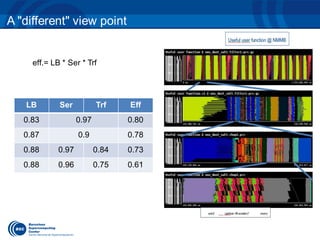
A "different" view point
LB Ser Trf Eff
0.83 0.97 0.80
0.87 0.9 0.78
0.88 0.97 0.84 0.73
0.88 0.96 0.75 0.61
eff.= LB * Ser * Trf
13
One hour simulation
One hour simulation, chemistry configuration for global model,
24 km resolution
14
One hour simulation
Useful functions
15
Zoom on EBI solver and next calls
EBI solver (run_ebi) and the calls till the next call to the solver
16
Zoom between EBI solvers
The useful functions call between two EBI solvers
The first two dark blue areas are horizontal diffusion calls and
the light dark is advection chemistry.
17
Horizontal diffusion
We zoom on horizontal diffusion and the calls that follow
Horizontal diffusion (blue colour) has load imbalance
Experiences with OmpSs
19
Objectives
Trying to apply OmpSs on a real application
Applying incremental methodology
Identify opportunities
Exploring difficulties
20
OmpSs introduction
Parallel Programming Model
- Build on existing standard: OpenMP
- Directive based to keep a serial version
- Targeting: SMP, clusters, and accelerator devices
- Developed in Barcelona Supercomputing Center (BSC)
Mercurium source-to-source compiler
Nanos++ runtime system
https://pm.bsc.es/ompss
21
Studying cases
Taskify a computation routine and investigate potential improvements and
overlap between computations of different granularities
Overlap communication with packing and unpacking costs
Overlap independent coarse grain operations composed of communication
and computation phases
22
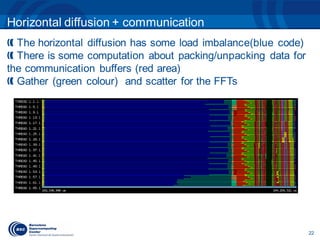
Horizontal diffusion + communication
The horizontal diffusion has some load imbalance(blue code)
There is some computation about packing/unpacking data for
the communication buffers (red area)
Gather (green colour) and scatter for the FFTs
23
Horizontal diffusion skeleton code
The hdiff subroutine has the following loops and dependencies
24
Parallelizing loops
Part of hdiff with 2 threads
Parallelizing the most important loops
We have a speedup of 1.3 by using
worksharing
25
Comparison
The execution of hdiff subroutine with 1 thread takes 120 ms
The execution of hdiff subroutine with 2 threads takes 56 ms,
the speedup is 2.14
26
Issues related to communication
We study the exch4 subroutine (red colour)
The useful function of exch4 has some computation
The communication creates a pattern and the duration of the
MPI_Wait calls can vary
27
Issues related to communication
Big load imbalance because message order
There is also some computation
28
Taskify subroutine exch4
We observe the MPI_Wait calls in the first thread
In the same moment the second thread does the necessary
computation and overlaps the communication
29
Taskify subroutine exch4
The total execution of exch4 subrouting with 1 thread
The total execution of exch4 subroutine with 2 threads
With 2 threads the speedup is 1.76 (more improvements have
been identified)
30
Advection chemistry and FFT
Advection chemistry (blue color) and 54 calls to
gather/FFT/scatter till monotonization chemistry (brown color)
Initial study to test the improvements of the execution with the
OmpSs programming model
31
Study case: gather/FFT/scatter
Workflow, two iterations, using two threads, declaring
dependencies
32
Study case: gather/FFT/scatter
Paraver view, two iterations, four tracers totally
Thread 1:
Iteration 1: FFT_1, scatter_1, scatter_2
Iteration 2: gather_4, FFT_4, scatter_4
Thread 2:
Iteration 1: gather_1, gather_2, fft_2
Iteration 2: gather_3, FFT_3, scatter_3
33
Study case: gather/FFT/scatter - Performance
Comparing the execution time of 54 calls to gather/FFT/scatter
with one and two threads
The speedup with two threads is 1.56 and we have identified
potential improvements
34
MPI Bandwidth
MPI bandwidth for gather/scatter
MPI bandwidth over 1GB/s for gather/scatter
35
Combination of advection chemistry and FFT
Advection chemistry with worksharing (not for all the loops),
FFTs for one thread
Similar but with two threads
The speedup for the advection chemistry routine is 1.6 and
overall is 1.58
36
Comparison between MPI and MPI+OmpSs
Pure MPI, 128 computation processes and 4 I/O
MPI + OmpSs: 64 MPI processes + 64 threads + 4 I/O
The load imbalance for the FFT with pure MPI is 28% while
with MPI+OmpSs is 54%
37
Incremental methodology with OmpSs
Taskify the loops
Start with 1 thread, use if(0) for serializing tasks
Test that dependencies are correct (usually trial and error)
Imagine an application crashing after adding 20+ new pragmas
(true story)
Do not parallelize loops that do not contain significant
computation
38
Conclusions
The incremental methodology is important for less overhead in
the application
OmpSs can be applied on a real application but is not
straightforward
It can achieve pretty good speedup, depending on the case
Overlapping communication with computation is a really
interesting topic
We are still in the beginning but OmpSs seems promising
39
Future improvements
Investigate the usage of multithreaded MPI
One of the main functions of the application is the EBI solver
(run_ebi). There is a problem with global variables that make the
function not reentrant. Refactoring of the code is needed.
Porting more code to OmpSs and investigate MPI calls as tasks
Some computation is independent to the model's layers or to tracers.
OpenCL kernels are going to be developed to test the performance on
accelerators
Testing versioning scheduler
The dynamic load balancing library should be studied further
(http://pm.bsc.es/dlb)
Apply OmpSs for a data assimilation simulation
www.bsc.es
Thank you!
For further information please contact
georgios.markomanolis@bsc.es
"Work funded by the SEV-2011-00067 grant of the Severo
Ochoa Program, awarded by the Spanish Government."
Acknowledgements:
Rosa M. Badia, Judit Gimenez, Roger Ferrer Ibáñez, Julian Morillo,
Victor López, Xavier Teruel, Harald Servat, BSC support
40

Optimizing an Earth Science Atmospheric Application with the OmpSs Programming Model

  • 1.
    www.bsc.es ECMWF, Reading, UK,31 October 2014 George S. Markomanolis, Jesus Labarta, Oriol Jorba Optimizing an Earth Science Atmospheric Application with the OmpSs Programming Model Workshop on High performance computing in meteorology
  • 2.
    2 Outline Introduction to NMMB/BSC-CTM Performanceoverview of NMMB/BSC-CTM Experiences with OmpSs Future work
  • 3.
    Severo-Ochoa Earth SciencesApplication Development of a Unified Meteorology/Air Quality/Climate model • Towards a global high-resolution system for global to local assessments International collaborations: Meteorology Climate Global aerosols Air Quality Uni. of California Irvine Goddard Institute Space Studies National Centers for Environmental Predictions Extending NMMB/BSC-CTM from coarse regional scales to global high-resolution configurations Coupling with a Data Assimilation System for Aerosols
  • 4.
    Where do wesolve the primitive equations? Grid discretization High performance computing resources: If we plan to solve small scale features we need higher resolution in the mesh and so more HPC resources are required.
  • 5.
    We need tobe able to run this models in Multi-core architectures. Model domain is decomposed in patches Patch: portion of the model domain allocated to a distributed/shared memory node. 5 ParallelizingAtmospheric Models MPI Communication with neighbours Patch
  • 6.
    6 NMMB/BSC-CTM NMMB/BSC-CTM is usedoperationally for the dust forecast center in Barcelona NMMB is the operational model of NCEP The general purpose is to improve its scalability and the simulation resolution
  • 7.
    7 MarenoStrum III 3,056 computenodes 2x Intel SandyBridge-EP E5-2670 2.6 GHz 32 GB memory per node Infiniband FDR10 OpenMPI 1.8.1 ifort 13.0.1
  • 8.
    Performance Overview ofNMMB/BSC-CTM Model
  • 9.
    Execution diagram –Focus on the Model
  • 10.
    Paraver One hour simulationof NMMB/BSC-CTM, global, 24km, 64 layers meteo: 9 tracers meteo + aerosols: 9 + 16 tracers meteo + aerosols + gases: 9 + 16 + 53
  • 11.
    Dynamic load balancing Differentsimulation dates cause different load balance issue (useful functions, global 24km meteo configuration) 20/12/2005 20/07/2005
  • 12.
    A "different" viewpoint LB Ser Trf Eff 0.83 0.97 0.80 0.87 0.9 0.78 0.88 0.97 0.84 0.73 0.88 0.96 0.75 0.61 eff.= LB * Ser * Trf
  • 13.
    13 One hour simulation Onehour simulation, chemistry configuration for global model, 24 km resolution
  • 14.
  • 15.
    15 Zoom on EBIsolver and next calls EBI solver (run_ebi) and the calls till the next call to the solver
  • 16.
    16 Zoom between EBIsolvers The useful functions call between two EBI solvers The first two dark blue areas are horizontal diffusion calls and the light dark is advection chemistry.
  • 17.
    17 Horizontal diffusion We zoomon horizontal diffusion and the calls that follow Horizontal diffusion (blue colour) has load imbalance
  • 18.
  • 19.
    19 Objectives Trying to applyOmpSs on a real application Applying incremental methodology Identify opportunities Exploring difficulties
  • 20.
    20 OmpSs introduction Parallel ProgrammingModel - Build on existing standard: OpenMP - Directive based to keep a serial version - Targeting: SMP, clusters, and accelerator devices - Developed in Barcelona Supercomputing Center (BSC) Mercurium source-to-source compiler Nanos++ runtime system https://pm.bsc.es/ompss
  • 21.
    21 Studying cases Taskify acomputation routine and investigate potential improvements and overlap between computations of different granularities Overlap communication with packing and unpacking costs Overlap independent coarse grain operations composed of communication and computation phases
  • 22.
    22 Horizontal diffusion +communication The horizontal diffusion has some load imbalance(blue code) There is some computation about packing/unpacking data for the communication buffers (red area) Gather (green colour) and scatter for the FFTs
  • 23.
    23 Horizontal diffusion skeletoncode The hdiff subroutine has the following loops and dependencies
  • 24.
    24 Parallelizing loops Part ofhdiff with 2 threads Parallelizing the most important loops We have a speedup of 1.3 by using worksharing
  • 25.
    25 Comparison The execution ofhdiff subroutine with 1 thread takes 120 ms The execution of hdiff subroutine with 2 threads takes 56 ms, the speedup is 2.14
  • 26.
    26 Issues related tocommunication We study the exch4 subroutine (red colour) The useful function of exch4 has some computation The communication creates a pattern and the duration of the MPI_Wait calls can vary
  • 27.
    27 Issues related tocommunication Big load imbalance because message order There is also some computation
  • 28.
    28 Taskify subroutine exch4 Weobserve the MPI_Wait calls in the first thread In the same moment the second thread does the necessary computation and overlaps the communication
  • 29.
    29 Taskify subroutine exch4 Thetotal execution of exch4 subrouting with 1 thread The total execution of exch4 subroutine with 2 threads With 2 threads the speedup is 1.76 (more improvements have been identified)
  • 30.
    30 Advection chemistry andFFT Advection chemistry (blue color) and 54 calls to gather/FFT/scatter till monotonization chemistry (brown color) Initial study to test the improvements of the execution with the OmpSs programming model
  • 31.
    31 Study case: gather/FFT/scatter Workflow,two iterations, using two threads, declaring dependencies
  • 32.
    32 Study case: gather/FFT/scatter Paraverview, two iterations, four tracers totally Thread 1: Iteration 1: FFT_1, scatter_1, scatter_2 Iteration 2: gather_4, FFT_4, scatter_4 Thread 2: Iteration 1: gather_1, gather_2, fft_2 Iteration 2: gather_3, FFT_3, scatter_3
  • 33.
    33 Study case: gather/FFT/scatter- Performance Comparing the execution time of 54 calls to gather/FFT/scatter with one and two threads The speedup with two threads is 1.56 and we have identified potential improvements
  • 34.
    34 MPI Bandwidth MPI bandwidthfor gather/scatter MPI bandwidth over 1GB/s for gather/scatter
  • 35.
    35 Combination of advectionchemistry and FFT Advection chemistry with worksharing (not for all the loops), FFTs for one thread Similar but with two threads The speedup for the advection chemistry routine is 1.6 and overall is 1.58
  • 36.
    36 Comparison between MPIand MPI+OmpSs Pure MPI, 128 computation processes and 4 I/O MPI + OmpSs: 64 MPI processes + 64 threads + 4 I/O The load imbalance for the FFT with pure MPI is 28% while with MPI+OmpSs is 54%
  • 37.
    37 Incremental methodology withOmpSs Taskify the loops Start with 1 thread, use if(0) for serializing tasks Test that dependencies are correct (usually trial and error) Imagine an application crashing after adding 20+ new pragmas (true story) Do not parallelize loops that do not contain significant computation
  • 38.
    38 Conclusions The incremental methodologyis important for less overhead in the application OmpSs can be applied on a real application but is not straightforward It can achieve pretty good speedup, depending on the case Overlapping communication with computation is a really interesting topic We are still in the beginning but OmpSs seems promising
  • 39.
    39 Future improvements Investigate theusage of multithreaded MPI One of the main functions of the application is the EBI solver (run_ebi). There is a problem with global variables that make the function not reentrant. Refactoring of the code is needed. Porting more code to OmpSs and investigate MPI calls as tasks Some computation is independent to the model's layers or to tracers. OpenCL kernels are going to be developed to test the performance on accelerators Testing versioning scheduler The dynamic load balancing library should be studied further (http://pm.bsc.es/dlb) Apply OmpSs for a data assimilation simulation
  • 40.
    www.bsc.es Thank you! For furtherinformation please contact georgios.markomanolis@bsc.es "Work funded by the SEV-2011-00067 grant of the Severo Ochoa Program, awarded by the Spanish Government." Acknowledgements: Rosa M. Badia, Judit Gimenez, Roger Ferrer Ibáñez, Julian Morillo, Victor López, Xavier Teruel, Harald Servat, BSC support 40