ORNL is managed by UT-Battelle, LLC for the US Department of Energy
Performance Analysis with Scalasca part II
George S. Markomanolis
8 August 2019
22 Open slide master to edit
MiniWeather MPI+OpenACC
• Compilations
• MPI+OpenACC: make PREP="scorep --mpp=mpi --openacc –
pdt" openacc
• Cube4 does not show OpenACC information
33 Open slide master to edit
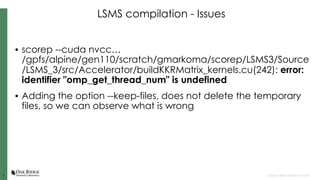
LSMS compilation - Issues
• scorep --cuda nvcc…
/gpfs/alpine/gen110/scratch/gmarkoma/scorep/LSMS3/Source
/LSMS_3/src/Accelerator/buildKKRMatrix_kernels.cu(242): error:
identifier "omp_get_thread_num" is undefined
• Adding the option --keep-files, does not delete the temporary
files, so we can observe what is wrong
44 Open slide master to edit
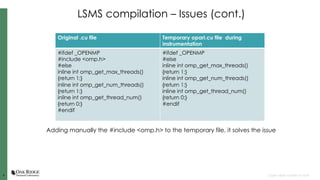
LSMS compilation – Issues (cont.)
Original .cu file Temporary opari.cu file during
instrumentation
#ifdef _OPENMP
#include <omp.h>
#else
inline int omp_get_max_threads()
{return 1;}
inline int omp_get_num_threads()
{return 1;}
inline int omp_get_thread_num()
{return 0;}
#endif
#ifdef _OPENMP
#else
inline int omp_get_max_threads()
{return 1;}
inline int omp_get_num_threads()
{return 1;}
inline int omp_get_thread_num()
{return 0;}
#endif
Adding manually the #include <omp.h> to the temporary file, it solves the issue
55 Open slide master to edit
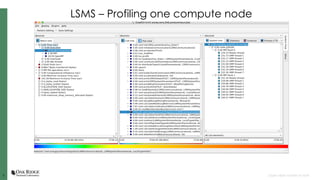
LSMS – Profiling one compute node
66 Open slide master to edit
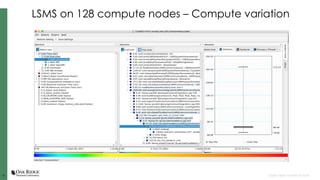
LSMS on 128 compute nodes – Compute variation
77 Open slide master to edit
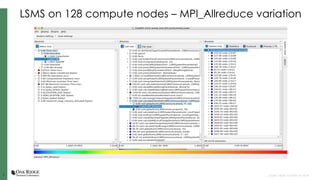
LSMS on 128 compute nodes – MPI_Allreduce variation
88 Open slide master to edit
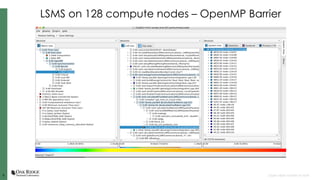
LSMS on 128 compute nodes – OpenMP Barrier
99 Open slide master to edit
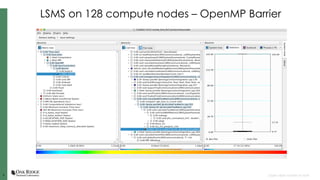
LSMS on 128 compute nodes – OpenMP Barrier
1010 Open slide master to edit
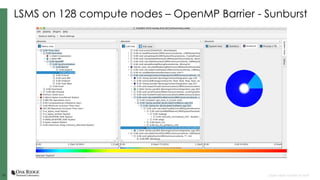
LSMS on 128 compute nodes – OpenMP Barrier - Sunburst
1111 Open slide master to edit
LSMS – Buffer for tracing
• scalasca -examine -s /gpfs/alpine/…/scorep_lsms_Ox8_sum/
INFO: Score report written to /gpfs/…/scorep_lsms_Ox8_sum/scorep.score
vim /gpfs/…/scorep_lsms_Ox8_sum/scorep.score
Estimated aggregate size of event trace: 24TB
Estimated requirements for largest trace buffer (max_buf): 36GB
Estimated memory requirements (SCOREP_TOTAL_MEMORY): 36GB
(warning: The memory requirements cannot be satisfied by Score-P to avoid intermediate flushes when tracing. Set SCOREP_TOTAL_MEMORY=4G to get the maximum
supported memory or reduce requirements using USR regions filters.)
flt type max_buf[B] visits time[s] time[%] time/visit[us] region
ALL 37,758,243,091 2,906,934,475 3738.13 100.0 1.29 ALL
USR 37,757,438,730 2,906,899,463 3714.45 99.4 1.28 USR
OMP 757,272 32,688 18.59 0.5 568.66 OMP
MPI 29,168 932 2.58 0.1 2772.73 MPI
COM 17,880 1,390 2.50 0.1 1798.55 COM
SCOREP 41 2 0.00 0.0 242.20 SCOREP
USR 22,486,328,384 1,729,717,541 260.77 7.0 0.15 dfv_m
USR 9,921,071,888 763,159,376 126.99 3.4 0.17 fit
USR 1,064,960,000 81,920,000 343.03 9.2 4.19 void bulirsch_stoer_integrator
USR 846,102,582 65,083,854 19.65 0.5 0.30 void plm_normalized_(int*, double*, double*)
1212 Open slide master to edit
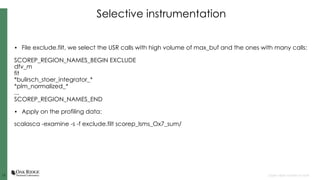
Selective instrumentation
• File exclude.filt, we select the USR calls with high volume of max_buf and the ones with many calls:
SCOREP_REGION_NAMES_BEGIN EXCLUDE
dfv_m
fit
*bulirsch_stoer_integrator_*
*plm_normalized_*
...
SCOREP_REGION_NAMES_END
• Apply on the profiling data:
scalasca -examine -s -f exclude.filt scorep_lsms_Ox7_sum/
1313 Open slide master to edit
Selective instrumentation (cont.)
• vim scorep_lsms_Ox7_sum/scorep.score_exclude.filt
Estimated aggregate size of event trace: 3100MB
Estimated requirements for largest trace buffer (max_buf): 6MB
Estimated memory requirements (SCOREP_TOTAL_MEMORY): 20MB
(hint: When tracing set SCOREP_TOTAL_MEMORY=20MB to avoid intermediate flushes or reduce requirements using USR regions filters.)
flt type max_buf[B] visits time[s] time[%] time/visit[us] region
- ALL 37,768,557,978 997,234,022,247 1508955.54 100.0 1.51 ALL
- USR 37,767,383,966 997,216,546,439 1237070.04 82.0 1.24 USR
- MPI 1,160,452 5,948,480 139997.90 9.3 23535.07 MPI
- OMP 662,613 10,983,168 129188.73 8.6 11762.43 OMP
- COM 302,424 543,392 2698.66 0.2 4966.33 COM
- SCOREP 41 768 0.21 0.0 270.75 SCOREP
* ALL 5,851,181 108,920,629 1061962.47 70.4 9749.87 ALL-FLT
+ FLT 37,763,922,579 997,125,101,618 446993.07 29.6 0.45 FLT
* USR 3,725,651 91,444,821 790076.96 52.4 8639.93 USR-FLT
- MPI 1,160,452 5,948,480 139997.90 9.3 23535.07 MPI-FLT
- OMP 662,613 10,983,168 129188.73 8.6 11762.43 OMP-FLT
* COM 302,424 543,392 2698.66 0.2 4966.33 COM-FLT
- SCOREP 41 768 0.21 0.0 270.75 SCOREP-FLT
Execute: scalasca -analyze -q -t -f /full_path/exclude.filt jsrun …
1414 Open slide master to edit
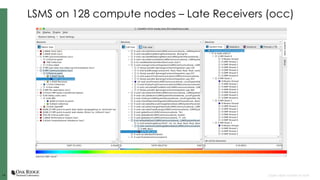
LSMS on 128 compute nodes – Late Receivers (occ)
1515 Open slide master to edit
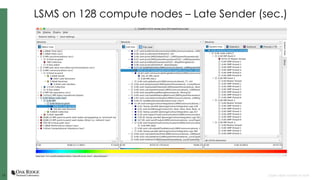
LSMS on 128 compute nodes – Late Sender (sec.)
1616 Open slide master to edit
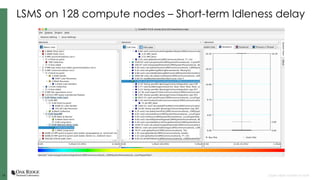
LSMS on 128 compute nodes – Short-term Idleness delay
1717 Open slide master to edit
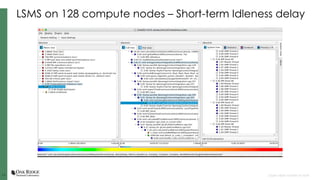
LSMS on 128 compute nodes – Short-term Idleness delay
1818 Open slide master to edit
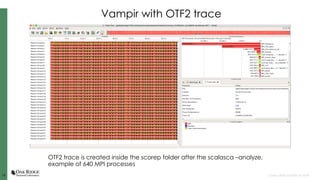
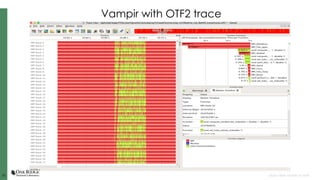
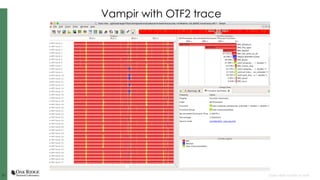
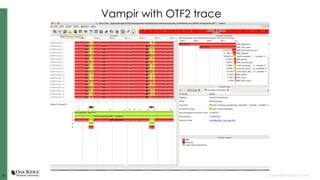
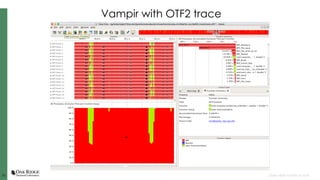
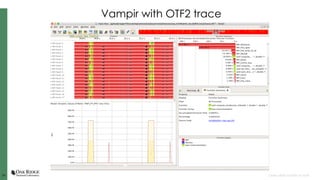
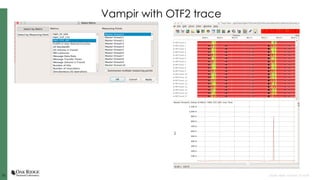
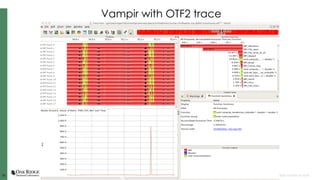
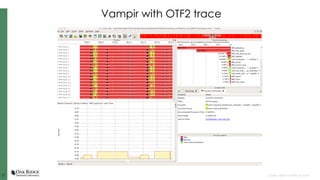
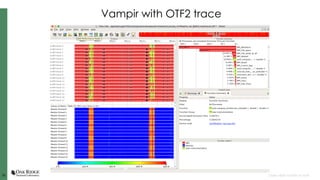
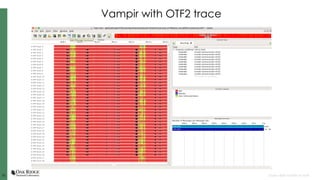
Vampir with OTF2 trace
OTF2 trace is created inside the scorep folder after the scalasca –analyze,
example of 640 MPI processes
1919 Open slide master to edit
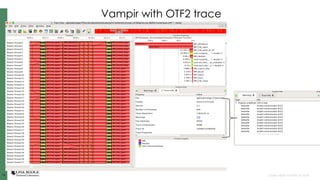
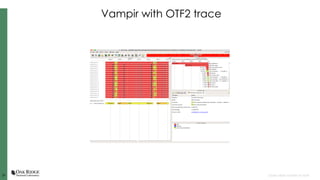
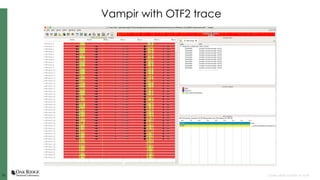
Vampir with OTF2 trace
2020 Open slide master to edit
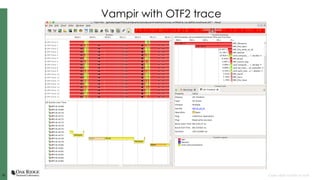
Vampir with OTF2 trace
2121 Open slide master to edit
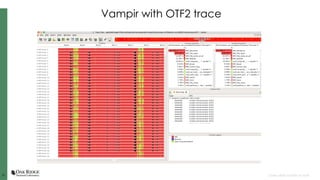
Vampir with OTF2 trace
2222 Open slide master to edit
Vampir with OTF2 trace
2323 Open slide master to edit
Vampir with OTF2 trace
2424 Open slide master to edit
Vampir with OTF2 trace
2525 Open slide master to edit
Vampir with OTF2 trace
2626 Open slide master to edit
Vampir with OTF2 trace
2727 Open slide master to edit
Vampir with OTF2 trace
2828 Open slide master to edit
Vampir with OTF2 trace
2929 Open slide master to edit
Vampir with OTF2 trace
3030 Open slide master to edit
Vampir with OTF2 trace
3131 Open slide master to edit
Vampir with OTF2 trace
3232 Open slide master to edit
Vampir with OTF2 trace
3333 Open slide master to edit
Vampir with OTF2 trace
3434 Open slide master to edit
Vampir with OTF2 trace
3535 Open slide master to edit
Vampir with OTF2 trace
3636 Open slide master to edit
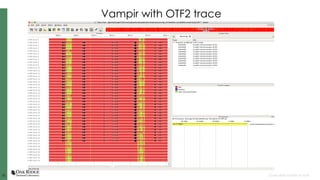
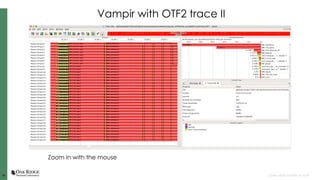
Vampir with OTF2 trace II
Zoom in with the mouse
3737 Open slide master to edit
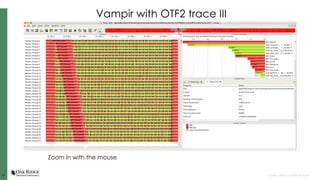
Vampir with OTF2 trace III
Zoom in with the mouse
3838 Open slide master to edit
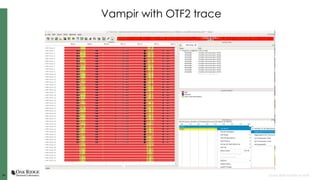
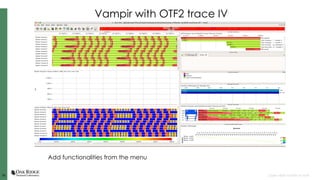
Vampir with OTF2 trace IV
Add functionalities from the menu
3939 Open slide master to edit
Conclusions
• Scalasca can identify bottlenecks based on some patterns
• Useful for MPI and OpenMP
• It can not provide useful information about GPUs but the
information exists inside the traces
• It can create OTF2 trace files and use Vampir to visualize

Performance Analysis with Scalasca, part II

  • 1.
    ORNL is managedby UT-Battelle, LLC for the US Department of Energy Performance Analysis with Scalasca part II George S. Markomanolis 8 August 2019
  • 2.
    22 Open slidemaster to edit MiniWeather MPI+OpenACC • Compilations • MPI+OpenACC: make PREP="scorep --mpp=mpi --openacc – pdt" openacc • Cube4 does not show OpenACC information
  • 3.
    33 Open slidemaster to edit LSMS compilation - Issues • scorep --cuda nvcc… /gpfs/alpine/gen110/scratch/gmarkoma/scorep/LSMS3/Source /LSMS_3/src/Accelerator/buildKKRMatrix_kernels.cu(242): error: identifier "omp_get_thread_num" is undefined • Adding the option --keep-files, does not delete the temporary files, so we can observe what is wrong
  • 4.
    44 Open slidemaster to edit LSMS compilation – Issues (cont.) Original .cu file Temporary opari.cu file during instrumentation #ifdef _OPENMP #include <omp.h> #else inline int omp_get_max_threads() {return 1;} inline int omp_get_num_threads() {return 1;} inline int omp_get_thread_num() {return 0;} #endif #ifdef _OPENMP #else inline int omp_get_max_threads() {return 1;} inline int omp_get_num_threads() {return 1;} inline int omp_get_thread_num() {return 0;} #endif Adding manually the #include <omp.h> to the temporary file, it solves the issue
  • 5.
    55 Open slidemaster to edit LSMS – Profiling one compute node
  • 6.
    66 Open slidemaster to edit LSMS on 128 compute nodes – Compute variation
  • 7.
    77 Open slidemaster to edit LSMS on 128 compute nodes – MPI_Allreduce variation
  • 8.
    88 Open slidemaster to edit LSMS on 128 compute nodes – OpenMP Barrier
  • 9.
    99 Open slidemaster to edit LSMS on 128 compute nodes – OpenMP Barrier
  • 10.
    1010 Open slidemaster to edit LSMS on 128 compute nodes – OpenMP Barrier - Sunburst
  • 11.
    1111 Open slidemaster to edit LSMS – Buffer for tracing • scalasca -examine -s /gpfs/alpine/…/scorep_lsms_Ox8_sum/ INFO: Score report written to /gpfs/…/scorep_lsms_Ox8_sum/scorep.score vim /gpfs/…/scorep_lsms_Ox8_sum/scorep.score Estimated aggregate size of event trace: 24TB Estimated requirements for largest trace buffer (max_buf): 36GB Estimated memory requirements (SCOREP_TOTAL_MEMORY): 36GB (warning: The memory requirements cannot be satisfied by Score-P to avoid intermediate flushes when tracing. Set SCOREP_TOTAL_MEMORY=4G to get the maximum supported memory or reduce requirements using USR regions filters.) flt type max_buf[B] visits time[s] time[%] time/visit[us] region ALL 37,758,243,091 2,906,934,475 3738.13 100.0 1.29 ALL USR 37,757,438,730 2,906,899,463 3714.45 99.4 1.28 USR OMP 757,272 32,688 18.59 0.5 568.66 OMP MPI 29,168 932 2.58 0.1 2772.73 MPI COM 17,880 1,390 2.50 0.1 1798.55 COM SCOREP 41 2 0.00 0.0 242.20 SCOREP USR 22,486,328,384 1,729,717,541 260.77 7.0 0.15 dfv_m USR 9,921,071,888 763,159,376 126.99 3.4 0.17 fit USR 1,064,960,000 81,920,000 343.03 9.2 4.19 void bulirsch_stoer_integrator USR 846,102,582 65,083,854 19.65 0.5 0.30 void plm_normalized_(int*, double*, double*)
  • 12.
    1212 Open slidemaster to edit Selective instrumentation • File exclude.filt, we select the USR calls with high volume of max_buf and the ones with many calls: SCOREP_REGION_NAMES_BEGIN EXCLUDE dfv_m fit *bulirsch_stoer_integrator_* *plm_normalized_* ... SCOREP_REGION_NAMES_END • Apply on the profiling data: scalasca -examine -s -f exclude.filt scorep_lsms_Ox7_sum/
  • 13.
    1313 Open slidemaster to edit Selective instrumentation (cont.) • vim scorep_lsms_Ox7_sum/scorep.score_exclude.filt Estimated aggregate size of event trace: 3100MB Estimated requirements for largest trace buffer (max_buf): 6MB Estimated memory requirements (SCOREP_TOTAL_MEMORY): 20MB (hint: When tracing set SCOREP_TOTAL_MEMORY=20MB to avoid intermediate flushes or reduce requirements using USR regions filters.) flt type max_buf[B] visits time[s] time[%] time/visit[us] region - ALL 37,768,557,978 997,234,022,247 1508955.54 100.0 1.51 ALL - USR 37,767,383,966 997,216,546,439 1237070.04 82.0 1.24 USR - MPI 1,160,452 5,948,480 139997.90 9.3 23535.07 MPI - OMP 662,613 10,983,168 129188.73 8.6 11762.43 OMP - COM 302,424 543,392 2698.66 0.2 4966.33 COM - SCOREP 41 768 0.21 0.0 270.75 SCOREP * ALL 5,851,181 108,920,629 1061962.47 70.4 9749.87 ALL-FLT + FLT 37,763,922,579 997,125,101,618 446993.07 29.6 0.45 FLT * USR 3,725,651 91,444,821 790076.96 52.4 8639.93 USR-FLT - MPI 1,160,452 5,948,480 139997.90 9.3 23535.07 MPI-FLT - OMP 662,613 10,983,168 129188.73 8.6 11762.43 OMP-FLT * COM 302,424 543,392 2698.66 0.2 4966.33 COM-FLT - SCOREP 41 768 0.21 0.0 270.75 SCOREP-FLT Execute: scalasca -analyze -q -t -f /full_path/exclude.filt jsrun …
  • 14.
    1414 Open slidemaster to edit LSMS on 128 compute nodes – Late Receivers (occ)
  • 15.
    1515 Open slidemaster to edit LSMS on 128 compute nodes – Late Sender (sec.)
  • 16.
    1616 Open slidemaster to edit LSMS on 128 compute nodes – Short-term Idleness delay
  • 17.
    1717 Open slidemaster to edit LSMS on 128 compute nodes – Short-term Idleness delay
  • 18.
    1818 Open slidemaster to edit Vampir with OTF2 trace OTF2 trace is created inside the scorep folder after the scalasca –analyze, example of 640 MPI processes
  • 19.
    1919 Open slidemaster to edit Vampir with OTF2 trace
  • 20.
    2020 Open slidemaster to edit Vampir with OTF2 trace
  • 21.
    2121 Open slidemaster to edit Vampir with OTF2 trace
  • 22.
    2222 Open slidemaster to edit Vampir with OTF2 trace
  • 23.
    2323 Open slidemaster to edit Vampir with OTF2 trace
  • 24.
    2424 Open slidemaster to edit Vampir with OTF2 trace
  • 25.
    2525 Open slidemaster to edit Vampir with OTF2 trace
  • 26.
    2626 Open slidemaster to edit Vampir with OTF2 trace
  • 27.
    2727 Open slidemaster to edit Vampir with OTF2 trace
  • 28.
    2828 Open slidemaster to edit Vampir with OTF2 trace
  • 29.
    2929 Open slidemaster to edit Vampir with OTF2 trace
  • 30.
    3030 Open slidemaster to edit Vampir with OTF2 trace
  • 31.
    3131 Open slidemaster to edit Vampir with OTF2 trace
  • 32.
    3232 Open slidemaster to edit Vampir with OTF2 trace
  • 33.
    3333 Open slidemaster to edit Vampir with OTF2 trace
  • 34.
    3434 Open slidemaster to edit Vampir with OTF2 trace
  • 35.
    3535 Open slidemaster to edit Vampir with OTF2 trace
  • 36.
    3636 Open slidemaster to edit Vampir with OTF2 trace II Zoom in with the mouse
  • 37.
    3737 Open slidemaster to edit Vampir with OTF2 trace III Zoom in with the mouse
  • 38.
    3838 Open slidemaster to edit Vampir with OTF2 trace IV Add functionalities from the menu
  • 39.
    3939 Open slidemaster to edit Conclusions • Scalasca can identify bottlenecks based on some patterns • Useful for MPI and OpenMP • It can not provide useful information about GPUs but the information exists inside the traces • It can create OTF2 trace files and use Vampir to visualize