Increasing	
  Infrastructure	
  Ef/iciency	
  via	
  Optimized	
  
NFV	
  Placement	
  in	
  OpenStack	
  Clouds	
  
Yathiraj	
  Udupi,	
  Debo	
  Dutta	
  –	
  Cisco	
  
Ram	
  (Ramki)	
  Krishnan	
  -­‐	
  Brocade	


OpenStack	
  Atlanta	
  Summit,	
  	
  May	
  2014	
  
Who and why?
Debo/Yathi	
  -­‐	
  Cisco	
  Cloud	
  CTO	
  ofLice	
  
Ramki	
  -­‐	
  Brocade	
  CTO	
  ofLice	
  
Goal:	
  Drive	
  Innovative	
  Open	
  Source	
  solutions	
  
for	
  NFV	
  with	
  OpenStack	
  
Our Thesis
•  Toby	
  Ford@AT&T’s	
  NFV	
  talk	
  on	
  Tue,	
  May	
  13th	
  
•  Worlds	
  of	
  IT	
  and	
  Telco	
  are	
  coming	
  together	
  	
  
•  Telco	
  Cloud	
  -­‐	
  OpenStack	
  as	
  the	
  infrastructure	
  foundation	
  
•  Goal:	
  Transform	
  OpenStack	
  to	
  a	
  Carrier-­‐grade	
  
cloud	
  solution	
  	
  
•  We	
  deep	
  dive	
  into	
  some	
  high-­‐level	
  gaps	
  Toby	
  identiLied	
  
•  We	
  demo	
  some	
  initial	
  progress	
  
Agenda	
  
•  NFV	
  Summary	
  
•  Cloud	
  NFV	
  Use	
  Case	
  
•  Drive	
  Innovation	
  -­‐	
  EfLicient	
  Resource	
  
Placement	
  Strategies	
  
•  Extensions	
  to	
  OpenStack	
  scheduler	
  
•  Conclusion	
  	
  
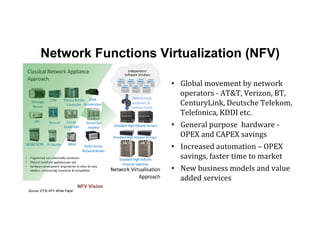
Network Functions Virtualization (NFV)
NFV Vision
Source: ETSI NFV White Paper
•  Global	
  movement	
  by	
  network	
  
operators	
  -­‐	
  AT&T,	
  Verizon,	
  BT,	
  
CenturyLink,	
  Deutsche	
  Telekom,	
  
Telefonica,	
  KDDI	
  etc.	
  
•  General	
  purpose	
  	
  hardware	
  -­‐	
  
OPEX	
  and	
  CAPEX	
  savings	
  
•  Increased	
  automation	
  –	
  OPEX	
  
savings,	
  faster	
  time	
  to	
  market	
  
•  New	
  business	
  models	
  and	
  value	
  
added	
  services
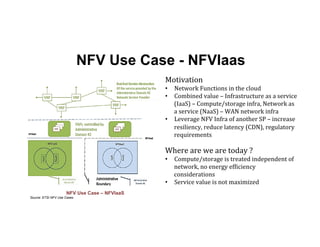
NFV Use Case - NFVIaas
Motivation	
  	
  
•  Network	
  Functions	
  in	
  the	
  cloud	
  
•  Combined	
  value	
  –	
  Infrastructure	
  as	
  a	
  service	
  
(IaaS)	
  –	
  Compute/storage	
  infra,	
  Network	
  as	
  
a	
  service	
  (NaaS)	
  –	
  WAN	
  network	
  infra	
  
•  Leverage	
  NFV	
  Infra	
  of	
  another	
  SP	
  –	
  increase	
  
resiliency,	
  reduce	
  latency	
  (CDN),	
  regulatory	
  
requirements	


Where	
  are	
  we	
  are	
  today	
  ?	
  
•  Compute/storage	
  is	
  treated	
  independent	
  of	
  
network,	
  no	
  energy	
  efLiciency	
  
considerations	
  
•  Service	
  value	
  is	
  not	
  maximized	
  
NFV Use Case – NFVIaaS
Source: ETSI NFV Use Cases
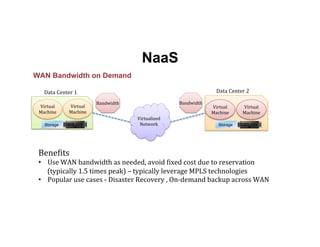
NaaS
Virtualized	
  
Network	
  
Bandwidth	
  Bandwidth	
  
Virtual	
  
Machine	
  
Virtual	
  
Machine	
  
Virtual	
  
Machine	
  
Virtual	
  
Machine	
  
WAN Bandwidth on Demand
Data	
  Center	
  1	
   Data	
  Center	
  2	
  
BeneLits	
  
•  Use	
  WAN	
  bandwidth	
  as	
  needed,	
  avoid	
  Lixed	
  cost	
  due	
  to	
  reservation	
  
(typically	
  1.5	
  times	
  peak)	
  –	
  typically	
  leverage	
  MPLS	
  technologies	
  
•  Popular	
  use	
  cases	
  -­‐	
  Disaster	
  Recovery	
  ,	
  On-­‐demand	
  backup	
  across	
  WAN	
  
StorageStorage
NFVIaas (IaaS+NaaS)
Virtualized	
  
Network	
  
Bandwidth	
  Bandwidth	
  
Virtual	
  
Machine	
  
Virtual	
  
Machine	
  
Virtual	
  
Machine	
  
Virtual	
  
Machine	
  
Data	
  Center	
  1	
   Data	
  Center	
  2	
  
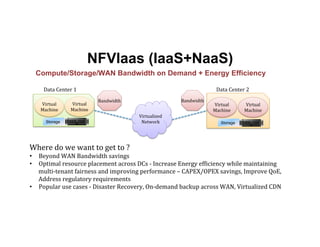
Where	
  do	
  we	
  want	
  to	
  get	
  to	
  ?	
  
•  Beyond	
  WAN	
  Bandwidth	
  savings	
  
•  Optimal	
  resource	
  placement	
  across	
  DCs	
  -­‐	
  Increase	
  Energy	
  efLiciency	
  while	
  maintaining	
  
multi-­‐tenant	
  fairness	
  and	
  improving	
  performance	
  –	
  CAPEX/OPEX	
  savings,	
  Improve	
  QoE,	
  
Address	
  regulatory	
  requirements	
  
•  Popular	
  use	
  cases	
  -­‐	
  Disaster	
  Recovery,	
  On-­‐demand	
  backup	
  across	
  WAN,	
  Virtualized	
  CDN	
  
Compute/Storage/WAN Bandwidth on Demand + Energy Efficiency
Storage Storage
NFVIaas (IaaS+NaaS)
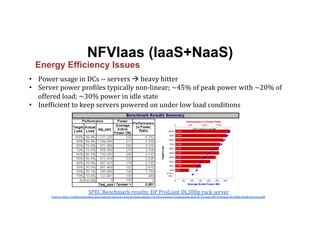
•  Power	
  usage	
  in	
  DCs	
  -­‐-­‐	
  servers	
  à	
  heavy	
  hitter	
  
•  Server	
  power	
  proLiles	
  typically	
  non-­‐linear;	
  ~45%	
  of	
  peak	
  power	
  with	
  ~20%	
  of	
  
offered	
  load;	
  ~30%	
  power	
  in	
  idle	
  state	
  
•  InefLicient	
  to	
  keep	
  servers	
  powered	
  on	
  under	
  low	
  load	
  conditions	
  
Energy Efficiency Issues
SPEC	
  Benchmark	
  results:	
  HP	
  ProLiant	
  DL380p	
  rack	
  server	
  
Source:	
  http://i.dell.com/sites/doccontent/shared-­‐content/data-­‐sheets/en/Documents/Comparing-­‐Dell-­‐R720-­‐and-­‐HP-­‐Proliant-­‐DL380p-­‐Gen8-­‐Servers.pdf	
  
NFV – Huge opportunity for Openstack
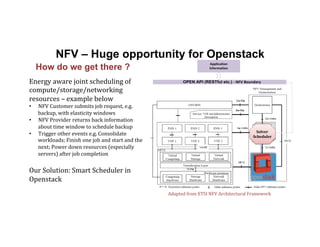
Energy	
  aware	
  joint	
  scheduling	
  of	
  
compute/storage/networking	
  
resources	
  –	
  example	
  below	
  
•  NFV	
  Customer	
  submits	
  job	
  request,	
  e.g.	
  
backup,	
  with	
  elasticity	
  windows	
  
•  NFV	
  Provider	
  returns	
  back	
  information	
  
about	
  time	
  window	
  to	
  schedule	
  backup	
  
•  Trigger	
  other	
  events	
  e.g.	
  Consolidate	
  
workloads;	
  Finish	
  one	
  job	
  and	
  start	
  and	
  the	
  
next;	
  Power	
  down	
  resources	
  (especially	
  
servers)	
  after	
  job	
  completion	


Our	
  Solution:	
  Smart	
  Scheduler	
  in	
  
Openstack	
  
How do we get there ?
Solver	
  	
  
Scheduler	
  
Adapted	
  from	
  ETSI	
  NFV	
  Architectural	
  Framework	
  
Users:
Minimize costs… (Energy &
Network Efficiency)
Maximize Performance...
Infrastructure:
State (BigData?)
(Storage/Network/Compute
state, Energy Profiles, Policy/
constraints etc.)
Smart Scheduling in
Smart Scheduling in OpenStack for Optimized
NFV Resource Placements
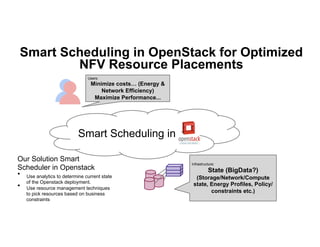
Our Solution Smart
Scheduler in Openstack
•  Use analytics to determine current state
of the Openstack deployment.
•  Use resource management techniques
to pick resources based on business
constraints
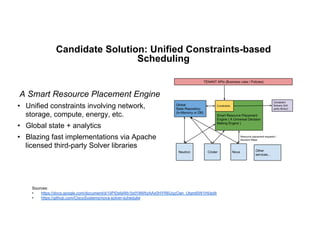
Candidate Solution: Unified Constraints-based
Scheduling
A Smart Resource Placement Engine
•  Unified constraints involving network,
storage, compute, energy, etc.
•  Global state + analytics
•  Blazing fast implementations via Apache
licensed third-party Solver libraries
Sources:
•  https://docs.google.com/document/d/1IiPI0sfaWb1bdYiMWzAAx0HYR6UqzOan_Utgml5W1HI/edit
•  https://github.com/CiscoSystems/nova-solver-scheduler
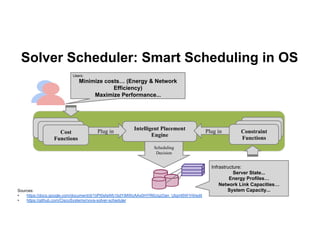
Solver Scheduler: Smart Scheduling in OS
Intelligent Placement
Engine
Plug in Plug in
Scheduling
Decision
Cost
Functions
Constraint
Functions
Users:
Minimize costs… (Energy & Network
Efficiency)
Maximize Performance...
Infrastructure:
Server State...
Energy Profiles…
Network Link Capacities…
System Capacity...Sources:
•  https://docs.google.com/document/d/1IiPI0sfaWb1bdYiMWzAAx0HYR6UqzOan_Utgml5W1HI/edit
•  https://github.com/CiscoSystems/nova-solver-scheduler
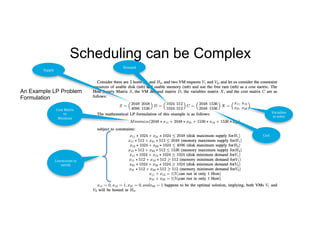
An Example LP Problem
Formulation
Supply	
  
Demand	
  
Cost	
  Metric	
  
to	
  	
  
Minimize	
  
Constraints	
  to	
  
satisfy	
  
Cost	
  
Variables	
  
to	
  solve	
  
Scheduling can be Complex
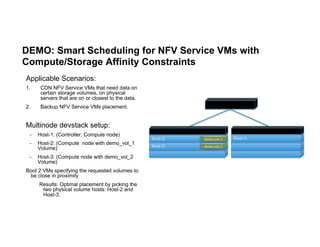
DEMO: Smart Scheduling for NFV Service VMs with
Compute/Storage Affinity Constraints
Applicable Scenarios:
1.  CDN NFV Service VMs that need data on
certain storage volumes, on physical
servers that are on or closest to the data.
2.  Backup NFV Service VMs placement.
Multinode devstack setup:
-  Host-1: (Controller, Compute node)
-  Host-2: (Compute node with demo_vol_1
Volume)
-  Host-3: (Compute node with demo_vol_2
Volume)
Boot 2 VMs specifying the requested volumes to
be close in proximity
Results: Optimal placement by picking the
two physical volume hosts: Host-2 and
Host-3.
Host-­‐3:	
  	
  
Host-­‐2:	
  	
   Host-­‐1:	
  demo_vol_1	
  
demo_vol_2	
  
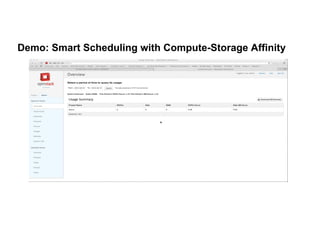
Demo: Smart Scheduling with Compute-Storage Affinity
Conclusion	
  
•  NFV	
  Value	
  Proposition	
  
•  NVF	
  is	
  a	
  killer	
  use-­‐case	
  for	
  Openstack	
  	
  
•  Call	
  for	
  community	
  action	
  
•  Scheduler	
  Gap	
  and	
  a	
  candidate	
  solution	
  [e.g.	
  SolverScheduler,	
  blueprint	
  exists,	
  
code	
  pushed	
  for	
  review	
  in	
  Icehouse]	
  
•  Cross-­‐Scheduler	
  API	
  w.	
  constraints	
  [e.g.	
  augment	
  server-­‐groups	
  API	
  released	
  in	
  
Icehouse]	
  
•  Neutron	
  hooks	
  for	
  Virtual	
  Network	
  Services	
  (and	
  API)	


Optimized placement in Openstack for NFV

  • 1.
    Increasing  Infrastructure  Ef/iciency  via  Optimized   NFV  Placement  in  OpenStack  Clouds   Yathiraj  Udupi,  Debo  Dutta  –  Cisco   Ram  (Ramki)  Krishnan  -­‐  Brocade     OpenStack  Atlanta  Summit,    May  2014  
  • 2.
    Who and why? Debo/Yathi  -­‐  Cisco  Cloud  CTO  ofLice   Ramki  -­‐  Brocade  CTO  ofLice   Goal:  Drive  Innovative  Open  Source  solutions   for  NFV  with  OpenStack  
  • 3.
    Our Thesis •  Toby  Ford@AT&T’s  NFV  talk  on  Tue,  May  13th   •  Worlds  of  IT  and  Telco  are  coming  together     •  Telco  Cloud  -­‐  OpenStack  as  the  infrastructure  foundation   •  Goal:  Transform  OpenStack  to  a  Carrier-­‐grade   cloud  solution     •  We  deep  dive  into  some  high-­‐level  gaps  Toby  identiLied   •  We  demo  some  initial  progress  
  • 4.
    Agenda   •  NFV  Summary   •  Cloud  NFV  Use  Case   •  Drive  Innovation  -­‐  EfLicient  Resource   Placement  Strategies   •  Extensions  to  OpenStack  scheduler   •  Conclusion    
  • 5.
    Network Functions Virtualization(NFV) NFV Vision Source: ETSI NFV White Paper •  Global  movement  by  network   operators  -­‐  AT&T,  Verizon,  BT,   CenturyLink,  Deutsche  Telekom,   Telefonica,  KDDI  etc.   •  General  purpose    hardware  -­‐   OPEX  and  CAPEX  savings   •  Increased  automation  –  OPEX   savings,  faster  time  to  market   •  New  business  models  and  value   added  services
  • 6.
    NFV Use Case- NFVIaas Motivation     •  Network  Functions  in  the  cloud   •  Combined  value  –  Infrastructure  as  a  service   (IaaS)  –  Compute/storage  infra,  Network  as   a  service  (NaaS)  –  WAN  network  infra   •  Leverage  NFV  Infra  of  another  SP  –  increase   resiliency,  reduce  latency  (CDN),  regulatory   requirements       Where  are  we  are  today  ?   •  Compute/storage  is  treated  independent  of   network,  no  energy  efLiciency   considerations   •  Service  value  is  not  maximized   NFV Use Case – NFVIaaS Source: ETSI NFV Use Cases
  • 7.
    NaaS Virtualized   Network   Bandwidth  Bandwidth   Virtual   Machine   Virtual   Machine   Virtual   Machine   Virtual   Machine   WAN Bandwidth on Demand Data  Center  1   Data  Center  2   BeneLits   •  Use  WAN  bandwidth  as  needed,  avoid  Lixed  cost  due  to  reservation   (typically  1.5  times  peak)  –  typically  leverage  MPLS  technologies   •  Popular  use  cases  -­‐  Disaster  Recovery  ,  On-­‐demand  backup  across  WAN   StorageStorage
  • 8.
    NFVIaas (IaaS+NaaS) Virtualized   Network   Bandwidth  Bandwidth   Virtual   Machine   Virtual   Machine   Virtual   Machine   Virtual   Machine   Data  Center  1   Data  Center  2   Where  do  we  want  to  get  to  ?   •  Beyond  WAN  Bandwidth  savings   •  Optimal  resource  placement  across  DCs  -­‐  Increase  Energy  efLiciency  while  maintaining   multi-­‐tenant  fairness  and  improving  performance  –  CAPEX/OPEX  savings,  Improve  QoE,   Address  regulatory  requirements   •  Popular  use  cases  -­‐  Disaster  Recovery,  On-­‐demand  backup  across  WAN,  Virtualized  CDN   Compute/Storage/WAN Bandwidth on Demand + Energy Efficiency Storage Storage
  • 9.
    NFVIaas (IaaS+NaaS) •  Power  usage  in  DCs  -­‐-­‐  servers  à  heavy  hitter   •  Server  power  proLiles  typically  non-­‐linear;  ~45%  of  peak  power  with  ~20%  of   offered  load;  ~30%  power  in  idle  state   •  InefLicient  to  keep  servers  powered  on  under  low  load  conditions   Energy Efficiency Issues SPEC  Benchmark  results:  HP  ProLiant  DL380p  rack  server   Source:  http://i.dell.com/sites/doccontent/shared-­‐content/data-­‐sheets/en/Documents/Comparing-­‐Dell-­‐R720-­‐and-­‐HP-­‐Proliant-­‐DL380p-­‐Gen8-­‐Servers.pdf  
  • 10.
    NFV – Hugeopportunity for Openstack Energy  aware  joint  scheduling  of   compute/storage/networking   resources  –  example  below   •  NFV  Customer  submits  job  request,  e.g.   backup,  with  elasticity  windows   •  NFV  Provider  returns  back  information   about  time  window  to  schedule  backup   •  Trigger  other  events  e.g.  Consolidate   workloads;  Finish  one  job  and  start  and  the   next;  Power  down  resources  (especially   servers)  after  job  completion       Our  Solution:  Smart  Scheduler  in   Openstack   How do we get there ? Solver     Scheduler   Adapted  from  ETSI  NFV  Architectural  Framework  
  • 11.
    Users: Minimize costs… (Energy& Network Efficiency) Maximize Performance... Infrastructure: State (BigData?) (Storage/Network/Compute state, Energy Profiles, Policy/ constraints etc.) Smart Scheduling in Smart Scheduling in OpenStack for Optimized NFV Resource Placements Our Solution Smart Scheduler in Openstack •  Use analytics to determine current state of the Openstack deployment. •  Use resource management techniques to pick resources based on business constraints
  • 12.
    Candidate Solution: UnifiedConstraints-based Scheduling A Smart Resource Placement Engine •  Unified constraints involving network, storage, compute, energy, etc. •  Global state + analytics •  Blazing fast implementations via Apache licensed third-party Solver libraries Sources: •  https://docs.google.com/document/d/1IiPI0sfaWb1bdYiMWzAAx0HYR6UqzOan_Utgml5W1HI/edit •  https://github.com/CiscoSystems/nova-solver-scheduler
  • 13.
    Solver Scheduler: SmartScheduling in OS Intelligent Placement Engine Plug in Plug in Scheduling Decision Cost Functions Constraint Functions Users: Minimize costs… (Energy & Network Efficiency) Maximize Performance... Infrastructure: Server State... Energy Profiles… Network Link Capacities… System Capacity...Sources: •  https://docs.google.com/document/d/1IiPI0sfaWb1bdYiMWzAAx0HYR6UqzOan_Utgml5W1HI/edit •  https://github.com/CiscoSystems/nova-solver-scheduler
  • 14.
    An Example LPProblem Formulation Supply   Demand   Cost  Metric   to     Minimize   Constraints  to   satisfy   Cost   Variables   to  solve   Scheduling can be Complex
  • 15.
    DEMO: Smart Schedulingfor NFV Service VMs with Compute/Storage Affinity Constraints Applicable Scenarios: 1.  CDN NFV Service VMs that need data on certain storage volumes, on physical servers that are on or closest to the data. 2.  Backup NFV Service VMs placement. Multinode devstack setup: -  Host-1: (Controller, Compute node) -  Host-2: (Compute node with demo_vol_1 Volume) -  Host-3: (Compute node with demo_vol_2 Volume) Boot 2 VMs specifying the requested volumes to be close in proximity Results: Optimal placement by picking the two physical volume hosts: Host-2 and Host-3. Host-­‐3:     Host-­‐2:     Host-­‐1:  demo_vol_1   demo_vol_2  
  • 16.
    Demo: Smart Schedulingwith Compute-Storage Affinity
  • 17.
    Conclusion   •  NFV  Value  Proposition   •  NVF  is  a  killer  use-­‐case  for  Openstack     •  Call  for  community  action   •  Scheduler  Gap  and  a  candidate  solution  [e.g.  SolverScheduler,  blueprint  exists,   code  pushed  for  review  in  Icehouse]   •  Cross-­‐Scheduler  API  w.  constraints  [e.g.  augment  server-­‐groups  API  released  in   Icehouse]   •  Neutron  hooks  for  Virtual  Network  Services  (and  API)