1
Confidential
2
Confidential
Stream data processing at
BigData landscape
3
Confidential
Intro
Meet your speaker today:
Oleksandr Fedirko - CEE Head of Big Data Practice
4
Confidential
High level agenda
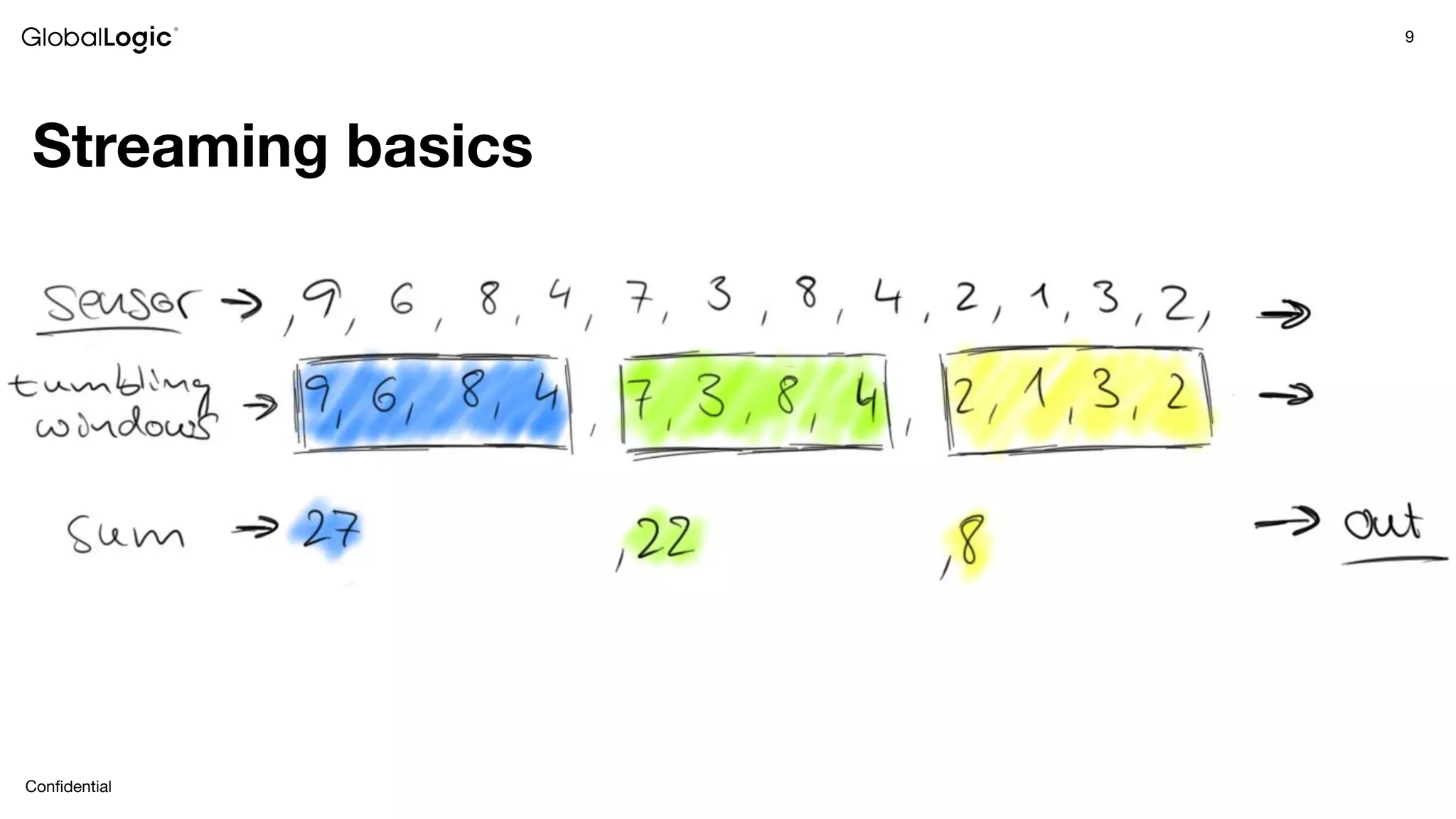
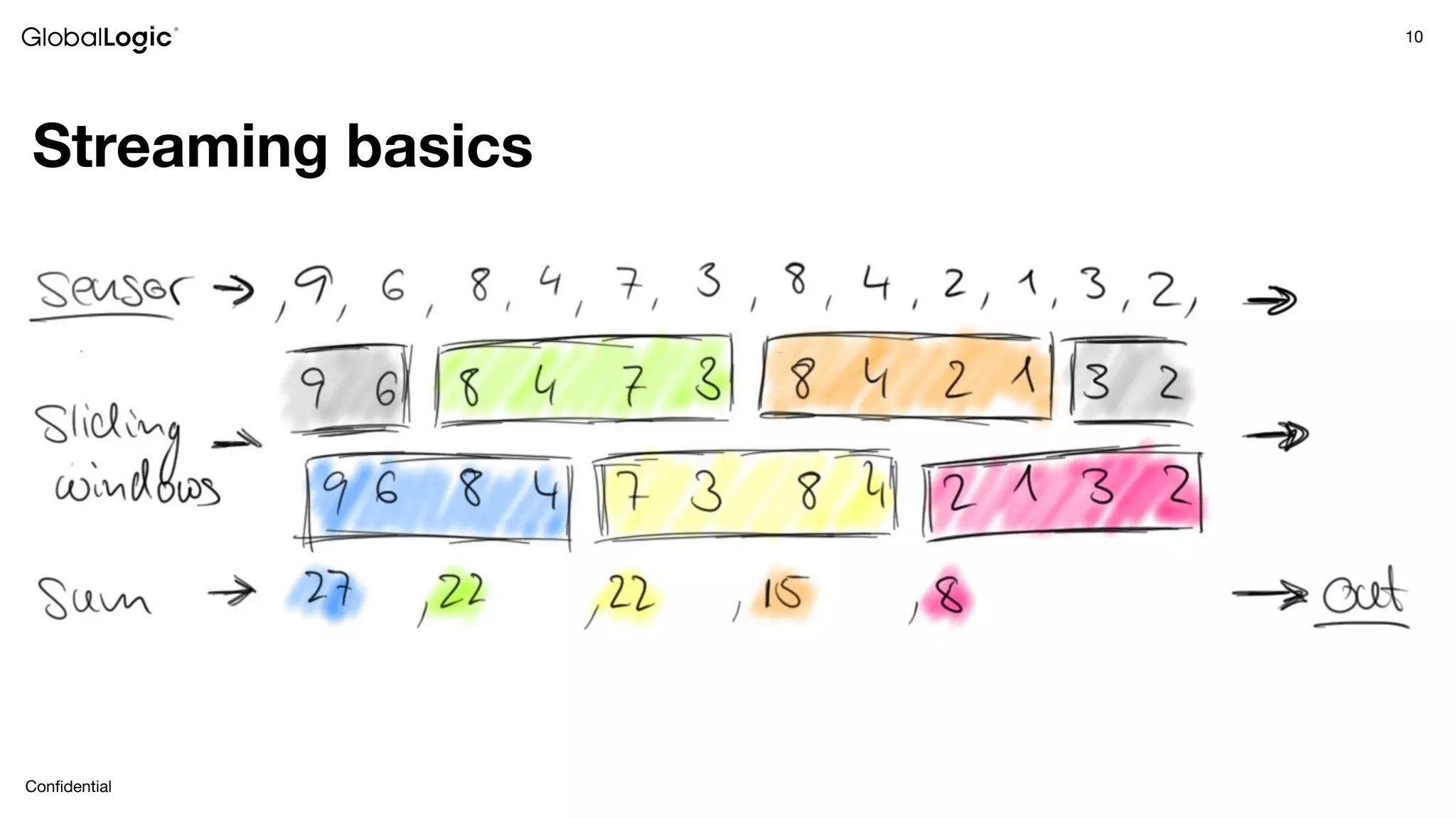
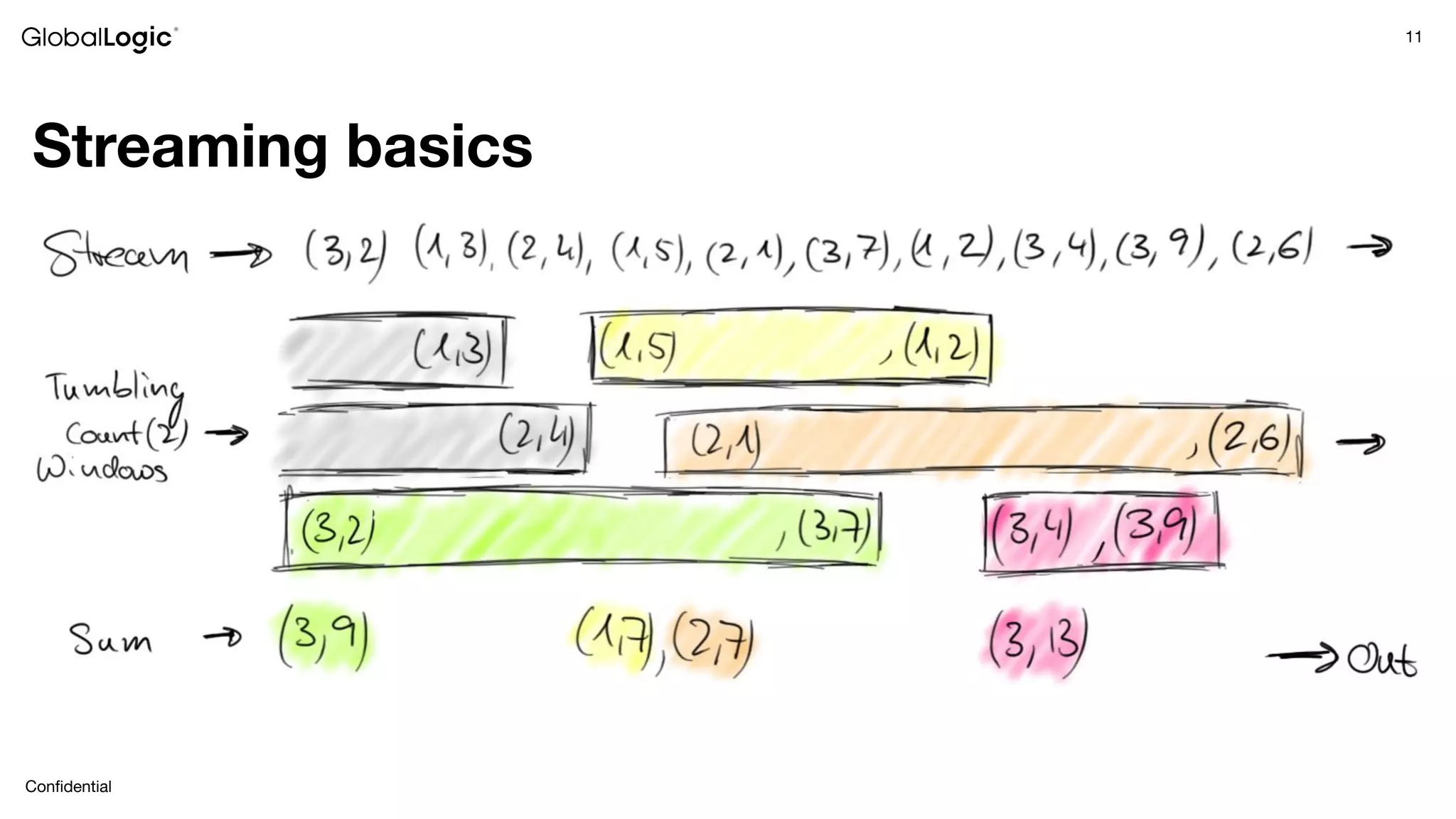
Streaming basics
Types of stream systems
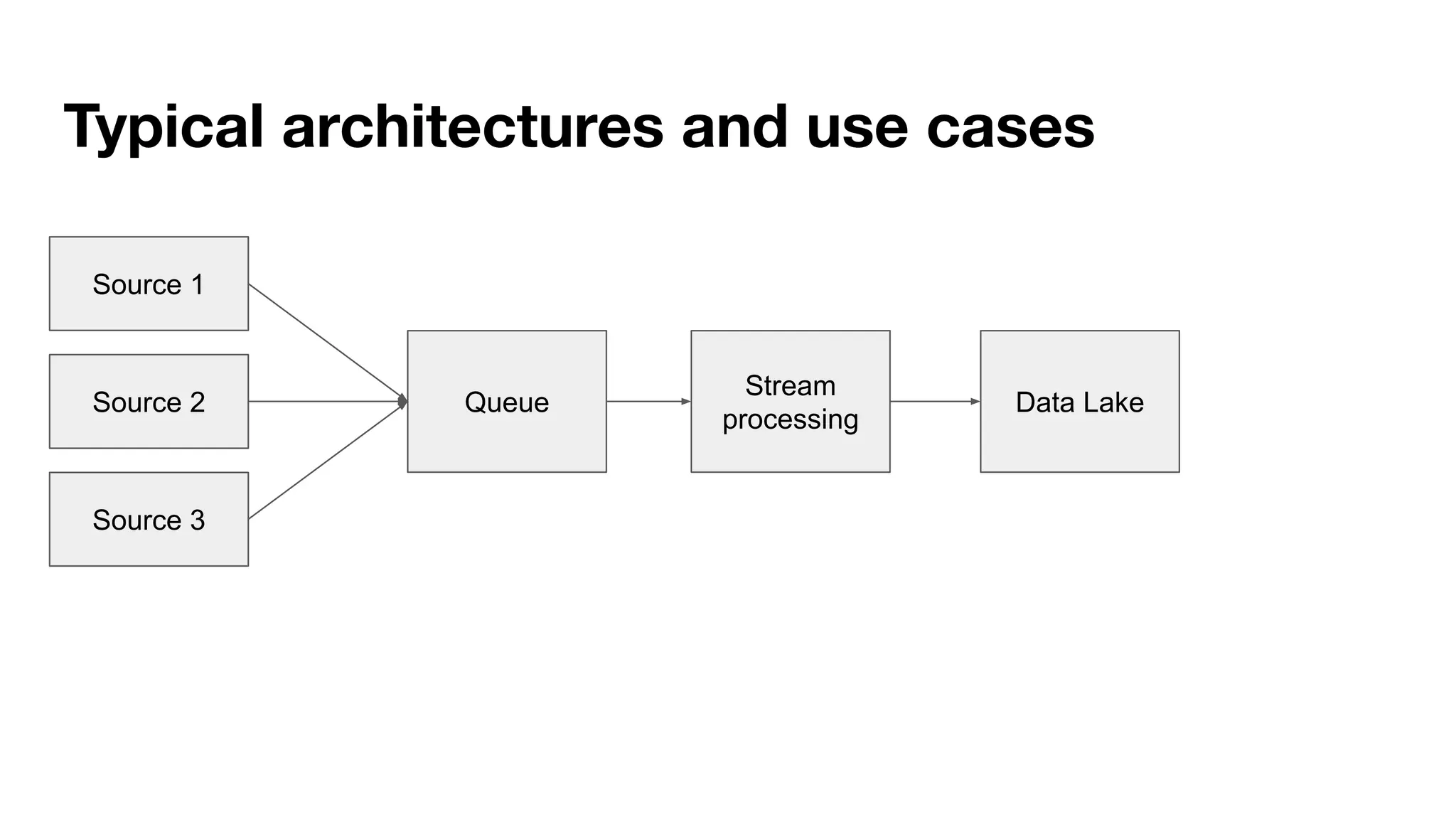
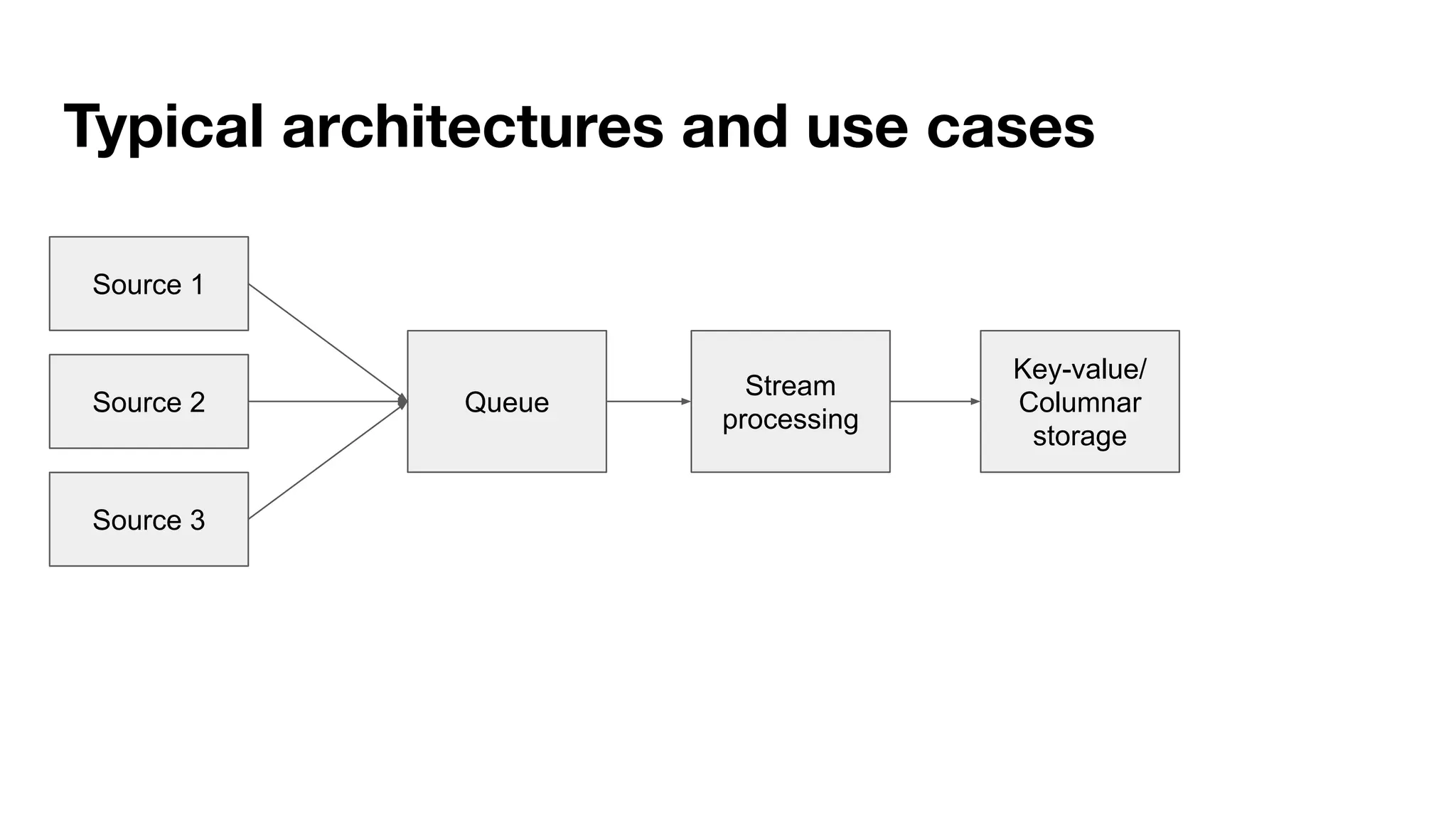
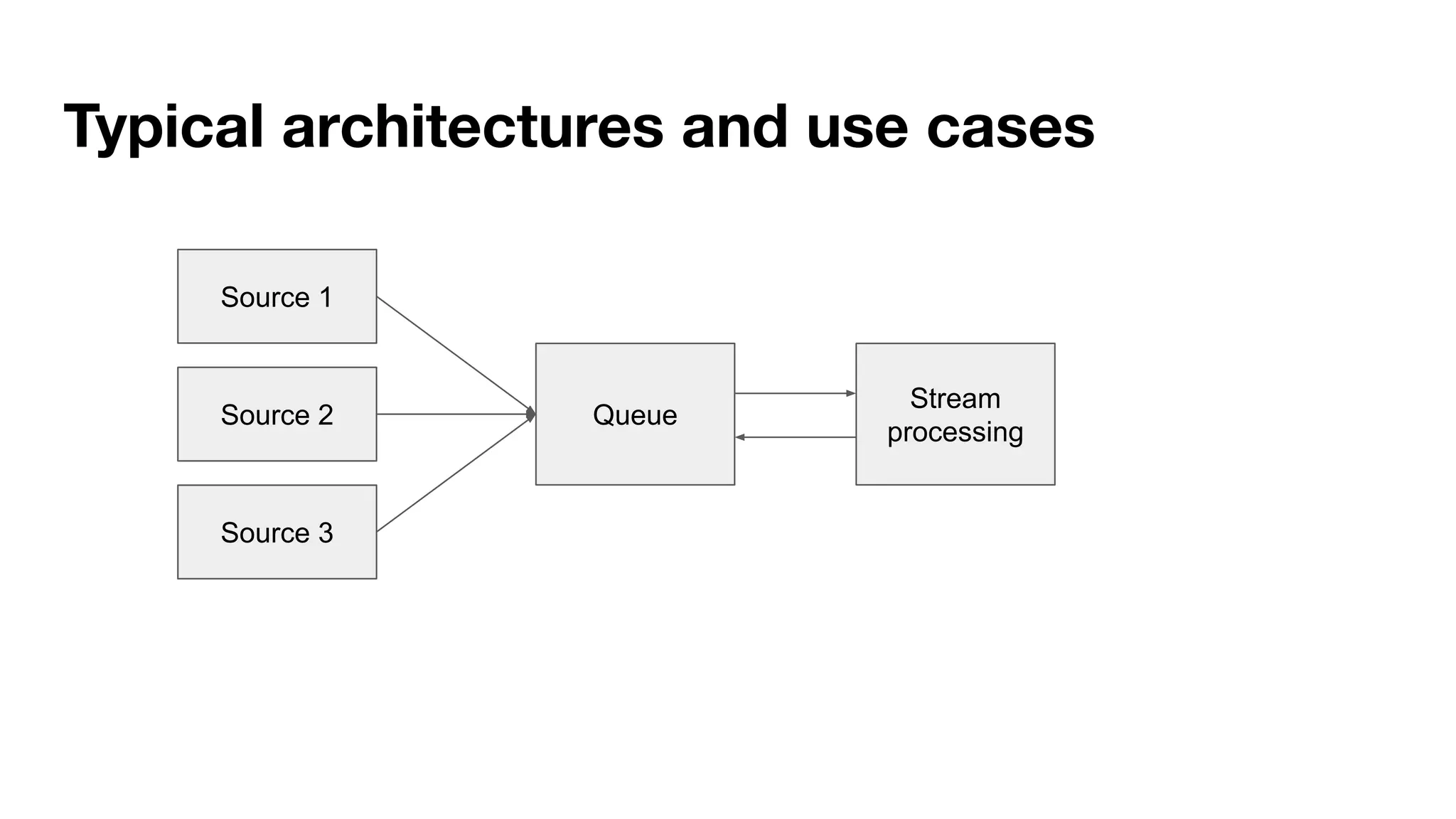
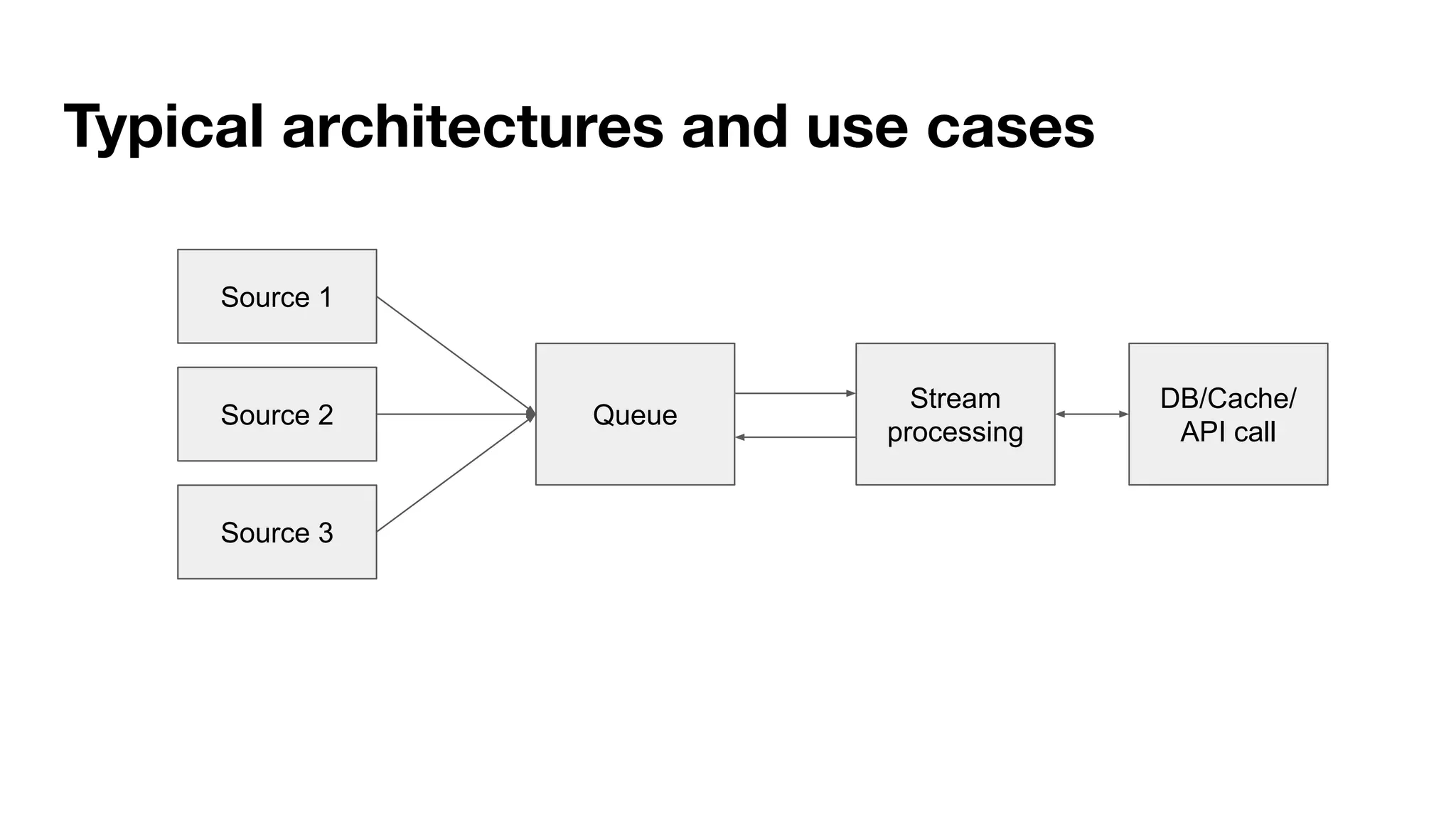
Typical architectures and use cases
Main consideration on a project with Stream processing
Stream processing tools overview
Case study
Q&A session
5
Confidential
5
Streaming basics
6
Confidential
Streaming basics
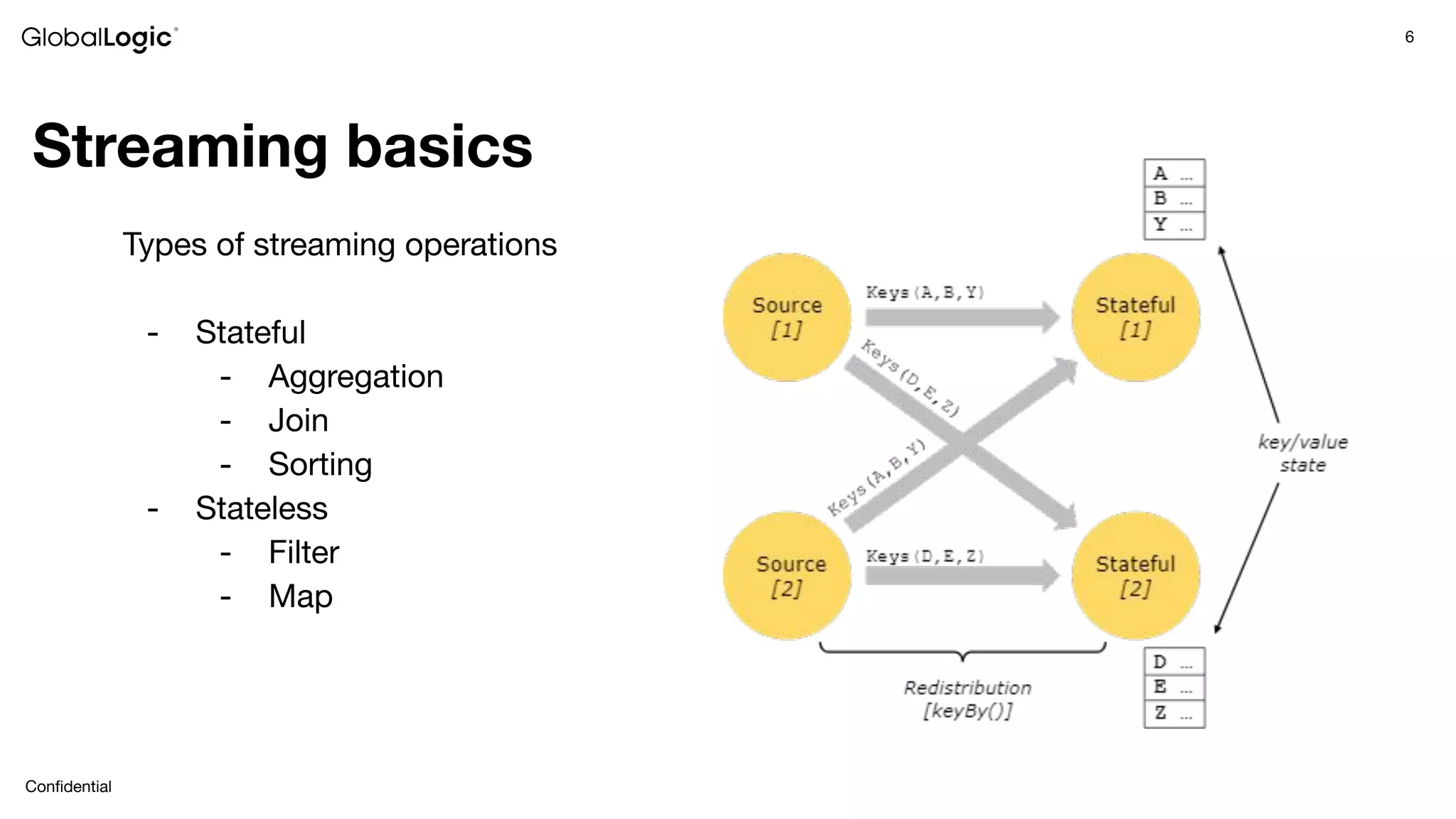
Types of streaming operations
- Stateful
- Aggregation
- Join
- Sorting
- Stateless
- Filter
- Map
7
Confidential
Streaming basics
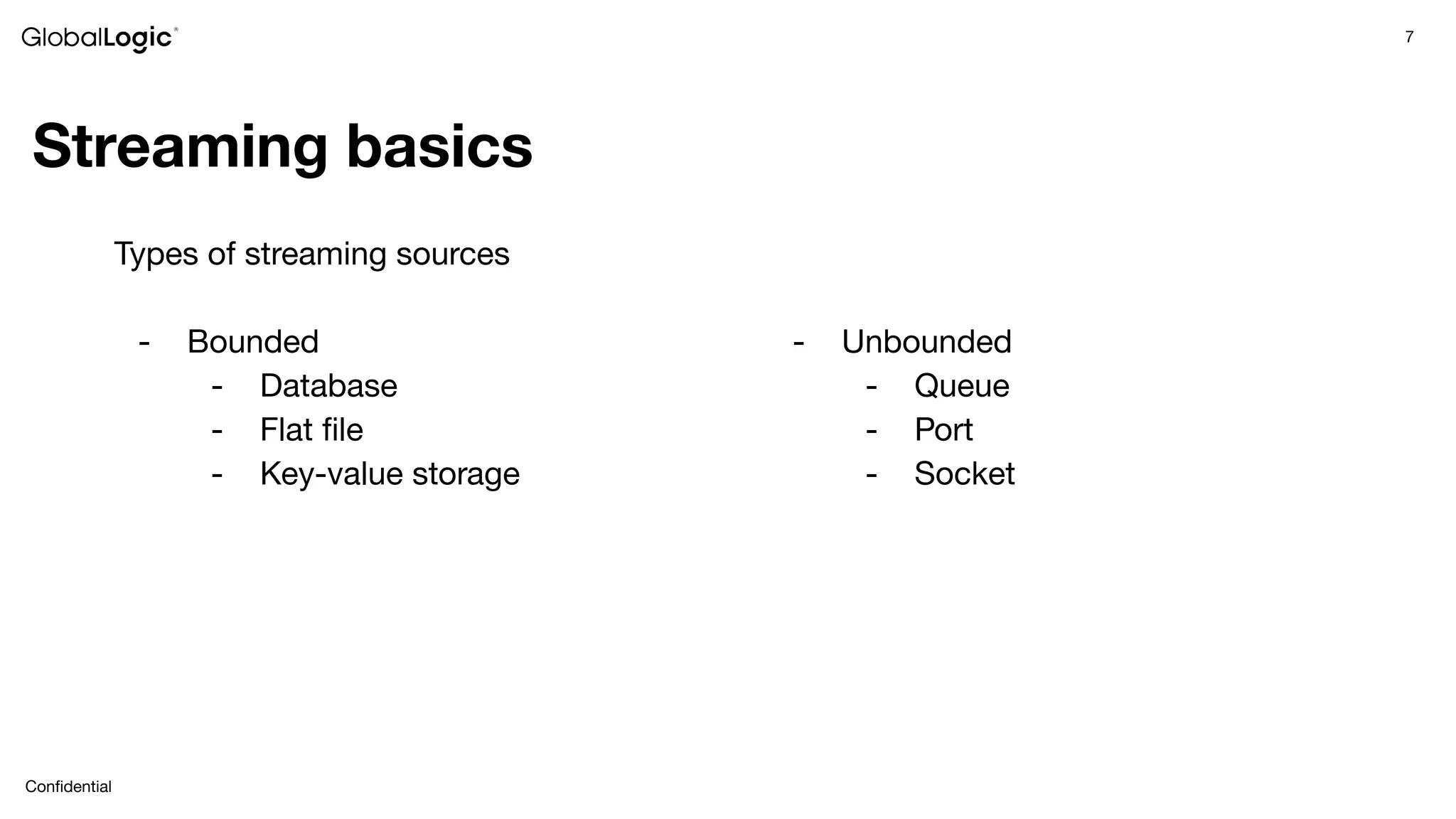
Types of streaming sources
- Bounded
- Database
- Flat file
- Key-value storage
- Unbounded
- Queue
- Port
- Socket
8
Confidential
Streaming basics
9
Confidential
Streaming basics
10
Confidential
Streaming basics
11
Confidential
Streaming basics
12
Confidential
12
Types of stream systems
13
Confidential
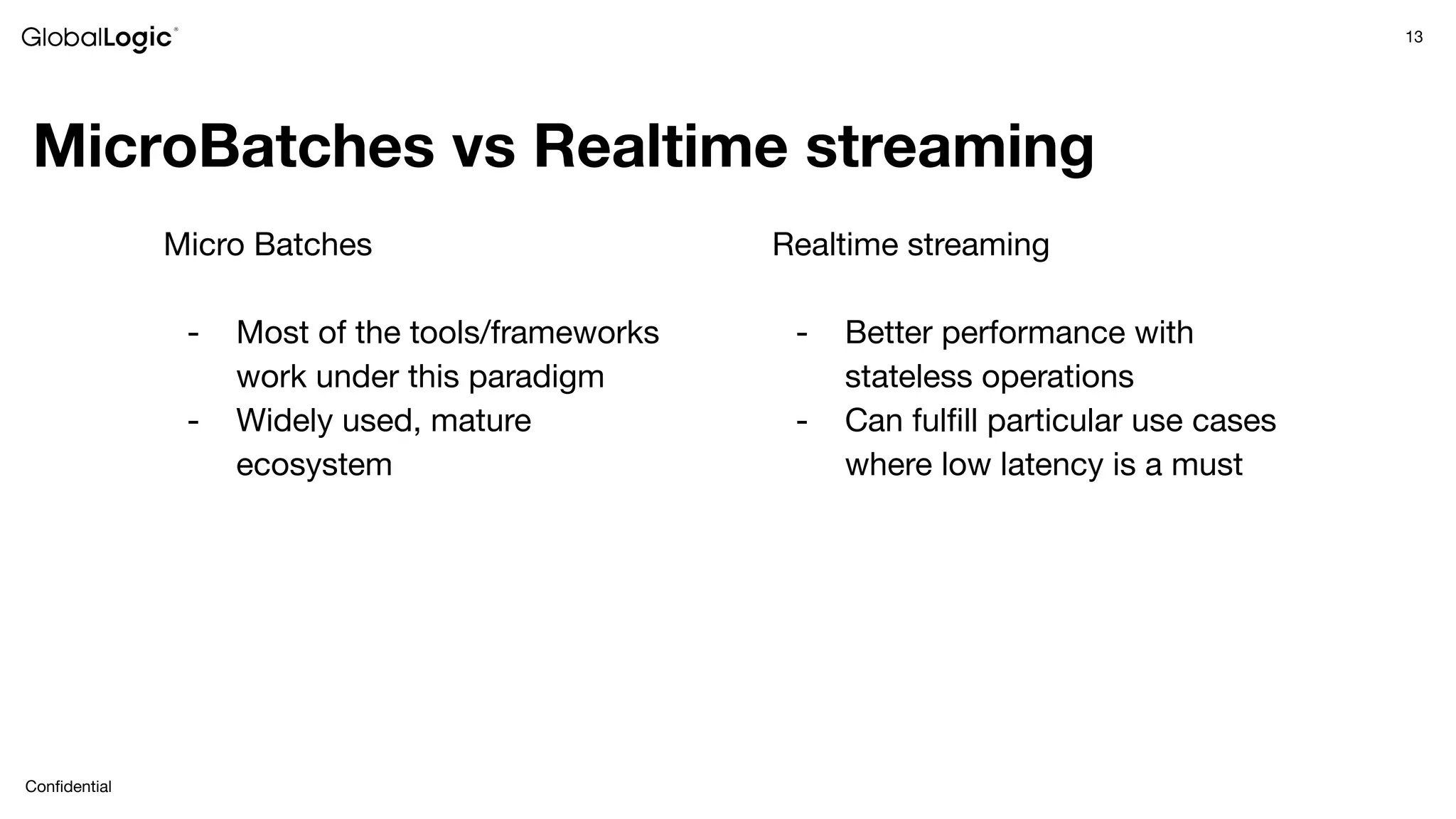
MicroBatches vs Realtime streaming
Micro Batches
- Most of the tools/frameworks
work under this paradigm
- Widely used, mature
ecosystem
Realtime streaming
- Better performance with
stateless operations
- Can fulfill particular use cases
where low latency is a must
14
Confidential
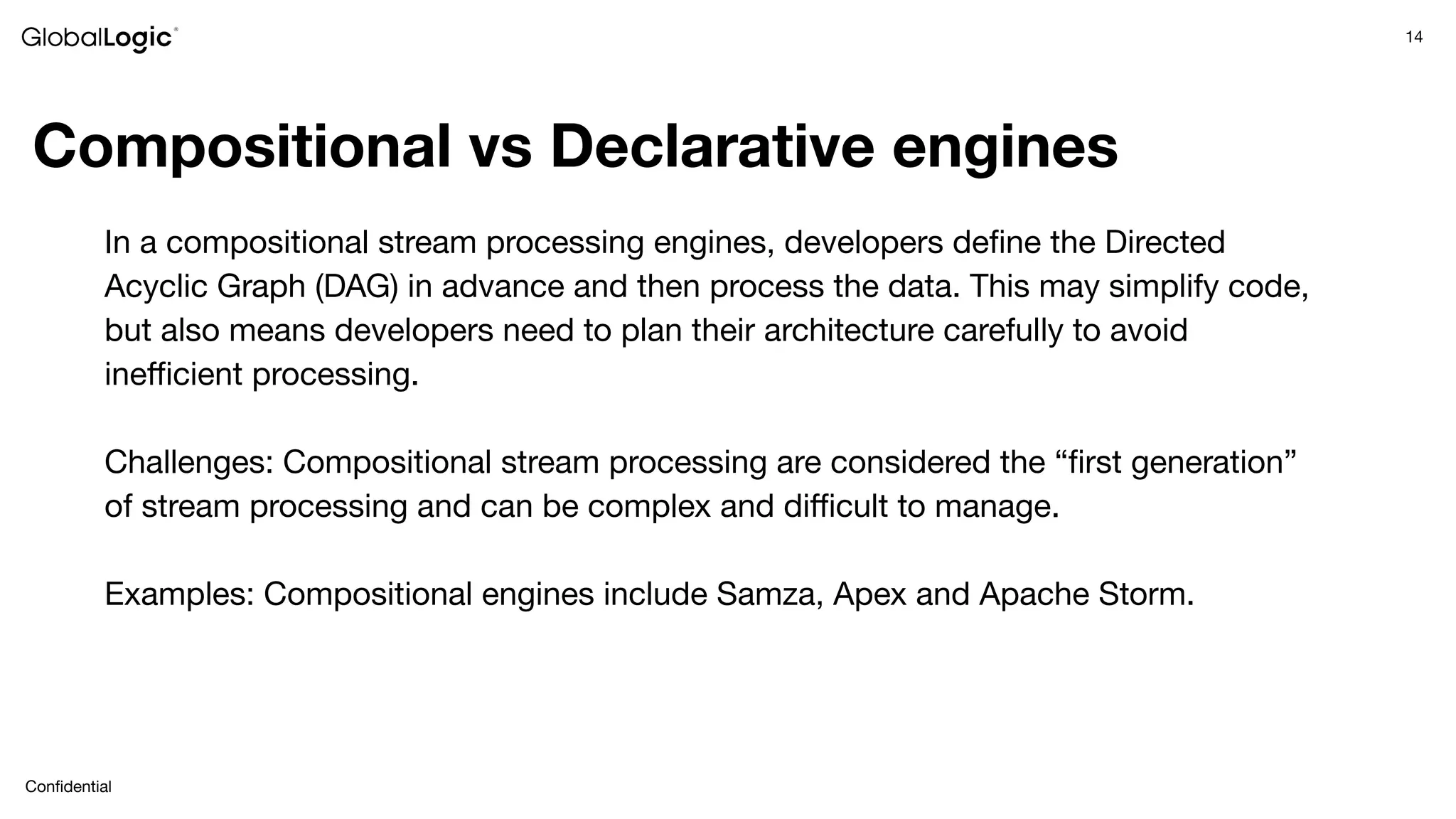
Compositional vs Declarative engines
In a compositional stream processing engines, developers define the Directed
Acyclic Graph (DAG) in advance and then process the data. This may simplify code,
but also means developers need to plan their architecture carefully to avoid
inefficient processing.
Challenges: Compositional stream processing are considered the “first generation”
of stream processing and can be complex and difficult to manage.
Examples: Compositional engines include Samza, Apex and Apache Storm.
15
Confidential
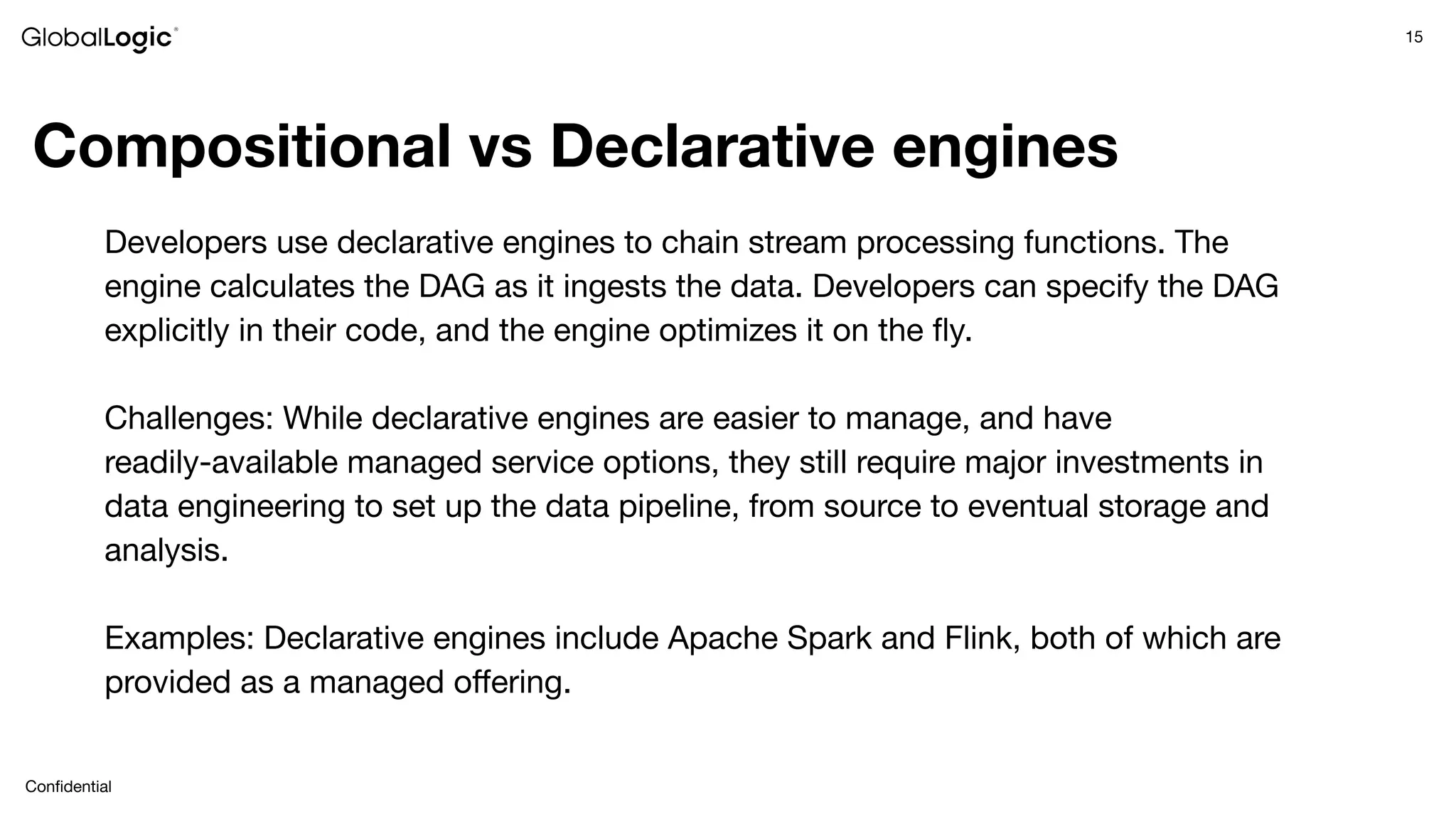
Compositional vs Declarative engines
Developers use declarative engines to chain stream processing functions. The
engine calculates the DAG as it ingests the data. Developers can specify the DAG
explicitly in their code, and the engine optimizes it on the fly.
Challenges: While declarative engines are easier to manage, and have
readily-available managed service options, they still require major investments in
data engineering to set up the data pipeline, from source to eventual storage and
analysis.
Examples: Declarative engines include Apache Spark and Flink, both of which are
provided as a managed offering.
16
Confidential
16
Typical architectures and use
cases
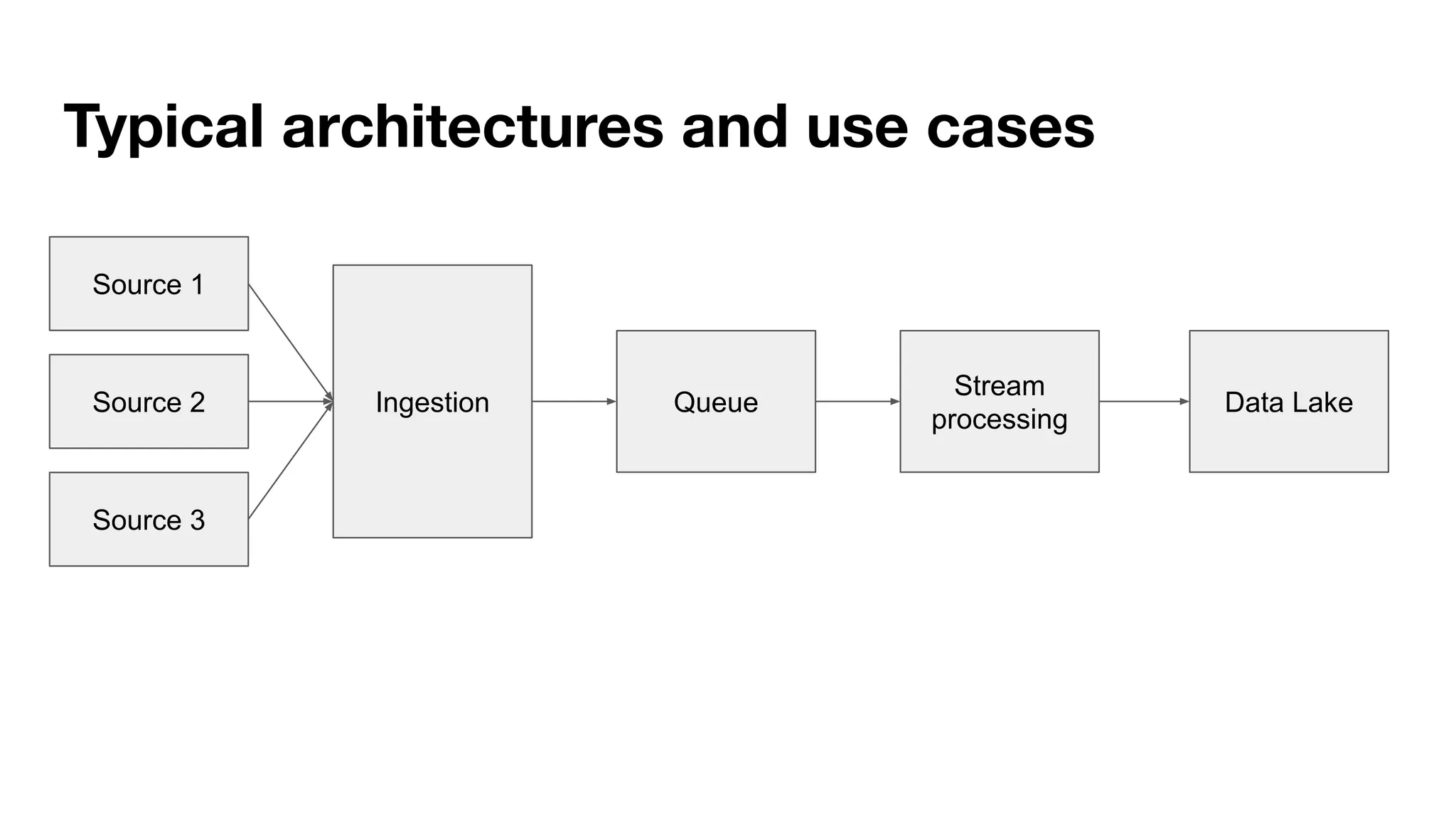
Typical architectures and use cases
Source 1
Source 2
Source 3
Ingestion
Stream
processing
Queue Data Lake
Source 1
Source 2
Source 3
Stream
processing
Queue Data Lake
Typical architectures and use cases
Source 1
Source 2
Source 3
Stream
processing
Queue
Key-value/
Columnar
storage
Typical architectures and use cases
Source 1
Source 2
Source 3
Stream
processing
Queue
Typical architectures and use cases
Source 1
Source 2
Source 3
Stream
processing
Queue
DB/Cache/
API call
Typical architectures and use cases
22
Confidential
22
Main consideration on a project
with Stream processing
23
Confidential
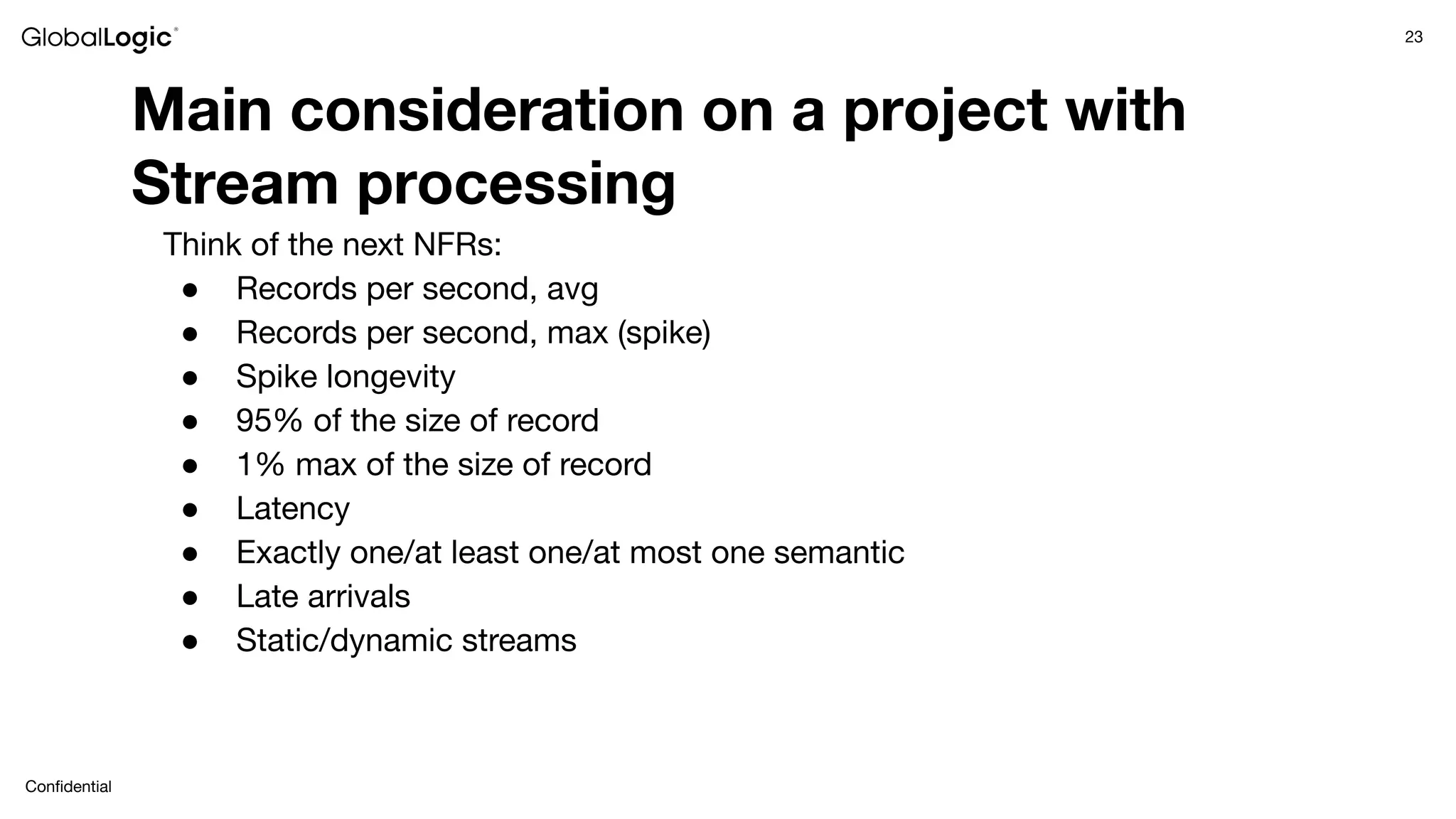
Main consideration on a project with
Stream processing
Think of the next NFRs:
● Records per second, avg
● Records per second, max (spike)
● Spike longevity
● 95% of the size of record
● 1% max of the size of record
● Latency
● Exactly one/at least one/at most one semantic
● Late arrivals
● Static/dynamic streams
24
Confidential
24
Stream processing tools overview
25
Confidential
Stream processing tools overview
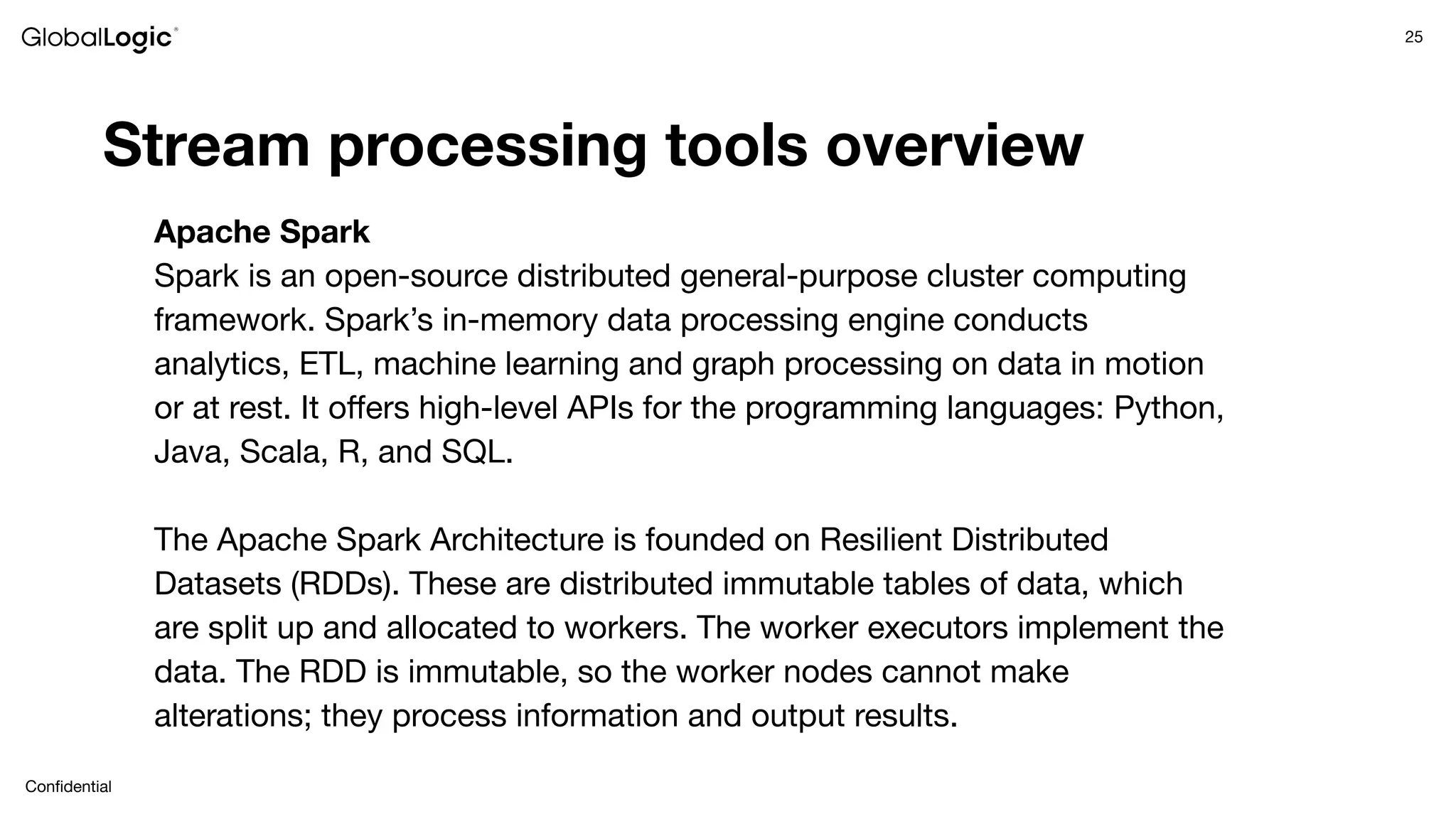
Apache Spark
Spark is an open-source distributed general-purpose cluster computing
framework. Spark’s in-memory data processing engine conducts
analytics, ETL, machine learning and graph processing on data in motion
or at rest. It offers high-level APIs for the programming languages: Python,
Java, Scala, R, and SQL.
The Apache Spark Architecture is founded on Resilient Distributed
Datasets (RDDs). These are distributed immutable tables of data, which
are split up and allocated to workers. The worker executors implement the
data. The RDD is immutable, so the worker nodes cannot make
alterations; they process information and output results.
26
Confidential
Stream processing tools overview
Pros: Apache Spark is a mature product with a large community, proven
in production for many use cases, and readily supports SQL querying.
Cons:
● Spark can be complex to set up and implement
● It is not a true streaming engine (it performs very fast batch
processing)
● Limited language support
● Latency of a few seconds, which eliminates some real-time analytics
use cases
27
Confidential
Stream processing tools overview
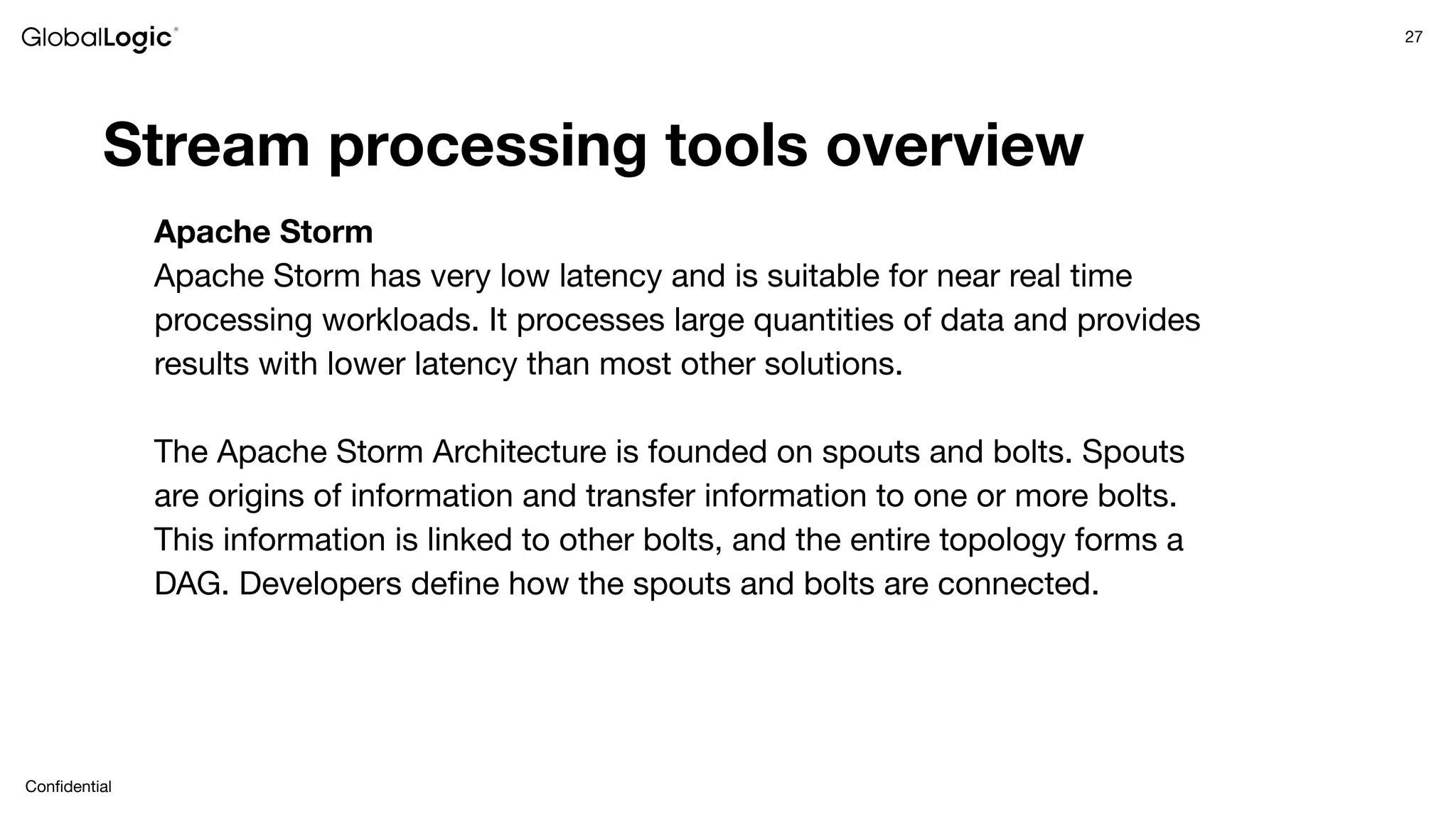
Apache Storm
Apache Storm has very low latency and is suitable for near real time
processing workloads. It processes large quantities of data and provides
results with lower latency than most other solutions.
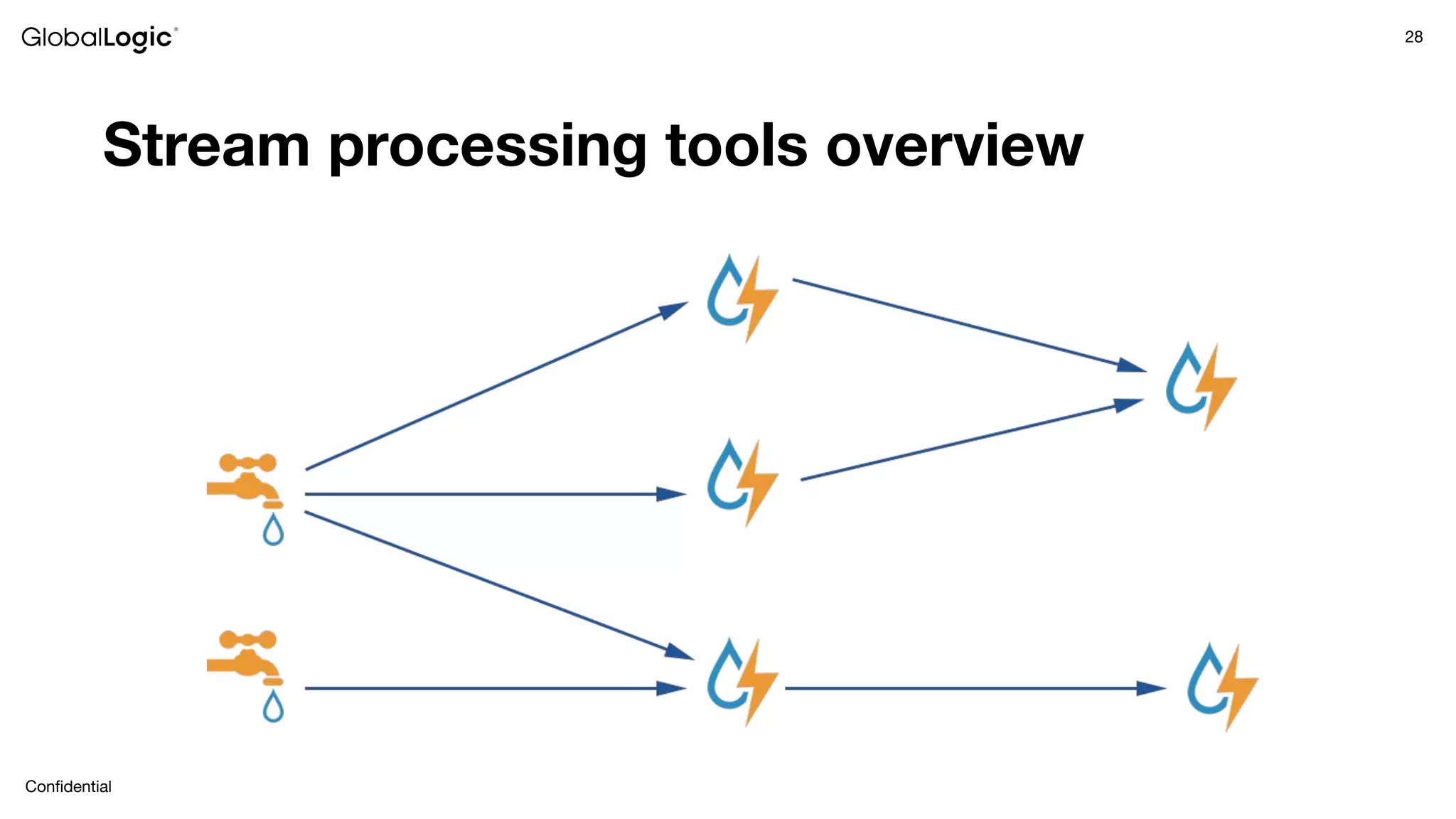
The Apache Storm Architecture is founded on spouts and bolts. Spouts
are origins of information and transfer information to one or more bolts.
This information is linked to other bolts, and the entire topology forms a
DAG. Developers define how the spouts and bolts are connected.
28
Confidential
Stream processing tools overview
29
Confidential
Stream processing tools overview
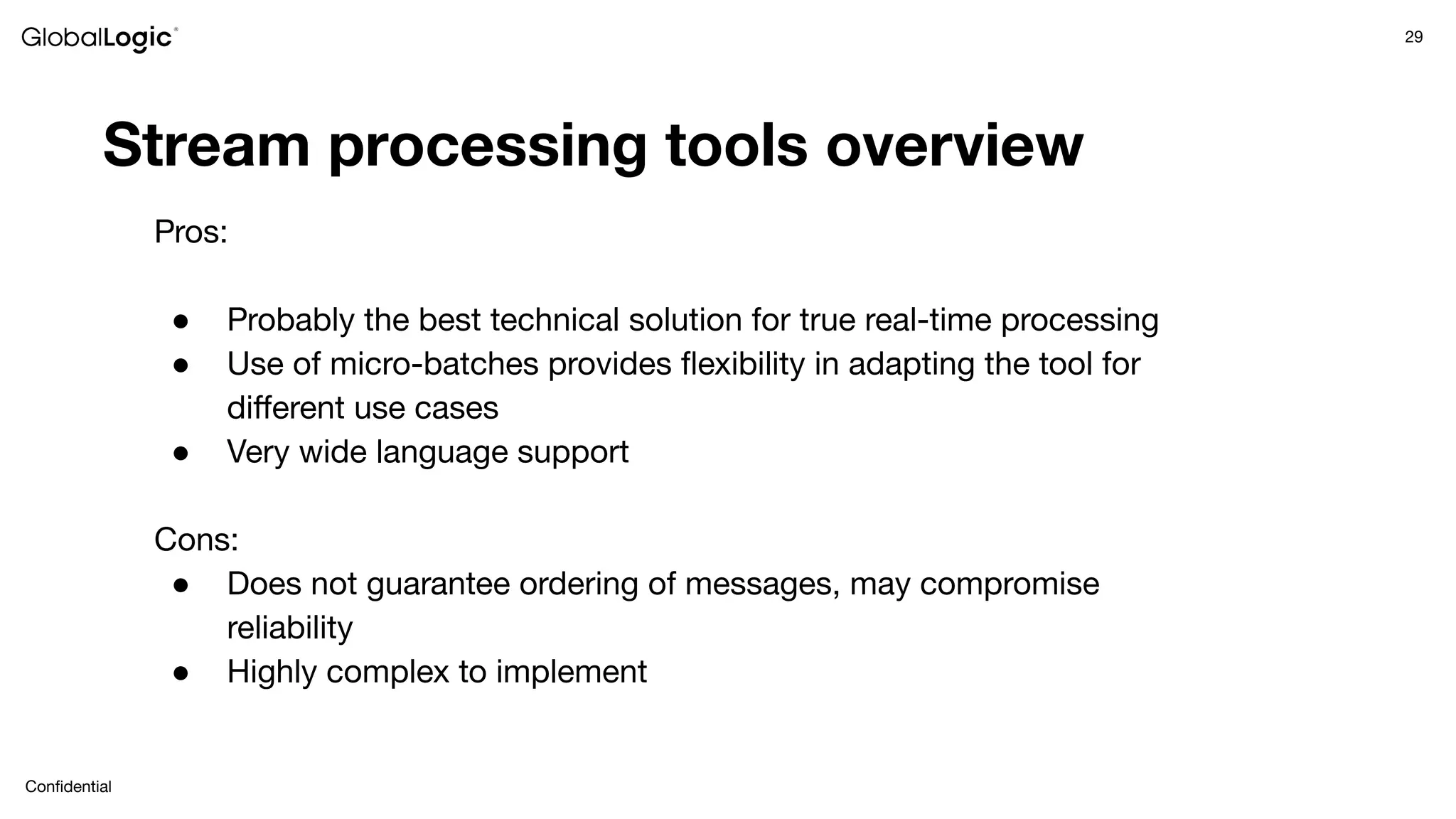
Pros:
● Probably the best technical solution for true real-time processing
● Use of micro-batches provides flexibility in adapting the tool for
different use cases
● Very wide language support
Cons:
● Does not guarantee ordering of messages, may compromise
reliability
● Highly complex to implement
30
Confidential
Stream processing tools overview
Apache Flink
Flink is based on the concept of streams and transformations. Data
comes into the system via a source and leaves via a sink. To produce a
Flink job Apache Maven is used. Maven has a skeleton project where the
packing requirements and dependencies are ready, so the developer can
add custom code.
Apache Flink is a stream processing framework that also handles batch
tasks. Flink approaches batches as data streams with finite boundaries.
31
Confidential
Stream processing tools overview
Pros:
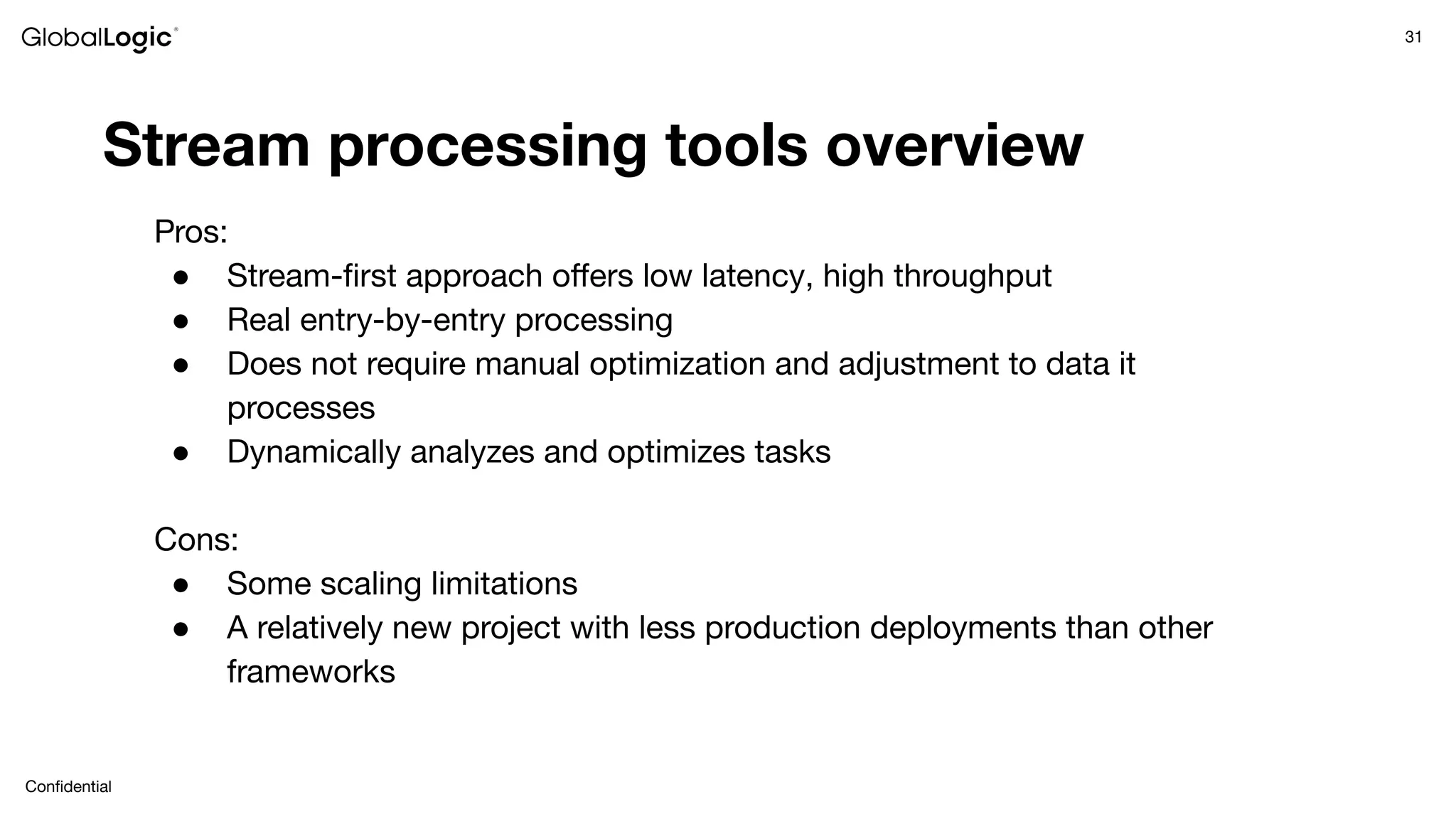
● Stream-first approach offers low latency, high throughput
● Real entry-by-entry processing
● Does not require manual optimization and adjustment to data it
processes
● Dynamically analyzes and optimizes tasks
Cons:
● Some scaling limitations
● A relatively new project with less production deployments than other
frameworks
32
Confidential
Stream processing tools overview (cloud)
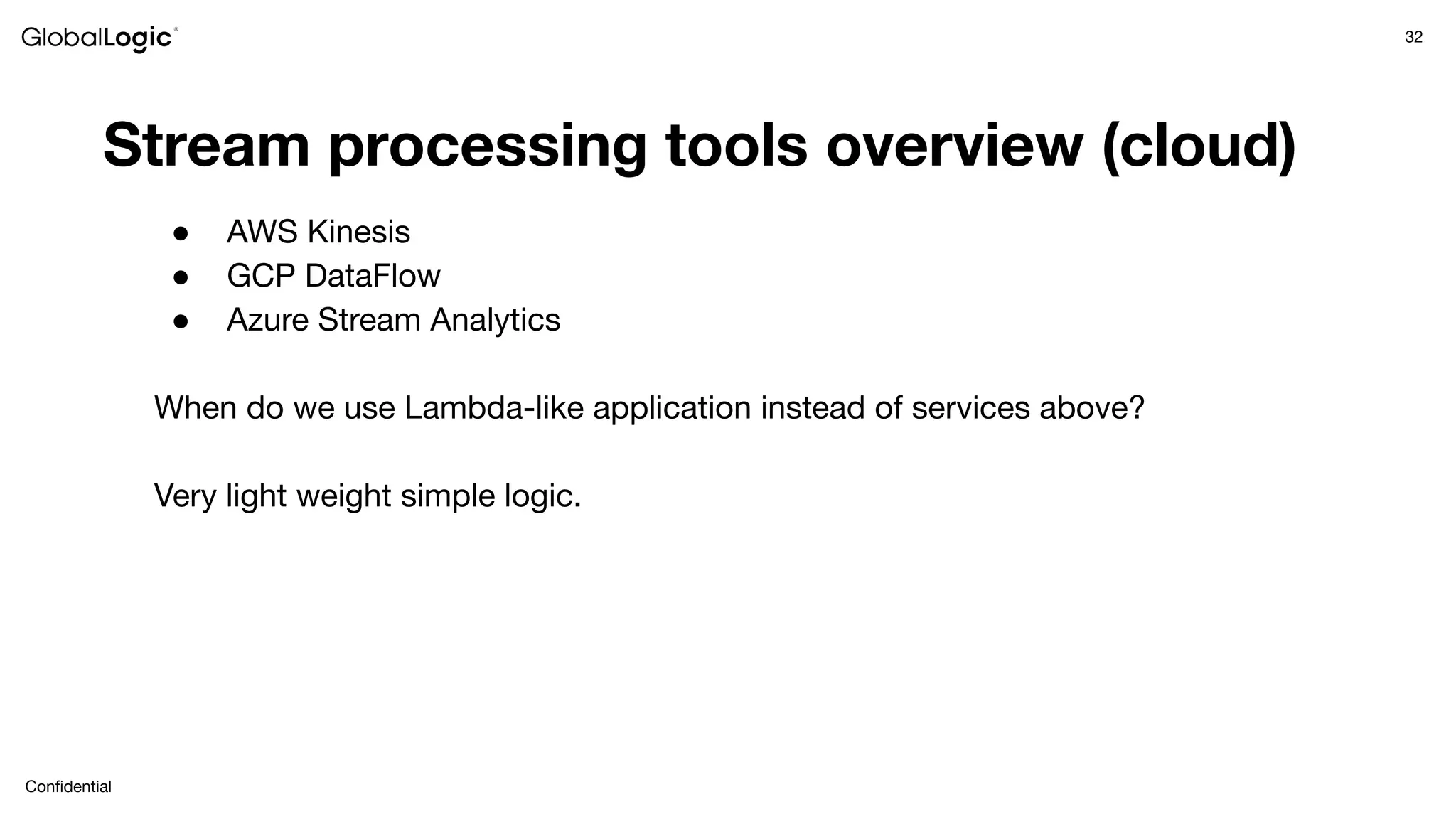
● AWS Kinesis
● GCP DataFlow
● Azure Stream Analytics
When do we use Lambda-like application instead of services above?
Very light weight simple logic.
33
Confidential
33
Case study
Confidential
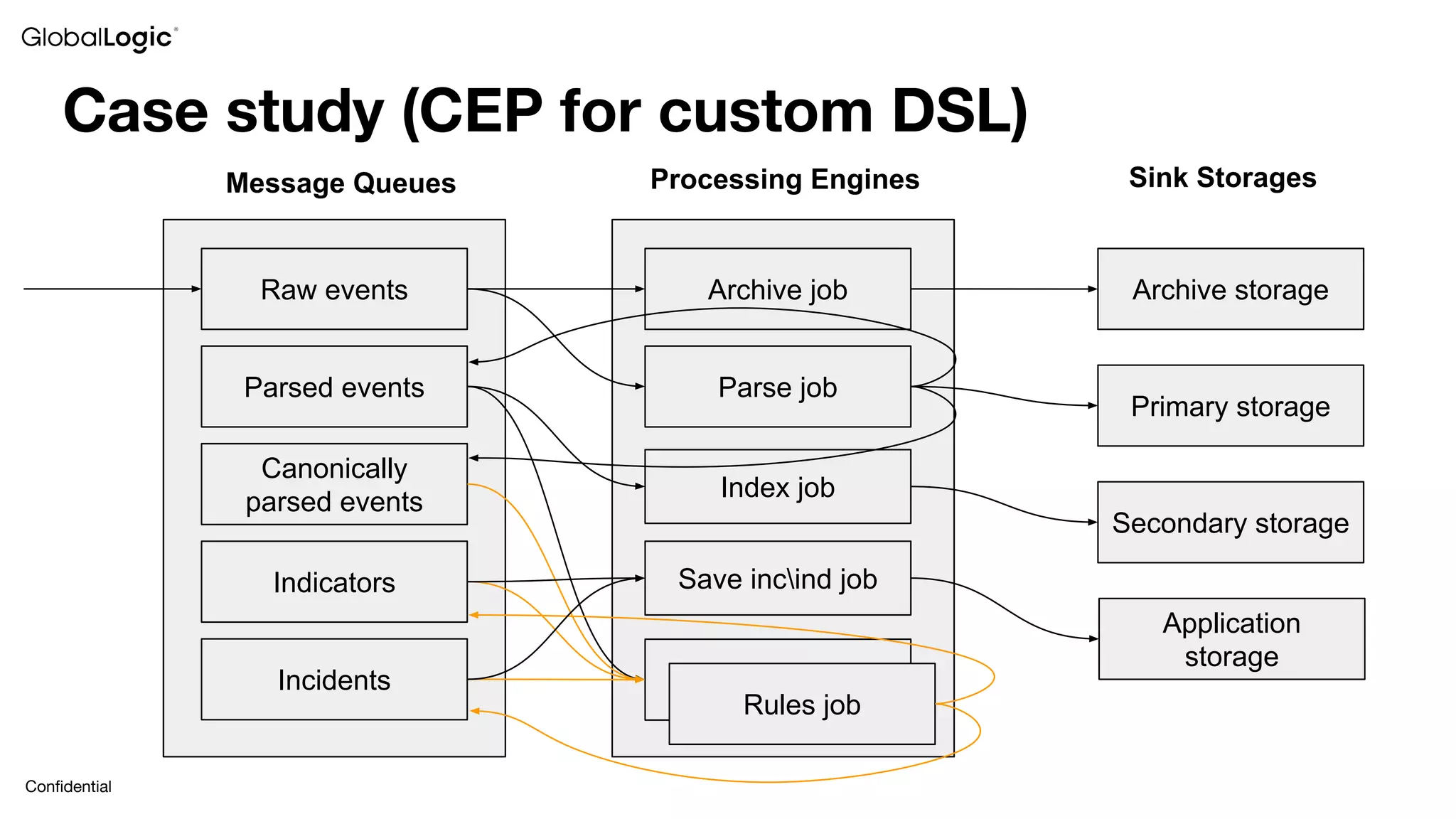
Case study (CEP for custom DSL)
Raw events
Parsed events
Canonically
parsed events
Indicators
Incidents
Archive job
Parse job
Index job
Archive storage
Primary storage
Index job
Rules job
Secondary storage
Application
storage
Save incind job
Message Queues Processing Engines Sink Storages
35
Confidential
35
FAQ
36
Confidential
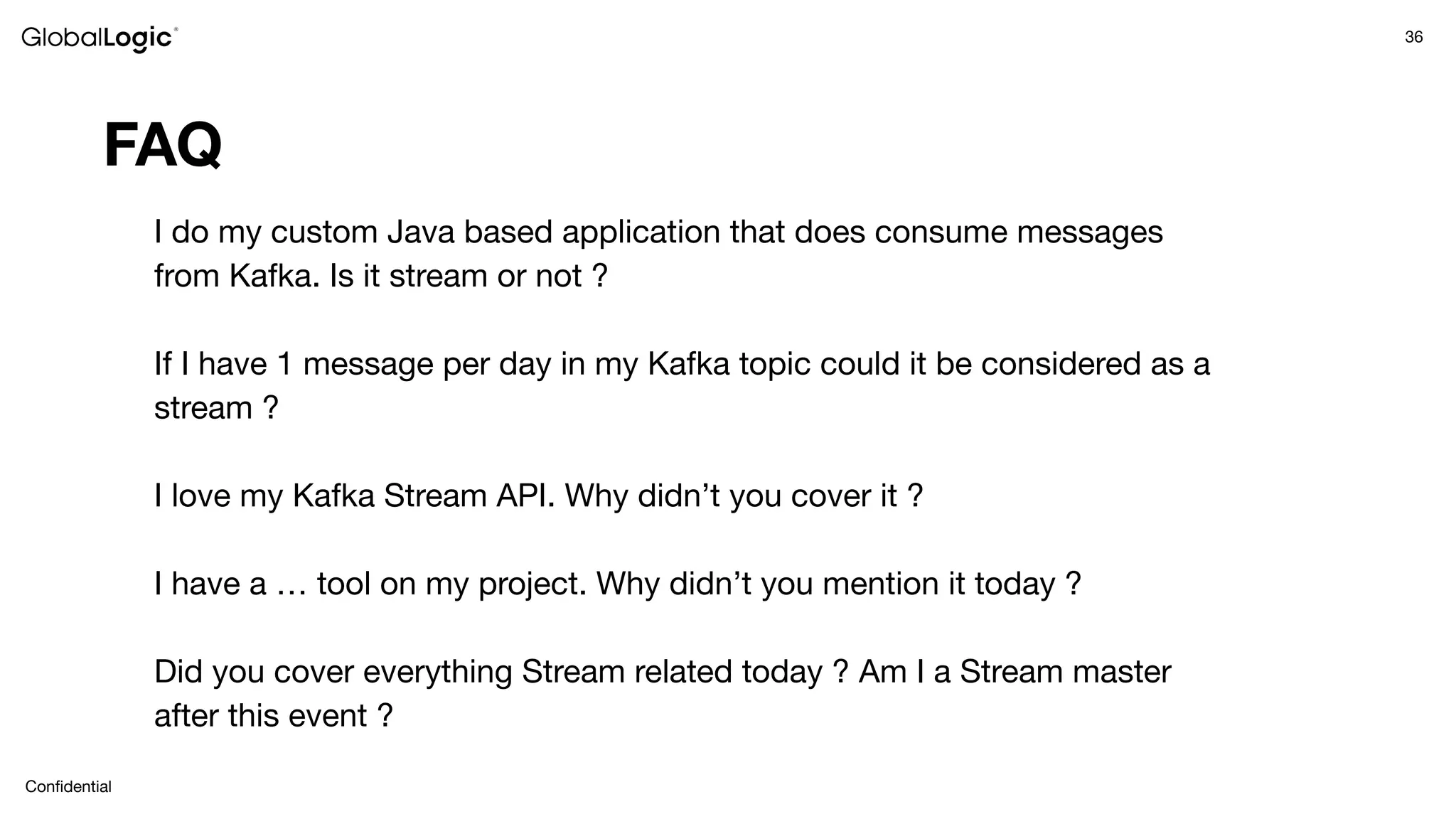
FAQ
I do my custom Java based application that does consume messages
from Kafka. Is it stream or not ?
If I have 1 message per day in my Kafka topic could it be considered as a
stream ?
I love my Kafka Stream API. Why didn’t you cover it ?
I have a … tool on my project. Why didn’t you mention it today ?
Did you cover everything Stream related today ? Am I a Stream master
after this event ?
37
Confidential
37
Q&A session
38
Confidential
Thank you!

Stream Data Processing at Big Data Landscape by Oleksandr Fedirko

  • 1.
  • 2.
  • 3.
    3 Confidential Intro Meet your speakertoday: Oleksandr Fedirko - CEE Head of Big Data Practice
  • 4.
    4 Confidential High level agenda Streamingbasics Types of stream systems Typical architectures and use cases Main consideration on a project with Stream processing Stream processing tools overview Case study Q&A session
  • 5.
  • 6.
    6 Confidential Streaming basics Types ofstreaming operations - Stateful - Aggregation - Join - Sorting - Stateless - Filter - Map
  • 7.
    7 Confidential Streaming basics Types ofstreaming sources - Bounded - Database - Flat file - Key-value storage - Unbounded - Queue - Port - Socket
  • 8.
  • 9.
  • 10.
  • 11.
  • 12.
  • 13.
    13 Confidential MicroBatches vs Realtimestreaming Micro Batches - Most of the tools/frameworks work under this paradigm - Widely used, mature ecosystem Realtime streaming - Better performance with stateless operations - Can fulfill particular use cases where low latency is a must
  • 14.
    14 Confidential Compositional vs Declarativeengines In a compositional stream processing engines, developers define the Directed Acyclic Graph (DAG) in advance and then process the data. This may simplify code, but also means developers need to plan their architecture carefully to avoid inefficient processing. Challenges: Compositional stream processing are considered the “first generation” of stream processing and can be complex and difficult to manage. Examples: Compositional engines include Samza, Apex and Apache Storm.
  • 15.
    15 Confidential Compositional vs Declarativeengines Developers use declarative engines to chain stream processing functions. The engine calculates the DAG as it ingests the data. Developers can specify the DAG explicitly in their code, and the engine optimizes it on the fly. Challenges: While declarative engines are easier to manage, and have readily-available managed service options, they still require major investments in data engineering to set up the data pipeline, from source to eventual storage and analysis. Examples: Declarative engines include Apache Spark and Flink, both of which are provided as a managed offering.
  • 16.
  • 17.
    Typical architectures anduse cases Source 1 Source 2 Source 3 Ingestion Stream processing Queue Data Lake
  • 18.
    Source 1 Source 2 Source3 Stream processing Queue Data Lake Typical architectures and use cases
  • 19.
    Source 1 Source 2 Source3 Stream processing Queue Key-value/ Columnar storage Typical architectures and use cases
  • 20.
    Source 1 Source 2 Source3 Stream processing Queue Typical architectures and use cases
  • 21.
    Source 1 Source 2 Source3 Stream processing Queue DB/Cache/ API call Typical architectures and use cases
  • 22.
    22 Confidential 22 Main consideration ona project with Stream processing
  • 23.
    23 Confidential Main consideration ona project with Stream processing Think of the next NFRs: ● Records per second, avg ● Records per second, max (spike) ● Spike longevity ● 95% of the size of record ● 1% max of the size of record ● Latency ● Exactly one/at least one/at most one semantic ● Late arrivals ● Static/dynamic streams
  • 24.
  • 25.
    25 Confidential Stream processing toolsoverview Apache Spark Spark is an open-source distributed general-purpose cluster computing framework. Spark’s in-memory data processing engine conducts analytics, ETL, machine learning and graph processing on data in motion or at rest. It offers high-level APIs for the programming languages: Python, Java, Scala, R, and SQL. The Apache Spark Architecture is founded on Resilient Distributed Datasets (RDDs). These are distributed immutable tables of data, which are split up and allocated to workers. The worker executors implement the data. The RDD is immutable, so the worker nodes cannot make alterations; they process information and output results.
  • 26.
    26 Confidential Stream processing toolsoverview Pros: Apache Spark is a mature product with a large community, proven in production for many use cases, and readily supports SQL querying. Cons: ● Spark can be complex to set up and implement ● It is not a true streaming engine (it performs very fast batch processing) ● Limited language support ● Latency of a few seconds, which eliminates some real-time analytics use cases
  • 27.
    27 Confidential Stream processing toolsoverview Apache Storm Apache Storm has very low latency and is suitable for near real time processing workloads. It processes large quantities of data and provides results with lower latency than most other solutions. The Apache Storm Architecture is founded on spouts and bolts. Spouts are origins of information and transfer information to one or more bolts. This information is linked to other bolts, and the entire topology forms a DAG. Developers define how the spouts and bolts are connected.
  • 28.
  • 29.
    29 Confidential Stream processing toolsoverview Pros: ● Probably the best technical solution for true real-time processing ● Use of micro-batches provides flexibility in adapting the tool for different use cases ● Very wide language support Cons: ● Does not guarantee ordering of messages, may compromise reliability ● Highly complex to implement
  • 30.
    30 Confidential Stream processing toolsoverview Apache Flink Flink is based on the concept of streams and transformations. Data comes into the system via a source and leaves via a sink. To produce a Flink job Apache Maven is used. Maven has a skeleton project where the packing requirements and dependencies are ready, so the developer can add custom code. Apache Flink is a stream processing framework that also handles batch tasks. Flink approaches batches as data streams with finite boundaries.
  • 31.
    31 Confidential Stream processing toolsoverview Pros: ● Stream-first approach offers low latency, high throughput ● Real entry-by-entry processing ● Does not require manual optimization and adjustment to data it processes ● Dynamically analyzes and optimizes tasks Cons: ● Some scaling limitations ● A relatively new project with less production deployments than other frameworks
  • 32.
    32 Confidential Stream processing toolsoverview (cloud) ● AWS Kinesis ● GCP DataFlow ● Azure Stream Analytics When do we use Lambda-like application instead of services above? Very light weight simple logic.
  • 33.
  • 34.
    Confidential Case study (CEPfor custom DSL) Raw events Parsed events Canonically parsed events Indicators Incidents Archive job Parse job Index job Archive storage Primary storage Index job Rules job Secondary storage Application storage Save incind job Message Queues Processing Engines Sink Storages
  • 35.
  • 36.
    36 Confidential FAQ I do mycustom Java based application that does consume messages from Kafka. Is it stream or not ? If I have 1 message per day in my Kafka topic could it be considered as a stream ? I love my Kafka Stream API. Why didn’t you cover it ? I have a … tool on my project. Why didn’t you mention it today ? Did you cover everything Stream related today ? Am I a Stream master after this event ?
  • 37.
  • 38.