Reliable Rate-Optimized Video
Multicasting Services over
LTE/LTE-A
Andrea Tassi
Francesco Chiti
Romano Fantacci
Chadi Khirallah
John Thompson
Dejan Vukobratović
C o n t a c t s
{name.surname}@unifi.it
{name.surname}@ed.ac.uk
{name.surname}@ktios.net
Index
1. Novel multi-rate design for eMBMS
LTE/LTE-A networks based on RNC
2. B a c k g r o u n d and previous works
3. RNC-based rate allocation
model f o r SC-eMBMS systems
4. N u m e r i c a l r e s u l t s
1. Novel Multi-Rate Design
for eMBMS LTE/LTE-A
Networks Based on RNC
Rate-Optimized Multicast Services
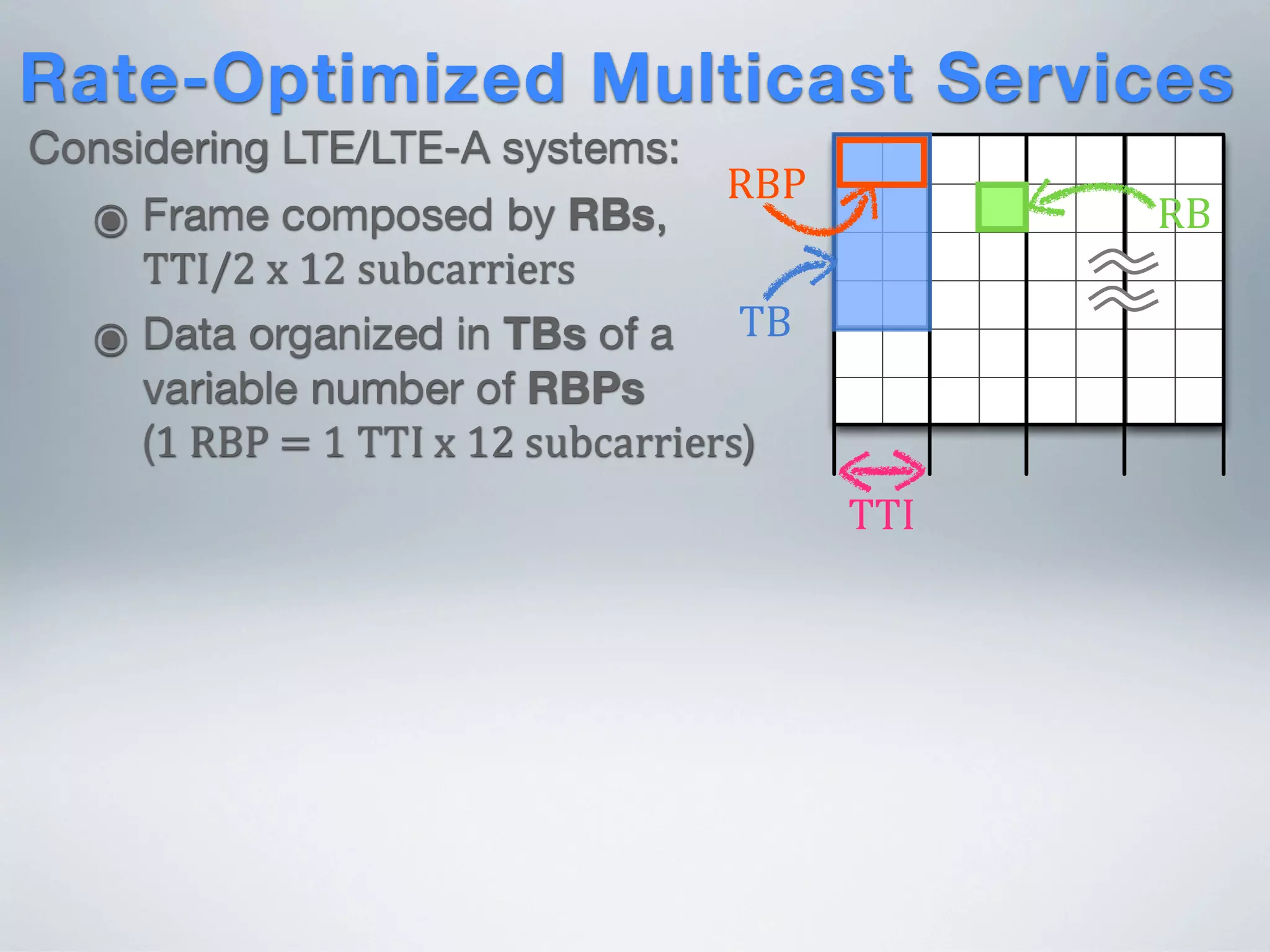
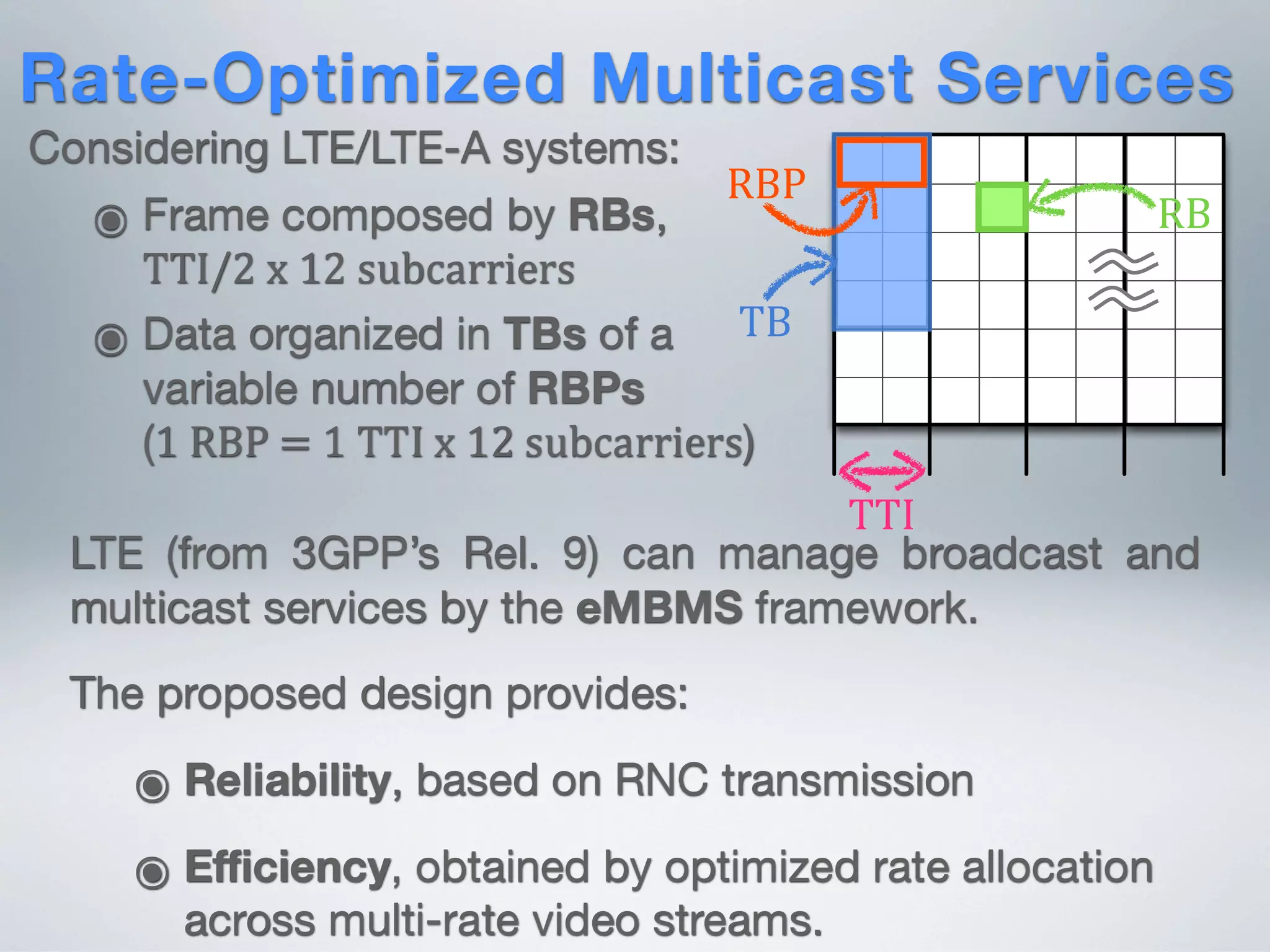
Considering LTE/LTE-A systems:
๏ Frame composed by RBs,
TTI/2  x  12  subcarriers
๏ Data organized in TBs of a
variable number of RBPs
(1  RBP  =  1  TTI  x  12  subcarriers)
TB
RBP
TTI
RB
Rate-Optimized Multicast Services
Considering LTE/LTE-A systems:
๏ Frame composed by RBs,
TTI/2  x  12  subcarriers
๏ Data organized in TBs of a
variable number of RBPs
(1  RBP  =  1  TTI  x  12  subcarriers)
LTE (from 3GPP’s Rel. 9) can manage broadcast and
multicast services by the eMBMS framework.
The proposed design provides:
๏ Reliability, based on RNC transmission
๏ Efficiency, obtained by optimized rate allocation
across multi-rate video streams.
TB
RBP
TTI
RB
2. Background and Previous
Works
Previous Works (1/2)
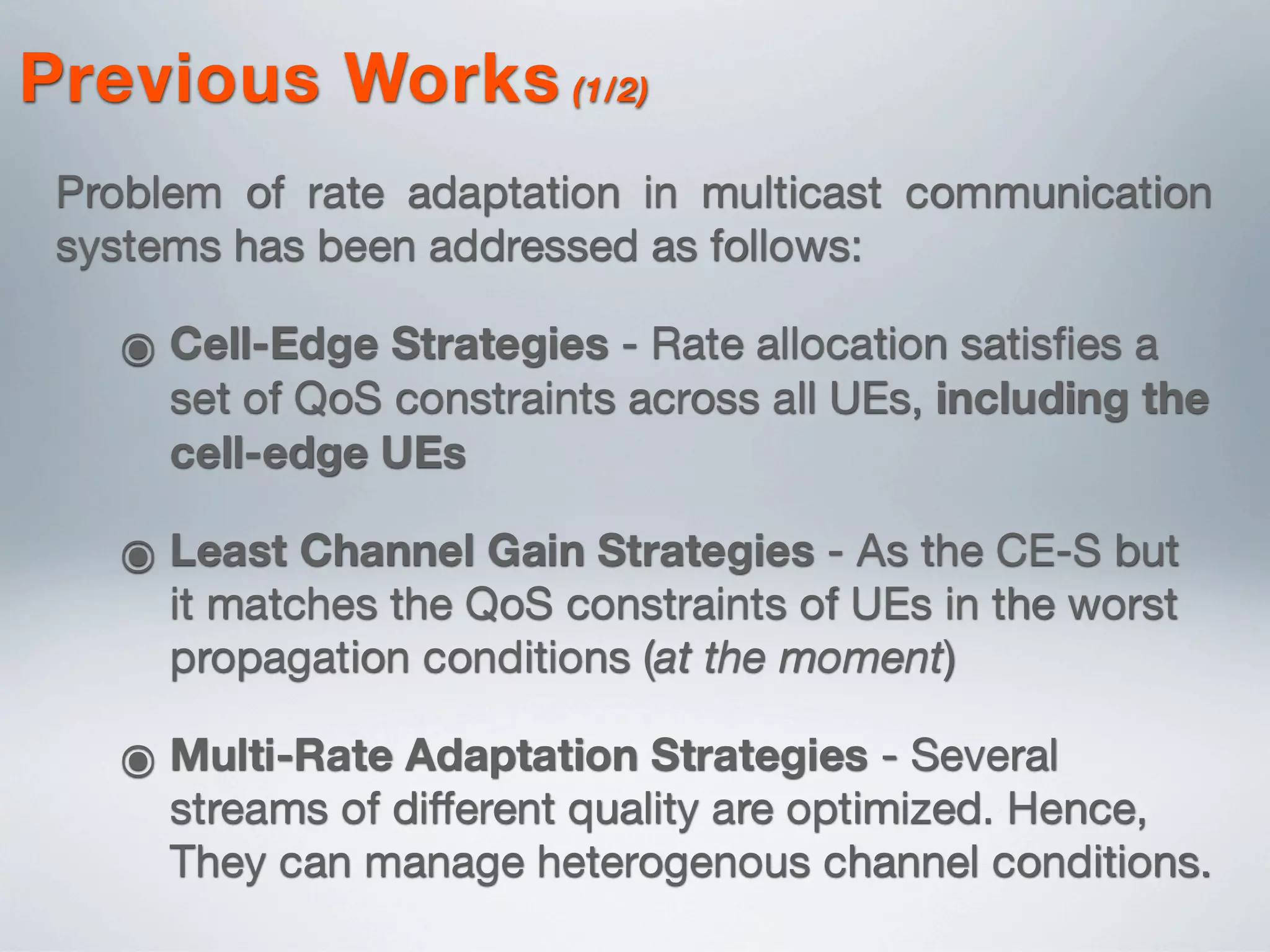
Problem of rate adaptation in multicast communication
systems has been addressed as follows:
๏ Cell-Edge Strategies - Rate allocation satisfies a
set of QoS constraints across all UEs, including the
cell-edge UEs
๏ Least Channel Gain Strategies - As the CE-S but
it matches the QoS constraints of UEs in the worst
propagation conditions (at the moment)
๏ Multi-Rate Adaptation Strategies - Several
streams of different quality are optimized. Hence,
They can manage heterogenous channel conditions.
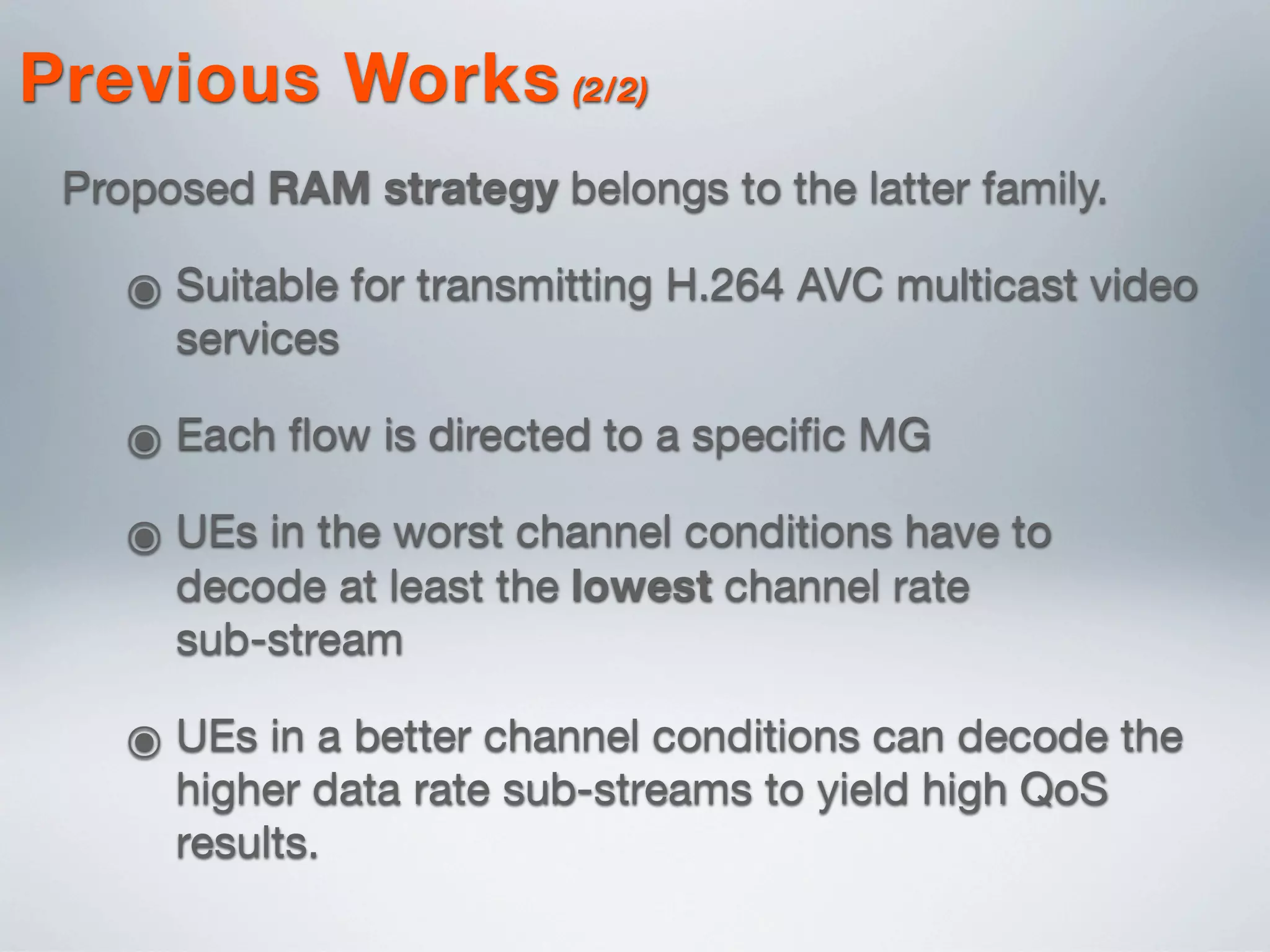
Proposed RAM strategy belongs to the latter family.
๏ Suitable for transmitting H.264 AVC multicast video
services
๏ Each flow is directed to a specific MG
๏ UEs in the worst channel conditions have to
decode at least the lowest channel rate
sub-stream
๏ UEs in a better channel conditions can decode the
higher data rate sub-streams to yield high QoS
results.
Previous Works (2/2)
๏ Coded symbols are transmitted until the MG receive a
set of K linearly independent coded symbols.
rate design for evolved Multimedia Multicast/Broadcast Ser-
vice (eMBMS) in fourth generation (4G) Long-Term Evolution
(LTE)/LTE-Advanced (LTE-A) networks. The proposed design
provides: i) reliability, based on random network coded (RNC)
transmission, and ii) efficiency, obtained by optimized rate allo-
cation across multi-rate RNC streams. The paper provides an in-
depth description of the system realization and demonstrates the
feasibility of the proposed eMBMS design using both analytical
and simulation results. The system performance is compared with
popular multi-rate multicast approaches in a realistic simulated
LTE/LTE-A environment.
I. INTRODUCTION
ci =
KX
j=1
gj xj
Video content delivery over fourth generation (4G) net-
works, such as Long-Term Evolution (LTE)/LTE-Advanced
(LTE-A), is estimated to grow 18-fold between 2011-2016
r
a
n
r
b
m
p
M
o
p
a
d
f
s
I
a
r
UE1
UE2
UE3
UE4
UEY
eNB
Multicast3Group
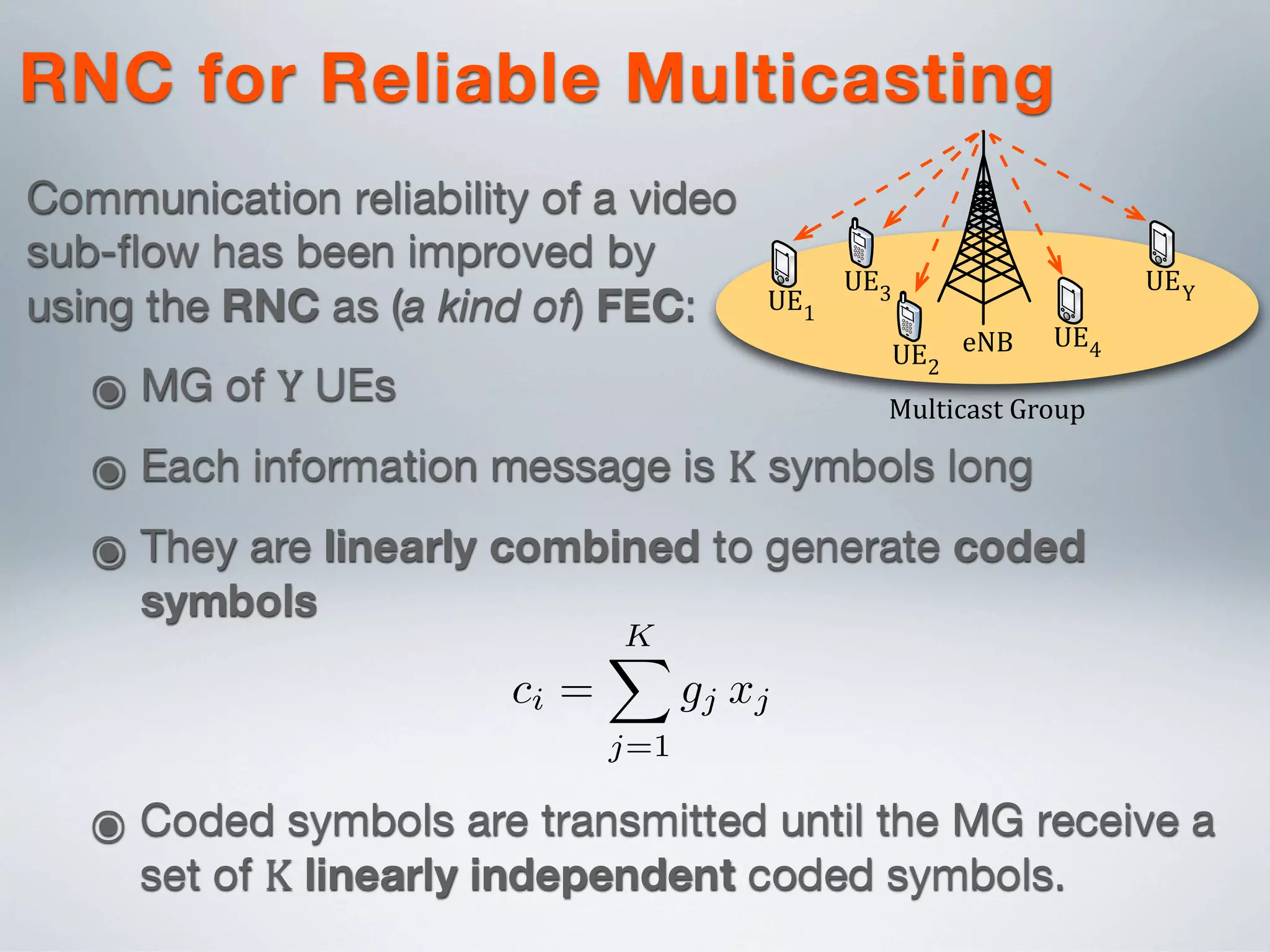
RNC for Reliable Multicasting
Communication reliability of a video
sub-flow has been improved by
using the RNC as (a kind of) FEC:
๏ MG of Y UEs
๏ Each information message is K symbols long
๏ They are linearly combined to generate coded
symbols
3. RNC-based Rate
Allocation Model for
SC-eMBMS systems
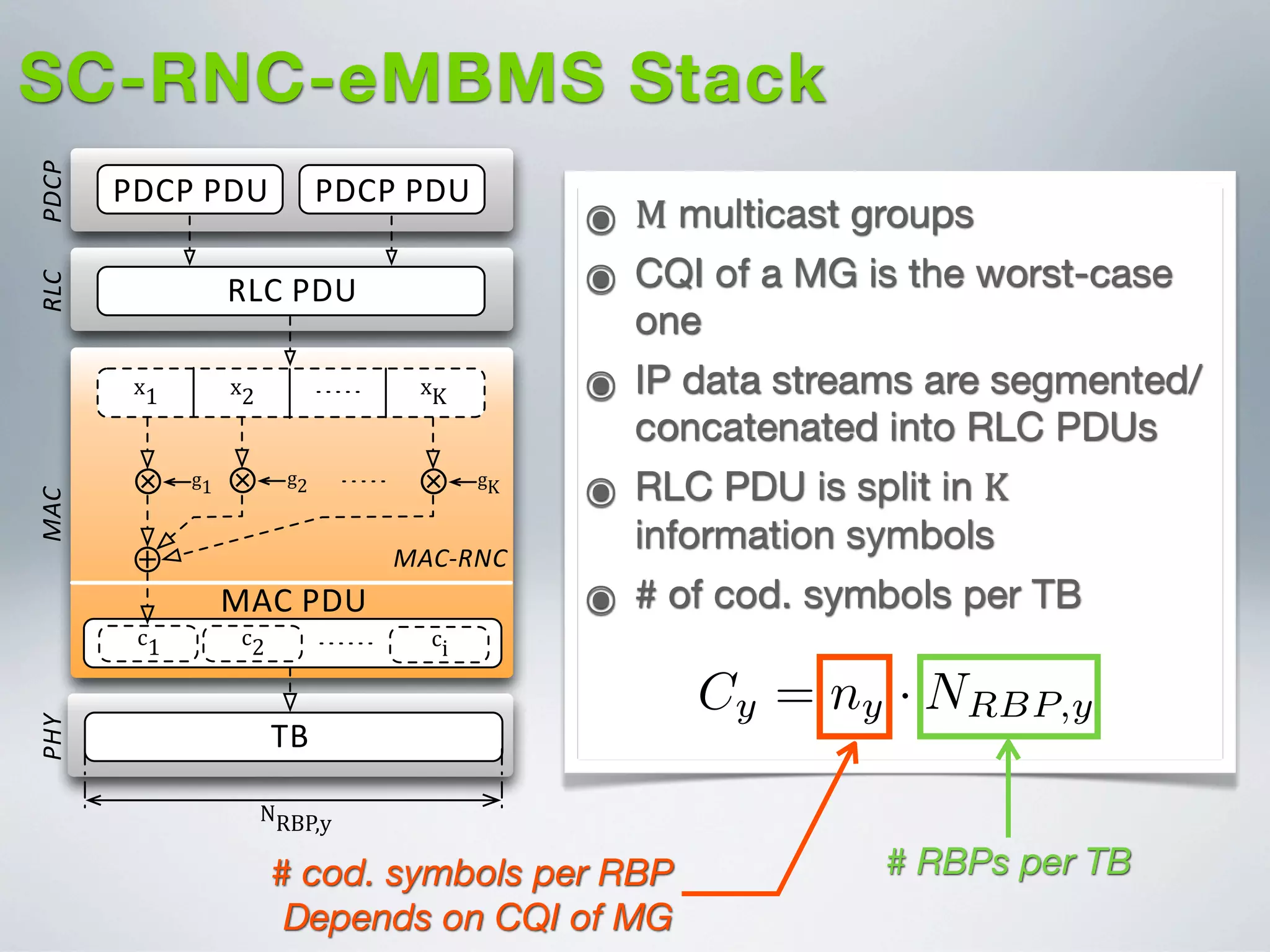
SC-RNC-eMBMS Stack
๏ M multicast groups
๏ CQI of a MG is the worst-case
one
๏ IP data streams are segmented/
concatenated into RLC PDUs
๏ RLC PDU is split in K
information symbols
๏ # of cod. symbols per TB
PHY TBs with reconstruction probability o
the selection of the number of MGs M and
MC schemes can be mapped to a partition
Table II (M = 4, MC={12,10,6,4}). In this
a partition scheme such that the area of the
(where di is the distance between the eNB
ring belonging to the i-th MG) increases c
The capacity of PHY TBs broadcasted ov
pends on the MC mode selected and the am
resources allocated to the k-th MG:
Cy = ny · NRBP,y · L [bi
where nk and NRBP,k represent the numbe
per PHY TB (as reported in Table I) and t
cation (expressed in terms of number of R
# cod. symbols per RBP
Depends on CQI of MG
# RBPs per TB
PDCP$PDU PDCP$PDU
RLC$PDU
x1 x2 xK
⊗ g2⊗ g1 ⊗ gK
⊕
c1 c2 ci
MAC$PDU
TB
PDCPRLCMAC
MAC(RNC
PHY
NRBP,y
Combinatorial Error Model (1/2)
๏ Characterisation of the r.v. Vi. The i-th UE recovers a RLC
PDU after j TBs with a prob. equal to
Delivery prob. of a over j TBs Prob. that at least K symbols
are lin. indep. over a finite field
Fq
n
o-
R
el
g
es
e
e
h
n
e
e
e
d
e
of
Let pi be the probability of reception of a PHY TB at the i-
th UE. The cumulative density function (CDF) of Vi for j 0
and j · nk · NRBP,k K is expressed as (see Eq. (12) of [?])
Pr{Vi  j} = fi(j) =
jX
a=1
ui a, j w a ny NRBP,y (3)
where (see Eqs. (12) and (7) of [?])
ui(n, c) =
8
<
:
✓
c
n
◆
pn
i
h
1 pi
ic n
if K  n  c
0 otherwise,
(4)
and,
8
><
K 1Y h 1 i
if K  ≤  a  ≤  j, otherwise it is 0
he eNB and the outermost
reases close to linearly.
asted over the k-th MG de-
d the amount of frequency
:
· L [bits] (1)
e number of coded symbols
I) and the frequency allo-
ber of RBPs), respectively.
we adopt the source/coded
2 [?]. Thus a single PHY
F = nk · NRBP,k coded
at all the UEs belonging to
Bs allocated over the same
. Hence, in the rest of this
the frequency allocation to
Es are placed in the macro-
where (see Eqs. (12) and (7) of [?])
ui(a, j) =
✓
j
a
◆
pa
i
h
1 pi
ij a
ui(a, j) =
8
>><
>>:
✓
j
a
◆
pa
i
h
1 pi
ij a
if K 
0 otherw
and,
w(c) =
K 1Y
b=0
h
1
1
qc b
i
w(c) =
8
><
>:
K 1Y
b=0
h
1
1
qc b
i
if c
0 otherw
For j · nk · NRBP,i < K we have that fi(j) = 0
From (2) and (3) the expected value of the ran
if c  ≥  K, otherwise it is 0
B. Combinatorial Error Model for Multicast Communication
Let Vi (for i = 1, . . . , ˜uk) be a random variable representin
he number of PHY TB transmissions performed by the eNB
o ensure the correct reception of a RLC PDU by the i-t
UE in the k-th MG. In other words, Vi is the number o
ransmission attempts to ensure the correct reception of K
inearly independent coded symbols by the i-th UE. Also, le
U = max
i=1,...,Y
n
Vi
o
(2
๏ The r.v. representing the number of PHY TB transmissions
to ensure the reception of the RLC PDU by the MG is
m variable representing the number of PHY TB
ns performed by the eNB to ensure the correct
f the RLC PDU by all receiving UEs [?].
e the probability of reception of a PHY TB at the i-
cumulative density function (CDF) of Vi for j 0
NRBP,k K is expressed as (see Eq. (12) of [?])
j} = fi(j) =
jX
a=1
ui a, j w a nk NRBP,k (8)
Eqs. (12) and (7) of [?])
ui(a, j) =
✓
j
a
◆
Pj a
e
h
1 Pe
ia
(9)
=
8
>><
>>:
✓
j
a
◆
pa
e
h
1 pe
ij a
if K  a  j
0 otherwise
(10)
K 1Y h 1 i
Combinatorial Error Model (2/2)
๏ The avg. number of U is
Avg. value of U
⇣(Y, NRBP,y) =
1X
n=0
n
" YY
i=1
fi(n)
YY
i=1
fi(n 1)
#
.
TABLE
MINIMUM SUSTAINED BITRATE
LCG-S/R
Generation FR-S Bitrate
Length [Mbps]
125 1.4 v
625 1.5 v1
1125 1.6 v1
1200 1.6 v1 =
p.m.f. of U
Combinatorial Error Model (2/2)
๏ The avg. information bit rate of the MG is
resource sharing among MGs with the goal of matching th
sustainable data rates requested by the set of heterogeneou
UEs. The presented Rate Adaptation Model (RAM) fits to th
system model where the optimal rate allocation is provided b
the eNB, for example, for maximum user satisfaction durin
the transmission of layered scalable video source. We assum
that the provided allocation (i.e., the dimensions in terms o
RBPs of PHY TBs directed to each MG) cannot be change
during the video broadcasting process.
From Eq. (6) the k-th MG will receive an informatio
stream characterized by a bit rate defined as follows:
by = by
⇣
Y, NRBP,y
⌘
=
L · K
TTI · ⇣(Y, NRBP,y)
[bps]. (7
In this specific context the RAM optimisation model can b
defined as follows (N+
= N  {0}):
The information bits
belonging to the RLC PDU
1 ms
๏ The avg. number of U is
Avg. value of U
⇣(Y, NRBP,y) =
1X
n=0
n
" YY
i=1
fi(n)
YY
i=1
fi(n 1)
#
.
TABLE
MINIMUM SUSTAINED BITRATE
LCG-S/R
Generation FR-S Bitrate
Length [Mbps]
125 1.4 v
625 1.5 v1
1125 1.6 v1
1200 1.6 v1 =
p.m.f. of U
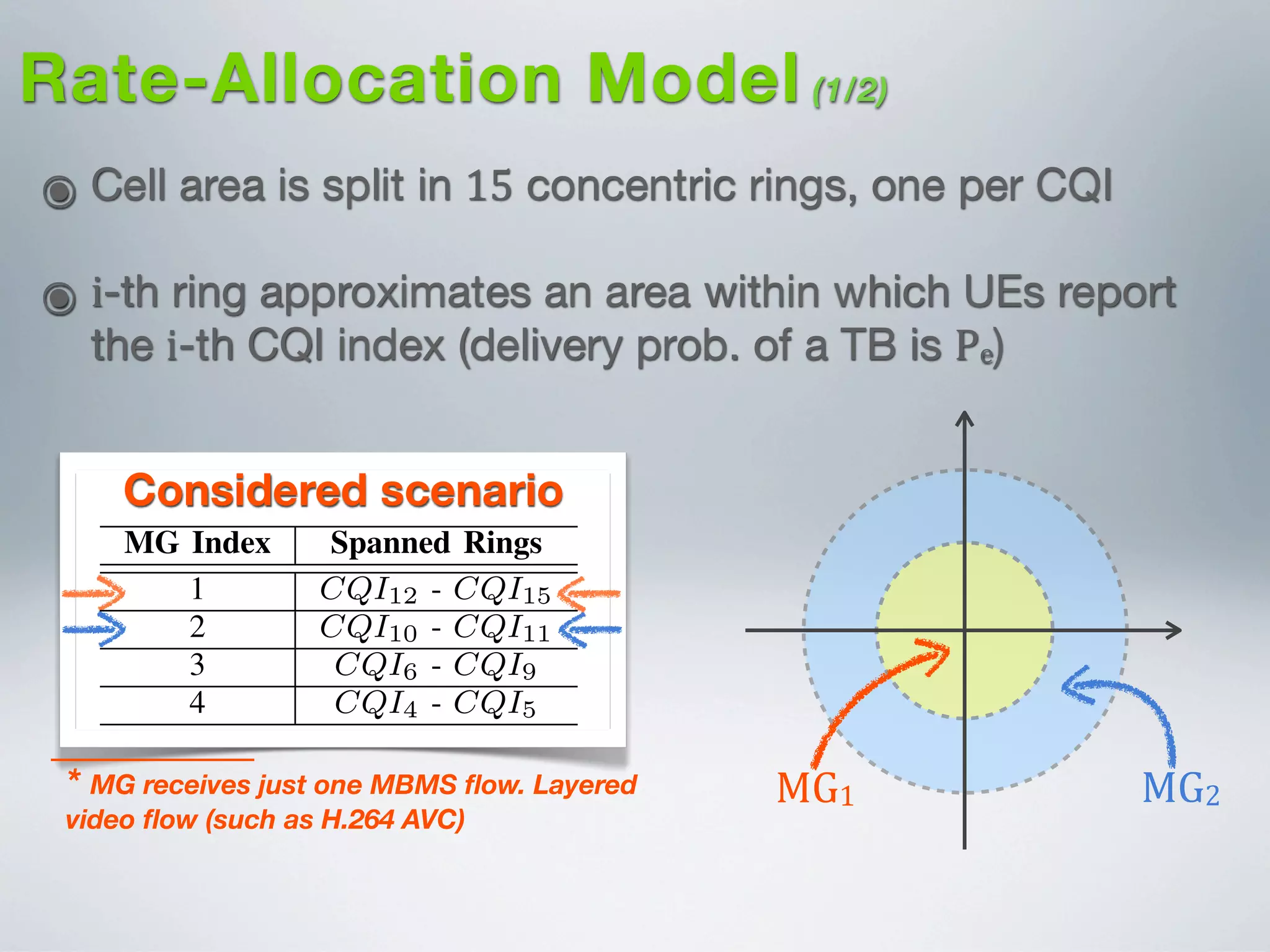
Rate-Allocation Model (1/2)
๏ Cell area is split in 15 concentric rings, one per CQI
๏ i-th ring approximates an area within which UEs report
the i-th CQI index (delivery prob. of a TB is Pe)
Considered scenario
* MG receives just one MBMS flow. Layered
video flow (such as H.264 AVC)
MG1 MG2
TABLE II
EXAMPLE SET OF MULTICAST GROUPS.
MG Index Spanned Rings
1 CQI12 - CQI15
2 CQI10 - CQI11
3 CQI6 - CQI9
4 CQI4 - CQI5
are assigned higher rate MC schemes in order to
heir PHY layer transmission rates; while an MG in
annel conditions need to receive PHY TBs processed
paper, we use NRBP,k
the k-th MG.
Finally, we assume th
cell area of radius Rc u
density . The hit prob
ring defined by ri 1 
The average number of
B. Combinatorial Erro
Let Vi (for i = 1, . . .
the number of PHY TB
I. INTRODUCTION
minimize
MX
k=1
k
⇣
15 CQIk
⌘
(1)
s.t. bk
⇣
Yk, NRBP,k
⌘
vk k, k = 1, . . . , M (2)
k  vk, k = 1, . . . , M (3)
MX
k=1
NRBP,k  ˆNRBP (4)
NRBP,k 2 N+
, k = 1, . . . , M (5)
Video content delivery over fourth generation (4G) net-
works, such as Long-Term Evolution (LTE)/LTE-Advanced
(LTE-A), is estimated to grow 18-fold between 2011-2016
[?]. This growth is mainly attributed to the surge in demand
for bandwidth-intensive mobile multimedia services by LTE-
based smartphones, tablets and laptops. 3GPP standards pro-
vide a bandwidth efficient broadcast and multicast solution
access con
network (R
round-trip
benefits sp
The foc
multi-rate
proach is
MAC-RNC
of heterog
proposed
applied to
different m
feasibility
service th
Its efficien
against the
realistic LT
The pa
the necess
LTE/LTE-
LTE/LTE-
Rate-Allocation Model (2/2)
(4) TB size optimization (i.e., NRBP,k  optimization for each flow)
matching the system constraints.
I. INTRODUCTION
minimize
MX
k=1
k
⇣
15 CQIk
⌘
(1)
s.t. bk
⇣
Yk, NRBP,k
⌘
vk k, k = 1, . . . , M (2)
k  vk, k = 1, . . . , M (3)
MX
k=1
NRBP,k  ˆNRBP (4)
NRBP,k 2 N+
, k = 1, . . . , M (5)
Video content delivery over fourth generation (4G) net-
works, such as Long-Term Evolution (LTE)/LTE-Advanced
(LTE-A), is estimated to grow 18-fold between 2011-2016
[?]. This growth is mainly attributed to the surge in demand
for bandwidth-intensive mobile multimedia services by LTE-
based smartphones, tablets and laptops. 3GPP standards pro-
vide a bandwidth efficient broadcast and multicast solution
access con
network (R
round-trip
benefits sp
The foc
multi-rate
proach is
MAC-RNC
of heterog
proposed
applied to
different m
feasibility
service th
Its efficien
against the
realistic LT
The pa
the necess
LTE/LTE-
LTE/LTE-
Rate-Allocation Model (2/2)
(2)-(3) vk is the information bit rate per MG of the k-th QoS
profile. If it cannot be matched, the slack variable δk is
not null.
(4) TB size optimization (i.e., NRBP,k  optimization for each flow)
matching the system constraints.
I. INTRODUCTION
minimize
MX
k=1
k
⇣
15 CQIk
⌘
(1)
s.t. bk
⇣
Yk, NRBP,k
⌘
vk k, k = 1, . . . , M (2)
k  vk, k = 1, . . . , M (3)
MX
k=1
NRBP,k  ˆNRBP (4)
NRBP,k 2 N+
, k = 1, . . . , M (5)
Video content delivery over fourth generation (4G) net-
works, such as Long-Term Evolution (LTE)/LTE-Advanced
(LTE-A), is estimated to grow 18-fold between 2011-2016
[?]. This growth is mainly attributed to the surge in demand
for bandwidth-intensive mobile multimedia services by LTE-
based smartphones, tablets and laptops. 3GPP standards pro-
vide a bandwidth efficient broadcast and multicast solution
access con
network (R
round-trip
benefits sp
The foc
multi-rate
proach is
MAC-RNC
of heterog
proposed
applied to
different m
feasibility
service th
Its efficien
against the
realistic LT
The pa
the necess
LTE/LTE-
LTE/LTE-
Rate-Allocation Model (2/2)
(2)-(3) vk is the information bit rate per MG of the k-th QoS
profile. If it cannot be matched, the slack variable δk is
not null.
(4) TB size optimization (i.e., NRBP,k  optimization for each flow)
matching the system constraints.
(1) the O.F. minimizes the weighted sum of the violations.
4. Numerical Results
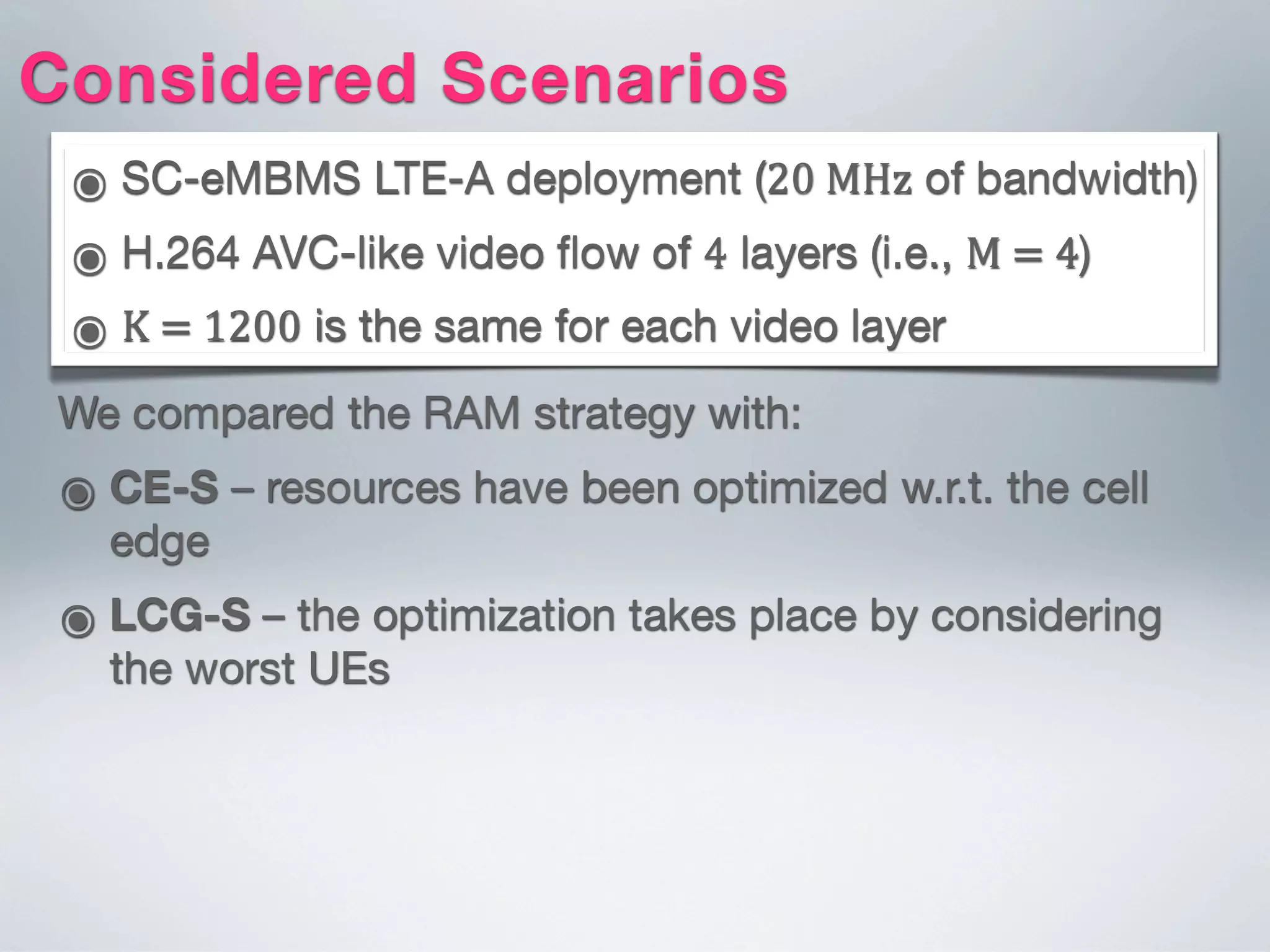
๏ SC-eMBMS LTE-A deployment (20  MHz of bandwidth)
๏ H.264 AVC-like video flow of 4 layers (i.e., M  =  4)
๏ K  =  1200 is the same for each video layer
Considered Scenarios
We compared the RAM strategy with:
๏ CE-S – resources have been optimized w.r.t. the cell
edge
๏ LCG-S – the optimization takes place by considering
the worst UEs
๏ SC-eMBMS LTE-A deployment (20  MHz of bandwidth)
๏ H.264 AVC-like video flow of 4 layers (i.e., M  =  4)
๏ K  =  1200 is the same for each video layer
Considered Scenarios
We compared the RAM strategy with:
๏ CE-S – resources have been optimized w.r.t. the cell
edge
๏ LCG-S – the optimization takes place by considering
the worst UEs
Avg cell
rate
Es are given in the second column of Table III;
he Least Channel Gain Strategy (LCG-S) - the eNB
oadcasts only a traffic flow with a bitrate that matches
e vh value (where h is the non-empty MG characterized
y the lowest CQI index). The third column of Table III
ves the considered minimum sustained bitrates (vk).
rameters vk (for k = 1, . . . , M = 4) of the RAM-S
vided in the third column of Table III. Finally, in the
ng, we considered network scenarios characterized by
B inter-site distance (ISD) of 1000m.
bk be the average downlink bitrate characterizing the
nk flow directed to the k-th MG (defined by Eq. (14)).
erage cell rate ˆb can be defined as follows:
ˆb =
MX
l=1
bl [bps]. (21)
Information bitrate
125 625 1125 1625
0
3
Generation Length ( K )
Fig. 3. The average cell rate as function of the K for different rate
strategies and considering = 15 UEs in the cell.
Hence, ˆb represents the actual bitrate that the UEs be
to the innermost MG will be able to get by combini
multicast flow broadcasted by the eNB (see Sec. III-A
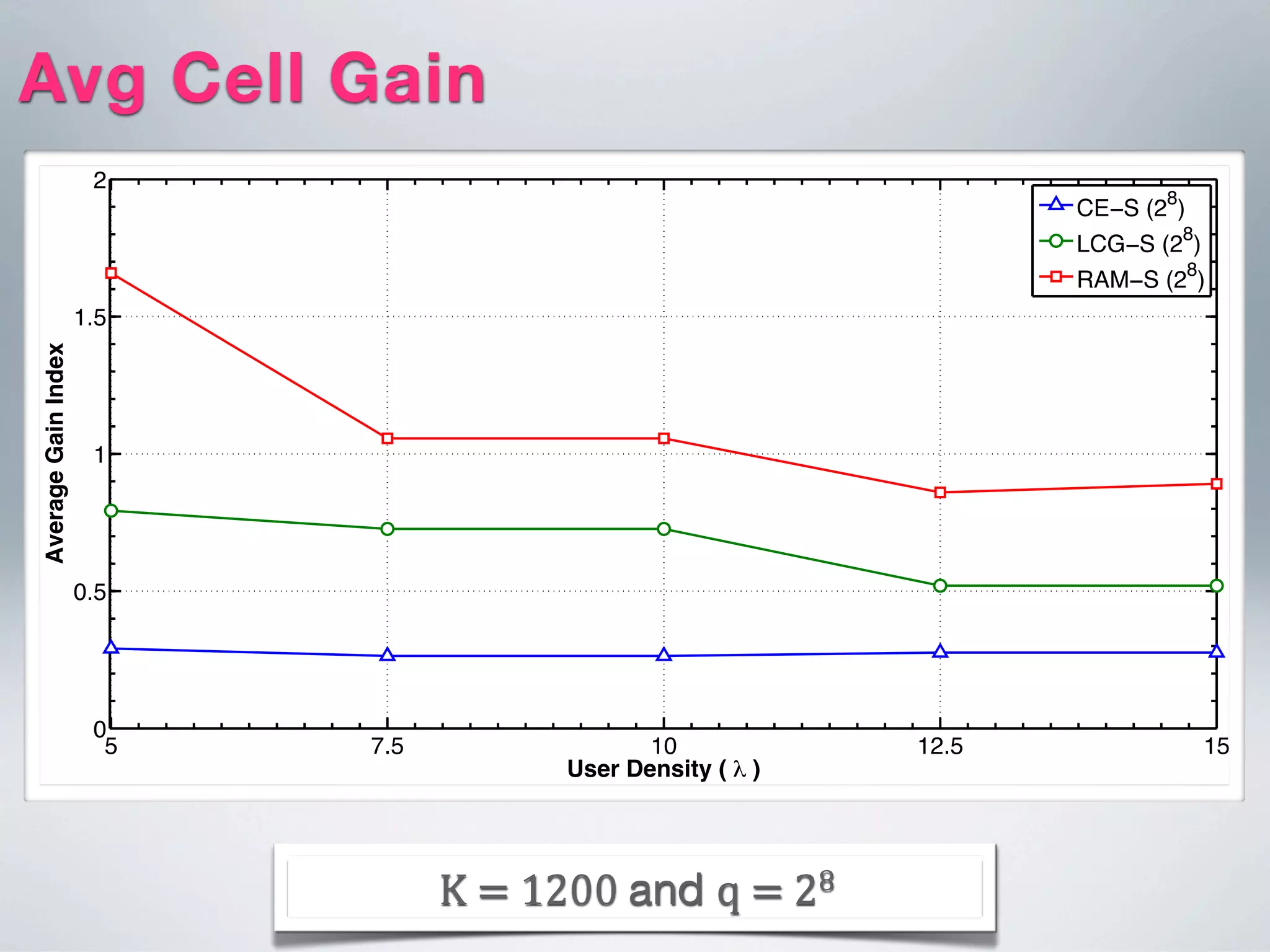
Moreover, let ok = bk/vk be the gain index charac
the k-th MG. If ok 1 then the QoS constraint of
flow is guaranteed. The average cell gain index is defi
o =
PM
l=1 | Yl>0 CQIl ol
PM
l=1 | Yl>0 CQIl
.
It represents an aggregated measure of the capability of
Avg gain index
ol  =  bl/vl
K  =  1200  and q  =  28
Avg Cell Rate
5 7.5 10 12.5 15
0
5
10
15
20
25
30
User Density ( )
AverageCellRate[Mbps]
CE−S (q = 2
8
)
LCG−S (q = 28
)
RAM−S (q = 28
)
K  =  1200  and q  =  28
Avg Cell Gain
5 7.5 10 12.5 15
0
0.5
1
1.5
2
User Density ( )
AverageGainIndex
CE−S (2
8
)
LCG−S (28
)
RAM−S (2
8
)
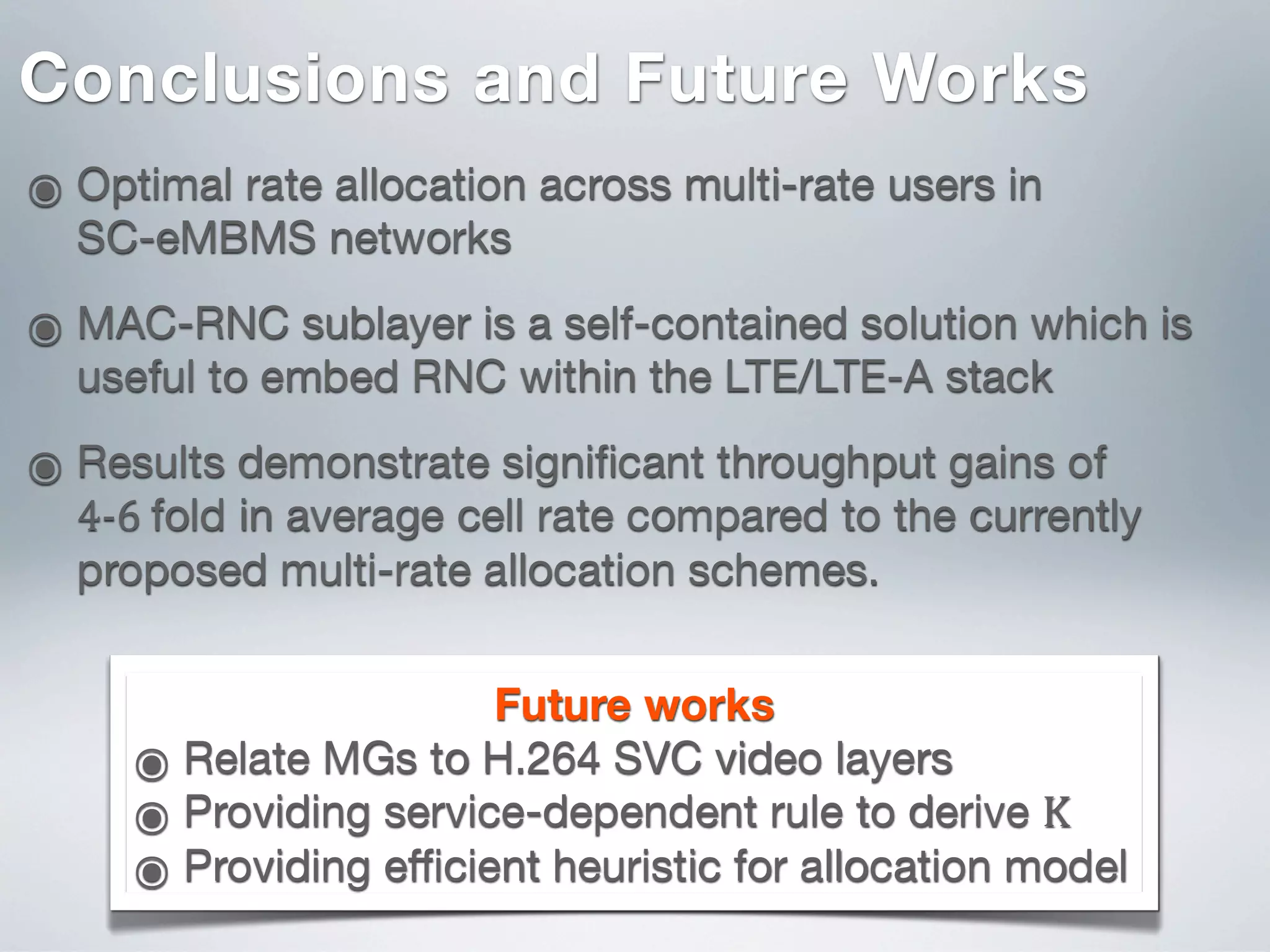
๏ Optimal rate allocation across multi-rate users in
SC-eMBMS networks
๏ MAC-RNC sublayer is a self-contained solution which is
useful to embed RNC within the LTE/LTE-A stack
๏ Results demonstrate significant throughput gains of
4-­‐6  fold in average cell rate compared to the currently
proposed multi-rate allocation schemes.
Conclusions and Future Works
Future works
๏ Relate MGs to H.264 SVC video layers
๏ Providing service-dependent rule to derive K
๏ Providing efficient heuristic for allocation model
Thank you for
your attention
Reliable Rate-Optimized Video
Multicasting Services over
LTE/LTE-A
Andrea Tassi
Francesco Chiti
Romano Fantacci
Chadi Khirallah
John Thompson
Dejan Vukobratović
C o n t a c t s
{name.surname}@unifi.it
{name.surname}@ed.ac.uk
{name.surname}@ktios.net

Presentation of 'Reliable Rate-Optimized Video Multicasting Services over LTE/LTE-A'

  • 1.
    Reliable Rate-Optimized Video MulticastingServices over LTE/LTE-A Andrea Tassi Francesco Chiti Romano Fantacci Chadi Khirallah John Thompson Dejan Vukobratović C o n t a c t s {name.surname}@unifi.it {name.surname}@ed.ac.uk {name.surname}@ktios.net
  • 2.
    Index 1. Novel multi-ratedesign for eMBMS LTE/LTE-A networks based on RNC 2. B a c k g r o u n d and previous works 3. RNC-based rate allocation model f o r SC-eMBMS systems 4. N u m e r i c a l r e s u l t s
  • 3.
    1. Novel Multi-RateDesign for eMBMS LTE/LTE-A Networks Based on RNC
  • 4.
    Rate-Optimized Multicast Services ConsideringLTE/LTE-A systems: ๏ Frame composed by RBs, TTI/2  x  12  subcarriers ๏ Data organized in TBs of a variable number of RBPs (1  RBP  =  1  TTI  x  12  subcarriers) TB RBP TTI RB
  • 5.
    Rate-Optimized Multicast Services ConsideringLTE/LTE-A systems: ๏ Frame composed by RBs, TTI/2  x  12  subcarriers ๏ Data organized in TBs of a variable number of RBPs (1  RBP  =  1  TTI  x  12  subcarriers) LTE (from 3GPP’s Rel. 9) can manage broadcast and multicast services by the eMBMS framework. The proposed design provides: ๏ Reliability, based on RNC transmission ๏ Efficiency, obtained by optimized rate allocation across multi-rate video streams. TB RBP TTI RB
  • 6.
    2. Background andPrevious Works
  • 7.
    Previous Works (1/2) Problemof rate adaptation in multicast communication systems has been addressed as follows: ๏ Cell-Edge Strategies - Rate allocation satisfies a set of QoS constraints across all UEs, including the cell-edge UEs ๏ Least Channel Gain Strategies - As the CE-S but it matches the QoS constraints of UEs in the worst propagation conditions (at the moment) ๏ Multi-Rate Adaptation Strategies - Several streams of different quality are optimized. Hence, They can manage heterogenous channel conditions.
  • 8.
    Proposed RAM strategybelongs to the latter family. ๏ Suitable for transmitting H.264 AVC multicast video services ๏ Each flow is directed to a specific MG ๏ UEs in the worst channel conditions have to decode at least the lowest channel rate sub-stream ๏ UEs in a better channel conditions can decode the higher data rate sub-streams to yield high QoS results. Previous Works (2/2)
  • 9.
    ๏ Coded symbolsare transmitted until the MG receive a set of K linearly independent coded symbols. rate design for evolved Multimedia Multicast/Broadcast Ser- vice (eMBMS) in fourth generation (4G) Long-Term Evolution (LTE)/LTE-Advanced (LTE-A) networks. The proposed design provides: i) reliability, based on random network coded (RNC) transmission, and ii) efficiency, obtained by optimized rate allo- cation across multi-rate RNC streams. The paper provides an in- depth description of the system realization and demonstrates the feasibility of the proposed eMBMS design using both analytical and simulation results. The system performance is compared with popular multi-rate multicast approaches in a realistic simulated LTE/LTE-A environment. I. INTRODUCTION ci = KX j=1 gj xj Video content delivery over fourth generation (4G) net- works, such as Long-Term Evolution (LTE)/LTE-Advanced (LTE-A), is estimated to grow 18-fold between 2011-2016 r a n r b m p M o p a d f s I a r UE1 UE2 UE3 UE4 UEY eNB Multicast3Group RNC for Reliable Multicasting Communication reliability of a video sub-flow has been improved by using the RNC as (a kind of) FEC: ๏ MG of Y UEs ๏ Each information message is K symbols long ๏ They are linearly combined to generate coded symbols
  • 10.
    3. RNC-based Rate AllocationModel for SC-eMBMS systems
  • 11.
    SC-RNC-eMBMS Stack ๏ Mmulticast groups ๏ CQI of a MG is the worst-case one ๏ IP data streams are segmented/ concatenated into RLC PDUs ๏ RLC PDU is split in K information symbols ๏ # of cod. symbols per TB PHY TBs with reconstruction probability o the selection of the number of MGs M and MC schemes can be mapped to a partition Table II (M = 4, MC={12,10,6,4}). In this a partition scheme such that the area of the (where di is the distance between the eNB ring belonging to the i-th MG) increases c The capacity of PHY TBs broadcasted ov pends on the MC mode selected and the am resources allocated to the k-th MG: Cy = ny · NRBP,y · L [bi where nk and NRBP,k represent the numbe per PHY TB (as reported in Table I) and t cation (expressed in terms of number of R # cod. symbols per RBP Depends on CQI of MG # RBPs per TB PDCP$PDU PDCP$PDU RLC$PDU x1 x2 xK ⊗ g2⊗ g1 ⊗ gK ⊕ c1 c2 ci MAC$PDU TB PDCPRLCMAC MAC(RNC PHY NRBP,y
  • 12.
    Combinatorial Error Model(1/2) ๏ Characterisation of the r.v. Vi. The i-th UE recovers a RLC PDU after j TBs with a prob. equal to Delivery prob. of a over j TBs Prob. that at least K symbols are lin. indep. over a finite field Fq n o- R el g es e e h n e e e d e of Let pi be the probability of reception of a PHY TB at the i- th UE. The cumulative density function (CDF) of Vi for j 0 and j · nk · NRBP,k K is expressed as (see Eq. (12) of [?]) Pr{Vi  j} = fi(j) = jX a=1 ui a, j w a ny NRBP,y (3) where (see Eqs. (12) and (7) of [?]) ui(n, c) = 8 < : ✓ c n ◆ pn i h 1 pi ic n if K  n  c 0 otherwise, (4) and, 8 >< K 1Y h 1 i if K  ≤  a  ≤  j, otherwise it is 0 he eNB and the outermost reases close to linearly. asted over the k-th MG de- d the amount of frequency : · L [bits] (1) e number of coded symbols I) and the frequency allo- ber of RBPs), respectively. we adopt the source/coded 2 [?]. Thus a single PHY F = nk · NRBP,k coded at all the UEs belonging to Bs allocated over the same . Hence, in the rest of this the frequency allocation to Es are placed in the macro- where (see Eqs. (12) and (7) of [?]) ui(a, j) = ✓ j a ◆ pa i h 1 pi ij a ui(a, j) = 8 >>< >>: ✓ j a ◆ pa i h 1 pi ij a if K  0 otherw and, w(c) = K 1Y b=0 h 1 1 qc b i w(c) = 8 >< >: K 1Y b=0 h 1 1 qc b i if c 0 otherw For j · nk · NRBP,i < K we have that fi(j) = 0 From (2) and (3) the expected value of the ran if c  ≥  K, otherwise it is 0 B. Combinatorial Error Model for Multicast Communication Let Vi (for i = 1, . . . , ˜uk) be a random variable representin he number of PHY TB transmissions performed by the eNB o ensure the correct reception of a RLC PDU by the i-t UE in the k-th MG. In other words, Vi is the number o ransmission attempts to ensure the correct reception of K inearly independent coded symbols by the i-th UE. Also, le U = max i=1,...,Y n Vi o (2 ๏ The r.v. representing the number of PHY TB transmissions to ensure the reception of the RLC PDU by the MG is m variable representing the number of PHY TB ns performed by the eNB to ensure the correct f the RLC PDU by all receiving UEs [?]. e the probability of reception of a PHY TB at the i- cumulative density function (CDF) of Vi for j 0 NRBP,k K is expressed as (see Eq. (12) of [?]) j} = fi(j) = jX a=1 ui a, j w a nk NRBP,k (8) Eqs. (12) and (7) of [?]) ui(a, j) = ✓ j a ◆ Pj a e h 1 Pe ia (9) = 8 >>< >>: ✓ j a ◆ pa e h 1 pe ij a if K  a  j 0 otherwise (10) K 1Y h 1 i
  • 13.
    Combinatorial Error Model(2/2) ๏ The avg. number of U is Avg. value of U ⇣(Y, NRBP,y) = 1X n=0 n " YY i=1 fi(n) YY i=1 fi(n 1) # . TABLE MINIMUM SUSTAINED BITRATE LCG-S/R Generation FR-S Bitrate Length [Mbps] 125 1.4 v 625 1.5 v1 1125 1.6 v1 1200 1.6 v1 = p.m.f. of U
  • 14.
    Combinatorial Error Model(2/2) ๏ The avg. information bit rate of the MG is resource sharing among MGs with the goal of matching th sustainable data rates requested by the set of heterogeneou UEs. The presented Rate Adaptation Model (RAM) fits to th system model where the optimal rate allocation is provided b the eNB, for example, for maximum user satisfaction durin the transmission of layered scalable video source. We assum that the provided allocation (i.e., the dimensions in terms o RBPs of PHY TBs directed to each MG) cannot be change during the video broadcasting process. From Eq. (6) the k-th MG will receive an informatio stream characterized by a bit rate defined as follows: by = by ⇣ Y, NRBP,y ⌘ = L · K TTI · ⇣(Y, NRBP,y) [bps]. (7 In this specific context the RAM optimisation model can b defined as follows (N+ = N {0}): The information bits belonging to the RLC PDU 1 ms ๏ The avg. number of U is Avg. value of U ⇣(Y, NRBP,y) = 1X n=0 n " YY i=1 fi(n) YY i=1 fi(n 1) # . TABLE MINIMUM SUSTAINED BITRATE LCG-S/R Generation FR-S Bitrate Length [Mbps] 125 1.4 v 625 1.5 v1 1125 1.6 v1 1200 1.6 v1 = p.m.f. of U
  • 15.
    Rate-Allocation Model (1/2) ๏Cell area is split in 15 concentric rings, one per CQI ๏ i-th ring approximates an area within which UEs report the i-th CQI index (delivery prob. of a TB is Pe) Considered scenario * MG receives just one MBMS flow. Layered video flow (such as H.264 AVC) MG1 MG2 TABLE II EXAMPLE SET OF MULTICAST GROUPS. MG Index Spanned Rings 1 CQI12 - CQI15 2 CQI10 - CQI11 3 CQI6 - CQI9 4 CQI4 - CQI5 are assigned higher rate MC schemes in order to heir PHY layer transmission rates; while an MG in annel conditions need to receive PHY TBs processed paper, we use NRBP,k the k-th MG. Finally, we assume th cell area of radius Rc u density . The hit prob ring defined by ri 1  The average number of B. Combinatorial Erro Let Vi (for i = 1, . . . the number of PHY TB
  • 16.
    I. INTRODUCTION minimize MX k=1 k ⇣ 15 CQIk ⌘ (1) s.t.bk ⇣ Yk, NRBP,k ⌘ vk k, k = 1, . . . , M (2) k  vk, k = 1, . . . , M (3) MX k=1 NRBP,k  ˆNRBP (4) NRBP,k 2 N+ , k = 1, . . . , M (5) Video content delivery over fourth generation (4G) net- works, such as Long-Term Evolution (LTE)/LTE-Advanced (LTE-A), is estimated to grow 18-fold between 2011-2016 [?]. This growth is mainly attributed to the surge in demand for bandwidth-intensive mobile multimedia services by LTE- based smartphones, tablets and laptops. 3GPP standards pro- vide a bandwidth efficient broadcast and multicast solution access con network (R round-trip benefits sp The foc multi-rate proach is MAC-RNC of heterog proposed applied to different m feasibility service th Its efficien against the realistic LT The pa the necess LTE/LTE- LTE/LTE- Rate-Allocation Model (2/2) (4) TB size optimization (i.e., NRBP,k  optimization for each flow) matching the system constraints.
  • 17.
    I. INTRODUCTION minimize MX k=1 k ⇣ 15 CQIk ⌘ (1) s.t.bk ⇣ Yk, NRBP,k ⌘ vk k, k = 1, . . . , M (2) k  vk, k = 1, . . . , M (3) MX k=1 NRBP,k  ˆNRBP (4) NRBP,k 2 N+ , k = 1, . . . , M (5) Video content delivery over fourth generation (4G) net- works, such as Long-Term Evolution (LTE)/LTE-Advanced (LTE-A), is estimated to grow 18-fold between 2011-2016 [?]. This growth is mainly attributed to the surge in demand for bandwidth-intensive mobile multimedia services by LTE- based smartphones, tablets and laptops. 3GPP standards pro- vide a bandwidth efficient broadcast and multicast solution access con network (R round-trip benefits sp The foc multi-rate proach is MAC-RNC of heterog proposed applied to different m feasibility service th Its efficien against the realistic LT The pa the necess LTE/LTE- LTE/LTE- Rate-Allocation Model (2/2) (2)-(3) vk is the information bit rate per MG of the k-th QoS profile. If it cannot be matched, the slack variable δk is not null. (4) TB size optimization (i.e., NRBP,k  optimization for each flow) matching the system constraints.
  • 18.
    I. INTRODUCTION minimize MX k=1 k ⇣ 15 CQIk ⌘ (1) s.t.bk ⇣ Yk, NRBP,k ⌘ vk k, k = 1, . . . , M (2) k  vk, k = 1, . . . , M (3) MX k=1 NRBP,k  ˆNRBP (4) NRBP,k 2 N+ , k = 1, . . . , M (5) Video content delivery over fourth generation (4G) net- works, such as Long-Term Evolution (LTE)/LTE-Advanced (LTE-A), is estimated to grow 18-fold between 2011-2016 [?]. This growth is mainly attributed to the surge in demand for bandwidth-intensive mobile multimedia services by LTE- based smartphones, tablets and laptops. 3GPP standards pro- vide a bandwidth efficient broadcast and multicast solution access con network (R round-trip benefits sp The foc multi-rate proach is MAC-RNC of heterog proposed applied to different m feasibility service th Its efficien against the realistic LT The pa the necess LTE/LTE- LTE/LTE- Rate-Allocation Model (2/2) (2)-(3) vk is the information bit rate per MG of the k-th QoS profile. If it cannot be matched, the slack variable δk is not null. (4) TB size optimization (i.e., NRBP,k  optimization for each flow) matching the system constraints. (1) the O.F. minimizes the weighted sum of the violations.
  • 19.
  • 20.
    ๏ SC-eMBMS LTE-Adeployment (20  MHz of bandwidth) ๏ H.264 AVC-like video flow of 4 layers (i.e., M  =  4) ๏ K  =  1200 is the same for each video layer Considered Scenarios We compared the RAM strategy with: ๏ CE-S – resources have been optimized w.r.t. the cell edge ๏ LCG-S – the optimization takes place by considering the worst UEs
  • 21.
    ๏ SC-eMBMS LTE-Adeployment (20  MHz of bandwidth) ๏ H.264 AVC-like video flow of 4 layers (i.e., M  =  4) ๏ K  =  1200 is the same for each video layer Considered Scenarios We compared the RAM strategy with: ๏ CE-S – resources have been optimized w.r.t. the cell edge ๏ LCG-S – the optimization takes place by considering the worst UEs Avg cell rate Es are given in the second column of Table III; he Least Channel Gain Strategy (LCG-S) - the eNB oadcasts only a traffic flow with a bitrate that matches e vh value (where h is the non-empty MG characterized y the lowest CQI index). The third column of Table III ves the considered minimum sustained bitrates (vk). rameters vk (for k = 1, . . . , M = 4) of the RAM-S vided in the third column of Table III. Finally, in the ng, we considered network scenarios characterized by B inter-site distance (ISD) of 1000m. bk be the average downlink bitrate characterizing the nk flow directed to the k-th MG (defined by Eq. (14)). erage cell rate ˆb can be defined as follows: ˆb = MX l=1 bl [bps]. (21) Information bitrate 125 625 1125 1625 0 3 Generation Length ( K ) Fig. 3. The average cell rate as function of the K for different rate strategies and considering = 15 UEs in the cell. Hence, ˆb represents the actual bitrate that the UEs be to the innermost MG will be able to get by combini multicast flow broadcasted by the eNB (see Sec. III-A Moreover, let ok = bk/vk be the gain index charac the k-th MG. If ok 1 then the QoS constraint of flow is guaranteed. The average cell gain index is defi o = PM l=1 | Yl>0 CQIl ol PM l=1 | Yl>0 CQIl . It represents an aggregated measure of the capability of Avg gain index ol  =  bl/vl
  • 22.
    K  =  1200 and q  =  28 Avg Cell Rate 5 7.5 10 12.5 15 0 5 10 15 20 25 30 User Density ( ) AverageCellRate[Mbps] CE−S (q = 2 8 ) LCG−S (q = 28 ) RAM−S (q = 28 )
  • 23.
    K  =  1200 and q  =  28 Avg Cell Gain 5 7.5 10 12.5 15 0 0.5 1 1.5 2 User Density ( ) AverageGainIndex CE−S (2 8 ) LCG−S (28 ) RAM−S (2 8 )
  • 24.
    ๏ Optimal rateallocation across multi-rate users in SC-eMBMS networks ๏ MAC-RNC sublayer is a self-contained solution which is useful to embed RNC within the LTE/LTE-A stack ๏ Results demonstrate significant throughput gains of 4-­‐6  fold in average cell rate compared to the currently proposed multi-rate allocation schemes. Conclusions and Future Works Future works ๏ Relate MGs to H.264 SVC video layers ๏ Providing service-dependent rule to derive K ๏ Providing efficient heuristic for allocation model
  • 25.
  • 26.
    Reliable Rate-Optimized Video MulticastingServices over LTE/LTE-A Andrea Tassi Francesco Chiti Romano Fantacci Chadi Khirallah John Thompson Dejan Vukobratović C o n t a c t s {name.surname}@unifi.it {name.surname}@ed.ac.uk {name.surname}@ktios.net