Lekashri S. Int. Journal of Engineering Research and Applications www.ijera.com
ISSN: 2248-9622, Vol. 6, Issue 4, (Part - 7) April 2016, pp.45-48
www.ijera.com 45|P a g e
Optimization of Test Pattern Using Genetic Algorithm for Testing
SRAM
Lekashri S
PhD Scholar, Anna University, Chennai, Tamil Nadu, India
ABSTRACT
An optimization of test pattern for testing of a Static Random Access Memory (SRAM) using genetic algorithm
interconnects presented here is a method that associates a turn on inputs to numerous nets, which gives rise to
test vectors to determine stuck-at, open, and bridging faults. This set up gives us privilege in reducing
unnecessary composition that reduces the testing time for application-dependent testing for coverage of faults.
This optimized test pattern is used as a test source for testing a circuit and identifying the faults in the circuit.
The faults which are covered in are stuck at open and bridging faults. Genetic algorithm reduces the redundancy
and optimizes the test pattern which results in reduced testing time and power consumption.
Keywords: Test pattern generator (TPG), Genetic Algorithm (GA), Linear feedback shift register (LFSR) Build
in self-test (BIST), Circuit under test (CUT), Output response analyzer (ORA).
I. INTRODUCTION
Built in Self-Test (BIST) is an emerging
technique for testing complex VLSI systems. To test
a design by using a BIST methodology, the design
has to be modified (enhanced) in such a way that part
of the circuit is used to test the design itself.
Therefore, BIST is defined as a Design for testability
(DFT) technique in which testing is accomplished
through built-in hardware components. A general
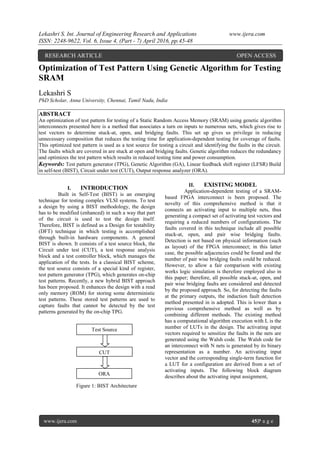
BIST is shown. It consists of a test source block, the
Circuit under test (CUT), a test response analysis
block and a test controller block, which manages the
application of the tests. In a classical BIST scheme,
the test source consists of a special kind of register,
test pattern generator (TPG), which generates on-chip
test patterns. Recently, a new hybrid BIST approach
has been proposed. It enhances the design with a read
only memory (ROM) for storing some deterministic
test patterns. These stored test patterns are used to
capture faults that cannot be detected by the test
patterns generated by the on-chip TPG.
Figure 1: BIST Architecture
II. EXISTING MODEL
Application-dependent testing of a SRAM-
based FPGA interconnect is been proposed. The
novelty of this comprehensive method is that it
connects an activating input to multiple nets, thus
generating a compact set of activating test vectors and
requiring a reduced numbers of configurations. The
faults covered in this technique include all possible
stuck-at, open, and pair wise bridging faults.
Detection is not based on physical information (such
as layout) of the FPGA interconnect; in this latter
case, the possible adjacencies could be found and the
number of pair wise bridging faults could be reduced.
However, to allow a fair comparison with existing
works logic simulation is therefore employed also in
this paper; therefore, all possible stuck-at, open, and
pair wise bridging faults are considered and detected
by the proposed approach. So, for detecting the faults
at the primary outputs, the induction fault detection
method presented in is adopted. This is lower than a
previous comprehensive method as well as by
combining different methods. The existing method
has a computational algorithm execution with L is the
number of LUTs in the design. The activating input
vectors required to sensitize the faults in the nets are
generated using the Walsh code. The Walsh code for
an interconnect with N nets is generated by its binary
representation as a number. An activating input
vector and the corresponding single-term function for
a LUT for a configuration are derived from a set of
activating inputs. The following block diagram
describes about the activating input assignment,
Test Source
CUT
ORA
RESEARCH ARTICLE OPEN ACCESS
Lekashri S. Int. Journal of Engineering Research and Applications www.ijera.com
ISSN: 2248-9622, Vol. 6, Issue 4, (Part - 7) April 2016, pp.45-48
www.ijera.com 46|P a g e
Figure 2: An Input Assignment
III. CONFIGURATION GENERATION
ALGORITTHM
The process of assigning activating inputs
and test vectors in the configurations for the nets
starts by extracting the interconnect features of a
specific circuit mapped to an FGPA (in this case, this
is given by the Vertex 4) from the Native Generic
Database (NGD) of the design. The NGD is
converted to a text file and then the nets are sorted
based on the number of connected LUTs. A greedy
criterion for selecting the activating inputs and test
vectors is used as follows: The first activating input is
assigned to a net that is connected to the largest
number of LUTs, followed by assigning the second
and third activating inputs to the other nets in a
descending order. However, during each activating
input assignment, it must be ensured that no two (or
more) nets connected to a LUT are driven by the
same activating input. In the case of two nets
connected to the same LUT having the same
activating input, one of the activating inputs is
assigned to the next available activating input to
resolve the conflict. The pseudo code for the above
process as given in the induction method of Tahoori
[3] is utilized for propagating the sensitized faults to
the primary output, thus accomplishing observability
in detection.
At completion of the algorithm, the
activating inputs to the LUTs are found and hence,
the corresponding test configurations can be
determined.
IV. PROPOSED METHOD
Optimization of test patterns for testing
SRAM using genetic algorithm is been proposed. The
novelty of this comprehensive method is that it
connects an activating input to multiple nets, thus
generating a compact set of activating test vectors and
requiring a reduced numbers of configurations. The
faults covered in this technique include all possible
stuck-at, open, and pair wise bridging faults.
However, to allow a fair comparison with existing
works logic simulation is therefore employed also in
this paper; therefore, all possible stuck-at, open, and
pair wise bridging faults are considered and detected
by the proposed approach. So, for detecting the faults
at the primary outputs, the induction fault detection
method is adopted. The proposed method optimizes
the test pattern in execution .This is lower than a
previous comprehensive method. The proposed
method has a genetic algorithm execution. Therefore,
the proposed method differs from previous
approaches with respect to test pattern. The test
patterns are generated by using Linear feedback shift
register (LFSR).
An LFSR is a shift register with feedbacks
from the last stage and other stages. The outputs of its
flip-flops form the test pattern. Each state of the
LFSR corresponds to one test pattern. The number of
unique test patterns the LFSR can generate depends
on the number and location of the feedbacks as well
as its initial value, which is known as the seed. An
example of an LFSR is shown in Figure 3
Figure 3: LFSR Example
It is initialized with the seed 0001. In the
subsequent clock cycles, a series of test patterns are
produced at the outputs of the flip-flops. This LFSR,
which has n=4 flip-flops, produces a total of 15 (2n -
1) distinct patterns (except 0000) as shown in
Figure.3. The feedback positions are usually
described by a characteristic polynomial. In our
example, feedbacks are made from the first (x) and
the fourth (x4) positions, hence the characteristic
polynomial of the LFSR is p(x) = 1 + x + x4. The
0 0 0 1
1 0 0 0
1 1 0 0
1 1 1 0
1 1 1 1
0 1 1 1
1 0 1 1
0 1 0 0
1 0 1 1
1 1 0 0
0 1 1 0
0 0 1 1
1 0 0 1
0 1 0 0
0 0 1 0
0 0 0 1
Lekashri S. Int. Journal of Engineering Research and Applications www.ijera.com
ISSN: 2248-9622, Vol. 6, Issue 4, (Part - 7) April 2016, pp.45-48
www.ijera.com 47|P a g e
choice of feedback positions (the choice of the
polynomial) determines the length of the test
sequences generated. Special polynomials known as
primitive polynomials give maximal length sequences
(2n-1). A polynomial p(x) = 1 + x + x4, which is used
in our example, is primitive. It generates a sequence
of 15 distinct test patterns before repetition.
Therefore, when designing an LFSR a good choice of
seed and polynomial is crucial for generating a good
sequence of tests. These test patterns optimized by
using genetic algorithm (GA)
V. GENETIC ALGORITHM
Genetic algorithm (GA) is an adaptive
heuristic search algorithm based on the mechanism of
natural selection and evaluation. GA is an artificial
intelligence procedure and robust search method.
This technique is efficient for finding combinatorial
optimization problem. The objective of GA is to find
optimal solution to a problem. Genetic algorithm
belongs to the class of evolutionary algorithm which
generates solution to optimization problems using
techniques inspired by natural evolution such as
inheritance, mutation, selection and crossover.
VI. BLOCK DESCRIPTION
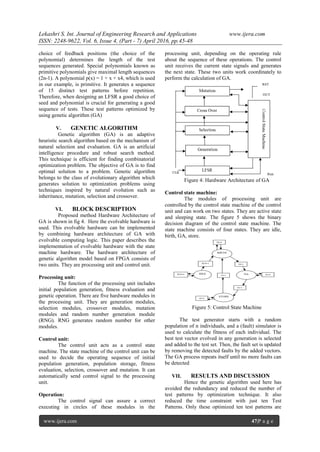
Proposed method Hardware Architecture of
GA is shown in fig 4. Here the evolvable hardware is
used. This evolvable hardware can be implemented
by combining hardware architecture of GA with
evolvable computing logic. This paper describes the
implementation of evolvable hardware with the state
machine hardware. The hardware architecture of
genetic algorithm model based on FPGA consists of
two units. They are processing unit and control unit.
Processing unit:
The function of the processing unit includes
initial population generation, fitness evaluation and
genetic operation. There are five hardware modules in
the processing unit. They are generation modules,
selection modules, crossover modules, mutation
modules and random number generation module
(RNG). RNG generates random number for other
modules.
Control unit:
The control unit acts as a control state
machine. The state machine of the control unit can be
used to decide the operating sequence of initial
population generation, population storage, fitness
evaluation, selection, crossover and mutation. It can
automatically send control signal to the processing
unit.
Operation:
The control signal can assure a correct
executing in circles of these modules in the
processing unit, depending on the operating rule
about the sequence of these operations. The control
unit receives the current state signals and generates
the next state. These two units work coordinately to
perform the calculation of GA.
Figure 4: Hardware Architecture of GA
Control state machine:
The modules of processing unit are
controlled by the control state machine of the control
unit and can work on two states. They are active state
and sleeping state. The figure 5 shows the binary
decision diagram of the control state machine. The
state machine consists of four states. They are idle,
birth, GA, store.
Figure 5: Control State Machine
The test generator starts with a random
population of n individuals, and a (fault) simulator is
used to calculate the fitness of each individual. The
best test vector evolved in any generation is selected
and added to the test set. Then, the fault set is updated
by removing the detected faults by the added vectors.
The GA process repeats itself until no more faults can
be detected
VII. RESULTS AND DISCUSSION
Hence the genetic algorithm used here has
avoided the redundancy and reduced the number of
test patterns by optimization technique. It also
reduced the time constraint with just ten Test
Patterns. Only these optimized ten test patterns are
Lekashri S. Int. Journal of Engineering Research and Applications www.ijera.com
ISSN: 2248-9622, Vol. 6, Issue 4, (Part - 7) April 2016, pp.45-48
www.ijera.com 48|P a g e
used for testing and fault analysis of the circuit. The
simulated output of without fault and with fault are
shown below in fig 6 & fig 7 respectively. Thus the
observed results from the proposed architecture
achieves minimum power in the range of 220-230
mW and the reduced time constraint is about 1.5-2 ns.
Figure 6: Without Fault
Figure 7: With Fault
VIII. CONCLUSION
Thus genetic algorithmic method for
optimizing test pattern for testing of a SRAM that is
been proposed relies on generating minimized test
patterns. This algorithmic-based method detects all
stuck-at, open, and pair wise bridging faults,
optimizes test patterns with minimum time constraint
and less power consumption.
REFERENCES
[1] M. J. O'Dare and T. Arslan,”Generating Test
Patterns For Vlsi Circuits Using A Genetic
Algorithm” ,U.K.
[2] Lalit A. Patel, Sarman K. Hadia,“Transistor
Level Fault Finding in VLSI Circuits using
Genetic Algorithm “
[3] M.B. Tahoori, “Application-Dependent
Testing of FPGAs,” IEEE Trans. Very Large
Scale Integration Systems, vol. 14, no. 9, pp.
1024- 1033, Sept. 2006.
[4] M.B. Tahoori, “Application-Dependent
Testing of FPGA Interconnects,” Proc. 18th
IEEE Int’l Symp. Defect and Fault
Tolerance in VLSI Systems, pp. 409-416,
Nov. 2003.
[5] M.B. Tahoori, “Application-Dependent
Diagnosis of FPGAs,” Proc. IEEE Int’l Test
Conf., pp. 645-654, Oct. 2004.
[6] A. Doumar and H. Ito, “Testing the Logic
Cells and Interconnect Resources for
FPGAs,” Proc. Eighth Asian Test Symp., pp.
369-374, Nov. 1999.
[7] Y. Yu, J. Xu, W.K. Huang, and F.
Lombardi, “A Diagnosis Method for
Interconnects in SRAM Based FPGAs,”
Proc. Seventh Asian Test Symp., pp. 278-
282, Dec. 1998.
[8] W.K. Huang, X.T. Chen, and F. Lombardi,
“On the Diagnosis of Programmable
Interconnect System: Theory and
Application,” Proc. 14th VLSl Test Symp.,
pp. 204-209, Apr. 1996.
[9] F. Lombardi, D. Ashen, X. Chen, and W.K.
Huang, “Diagnosing Programmable
Interconnect System for FPGAs,” Proc.
Fourth ACM Int’l Symp. Field-
Programmable Gate Arrays, pp. 100-106,
1996.
[10] Feng Liang, Luwen Zhang, Shaochong Lei,
Guohe Zhang, Kaile Gao an

Optimization of Test Pattern Using Genetic Algorithm for Testing SRAM

  • 1.
    Lekashri S. Int.Journal of Engineering Research and Applications www.ijera.com ISSN: 2248-9622, Vol. 6, Issue 4, (Part - 7) April 2016, pp.45-48 www.ijera.com 45|P a g e Optimization of Test Pattern Using Genetic Algorithm for Testing SRAM Lekashri S PhD Scholar, Anna University, Chennai, Tamil Nadu, India ABSTRACT An optimization of test pattern for testing of a Static Random Access Memory (SRAM) using genetic algorithm interconnects presented here is a method that associates a turn on inputs to numerous nets, which gives rise to test vectors to determine stuck-at, open, and bridging faults. This set up gives us privilege in reducing unnecessary composition that reduces the testing time for application-dependent testing for coverage of faults. This optimized test pattern is used as a test source for testing a circuit and identifying the faults in the circuit. The faults which are covered in are stuck at open and bridging faults. Genetic algorithm reduces the redundancy and optimizes the test pattern which results in reduced testing time and power consumption. Keywords: Test pattern generator (TPG), Genetic Algorithm (GA), Linear feedback shift register (LFSR) Build in self-test (BIST), Circuit under test (CUT), Output response analyzer (ORA). I. INTRODUCTION Built in Self-Test (BIST) is an emerging technique for testing complex VLSI systems. To test a design by using a BIST methodology, the design has to be modified (enhanced) in such a way that part of the circuit is used to test the design itself. Therefore, BIST is defined as a Design for testability (DFT) technique in which testing is accomplished through built-in hardware components. A general BIST is shown. It consists of a test source block, the Circuit under test (CUT), a test response analysis block and a test controller block, which manages the application of the tests. In a classical BIST scheme, the test source consists of a special kind of register, test pattern generator (TPG), which generates on-chip test patterns. Recently, a new hybrid BIST approach has been proposed. It enhances the design with a read only memory (ROM) for storing some deterministic test patterns. These stored test patterns are used to capture faults that cannot be detected by the test patterns generated by the on-chip TPG. Figure 1: BIST Architecture II. EXISTING MODEL Application-dependent testing of a SRAM- based FPGA interconnect is been proposed. The novelty of this comprehensive method is that it connects an activating input to multiple nets, thus generating a compact set of activating test vectors and requiring a reduced numbers of configurations. The faults covered in this technique include all possible stuck-at, open, and pair wise bridging faults. Detection is not based on physical information (such as layout) of the FPGA interconnect; in this latter case, the possible adjacencies could be found and the number of pair wise bridging faults could be reduced. However, to allow a fair comparison with existing works logic simulation is therefore employed also in this paper; therefore, all possible stuck-at, open, and pair wise bridging faults are considered and detected by the proposed approach. So, for detecting the faults at the primary outputs, the induction fault detection method presented in is adopted. This is lower than a previous comprehensive method as well as by combining different methods. The existing method has a computational algorithm execution with L is the number of LUTs in the design. The activating input vectors required to sensitize the faults in the nets are generated using the Walsh code. The Walsh code for an interconnect with N nets is generated by its binary representation as a number. An activating input vector and the corresponding single-term function for a LUT for a configuration are derived from a set of activating inputs. The following block diagram describes about the activating input assignment, Test Source CUT ORA RESEARCH ARTICLE OPEN ACCESS
  • 2.
    Lekashri S. Int.Journal of Engineering Research and Applications www.ijera.com ISSN: 2248-9622, Vol. 6, Issue 4, (Part - 7) April 2016, pp.45-48 www.ijera.com 46|P a g e Figure 2: An Input Assignment III. CONFIGURATION GENERATION ALGORITTHM The process of assigning activating inputs and test vectors in the configurations for the nets starts by extracting the interconnect features of a specific circuit mapped to an FGPA (in this case, this is given by the Vertex 4) from the Native Generic Database (NGD) of the design. The NGD is converted to a text file and then the nets are sorted based on the number of connected LUTs. A greedy criterion for selecting the activating inputs and test vectors is used as follows: The first activating input is assigned to a net that is connected to the largest number of LUTs, followed by assigning the second and third activating inputs to the other nets in a descending order. However, during each activating input assignment, it must be ensured that no two (or more) nets connected to a LUT are driven by the same activating input. In the case of two nets connected to the same LUT having the same activating input, one of the activating inputs is assigned to the next available activating input to resolve the conflict. The pseudo code for the above process as given in the induction method of Tahoori [3] is utilized for propagating the sensitized faults to the primary output, thus accomplishing observability in detection. At completion of the algorithm, the activating inputs to the LUTs are found and hence, the corresponding test configurations can be determined. IV. PROPOSED METHOD Optimization of test patterns for testing SRAM using genetic algorithm is been proposed. The novelty of this comprehensive method is that it connects an activating input to multiple nets, thus generating a compact set of activating test vectors and requiring a reduced numbers of configurations. The faults covered in this technique include all possible stuck-at, open, and pair wise bridging faults. However, to allow a fair comparison with existing works logic simulation is therefore employed also in this paper; therefore, all possible stuck-at, open, and pair wise bridging faults are considered and detected by the proposed approach. So, for detecting the faults at the primary outputs, the induction fault detection method is adopted. The proposed method optimizes the test pattern in execution .This is lower than a previous comprehensive method. The proposed method has a genetic algorithm execution. Therefore, the proposed method differs from previous approaches with respect to test pattern. The test patterns are generated by using Linear feedback shift register (LFSR). An LFSR is a shift register with feedbacks from the last stage and other stages. The outputs of its flip-flops form the test pattern. Each state of the LFSR corresponds to one test pattern. The number of unique test patterns the LFSR can generate depends on the number and location of the feedbacks as well as its initial value, which is known as the seed. An example of an LFSR is shown in Figure 3 Figure 3: LFSR Example It is initialized with the seed 0001. In the subsequent clock cycles, a series of test patterns are produced at the outputs of the flip-flops. This LFSR, which has n=4 flip-flops, produces a total of 15 (2n - 1) distinct patterns (except 0000) as shown in Figure.3. The feedback positions are usually described by a characteristic polynomial. In our example, feedbacks are made from the first (x) and the fourth (x4) positions, hence the characteristic polynomial of the LFSR is p(x) = 1 + x + x4. The 0 0 0 1 1 0 0 0 1 1 0 0 1 1 1 0 1 1 1 1 0 1 1 1 1 0 1 1 0 1 0 0 1 0 1 1 1 1 0 0 0 1 1 0 0 0 1 1 1 0 0 1 0 1 0 0 0 0 1 0 0 0 0 1
  • 3.
    Lekashri S. Int.Journal of Engineering Research and Applications www.ijera.com ISSN: 2248-9622, Vol. 6, Issue 4, (Part - 7) April 2016, pp.45-48 www.ijera.com 47|P a g e choice of feedback positions (the choice of the polynomial) determines the length of the test sequences generated. Special polynomials known as primitive polynomials give maximal length sequences (2n-1). A polynomial p(x) = 1 + x + x4, which is used in our example, is primitive. It generates a sequence of 15 distinct test patterns before repetition. Therefore, when designing an LFSR a good choice of seed and polynomial is crucial for generating a good sequence of tests. These test patterns optimized by using genetic algorithm (GA) V. GENETIC ALGORITHM Genetic algorithm (GA) is an adaptive heuristic search algorithm based on the mechanism of natural selection and evaluation. GA is an artificial intelligence procedure and robust search method. This technique is efficient for finding combinatorial optimization problem. The objective of GA is to find optimal solution to a problem. Genetic algorithm belongs to the class of evolutionary algorithm which generates solution to optimization problems using techniques inspired by natural evolution such as inheritance, mutation, selection and crossover. VI. BLOCK DESCRIPTION Proposed method Hardware Architecture of GA is shown in fig 4. Here the evolvable hardware is used. This evolvable hardware can be implemented by combining hardware architecture of GA with evolvable computing logic. This paper describes the implementation of evolvable hardware with the state machine hardware. The hardware architecture of genetic algorithm model based on FPGA consists of two units. They are processing unit and control unit. Processing unit: The function of the processing unit includes initial population generation, fitness evaluation and genetic operation. There are five hardware modules in the processing unit. They are generation modules, selection modules, crossover modules, mutation modules and random number generation module (RNG). RNG generates random number for other modules. Control unit: The control unit acts as a control state machine. The state machine of the control unit can be used to decide the operating sequence of initial population generation, population storage, fitness evaluation, selection, crossover and mutation. It can automatically send control signal to the processing unit. Operation: The control signal can assure a correct executing in circles of these modules in the processing unit, depending on the operating rule about the sequence of these operations. The control unit receives the current state signals and generates the next state. These two units work coordinately to perform the calculation of GA. Figure 4: Hardware Architecture of GA Control state machine: The modules of processing unit are controlled by the control state machine of the control unit and can work on two states. They are active state and sleeping state. The figure 5 shows the binary decision diagram of the control state machine. The state machine consists of four states. They are idle, birth, GA, store. Figure 5: Control State Machine The test generator starts with a random population of n individuals, and a (fault) simulator is used to calculate the fitness of each individual. The best test vector evolved in any generation is selected and added to the test set. Then, the fault set is updated by removing the detected faults by the added vectors. The GA process repeats itself until no more faults can be detected VII. RESULTS AND DISCUSSION Hence the genetic algorithm used here has avoided the redundancy and reduced the number of test patterns by optimization technique. It also reduced the time constraint with just ten Test Patterns. Only these optimized ten test patterns are
  • 4.
    Lekashri S. Int.Journal of Engineering Research and Applications www.ijera.com ISSN: 2248-9622, Vol. 6, Issue 4, (Part - 7) April 2016, pp.45-48 www.ijera.com 48|P a g e used for testing and fault analysis of the circuit. The simulated output of without fault and with fault are shown below in fig 6 & fig 7 respectively. Thus the observed results from the proposed architecture achieves minimum power in the range of 220-230 mW and the reduced time constraint is about 1.5-2 ns. Figure 6: Without Fault Figure 7: With Fault VIII. CONCLUSION Thus genetic algorithmic method for optimizing test pattern for testing of a SRAM that is been proposed relies on generating minimized test patterns. This algorithmic-based method detects all stuck-at, open, and pair wise bridging faults, optimizes test patterns with minimum time constraint and less power consumption. REFERENCES [1] M. J. O'Dare and T. Arslan,”Generating Test Patterns For Vlsi Circuits Using A Genetic Algorithm” ,U.K. [2] Lalit A. Patel, Sarman K. Hadia,“Transistor Level Fault Finding in VLSI Circuits using Genetic Algorithm “ [3] M.B. Tahoori, “Application-Dependent Testing of FPGAs,” IEEE Trans. Very Large Scale Integration Systems, vol. 14, no. 9, pp. 1024- 1033, Sept. 2006. [4] M.B. Tahoori, “Application-Dependent Testing of FPGA Interconnects,” Proc. 18th IEEE Int’l Symp. Defect and Fault Tolerance in VLSI Systems, pp. 409-416, Nov. 2003. [5] M.B. Tahoori, “Application-Dependent Diagnosis of FPGAs,” Proc. IEEE Int’l Test Conf., pp. 645-654, Oct. 2004. [6] A. Doumar and H. Ito, “Testing the Logic Cells and Interconnect Resources for FPGAs,” Proc. Eighth Asian Test Symp., pp. 369-374, Nov. 1999. [7] Y. Yu, J. Xu, W.K. Huang, and F. Lombardi, “A Diagnosis Method for Interconnects in SRAM Based FPGAs,” Proc. Seventh Asian Test Symp., pp. 278- 282, Dec. 1998. [8] W.K. Huang, X.T. Chen, and F. Lombardi, “On the Diagnosis of Programmable Interconnect System: Theory and Application,” Proc. 14th VLSl Test Symp., pp. 204-209, Apr. 1996. [9] F. Lombardi, D. Ashen, X. Chen, and W.K. Huang, “Diagnosing Programmable Interconnect System for FPGAs,” Proc. Fourth ACM Int’l Symp. Field- Programmable Gate Arrays, pp. 100-106, 1996. [10] Feng Liang, Luwen Zhang, Shaochong Lei, Guohe Zhang, Kaile Gao an