The constructor constructs the objects and destructor
destroys the objects.
The compiler automatically executes these functions. The
programmer does not need to make any effort for
invoking these functions.
When an object is created, constructor is executed. The
programmer can also pass values to the constructor to
initialize member variables with different values.
The destructor is executed at the end of the function
when objects are of no use or go out of scope.
If the programmer does not define them, the compiler
executes implicit constructor and destructor.
1
Constructors and destructors are special member functions. They
decide how the objects of a class are created, initialized, copied,
and destroyed. Their names are distinguished from all other
member functions because their names are same as the class they
belong to. The only difference is that destructor is preceded by a ~
(tilde) operator.
2
Constructors
• Constructors have the same name as that of the class they belong
to.
• Constructors are executed when an object is declared.
• Constructors have neither return value nor void.
• The main function of constructor is to initialize objects and allocate
appropriate memory to objects.
• Though constructors are executed implicitly, they can be invoked
explicitly.
• Constructors can have default values and can be overloaded.
• The constructor without arguments is called as default constructor.
3
Destructors
• Destructors have the same name as that of the class they belong to
preceded by ~ (tilde).
• Similar to constructors, the destructors do not have return type and not
even void.
• Constructors and destructors cannot be inherited, though a derived class
can call the constructors and destructors of the base class.
• Destructors can be virtual, but constructors cannot.
• Only one destructor can be defined in the destructor. The destructor
does not have any arguments.
• Destructors neither have default values nor can be overloaded.
• Programmer cannot access addresses of constructors and destructors.
• Constructors and destructors can make implicit calls to
operators new and delete if memory allocation/de-allocation is needed
for an object.
• An object with a constructor or destructor cannot be used as a member
of a union. 4
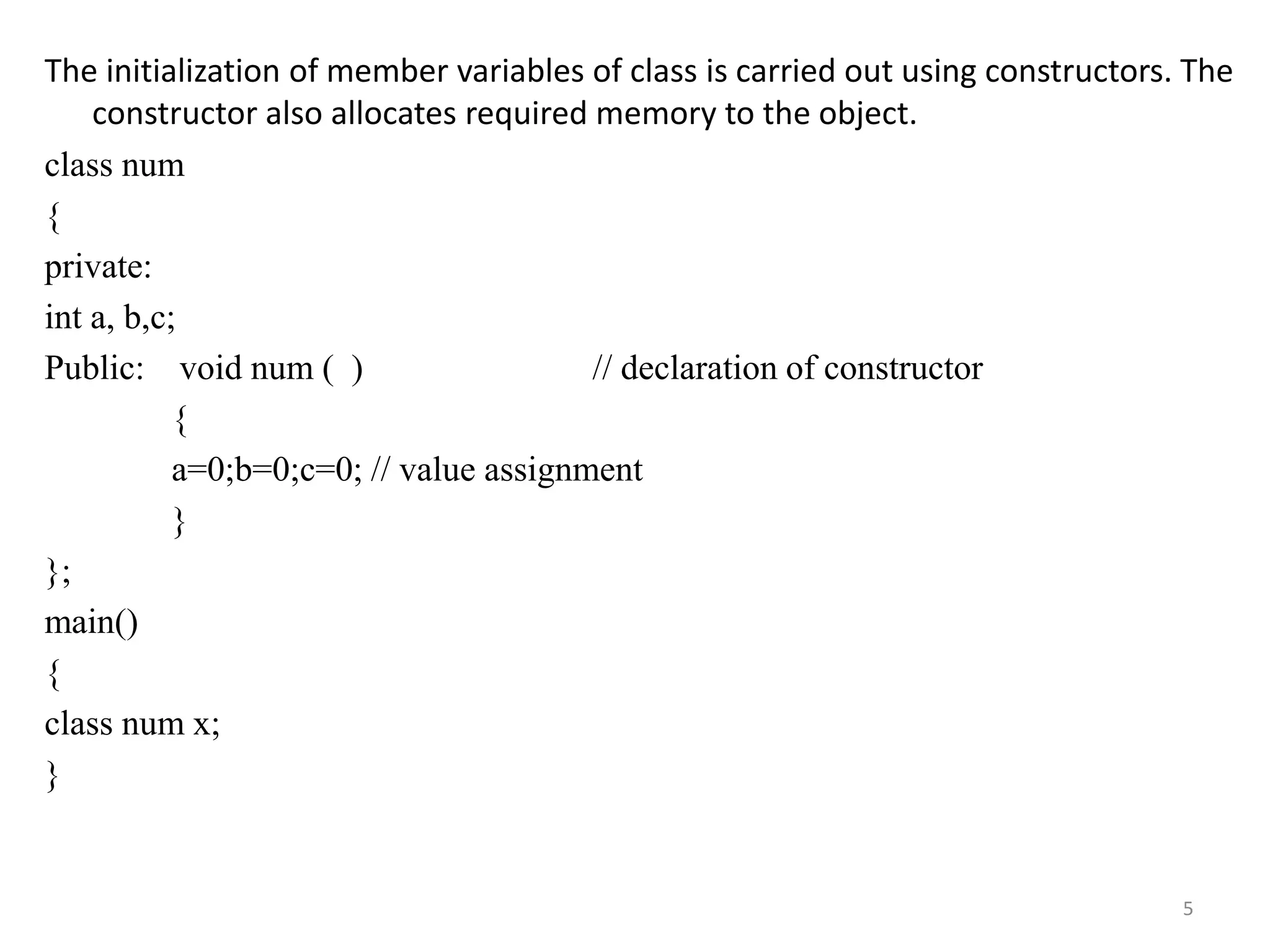
The initialization of member variables of class is carried out using constructors. The
constructor also allocates required memory to the object.
class num
{
private:
int a, b,c;
Public: void num ( ) // declaration of constructor
{
a=0;b=0;c=0; // value assignment
}
};
main()
{
class num x;
}
5
In the above example, class num has three member integer
variables a, b, and c. The declaration of constructor can be done
inside the class and definition outside the class. In definition, the
member variables of a class num are initialized to zero.
In the function main(), x is an object of type class num. When an
object is created, its member variables (private and public) are
automatically initialized to the given value. The programmer
need not write any statement to call the constructor. The
compiler automatically calls the constructors. If programmer
writes a statement for calling a constructor, a constructor is
called again. In case there is no constructor in the program, the
compiler calls a dummy constructor. The constructor without
argument is known as default constructor.
6
Write a program to show that for each object constructor is called separately.
#include<iostream.h>
#include<conio.h>
class num {
private: int a;
public: num (void) // definition of constructor
{
cout<<"n Constructor called.";
a=1;
cout<<"a="<<a;
} };
main()
{
clrscr();
num x,y,z;
num a[2];
return 0;
}
7
Constructors initialize the member variables with given values. It is
also possible to create constructor with arguments, and such
constructors are called parameterized constructors. For such
constructors, it is necessary to pass values to the constructor when
an object is created.
8
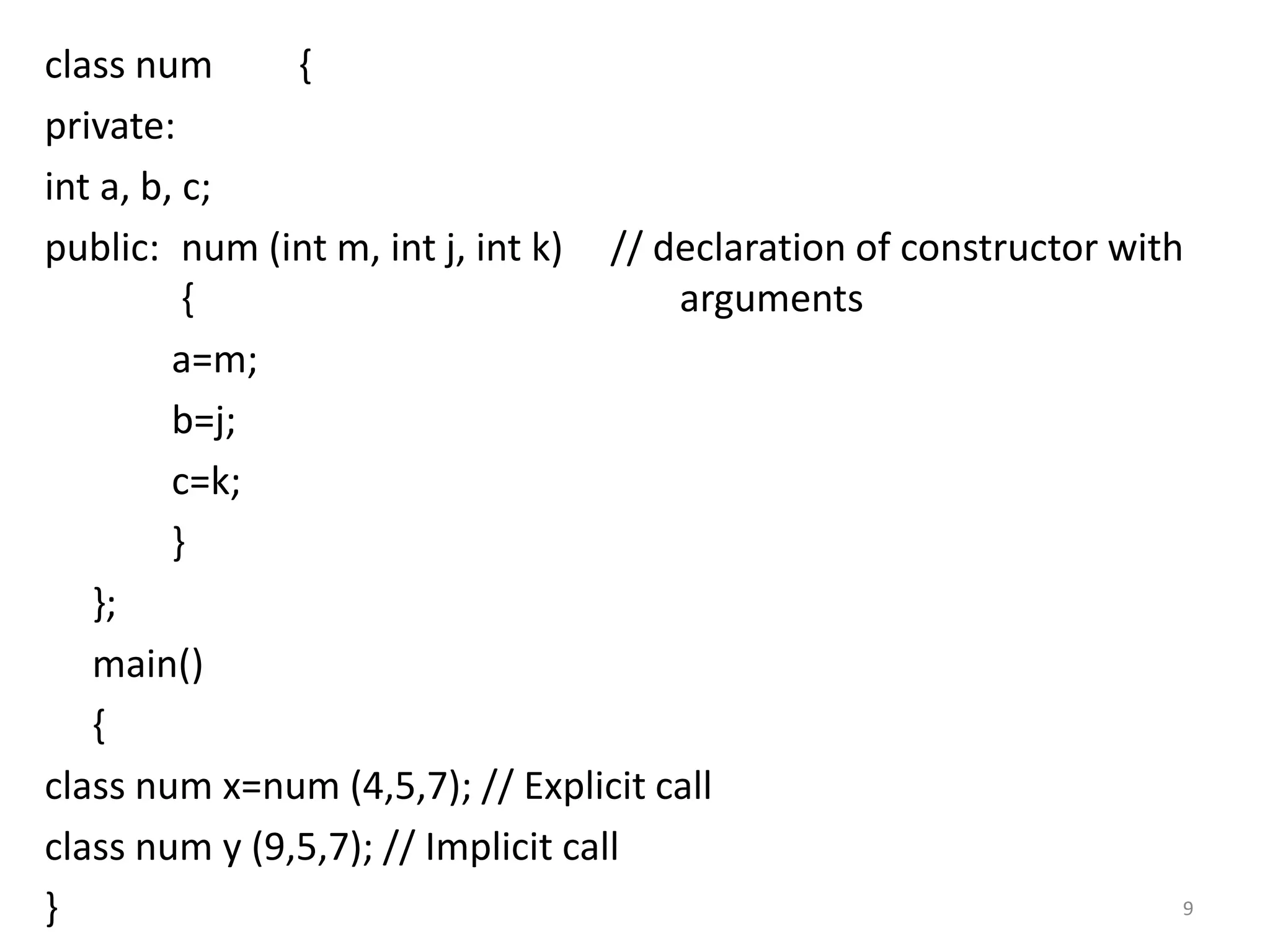
class num {
private:
int a, b, c;
public: num (int m, int j, int k) // declaration of constructor with
{ arguments
a=m;
b=j;
c=k;
}
};
main()
{
class num x=num (4,5,7); // Explicit call
class num y (9,5,7); // Implicit call
} 9
In the above example, the declaration and definition of a constructor
contains three integer arguments. In the definition, the three
arguments m, j, and k are assigned to member variables a, b, and c.
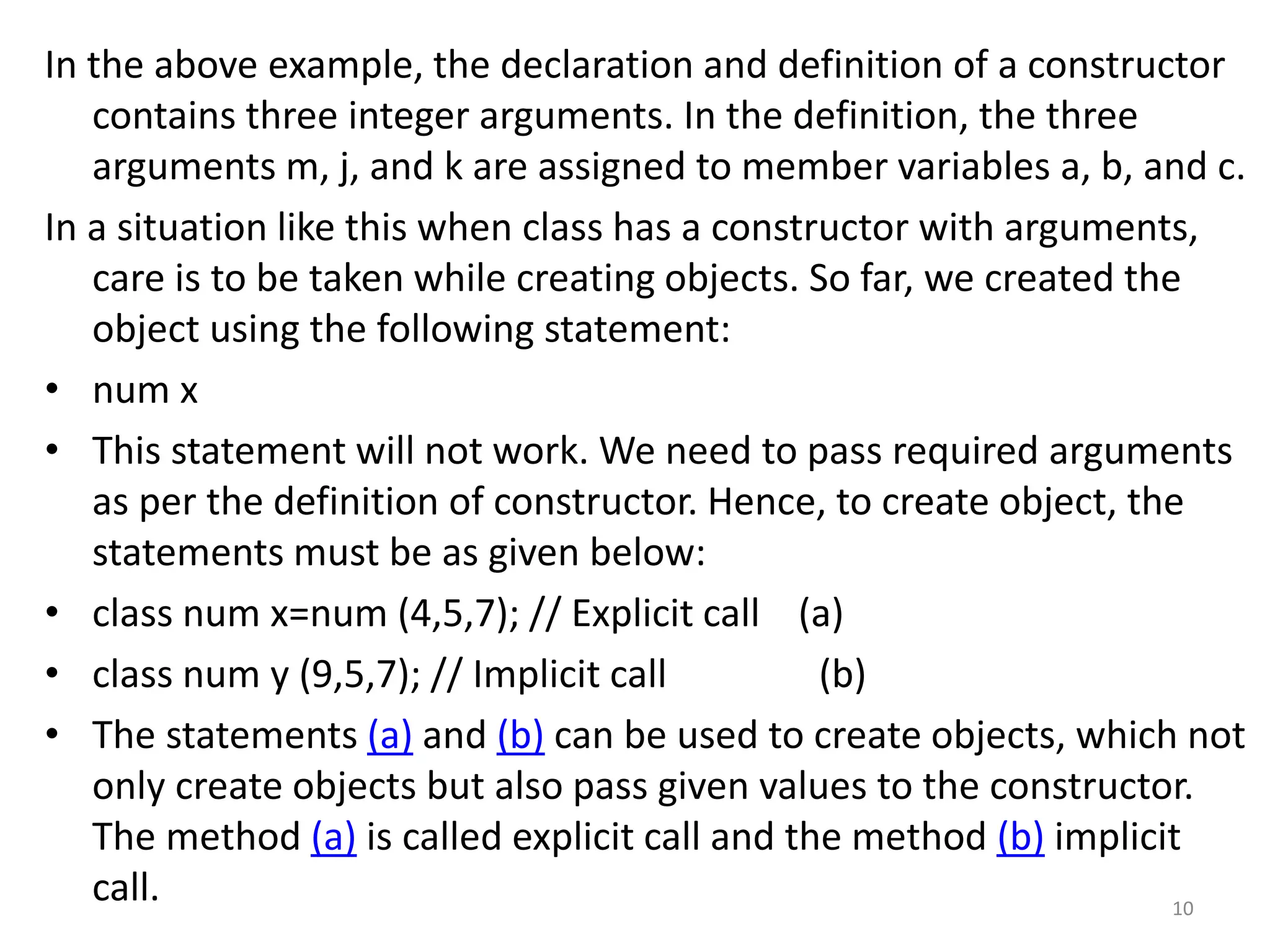
In a situation like this when class has a constructor with arguments,
care is to be taken while creating objects. So far, we created the
object using the following statement:
• num x
• This statement will not work. We need to pass required arguments
as per the definition of constructor. Hence, to create object, the
statements must be as given below:
• class num x=num (4,5,7); // Explicit call (a)
• class num y (9,5,7); // Implicit call (b)
• The statements (a) and (b) can be used to create objects, which not
only create objects but also pass given values to the constructor.
The method (a) is called explicit call and the method (b) implicit
call. 10
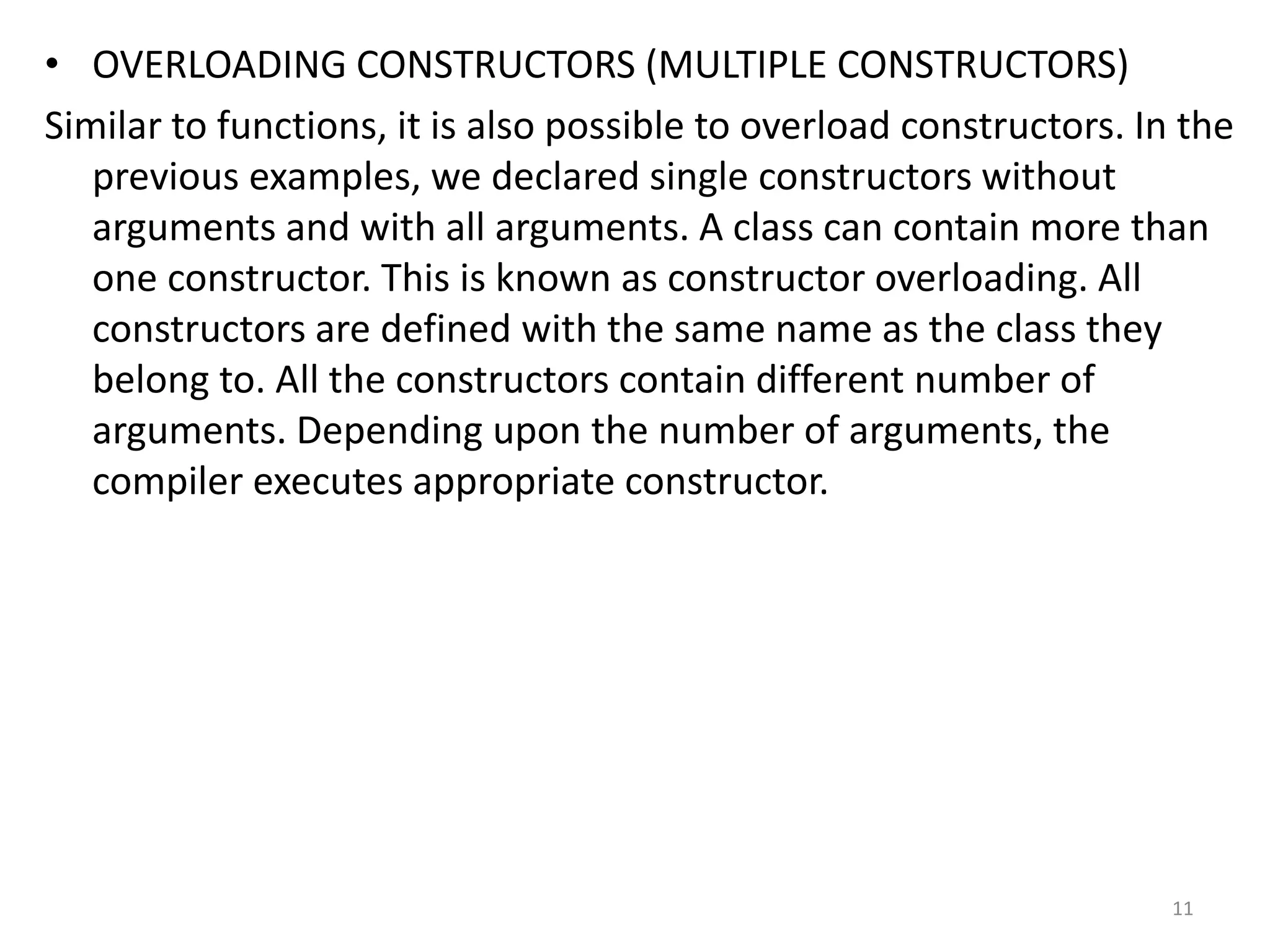
• OVERLOADING CONSTRUCTORS (MULTIPLE CONSTRUCTORS)
Similar to functions, it is also possible to overload constructors. In the
previous examples, we declared single constructors without
arguments and with all arguments. A class can contain more than
one constructor. This is known as constructor overloading. All
constructors are defined with the same name as the class they
belong to. All the constructors contain different number of
arguments. Depending upon the number of arguments, the
compiler executes appropriate constructor.
11
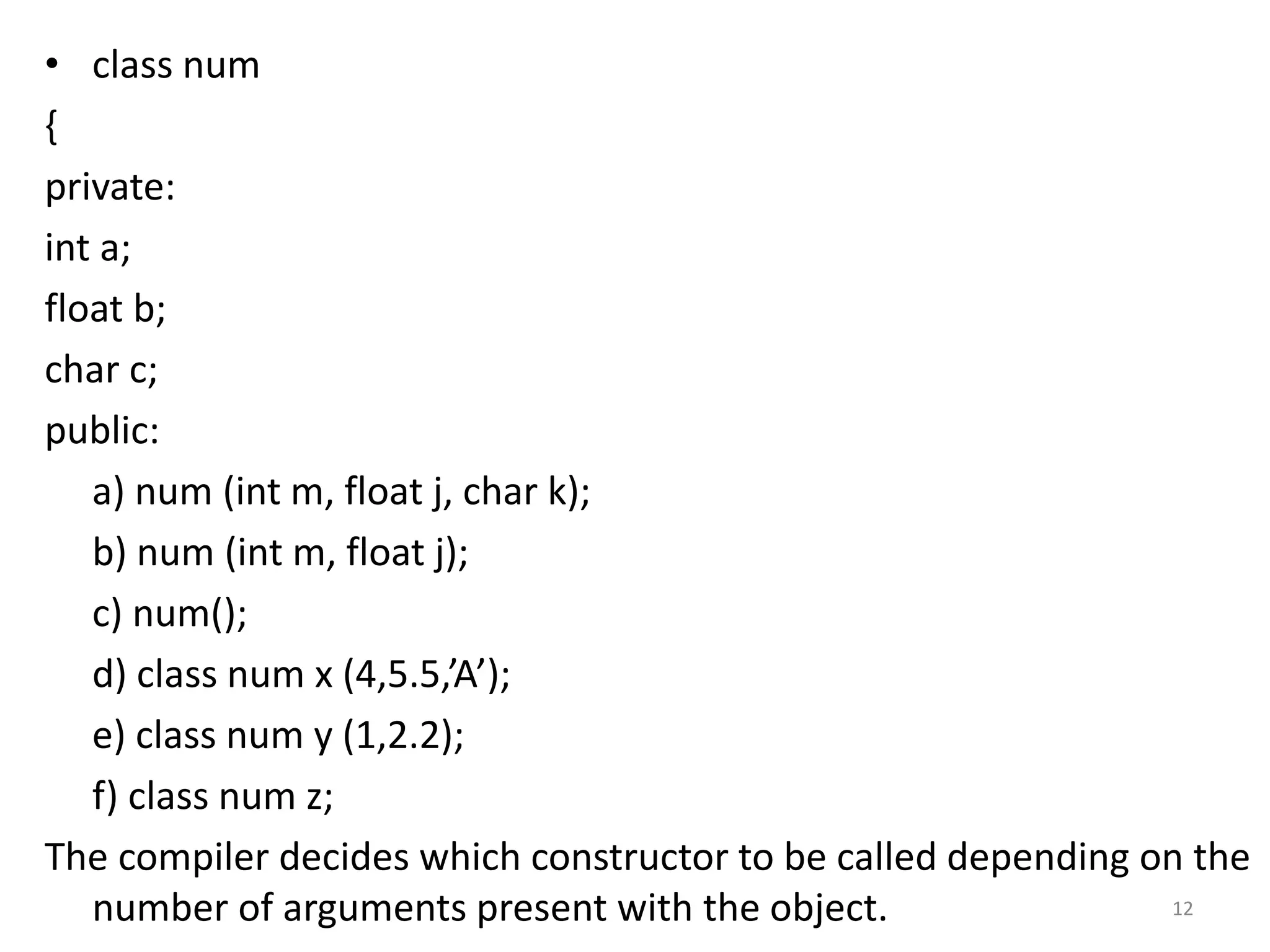
• class num
{
private:
int a;
float b;
char c;
public:
a) num (int m, float j, char k);
b) num (int m, float j);
c) num();
d) class num x (4,5.5,’A’);
e) class num y (1,2.2);
f) class num z;
The compiler decides which constructor to be called depending on the
number of arguments present with the object. 12
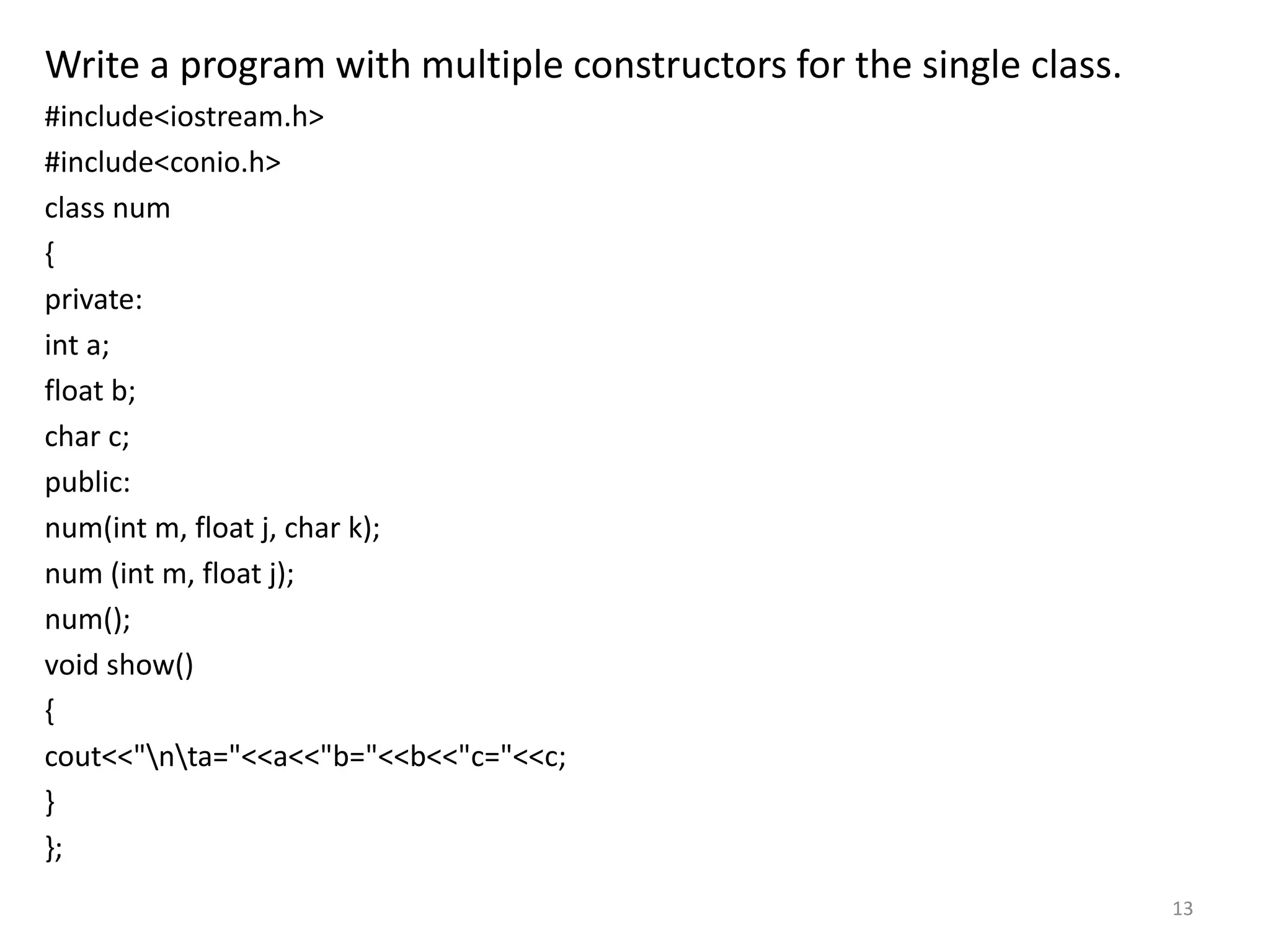
Write a program with multiple constructors for the single class.
#include<iostream.h>
#include<conio.h>
class num
{
private:
int a;
float b;
char c;
public:
num(int m, float j, char k);
num (int m, float j);
num();
void show()
{
cout<<"nta="<<a<<"b="<<b<<"c="<<c;
}
};
13
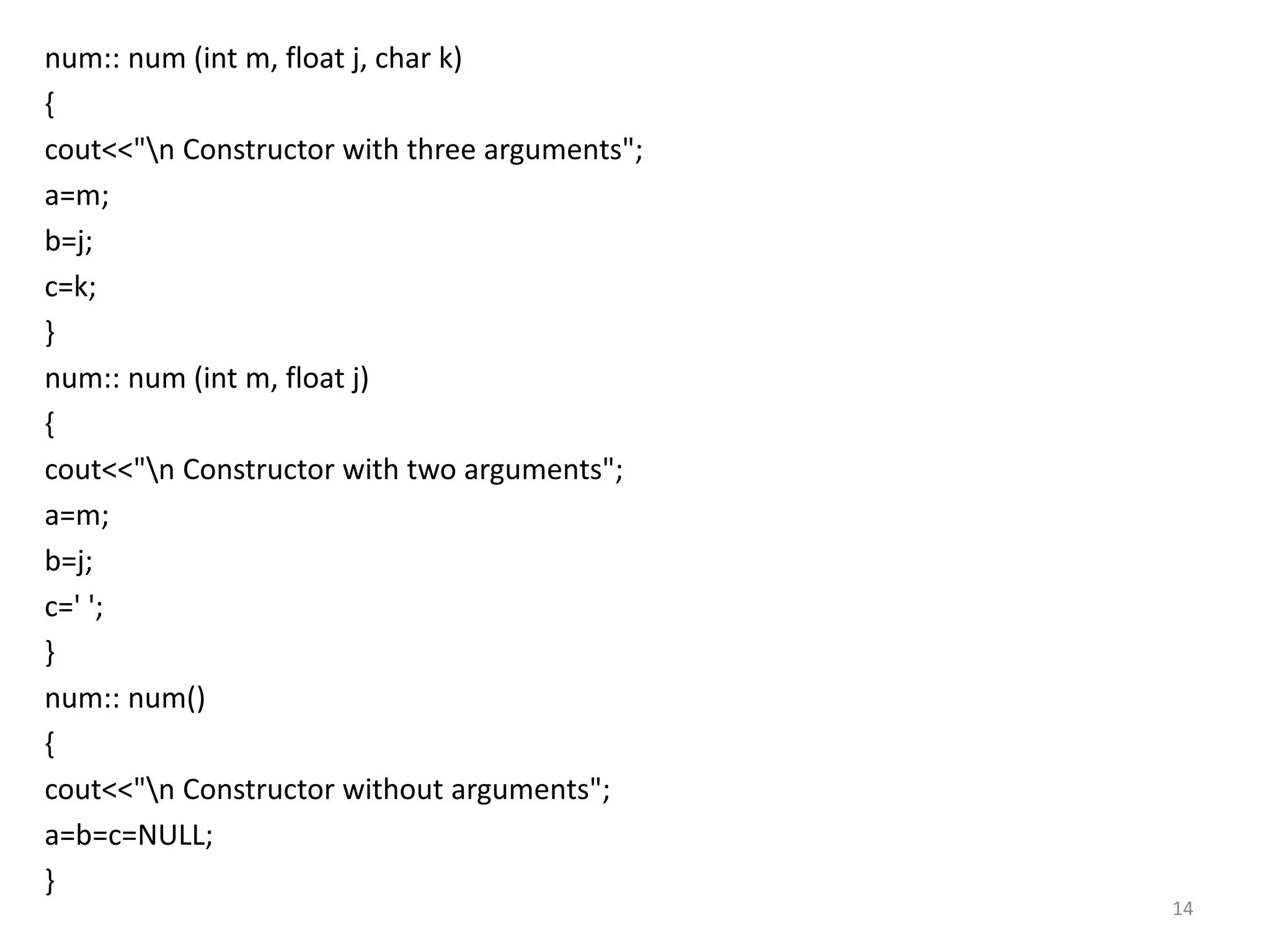
num:: num (int m, float j, char k)
{
cout<<"n Constructor with three arguments";
a=m;
b=j;
c=k;
}
num:: num (int m, float j)
{
cout<<"n Constructor with two arguments";
a=m;
b=j;
c=' ';
}
num:: num()
{
cout<<"n Constructor without arguments";
a=b=c=NULL;
}
14
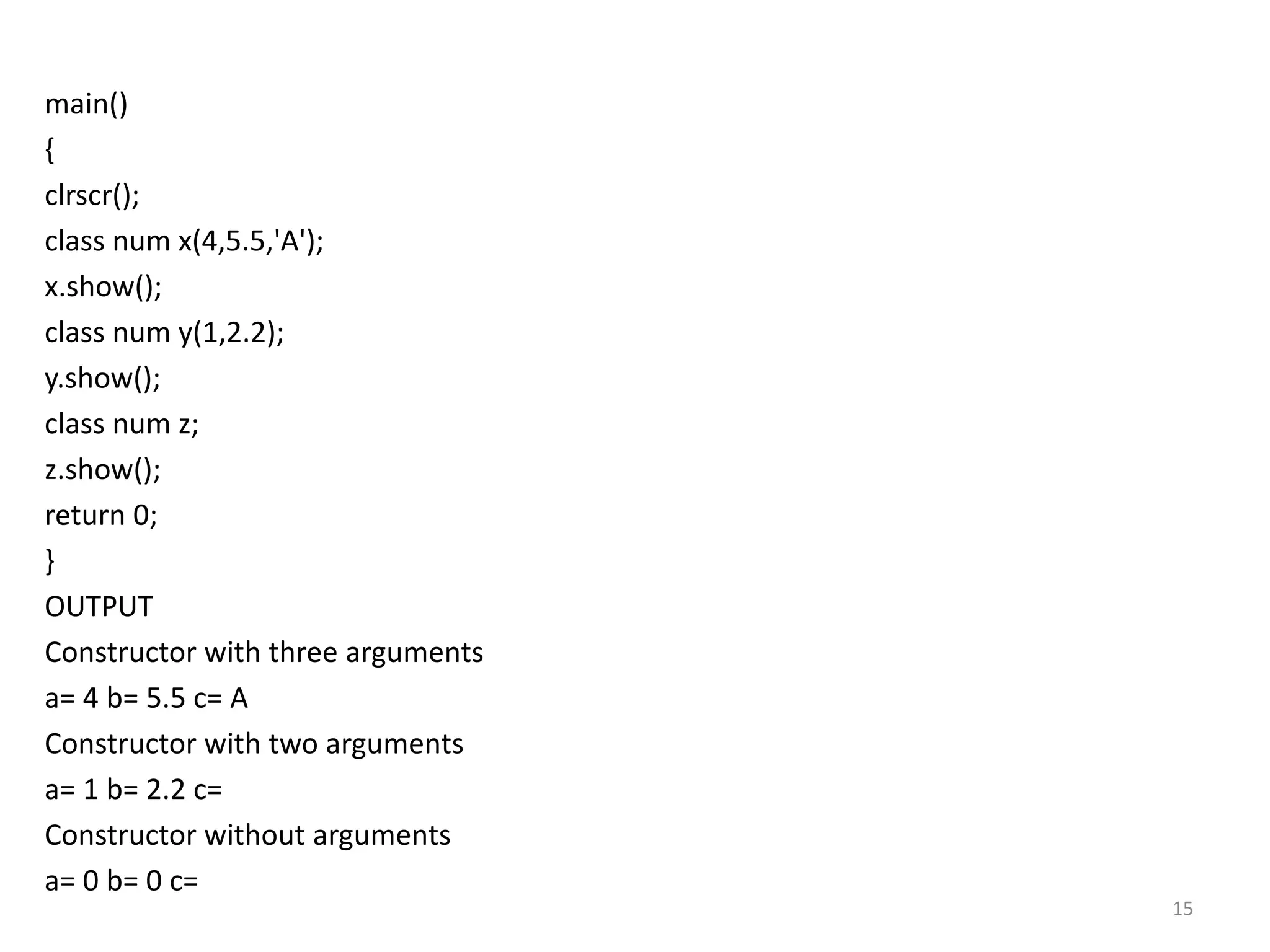
main()
{
clrscr();
class num x(4,5.5,'A');
x.show();
class num y(1,2.2);
y.show();
class num z;
z.show();
return 0;
}
OUTPUT
Constructor with three arguments
a= 4 b= 5.5 c= A
Constructor with two arguments
a= 1 b= 2.2 c=
Constructor without arguments
a= 0 b= 0 c=
15
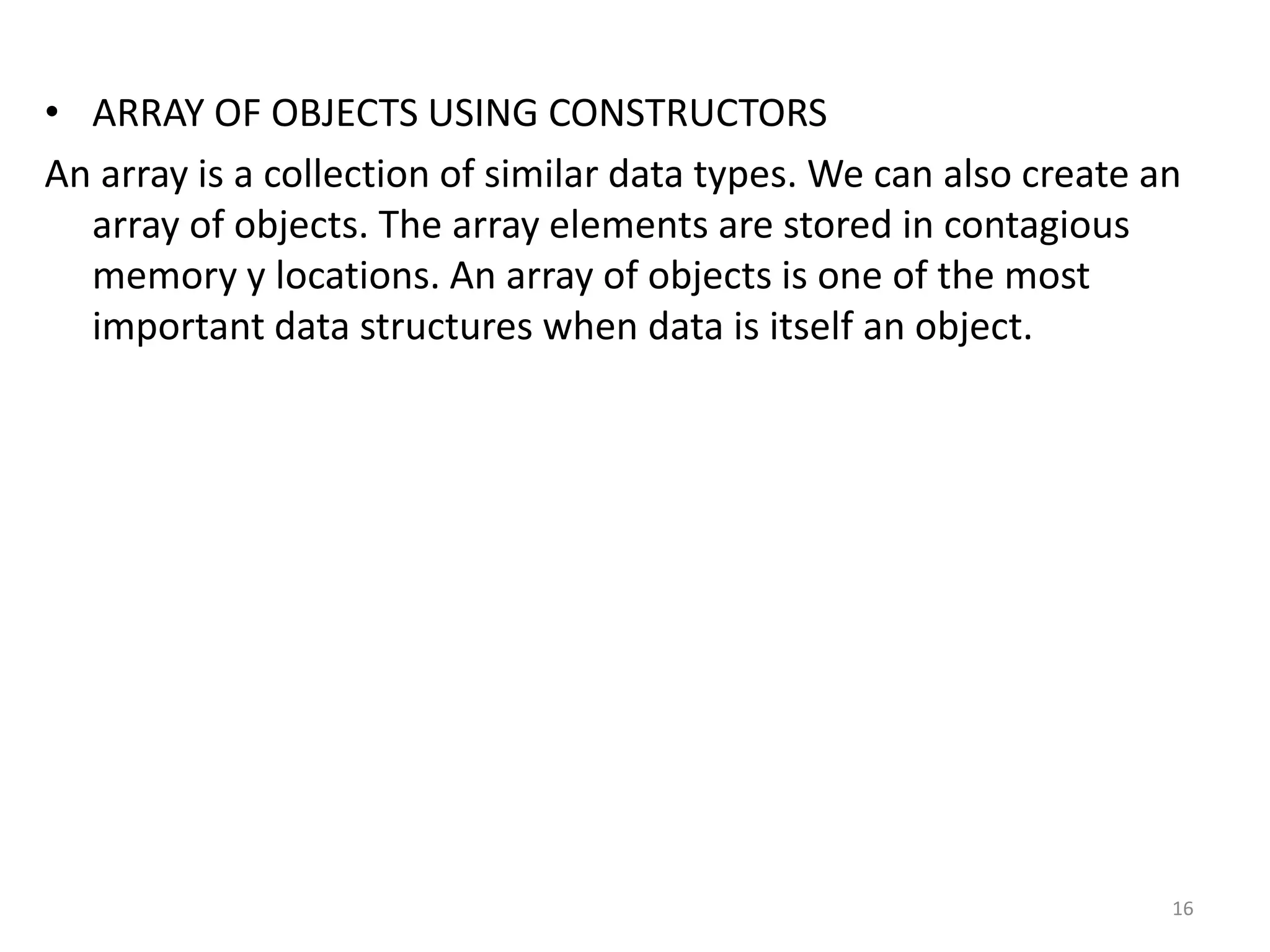
• ARRAY OF OBJECTS USING CONSTRUCTORS
An array is a collection of similar data types. We can also create an
array of objects. The array elements are stored in contagious
memory y locations. An array of objects is one of the most
important data structures when data is itself an object.
16
Write a program to declare array of objects by using constructor.
#include<iostream.h>
#include<conio.h>
#include<stdio.h>
class capital {
Public: char name[20],cpt[20];
capital()
{
cout<<"nState and its capital:";
cin>>name>>cpt;
} };
int main() {
clrscr();
capital c[3];
return 0; }
OUTPUT
State and its capital: Maharashtra Mumbai
State and its capital: Tamilnadu Chennai
State and its capital: Andhra-Pradesh Hyderabad
17
The above program is generalized and can be extended to large
number of objects. We have created an array of objects c[3] in the
above program. The object c[3] initializes three names of the states
and their capitals through keyboard, and the object c[3] calls the
constructor three times.
18
CONSTRUCTORS WITH DEFAULT ARGUMENTS
Similar to functions, it is also possible to declare constructors with
default arguments. Consider the following example:
power(int 9,int 3);
In the above example, the default value for the first argument is nine
and three for second.
power p1 (3);
In this statement, object p1 is created and 9 raise to 3 expression is
calculated. Here, one argument is absent hence default value 9 is
taken, and its third power is calculated.
19
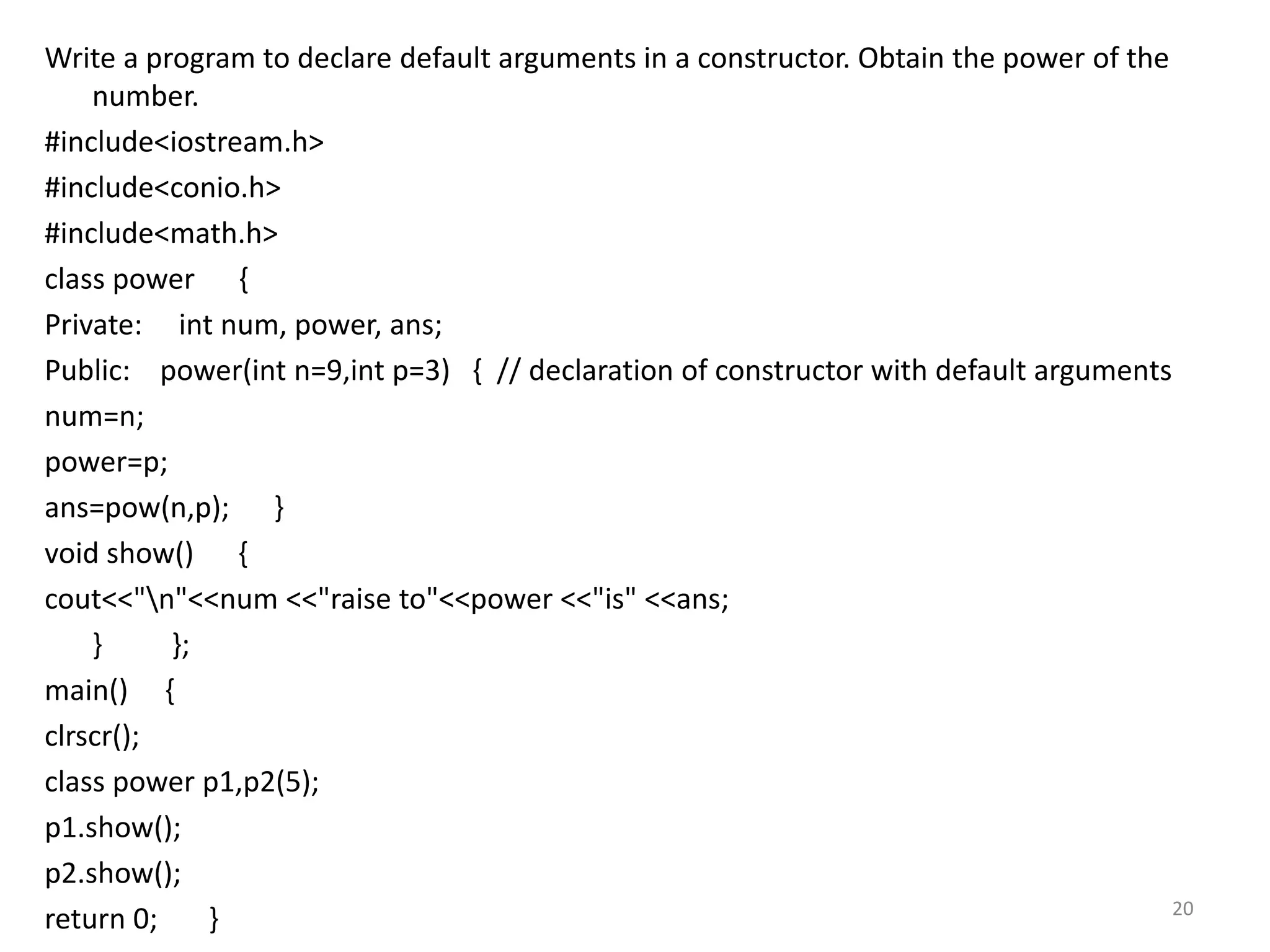
Write a program to declare default arguments in a constructor. Obtain the power of the
number.
#include<iostream.h>
#include<conio.h>
#include<math.h>
class power {
Private: int num, power, ans;
Public: power(int n=9,int p=3) { // declaration of constructor with default arguments
num=n;
power=p;
ans=pow(n,p); }
void show() {
cout<<"n"<<num <<"raise to"<<power <<"is" <<ans;
} };
main() {
clrscr();
class power p1,p2(5);
p1.show();
p2.show();
return 0; } 20
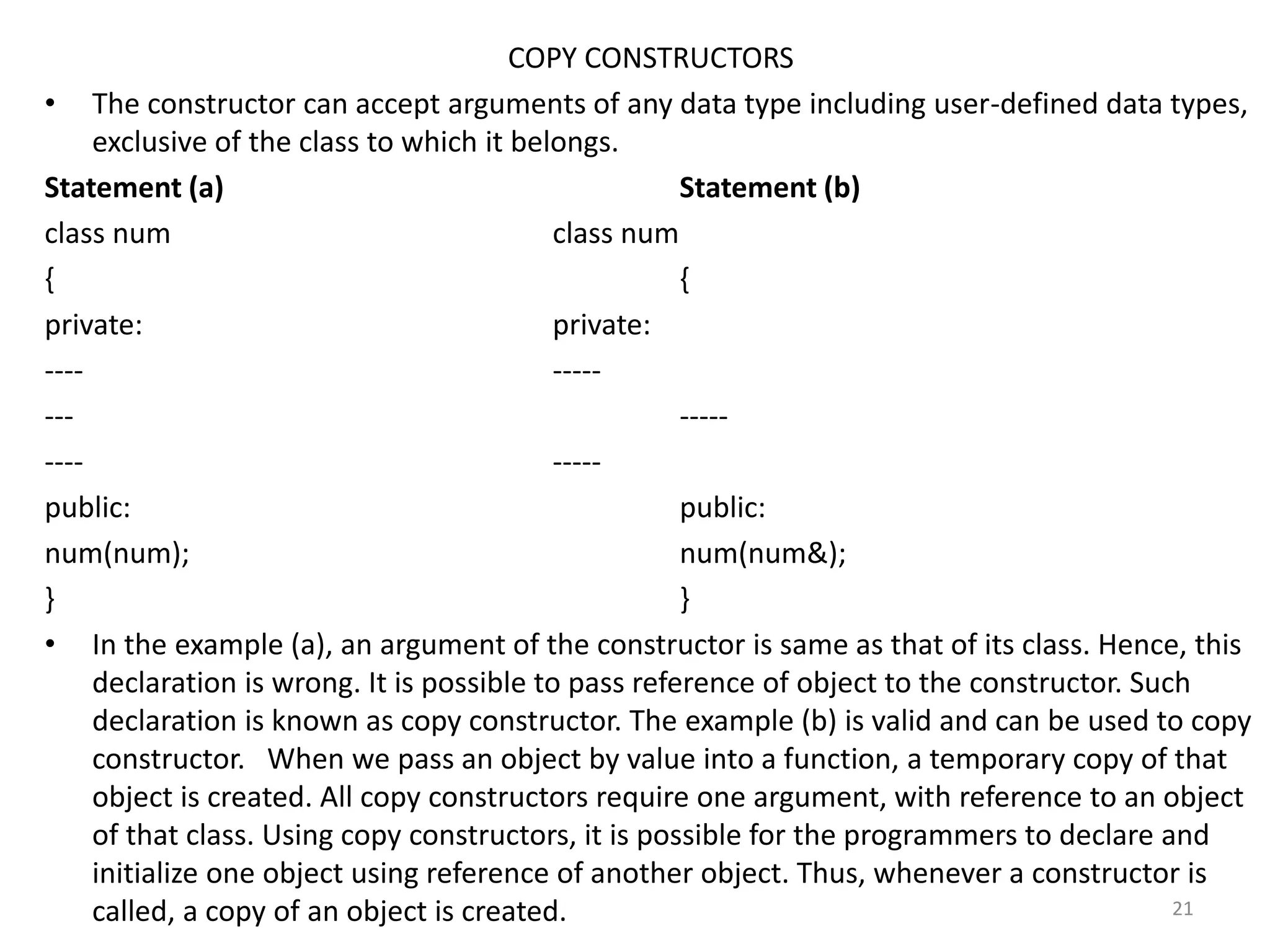
COPY CONSTRUCTORS
• The constructor can accept arguments of any data type including user-defined data types,
exclusive of the class to which it belongs.
Statement (a) Statement (b)
class num class num
{ {
private: private:
---- -----
--- -----
---- -----
public: public:
num(num); num(num&);
} }
• In the example (a), an argument of the constructor is same as that of its class. Hence, this
declaration is wrong. It is possible to pass reference of object to the constructor. Such
declaration is known as copy constructor. The example (b) is valid and can be used to copy
constructor. When we pass an object by value into a function, a temporary copy of that
object is created. All copy constructors require one argument, with reference to an object
of that class. Using copy constructors, it is possible for the programmers to declare and
initialize one object using reference of another object. Thus, whenever a constructor is
called, a copy of an object is created. 21
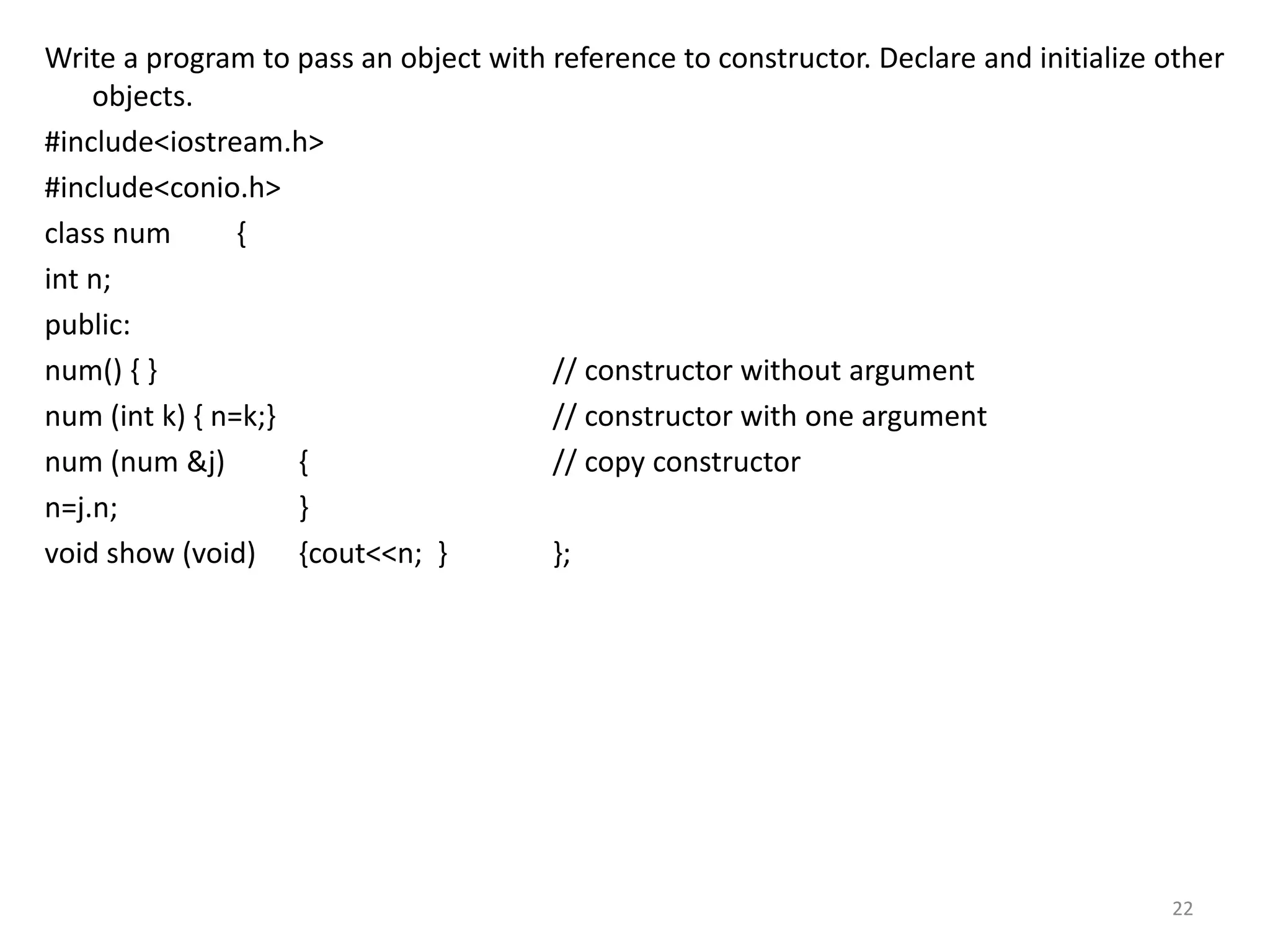
Write a program to pass an object with reference to constructor. Declare and initialize other
objects.
#include<iostream.h>
#include<conio.h>
class num {
int n;
public:
num() { } // constructor without argument
num (int k) { n=k;} // constructor with one argument
num (num &j) { // copy constructor
n=j.n; }
void show (void) {cout<<n; } };
22
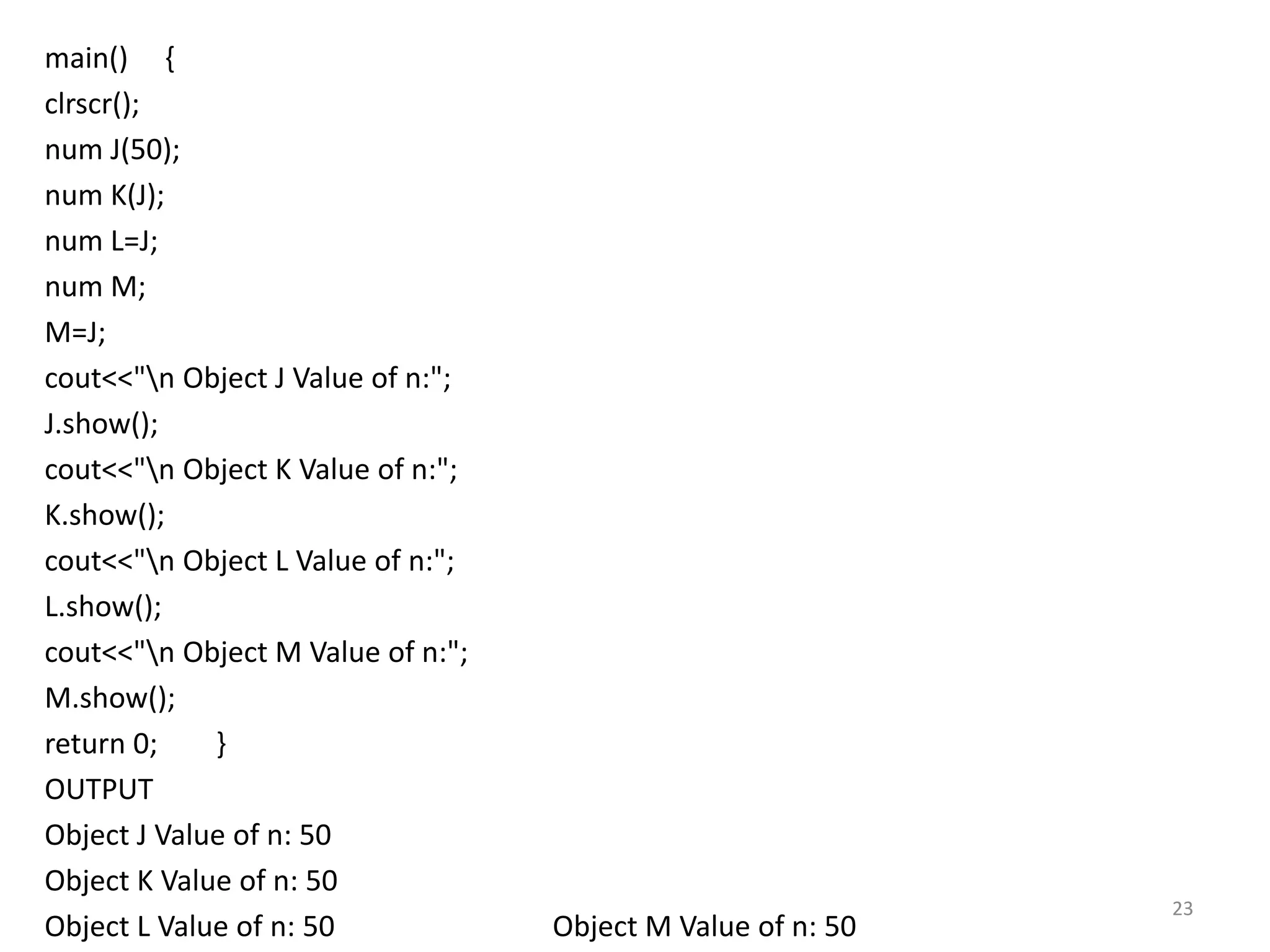
main() {
clrscr();
num J(50);
num K(J);
num L=J;
num M;
M=J;
cout<<"n Object J Value of n:";
J.show();
cout<<"n Object K Value of n:";
K.show();
cout<<"n Object L Value of n:";
L.show();
cout<<"n Object M Value of n:";
M.show();
return 0; }
OUTPUT
Object J Value of n: 50
Object K Value of n: 50
Object L Value of n: 50 Object M Value of n: 50
23
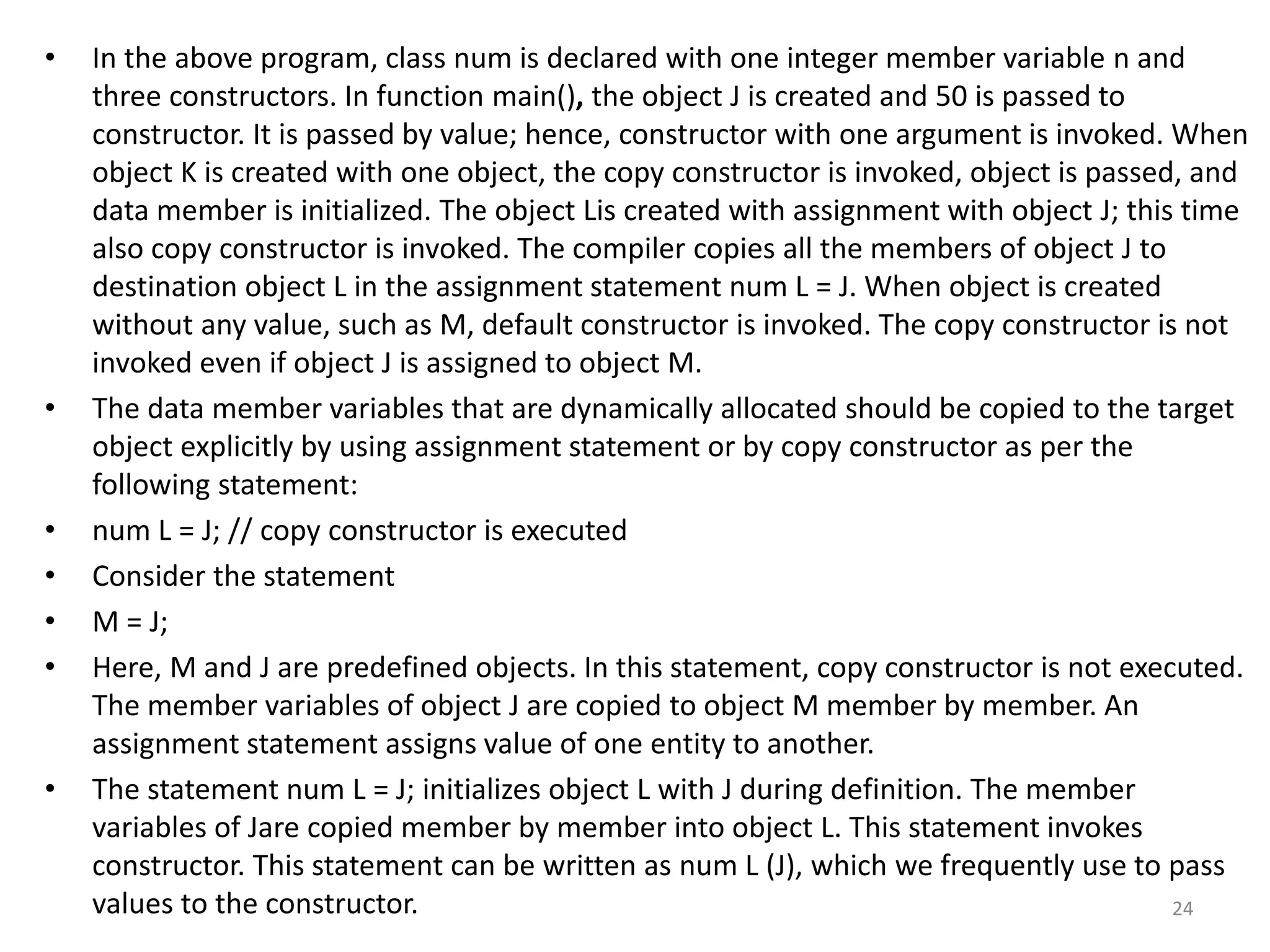
• In the above program, class num is declared with one integer member variable n and
three constructors. In function main(), the object J is created and 50 is passed to
constructor. It is passed by value; hence, constructor with one argument is invoked. When
object K is created with one object, the copy constructor is invoked, object is passed, and
data member is initialized. The object Lis created with assignment with object J; this time
also copy constructor is invoked. The compiler copies all the members of object J to
destination object L in the assignment statement num L = J. When object is created
without any value, such as M, default constructor is invoked. The copy constructor is not
invoked even if object J is assigned to object M.
• The data member variables that are dynamically allocated should be copied to the target
object explicitly by using assignment statement or by copy constructor as per the
following statement:
• num L = J; // copy constructor is executed
• Consider the statement
• M = J;
• Here, M and J are predefined objects. In this statement, copy constructor is not executed.
The member variables of object J are copied to object M member by member. An
assignment statement assigns value of one entity to another.
• The statement num L = J; initializes object L with J during definition. The member
variables of Jare copied member by member into object L. This statement invokes
constructor. This statement can be written as num L (J), which we frequently use to pass
values to the constructor. 24
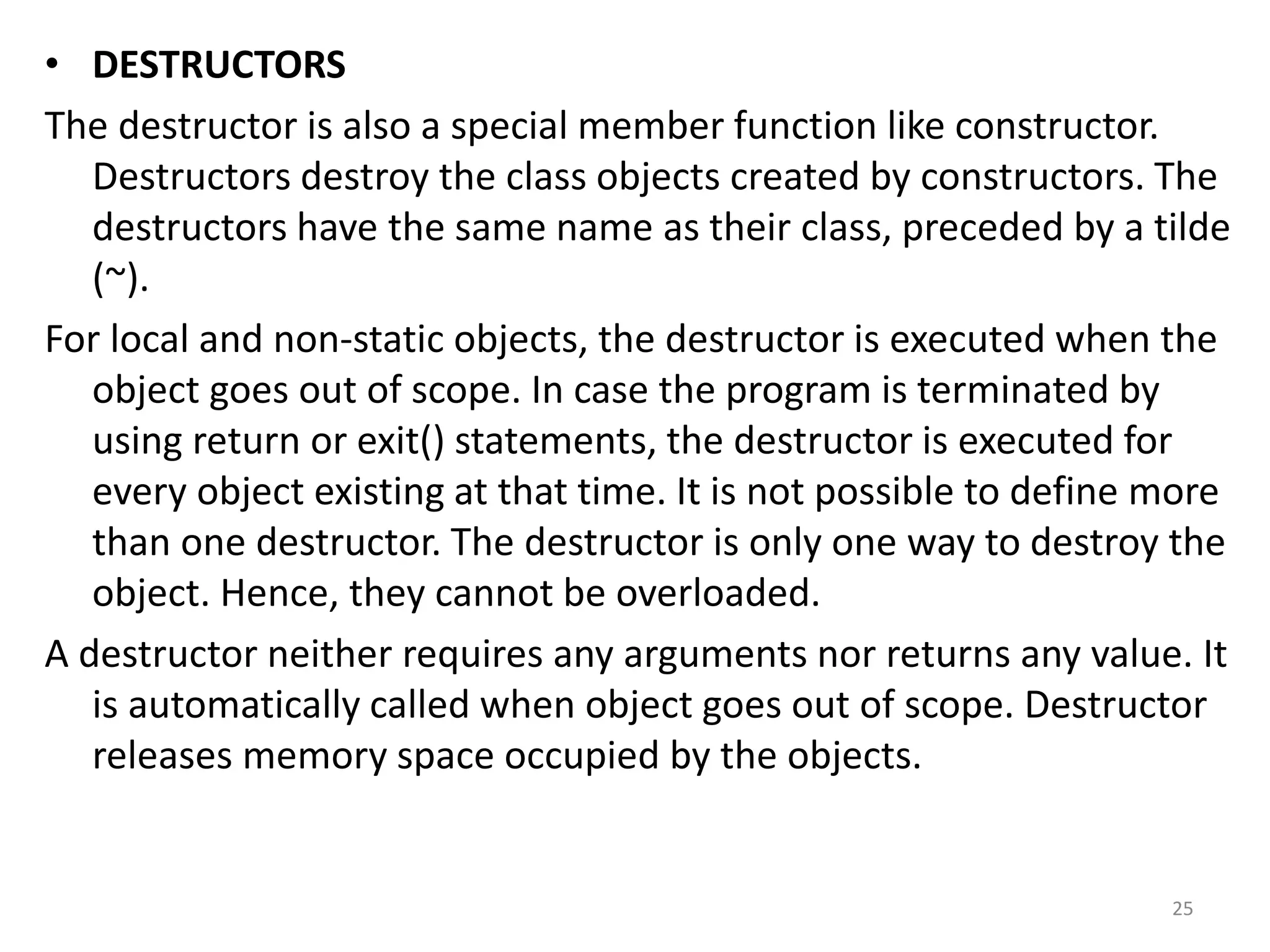
• DESTRUCTORS
The destructor is also a special member function like constructor.
Destructors destroy the class objects created by constructors. The
destructors have the same name as their class, preceded by a tilde
(~).
For local and non-static objects, the destructor is executed when the
object goes out of scope. In case the program is terminated by
using return or exit() statements, the destructor is executed for
every object existing at that time. It is not possible to define more
than one destructor. The destructor is only one way to destroy the
object. Hence, they cannot be overloaded.
A destructor neither requires any arguments nor returns any value. It
is automatically called when object goes out of scope. Destructor
releases memory space occupied by the objects.
25
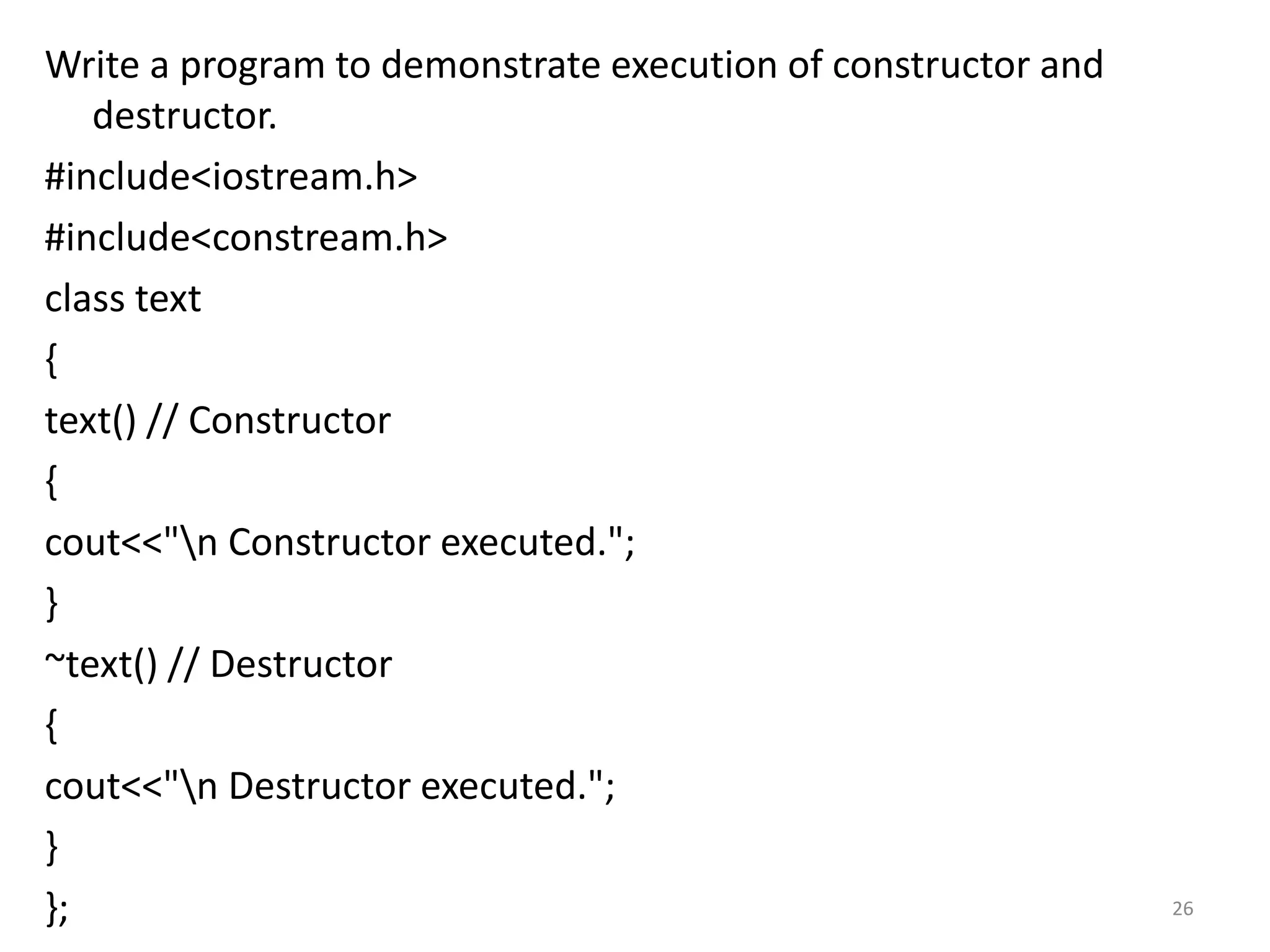
Write a program to demonstrate execution of constructor and
destructor.
#include<iostream.h>
#include<constream.h>
class text
{
text() // Constructor
{
cout<<"n Constructor executed.";
}
~text() // Destructor
{
cout<<"n Destructor executed.";
}
}; 26
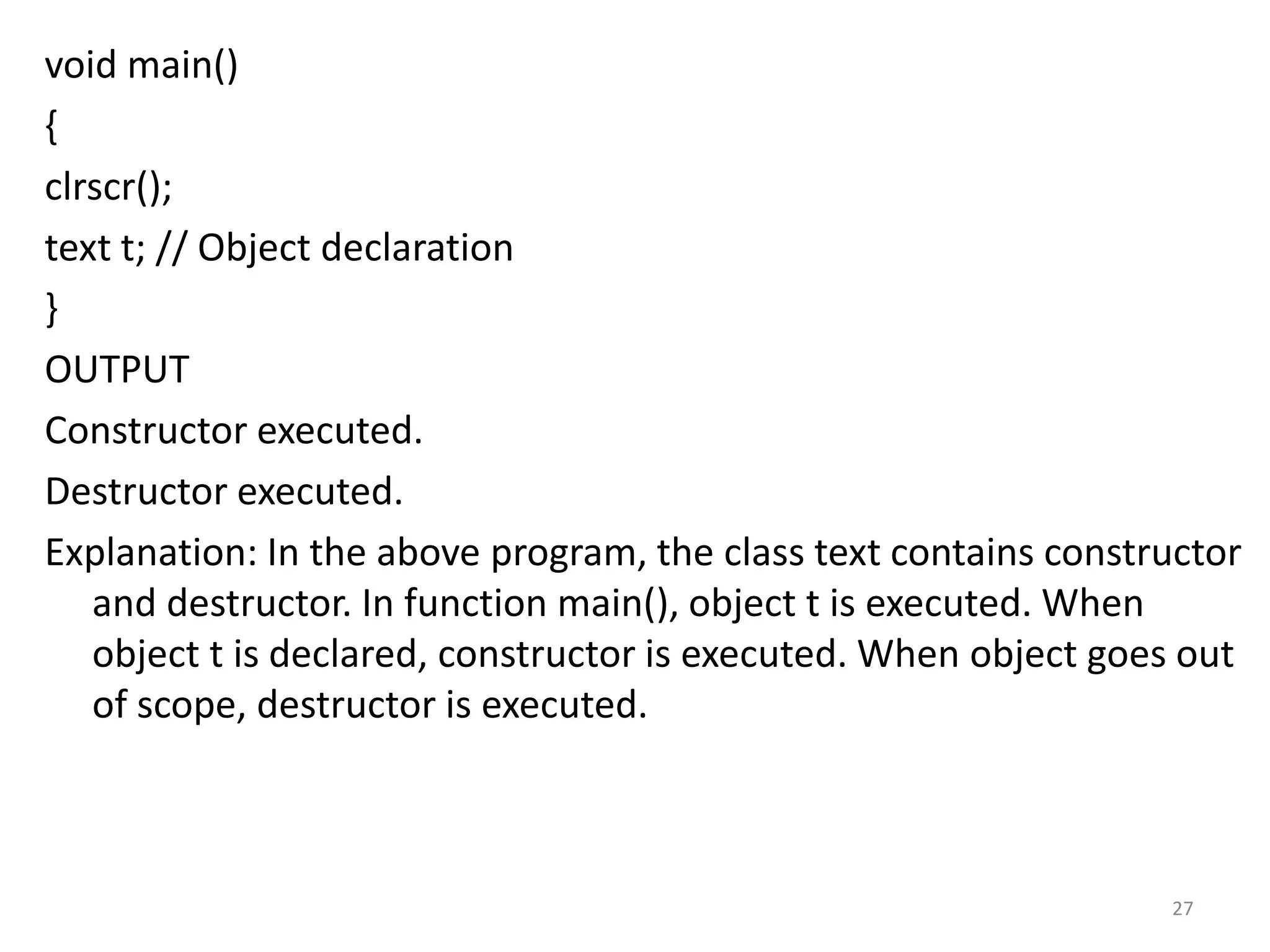
void main()
{
clrscr();
text t; // Object declaration
}
OUTPUT
Constructor executed.
Destructor executed.
Explanation: In the above program, the class text contains constructor
and destructor. In function main(), object t is executed. When
object t is declared, constructor is executed. When object goes out
of scope, destructor is executed.
27

Constructors and destructors in C++

  • 1.
    The constructor constructsthe objects and destructor destroys the objects. The compiler automatically executes these functions. The programmer does not need to make any effort for invoking these functions. When an object is created, constructor is executed. The programmer can also pass values to the constructor to initialize member variables with different values. The destructor is executed at the end of the function when objects are of no use or go out of scope. If the programmer does not define them, the compiler executes implicit constructor and destructor. 1
  • 2.
    Constructors and destructorsare special member functions. They decide how the objects of a class are created, initialized, copied, and destroyed. Their names are distinguished from all other member functions because their names are same as the class they belong to. The only difference is that destructor is preceded by a ~ (tilde) operator. 2
  • 3.
    Constructors • Constructors havethe same name as that of the class they belong to. • Constructors are executed when an object is declared. • Constructors have neither return value nor void. • The main function of constructor is to initialize objects and allocate appropriate memory to objects. • Though constructors are executed implicitly, they can be invoked explicitly. • Constructors can have default values and can be overloaded. • The constructor without arguments is called as default constructor. 3
  • 4.
    Destructors • Destructors havethe same name as that of the class they belong to preceded by ~ (tilde). • Similar to constructors, the destructors do not have return type and not even void. • Constructors and destructors cannot be inherited, though a derived class can call the constructors and destructors of the base class. • Destructors can be virtual, but constructors cannot. • Only one destructor can be defined in the destructor. The destructor does not have any arguments. • Destructors neither have default values nor can be overloaded. • Programmer cannot access addresses of constructors and destructors. • Constructors and destructors can make implicit calls to operators new and delete if memory allocation/de-allocation is needed for an object. • An object with a constructor or destructor cannot be used as a member of a union. 4
  • 5.
    The initialization ofmember variables of class is carried out using constructors. The constructor also allocates required memory to the object. class num { private: int a, b,c; Public: void num ( ) // declaration of constructor { a=0;b=0;c=0; // value assignment } }; main() { class num x; } 5
  • 6.
    In the aboveexample, class num has three member integer variables a, b, and c. The declaration of constructor can be done inside the class and definition outside the class. In definition, the member variables of a class num are initialized to zero. In the function main(), x is an object of type class num. When an object is created, its member variables (private and public) are automatically initialized to the given value. The programmer need not write any statement to call the constructor. The compiler automatically calls the constructors. If programmer writes a statement for calling a constructor, a constructor is called again. In case there is no constructor in the program, the compiler calls a dummy constructor. The constructor without argument is known as default constructor. 6
  • 7.
    Write a programto show that for each object constructor is called separately. #include<iostream.h> #include<conio.h> class num { private: int a; public: num (void) // definition of constructor { cout<<"n Constructor called."; a=1; cout<<"a="<<a; } }; main() { clrscr(); num x,y,z; num a[2]; return 0; } 7
  • 8.
    Constructors initialize themember variables with given values. It is also possible to create constructor with arguments, and such constructors are called parameterized constructors. For such constructors, it is necessary to pass values to the constructor when an object is created. 8
  • 9.
    class num { private: inta, b, c; public: num (int m, int j, int k) // declaration of constructor with { arguments a=m; b=j; c=k; } }; main() { class num x=num (4,5,7); // Explicit call class num y (9,5,7); // Implicit call } 9
  • 10.
    In the aboveexample, the declaration and definition of a constructor contains three integer arguments. In the definition, the three arguments m, j, and k are assigned to member variables a, b, and c. In a situation like this when class has a constructor with arguments, care is to be taken while creating objects. So far, we created the object using the following statement: • num x • This statement will not work. We need to pass required arguments as per the definition of constructor. Hence, to create object, the statements must be as given below: • class num x=num (4,5,7); // Explicit call (a) • class num y (9,5,7); // Implicit call (b) • The statements (a) and (b) can be used to create objects, which not only create objects but also pass given values to the constructor. The method (a) is called explicit call and the method (b) implicit call. 10
  • 11.
    • OVERLOADING CONSTRUCTORS(MULTIPLE CONSTRUCTORS) Similar to functions, it is also possible to overload constructors. In the previous examples, we declared single constructors without arguments and with all arguments. A class can contain more than one constructor. This is known as constructor overloading. All constructors are defined with the same name as the class they belong to. All the constructors contain different number of arguments. Depending upon the number of arguments, the compiler executes appropriate constructor. 11
  • 12.
    • class num { private: inta; float b; char c; public: a) num (int m, float j, char k); b) num (int m, float j); c) num(); d) class num x (4,5.5,’A’); e) class num y (1,2.2); f) class num z; The compiler decides which constructor to be called depending on the number of arguments present with the object. 12
  • 13.
    Write a programwith multiple constructors for the single class. #include<iostream.h> #include<conio.h> class num { private: int a; float b; char c; public: num(int m, float j, char k); num (int m, float j); num(); void show() { cout<<"nta="<<a<<"b="<<b<<"c="<<c; } }; 13
  • 14.
    num:: num (intm, float j, char k) { cout<<"n Constructor with three arguments"; a=m; b=j; c=k; } num:: num (int m, float j) { cout<<"n Constructor with two arguments"; a=m; b=j; c=' '; } num:: num() { cout<<"n Constructor without arguments"; a=b=c=NULL; } 14
  • 15.
    main() { clrscr(); class num x(4,5.5,'A'); x.show(); classnum y(1,2.2); y.show(); class num z; z.show(); return 0; } OUTPUT Constructor with three arguments a= 4 b= 5.5 c= A Constructor with two arguments a= 1 b= 2.2 c= Constructor without arguments a= 0 b= 0 c= 15
  • 16.
    • ARRAY OFOBJECTS USING CONSTRUCTORS An array is a collection of similar data types. We can also create an array of objects. The array elements are stored in contagious memory y locations. An array of objects is one of the most important data structures when data is itself an object. 16
  • 17.
    Write a programto declare array of objects by using constructor. #include<iostream.h> #include<conio.h> #include<stdio.h> class capital { Public: char name[20],cpt[20]; capital() { cout<<"nState and its capital:"; cin>>name>>cpt; } }; int main() { clrscr(); capital c[3]; return 0; } OUTPUT State and its capital: Maharashtra Mumbai State and its capital: Tamilnadu Chennai State and its capital: Andhra-Pradesh Hyderabad 17
  • 18.
    The above programis generalized and can be extended to large number of objects. We have created an array of objects c[3] in the above program. The object c[3] initializes three names of the states and their capitals through keyboard, and the object c[3] calls the constructor three times. 18
  • 19.
    CONSTRUCTORS WITH DEFAULTARGUMENTS Similar to functions, it is also possible to declare constructors with default arguments. Consider the following example: power(int 9,int 3); In the above example, the default value for the first argument is nine and three for second. power p1 (3); In this statement, object p1 is created and 9 raise to 3 expression is calculated. Here, one argument is absent hence default value 9 is taken, and its third power is calculated. 19
  • 20.
    Write a programto declare default arguments in a constructor. Obtain the power of the number. #include<iostream.h> #include<conio.h> #include<math.h> class power { Private: int num, power, ans; Public: power(int n=9,int p=3) { // declaration of constructor with default arguments num=n; power=p; ans=pow(n,p); } void show() { cout<<"n"<<num <<"raise to"<<power <<"is" <<ans; } }; main() { clrscr(); class power p1,p2(5); p1.show(); p2.show(); return 0; } 20
  • 21.
    COPY CONSTRUCTORS • Theconstructor can accept arguments of any data type including user-defined data types, exclusive of the class to which it belongs. Statement (a) Statement (b) class num class num { { private: private: ---- ----- --- ----- ---- ----- public: public: num(num); num(num&); } } • In the example (a), an argument of the constructor is same as that of its class. Hence, this declaration is wrong. It is possible to pass reference of object to the constructor. Such declaration is known as copy constructor. The example (b) is valid and can be used to copy constructor. When we pass an object by value into a function, a temporary copy of that object is created. All copy constructors require one argument, with reference to an object of that class. Using copy constructors, it is possible for the programmers to declare and initialize one object using reference of another object. Thus, whenever a constructor is called, a copy of an object is created. 21
  • 22.
    Write a programto pass an object with reference to constructor. Declare and initialize other objects. #include<iostream.h> #include<conio.h> class num { int n; public: num() { } // constructor without argument num (int k) { n=k;} // constructor with one argument num (num &j) { // copy constructor n=j.n; } void show (void) {cout<<n; } }; 22
  • 23.
    main() { clrscr(); num J(50); numK(J); num L=J; num M; M=J; cout<<"n Object J Value of n:"; J.show(); cout<<"n Object K Value of n:"; K.show(); cout<<"n Object L Value of n:"; L.show(); cout<<"n Object M Value of n:"; M.show(); return 0; } OUTPUT Object J Value of n: 50 Object K Value of n: 50 Object L Value of n: 50 Object M Value of n: 50 23
  • 24.
    • In theabove program, class num is declared with one integer member variable n and three constructors. In function main(), the object J is created and 50 is passed to constructor. It is passed by value; hence, constructor with one argument is invoked. When object K is created with one object, the copy constructor is invoked, object is passed, and data member is initialized. The object Lis created with assignment with object J; this time also copy constructor is invoked. The compiler copies all the members of object J to destination object L in the assignment statement num L = J. When object is created without any value, such as M, default constructor is invoked. The copy constructor is not invoked even if object J is assigned to object M. • The data member variables that are dynamically allocated should be copied to the target object explicitly by using assignment statement or by copy constructor as per the following statement: • num L = J; // copy constructor is executed • Consider the statement • M = J; • Here, M and J are predefined objects. In this statement, copy constructor is not executed. The member variables of object J are copied to object M member by member. An assignment statement assigns value of one entity to another. • The statement num L = J; initializes object L with J during definition. The member variables of Jare copied member by member into object L. This statement invokes constructor. This statement can be written as num L (J), which we frequently use to pass values to the constructor. 24
  • 25.
    • DESTRUCTORS The destructoris also a special member function like constructor. Destructors destroy the class objects created by constructors. The destructors have the same name as their class, preceded by a tilde (~). For local and non-static objects, the destructor is executed when the object goes out of scope. In case the program is terminated by using return or exit() statements, the destructor is executed for every object existing at that time. It is not possible to define more than one destructor. The destructor is only one way to destroy the object. Hence, they cannot be overloaded. A destructor neither requires any arguments nor returns any value. It is automatically called when object goes out of scope. Destructor releases memory space occupied by the objects. 25
  • 26.
    Write a programto demonstrate execution of constructor and destructor. #include<iostream.h> #include<constream.h> class text { text() // Constructor { cout<<"n Constructor executed."; } ~text() // Destructor { cout<<"n Destructor executed."; } }; 26
  • 27.
    void main() { clrscr(); text t;// Object declaration } OUTPUT Constructor executed. Destructor executed. Explanation: In the above program, the class text contains constructor and destructor. In function main(), object t is executed. When object t is declared, constructor is executed. When object goes out of scope, destructor is executed. 27