OPTIMIZATION IN STATISTICAL
PHYSICS
Kwan-Yuet Ho
Institute for Physical Science and Technology &
Department of Physics
University of Maryland
9/27/2012
 PhD (Physics), University of Maryland
Thesis: Properties of Metallic Helimagnets
Field: Condensed Matter Physics, Statistical Physics
 BSc (Physics & Math), Chinese University of Hong
Kong
Thesis: Quantum Entanglement of Continuous Systems
Field: Quantum Physics, Mathematical Physics
Other projects:
 Two-dimensional Bose gas
(Condensed Matter Physics, Statistical Physics,
Atomic Physics, Quantum Physics)
 Ultra-high Energy Cosmic Rays
(Particle Astrophysics)
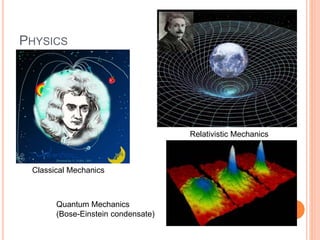
PHYSICS
Classical Mechanics
Relativistic Mechanics
Quantum Mechanics
(Bose-Einstein condensate)
PHYSICS
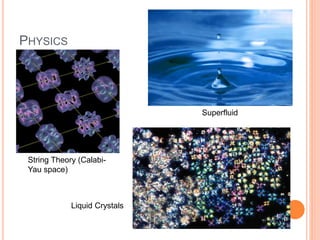
String Theory (Calabi-
Yau space)
Superfluid
Liquid Crystals
PHYSICS
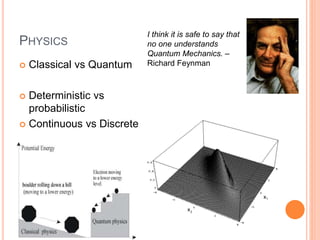
 Classical vs Quantum
 Deterministic vs
probabilistic
 Continuous vs Discrete
I think it is safe to say that
no one understands
Quantum Mechanics. –
Richard Feynman
PHYSICS
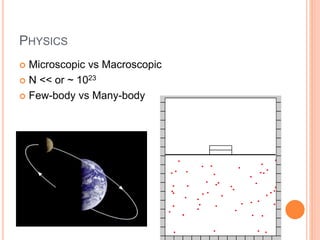
 Microscopic vs Macroscopic
 N << or ~ 1023
 Few-body vs Many-body
PHYSICS
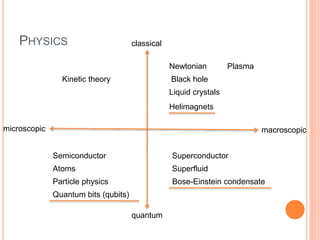
macroscopicmicroscopic
classical
quantum
Newtonian
Black hole
Plasma
Liquid crystals
Helimagnets
Superconductor
Superfluid
Bose-Einstein condensate
Semiconductor
Atoms
Particle physics
Quantum bits (qubits)
Kinetic theory
A CRASH COURSE OF STATISTICAL PHYSICS
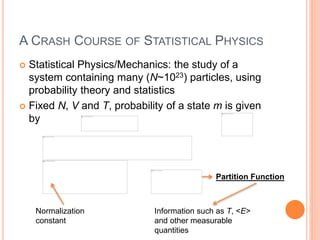
 Statistical Physics/Mechanics: the study of a
system containing many (N~1023) particles, using
probability theory and statistics
 Fixed N, V and T, probability of a state m is given
by
Partition Function
Information such as T, <E>
and other measurable
quantities
Normalization
constant
A CRASH COURSE OF STATISTICAL PHYSICS
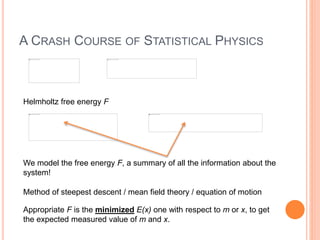
Helmholtz free energy F
We model the free energy F, a summary of all the information about the
system!
Appropriate F is the minimized E(x) one with respect to m or x, to get
the expected measured value of m and x.
Method of steepest descent / mean field theory / equation of motion
A CRASH COURSE OF STATISTICAL PHYSICS
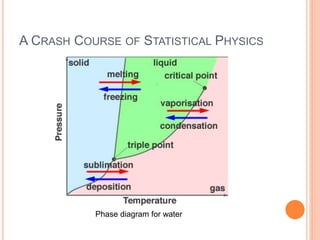
Phase diagram for water
A CRASH COURSE OF STATISTICAL PHYSICS
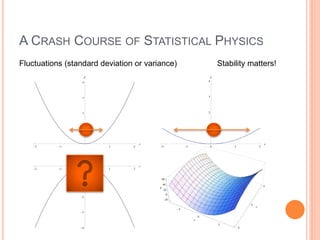
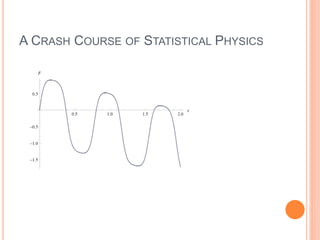
Stability matters!Fluctuations (standard deviation or variance)
A CRASH COURSE OF STATISTICAL PHYSICS
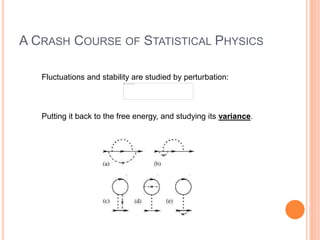
Fluctuations and stability are studied by perturbation:
Putting it back to the free energy, and studying its variance.
A CRASH COURSE OF STATISTICAL PHYSICS
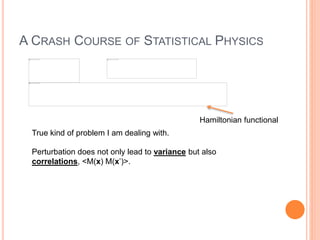
True kind of problem I am dealing with.
Perturbation does not only lead to variance but also
correlations, <M(x) M(x’)>.
Hamiltonian functional
HELIMAGNETS
 Leonard: What would you be if you were attached
to another object by an inclined plane, wrapped
helically around an axis?
 Sheldon: Screwed.
HELIMAGNETS
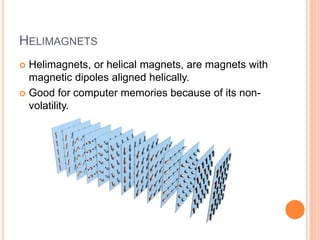
 Helimagnets, or helical magnets, are magnets with
magnetic dipoles aligned helically.
 Good for computer memories because of its non-
volatility.
HELIMAGNETS
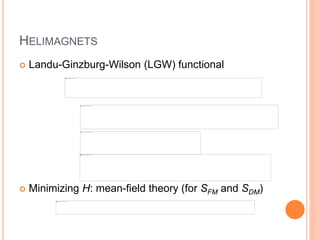
 Landu-Ginzburg-Wilson (LGW) functional
 Minimizing H: mean-field theory (for SFM and SDM)
HELIMAGNETS
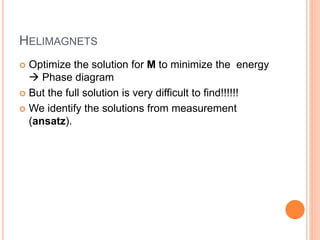
 Optimize the solution for M to minimize the energy
 Phase diagram
 But the full solution is very difficult to find!!!!!!
 We identify the solutions from measurement
(ansatz).
HELIMAGNETS
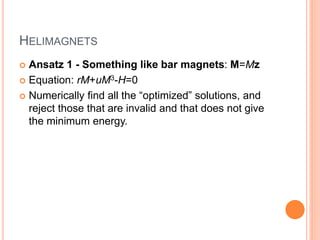
 Ansatz 1 - Something like bar magnets: M=Mz
 Equation: rM+uM3-H=0
 Numerically find all the “optimized” solutions, and
reject those that are invalid and that does not give
the minimum energy.
HELIMAGNETS
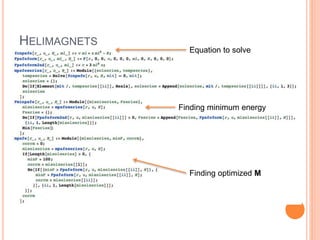
Equation to solve
Finding minimum energy
Finding optimized M
HELIMAGNETS
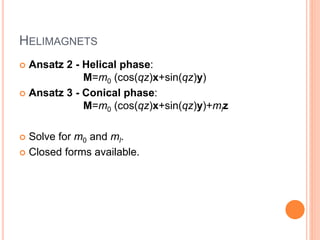
 Ansatz 2 - Helical phase:
M=m0 (cos(qz)x+sin(qz)y)
 Ansatz 3 - Conical phase:
M=m0 (cos(qz)x+sin(qz)y)+mlz
 Solve for m0 and ml.
 Closed forms available.
HELIMAGNETS
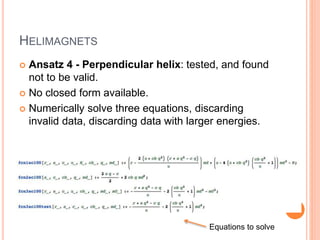
 Ansatz 4 - Perpendicular helix: tested, and found
not to be valid.
 No closed form available.
 Numerically solve three equations, discarding
invalid data, discarding data with larger energies.
Equations to solve
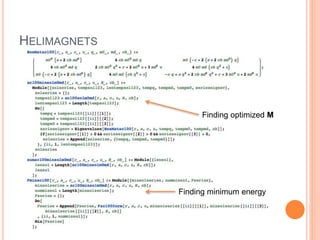
HELIMAGNETS
Finding minimum energy
Finding optimized M
HELIMAGNETS
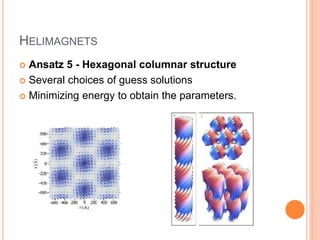
 Ansatz 5 - Hexagonal columnar structure
 Several choices of guess solutions
 Minimizing energy to obtain the parameters.
HELIMAGNETS
 In my program, all the postulated solutions are
considered.
 The code decides the solution by checking which
has the lowest energy.
HELIMAGNETS
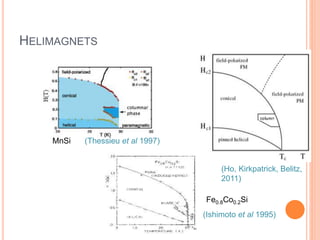
26
(Thessieu et al 1997)MnSi
(Ishimoto et al 1995)
Fe0.8Co0.2Si
(Ho, Kirkpatrick, Belitz,
2011)
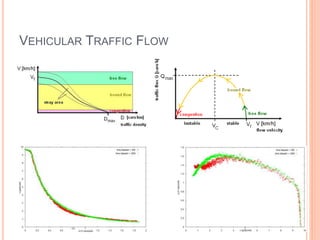
VEHICULAR TRAFFIC FLOW
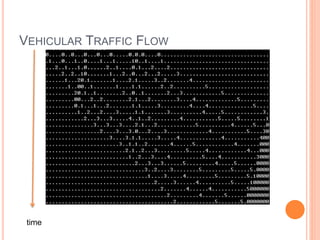
 Traffic is a big problem in Washington DC.
VEHICULAR TRAFFIC FLOW
time
VEHICULAR TRAFFIC FLOW
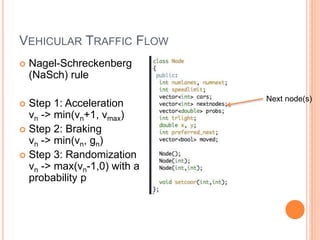
 Nagel-Schreckenberg
(NaSch) rule
 Step 1: Acceleration
vn -> min(vn+1, vmax)
 Step 2: Braking
vn -> min(vn, gn)
 Step 3: Randomization
vn -> max(vn-1,0) with a
probability p
Next node(s)
VEHICULAR TRAFFIC FLOW
 2-lane highway
 Lane-switching rule: At
cell i, find the distance
of the next barrier (a
car, a red traffic light,
the end of a road)
ahead for both lanes 0
(d0) and 1 (d1).
 On lane 0, switch to
lane 1 if d1>d0, and
vice versa.
VEHICULAR TRAFFIC FLOW
CONCLUSION
 Statistical physics is the study of many-body
physics using probability theory and statistics.
 The phase of the matter is the minimized energy of
the system. Finding the phase is an optimization
problem.
 The stability of the system depends on its variance
and correlation.
 The flow of traffic can be verified by microscopic
simulation by implementing linked list.
ACKNOWLEDGMENTS
 Theodore Kirkpatrick (University of Maryland)
 Dietrich Belitz (University of Oregon)
 Bei-lok Hu (University of Maryland)
 Esteban Calzetta (Universidad de Buenos Aires)
 Yan Sang (University of Oregon)
 Chi Kwong Law (Chinese University of Hong Kong)
 Lin Tian (University of California, Merced)
 Robert McKweon (Jefferson Lab)

Optimization in Statistical Physics

  • 1.
    OPTIMIZATION IN STATISTICAL PHYSICS Kwan-YuetHo Institute for Physical Science and Technology & Department of Physics University of Maryland 9/27/2012
  • 2.
     PhD (Physics),University of Maryland Thesis: Properties of Metallic Helimagnets Field: Condensed Matter Physics, Statistical Physics  BSc (Physics & Math), Chinese University of Hong Kong Thesis: Quantum Entanglement of Continuous Systems Field: Quantum Physics, Mathematical Physics Other projects:  Two-dimensional Bose gas (Condensed Matter Physics, Statistical Physics, Atomic Physics, Quantum Physics)  Ultra-high Energy Cosmic Rays (Particle Astrophysics)
  • 3.
  • 4.
    PHYSICS String Theory (Calabi- Yauspace) Superfluid Liquid Crystals
  • 5.
    PHYSICS  Classical vsQuantum  Deterministic vs probabilistic  Continuous vs Discrete I think it is safe to say that no one understands Quantum Mechanics. – Richard Feynman
  • 6.
    PHYSICS  Microscopic vsMacroscopic  N << or ~ 1023  Few-body vs Many-body
  • 7.
  • 8.
    A CRASH COURSEOF STATISTICAL PHYSICS  Statistical Physics/Mechanics: the study of a system containing many (N~1023) particles, using probability theory and statistics  Fixed N, V and T, probability of a state m is given by Partition Function Information such as T, <E> and other measurable quantities Normalization constant
  • 9.
    A CRASH COURSEOF STATISTICAL PHYSICS Helmholtz free energy F We model the free energy F, a summary of all the information about the system! Appropriate F is the minimized E(x) one with respect to m or x, to get the expected measured value of m and x. Method of steepest descent / mean field theory / equation of motion
  • 10.
    A CRASH COURSEOF STATISTICAL PHYSICS Phase diagram for water
  • 11.
    A CRASH COURSEOF STATISTICAL PHYSICS Stability matters!Fluctuations (standard deviation or variance)
  • 12.
    A CRASH COURSEOF STATISTICAL PHYSICS Fluctuations and stability are studied by perturbation: Putting it back to the free energy, and studying its variance.
  • 13.
    A CRASH COURSEOF STATISTICAL PHYSICS
  • 14.
    A CRASH COURSEOF STATISTICAL PHYSICS True kind of problem I am dealing with. Perturbation does not only lead to variance but also correlations, <M(x) M(x’)>. Hamiltonian functional
  • 15.
    HELIMAGNETS  Leonard: Whatwould you be if you were attached to another object by an inclined plane, wrapped helically around an axis?  Sheldon: Screwed.
  • 16.
    HELIMAGNETS  Helimagnets, orhelical magnets, are magnets with magnetic dipoles aligned helically.  Good for computer memories because of its non- volatility.
  • 17.
    HELIMAGNETS  Landu-Ginzburg-Wilson (LGW)functional  Minimizing H: mean-field theory (for SFM and SDM)
  • 18.
    HELIMAGNETS  Optimize thesolution for M to minimize the energy  Phase diagram  But the full solution is very difficult to find!!!!!!  We identify the solutions from measurement (ansatz).
  • 19.
    HELIMAGNETS  Ansatz 1- Something like bar magnets: M=Mz  Equation: rM+uM3-H=0  Numerically find all the “optimized” solutions, and reject those that are invalid and that does not give the minimum energy.
  • 20.
    HELIMAGNETS Equation to solve Findingminimum energy Finding optimized M
  • 21.
    HELIMAGNETS  Ansatz 2- Helical phase: M=m0 (cos(qz)x+sin(qz)y)  Ansatz 3 - Conical phase: M=m0 (cos(qz)x+sin(qz)y)+mlz  Solve for m0 and ml.  Closed forms available.
  • 22.
    HELIMAGNETS  Ansatz 4- Perpendicular helix: tested, and found not to be valid.  No closed form available.  Numerically solve three equations, discarding invalid data, discarding data with larger energies. Equations to solve
  • 23.
  • 24.
    HELIMAGNETS  Ansatz 5- Hexagonal columnar structure  Several choices of guess solutions  Minimizing energy to obtain the parameters.
  • 25.
    HELIMAGNETS  In myprogram, all the postulated solutions are considered.  The code decides the solution by checking which has the lowest energy.
  • 26.
    HELIMAGNETS 26 (Thessieu et al1997)MnSi (Ishimoto et al 1995) Fe0.8Co0.2Si (Ho, Kirkpatrick, Belitz, 2011)
  • 27.
    VEHICULAR TRAFFIC FLOW Traffic is a big problem in Washington DC.
  • 28.
  • 29.
    VEHICULAR TRAFFIC FLOW Nagel-Schreckenberg (NaSch) rule  Step 1: Acceleration vn -> min(vn+1, vmax)  Step 2: Braking vn -> min(vn, gn)  Step 3: Randomization vn -> max(vn-1,0) with a probability p Next node(s)
  • 30.
    VEHICULAR TRAFFIC FLOW 2-lane highway  Lane-switching rule: At cell i, find the distance of the next barrier (a car, a red traffic light, the end of a road) ahead for both lanes 0 (d0) and 1 (d1).  On lane 0, switch to lane 1 if d1>d0, and vice versa.
  • 31.
  • 32.
    CONCLUSION  Statistical physicsis the study of many-body physics using probability theory and statistics.  The phase of the matter is the minimized energy of the system. Finding the phase is an optimization problem.  The stability of the system depends on its variance and correlation.  The flow of traffic can be verified by microscopic simulation by implementing linked list.
  • 33.
    ACKNOWLEDGMENTS  Theodore Kirkpatrick(University of Maryland)  Dietrich Belitz (University of Oregon)  Bei-lok Hu (University of Maryland)  Esteban Calzetta (Universidad de Buenos Aires)  Yan Sang (University of Oregon)  Chi Kwong Law (Chinese University of Hong Kong)  Lin Tian (University of California, Merced)  Robert McKweon (Jefferson Lab)