Optimization Techniques for Power
System Problems
BY
K.Kathiravan AP/EEE
Theni kammavar sangam college of technology
Theni
Email ID: electrickathir@rediffmail.com
5/21/2017 1K.Kathiravan , AP/EEE, TKSCT- Theni
Definition of Optimization
Optimization is the mathematical discipline
which is concern with finding the Maxima and
Minima of function, possibly subject to the
constraints for continuous and Differential
functions.
 It is derived from the Latin Word ‘Optimus’
5/21/2017 2K.Kathiravan , AP/EEE, TKSCT- Theni
Where can we use Optimization?
 Architecture
 Electrical Network
 Economics
 Material Design
 Image Processing
 Transportation
 Nutrition and Etc..
5/21/2017 K.Kathiravan , AP/EEE, TKSCT- Theni 3
Basic Terminologies
Objective Function
It is expressed in mathematical function.
Design variable & Decision Variable
• Values influence with Objective function.
• Aim is to find out the values Design/Decision Variables.
Parameters
Constant Physical system.
Constraints
Functional/Decision Variables/Physical limitation on Design
Feasible Solution
Solution that satisfies all constraints
Optimal Solution
Solution that give Optimum (Max or Min) objective
function value.
5/21/2017 K.Kathiravan , AP/EEE, TKSCT- Theni 4
What do we Optimize?
 A Real Function of N Variables
f(x1,X2,X3….Xn)
 With or With out constraints
5/21/2017 K.Kathiravan , AP/EEE, TKSCT- Theni 5
Classification of Optimization
Two of Classification
 Static Optimization
Variables have Numerical Values, Fixed
with respect to time.
 Dynamic Optimization
Variables are function of time.
5/21/2017 K.Kathiravan , AP/EEE, TKSCT- Theni 6
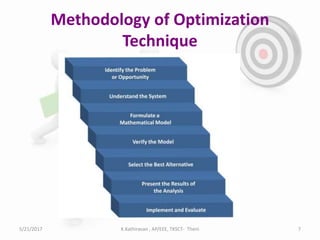
Methodology of Optimization
Technique
5/21/2017 K.Kathiravan , AP/EEE, TKSCT- Theni 7
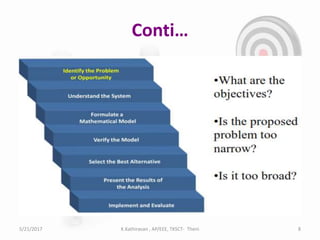
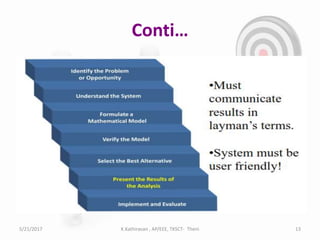
Conti…
5/21/2017 K.Kathiravan , AP/EEE, TKSCT- Theni 8
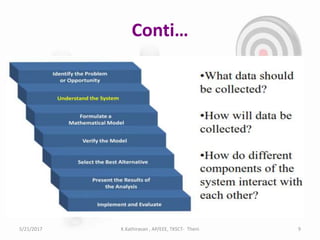
Conti…
5/21/2017 K.Kathiravan , AP/EEE, TKSCT- Theni 9
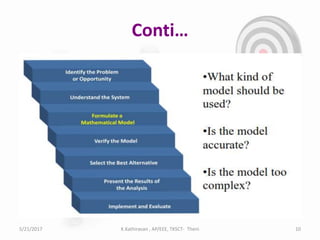
Conti…
5/21/2017 K.Kathiravan , AP/EEE, TKSCT- Theni 10
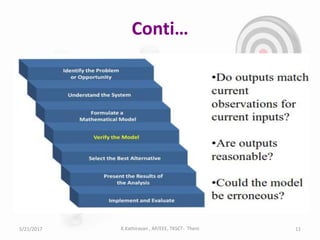
Conti…
5/21/2017 K.Kathiravan , AP/EEE, TKSCT- Theni 11
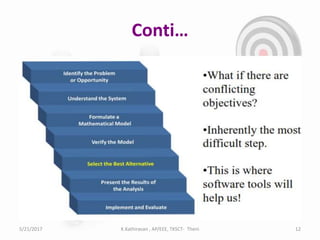
Conti…
5/21/2017 K.Kathiravan , AP/EEE, TKSCT- Theni 12
Conti…
5/21/2017 K.Kathiravan , AP/EEE, TKSCT- Theni 13
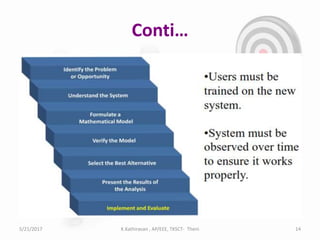
Conti…
5/21/2017 K.Kathiravan , AP/EEE, TKSCT- Theni 14
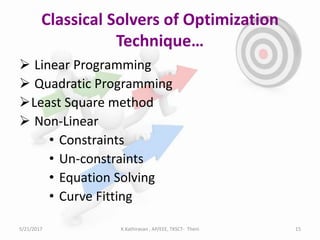
Classical Solvers of Optimization
Technique…
 Linear Programming
 Quadratic Programming
Least Square method
 Non-Linear
• Constraints
• Un-constraints
• Equation Solving
• Curve Fitting
5/21/2017 K.Kathiravan , AP/EEE, TKSCT- Theni 15
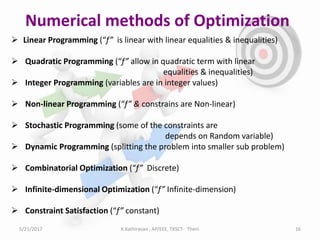
Numerical methods of Optimization
 Linear Programming (“f” is linear with linear equalities & inequalities)
 Quadratic Programming (“f” allow in quadratic term with linear
equalities & inequalities)
 Integer Programming (variables are in integer values)
 Non-linear Programming (“f” & constrains are Non-linear)
 Stochastic Programming (some of the constraints are
depends on Random variable)
 Dynamic Programming (splitting the problem into smaller sub problem)
 Combinatorial Optimization (“f” Discrete)
 Infinite-dimensional Optimization (“f” Infinite-dimension)
 Constraint Satisfaction (“f” constant)
5/21/2017 K.Kathiravan , AP/EEE, TKSCT- Theni 16
Importance of Power System
Optimization
Power system engineering has the longest history of
development among the various areas of electrical engineering.
practical numerical optimization methods have played a very
important role.
Value contributed by system optimization
Considerable in economical terms with hundreds
of millions of dollars saved annually in large utilities.
• Fuel cost
• Improved operational reliability
• System security
5/21/2017 17K.Kathiravan , AP/EEE, TKSCT- Theni
Importance Conti…
 Power systems are getting larger and more complicated
• Increase of load demand
• Fossil fuel demand of thermal power plants
Increases which causes
• Rising costs
• Rising emissions into the environment.
Therefore,
Optimization has become essential for the operation of power
system utilities in terms of
• Fuel cost savings
• Environmental preservation
5/21/2017 18K.Kathiravan , AP/EEE, TKSCT- Theni
Optimization Aim and Focus…
 To minimize the cost of power generation in regulated
power systems.
 To maximize social welfare in deregulated power systems,
while satisfying various operating constraints.
5/21/2017 19K.Kathiravan , AP/EEE, TKSCT- Theni
Optimization problems are nonlinear, which
including
• Nonlinear objective functions
• Nonlinear equality and inequality constraints.
Optimization Problem Constraints…
5/21/2017 20K.Kathiravan , AP/EEE, TKSCT- Theni
Optimization for Environmental
Reasons
 Dwindling fossil fuel resources
• Oil
•Coal
• Limitations to large scale renewable energy
development
• Controversial nuclear energy
• Unsustainable levels of environmental emissions
 Optimization is more important for power system
operation for economical and environmental
reasons.
5/21/2017 21K.Kathiravan , AP/EEE, TKSCT- Theni
To Solve Power System Optimization
Problems
 Numerous methods are found
• Conventional
• Artificial intelligence
 Above methods are Constantly improved & Developed
• Deal with large size systems
• Interconnected systems
 Optimization problems
• Complex due to a large number of constraints.
Hence,
 Finding better solutions with shorter computation
times is the goal of these methods.
5/21/2017 22K.Kathiravan , AP/EEE, TKSCT- Theni
Several Optimization Issues
 Economic Dispatch (ED)
 Unit Commitment (UC)
 Hydrothermal scheduling
 Optimal power flow (OPF)
 Optimal Reactive power flow (ORDP)
 Voltage Stability
 Available Transfer Capability (ATC)
 FACTS Devices Placement
 Maintenance scheduling
 Distributed Generation
 Capacitor Placement in Radial Distribution
Network(RDN)
 Phasor measurement unit (PMU) placement and etc..
5/21/2017 23K.Kathiravan , AP/EEE, TKSCT- Theni
Artificial Intelligence As A New Trend
In Optimization Problems
 widely used for solving optimization problems.
ADVANTAGE
 Deal with complex problems that cannot be
solved by conventional methods.
Easy to apply due to their simple mathematical
structure.
Easy to combine with other methods to hybrid
systems adding the strengths of each single
method.
Methods generally simulate natural phenomena
or the social behavior of humans or animals.
5/21/2017 24K.Kathiravan , AP/EEE, TKSCT- Theni
Expert Systems
 Expert systems were developed during the 1960s and 1970s
and commercially applied throughout the 1980s.
 Methodologies of expert systems
• Rule-Based Systems
• Knowledge-Based Systems
• Neural Networks
• Object-Oriented Methodology
• Case-Based Reasoning
• System Architecture
• Intelligent Agent Systems
• Database Methodology
• Modeling
• Ontology.5/21/2017 25K.Kathiravan , AP/EEE, TKSCT- Theni
Expert Systems Conti…
Expert systems are combined with fuzzy
systems to fuzzy-expert systems.
Expert systems are combined with neural
networks to neuron-expert systems.
Recently, with the development of computer
techniques(expert systems are applicable to
online applications).
5/21/2017 26K.Kathiravan , AP/EEE, TKSCT- Theni
Fuzzy Systems
Fuzzy systems were developed in 1965 and have
become popular in technical problem solving.
It is Mathematical means of describing vagueness
(imprecision or Indistinctness) in linguistic terms
instead of an exact mathematical description.
They are appropriate for dealing with uncertainties
and approximate reasoning.
Membership functions are vaguely defined to
represent the degree of truth of some events or
conditions.
The values of membership functions range from 0
to 1 in their linguistic form associated with
imprecise concepts.
5/21/2017 27K.Kathiravan , AP/EEE, TKSCT- Theni
Artificial Neural Network
 It is Mathematical models by simulating the human biological neural network for
processing information.
 A Neural Network consists of some layers of Artificial Neurons linked by weight
connections.
 Various Neural Networks by their structure such as
• Feed Forward,
• Back Propagation,
• Radial Basis Function,
• Recurrent Networks, etc.
 Each type has some specific work after being trained.
 It is infer a function from observations which is particularly useful for
applications with the complex tasks faced in real life like function.
• Approximation
• Classification
• Data Processing, etc.
 Its primary advantage are capability to learn algorithms
• Online adaption of dynamic systems,
• Quick parallel computation
• Intelligent Interpolation of data.5/21/2017 28K.Kathiravan , AP/EEE, TKSCT- Theni
Simulated Annealing
It is Meta-heuristic search algorithm for solving
optimization problems by locating a good
approximation at the global optimum point of a
given function in a search space.
 This method simulates the annealing in
metallurgy used for heating and controlled cooling
of a metal for its crystal resizing and effect
reduction.
Simulated annealing was developed in the 1980s
for solving optimization problems in a discrete
searching space and proved more efficient than
the method of exhaustive enumeration of the
search space.
5/21/2017 29K.Kathiravan , AP/EEE, TKSCT- Theni
Taboo Search
 It is Meta-heuristic search for solving combinatorial
optimization problems in
• Management Science
• Industrial Engineering
• Economic
• Computer Science.
 This method belongs to the local search techniques but
it enhances the performance of local search methods
using memory structures to match them with local
minima at the beginning.
 Once a potential solution has been obtained, it is marked
as taboo, thus the algorithm does not visit that
possibility again and again during the search process.
 Taboo search was developed in the 1970s and recently
has been widely used for its powerful search capabilities.5/21/2017 30K.Kathiravan , AP/EEE, TKSCT- Theni
Ant colony Optimization Algorithm
It is Probabilistic technique to solve optimization
problems.
It can be reduced to the problem of finding the
shortest paths through graphs based on the
behavior of ants in finding food for their colony by
marking their trails with pheromones.
The shortest path is the trail with the most
pheromone marks which the ants will use to carry
their food back home.
This algorithm was developed in 1991 and since
then, many variants of this principle have been
developed.
5/21/2017 31K.Kathiravan , AP/EEE, TKSCT- Theni
Genetic Algorithm It is Search technique used to find the exact or approximately best solution for
optimization problems.
 The genetic algorithm belongs to evolutionary computation using the techniques
inspired by evolutionary biology such as
• Inheritance
• Mutation
• Selection
• Crossover
 The genetic algorithm was developed part by part from the 1950s onward and is
one of the most popular methods applied to various optimization problems in
• Bioinformatics
• Computer science
• Engineering
• Economics
• Chemistry
• Manufacturing,
• Mathematics,
• Physics and etc..
 This method can take long computational times to get the optimal solution.
5/21/2017 32K.Kathiravan , AP/EEE, TKSCT- Theni
Evolutionary Programming
 Evolutionary computation paradigms to find the globally
optimal solution for an optimization problem.
 Evolutionary programming was developed in 1960 placing
emphasis on the behavior of the linkage between parents
and their offspring rather than trying to emulate the specific
genetic operators as observed in nature.
 The main operators of evolutionary programming consist of
• Mutation
• Evaluation
• Selection
 Widely this method is used in different optimization
techniques due to its powerful search capabilities.5/21/2017 33K.Kathiravan , AP/EEE, TKSCT- Theni
Particle Swarm Optimization
 It is Heuristic algorithms developed under emulation of the simplified
social behavior of animals in swarms (fish schools and bird flocks).
 It is a population based evolutionary algorithm found to be efficient
in solving continuous non-linear optimization problems.
 It provides a population-based search procedure, in which individuals
(particles) change their positions (states) over time.
 It uses a velocity vector based on the social behavior of the individuals
of the population to update the current position of each particle in the
swarm flying in a multidimensional search space of a problem.
 During the flight each particle with a certain velocity is dynamically
adjusted according to its flight experience and that of its neighboring
particles to find the best position for itself among its neighbors.
 Developed since 1995, particle swarm optimization has been
successfully applied in many researches and application areas such as
• Engineering
• Management system & Finance
5/21/2017 34K.Kathiravan , AP/EEE, TKSCT- Theni
Differential Evolution
 It is Belonging to the class of evolution strategy
optimizers, is a method of mathematical optimization of
multidimensional functions to find the global minimum of
a multidimensional and multimodal function fairly fast and
reasonably robust.
 Developed in the mid 1990s, the differential evolution
method is a simple population based and stochastic
function minimizer.
 The central idea of this method is a scheme to generate
trial parameter vectors by adding the weight difference
between two population vectors to a third one that makes
the scheme completely self-organizing.
 The trial vector is used for the next generation if it yields a
reduction in the value of an objective function.
5/21/2017 35K.Kathiravan , AP/EEE, TKSCT- Theni
Conti…
In general, the methods based on Artificial
intelligence are continuously developed
further for other application in different
power system optimization problems.
Recently, hybrid systems combining the
strengths of each single method have been
favored by researchers due to various
advantages over the single methods as
presented above.
5/21/2017 36K.Kathiravan , AP/EEE, TKSCT- Theni
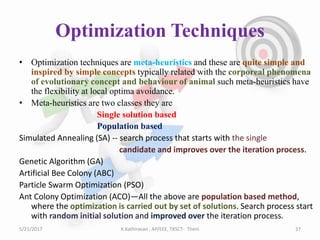
Optimization Techniques
• Optimization techniques are meta-heuristics and these are quite simple and
inspired by simple concepts typically related with the corporeal phenomena
of evolutionary concept and behaviour of animal such meta-heuristics have
the flexibility at local optima avoidance.
• Meta-heuristics are two classes they are
Single solution based
Population based
Simulated Annealing (SA) -- search process that starts with the single
candidate and improves over the iteration process.
Genetic Algorithm (GA)
Artificial Bee Colony (ABC)
Particle Swarm Optimization (PSO)
Ant Colony Optimization (ACO)—All the above are population based method,
where the optimization is carried out by set of solutions. Search process start
with random initial solution and improved over the iteration process.
37K.Kathiravan , AP/EEE, TKSCT- Theni5/21/2017
Conti…
simulated annaling.ppt
Differential Evolution Basics.pptx
DE.docx
ABC optimization.docx
5/21/2017 38K.Kathiravan , AP/EEE, TKSCT- Theni
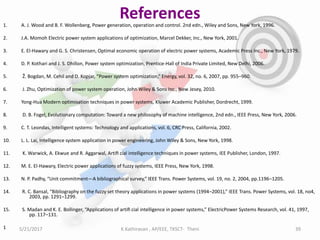
References1. A. J. Wood and B. F. Wollenberg, Power generation, operation and control. 2nd edn., Wiley and Sons, New York, 1996.
2. J.A. Momoh Electric power system applications of optimization, Marcel Dekker, Inc., New York, 2001.
3. E. El-Hawary and G. S. Christensen, Optimal economic operation of electric power systems, Academic Press Inc., New York, 1979.
4. D. P. Kothari and J. S. Dhillon, Power system optimization, Prentice-Hall of India Private Limited, New Delhi, 2006.
5. Ž. Bogdan, M. Cehil and D. Kopjar, “Power system optimization,” Energy, vol. 32, no. 6, 2007, pp. 955–960.
6. J. Zhu, Optimization of power system operation, John Wiley & Sons Inc., New Jesey, 2010.
7. Yong-Hua Modern optimisation techniques in power systems, Kluwer Academic Publisher, Dordrecht, 1999.
8. D. B. Fogel, Evolutionary computation: Toward a new philosophy of machine intelligence, 2nd edn., IEEE Press, New York, 2006.
9. C. T. Leondas, Intelligent systems: Technology and applications, vol. 6, CRC Press, California, 2002.
10. L. L. Lai, Intelligence system application in power engineering, John Wiley & Sons, New York, 1998.
11. K. Warwick, A. Ekwue and R. Aggarwal, Artifi cial intelligence techniques in power systems, IEE Publisher, London, 1997.
12. M. E. El-Hawary, Electric power applications of fuzzy systems, IEEE Press, New York, 1998.
13. N. P. Padhy, “Unit commitment—A bibliographical survey,” IEEE Trans. Power Systems, vol. 19, no. 2, 2004, pp.1196–1205.
14. R. C. Bansal, “Bibliography on the fuzzy set theory applications in power systems (1994–2001),” IEEE Trans. Power Systems, vol. 18, no4,
2003, pp. 1291–1299.
15. S. Madan and K. E. Bollinger, “Applications of artifi cial intelligence in power systems,” ElectricPower Systems Research, vol. 41, 1997,
pp. 117–131.
1 5/21/2017 39K.Kathiravan , AP/EEE, TKSCT- Theni
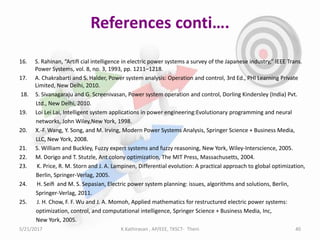
References conti….
16. S. Rahinan, “Artifi cial intelligence in electric power systems a survey of the Japanese industry,” IEEE Trans.
Power Systems, vol. 8, no. 3, 1993, pp. 1211–1218.
17. A. Chakrabarti and S. Halder, Power system analysis: Operation and control, 3rd Ed., PHI Learning Private
Limited, New Delhi, 2010.
18. S. Sivanagaraju and G. Screenivasan, Power system operation and control, Dorling Kindersley (India) Pvt.
Ltd., New Delhi, 2010.
19. Loi Lei Lai, Intelligent system applications in power engineering:Evolutionary programming and neural
networks, John Wiley,New York, 1998.
20. X.-F. Wang, Y. Song, and M. Irving, Modern Power Systems Analysis, Springer Science + Business Media,
LLC, New York, 2008.
21. S. William and Buckley, Fuzzy expert systems and fuzzy reasoning, New York, Wiley-Interscience, 2005.
22. M. Dorigo and T. Stutzle, Ant colony optimization, The MIT Press, Massachusetts, 2004.
23. K. Price, R. M. Storn and J. A. Lampinen, Differential evolution: A practical approach to global optimization,
Berlin, Springer-Verlag, 2005.
24. H. Seifi and M. S. Sepasian, Electric power system planning: issues, algorithms and solutions, Berlin,
Springer-Verlag, 2011.
25. J. H. Chow, F. F. Wu and J. A. Momoh, Applied mathematics for restructured electric power systems:
optimization, control, and computational intelligence, Springer Science + Business Media, Inc,
New York, 2005.
5/21/2017 40K.Kathiravan , AP/EEE, TKSCT- Theni
Special Thanks to Session Audiences
5/21/2017 41K.Kathiravan , AP/EEE, TKSCT- Theni
Optimization for-power-sy-8631549

Optimization for-power-sy-8631549

  • 1.
    Optimization Techniques forPower System Problems BY K.Kathiravan AP/EEE Theni kammavar sangam college of technology Theni Email ID: electrickathir@rediffmail.com 5/21/2017 1K.Kathiravan , AP/EEE, TKSCT- Theni
  • 2.
    Definition of Optimization Optimizationis the mathematical discipline which is concern with finding the Maxima and Minima of function, possibly subject to the constraints for continuous and Differential functions.  It is derived from the Latin Word ‘Optimus’ 5/21/2017 2K.Kathiravan , AP/EEE, TKSCT- Theni
  • 3.
    Where can weuse Optimization?  Architecture  Electrical Network  Economics  Material Design  Image Processing  Transportation  Nutrition and Etc.. 5/21/2017 K.Kathiravan , AP/EEE, TKSCT- Theni 3
  • 4.
    Basic Terminologies Objective Function Itis expressed in mathematical function. Design variable & Decision Variable • Values influence with Objective function. • Aim is to find out the values Design/Decision Variables. Parameters Constant Physical system. Constraints Functional/Decision Variables/Physical limitation on Design Feasible Solution Solution that satisfies all constraints Optimal Solution Solution that give Optimum (Max or Min) objective function value. 5/21/2017 K.Kathiravan , AP/EEE, TKSCT- Theni 4
  • 5.
    What do weOptimize?  A Real Function of N Variables f(x1,X2,X3….Xn)  With or With out constraints 5/21/2017 K.Kathiravan , AP/EEE, TKSCT- Theni 5
  • 6.
    Classification of Optimization Twoof Classification  Static Optimization Variables have Numerical Values, Fixed with respect to time.  Dynamic Optimization Variables are function of time. 5/21/2017 K.Kathiravan , AP/EEE, TKSCT- Theni 6
  • 7.
    Methodology of Optimization Technique 5/21/2017K.Kathiravan , AP/EEE, TKSCT- Theni 7
  • 8.
    Conti… 5/21/2017 K.Kathiravan ,AP/EEE, TKSCT- Theni 8
  • 9.
    Conti… 5/21/2017 K.Kathiravan ,AP/EEE, TKSCT- Theni 9
  • 10.
    Conti… 5/21/2017 K.Kathiravan ,AP/EEE, TKSCT- Theni 10
  • 11.
    Conti… 5/21/2017 K.Kathiravan ,AP/EEE, TKSCT- Theni 11
  • 12.
    Conti… 5/21/2017 K.Kathiravan ,AP/EEE, TKSCT- Theni 12
  • 13.
    Conti… 5/21/2017 K.Kathiravan ,AP/EEE, TKSCT- Theni 13
  • 14.
    Conti… 5/21/2017 K.Kathiravan ,AP/EEE, TKSCT- Theni 14
  • 15.
    Classical Solvers ofOptimization Technique…  Linear Programming  Quadratic Programming Least Square method  Non-Linear • Constraints • Un-constraints • Equation Solving • Curve Fitting 5/21/2017 K.Kathiravan , AP/EEE, TKSCT- Theni 15
  • 16.
    Numerical methods ofOptimization  Linear Programming (“f” is linear with linear equalities & inequalities)  Quadratic Programming (“f” allow in quadratic term with linear equalities & inequalities)  Integer Programming (variables are in integer values)  Non-linear Programming (“f” & constrains are Non-linear)  Stochastic Programming (some of the constraints are depends on Random variable)  Dynamic Programming (splitting the problem into smaller sub problem)  Combinatorial Optimization (“f” Discrete)  Infinite-dimensional Optimization (“f” Infinite-dimension)  Constraint Satisfaction (“f” constant) 5/21/2017 K.Kathiravan , AP/EEE, TKSCT- Theni 16
  • 17.
    Importance of PowerSystem Optimization Power system engineering has the longest history of development among the various areas of electrical engineering. practical numerical optimization methods have played a very important role. Value contributed by system optimization Considerable in economical terms with hundreds of millions of dollars saved annually in large utilities. • Fuel cost • Improved operational reliability • System security 5/21/2017 17K.Kathiravan , AP/EEE, TKSCT- Theni
  • 18.
    Importance Conti…  Powersystems are getting larger and more complicated • Increase of load demand • Fossil fuel demand of thermal power plants Increases which causes • Rising costs • Rising emissions into the environment. Therefore, Optimization has become essential for the operation of power system utilities in terms of • Fuel cost savings • Environmental preservation 5/21/2017 18K.Kathiravan , AP/EEE, TKSCT- Theni
  • 19.
    Optimization Aim andFocus…  To minimize the cost of power generation in regulated power systems.  To maximize social welfare in deregulated power systems, while satisfying various operating constraints. 5/21/2017 19K.Kathiravan , AP/EEE, TKSCT- Theni
  • 20.
    Optimization problems arenonlinear, which including • Nonlinear objective functions • Nonlinear equality and inequality constraints. Optimization Problem Constraints… 5/21/2017 20K.Kathiravan , AP/EEE, TKSCT- Theni
  • 21.
    Optimization for Environmental Reasons Dwindling fossil fuel resources • Oil •Coal • Limitations to large scale renewable energy development • Controversial nuclear energy • Unsustainable levels of environmental emissions  Optimization is more important for power system operation for economical and environmental reasons. 5/21/2017 21K.Kathiravan , AP/EEE, TKSCT- Theni
  • 22.
    To Solve PowerSystem Optimization Problems  Numerous methods are found • Conventional • Artificial intelligence  Above methods are Constantly improved & Developed • Deal with large size systems • Interconnected systems  Optimization problems • Complex due to a large number of constraints. Hence,  Finding better solutions with shorter computation times is the goal of these methods. 5/21/2017 22K.Kathiravan , AP/EEE, TKSCT- Theni
  • 23.
    Several Optimization Issues Economic Dispatch (ED)  Unit Commitment (UC)  Hydrothermal scheduling  Optimal power flow (OPF)  Optimal Reactive power flow (ORDP)  Voltage Stability  Available Transfer Capability (ATC)  FACTS Devices Placement  Maintenance scheduling  Distributed Generation  Capacitor Placement in Radial Distribution Network(RDN)  Phasor measurement unit (PMU) placement and etc.. 5/21/2017 23K.Kathiravan , AP/EEE, TKSCT- Theni
  • 24.
    Artificial Intelligence AsA New Trend In Optimization Problems  widely used for solving optimization problems. ADVANTAGE  Deal with complex problems that cannot be solved by conventional methods. Easy to apply due to their simple mathematical structure. Easy to combine with other methods to hybrid systems adding the strengths of each single method. Methods generally simulate natural phenomena or the social behavior of humans or animals. 5/21/2017 24K.Kathiravan , AP/EEE, TKSCT- Theni
  • 25.
    Expert Systems  Expertsystems were developed during the 1960s and 1970s and commercially applied throughout the 1980s.  Methodologies of expert systems • Rule-Based Systems • Knowledge-Based Systems • Neural Networks • Object-Oriented Methodology • Case-Based Reasoning • System Architecture • Intelligent Agent Systems • Database Methodology • Modeling • Ontology.5/21/2017 25K.Kathiravan , AP/EEE, TKSCT- Theni
  • 26.
    Expert Systems Conti… Expertsystems are combined with fuzzy systems to fuzzy-expert systems. Expert systems are combined with neural networks to neuron-expert systems. Recently, with the development of computer techniques(expert systems are applicable to online applications). 5/21/2017 26K.Kathiravan , AP/EEE, TKSCT- Theni
  • 27.
    Fuzzy Systems Fuzzy systemswere developed in 1965 and have become popular in technical problem solving. It is Mathematical means of describing vagueness (imprecision or Indistinctness) in linguistic terms instead of an exact mathematical description. They are appropriate for dealing with uncertainties and approximate reasoning. Membership functions are vaguely defined to represent the degree of truth of some events or conditions. The values of membership functions range from 0 to 1 in their linguistic form associated with imprecise concepts. 5/21/2017 27K.Kathiravan , AP/EEE, TKSCT- Theni
  • 28.
    Artificial Neural Network It is Mathematical models by simulating the human biological neural network for processing information.  A Neural Network consists of some layers of Artificial Neurons linked by weight connections.  Various Neural Networks by their structure such as • Feed Forward, • Back Propagation, • Radial Basis Function, • Recurrent Networks, etc.  Each type has some specific work after being trained.  It is infer a function from observations which is particularly useful for applications with the complex tasks faced in real life like function. • Approximation • Classification • Data Processing, etc.  Its primary advantage are capability to learn algorithms • Online adaption of dynamic systems, • Quick parallel computation • Intelligent Interpolation of data.5/21/2017 28K.Kathiravan , AP/EEE, TKSCT- Theni
  • 29.
    Simulated Annealing It isMeta-heuristic search algorithm for solving optimization problems by locating a good approximation at the global optimum point of a given function in a search space.  This method simulates the annealing in metallurgy used for heating and controlled cooling of a metal for its crystal resizing and effect reduction. Simulated annealing was developed in the 1980s for solving optimization problems in a discrete searching space and proved more efficient than the method of exhaustive enumeration of the search space. 5/21/2017 29K.Kathiravan , AP/EEE, TKSCT- Theni
  • 30.
    Taboo Search  Itis Meta-heuristic search for solving combinatorial optimization problems in • Management Science • Industrial Engineering • Economic • Computer Science.  This method belongs to the local search techniques but it enhances the performance of local search methods using memory structures to match them with local minima at the beginning.  Once a potential solution has been obtained, it is marked as taboo, thus the algorithm does not visit that possibility again and again during the search process.  Taboo search was developed in the 1970s and recently has been widely used for its powerful search capabilities.5/21/2017 30K.Kathiravan , AP/EEE, TKSCT- Theni
  • 31.
    Ant colony OptimizationAlgorithm It is Probabilistic technique to solve optimization problems. It can be reduced to the problem of finding the shortest paths through graphs based on the behavior of ants in finding food for their colony by marking their trails with pheromones. The shortest path is the trail with the most pheromone marks which the ants will use to carry their food back home. This algorithm was developed in 1991 and since then, many variants of this principle have been developed. 5/21/2017 31K.Kathiravan , AP/EEE, TKSCT- Theni
  • 32.
    Genetic Algorithm Itis Search technique used to find the exact or approximately best solution for optimization problems.  The genetic algorithm belongs to evolutionary computation using the techniques inspired by evolutionary biology such as • Inheritance • Mutation • Selection • Crossover  The genetic algorithm was developed part by part from the 1950s onward and is one of the most popular methods applied to various optimization problems in • Bioinformatics • Computer science • Engineering • Economics • Chemistry • Manufacturing, • Mathematics, • Physics and etc..  This method can take long computational times to get the optimal solution. 5/21/2017 32K.Kathiravan , AP/EEE, TKSCT- Theni
  • 33.
    Evolutionary Programming  Evolutionarycomputation paradigms to find the globally optimal solution for an optimization problem.  Evolutionary programming was developed in 1960 placing emphasis on the behavior of the linkage between parents and their offspring rather than trying to emulate the specific genetic operators as observed in nature.  The main operators of evolutionary programming consist of • Mutation • Evaluation • Selection  Widely this method is used in different optimization techniques due to its powerful search capabilities.5/21/2017 33K.Kathiravan , AP/EEE, TKSCT- Theni
  • 34.
    Particle Swarm Optimization It is Heuristic algorithms developed under emulation of the simplified social behavior of animals in swarms (fish schools and bird flocks).  It is a population based evolutionary algorithm found to be efficient in solving continuous non-linear optimization problems.  It provides a population-based search procedure, in which individuals (particles) change their positions (states) over time.  It uses a velocity vector based on the social behavior of the individuals of the population to update the current position of each particle in the swarm flying in a multidimensional search space of a problem.  During the flight each particle with a certain velocity is dynamically adjusted according to its flight experience and that of its neighboring particles to find the best position for itself among its neighbors.  Developed since 1995, particle swarm optimization has been successfully applied in many researches and application areas such as • Engineering • Management system & Finance 5/21/2017 34K.Kathiravan , AP/EEE, TKSCT- Theni
  • 35.
    Differential Evolution  Itis Belonging to the class of evolution strategy optimizers, is a method of mathematical optimization of multidimensional functions to find the global minimum of a multidimensional and multimodal function fairly fast and reasonably robust.  Developed in the mid 1990s, the differential evolution method is a simple population based and stochastic function minimizer.  The central idea of this method is a scheme to generate trial parameter vectors by adding the weight difference between two population vectors to a third one that makes the scheme completely self-organizing.  The trial vector is used for the next generation if it yields a reduction in the value of an objective function. 5/21/2017 35K.Kathiravan , AP/EEE, TKSCT- Theni
  • 36.
    Conti… In general, themethods based on Artificial intelligence are continuously developed further for other application in different power system optimization problems. Recently, hybrid systems combining the strengths of each single method have been favored by researchers due to various advantages over the single methods as presented above. 5/21/2017 36K.Kathiravan , AP/EEE, TKSCT- Theni
  • 37.
    Optimization Techniques • Optimizationtechniques are meta-heuristics and these are quite simple and inspired by simple concepts typically related with the corporeal phenomena of evolutionary concept and behaviour of animal such meta-heuristics have the flexibility at local optima avoidance. • Meta-heuristics are two classes they are Single solution based Population based Simulated Annealing (SA) -- search process that starts with the single candidate and improves over the iteration process. Genetic Algorithm (GA) Artificial Bee Colony (ABC) Particle Swarm Optimization (PSO) Ant Colony Optimization (ACO)—All the above are population based method, where the optimization is carried out by set of solutions. Search process start with random initial solution and improved over the iteration process. 37K.Kathiravan , AP/EEE, TKSCT- Theni5/21/2017
  • 38.
    Conti… simulated annaling.ppt Differential EvolutionBasics.pptx DE.docx ABC optimization.docx 5/21/2017 38K.Kathiravan , AP/EEE, TKSCT- Theni
  • 39.
    References1. A. J.Wood and B. F. Wollenberg, Power generation, operation and control. 2nd edn., Wiley and Sons, New York, 1996. 2. J.A. Momoh Electric power system applications of optimization, Marcel Dekker, Inc., New York, 2001. 3. E. El-Hawary and G. S. Christensen, Optimal economic operation of electric power systems, Academic Press Inc., New York, 1979. 4. D. P. Kothari and J. S. Dhillon, Power system optimization, Prentice-Hall of India Private Limited, New Delhi, 2006. 5. Ž. Bogdan, M. Cehil and D. Kopjar, “Power system optimization,” Energy, vol. 32, no. 6, 2007, pp. 955–960. 6. J. Zhu, Optimization of power system operation, John Wiley & Sons Inc., New Jesey, 2010. 7. Yong-Hua Modern optimisation techniques in power systems, Kluwer Academic Publisher, Dordrecht, 1999. 8. D. B. Fogel, Evolutionary computation: Toward a new philosophy of machine intelligence, 2nd edn., IEEE Press, New York, 2006. 9. C. T. Leondas, Intelligent systems: Technology and applications, vol. 6, CRC Press, California, 2002. 10. L. L. Lai, Intelligence system application in power engineering, John Wiley & Sons, New York, 1998. 11. K. Warwick, A. Ekwue and R. Aggarwal, Artifi cial intelligence techniques in power systems, IEE Publisher, London, 1997. 12. M. E. El-Hawary, Electric power applications of fuzzy systems, IEEE Press, New York, 1998. 13. N. P. Padhy, “Unit commitment—A bibliographical survey,” IEEE Trans. Power Systems, vol. 19, no. 2, 2004, pp.1196–1205. 14. R. C. Bansal, “Bibliography on the fuzzy set theory applications in power systems (1994–2001),” IEEE Trans. Power Systems, vol. 18, no4, 2003, pp. 1291–1299. 15. S. Madan and K. E. Bollinger, “Applications of artifi cial intelligence in power systems,” ElectricPower Systems Research, vol. 41, 1997, pp. 117–131. 1 5/21/2017 39K.Kathiravan , AP/EEE, TKSCT- Theni
  • 40.
    References conti…. 16. S.Rahinan, “Artifi cial intelligence in electric power systems a survey of the Japanese industry,” IEEE Trans. Power Systems, vol. 8, no. 3, 1993, pp. 1211–1218. 17. A. Chakrabarti and S. Halder, Power system analysis: Operation and control, 3rd Ed., PHI Learning Private Limited, New Delhi, 2010. 18. S. Sivanagaraju and G. Screenivasan, Power system operation and control, Dorling Kindersley (India) Pvt. Ltd., New Delhi, 2010. 19. Loi Lei Lai, Intelligent system applications in power engineering:Evolutionary programming and neural networks, John Wiley,New York, 1998. 20. X.-F. Wang, Y. Song, and M. Irving, Modern Power Systems Analysis, Springer Science + Business Media, LLC, New York, 2008. 21. S. William and Buckley, Fuzzy expert systems and fuzzy reasoning, New York, Wiley-Interscience, 2005. 22. M. Dorigo and T. Stutzle, Ant colony optimization, The MIT Press, Massachusetts, 2004. 23. K. Price, R. M. Storn and J. A. Lampinen, Differential evolution: A practical approach to global optimization, Berlin, Springer-Verlag, 2005. 24. H. Seifi and M. S. Sepasian, Electric power system planning: issues, algorithms and solutions, Berlin, Springer-Verlag, 2011. 25. J. H. Chow, F. F. Wu and J. A. Momoh, Applied mathematics for restructured electric power systems: optimization, control, and computational intelligence, Springer Science + Business Media, Inc, New York, 2005. 5/21/2017 40K.Kathiravan , AP/EEE, TKSCT- Theni
  • 41.
    Special Thanks toSession Audiences 5/21/2017 41K.Kathiravan , AP/EEE, TKSCT- Theni