EVOLUTIONARY COMPUTATION
Lecture #3
8/23/2024
Fall 2024
ECEN/MAE 5773
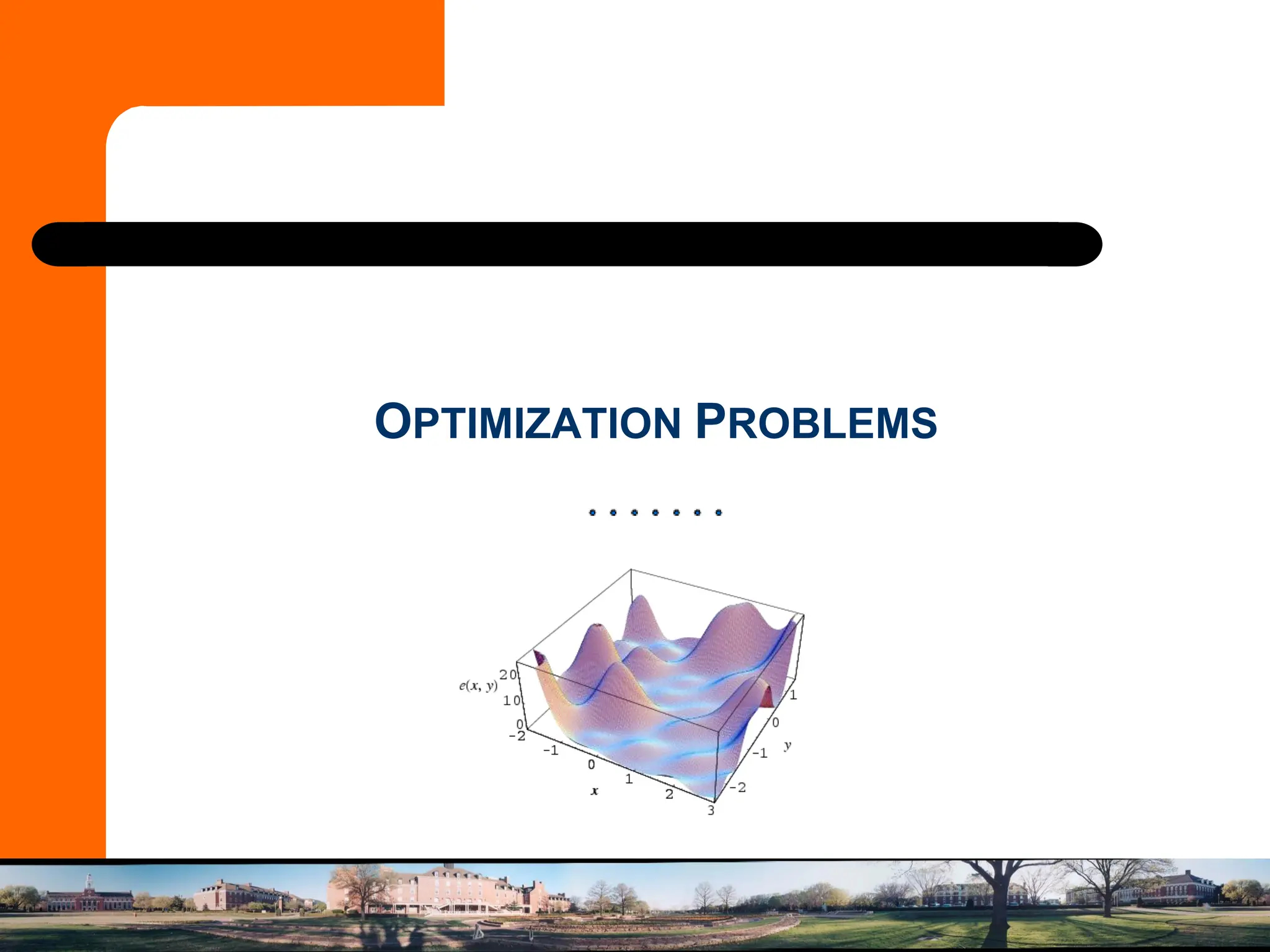
OPTIMIZATION PROBLEMS
Problem Formulation
3 basic ingredients…
⚫ a set of objective functions,
⚫ a set of decision variables,
⚫ a set of equality/inequality constraints.
The problem is
to search for the values of the decision variables that
minimize or maximize the objective functions while
satisfying the constraints…
An example…
How to partition 1,000 circuits into five regions
on a microchip and confirm to layout constraints?
5^1000 = 9.33263619E698
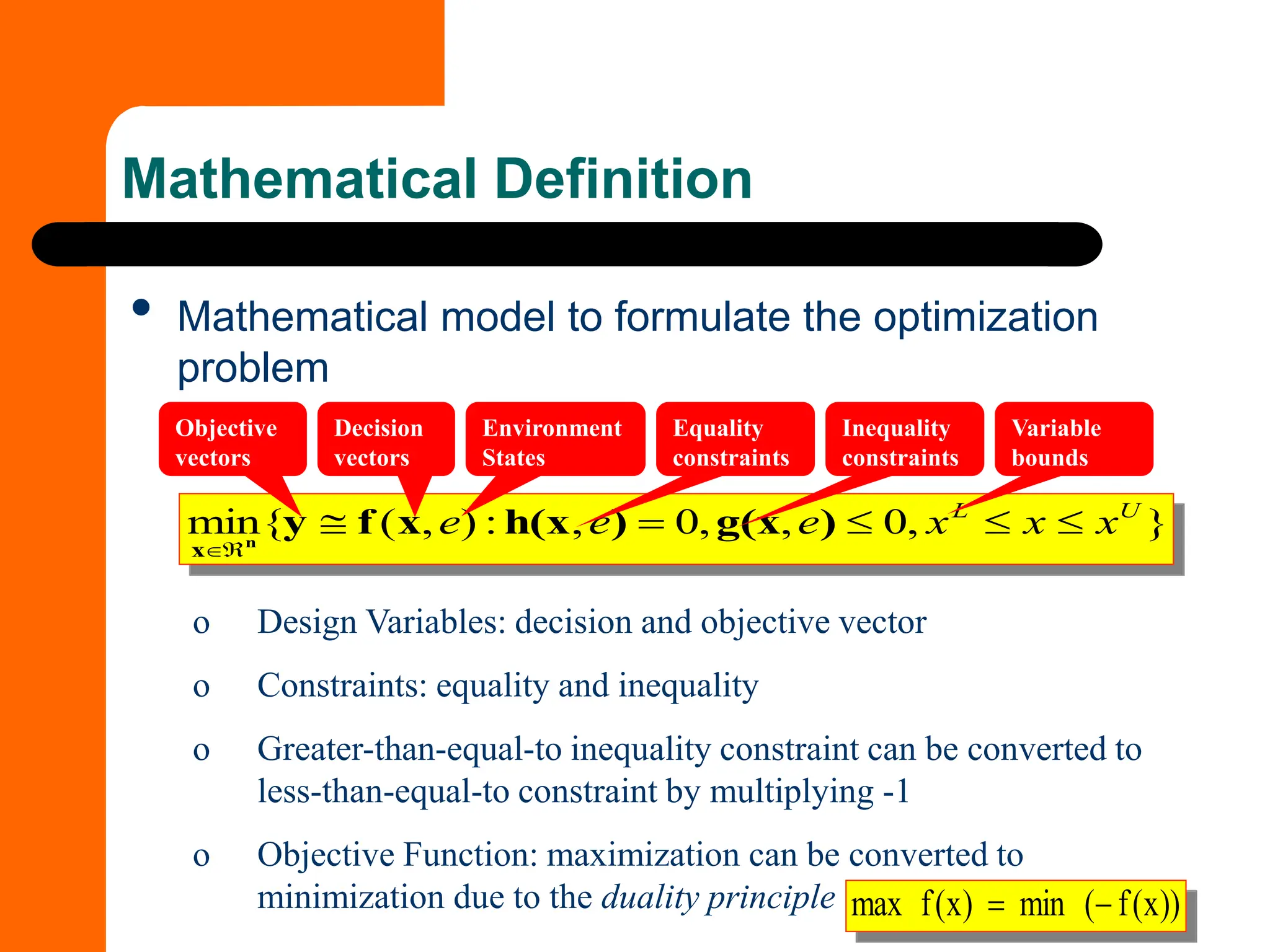
Mathematical Definition
• Mathematical model to formulate the optimization
problem
}
,
0
,
,
0
,
:
)
,
(
{
min U
L
x
x
x
e
e
e 


=



)
g(x
)
h(x
x
f
y
n
x
))
x
(
f
(
min
)
x
(
f
max −
=
o Design Variables: decision and objective vector
o Constraints: equality and inequality
o Greater-than-equal-to inequality constraint can be converted to
less-than-equal-to constraint by multiplying -1
o Objective Function: maximization can be converted to
minimization due to the duality principle
Objective
vectors
Decision
vectors
Equality
constraints
Inequality
constraints
Variable
bounds
Environment
States
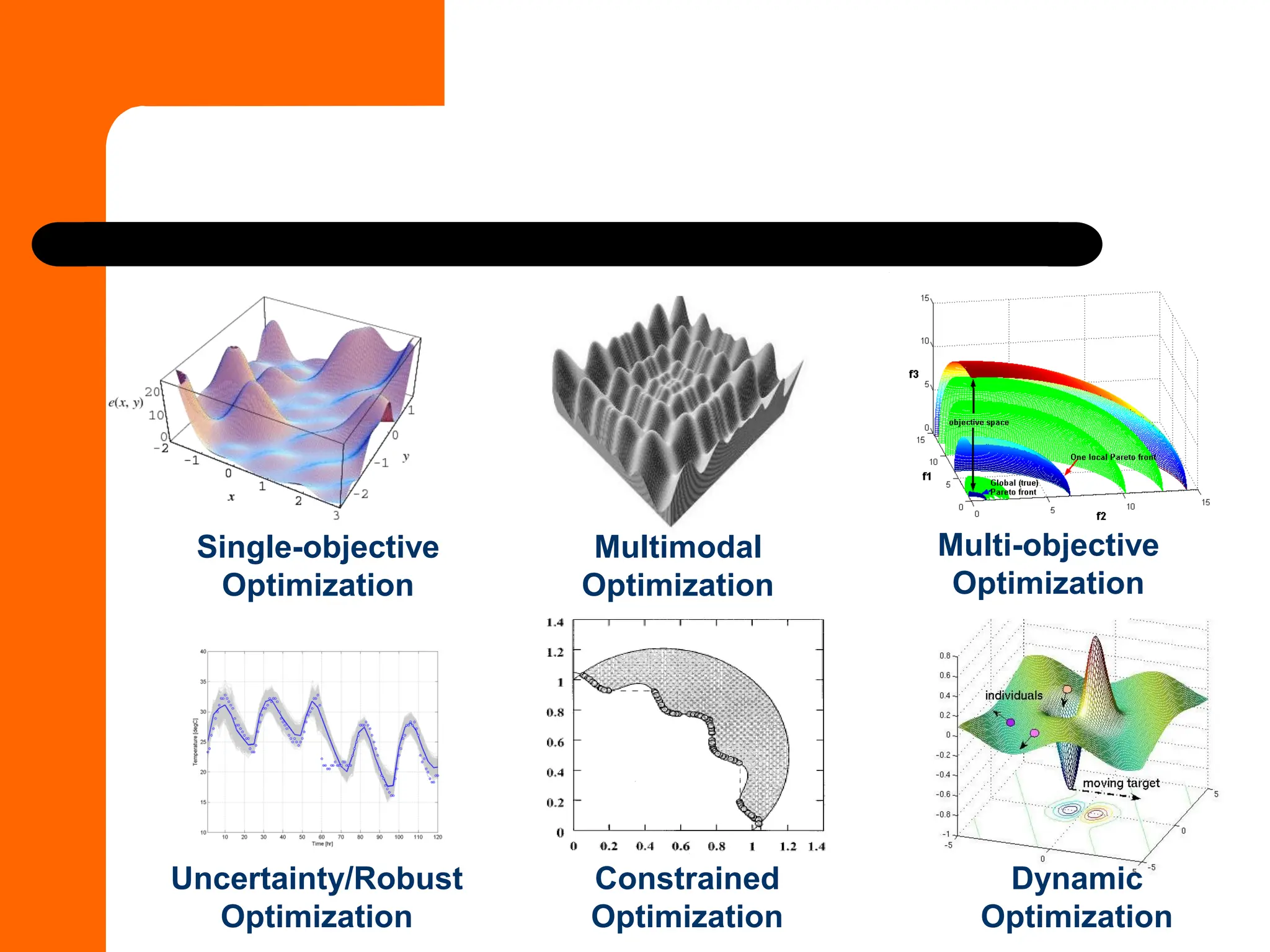
Single-objective
Optimization
Multimodal
Optimization
Constrained
Optimization
Multi-objective
Optimization
Dynamic
Optimization
Uncertainty/Robust
Optimization
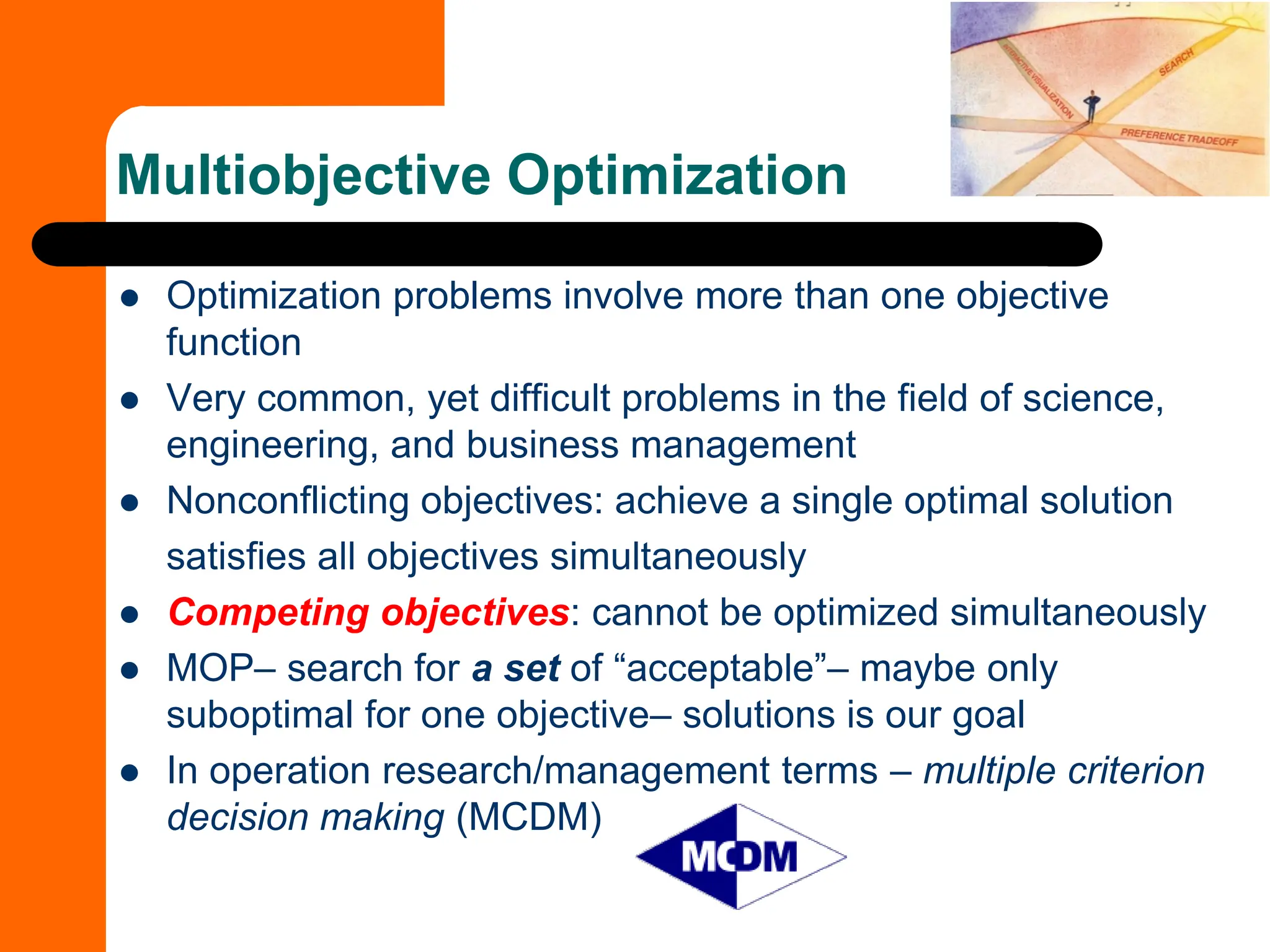
Multiobjective Optimization
⚫ Optimization problems involve more than one objective
function
⚫ Very common, yet difficult problems in the field of science,
engineering, and business management
⚫ Nonconflicting objectives: achieve a single optimal solution
satisfies all objectives simultaneously
⚫ Competing objectives: cannot be optimized simultaneously
⚫ MOP– search for a set of “acceptable”– maybe only
suboptimal for one objective– solutions is our goal
⚫ In operation research/management terms – multiple criterion
decision making (MCDM)
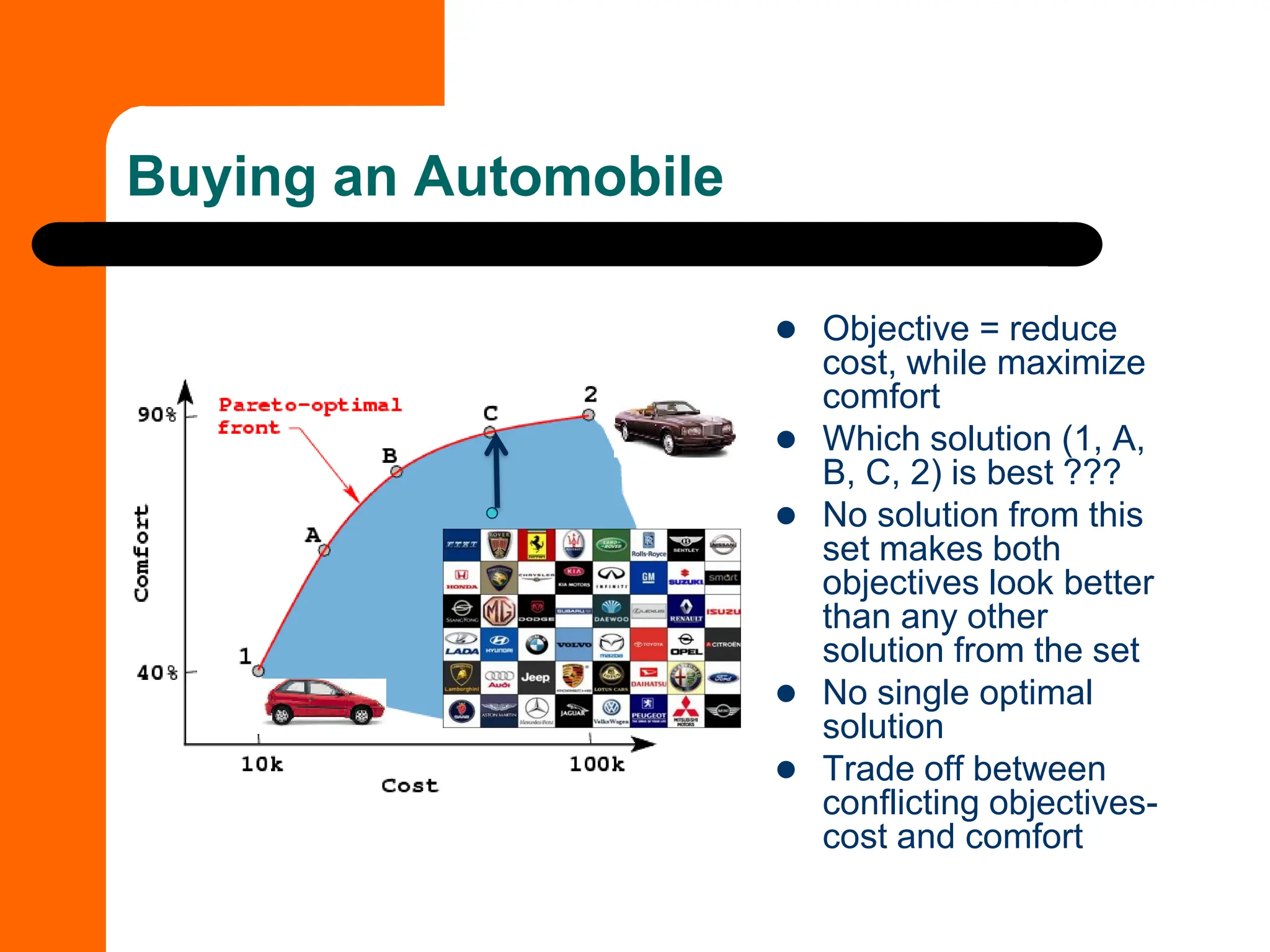
Buying an Automobile
⚫ Objective = reduce
cost, while maximize
comfort
⚫ Which solution (1, A,
B, C, 2) is best ???
⚫ No solution from this
set makes both
objectives look better
than any other
solution from the set
⚫ No single optimal
solution
⚫ Trade off between
conflicting objectives-
cost and comfort
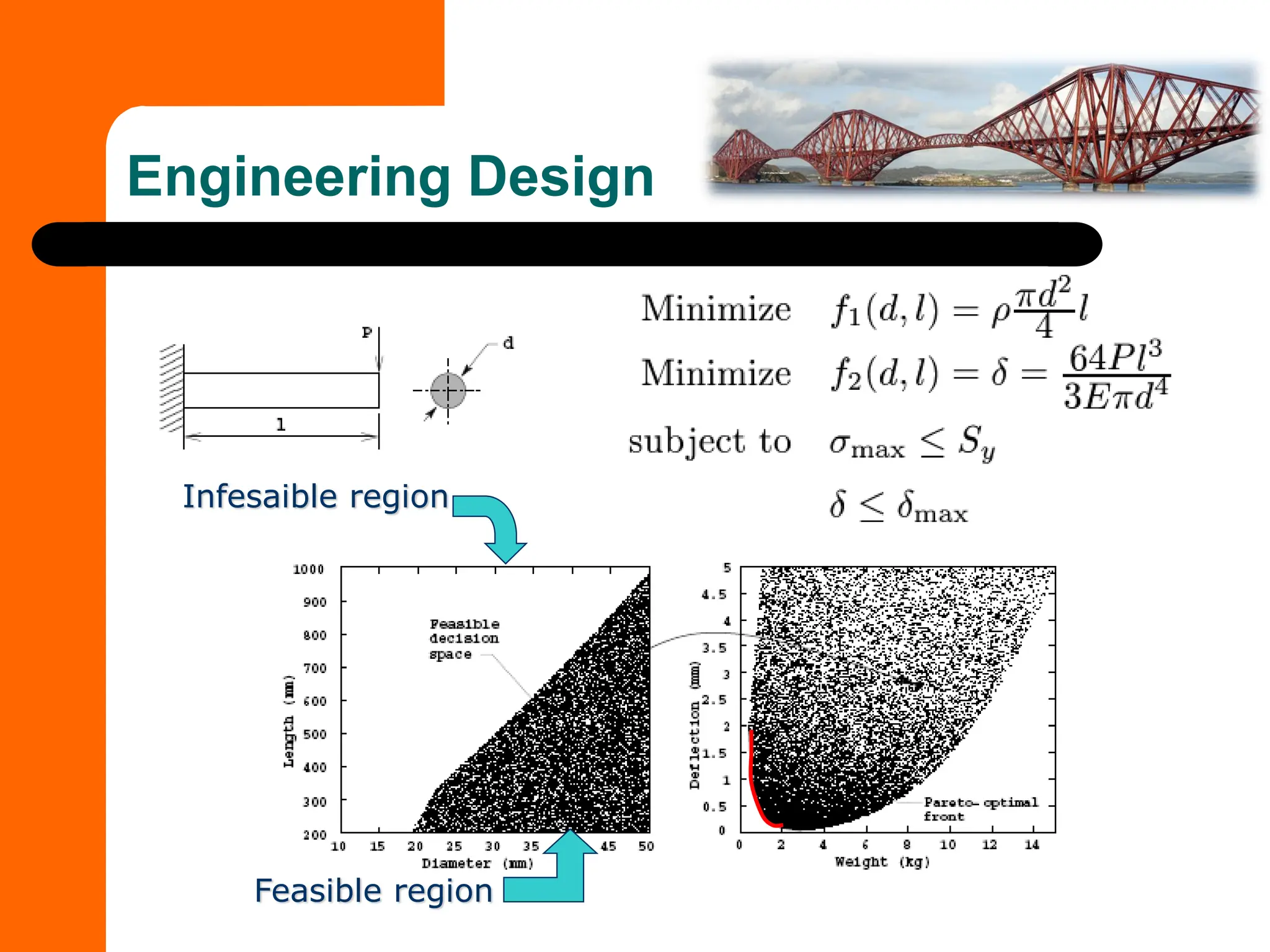
Engineering Design
Feasible region
Infesaible region
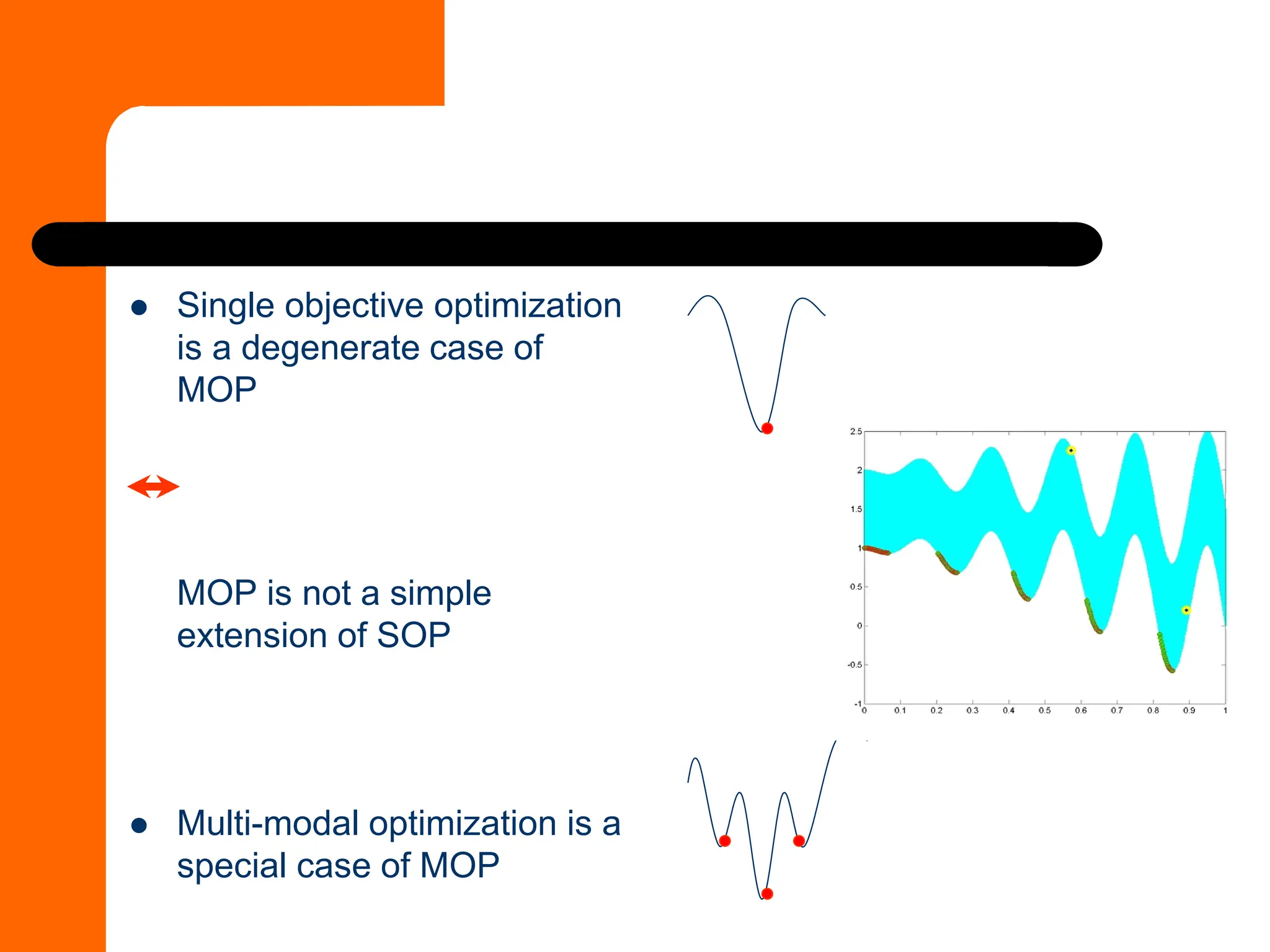
⚫ Single objective optimization
is a degenerate case of
MOP
MOP is not a simple
extension of SOP
⚫ Multi-modal optimization is a
special case of MOP
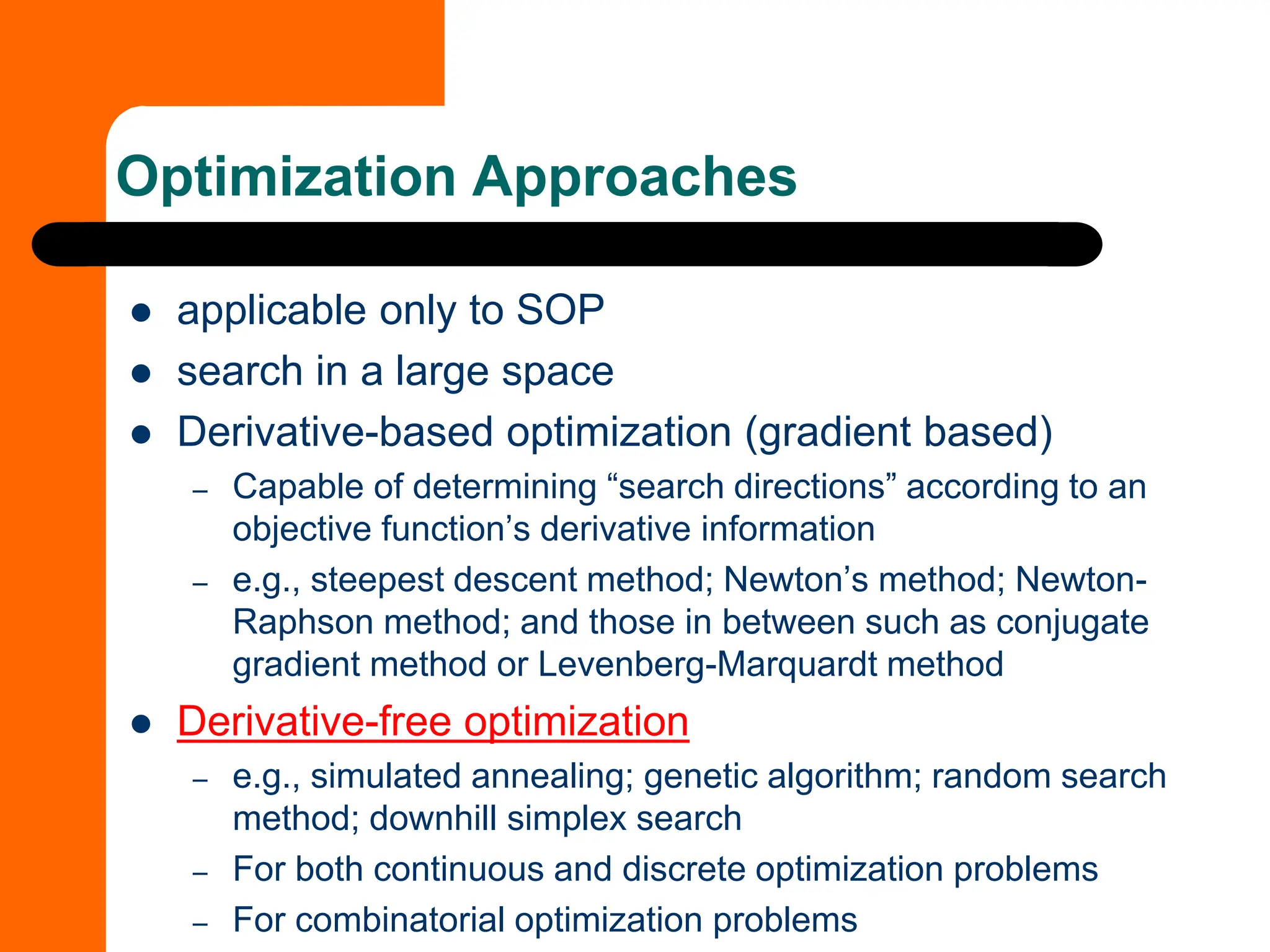
Optimization Approaches
⚫ applicable only to SOP
⚫ search in a large space
⚫ Derivative-based optimization (gradient based)
– Capable of determining “search directions” according to an
objective function’s derivative information
– e.g., steepest descent method; Newton’s method; Newton-
Raphson method; and those in between such as conjugate
gradient method or Levenberg-Marquardt method
⚫ Derivative-free optimization
– e.g., simulated annealing; genetic algorithm; random search
method; downhill simplex search
– For both continuous and discrete optimization problems
– For combinatorial optimization problems
Common Characteristics
⚫ Derivative freeness
– these methods do not need functional derivative
information to search for a set of parameters that
minimize a given objective function. Instead, they
rely exclusively on repeated evaluations of the
objective function. The subsequent search
direction after each evaluation follows certain
heuristic guidelines.
⚫ Intuitive guidelines
– The guidelines followed by these search
procedures are usually based on “simple,”
“heuristic” concepts. Some of these concepts are
motivated by so-called “nature’s wisdom,” such as
evolution and thermodynamics.
⚫ Slowness
– Without using derivatives, these methods are
bounded to be generally slower than derivative-
based optimization methods for continuous
optimization problems.
⚫ Flexibility
– Derivative freeness also relieve the requirement
for differentiable objective functions, so we can
use as complex an objective function as a specific
application might need, without sacrificing too
much in extra coding and computation time.
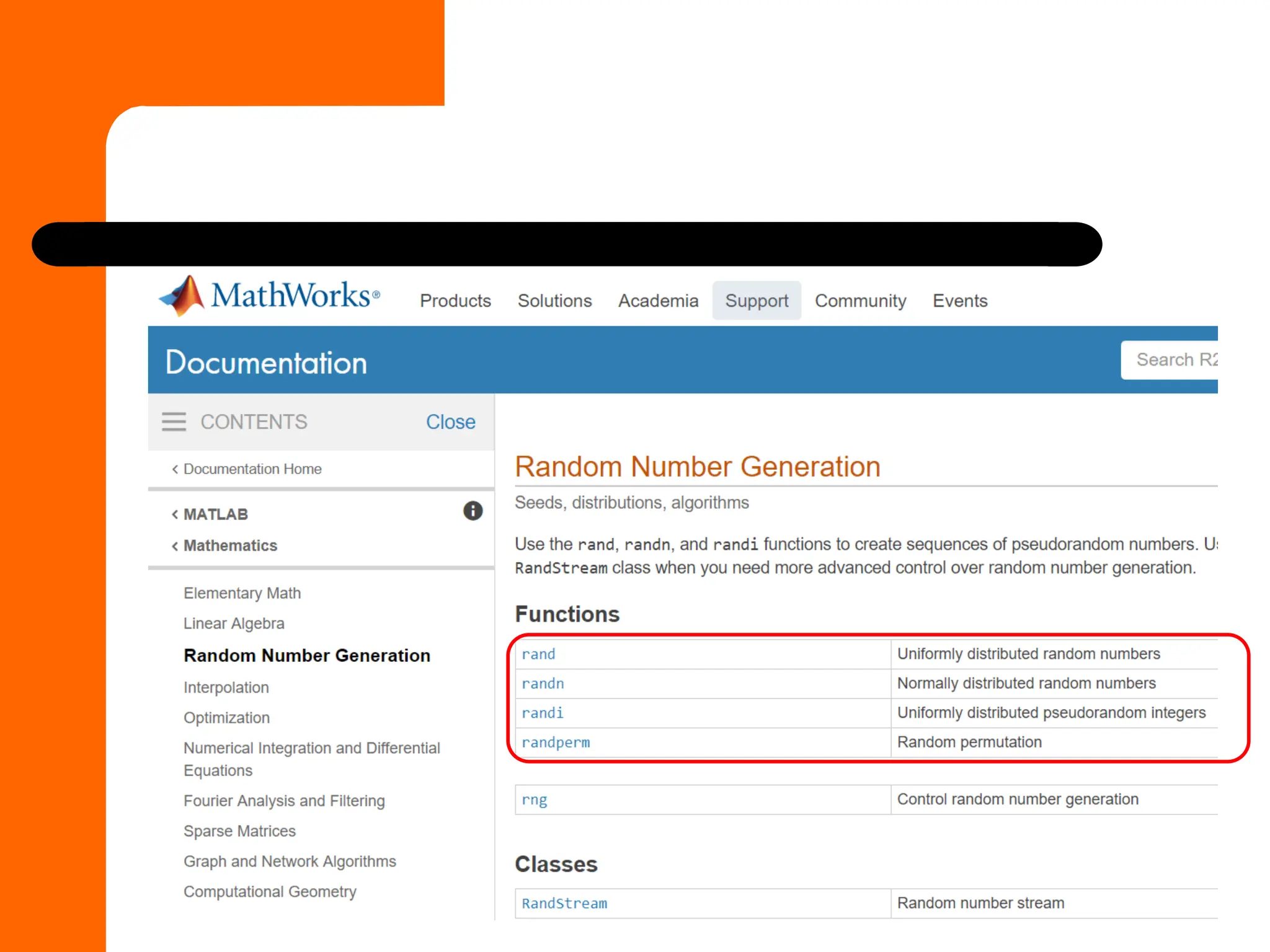
⚫ Randomness
– All of these methods (except standard downhill
simplex) are stochastic, which means that they all use
random number generators in determining subsequent
search directions. This element of randomness usually
gives rise to the overly optimistic view that these
methods are “global optimizers” that will find a global
optimum given enough computation time. In theory,
their random nature does make the probability of
finding an optimal solution nonzero over a fix amount
of computation time. In practice, however it might take
a considerable amount of computation time, if not
forever, to find the optimal solution of a given problem.
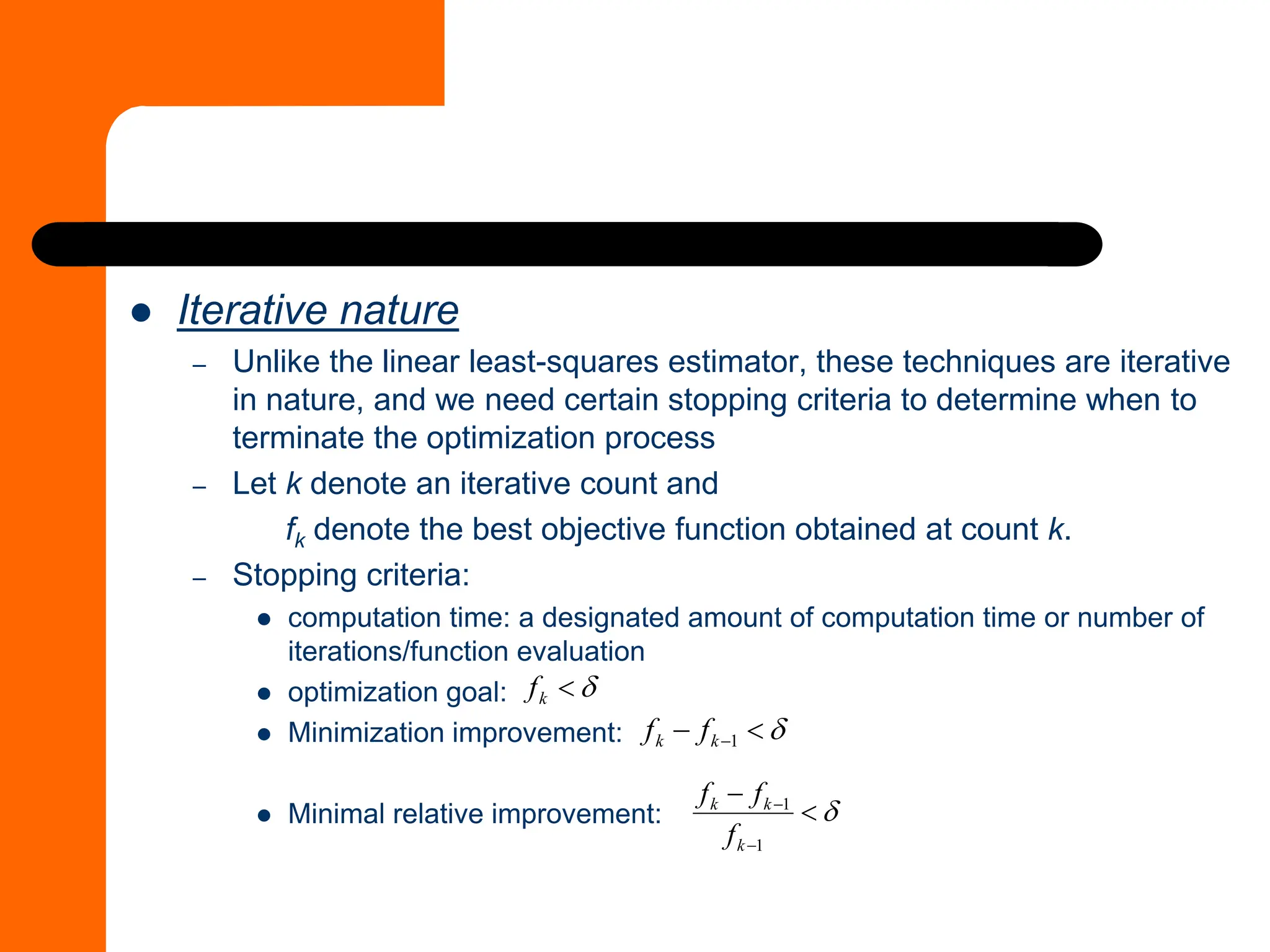
⚫ Iterative nature
– Unlike the linear least-squares estimator, these techniques are iterative
in nature, and we need certain stopping criteria to determine when to
terminate the optimization process
– Let k denote an iterative count and
fk denote the best objective function obtained at count k.
– Stopping criteria:
⚫ computation time: a designated amount of computation time or number of
iterations/function evaluation
⚫ optimization goal:
⚫ Minimization improvement:
⚫ Minimal relative improvement:


k
f


− −1
k
k f
f


−
−
−
1
1
k
k
k
f
f
f
⚫ Analytic opacity
– It is difficult to do analytic studies of these methods, in part
because of their randomness and problem–specific nature.
Therefore, most of our knowledge about them is based on
empirical studies.
⚫ Bundle methods Conjugate gradient method
⚫ Ellipsoid method Frank–Wolfe method
⚫ Gradient descent aka steepest descent or steepest ascent
⚫ Interior point methods
⚫ Line search - a technique for one dimensional optimization, usually used
as a subroutine for other, more general techniques.
⚫ Nelder-Mead method aka the Amoeba method
⚫ Newton's method Quasi-Newton methods
⚫ Simplex method
⚫ Subgradient method - similar to gradient method in case there are no
gradients
⚫ Constrained problems can often be transformed into unconstrained
problems with the help of Lagrange multipliers
Traditional Approaches
Heuristic Approaches
⚫ Ant colony optimization
⚫ Beam search
⚫ Cockroach algorithm
⚫ Differential Evolution
⚫ Evolution Strategy
⚫ Evolutionary Programming
⚫ Firefly algorithm
⚫ Genetic Algorithm
⚫ Hill climbing
⚫ Particle Swarm Optimization
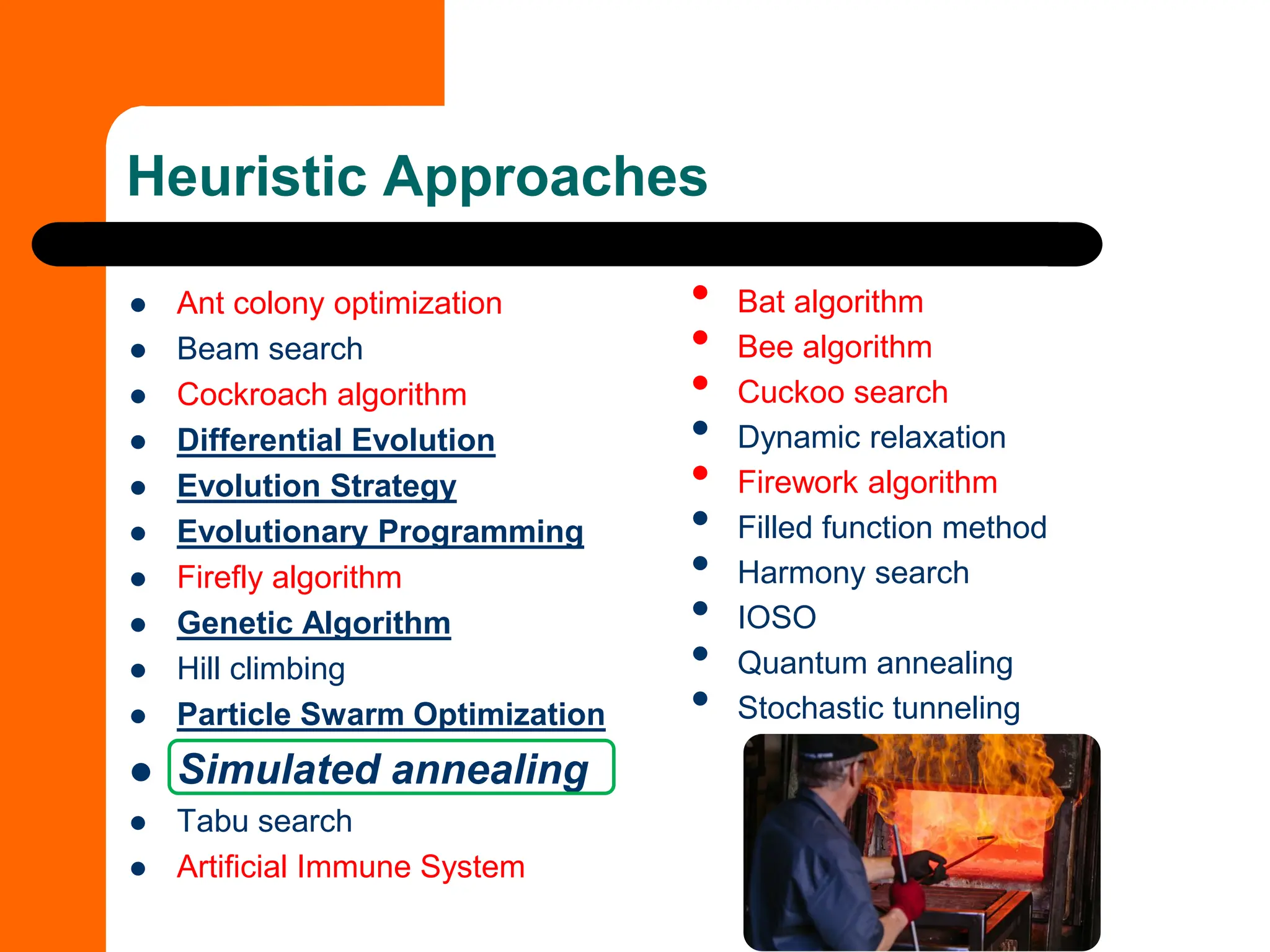
⚫ Simulated annealing
⚫ Tabu search
⚫ Artificial Immune System
• Bat algorithm
• Bee algorithm
• Cuckoo search
• Dynamic relaxation
• Firework algorithm
• Filled function method
• Harmony search
• IOSO
• Quantum annealing
• Stochastic tunneling
Some Approaches
⚫ Random Search
– simplest and most intuitive
⚫ Downhill Simplex
– based on heuristic adaptation of a geometric object (a
simplex) to explore a performance landscape
⚫ Simulated Annealing
– originated in the annealing process found in the
thermodynamics and metallurgy
⚫ Genetic Algorithm
– based on the concept of natural selection through the
“survival of the fittest” law
⚫ Ant Colony
– inspired by the natural metaphor that real ants are capable
of finding the shortest path from a food source to their nest
without using visual cues by exploiting pheromone
information
⚫ Random search
⚫ Greedy search (downhill)
1. Randomize the starting configuration
2. If possible, find a better configuration by making random changes to
the current configuration
3. Make this better configuration the current one, then go to step 2
4. If a better configuration is not found after a reasonable effort, conclude
that you have obtained a local minimum, save it in the variable
OPTIMUM (easily trapped in local minima)
5. Repeat from step 1, replacing OPTIMUM if appropriate, until your
patience or computing resource are exhausted; hope that the final
value of OPTIMUM is global.
⚫ Simulated annealing
– Allow perturbations to move uphill in a controlled fashion to escape
from local minima
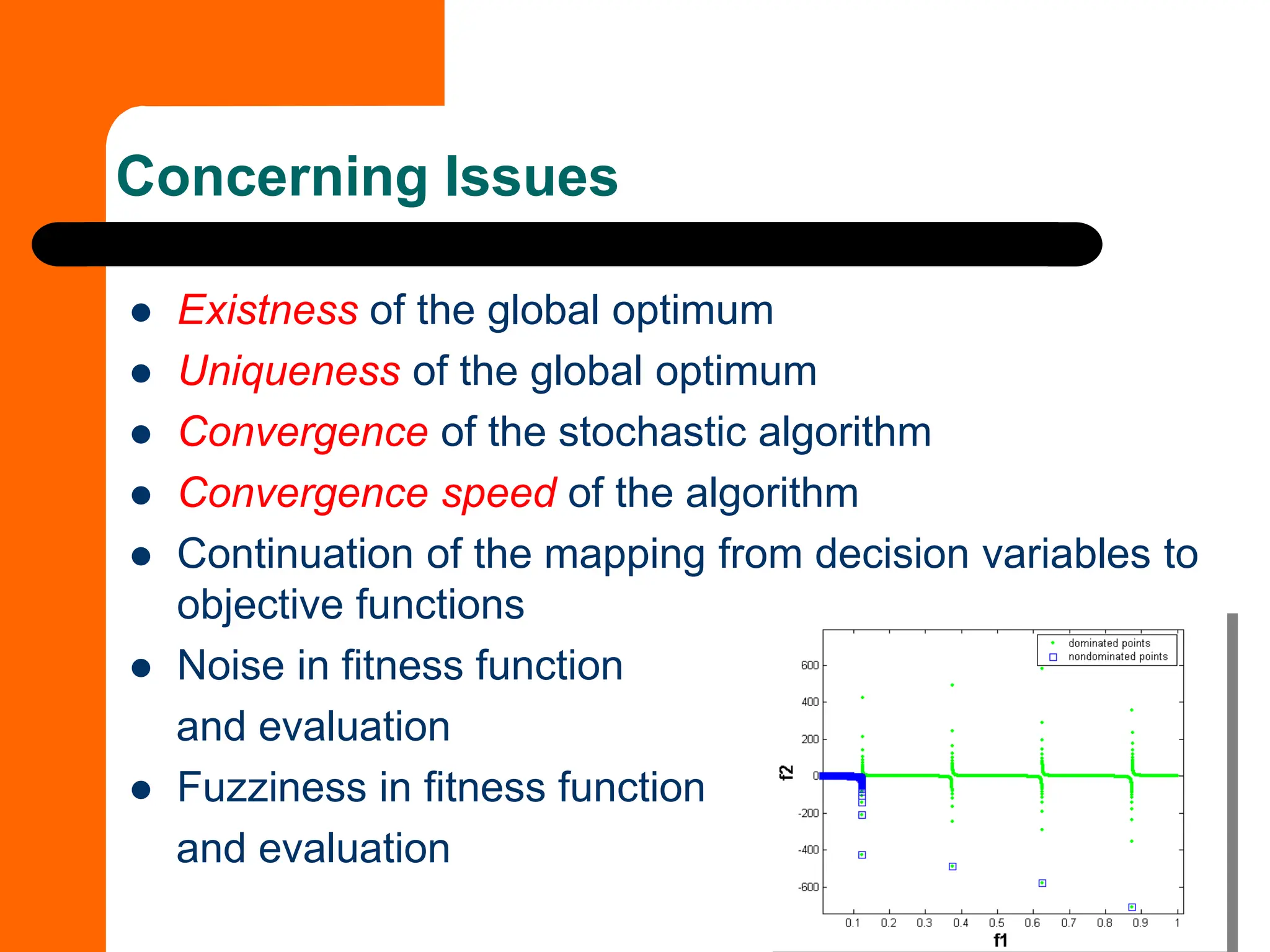
Concerning Issues
⚫ Existness of the global optimum
⚫ Uniqueness of the global optimum
⚫ Convergence of the stochastic algorithm
⚫ Convergence speed of the algorithm
⚫ Continuation of the mapping from decision variables to
objective functions
⚫ Noise in fitness function
and evaluation
⚫ Fuzziness in fitness function
and evaluation
Homework #1
• Post in Canvas
Assigned: 8/23/24;
Due: 8/30/24
⚫ Homework is due before midnight on the day.
⚫ Every homework solution in a SINGLE standalone PDF
file is to be turned in through Canvas website.
⚫ Using a scanner as needed, such as Adobe scan or
Scanner app from IOS and Android via your phone. Do
assure the pdf file created present a quality (readable)
output.
Policy on Homework Submitted
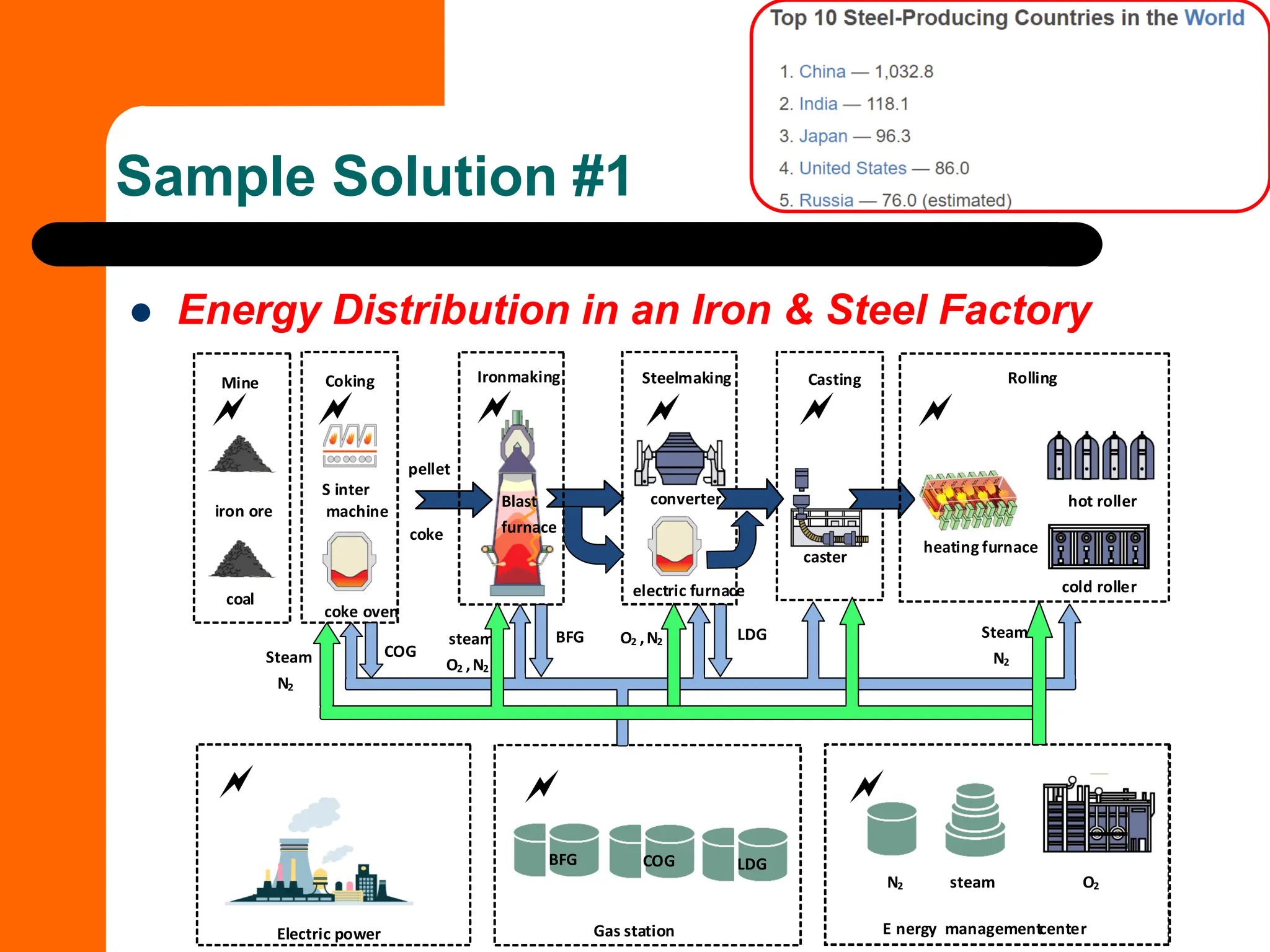
⚫ Energy Distribution in an Iron & Steel Factory
Coking
coke oven
S inter
machine
 
Casting
caster

Steelmaking
converter
electric furnace

Gas station E nergy managementcenter
steam

O2
N2
iron ore
Mine
coal


Electric power

Rolling
heating furnace
hot roller
cold roller
Ironmaking
pellet
coke

COG
BFG LDG
Steam
N2
Steam
N2
O2 ,N2
steam
O2 ,N2
Blast
furnace
BFG COG LDG
Sample Solution #1
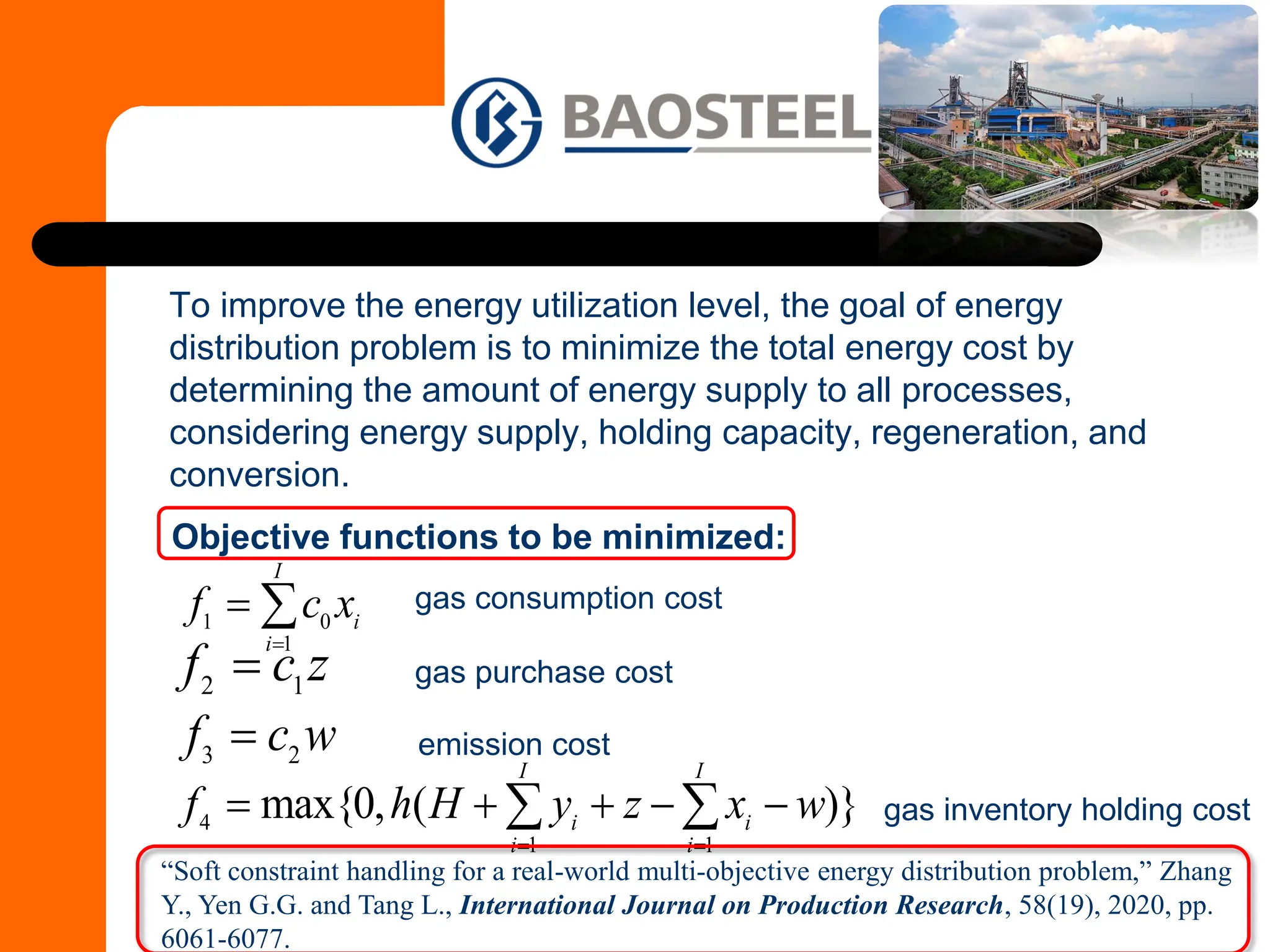
To improve the energy utilization level, the goal of energy
distribution problem is to minimize the total energy cost by
determining the amount of energy supply to all processes,
considering energy supply, holding capacity, regeneration, and
conversion.
1 0
1
I
i
i
f c x
=
= 
2 1
f c z
=
3 2
f c w
=
4
1 1
max{0, ( )}
I I
i i
i i
f h H y z x w
= =
= + + − −
 
Objective functions to be minimized:
gas consumption cost
gas purchase cost
emission cost
gas inventory holding cost
“Soft constraint handling for a real-world multi-objective energy distribution problem,” Zhang
Y., Yen G.G. and Tang L., International Journal on Production Research, 58(19), 2020, pp.
6061-6077.
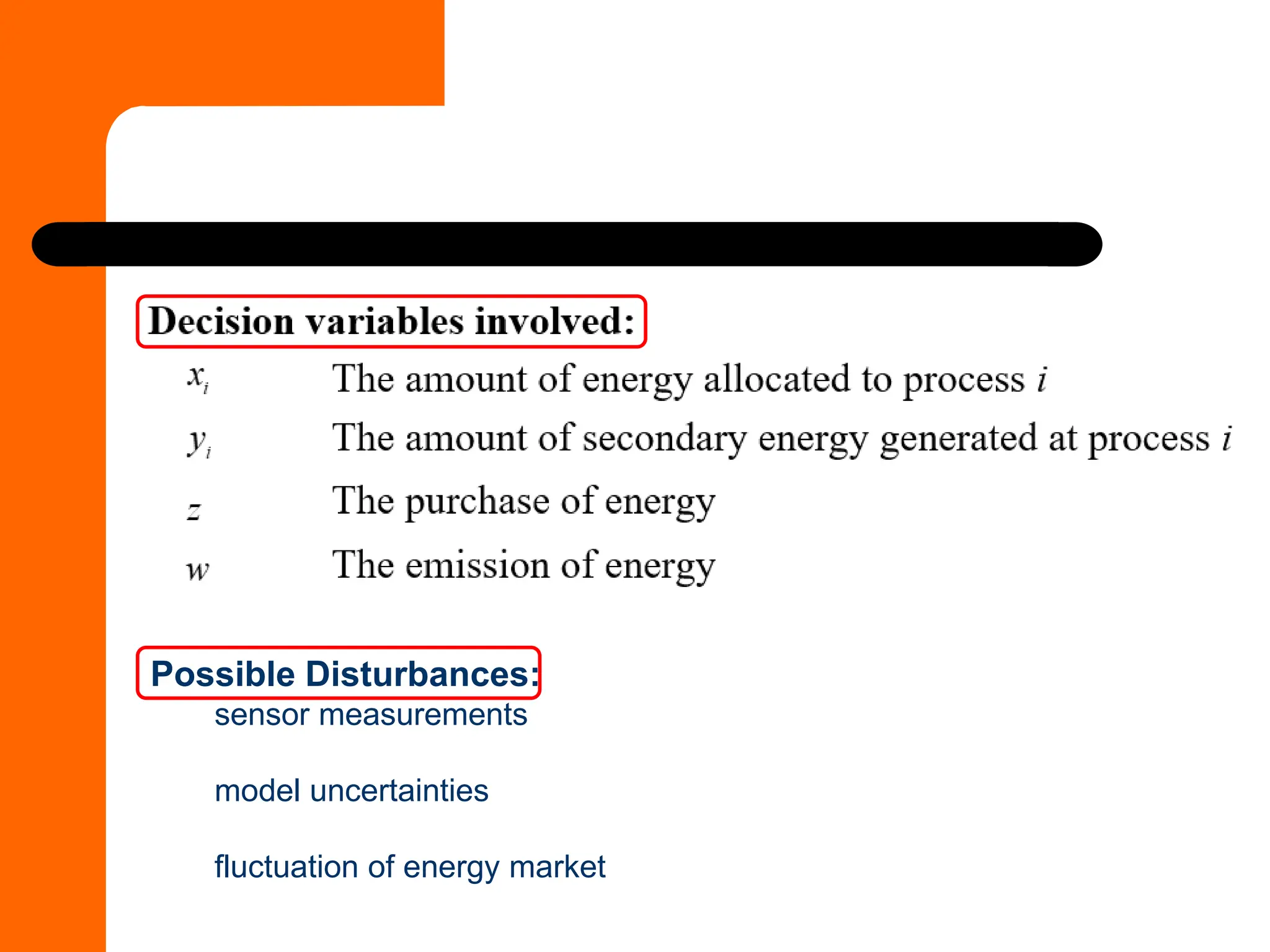
Possible Disturbances:
sensor measurements
model uncertainties
fluctuation of energy market
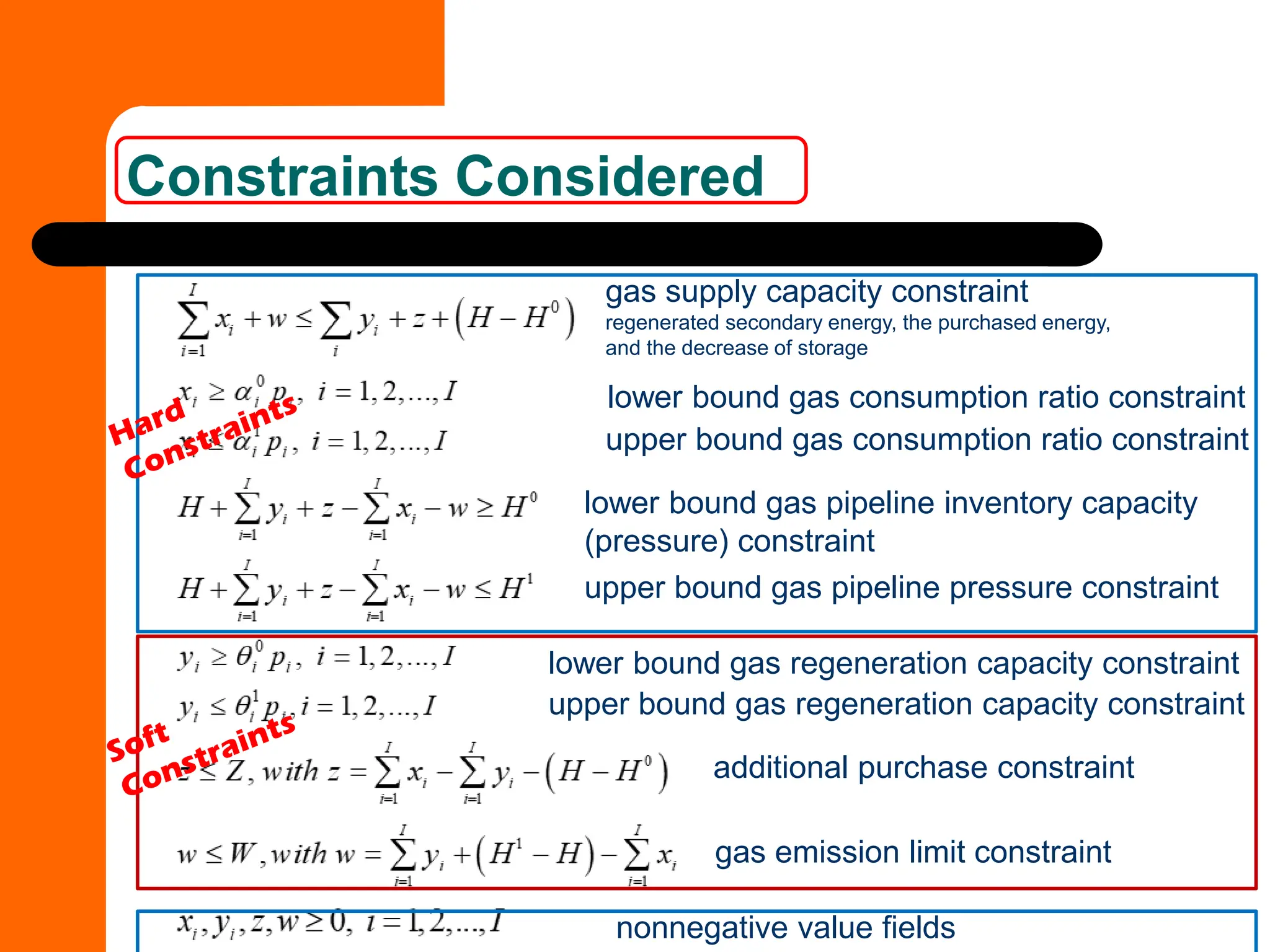
gas supply capacity constraint
regenerated secondary energy, the purchased energy,
and the decrease of storage
lower bound gas consumption ratio constraint
upper bound gas consumption ratio constraint
lower bound gas pipeline inventory capacity
(pressure) constraint
upper bound gas pipeline pressure constraint
lower bound gas regeneration capacity constraint
upper bound gas regeneration capacity constraint
additional purchase constraint
gas emission limit constraint
nonnegative value fields
Constraints Considered
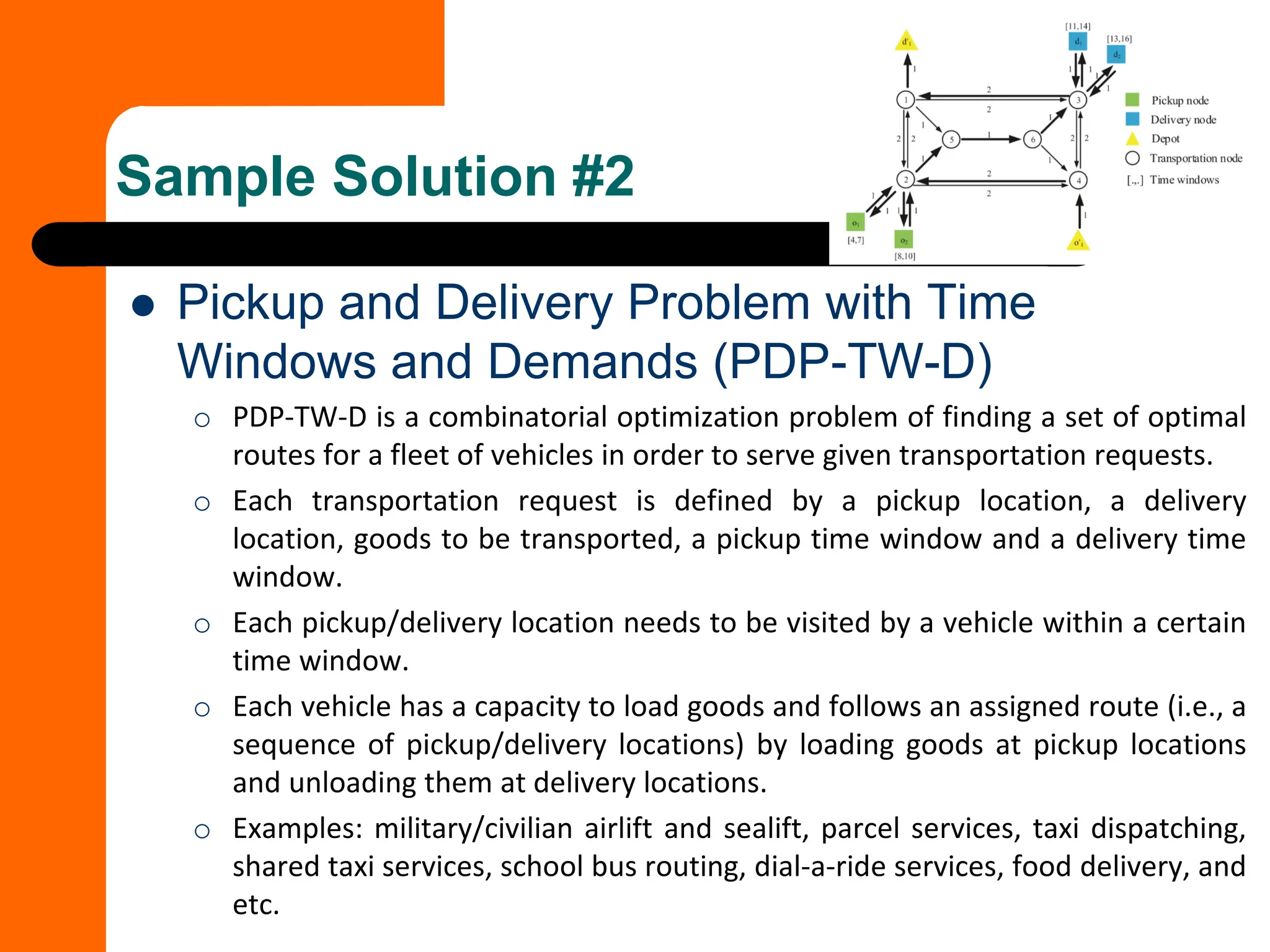
⚫ Pickup and Delivery Problem with Time
Windows and Demands (PDP-TW-D)
o PDP-TW-D is a combinatorial optimization problem of finding a set of optimal
routes for a fleet of vehicles in order to serve given transportation requests.
o Each transportation request is defined by a pickup location, a delivery
location, goods to be transported, a pickup time window and a delivery time
window.
o Each pickup/delivery location needs to be visited by a vehicle within a certain
time window.
o Each vehicle has a capacity to load goods and follows an assigned route (i.e., a
sequence of pickup/delivery locations) by loading goods at pickup locations
and unloading them at delivery locations.
o Examples: military/civilian airlift and sealift, parcel services, taxi dispatching,
shared taxi services, school bus routing, dial-a-ride services, food delivery, and
etc.
Sample Solution #2
f i v e c o n f l i c t o b j e c t i v e s :
T h r e e c o n s t r a i n t s :
Problem at hand- which restaurant to go for the dinner?
⚫ Objectives: 1) maximize food quality; 2) maximize portion
serving size; 3) minimize driving distance or time
⚫ Decision Variables: 1) cost; 2) reputation/rating from
Yelp; 3) business hours; 4) culinary style
⚫ Constraints: 1) cost should be mid-range/affordable for a
college student; 2) only interested in 2-star or 3-star; 3)
preferable Mexican or Italian food
⚫ Disturbances: 1) possible construction on the shortest
route; 2) subjective measure for food quality
Sample Solution #3
⚫ Objectives (y):
– Maximize Salary; Maximize Benefits Offered; Maximize
happiness; Minimize time on job
⚫ Decision Variables (x):
– Unionized Industry; Capability of doing assigned job; Work
schedule (mandatory work on weekends or mandatory overtime);
Reputation of field and/or industry; Ethics/Morals of
Industry/Company
⚫ Constraints (g & h):
– Experience required; Education Required; Availability in region;
Only interested in niche field of industry; Cost of living in area
⚫ Disturbances:
– Sudden debt; Happiness is a subjective measure;
Laws/Regulations expanding or shrinking field; A pandemic and
Sample Solution: what career field to go into
Most engineering problems, including
regulation, trajectory following, forecasting and
pattern classification,
can be formulated/structured as an
Optimization Problem
Critical Message Conveyed

Evolutionary computation 5773-lecture03-Fall24 (8-23-24).pdf

  • 1.
  • 2.
  • 3.
    Problem Formulation 3 basicingredients… ⚫ a set of objective functions, ⚫ a set of decision variables, ⚫ a set of equality/inequality constraints. The problem is to search for the values of the decision variables that minimize or maximize the objective functions while satisfying the constraints… An example… How to partition 1,000 circuits into five regions on a microchip and confirm to layout constraints? 5^1000 = 9.33263619E698
  • 4.
    Mathematical Definition • Mathematicalmodel to formulate the optimization problem } , 0 , , 0 , : ) , ( { min U L x x x e e e    =    ) g(x ) h(x x f y n x )) x ( f ( min ) x ( f max − = o Design Variables: decision and objective vector o Constraints: equality and inequality o Greater-than-equal-to inequality constraint can be converted to less-than-equal-to constraint by multiplying -1 o Objective Function: maximization can be converted to minimization due to the duality principle Objective vectors Decision vectors Equality constraints Inequality constraints Variable bounds Environment States
  • 5.
  • 6.
    Multiobjective Optimization ⚫ Optimizationproblems involve more than one objective function ⚫ Very common, yet difficult problems in the field of science, engineering, and business management ⚫ Nonconflicting objectives: achieve a single optimal solution satisfies all objectives simultaneously ⚫ Competing objectives: cannot be optimized simultaneously ⚫ MOP– search for a set of “acceptable”– maybe only suboptimal for one objective– solutions is our goal ⚫ In operation research/management terms – multiple criterion decision making (MCDM)
  • 7.
    Buying an Automobile ⚫Objective = reduce cost, while maximize comfort ⚫ Which solution (1, A, B, C, 2) is best ??? ⚫ No solution from this set makes both objectives look better than any other solution from the set ⚫ No single optimal solution ⚫ Trade off between conflicting objectives- cost and comfort
  • 8.
  • 9.
    ⚫ Single objectiveoptimization is a degenerate case of MOP MOP is not a simple extension of SOP ⚫ Multi-modal optimization is a special case of MOP
  • 10.
    Optimization Approaches ⚫ applicableonly to SOP ⚫ search in a large space ⚫ Derivative-based optimization (gradient based) – Capable of determining “search directions” according to an objective function’s derivative information – e.g., steepest descent method; Newton’s method; Newton- Raphson method; and those in between such as conjugate gradient method or Levenberg-Marquardt method ⚫ Derivative-free optimization – e.g., simulated annealing; genetic algorithm; random search method; downhill simplex search – For both continuous and discrete optimization problems – For combinatorial optimization problems
  • 11.
    Common Characteristics ⚫ Derivativefreeness – these methods do not need functional derivative information to search for a set of parameters that minimize a given objective function. Instead, they rely exclusively on repeated evaluations of the objective function. The subsequent search direction after each evaluation follows certain heuristic guidelines.
  • 12.
    ⚫ Intuitive guidelines –The guidelines followed by these search procedures are usually based on “simple,” “heuristic” concepts. Some of these concepts are motivated by so-called “nature’s wisdom,” such as evolution and thermodynamics. ⚫ Slowness – Without using derivatives, these methods are bounded to be generally slower than derivative- based optimization methods for continuous optimization problems.
  • 13.
    ⚫ Flexibility – Derivativefreeness also relieve the requirement for differentiable objective functions, so we can use as complex an objective function as a specific application might need, without sacrificing too much in extra coding and computation time.
  • 14.
    ⚫ Randomness – Allof these methods (except standard downhill simplex) are stochastic, which means that they all use random number generators in determining subsequent search directions. This element of randomness usually gives rise to the overly optimistic view that these methods are “global optimizers” that will find a global optimum given enough computation time. In theory, their random nature does make the probability of finding an optimal solution nonzero over a fix amount of computation time. In practice, however it might take a considerable amount of computation time, if not forever, to find the optimal solution of a given problem.
  • 18.
    ⚫ Iterative nature –Unlike the linear least-squares estimator, these techniques are iterative in nature, and we need certain stopping criteria to determine when to terminate the optimization process – Let k denote an iterative count and fk denote the best objective function obtained at count k. – Stopping criteria: ⚫ computation time: a designated amount of computation time or number of iterations/function evaluation ⚫ optimization goal: ⚫ Minimization improvement: ⚫ Minimal relative improvement:   k f   − −1 k k f f   − − − 1 1 k k k f f f
  • 19.
    ⚫ Analytic opacity –It is difficult to do analytic studies of these methods, in part because of their randomness and problem–specific nature. Therefore, most of our knowledge about them is based on empirical studies.
  • 20.
    ⚫ Bundle methodsConjugate gradient method ⚫ Ellipsoid method Frank–Wolfe method ⚫ Gradient descent aka steepest descent or steepest ascent ⚫ Interior point methods ⚫ Line search - a technique for one dimensional optimization, usually used as a subroutine for other, more general techniques. ⚫ Nelder-Mead method aka the Amoeba method ⚫ Newton's method Quasi-Newton methods ⚫ Simplex method ⚫ Subgradient method - similar to gradient method in case there are no gradients ⚫ Constrained problems can often be transformed into unconstrained problems with the help of Lagrange multipliers Traditional Approaches
  • 21.
    Heuristic Approaches ⚫ Antcolony optimization ⚫ Beam search ⚫ Cockroach algorithm ⚫ Differential Evolution ⚫ Evolution Strategy ⚫ Evolutionary Programming ⚫ Firefly algorithm ⚫ Genetic Algorithm ⚫ Hill climbing ⚫ Particle Swarm Optimization ⚫ Simulated annealing ⚫ Tabu search ⚫ Artificial Immune System • Bat algorithm • Bee algorithm • Cuckoo search • Dynamic relaxation • Firework algorithm • Filled function method • Harmony search • IOSO • Quantum annealing • Stochastic tunneling
  • 22.
    Some Approaches ⚫ RandomSearch – simplest and most intuitive ⚫ Downhill Simplex – based on heuristic adaptation of a geometric object (a simplex) to explore a performance landscape ⚫ Simulated Annealing – originated in the annealing process found in the thermodynamics and metallurgy ⚫ Genetic Algorithm – based on the concept of natural selection through the “survival of the fittest” law ⚫ Ant Colony – inspired by the natural metaphor that real ants are capable of finding the shortest path from a food source to their nest without using visual cues by exploiting pheromone information
  • 23.
    ⚫ Random search ⚫Greedy search (downhill) 1. Randomize the starting configuration 2. If possible, find a better configuration by making random changes to the current configuration 3. Make this better configuration the current one, then go to step 2 4. If a better configuration is not found after a reasonable effort, conclude that you have obtained a local minimum, save it in the variable OPTIMUM (easily trapped in local minima) 5. Repeat from step 1, replacing OPTIMUM if appropriate, until your patience or computing resource are exhausted; hope that the final value of OPTIMUM is global. ⚫ Simulated annealing – Allow perturbations to move uphill in a controlled fashion to escape from local minima
  • 24.
    Concerning Issues ⚫ Existnessof the global optimum ⚫ Uniqueness of the global optimum ⚫ Convergence of the stochastic algorithm ⚫ Convergence speed of the algorithm ⚫ Continuation of the mapping from decision variables to objective functions ⚫ Noise in fitness function and evaluation ⚫ Fuzziness in fitness function and evaluation
  • 25.
    Homework #1 • Postin Canvas Assigned: 8/23/24; Due: 8/30/24
  • 26.
    ⚫ Homework isdue before midnight on the day. ⚫ Every homework solution in a SINGLE standalone PDF file is to be turned in through Canvas website. ⚫ Using a scanner as needed, such as Adobe scan or Scanner app from IOS and Android via your phone. Do assure the pdf file created present a quality (readable) output. Policy on Homework Submitted
  • 27.
    ⚫ Energy Distributionin an Iron & Steel Factory Coking coke oven S inter machine   Casting caster  Steelmaking converter electric furnace  Gas station E nergy managementcenter steam  O2 N2 iron ore Mine coal   Electric power  Rolling heating furnace hot roller cold roller Ironmaking pellet coke  COG BFG LDG Steam N2 Steam N2 O2 ,N2 steam O2 ,N2 Blast furnace BFG COG LDG Sample Solution #1
  • 28.
    To improve theenergy utilization level, the goal of energy distribution problem is to minimize the total energy cost by determining the amount of energy supply to all processes, considering energy supply, holding capacity, regeneration, and conversion. 1 0 1 I i i f c x = =  2 1 f c z = 3 2 f c w = 4 1 1 max{0, ( )} I I i i i i f h H y z x w = = = + + − −   Objective functions to be minimized: gas consumption cost gas purchase cost emission cost gas inventory holding cost “Soft constraint handling for a real-world multi-objective energy distribution problem,” Zhang Y., Yen G.G. and Tang L., International Journal on Production Research, 58(19), 2020, pp. 6061-6077.
  • 29.
    Possible Disturbances: sensor measurements modeluncertainties fluctuation of energy market
  • 30.
    gas supply capacityconstraint regenerated secondary energy, the purchased energy, and the decrease of storage lower bound gas consumption ratio constraint upper bound gas consumption ratio constraint lower bound gas pipeline inventory capacity (pressure) constraint upper bound gas pipeline pressure constraint lower bound gas regeneration capacity constraint upper bound gas regeneration capacity constraint additional purchase constraint gas emission limit constraint nonnegative value fields Constraints Considered
  • 31.
    ⚫ Pickup andDelivery Problem with Time Windows and Demands (PDP-TW-D) o PDP-TW-D is a combinatorial optimization problem of finding a set of optimal routes for a fleet of vehicles in order to serve given transportation requests. o Each transportation request is defined by a pickup location, a delivery location, goods to be transported, a pickup time window and a delivery time window. o Each pickup/delivery location needs to be visited by a vehicle within a certain time window. o Each vehicle has a capacity to load goods and follows an assigned route (i.e., a sequence of pickup/delivery locations) by loading goods at pickup locations and unloading them at delivery locations. o Examples: military/civilian airlift and sealift, parcel services, taxi dispatching, shared taxi services, school bus routing, dial-a-ride services, food delivery, and etc. Sample Solution #2
  • 32.
    f i ve c o n f l i c t o b j e c t i v e s : T h r e e c o n s t r a i n t s :
  • 33.
    Problem at hand-which restaurant to go for the dinner? ⚫ Objectives: 1) maximize food quality; 2) maximize portion serving size; 3) minimize driving distance or time ⚫ Decision Variables: 1) cost; 2) reputation/rating from Yelp; 3) business hours; 4) culinary style ⚫ Constraints: 1) cost should be mid-range/affordable for a college student; 2) only interested in 2-star or 3-star; 3) preferable Mexican or Italian food ⚫ Disturbances: 1) possible construction on the shortest route; 2) subjective measure for food quality Sample Solution #3
  • 34.
    ⚫ Objectives (y): –Maximize Salary; Maximize Benefits Offered; Maximize happiness; Minimize time on job ⚫ Decision Variables (x): – Unionized Industry; Capability of doing assigned job; Work schedule (mandatory work on weekends or mandatory overtime); Reputation of field and/or industry; Ethics/Morals of Industry/Company ⚫ Constraints (g & h): – Experience required; Education Required; Availability in region; Only interested in niche field of industry; Cost of living in area ⚫ Disturbances: – Sudden debt; Happiness is a subjective measure; Laws/Regulations expanding or shrinking field; A pandemic and Sample Solution: what career field to go into
  • 35.
    Most engineering problems,including regulation, trajectory following, forecasting and pattern classification, can be formulated/structured as an Optimization Problem Critical Message Conveyed