Operations Research
The Scalable AI for Complex Decision Problems
Andrea Taverna, PhD CAP
Alumnus @ OptLab (UniMi)
Currently Operations Researcher in private sector
andrea.taverna@outlook.com
|in| https://www.linkedin.com/in/andrea-taverna-data-analytics
http://optlab.di.unimi.it
Disclaimer
Opinions stated here are my own and do not necessarily
reflect the official policy or position of my past, present or
future employers.
OptLab: a local reference for Operations Research!
▸ Research Laboratory at the
Computer Science Dept. of UniMi
▸ Lots of success stories on
business applications of
Operations Research
▸ Just ask!
Contact:
Prof. Alberto Ceselli
📧 alberto.ceselli@unimi.it
http://optlab.di.unimi.it
1. Operations Research, what is it?
2. Mathematical Programming, one versatile tool for solving
Complex Decision Problems
3. Decomposition: one versatile tool for massive scaling
Topics
Operations Research
Operations Research: what is it?
▸ Branch of Analytics for decision support
– Clarify problems through modelling
– Reliably recommend good decisions
– Answer complex questions (what if ? why? how?...)
▸ Also known as Prescriptive Analytics, Management Science
(MS), (Combinatorial) Optimization, Decision Science
▸ The best way to exploit Data Science!
Data Science & Operations Research Synergy
Example problem: Unit Commitment Problem (UCP)
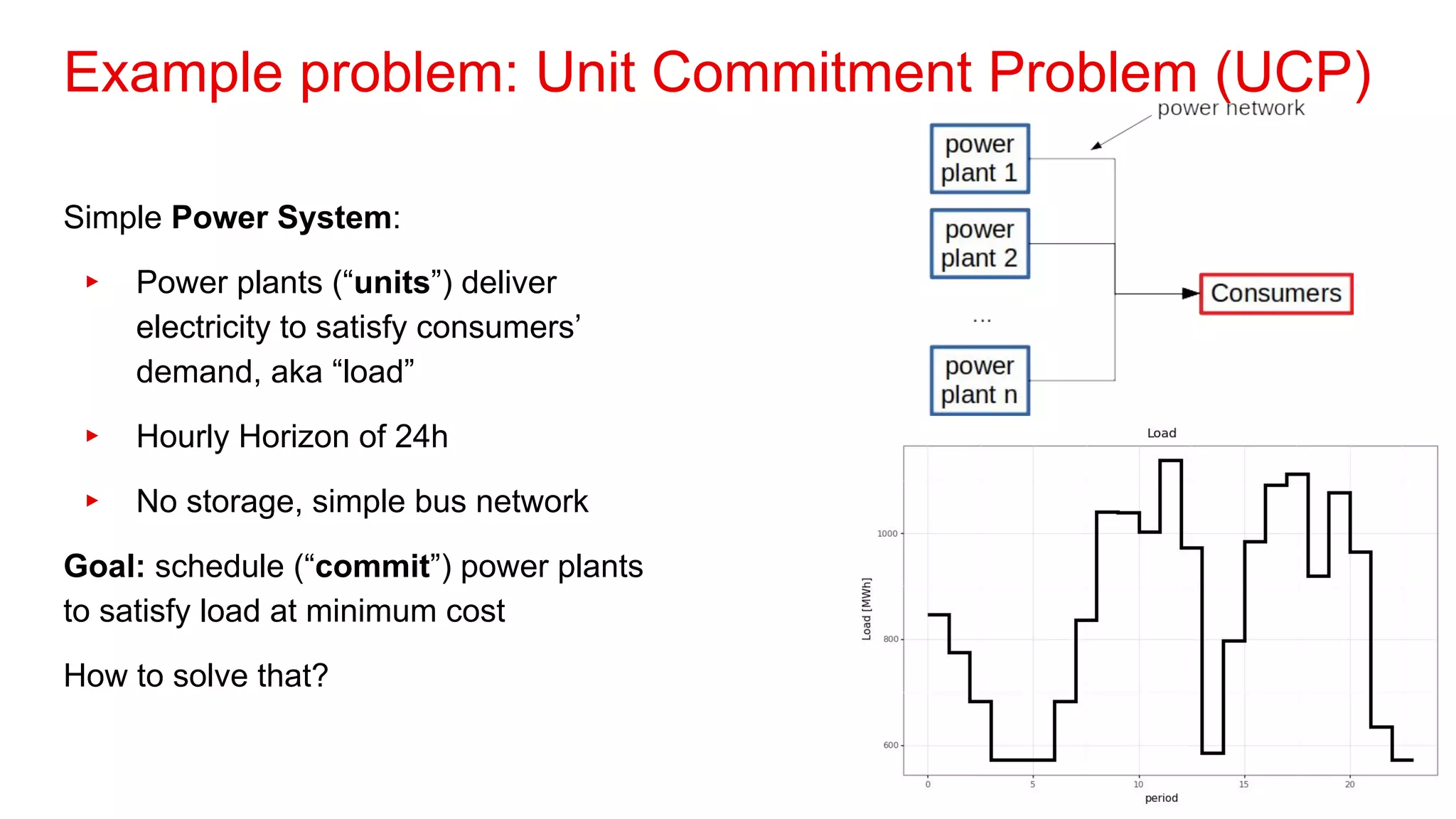
Simple Power System:
▸ Power plants (“units”) deliver
electricity to satisfy consumers’
demand, aka “load”
▸ Hourly Horizon of 24h
▸ No storage, simple bus network
Goal: schedule (“commit”) power plants
to satisfy load at minimum cost
How to solve that?
Mathematical Programming
A simple problem: Knapsack
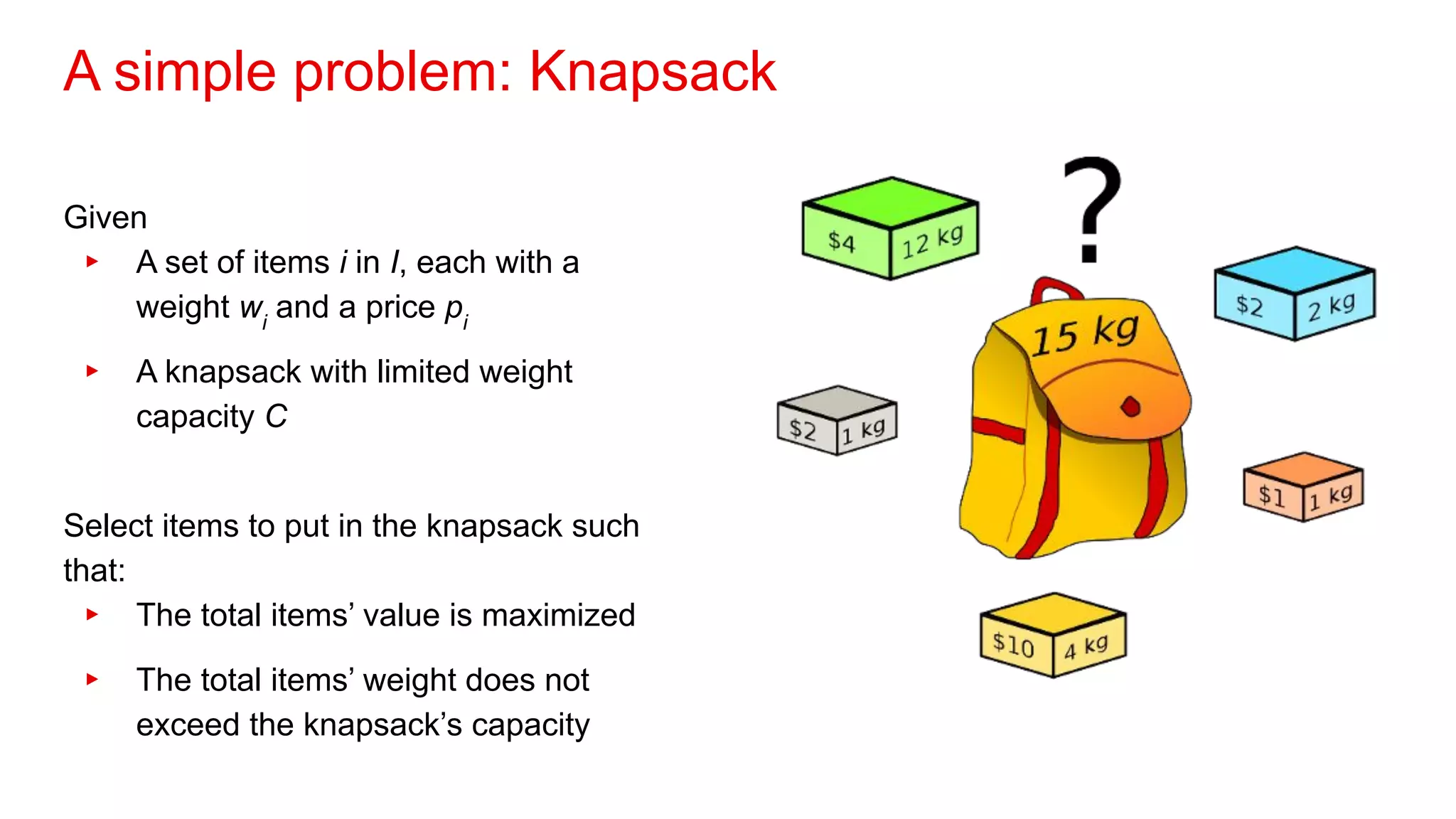
Given
▸ A set of items i in I, each with a
weight wi
and a price pi
▸ A knapsack with limited weight
capacity C
Select items to put in the knapsack such
that:
▸ The total items’ value is maximized
▸ The total items’ weight does not
exceed the knapsack’s capacity
Knapsack: Mathematical Program
Where xi
=1 iff item i is in the knapsack
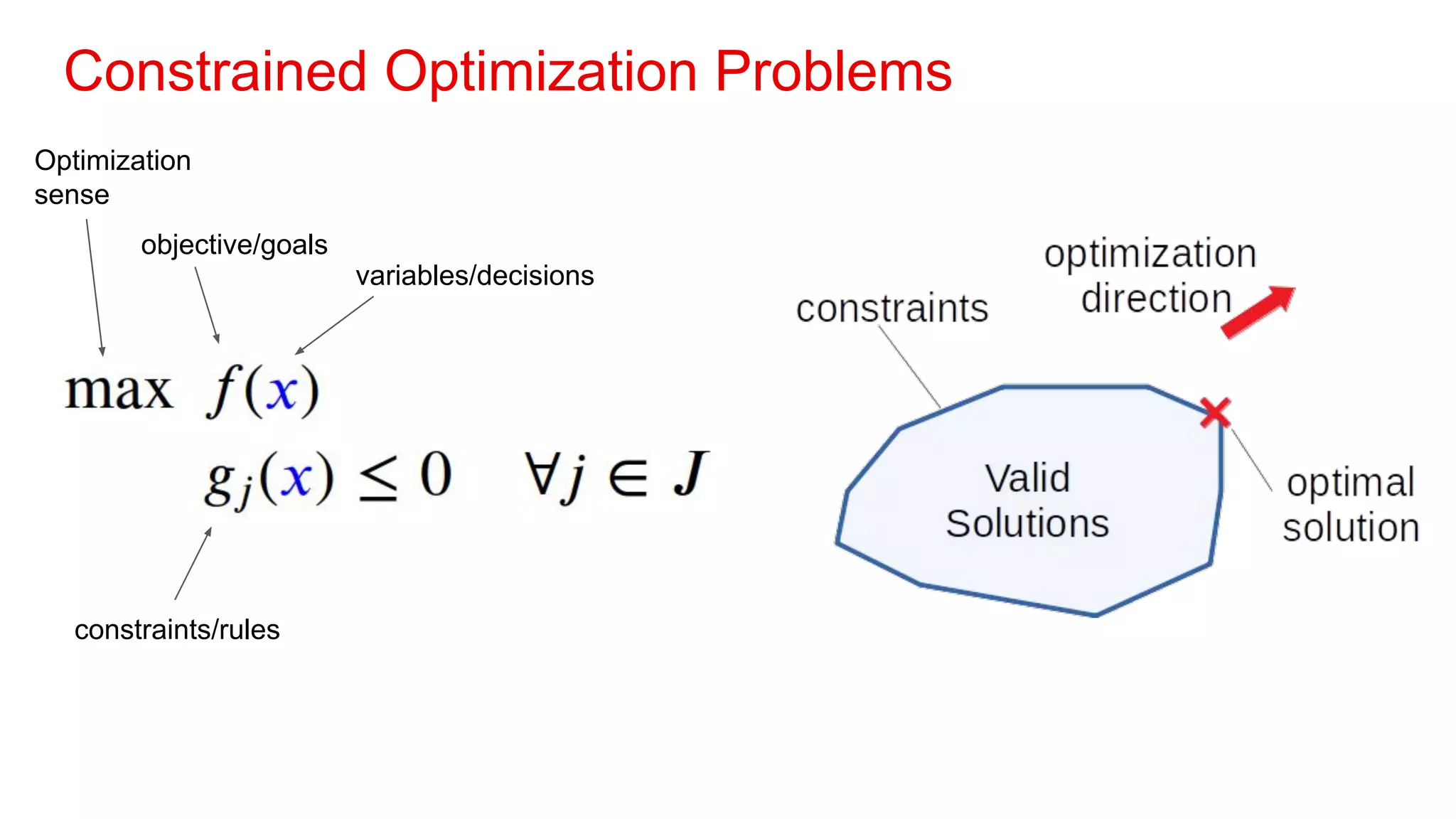
Constrained Optimization Problems
objective/goals
constraints/rules
variables/decisions
Optimization
sense
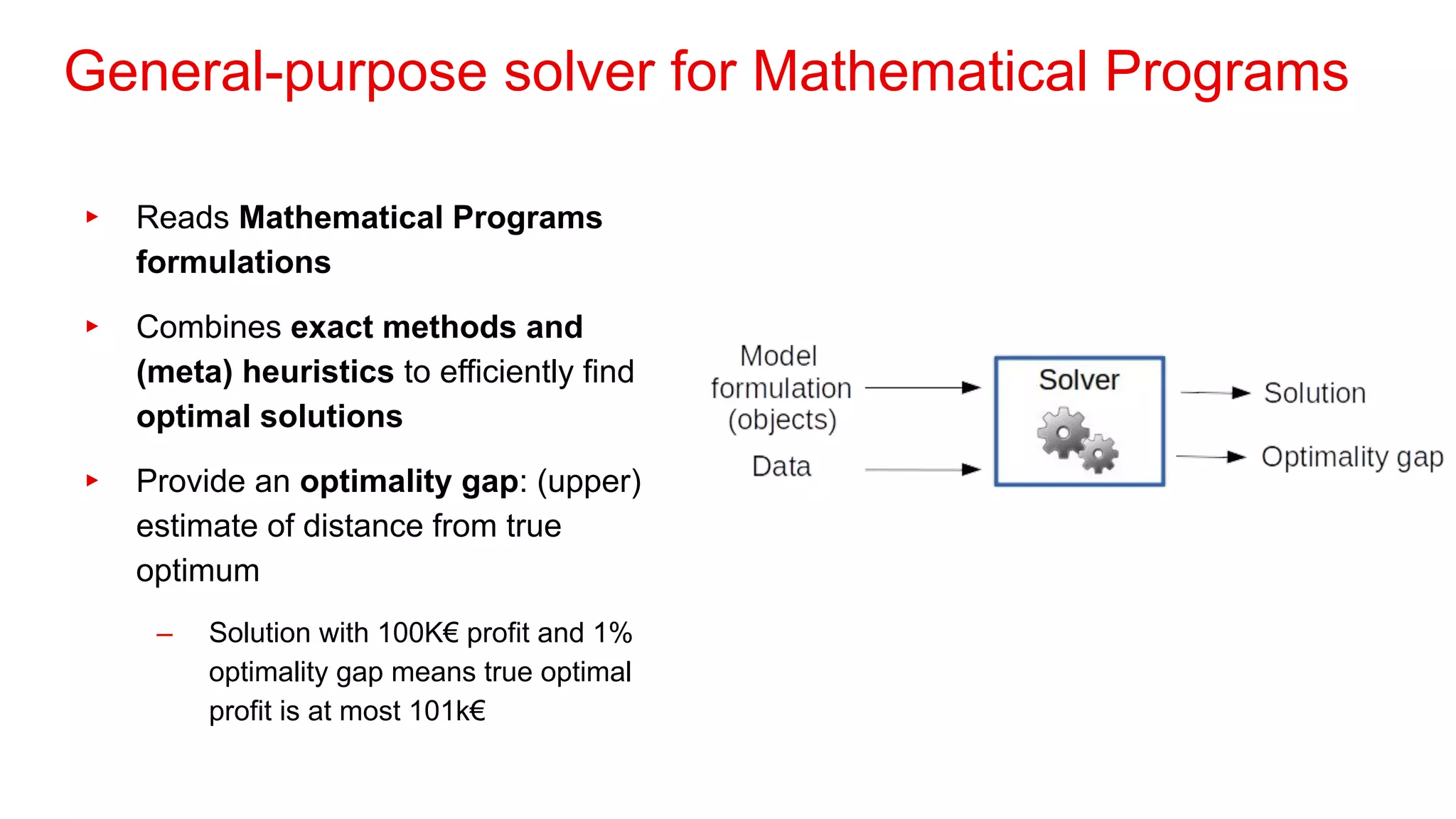
General-purpose solver for Mathematical Programs
▸ Reads Mathematical Programs
formulations
▸ Combines exact methods and
(meta) heuristics to efficiently find
optimal solutions
▸ Provide an optimality gap: (upper)
estimate of distance from true
optimum
– Solution with 100K€ profit and 1%
optimality gap means true optimal
profit is at most 101k€
Example: Knapsack with PuLP/CBC
▸ PuLP: modelling library/solver
interface
▸ CBC: math.prog. solver
▸ Both open source and from
COIN-OR
Just pip install pulprequired
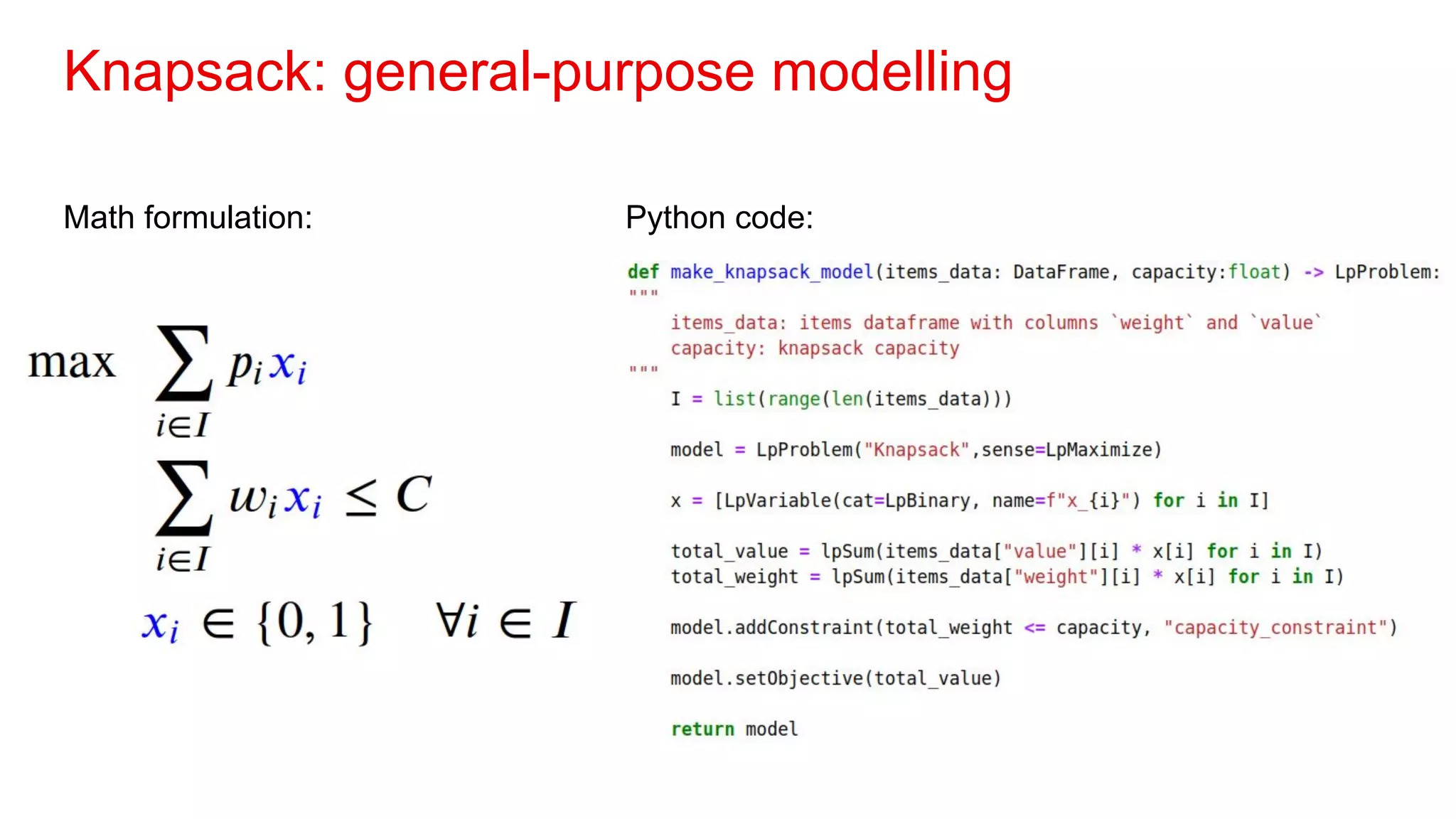
Knapsack: general-purpose modelling
Math formulation: Python code:
Knapsack: example
Which items do
I pick 🤔?
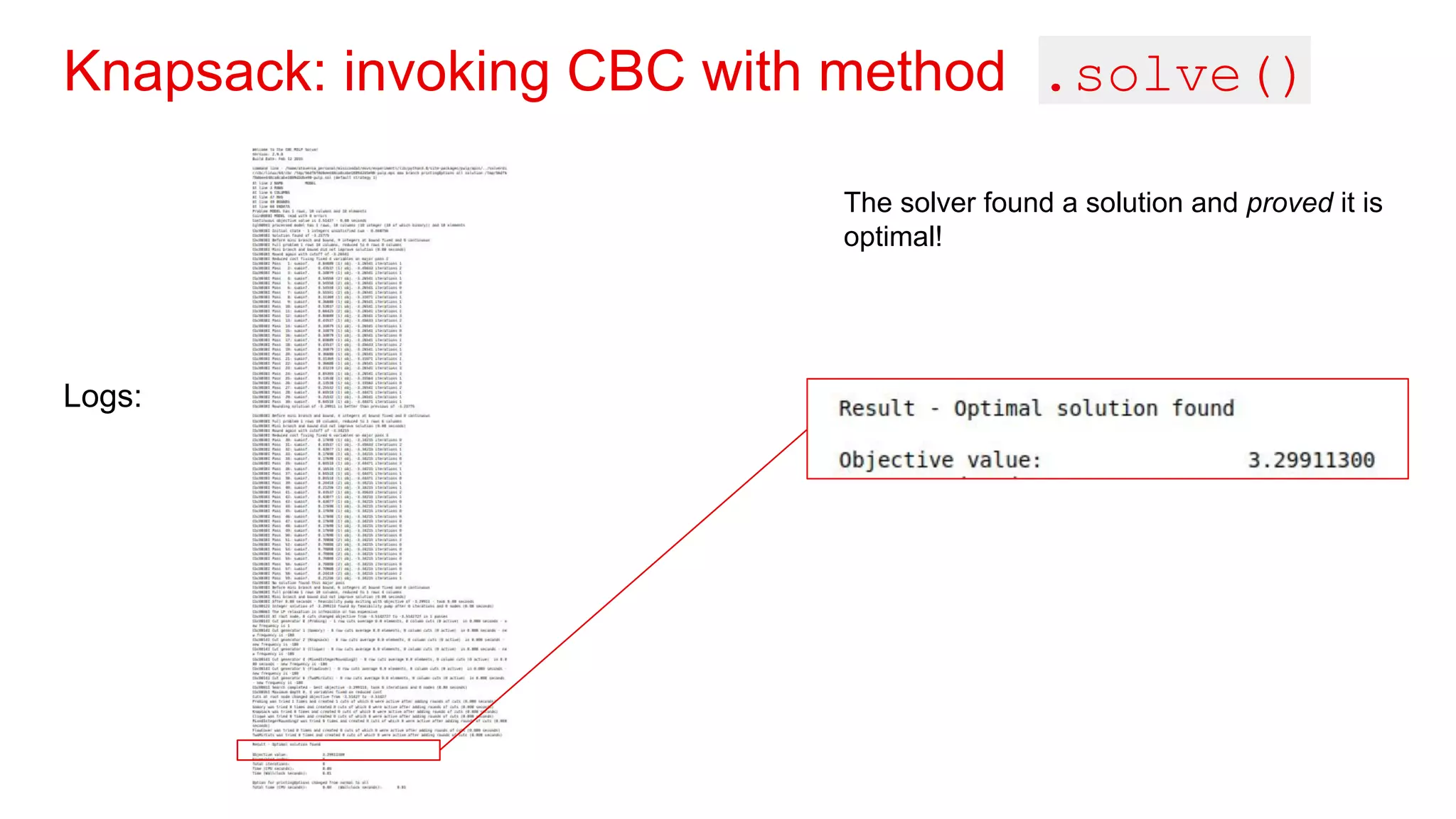
Knapsack: invoking CBC with method .solve()
Logs:
The solver found a solution and proved it is
optimal!
Knapsack: solution
Knapsack: interpretability /explainability/what-if
simulation
Possible questions about, e.g. item 8:
▸ Why wasn’t 8 picked?
▸ What would happen if 8 was in the knapsack?
To answer add the constraint x8
=1 in the model and solve it again!
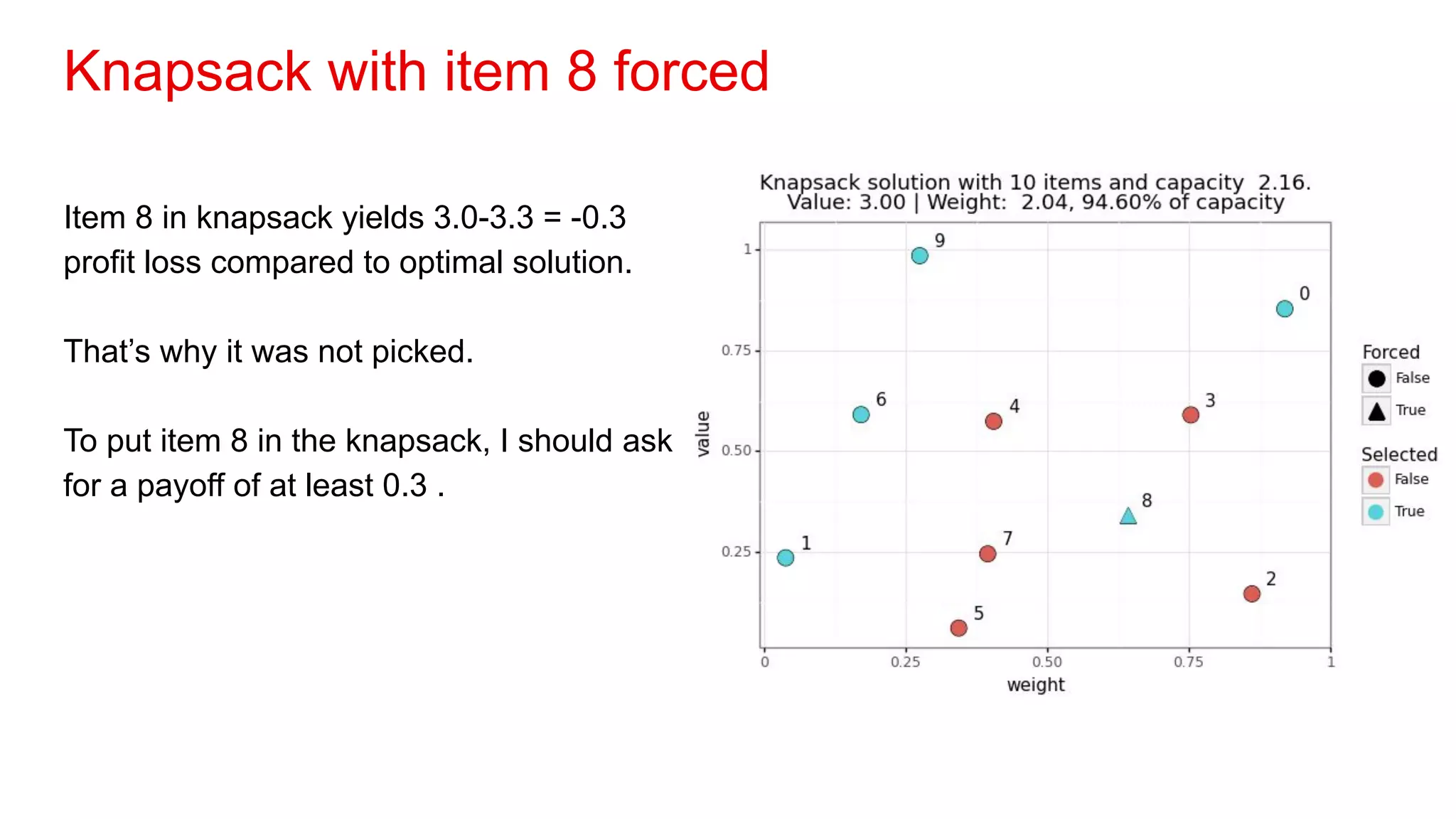
Knapsack with item 8 forced
Item 8 in knapsack yields 3.0-3.3 = -0.3
profit loss compared to optimal solution.
That’s why it was not picked.
To put item 8 in the knapsack, I should ask
for a payoff of at least 0.3 .
From Knapsack to practical problems
For decision problems, with Mathematical Programming you can:
▸ model problems with general language
▸ get high-quality solutions
▸ interpret and trust models
But can it scale to practical problems with realistic size 🤔?
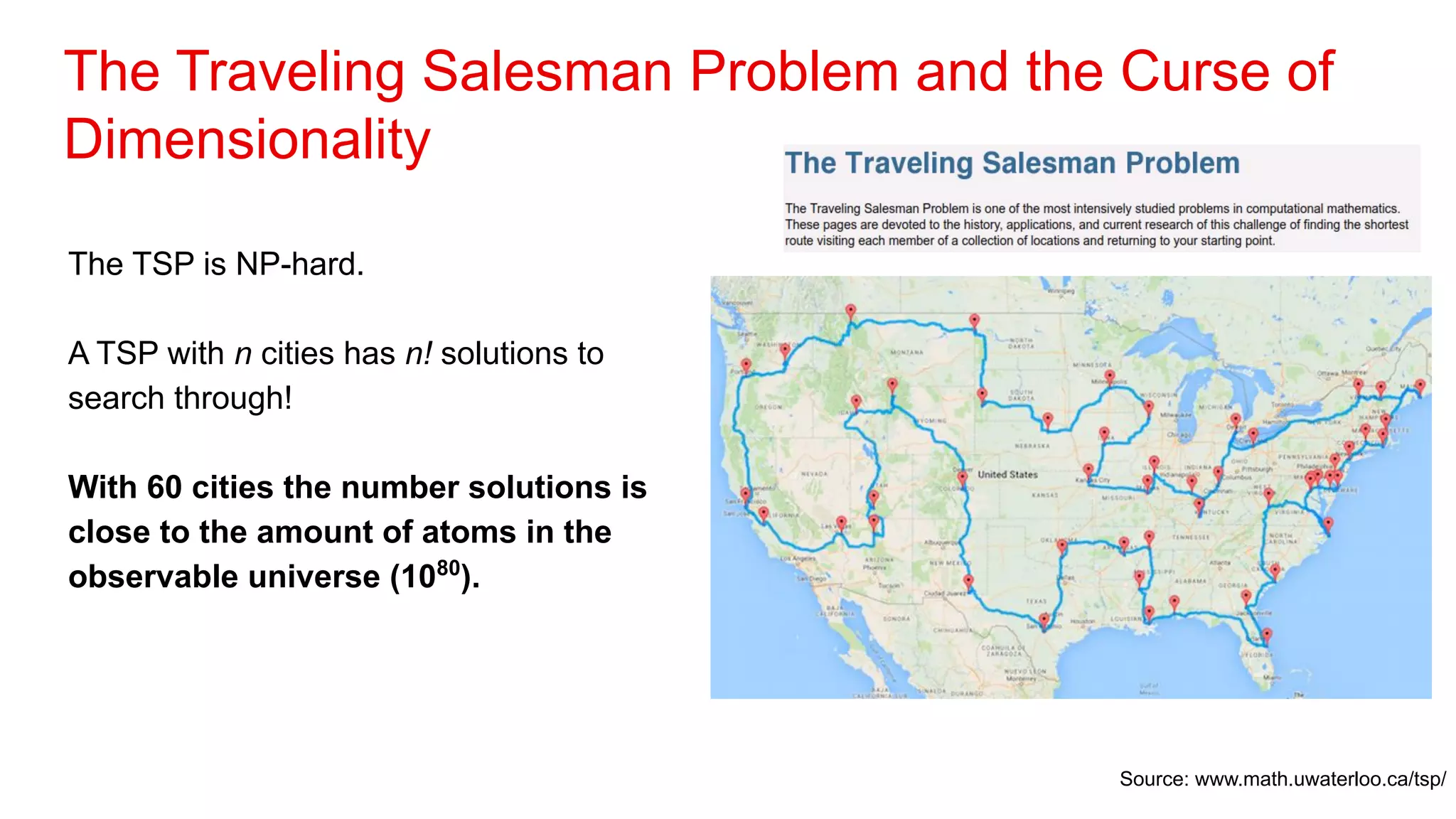
The Traveling Salesman Problem and the Curse of
Dimensionality
The TSP is NP-hard.
A TSP with n cities has n! solutions to
search through!
With 60 cities the number solutions is
close to the amount of atoms in the
observable universe (1080
).
Source: www.math.uwaterloo.ca/tsp/
New hopes: Modern Machine Learning (2021)
Challenge’s goal:
▸ encourage the development of innovative
approaches based on ML, Deep
Learning, Computer Vision …
▸ … that outperform traditional
Operations Research methods …
▸ … for routing problems
Link here
The Amazon Last Mile Challenge was
actually won by the “traditional” heuristics
developed by well-known TSP experts.
They also solved TSP for ~1.3bln stars in
the observable universe! (see pic)
“New hopes”: Operations Research (2021)
ML&OR: Integrate, don’t compete! /1
Is combinatorial optimization the right domain for ML? Classical solvers are
extremely mature and very powerful. It is not clear there’s a huge improvement by
applying ML, whereas there could be other domains [in combinatorial
optimization] where ML could shine brighter.
-- Vinod Nair, DeepMind
Panel discussion “Machine Learning in Combinatorial Optimization”
ML4CO NeurIPS 2021
ML&OR: Integrate, don’t compete! /2
We have seen ML cannot simply replace Optimization, and that may have
been the expectation when the hype was at his peak. Now we understand how we
can integrate these techniques into each other, and use ML inside solvers.
I find this much more interesting than seeing these as competing
technologies.
-- Timo Berthold, FICO Xpress Solver
An idea shared by most if not all members in the panel.
Panel discussion “Machine Learning in Combinatorial Optimization”
ML4CO NeurIPS 2021
From Knapsack to practical problems
For decision problems, with Mathematical Programming you can:
▸ model problems with general language
▸ get high-quality solutions
▸ interpret and trust the models
But can it scale to practical problems with realistic size 🤔?
YES!!!
Mathematical Programming
for Unit Commitment Problem
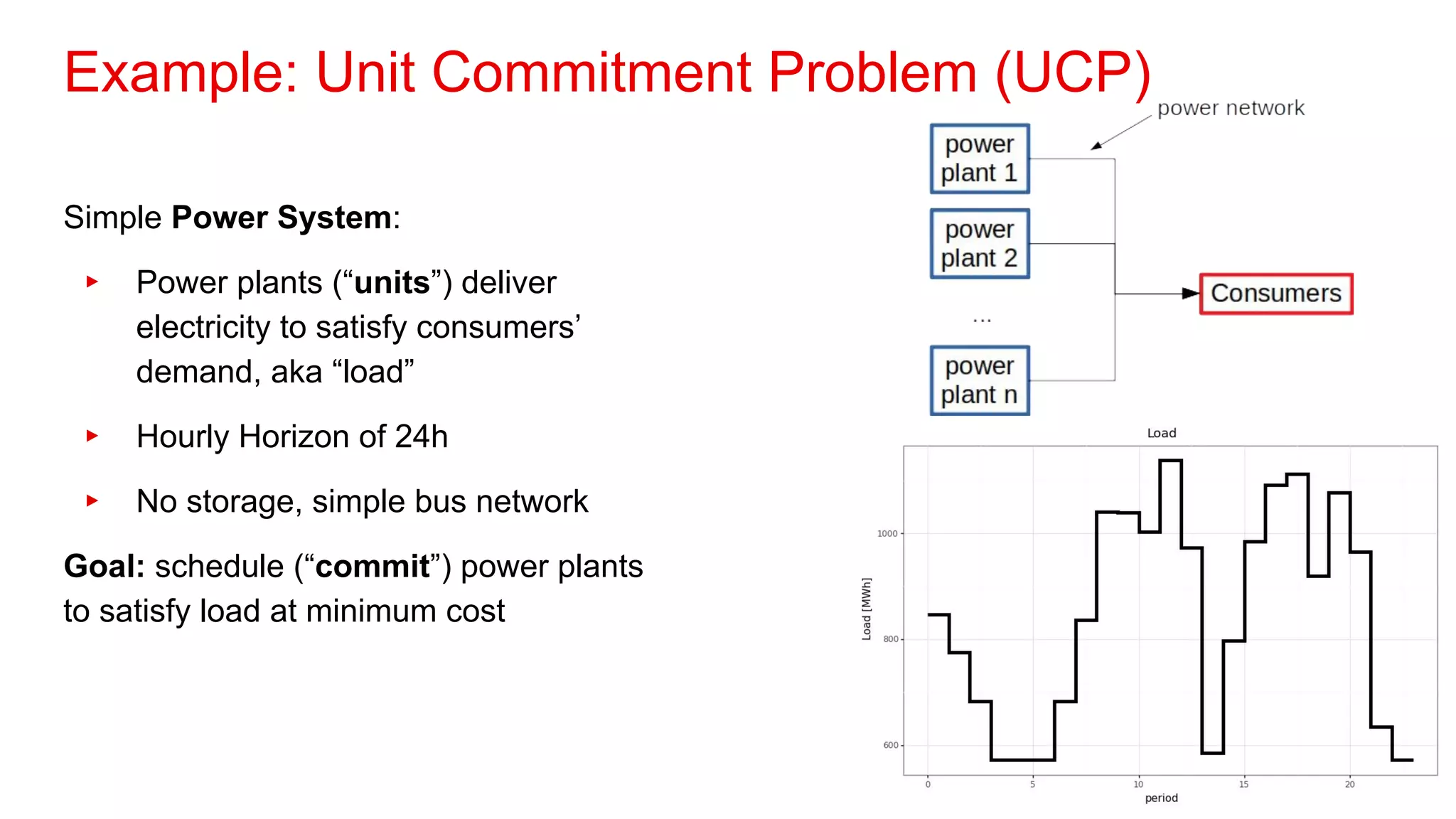
Example: Unit Commitment Problem (UCP)
Simple Power System:
▸ Power plants (“units”) deliver
electricity to satisfy consumers’
demand, aka “load”
▸ Hourly Horizon of 24h
▸ No storage, simple bus network
Goal: schedule (“commit”) power plants
to satisfy load at minimum cost
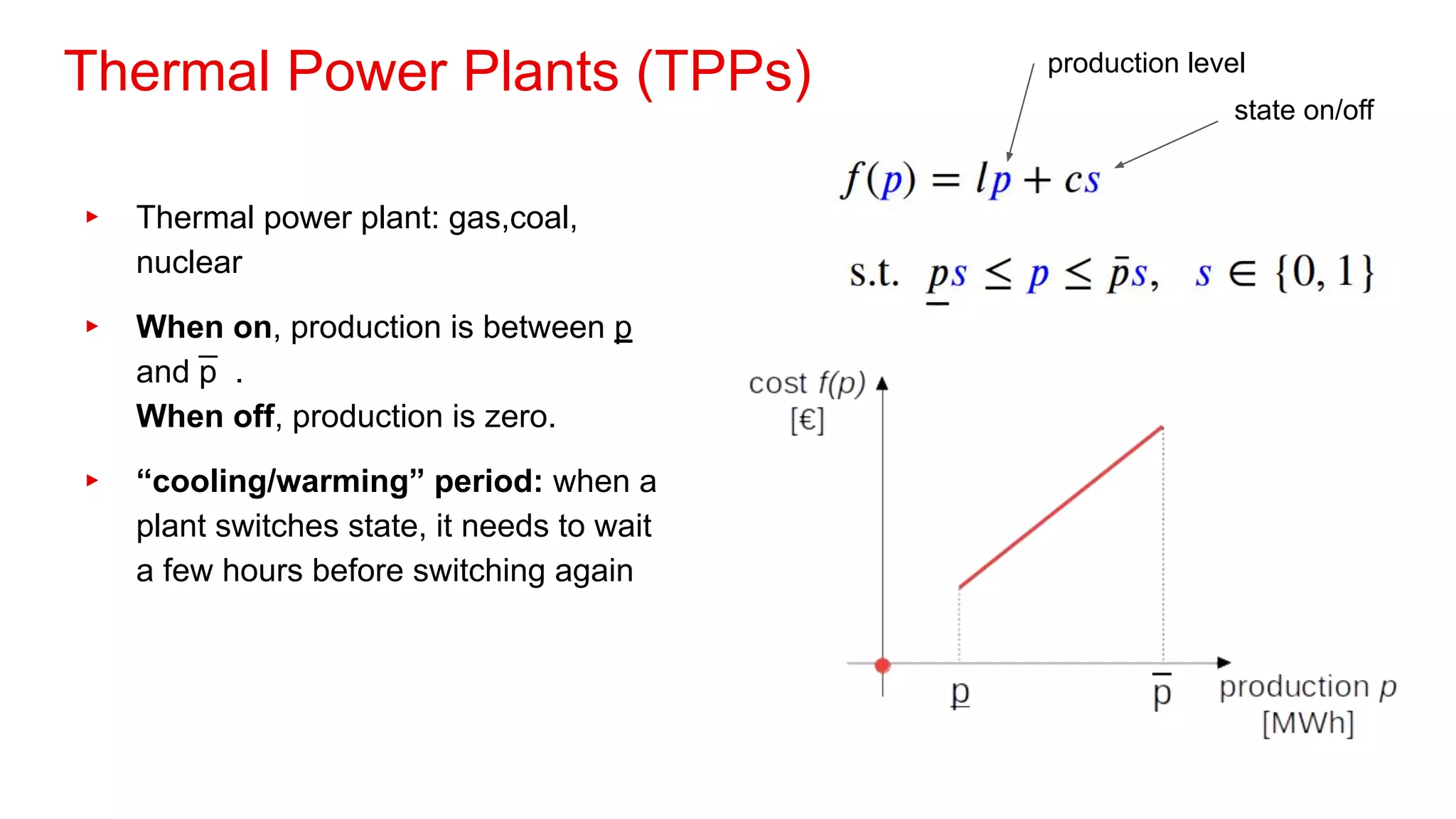
Thermal Power Plants (TPPs)
▸ Thermal power plant: gas,coal,
nuclear
▸ When on, production is between p
and p
̅ .
When off, production is zero.
▸ “cooling/warming” period: when a
plant switches state, it needs to wait
a few hours before switching again
production level
state on/off
UCP Model - math vs code
…
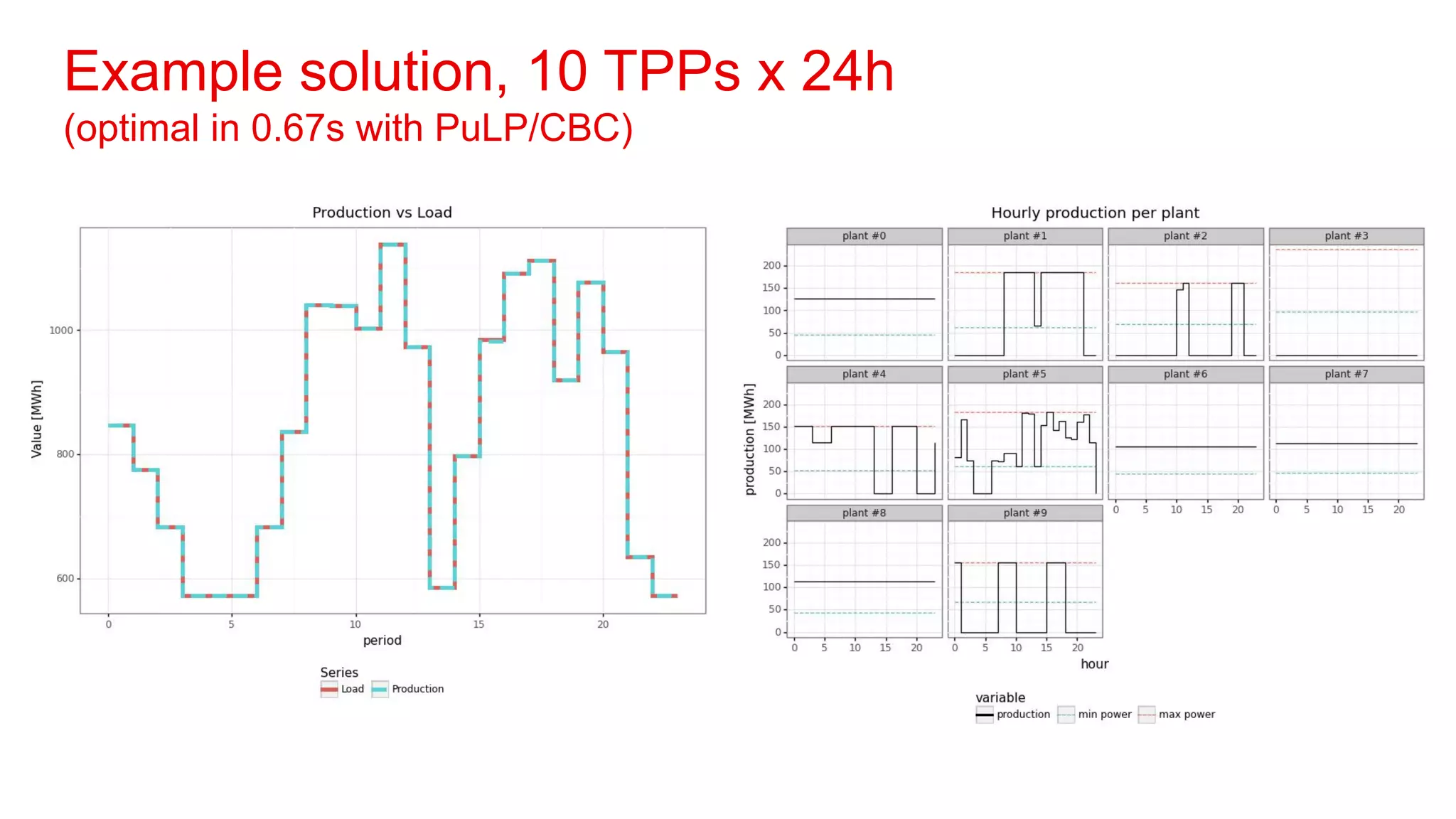
Example solution, 10 TPPs x 24h
(optimal in 0.67s with PuLP/CBC)
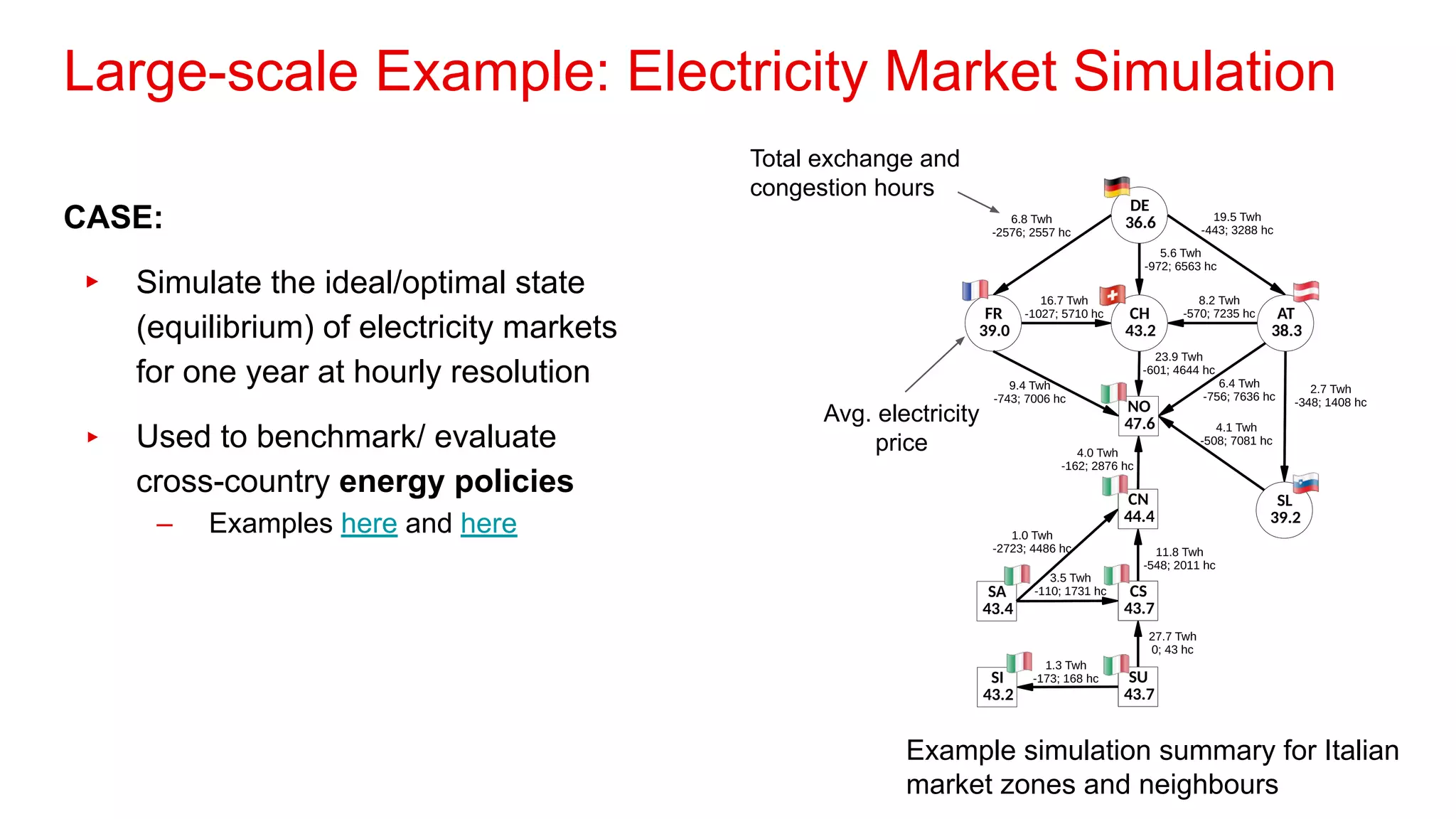
Large-scale Example: Electricity Market Simulation
CASE:
▸ Simulate the ideal/optimal state
(equilibrium) of electricity markets
for one year at hourly resolution
▸ Used to benchmark/ evaluate
cross-country energy policies
– Examples here and here
Example simulation summary for Italian
market zones and neighbours
Avg. electricity
price
Total exchange and
congestion hours
Large-scale Example: Electricity Market Simulation
CASE:
▸ For Italy and neighbours:
– ⋍120 power plants to turn on or off
– 8760 hours
– Plus network details etc…
– Total:
■ 1.8 mln variables
■ 2 mln constraints
SOLUTION SPACE SIZE:
⋍120,000 binary variables
(hourly on/off state of power plants)
=
2120,000
combinations
(FIY atoms in observable universe ⋍ 2250
)
Plus other 1.6 mln variables
and 2 mln constraints…
Large-scale Example: Electricity Market Simulation
SOLUTION:
▸ ≥99% optimality
▸ “No code” implementation (GAMS)
with limited parallelization on 8-core
32GB RAM requires ⋍ one hour.
– Huge time savings if python/java
were used with “full” parallelization
Where’s the trick?
SOLUTION SPACE SIZE:
⋍120,000 binary variables
(hourly on/off state of power plants)
=
2120,000
combinations
(FIY atoms in observable universe ⋍ 2250
)
Plus other 1.6 mln variables
and 2 mln constraints…
Decomposition
The decomposition trick
When a problem gets too big:
▸ decompose Original Problem into
easier, independent subproblems
▸ “master model” provides “prices on
decisions” to subproblems to better
coordinate
▸ Use a “heuristic combinator” to
combine subproblems’ partial
solutions into a “full solution” feasible
and optimal for the Original Problem
▸ Iterate until convergence (desired
optimality gap)
Given original problem P:
▸ Write coupling constraints as
penalties in the objective function,
weighted by lagrangian prices λ
▸ constraints violated ⇒ b-AT
x>0
⇒ the objective worsens
▸ Relaxed model R(λ) is easier than P
and decomposes in independent
subproblems
Decomposition, Lagrangian-style
Coupling
constraints
Non-coupling
constraints
original
objective
weighted
penalties
Master problem: finding good prices
Let opt S := optimal value of problem S.
Let φ(λ) = opt R(λ).
To find good prices solve the
Lagrangian Dual Problem
D: λ* = arg max φ(λ)
rationale:
▸ maxλ
φ(λ) ≤ opt P
▸ Obviously-bad prices yield relaxations
with optimum “too good”
φ(λ) << opt P
by violating relaxed constraints.
▸ Conversely, good prices yield
φ(λ) ~ opt P
Obviously-bad
prices area
😢:
Good prices
area 🙂
R(λ)
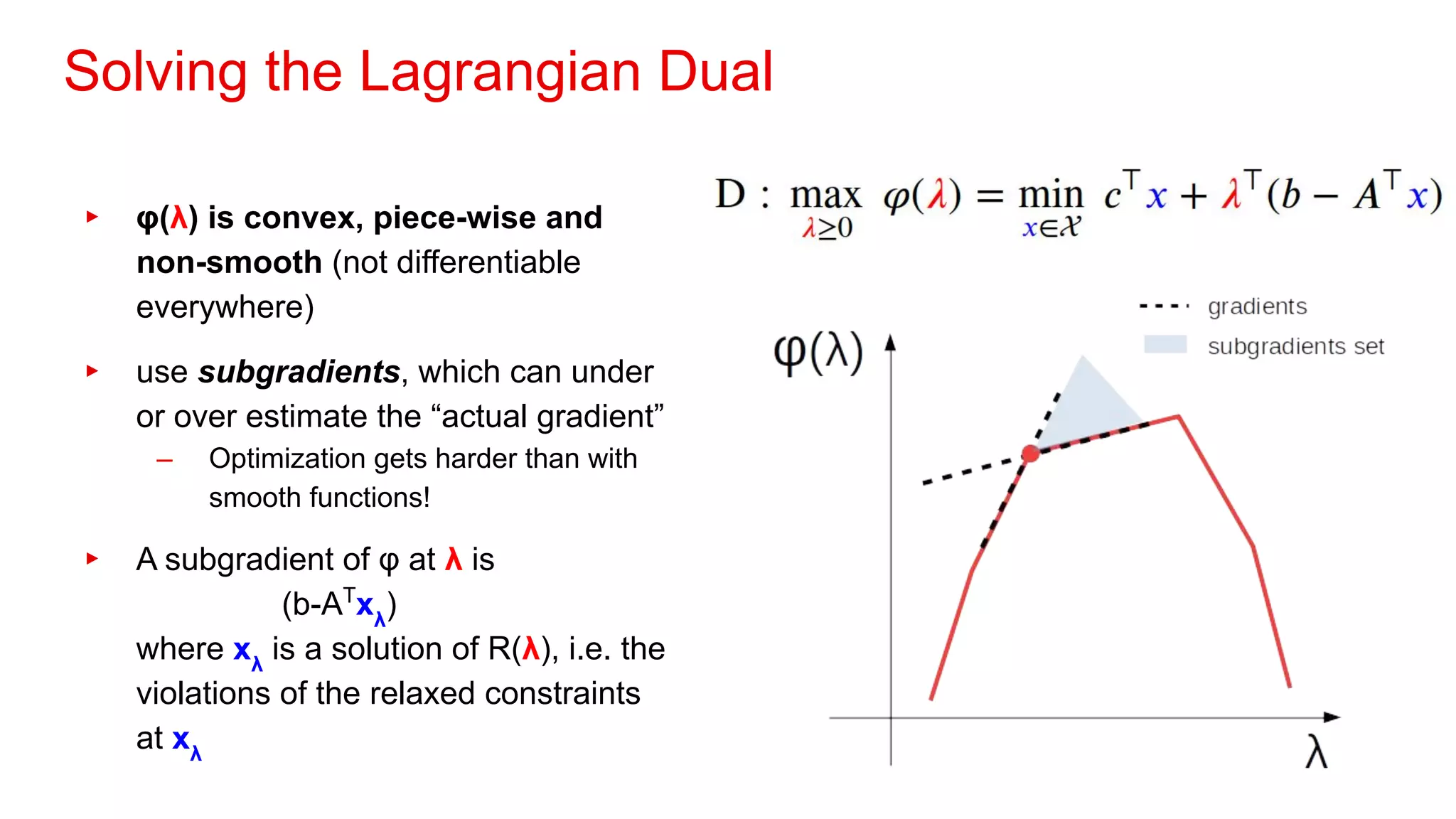
Solving the Lagrangian Dual
▸ φ(λ) is convex, piece-wise and
non-smooth (not differentiable
everywhere)
▸ use subgradients, which can under
or over estimate the “actual gradient”
– Optimization gets harder than with
smooth functions!
▸ A subgradient of φ at λ is
(b-AT
xλ
)
where xλ
is a solution of R(λ), i.e. the
violations of the relaxed constraints
at xλ
Typical Subgradient Descent:
▸ “Like” Gradient Descent, but with
SubGradients (gn
)
▸ Uses momentum/“deflection” to
reduce “zig-zagging”
▸ Polyak’s step size rule: step size
(sn
) depends on a parameter βn
and
an over-estimation φ^n
of the
optimum maxλ
φ(λ)
Non-Smooth Optimization: Subgradient Descent
▸ combine partial solutions xn
and
subgradients (b-Axn
) to iteratively
construct a piece-wise linear
approximation of φ
▸ Implemented as Mathematical
Program
Non-Smooth optimization: Cutting Plane (CP) subgradient
Non-Smooth Optimization: combining methods
Subgradient and Cutting Plane are often
combined to exploit complementary
strengths:
▸ Subgradient Descent: “local”,
performs small steps that improve
the current solution
▸ Cutting Plane: ”global”, larger steps
to explore the solution space, but can
jump to worse solutions
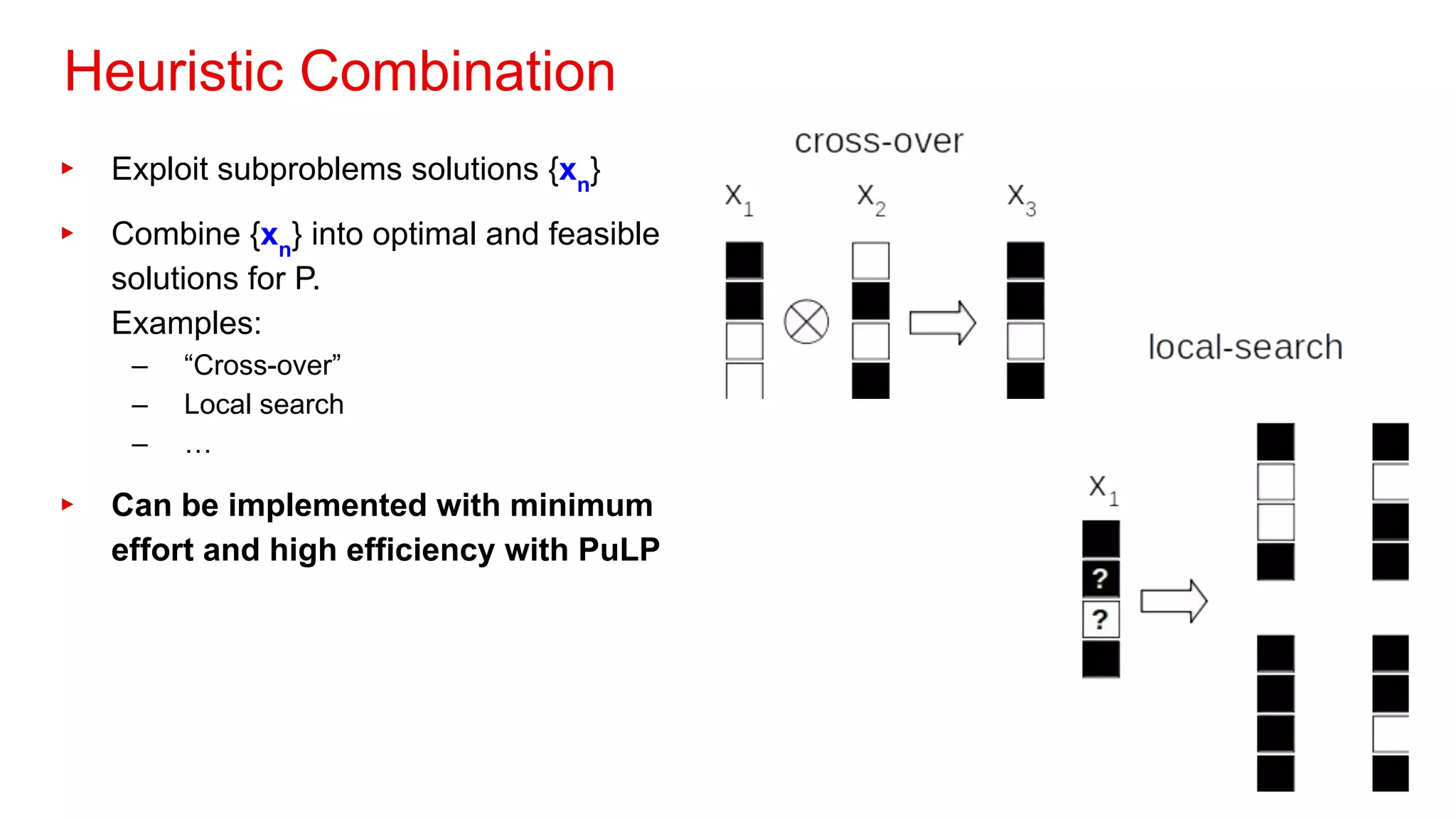
▸ Exploit subproblems solutions {xn
}
▸ Combine {xn
} into optimal and feasible
solutions for P.
Examples:
– “Cross-over”
– Local search
– …
▸ Can be implemented with minimum
effort and high efficiency with PuLP
Heuristic Combination
Lagrangian Decomposition
For Unit Commitment Problem
Lagrangian Decomposition for UCP
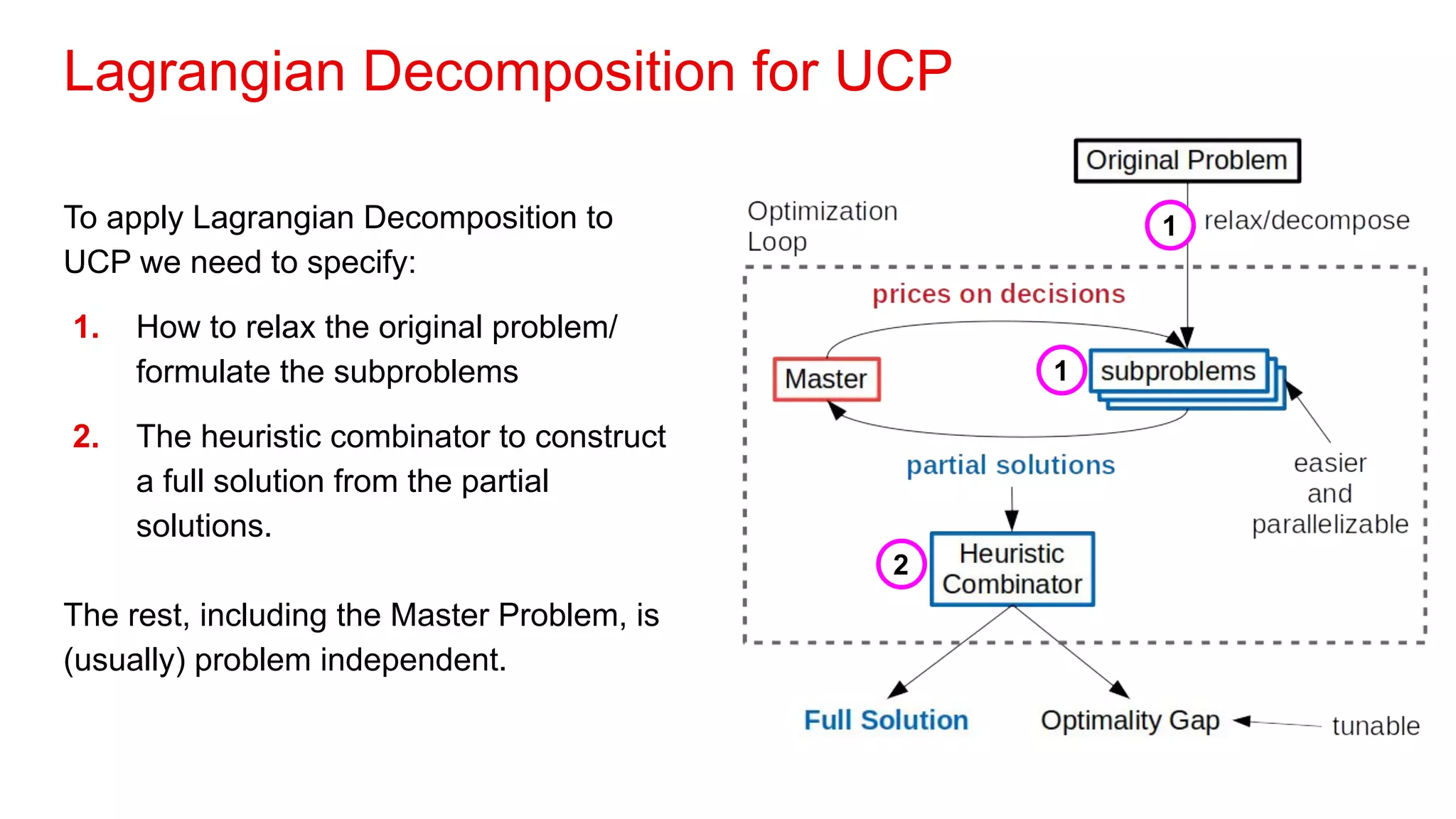
To apply Lagrangian Decomposition to
UCP we need to specify:
1. How to relax the original problem/
formulate the subproblems
2. The heuristic combinator to construct
a full solution from the partial
solutions.
The rest, including the Master Problem, is
(usually) problem independent.
1
2
1
Relaxation for UCP
▸ Separate each plant’s schedule from
its production levels
▸ Constraint violation: a power plant
produces while being off or does not
produce enough while being on
▸ Two groups of subproblems:
– a demand satisfaction problem,
continuous, easy
– Independent, very easy scheduling
problems, one for each power plant
both implemented in PuLP
#i: power plant id
Demand satisfaction Scheduling
problems
Combinatorial Heuristic for UCP
1. Combination: select for each power
plant a schedule among the ones in
partial solutions, then
2. Local search: re-optimize the overall
schedule in few selected hours
having high electricity prices
– “Electricity prices” from Pulp/CBC
Both steps implemented in PuLP
Combination
Combinatorial Heuristic for UCP
1. Combination: select for each power
plant a schedule among the ones in
partial solutions, then
2. Local search: re-optimize the overall
schedule in few selected hours
having high electricity prices
– “Electricity prices” from Pulp/CBC
Both steps implemented in PuLP
Leave
as it is
Re-optimize
Local search
UCP 10TPPsx24h with Lagrangian Decomposition
Final Solution with 7% optimality gap (2.3% from actual optimum)
Final solution found at iteration #5
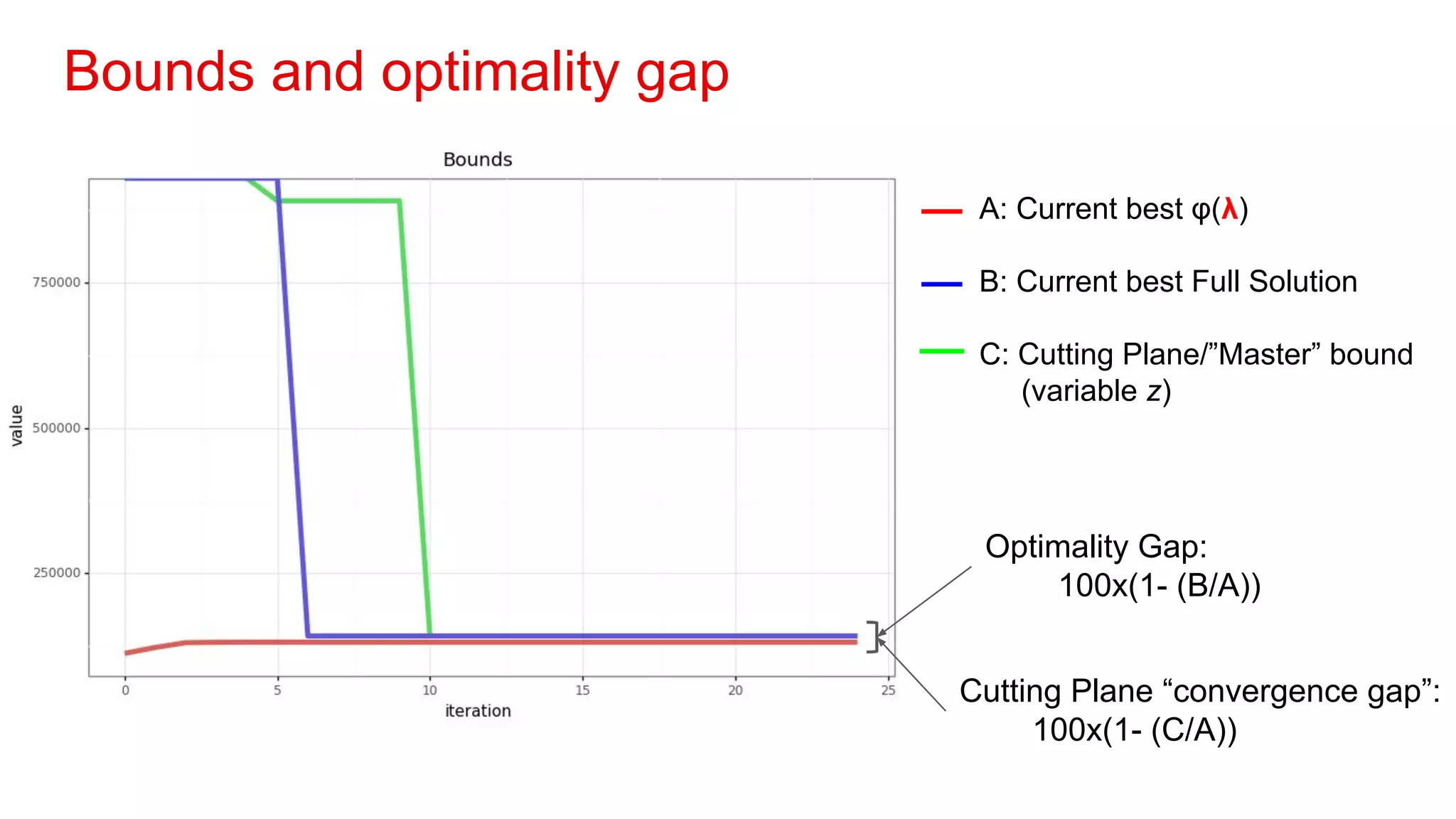
Bounds and optimality gap
A: Current best φ(λ)
B: Current best Full Solution
C: Cutting Plane/”Master” bound
(variable z)
Optimality Gap:
100x(1- (B/A))
Cutting Plane “convergence gap”:
100x(1- (C/A))
Take-away message
Today, only with OR you already can:
1. Solve complex large-scale optimization problems
2. Identify and clarify problems to your stakeholders and users
3. Revolutionize decision processes for the better!
STOP WAITING, START OPTIMIZING NOW!
Extra: more ML/OR Synergy
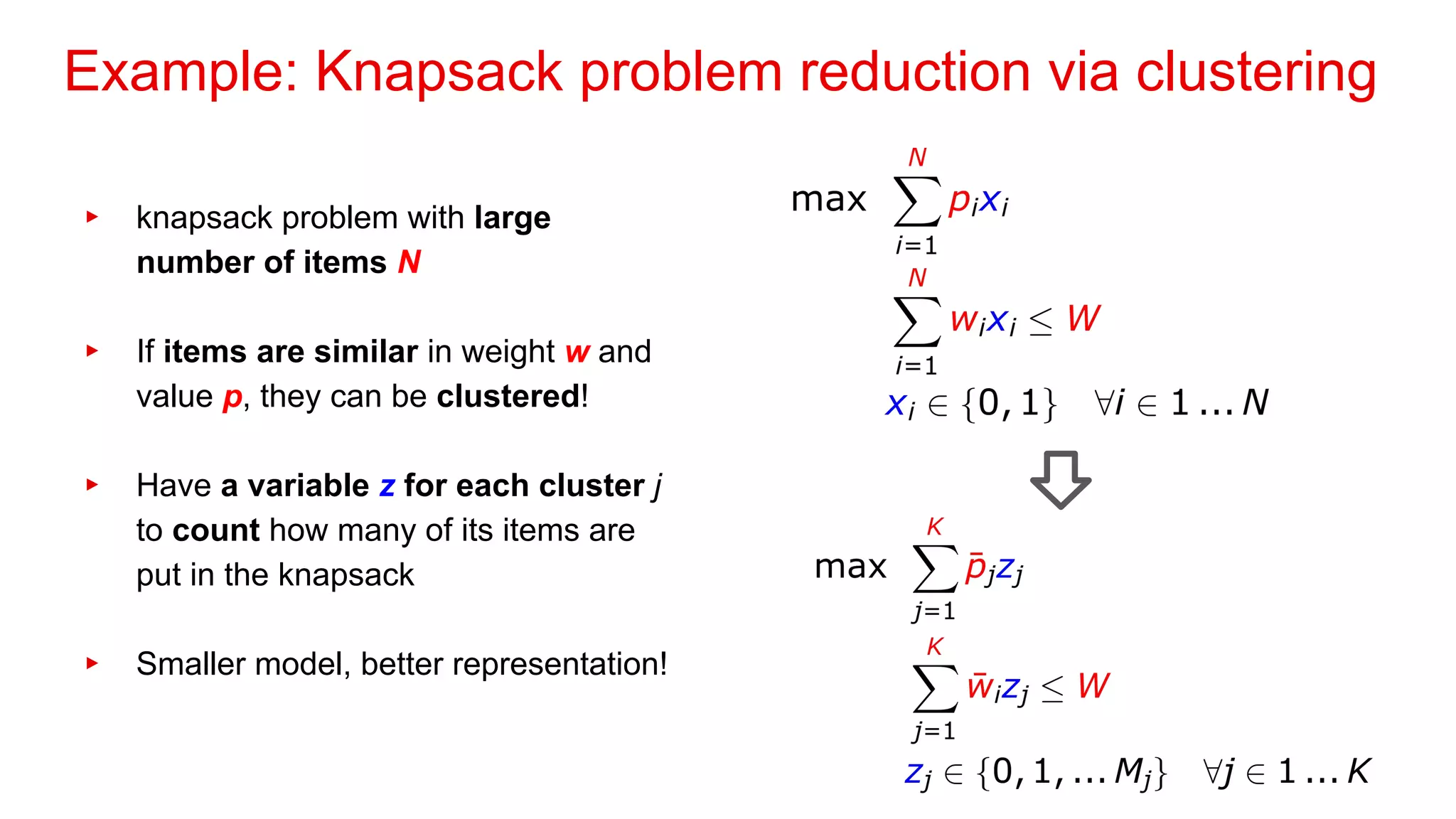
Example: Knapsack problem reduction via clustering
▸ knapsack problem with large
number of items N
▸ If items are similar in weight w and
value p, they can be clustered!
▸ Have a variable z for each cluster j
to count how many of its items are
put in the knapsack
▸ Smaller model, better representation!
Example: Clustered Knapsack
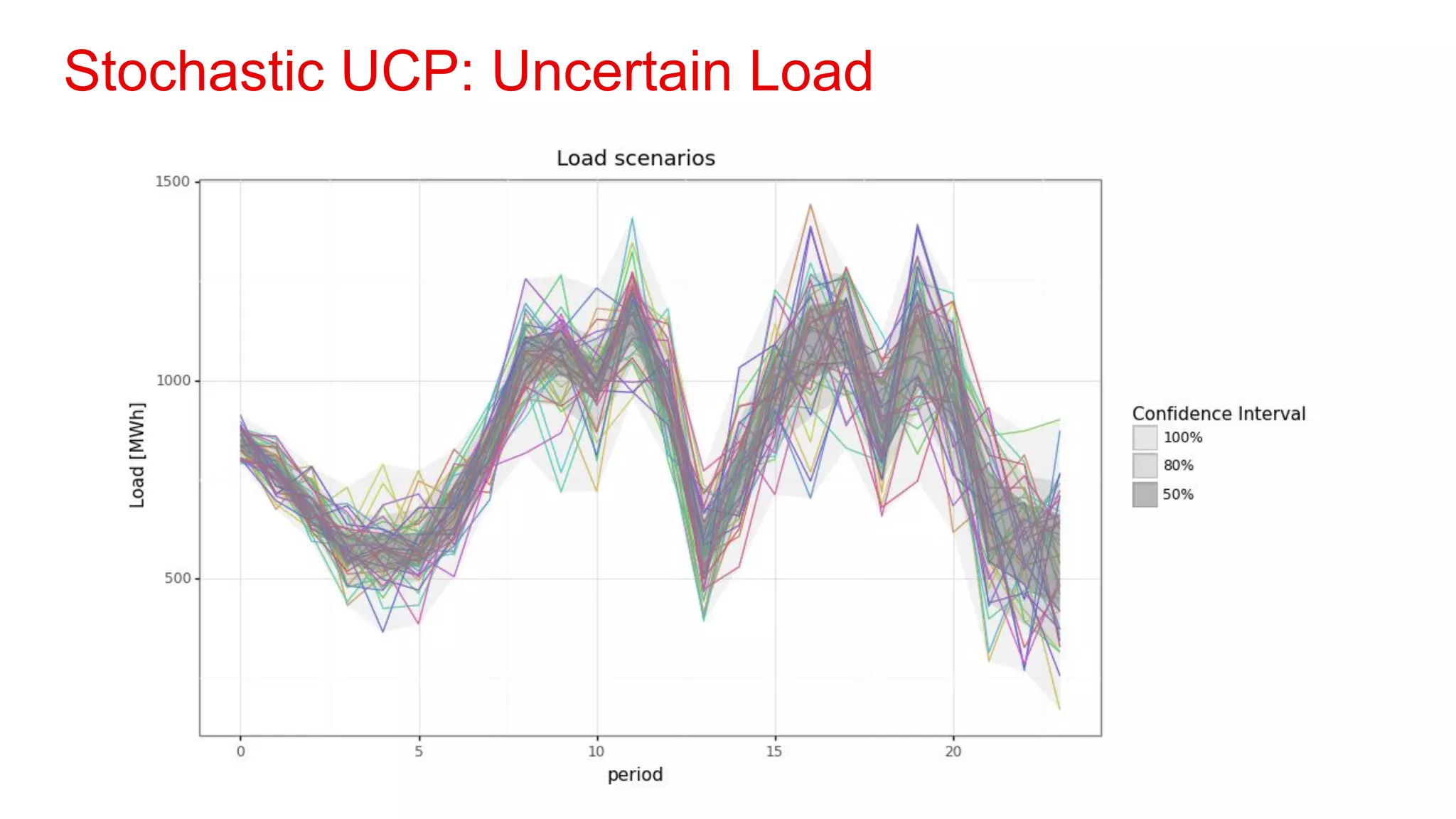
Example: exploiting Probabilistic Forecasts
▸ Forecast = expectation + confidence
interval
▸ Future will differ from expectation!
– Errors!
– Cannot optimize just for the
expected case!
▸ Make solution more robust:
– Sample different scenarios
– optimize expected outcome across
all the scenarios
Stochastic UCP: Uncertain Load
Stochastic UCP: Uncertainty-aware schedules
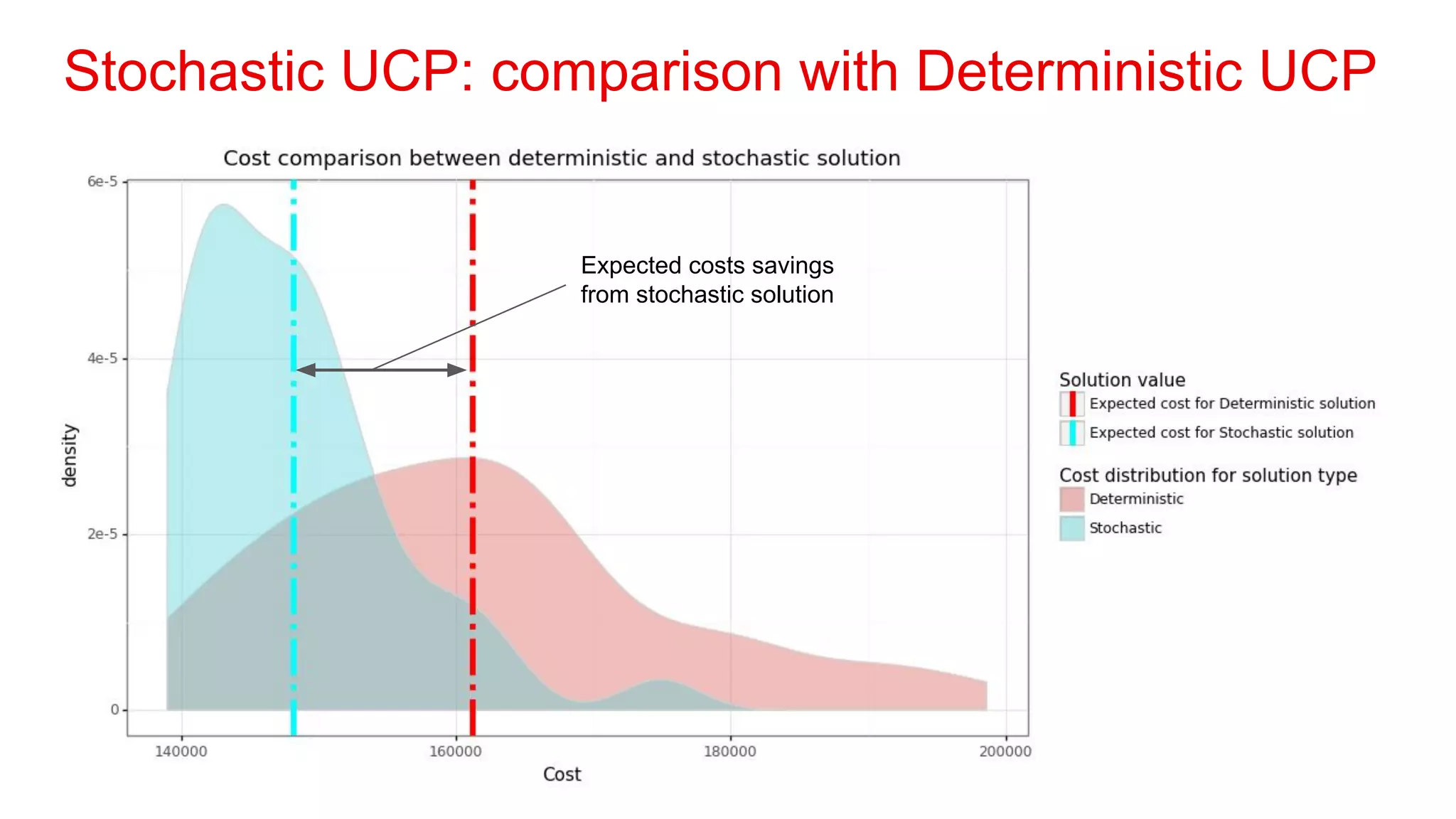
Stochastic UCP: comparison with Deterministic UCP
Expected costs savings
from stochastic solution

Meetup Luglio - Operations Research.pdf

  • 1.
    Operations Research The ScalableAI for Complex Decision Problems Andrea Taverna, PhD CAP Alumnus @ OptLab (UniMi) Currently Operations Researcher in private sector andrea.taverna@outlook.com |in| https://www.linkedin.com/in/andrea-taverna-data-analytics http://optlab.di.unimi.it
  • 2.
    Disclaimer Opinions stated hereare my own and do not necessarily reflect the official policy or position of my past, present or future employers.
  • 3.
    OptLab: a localreference for Operations Research! ▸ Research Laboratory at the Computer Science Dept. of UniMi ▸ Lots of success stories on business applications of Operations Research ▸ Just ask! Contact: Prof. Alberto Ceselli 📧 alberto.ceselli@unimi.it http://optlab.di.unimi.it
  • 4.
    1. Operations Research,what is it? 2. Mathematical Programming, one versatile tool for solving Complex Decision Problems 3. Decomposition: one versatile tool for massive scaling Topics
  • 5.
  • 6.
    Operations Research: whatis it? ▸ Branch of Analytics for decision support – Clarify problems through modelling – Reliably recommend good decisions – Answer complex questions (what if ? why? how?...) ▸ Also known as Prescriptive Analytics, Management Science (MS), (Combinatorial) Optimization, Decision Science ▸ The best way to exploit Data Science!
  • 7.
    Data Science &Operations Research Synergy
  • 8.
    Example problem: UnitCommitment Problem (UCP) Simple Power System: ▸ Power plants (“units”) deliver electricity to satisfy consumers’ demand, aka “load” ▸ Hourly Horizon of 24h ▸ No storage, simple bus network Goal: schedule (“commit”) power plants to satisfy load at minimum cost How to solve that?
  • 9.
  • 10.
    A simple problem:Knapsack Given ▸ A set of items i in I, each with a weight wi and a price pi ▸ A knapsack with limited weight capacity C Select items to put in the knapsack such that: ▸ The total items’ value is maximized ▸ The total items’ weight does not exceed the knapsack’s capacity
  • 11.
    Knapsack: Mathematical Program Wherexi =1 iff item i is in the knapsack
  • 12.
  • 13.
    General-purpose solver forMathematical Programs ▸ Reads Mathematical Programs formulations ▸ Combines exact methods and (meta) heuristics to efficiently find optimal solutions ▸ Provide an optimality gap: (upper) estimate of distance from true optimum – Solution with 100K€ profit and 1% optimality gap means true optimal profit is at most 101k€
  • 14.
    Example: Knapsack withPuLP/CBC ▸ PuLP: modelling library/solver interface ▸ CBC: math.prog. solver ▸ Both open source and from COIN-OR Just pip install pulprequired
  • 15.
  • 16.
  • 17.
    Knapsack: invoking CBCwith method .solve() Logs: The solver found a solution and proved it is optimal!
  • 18.
  • 19.
    Knapsack: interpretability /explainability/what-if simulation Possiblequestions about, e.g. item 8: ▸ Why wasn’t 8 picked? ▸ What would happen if 8 was in the knapsack? To answer add the constraint x8 =1 in the model and solve it again!
  • 20.
    Knapsack with item8 forced Item 8 in knapsack yields 3.0-3.3 = -0.3 profit loss compared to optimal solution. That’s why it was not picked. To put item 8 in the knapsack, I should ask for a payoff of at least 0.3 .
  • 21.
    From Knapsack topractical problems For decision problems, with Mathematical Programming you can: ▸ model problems with general language ▸ get high-quality solutions ▸ interpret and trust models But can it scale to practical problems with realistic size 🤔?
  • 22.
    The Traveling SalesmanProblem and the Curse of Dimensionality The TSP is NP-hard. A TSP with n cities has n! solutions to search through! With 60 cities the number solutions is close to the amount of atoms in the observable universe (1080 ). Source: www.math.uwaterloo.ca/tsp/
  • 23.
    New hopes: ModernMachine Learning (2021) Challenge’s goal: ▸ encourage the development of innovative approaches based on ML, Deep Learning, Computer Vision … ▸ … that outperform traditional Operations Research methods … ▸ … for routing problems Link here
  • 24.
    The Amazon LastMile Challenge was actually won by the “traditional” heuristics developed by well-known TSP experts. They also solved TSP for ~1.3bln stars in the observable universe! (see pic) “New hopes”: Operations Research (2021)
  • 25.
    ML&OR: Integrate, don’tcompete! /1 Is combinatorial optimization the right domain for ML? Classical solvers are extremely mature and very powerful. It is not clear there’s a huge improvement by applying ML, whereas there could be other domains [in combinatorial optimization] where ML could shine brighter. -- Vinod Nair, DeepMind Panel discussion “Machine Learning in Combinatorial Optimization” ML4CO NeurIPS 2021
  • 26.
    ML&OR: Integrate, don’tcompete! /2 We have seen ML cannot simply replace Optimization, and that may have been the expectation when the hype was at his peak. Now we understand how we can integrate these techniques into each other, and use ML inside solvers. I find this much more interesting than seeing these as competing technologies. -- Timo Berthold, FICO Xpress Solver An idea shared by most if not all members in the panel. Panel discussion “Machine Learning in Combinatorial Optimization” ML4CO NeurIPS 2021
  • 27.
    From Knapsack topractical problems For decision problems, with Mathematical Programming you can: ▸ model problems with general language ▸ get high-quality solutions ▸ interpret and trust the models But can it scale to practical problems with realistic size 🤔? YES!!!
  • 28.
  • 29.
    Example: Unit CommitmentProblem (UCP) Simple Power System: ▸ Power plants (“units”) deliver electricity to satisfy consumers’ demand, aka “load” ▸ Hourly Horizon of 24h ▸ No storage, simple bus network Goal: schedule (“commit”) power plants to satisfy load at minimum cost
  • 30.
    Thermal Power Plants(TPPs) ▸ Thermal power plant: gas,coal, nuclear ▸ When on, production is between p and p ̅ . When off, production is zero. ▸ “cooling/warming” period: when a plant switches state, it needs to wait a few hours before switching again production level state on/off
  • 31.
    UCP Model -math vs code …
  • 32.
    Example solution, 10TPPs x 24h (optimal in 0.67s with PuLP/CBC)
  • 33.
    Large-scale Example: ElectricityMarket Simulation CASE: ▸ Simulate the ideal/optimal state (equilibrium) of electricity markets for one year at hourly resolution ▸ Used to benchmark/ evaluate cross-country energy policies – Examples here and here Example simulation summary for Italian market zones and neighbours Avg. electricity price Total exchange and congestion hours
  • 34.
    Large-scale Example: ElectricityMarket Simulation CASE: ▸ For Italy and neighbours: – ⋍120 power plants to turn on or off – 8760 hours – Plus network details etc… – Total: ■ 1.8 mln variables ■ 2 mln constraints SOLUTION SPACE SIZE: ⋍120,000 binary variables (hourly on/off state of power plants) = 2120,000 combinations (FIY atoms in observable universe ⋍ 2250 ) Plus other 1.6 mln variables and 2 mln constraints…
  • 35.
    Large-scale Example: ElectricityMarket Simulation SOLUTION: ▸ ≥99% optimality ▸ “No code” implementation (GAMS) with limited parallelization on 8-core 32GB RAM requires ⋍ one hour. – Huge time savings if python/java were used with “full” parallelization Where’s the trick? SOLUTION SPACE SIZE: ⋍120,000 binary variables (hourly on/off state of power plants) = 2120,000 combinations (FIY atoms in observable universe ⋍ 2250 ) Plus other 1.6 mln variables and 2 mln constraints…
  • 36.
  • 37.
    The decomposition trick Whena problem gets too big: ▸ decompose Original Problem into easier, independent subproblems ▸ “master model” provides “prices on decisions” to subproblems to better coordinate ▸ Use a “heuristic combinator” to combine subproblems’ partial solutions into a “full solution” feasible and optimal for the Original Problem ▸ Iterate until convergence (desired optimality gap)
  • 38.
    Given original problemP: ▸ Write coupling constraints as penalties in the objective function, weighted by lagrangian prices λ ▸ constraints violated ⇒ b-AT x>0 ⇒ the objective worsens ▸ Relaxed model R(λ) is easier than P and decomposes in independent subproblems Decomposition, Lagrangian-style Coupling constraints Non-coupling constraints original objective weighted penalties
  • 39.
    Master problem: findinggood prices Let opt S := optimal value of problem S. Let φ(λ) = opt R(λ). To find good prices solve the Lagrangian Dual Problem D: λ* = arg max φ(λ) rationale: ▸ maxλ φ(λ) ≤ opt P ▸ Obviously-bad prices yield relaxations with optimum “too good” φ(λ) << opt P by violating relaxed constraints. ▸ Conversely, good prices yield φ(λ) ~ opt P Obviously-bad prices area 😢: Good prices area 🙂 R(λ)
  • 40.
    Solving the LagrangianDual ▸ φ(λ) is convex, piece-wise and non-smooth (not differentiable everywhere) ▸ use subgradients, which can under or over estimate the “actual gradient” – Optimization gets harder than with smooth functions! ▸ A subgradient of φ at λ is (b-AT xλ ) where xλ is a solution of R(λ), i.e. the violations of the relaxed constraints at xλ
  • 41.
    Typical Subgradient Descent: ▸“Like” Gradient Descent, but with SubGradients (gn ) ▸ Uses momentum/“deflection” to reduce “zig-zagging” ▸ Polyak’s step size rule: step size (sn ) depends on a parameter βn and an over-estimation φ^n of the optimum maxλ φ(λ) Non-Smooth Optimization: Subgradient Descent
  • 42.
    ▸ combine partialsolutions xn and subgradients (b-Axn ) to iteratively construct a piece-wise linear approximation of φ ▸ Implemented as Mathematical Program Non-Smooth optimization: Cutting Plane (CP) subgradient
  • 43.
    Non-Smooth Optimization: combiningmethods Subgradient and Cutting Plane are often combined to exploit complementary strengths: ▸ Subgradient Descent: “local”, performs small steps that improve the current solution ▸ Cutting Plane: ”global”, larger steps to explore the solution space, but can jump to worse solutions
  • 44.
    ▸ Exploit subproblemssolutions {xn } ▸ Combine {xn } into optimal and feasible solutions for P. Examples: – “Cross-over” – Local search – … ▸ Can be implemented with minimum effort and high efficiency with PuLP Heuristic Combination
  • 45.
  • 46.
    Lagrangian Decomposition forUCP To apply Lagrangian Decomposition to UCP we need to specify: 1. How to relax the original problem/ formulate the subproblems 2. The heuristic combinator to construct a full solution from the partial solutions. The rest, including the Master Problem, is (usually) problem independent. 1 2 1
  • 47.
    Relaxation for UCP ▸Separate each plant’s schedule from its production levels ▸ Constraint violation: a power plant produces while being off or does not produce enough while being on ▸ Two groups of subproblems: – a demand satisfaction problem, continuous, easy – Independent, very easy scheduling problems, one for each power plant both implemented in PuLP #i: power plant id Demand satisfaction Scheduling problems
  • 48.
    Combinatorial Heuristic forUCP 1. Combination: select for each power plant a schedule among the ones in partial solutions, then 2. Local search: re-optimize the overall schedule in few selected hours having high electricity prices – “Electricity prices” from Pulp/CBC Both steps implemented in PuLP Combination
  • 49.
    Combinatorial Heuristic forUCP 1. Combination: select for each power plant a schedule among the ones in partial solutions, then 2. Local search: re-optimize the overall schedule in few selected hours having high electricity prices – “Electricity prices” from Pulp/CBC Both steps implemented in PuLP Leave as it is Re-optimize Local search
  • 50.
    UCP 10TPPsx24h withLagrangian Decomposition Final Solution with 7% optimality gap (2.3% from actual optimum) Final solution found at iteration #5
  • 51.
    Bounds and optimalitygap A: Current best φ(λ) B: Current best Full Solution C: Cutting Plane/”Master” bound (variable z) Optimality Gap: 100x(1- (B/A)) Cutting Plane “convergence gap”: 100x(1- (C/A))
  • 52.
    Take-away message Today, onlywith OR you already can: 1. Solve complex large-scale optimization problems 2. Identify and clarify problems to your stakeholders and users 3. Revolutionize decision processes for the better! STOP WAITING, START OPTIMIZING NOW!
  • 53.
  • 54.
    Example: Knapsack problemreduction via clustering ▸ knapsack problem with large number of items N ▸ If items are similar in weight w and value p, they can be clustered! ▸ Have a variable z for each cluster j to count how many of its items are put in the knapsack ▸ Smaller model, better representation!
  • 55.
  • 56.
    Example: exploiting ProbabilisticForecasts ▸ Forecast = expectation + confidence interval ▸ Future will differ from expectation! – Errors! – Cannot optimize just for the expected case! ▸ Make solution more robust: – Sample different scenarios – optimize expected outcome across all the scenarios
  • 57.
  • 58.
  • 59.
    Stochastic UCP: comparisonwith Deterministic UCP Expected costs savings from stochastic solution