Oppositional Defiant
Disorder (ODD)
Tanner Hemesath
More than just the occasional outburst
• All children sometimes have emotional moments. It is when it becomes
consistent that it’s a problem.
• Characterized by frequent and consistent periods of irritation or
argumentation toward and authority figure.
• Typically begins in preschool years.
• There are no clear estimates for how many have ODD. It may be around the
ballpark of 1-in-16 people.
Symptoms
• The Diagnostic and Statistical Manual of Mental Disorders (DSM-5) lists
the following for the diagnosis of ODD:
• Includes 4 or more of: angry/irritable mood, argumentative/defiant
behavior, vindictiveness
• Occurs with at least 1 non-sibling
• Negatively impacts work/school/family
• Occurs independent of another mental health issue or substance abuse
• Lasts at least 6 months
Symptoms - Elaborated
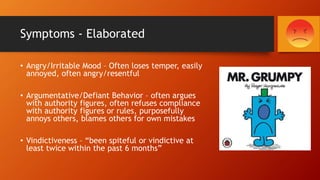
• Angry/Irritable Mood – Often loses temper, easily
annoyed, often angry/resentful
• Argumentative/Defiant Behavior – often argues
with authority figures, often refuses compliance
with authority figures or rules, purposefully
annoys others, blames others for own mistakes
• Vindictiveness – “been spiteful or vindictive at
least twice within the past 6 months”
Causes
• No direct cause has been identified. ODD may be inherited through
genetic disposition or may be a result of parenting styles or consistent
problems with other authority figures.
• Biological factors which increase risk: parents with a history of ADHD, ODD, CD, or mood disorders;
parents with substance abuse problems; impairment in parts of the brain responsible for judgment
and impulse control; brain-chemical imbalance; toxin exposure; poor nutrition
• Psychological factors: poor relationship with parent(s), neglectful/absent parent(s), difficulty
forming social relationships or identifying social cues
• Social factors: poverty, abuse, neglect, lack of supervision, inconsistent discipline, family instability
Lists taken from the American Academy of Child and Adolescent Psychiatry
Complications
• Individuals with ODD may have difficulty forming or keeping
relationships or working with others. This can lead to poor
academic performance, antisocial tendencies, impulsive behavior,
substance reliance…
• The reflexive No – a child with ODD might refuse to comply with
an authority figure before they even know what they’re going to
ask
Seeking help
• An individual with ODD often won’t see themselves as having an
issue. Instead, they see themselves as being unreasonably
burdened or that their actions don’t matter.
• If a child’s behavior is seen as abnormal, it is then that the parent
is required to schedule an appointment
Treatment
• There is no medication targeted at ODD. However, ODD is often
accompanied by another behavior issue like ADHD, which may be
medicated.
• Therapy and training involves not only the child, but also the
parent(s). Treatment is typically long-lasting.
• Parent training – Parents are trained to more positively affect and
cause less frustration for their child.
Treatment - continued
• Parent-child Interaction Therapy – therapists guide parents while
they interact with their child. The therapist might sit behind a
one-way window and use wireless communication with parents.
• Individual therapy with the child
• Cognitive training – Helping the child identify negative thought
processes and find alternatives.
Citations
• ODD – Child Mind Institute
https://childmind.org/guide/oppositional-defiant-disorder/
• ODD – MayoClinic http://www.mayoclinic.org/diseases-
conditions/oppositional-defiant-disorder/basics/definition/con-
20024559
• American Academy of Child & Adolescent Psychiatry
https://www.aacap.org/App_Themes/AACAP/docs/resource_cent
ers/odd/odd_resource_center_odd_guide.pdf

Oppositional defiant disorder (odd)

  • 1.
  • 2.
    More than justthe occasional outburst • All children sometimes have emotional moments. It is when it becomes consistent that it’s a problem. • Characterized by frequent and consistent periods of irritation or argumentation toward and authority figure. • Typically begins in preschool years. • There are no clear estimates for how many have ODD. It may be around the ballpark of 1-in-16 people.
  • 3.
    Symptoms • The Diagnosticand Statistical Manual of Mental Disorders (DSM-5) lists the following for the diagnosis of ODD: • Includes 4 or more of: angry/irritable mood, argumentative/defiant behavior, vindictiveness • Occurs with at least 1 non-sibling • Negatively impacts work/school/family • Occurs independent of another mental health issue or substance abuse • Lasts at least 6 months
  • 4.
    Symptoms - Elaborated •Angry/Irritable Mood – Often loses temper, easily annoyed, often angry/resentful • Argumentative/Defiant Behavior – often argues with authority figures, often refuses compliance with authority figures or rules, purposefully annoys others, blames others for own mistakes • Vindictiveness – “been spiteful or vindictive at least twice within the past 6 months”
  • 5.
    Causes • No directcause has been identified. ODD may be inherited through genetic disposition or may be a result of parenting styles or consistent problems with other authority figures. • Biological factors which increase risk: parents with a history of ADHD, ODD, CD, or mood disorders; parents with substance abuse problems; impairment in parts of the brain responsible for judgment and impulse control; brain-chemical imbalance; toxin exposure; poor nutrition • Psychological factors: poor relationship with parent(s), neglectful/absent parent(s), difficulty forming social relationships or identifying social cues • Social factors: poverty, abuse, neglect, lack of supervision, inconsistent discipline, family instability Lists taken from the American Academy of Child and Adolescent Psychiatry
  • 6.
    Complications • Individuals withODD may have difficulty forming or keeping relationships or working with others. This can lead to poor academic performance, antisocial tendencies, impulsive behavior, substance reliance… • The reflexive No – a child with ODD might refuse to comply with an authority figure before they even know what they’re going to ask
  • 7.
    Seeking help • Anindividual with ODD often won’t see themselves as having an issue. Instead, they see themselves as being unreasonably burdened or that their actions don’t matter. • If a child’s behavior is seen as abnormal, it is then that the parent is required to schedule an appointment
  • 8.
    Treatment • There isno medication targeted at ODD. However, ODD is often accompanied by another behavior issue like ADHD, which may be medicated. • Therapy and training involves not only the child, but also the parent(s). Treatment is typically long-lasting. • Parent training – Parents are trained to more positively affect and cause less frustration for their child.
  • 9.
    Treatment - continued •Parent-child Interaction Therapy – therapists guide parents while they interact with their child. The therapist might sit behind a one-way window and use wireless communication with parents. • Individual therapy with the child • Cognitive training – Helping the child identify negative thought processes and find alternatives.
  • 10.
    Citations • ODD –Child Mind Institute https://childmind.org/guide/oppositional-defiant-disorder/ • ODD – MayoClinic http://www.mayoclinic.org/diseases- conditions/oppositional-defiant-disorder/basics/definition/con- 20024559 • American Academy of Child & Adolescent Psychiatry https://www.aacap.org/App_Themes/AACAP/docs/resource_cent ers/odd/odd_resource_center_odd_guide.pdf