1
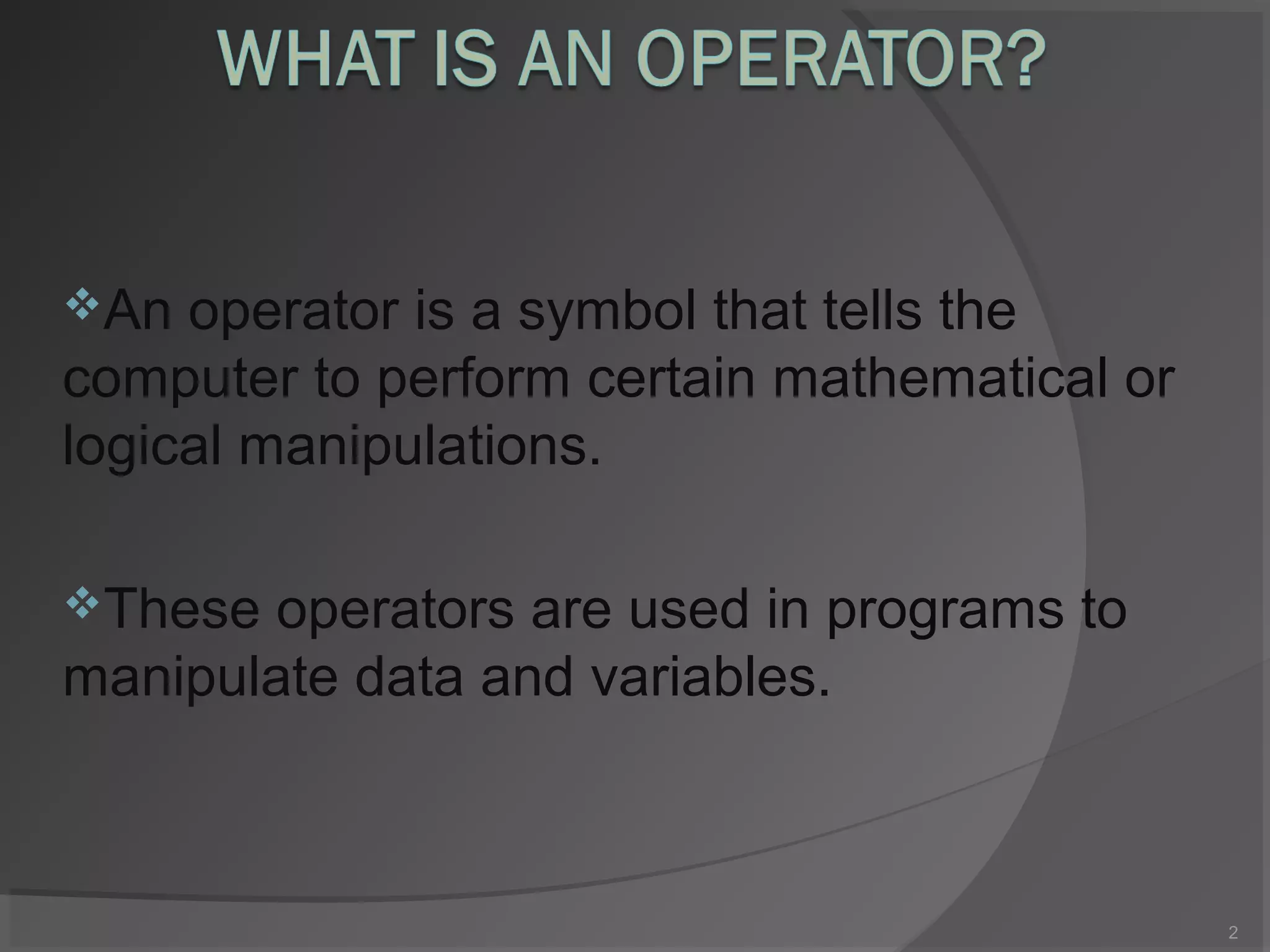
An operator is a symbol that tells the
computer to perform certain mathematical or
logical manipulations.
These operators are used in programs to
manipulate data and variables.
2
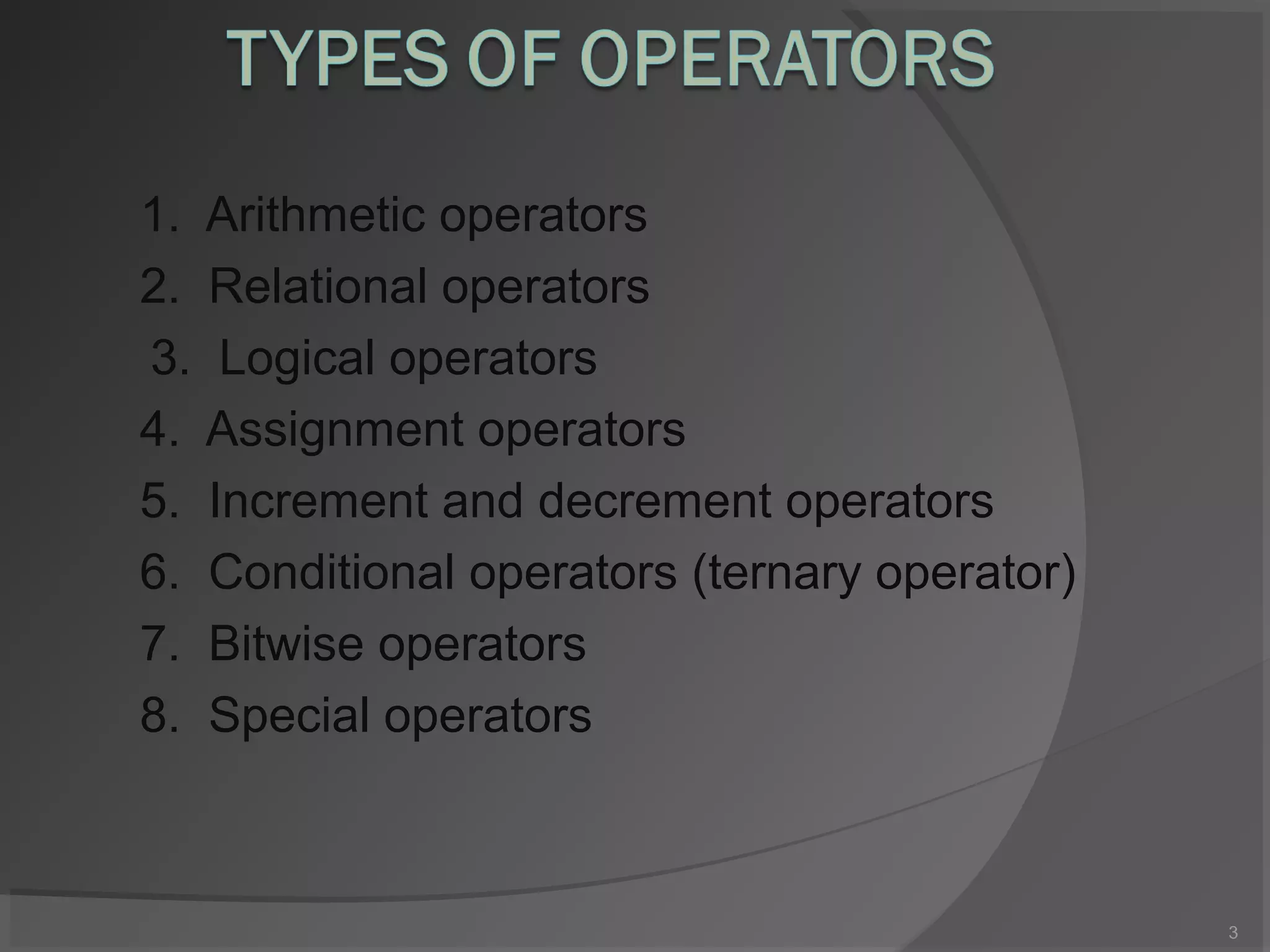
1. Arithmetic operators
2. Relational operators
3. Logical operators
4. Assignment operators
5. Increment and decrement operators
6. Conditional operators (ternary operator)
7. Bitwise operators
8. Special operators
3
Arithmetic operators are used to perform numerical calculations
among the values.
OPERATOR MEANING
+ Addition
- Subtraction
* Multiplication
/ Division
% Modulo Division
4
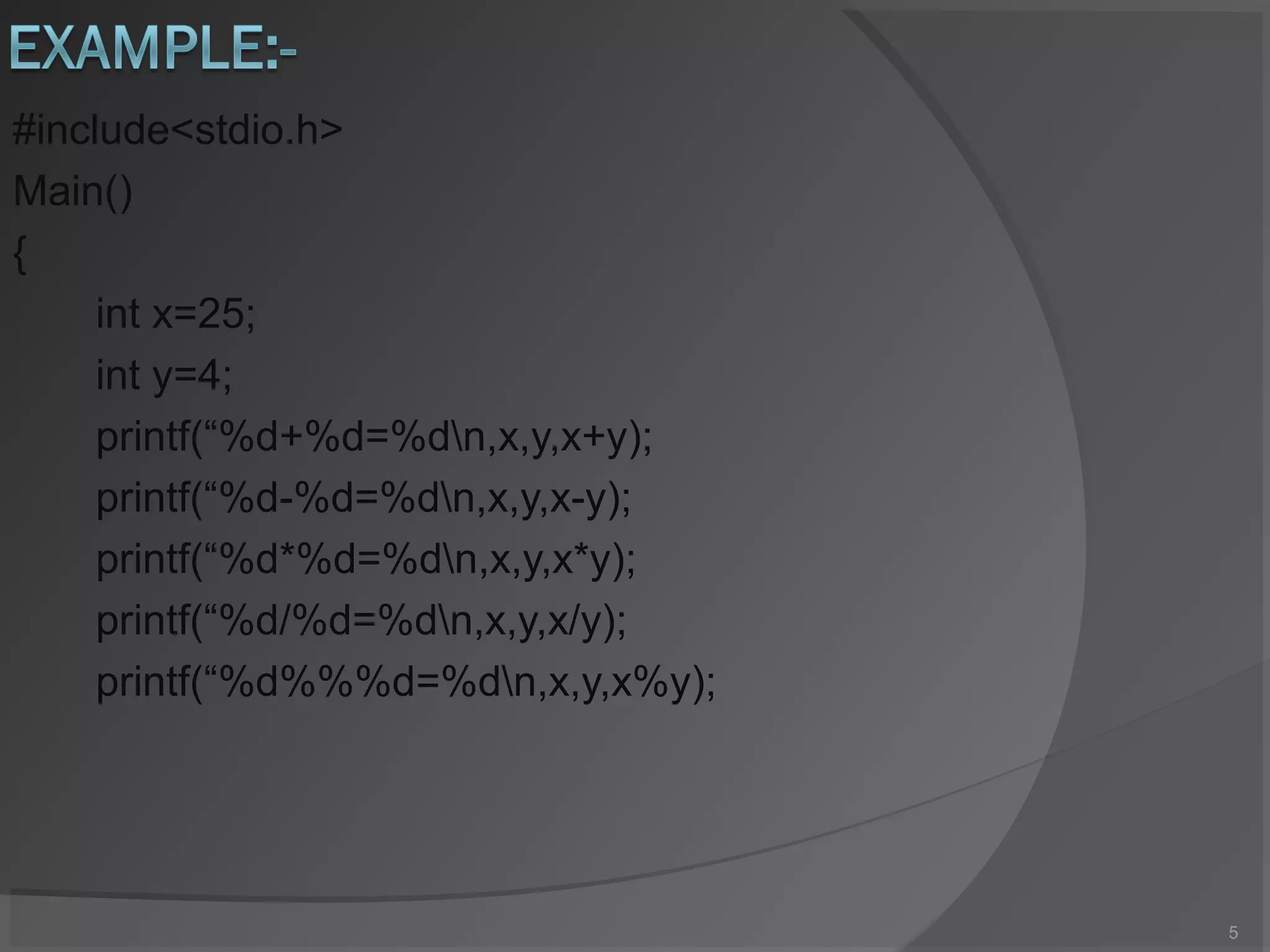
#include<stdio.h>
Main()
{
int x=25;
int y=4;
printf(“%d+%d=%dn,x,y,x+y);
printf(“%d-%d=%dn,x,y,x-y);
printf(“%d*%d=%dn,x,y,x*y);
printf(“%d/%d=%dn,x,y,x/y);
printf(“%d%%%d=%dn,x,y,x%y);
5
Relational operator are used to compare two operands.
Operands may be variable, constant or expression.
OperatorOperator MeaningMeaning
< Is less than
<= Is less than equal to
> Is greater than
>= Is greater than equal to
== Equal to
!= is not equal to
6
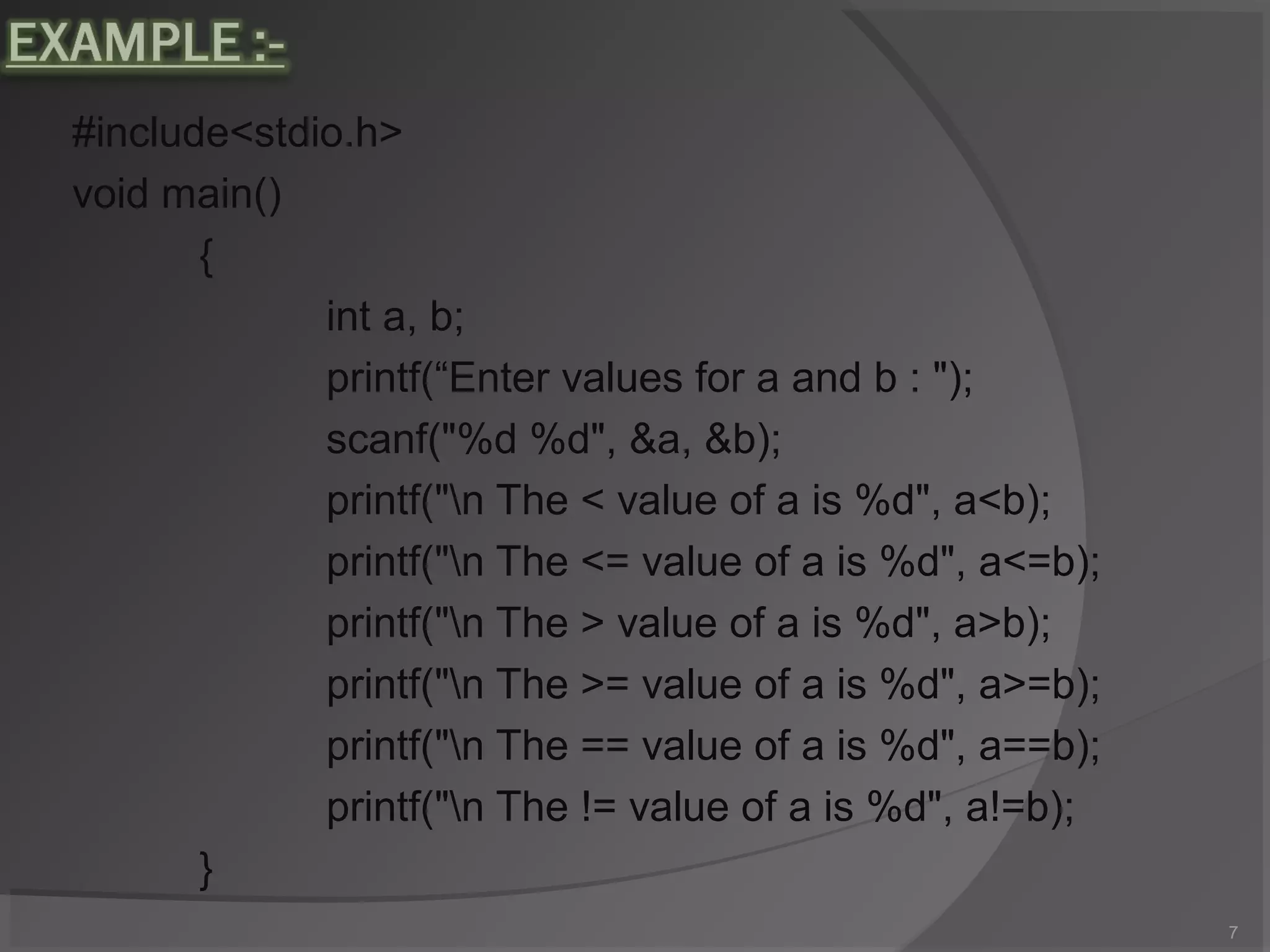
#include<stdio.h>
void main()
{
int a, b;
printf(“Enter values for a and b : ");
scanf("%d %d", &a, &b);
printf("n The < value of a is %d", a<b);
printf("n The <= value of a is %d", a<=b);
printf("n The > value of a is %d", a>b);
printf("n The >= value of a is %d", a>=b);
printf("n The == value of a is %d", a==b);
printf("n The != value of a is %d", a!=b);
}
7
LOGICAL OPERATORS:
OPERATOR MEANING
&& Logical AND
|| Logical OR
! Logical NOT
These operators are used for testing more than one condition and
making decisions.
'C' has three logical operators they are:
8
Example:-Example:-
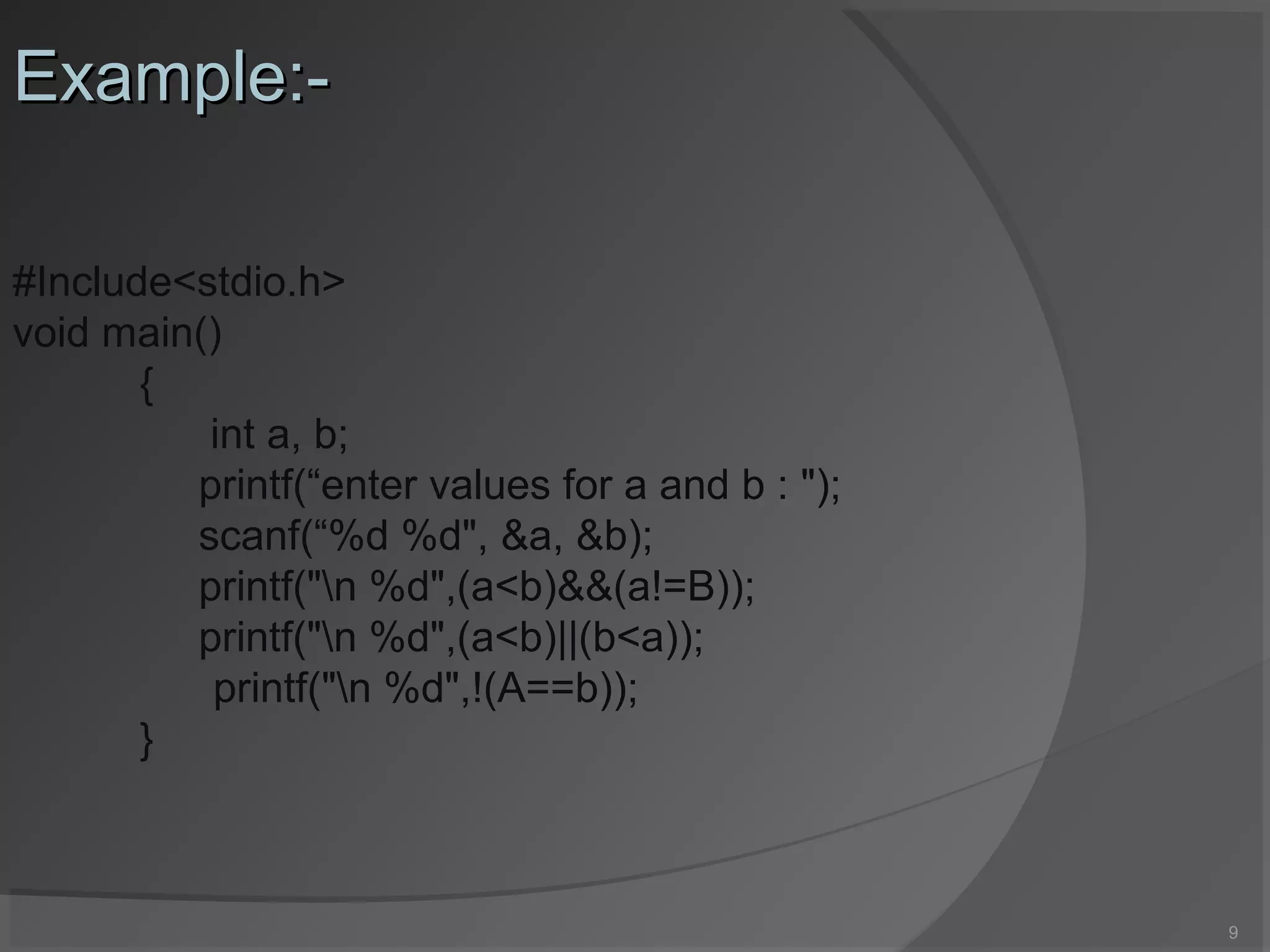
#Include<stdio.h>
void main()
{
int a, b;
printf(“enter values for a and b : ");
scanf(“%d %d", &a, &b);
printf("n %d",(a<b)&&(a!=B));
printf("n %d",(a<b)||(b<a));
printf("n %d",!(A==b));
}
9
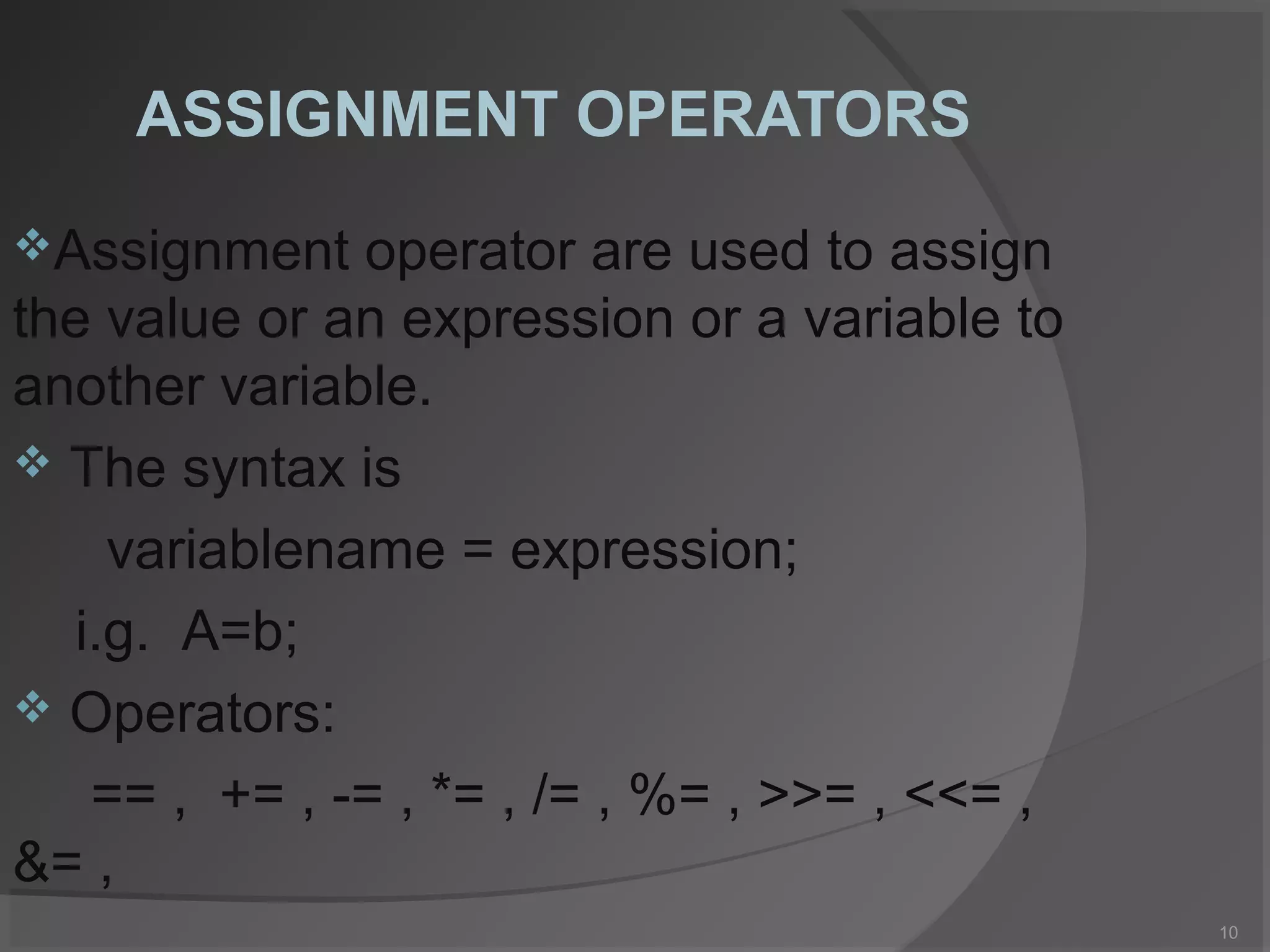
ASSIGNMENT OPERATORS
Assignment operator are used to assign
the value or an expression or a variable to
another variable.
 The syntax is
variablename = expression;
i.g. A=b;
 Operators:
== , += , -= , *= , /= , %= , >>= , <<= ,
&= ,
10
Increments & decrement operator is also called Unary .
The increment operator (++++) adder on to the variable and
decrement (- -- -) subtract one from the variable. There are
following unary operator
INCREMENT & DECREMENTINCREMENT & DECREMENT
OPERATORSOPERATORS
Operator Meaning
++x++x Pre increment
- -x- -x Pre decrement
x++x++ Post increment
X- -X- - Post decrement
11
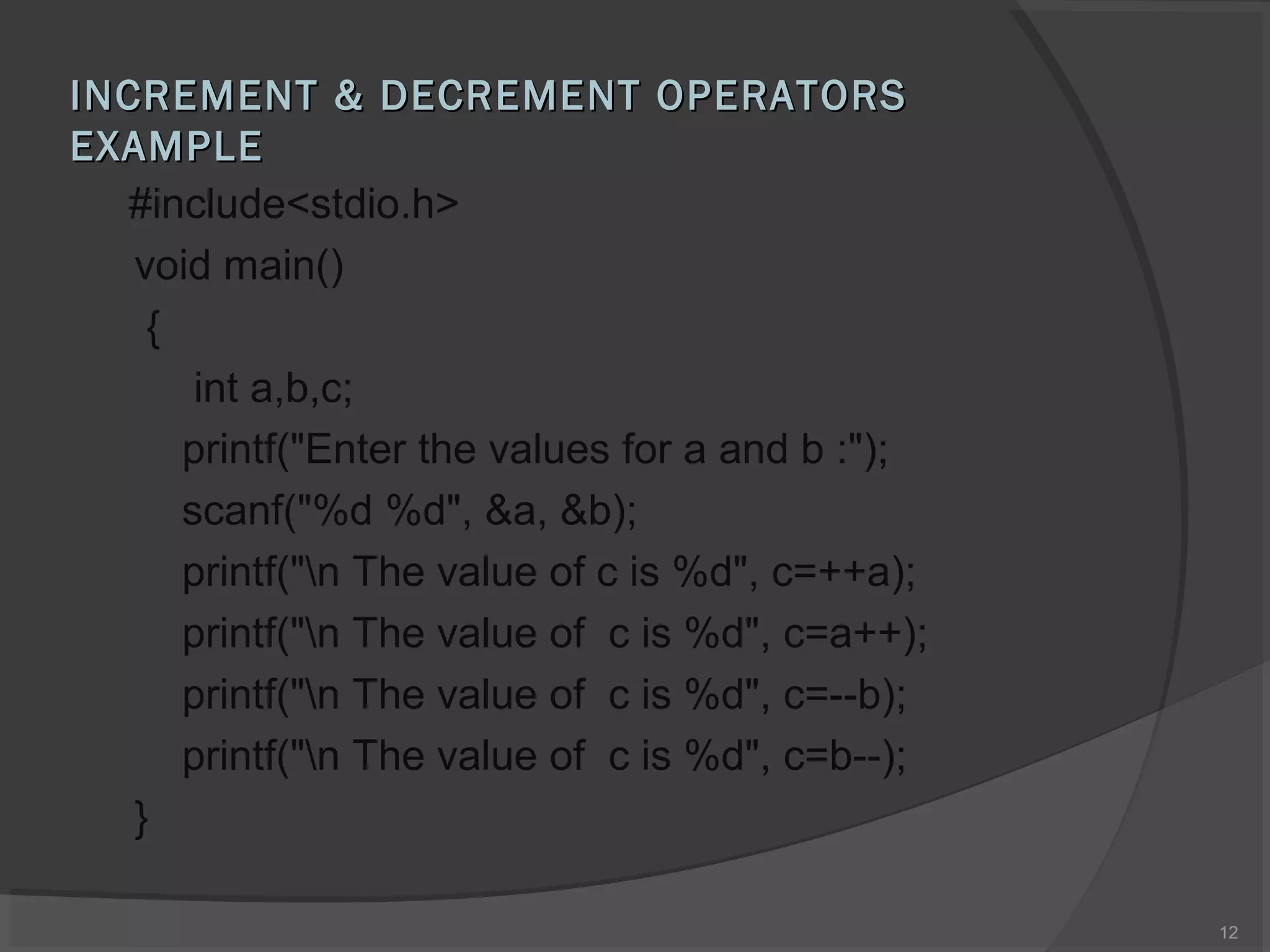
INCREMENT & DECREMENT OPERATORSINCREMENT & DECREMENT OPERATORS
EXAMPLEEXAMPLE
#include<stdio.h>
void main()
{
int a,b,c;
printf("Enter the values for a and b :");
scanf("%d %d", &a, &b);
printf("n The value of c is %d", c=++a);
printf("n The value of c is %d", c=a++);
printf("n The value of c is %d", c=--b);
printf("n The value of c is %d", c=b--);
}
12
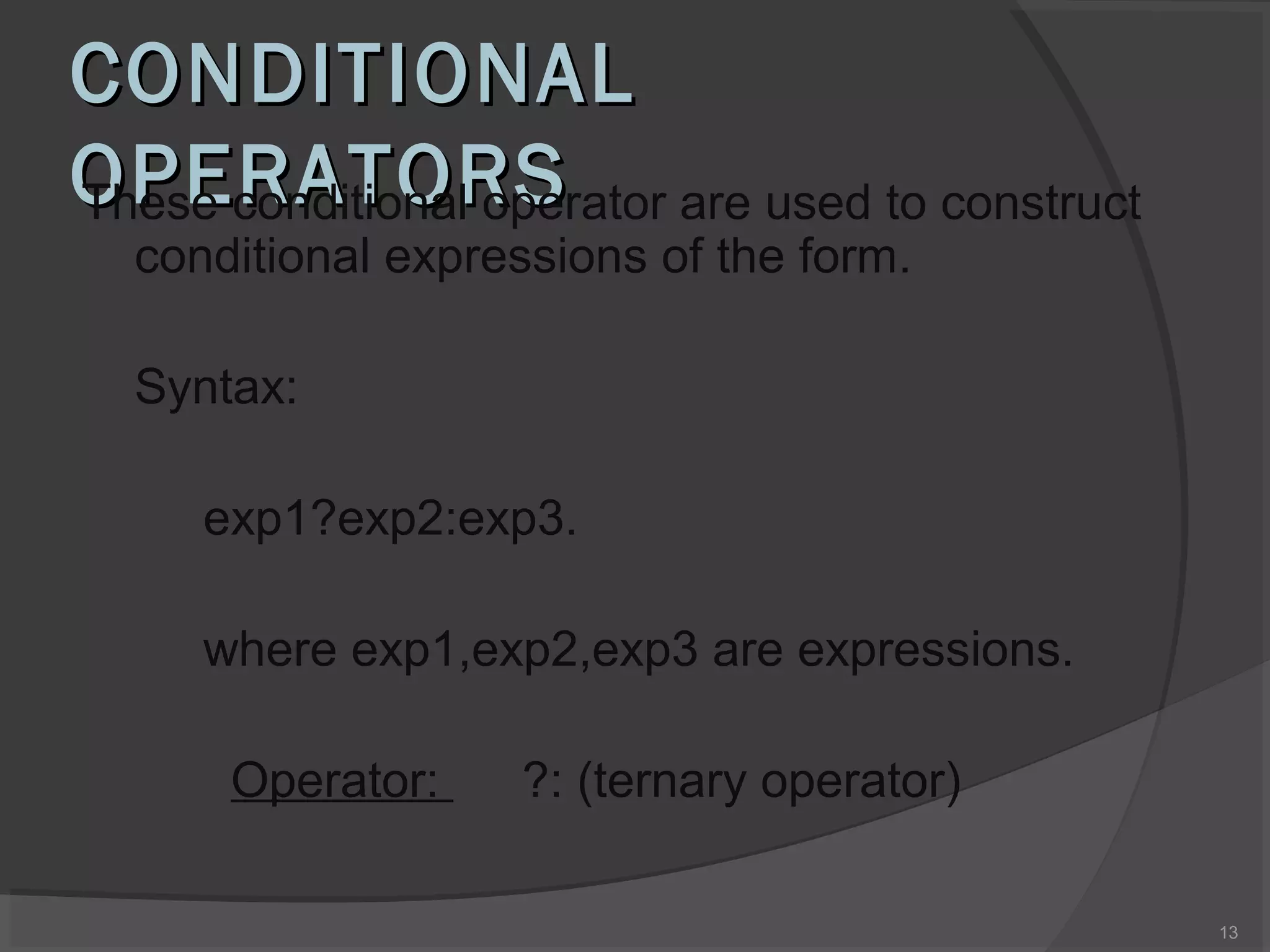
CONDITIONALCONDITIONAL
OPERATORSOPERATORSThese conditional operator are used to construct
conditional expressions of the form.
Syntax:
exp1?exp2:exp3.
where exp1,exp2,exp3 are expressions.
Operator: ?: (ternary operator)
13
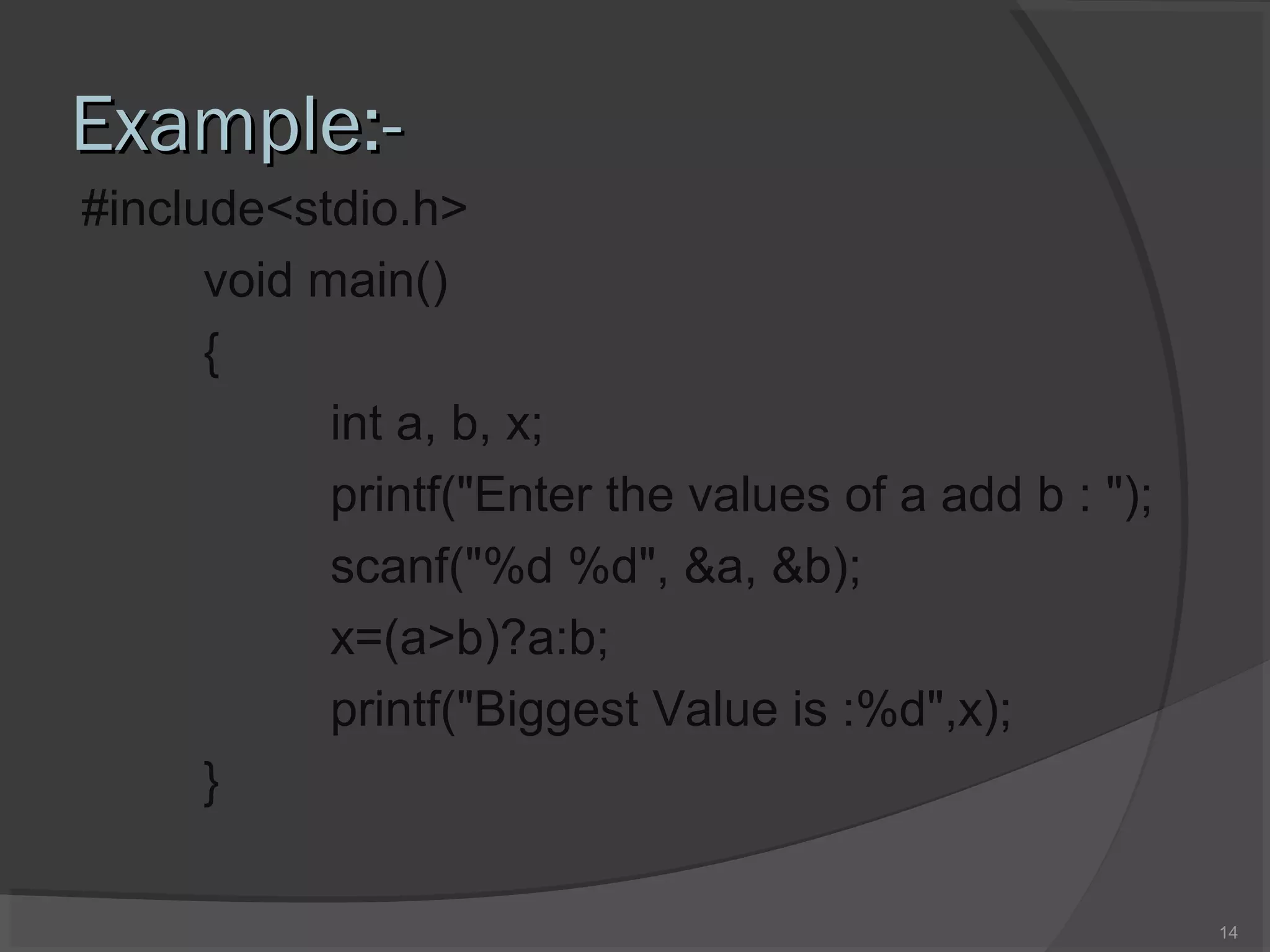
Example:-Example:-
#include<stdio.h>
void main()
{
int a, b, x;
printf("Enter the values of a add b : ");
scanf("%d %d", &a, &b);
x=(a>b)?a:b;
printf("Biggest Value is :%d",x);
}
14
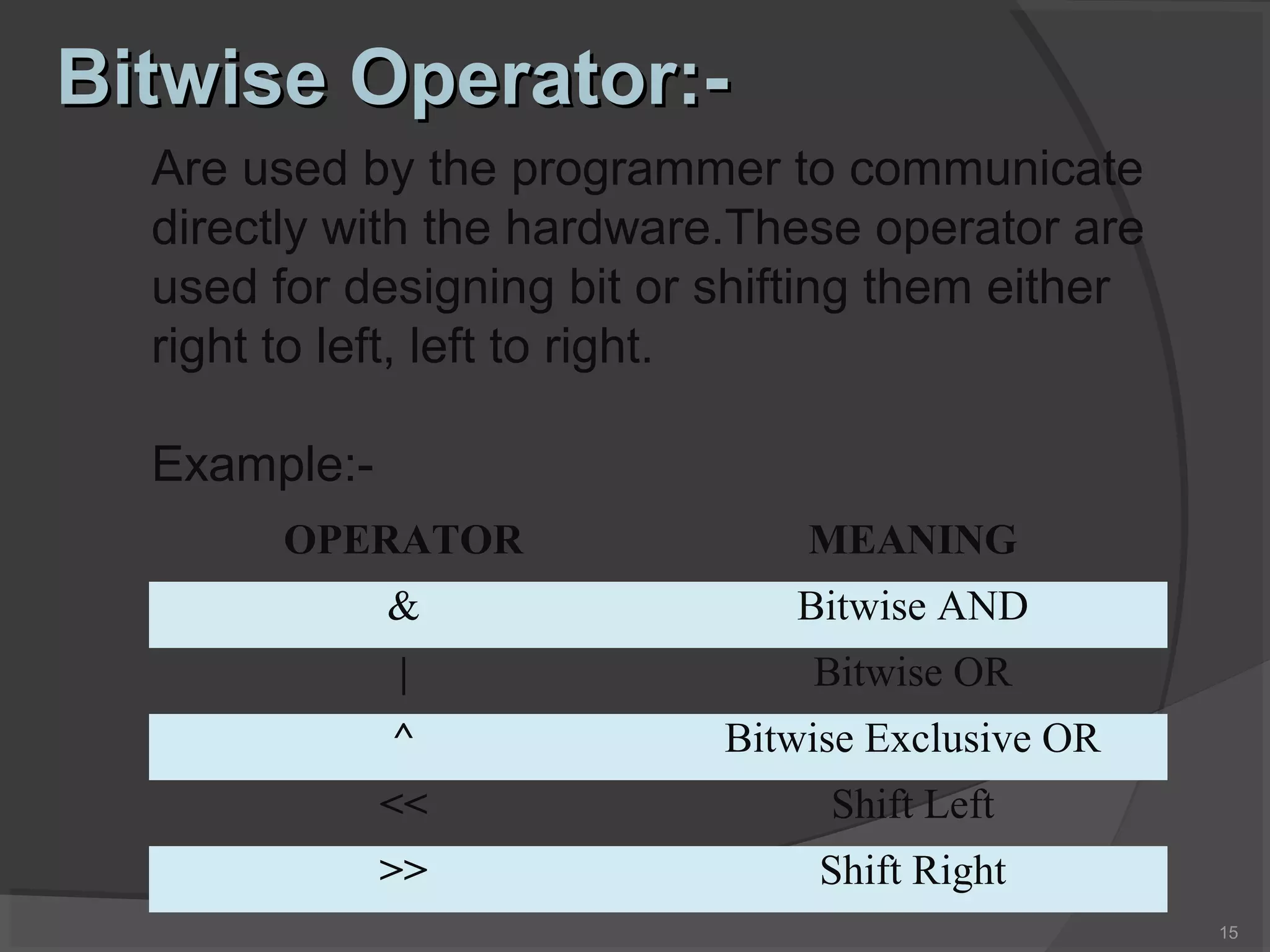
Bitwise Operator:-Bitwise Operator:-
Are used by the programmer to communicate
directly with the hardware.These operator are
used for designing bit or shifting them either
right to left, left to right.
Example:-
OPERATOR MEANING
& Bitwise AND
| Bitwise OR
^ Bitwise Exclusive OR
<< Shift Left
>> Shift Right
15
SPECIAL OPERATORSSPECIAL OPERATORS
'C' supports some special operators such as comma
operator, sizeof operator and pointerpointer operators.
Comma operator:Comma operator:
the comma operator is used to combine related
expressions.
A comma linked list of expressions are evaluated
left to right and the value of right most expression is
the value of combined expression..
Example: value=(x=10, y=5, x+y);
16
Special OperatorsSpecial Operators
Contd…Contd…
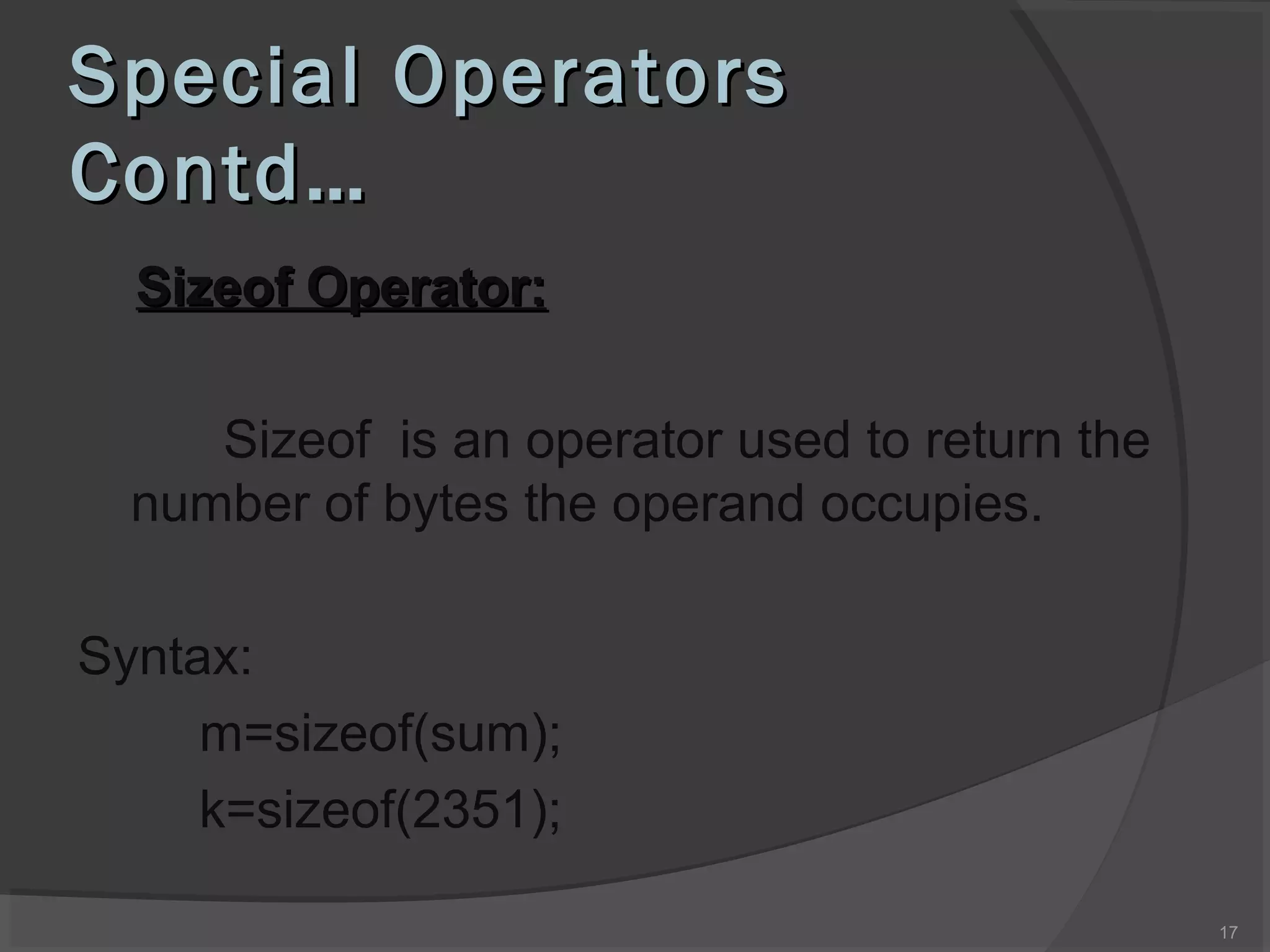
Sizeof Operator:Sizeof Operator:
Sizeof is an operator used to return the
number of bytes the operand occupies.
Syntax:
m=sizeof(sum);
k=sizeof(2351);
17
18

Operators in c language

  • 1.
  • 2.
    An operator isa symbol that tells the computer to perform certain mathematical or logical manipulations. These operators are used in programs to manipulate data and variables. 2
  • 3.
    1. Arithmetic operators 2.Relational operators 3. Logical operators 4. Assignment operators 5. Increment and decrement operators 6. Conditional operators (ternary operator) 7. Bitwise operators 8. Special operators 3
  • 4.
    Arithmetic operators areused to perform numerical calculations among the values. OPERATOR MEANING + Addition - Subtraction * Multiplication / Division % Modulo Division 4
  • 5.
  • 6.
    Relational operator areused to compare two operands. Operands may be variable, constant or expression. OperatorOperator MeaningMeaning < Is less than <= Is less than equal to > Is greater than >= Is greater than equal to == Equal to != is not equal to 6
  • 7.
    #include<stdio.h> void main() { int a,b; printf(“Enter values for a and b : "); scanf("%d %d", &a, &b); printf("n The < value of a is %d", a<b); printf("n The <= value of a is %d", a<=b); printf("n The > value of a is %d", a>b); printf("n The >= value of a is %d", a>=b); printf("n The == value of a is %d", a==b); printf("n The != value of a is %d", a!=b); } 7
  • 8.
    LOGICAL OPERATORS: OPERATOR MEANING &&Logical AND || Logical OR ! Logical NOT These operators are used for testing more than one condition and making decisions. 'C' has three logical operators they are: 8
  • 9.
    Example:-Example:- #Include<stdio.h> void main() { int a,b; printf(“enter values for a and b : "); scanf(“%d %d", &a, &b); printf("n %d",(a<b)&&(a!=B)); printf("n %d",(a<b)||(b<a)); printf("n %d",!(A==b)); } 9
  • 10.
    ASSIGNMENT OPERATORS Assignment operatorare used to assign the value or an expression or a variable to another variable.  The syntax is variablename = expression; i.g. A=b;  Operators: == , += , -= , *= , /= , %= , >>= , <<= , &= , 10
  • 11.
    Increments & decrementoperator is also called Unary . The increment operator (++++) adder on to the variable and decrement (- -- -) subtract one from the variable. There are following unary operator INCREMENT & DECREMENTINCREMENT & DECREMENT OPERATORSOPERATORS Operator Meaning ++x++x Pre increment - -x- -x Pre decrement x++x++ Post increment X- -X- - Post decrement 11
  • 12.
    INCREMENT & DECREMENTOPERATORSINCREMENT & DECREMENT OPERATORS EXAMPLEEXAMPLE #include<stdio.h> void main() { int a,b,c; printf("Enter the values for a and b :"); scanf("%d %d", &a, &b); printf("n The value of c is %d", c=++a); printf("n The value of c is %d", c=a++); printf("n The value of c is %d", c=--b); printf("n The value of c is %d", c=b--); } 12
  • 13.
    CONDITIONALCONDITIONAL OPERATORSOPERATORSThese conditional operatorare used to construct conditional expressions of the form. Syntax: exp1?exp2:exp3. where exp1,exp2,exp3 are expressions. Operator: ?: (ternary operator) 13
  • 14.
    Example:-Example:- #include<stdio.h> void main() { int a,b, x; printf("Enter the values of a add b : "); scanf("%d %d", &a, &b); x=(a>b)?a:b; printf("Biggest Value is :%d",x); } 14
  • 15.
    Bitwise Operator:-Bitwise Operator:- Areused by the programmer to communicate directly with the hardware.These operator are used for designing bit or shifting them either right to left, left to right. Example:- OPERATOR MEANING & Bitwise AND | Bitwise OR ^ Bitwise Exclusive OR << Shift Left >> Shift Right 15
  • 16.
    SPECIAL OPERATORSSPECIAL OPERATORS 'C'supports some special operators such as comma operator, sizeof operator and pointerpointer operators. Comma operator:Comma operator: the comma operator is used to combine related expressions. A comma linked list of expressions are evaluated left to right and the value of right most expression is the value of combined expression.. Example: value=(x=10, y=5, x+y); 16
  • 17.
    Special OperatorsSpecial Operators Contd…Contd… SizeofOperator:Sizeof Operator: Sizeof is an operator used to return the number of bytes the operand occupies. Syntax: m=sizeof(sum); k=sizeof(2351); 17
  • 18.