Facilitator:
Gregory Samuels
Balance Sheet
At the end of the lesson students should be able to:
Explain the concept of a Balance Sheet
Identify the components of a Balance Sheet
Classify items under the correct categories of a classified
balance sheet
Construct a classified Balance Sheet
Balance Sheet
DEFINITION:
A financial statement that summarizes a company's
assets, liabilities and shareholders' equity at a specific
point in time. These three balance sheet segments
give investors an idea as to what the company owns
and owes, as well as the amount invested by the
shareholders.
The balance sheet must follow the following formula:
Assets = Liabilities + Shareholders' Equity
The Balance Sheet
Assets
Anything the Business Owns
Order of Liquidity
Liabilities
Anything the Business Owes
Promise of Money
Maturity Date
Owner’s Equity
Beginning Capital – Add: Net Income – Less: Drawings
and/or Net Loss – Ending Capital
The Account Form Balance Sheet
The Classified Balance Sheet
Now that you are used to it...
LET’S CHANGE IT!!
The Classified Balance Sheet
Is a lot more specific than the balance sheet you are
used to
We are now grouping accounts within our main
categories
Assets & Liabilities more specifically
Different categories allow us to dive into the numbers
and compare similar items
ASSETS
Assets are broken down into two categories
1. Current Assets
 Assets that are smaller and easy to turn into cash
within the year
 Cash, Accounts Receivable, Supplies, Inventory
1. Fixed Assets
 Sometimes called Plant & Equipment
 Long term assets used in making goods or providing
services
 Large items: Equipment, Car, Building, Land
LIABILITIES
Very similar to assets
Broken into two groups
1. Current Liabilities
 Debts to be paid off within the year
 Accounts Payable, Bank Loan, HST
Payable/Recoverable
1. Long-Term Liabilities
 Debts to be paid off in over a year
 Mortgage, Long-Term Bank Loan
Owner’s Equity
What we have already learned
Beginning Balance
Net Income/Loss
Drawings
New Balance
Analyzing Numbers
A number that stakeholders like to know is called
working capital
The amount of money that the company should have to
work with on a short term basis
The higher the better
Indicates how easily the business can pay off its debts
Current Assets – Current Liabilities
The Classified Balance Sheet
We are no longer going to put our balance sheet into
Left Side and Right Side
This was to teach you the difference between Debit
Accounts and Credit Accounts
We will be listing ours from top to bottom
Kind of like the income statement
There will be one column for the accounts
There will be two columns for the numbers
PT’s PIZZA
Balance Sheet
October 31, 2013
The Asset Section
Assets
Current Assets
Cash xx
Accounts Receivable xx
Total Current Assets xx
Fixed Assets
Equipment xx
Automobile xx
Building xx
Land xx
Total Fixed Assets xx
Total Assets xx
The Liabilities Section
Liabilities
Current Liabilities
Accounts Payable xx
HST Payable xx
HST Recoverable (xx)
Total Current Liabilities xx
Long-Term Liabilities
Bank Loan xx
Mortgage Payable xx
Total Long-Term Liabilities xx
Total Liabilities xx
The Owner’s Equity Section
Owner’s Equity
D. Fense, Capital Oct. 31 $45000
Add: Net Income $1400
Less: D. Fense, Drawings ($950) $450
D. Fense, Capital Nov. 30 $45450
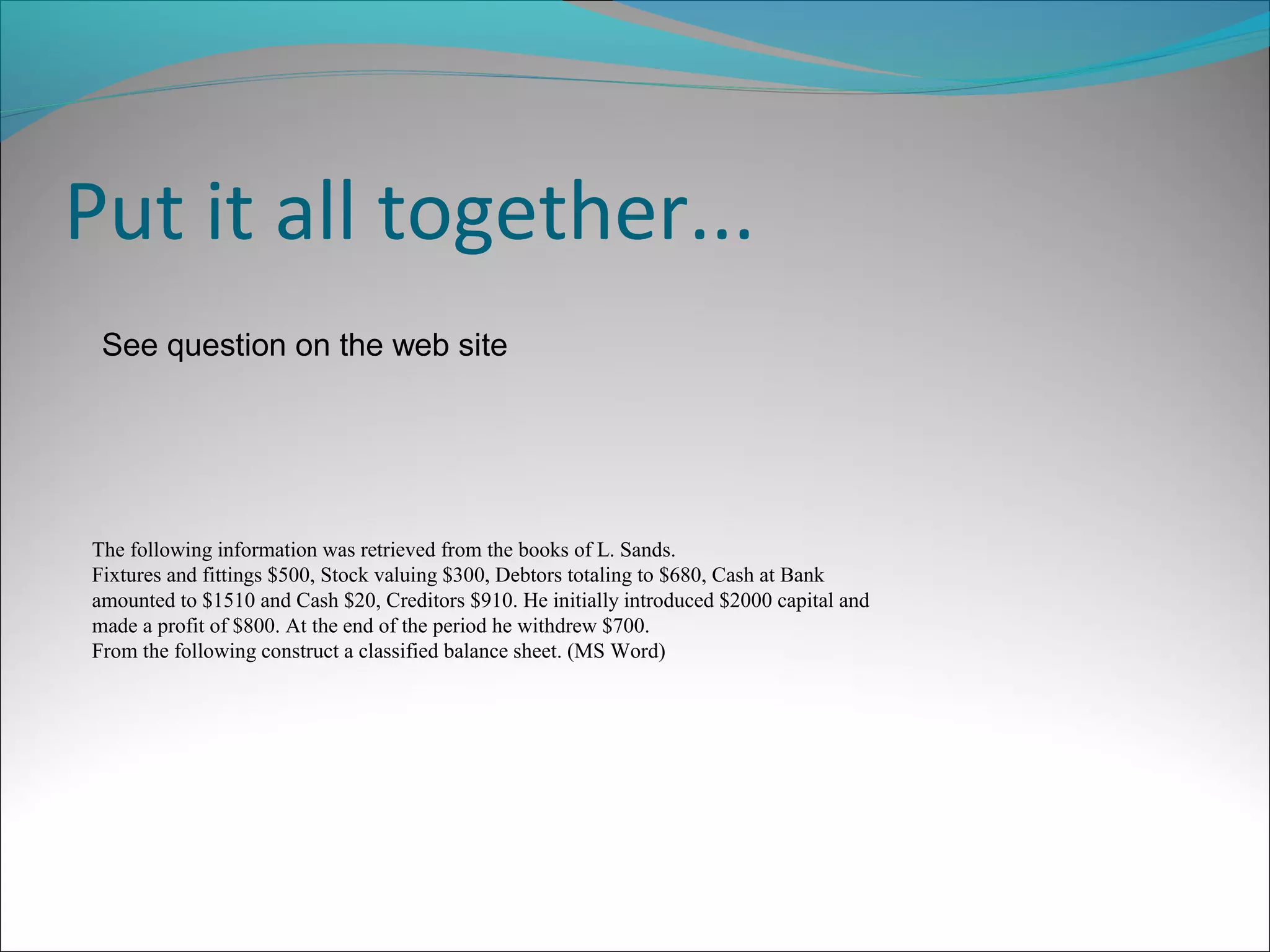
Put it all together...
See question on the web site
The following information was retrieved from the books of L. Sands.
Fixtures and fittings $500, Stock valuing $300, Debtors totaling to $680, Cash at Bank
amounted to $1510 and Cash $20, Creditors $910. He initially introduced $2000 capital and
made a profit of $800. At the end of the period he withdrew $700.
From the following construct a classified balance sheet. (MS Word)
Homework
See assignment in Google docs
Reference
Robinson S. & Wood F. (2004). Principles of Accounts
for the Caribbean. Essex: Pearson Education Limited.

The classified balance sheet

  • 1.
  • 2.
    Balance Sheet At theend of the lesson students should be able to: Explain the concept of a Balance Sheet Identify the components of a Balance Sheet Classify items under the correct categories of a classified balance sheet Construct a classified Balance Sheet
  • 3.
    Balance Sheet DEFINITION: A financialstatement that summarizes a company's assets, liabilities and shareholders' equity at a specific point in time. These three balance sheet segments give investors an idea as to what the company owns and owes, as well as the amount invested by the shareholders. The balance sheet must follow the following formula: Assets = Liabilities + Shareholders' Equity
  • 4.
    The Balance Sheet Assets Anythingthe Business Owns Order of Liquidity Liabilities Anything the Business Owes Promise of Money Maturity Date Owner’s Equity Beginning Capital – Add: Net Income – Less: Drawings and/or Net Loss – Ending Capital
  • 5.
    The Account FormBalance Sheet
  • 6.
    The Classified BalanceSheet Now that you are used to it... LET’S CHANGE IT!!
  • 7.
    The Classified BalanceSheet Is a lot more specific than the balance sheet you are used to We are now grouping accounts within our main categories Assets & Liabilities more specifically Different categories allow us to dive into the numbers and compare similar items
  • 8.
    ASSETS Assets are brokendown into two categories 1. Current Assets  Assets that are smaller and easy to turn into cash within the year  Cash, Accounts Receivable, Supplies, Inventory 1. Fixed Assets  Sometimes called Plant & Equipment  Long term assets used in making goods or providing services  Large items: Equipment, Car, Building, Land
  • 9.
    LIABILITIES Very similar toassets Broken into two groups 1. Current Liabilities  Debts to be paid off within the year  Accounts Payable, Bank Loan, HST Payable/Recoverable 1. Long-Term Liabilities  Debts to be paid off in over a year  Mortgage, Long-Term Bank Loan
  • 10.
    Owner’s Equity What wehave already learned Beginning Balance Net Income/Loss Drawings New Balance
  • 11.
    Analyzing Numbers A numberthat stakeholders like to know is called working capital The amount of money that the company should have to work with on a short term basis The higher the better Indicates how easily the business can pay off its debts Current Assets – Current Liabilities
  • 12.
    The Classified BalanceSheet We are no longer going to put our balance sheet into Left Side and Right Side This was to teach you the difference between Debit Accounts and Credit Accounts We will be listing ours from top to bottom Kind of like the income statement There will be one column for the accounts There will be two columns for the numbers
  • 13.
  • 14.
    The Asset Section Assets CurrentAssets Cash xx Accounts Receivable xx Total Current Assets xx Fixed Assets Equipment xx Automobile xx Building xx Land xx Total Fixed Assets xx Total Assets xx
  • 15.
    The Liabilities Section Liabilities CurrentLiabilities Accounts Payable xx HST Payable xx HST Recoverable (xx) Total Current Liabilities xx Long-Term Liabilities Bank Loan xx Mortgage Payable xx Total Long-Term Liabilities xx Total Liabilities xx
  • 16.
    The Owner’s EquitySection Owner’s Equity D. Fense, Capital Oct. 31 $45000 Add: Net Income $1400 Less: D. Fense, Drawings ($950) $450 D. Fense, Capital Nov. 30 $45450
  • 17.
    Put it alltogether... See question on the web site The following information was retrieved from the books of L. Sands. Fixtures and fittings $500, Stock valuing $300, Debtors totaling to $680, Cash at Bank amounted to $1510 and Cash $20, Creditors $910. He initially introduced $2000 capital and made a profit of $800. At the end of the period he withdrew $700. From the following construct a classified balance sheet. (MS Word)
  • 18.
  • 19.
    Reference Robinson S. &Wood F. (2004). Principles of Accounts for the Caribbean. Essex: Pearson Education Limited.