1
Executive Summery
Rajnigandha Melamine Ltd produces melamine tableware as make-to-stock philosophy. It
stocks its finished goods inventory in own warehouse sells the products from an outlet.
Customers are the end consumers and independent retailers. This distribution network we call
‘manufacturer and retail storage with customer pickup’. Rajnigandha sources its raw materials
from China and Taiwan uses independent transport agency for inbound transportation. Raw
materials are stored in the factory which minimizes inventory cost. The company focuses on
efficiency not on responsiveness. Customers get the facility of same day pickup but not much
differentiation. This company’s success depends on how they collaborate with its suppliers and
customers.
What Kind of Products is Melamine?
 Functional kind of product.
 Demand is uncertain. Main rivalry is the ceramic products.
 Volume of SKUs is high.
 Demand is same throughout the year except for the Eid-season.
2
Chapter 1
1.1 Introduction
Rajnigandha Melamine Ltd was established in 1991 in Chawkbazar, Dhaka. It was first
established with a view to produce plastic products. From 2001 they started to produce
melamine tableware’s. They produce more than 130 items and more than 1000 models
including melamine bowl, plate, condiment dish, serving tray, stewing pot, lunch box and
teacup.
Company Profile
 Business Name : Rajnigandha Melamine Ltd.
 Business type : Manufacturer, Distributor & Retailer
 Year of Established : 1991
 Total Employee Number : 65
 Business Address : 123 Becharam Deori, Chawkbazar, Dhaka
1.2 Company Overview:
Rajnigandha Melamine strongly believes that beautiful living starts at dining table and a
leading tableware manufacture, we are well conscious that everything on the table is equally
important, not only the food but also the art of table setting and of course the tableware.
Rajnigandha Melamine being one of the manufacturers of melamine tableware in Bangladesh
has always been utilizing the latest manufacturing technique and knowledge for innovative
designs of the highest quality. They have been unveiling beautiful melamine tableware since
2001, which is an extensive line of high quality tableware.
Beautiful colors, remarkable durability and shiny smooth glaze surface are spectacularly
integrated in the quality control system of Rajnigandha Melamine. They assure that their wide
range of products and styles that are not only durable and safe, functional and beautiful for
customers home and business as well. Their goal is to generate excitement among their
customers by delivering superior quality and innovative design products at cheapest prices.
3
1.3 Vision:
Their vision is to crop the major customer in the local market. They will be the most reliable
company in the market by cost. In the high competitive market they offer in lower cost and high
inventory.
1.4 Mission:
 Conducting their business in a safe, environmentally sustainable and economically
optimum manner
 Manufacturing and supplying their products that satisfy the needs of their customers
 Employing a diverse, innovative and results-oriented team motivated to deliver
excellence.
1.5 Objectives:
 Maximum output without producing faulty products.
 Generating more revenue by satisfying customer needs.
1.6 Strategy:
The company follows the cost leadership strategy as well as be responsive to the customer
orders by giving many varieties and availability. They follow the FIFO (first in first out) strategy.
They sell their ending inventory on account or in discount rate.
1.7 Basic Operation:
 Import raw materials directly from China or Taiwan. They order more or less 6 times in a
year having a replenishment cycle of 2 months.
 They operate three machines at the same time.
 They produce around 50,56,000 pieces product in a year. From this product in every
year there are 200,000 products are found to be as remaining inventory.
 They bear the resident and food cost of the labor.
 Take order and send product to the customer. They provide the labor cost but
transportation cost is bearded by the customers. Sometime customers come in their
retail house.
4
Chapter 2
2.1 Supply Chain Drivers
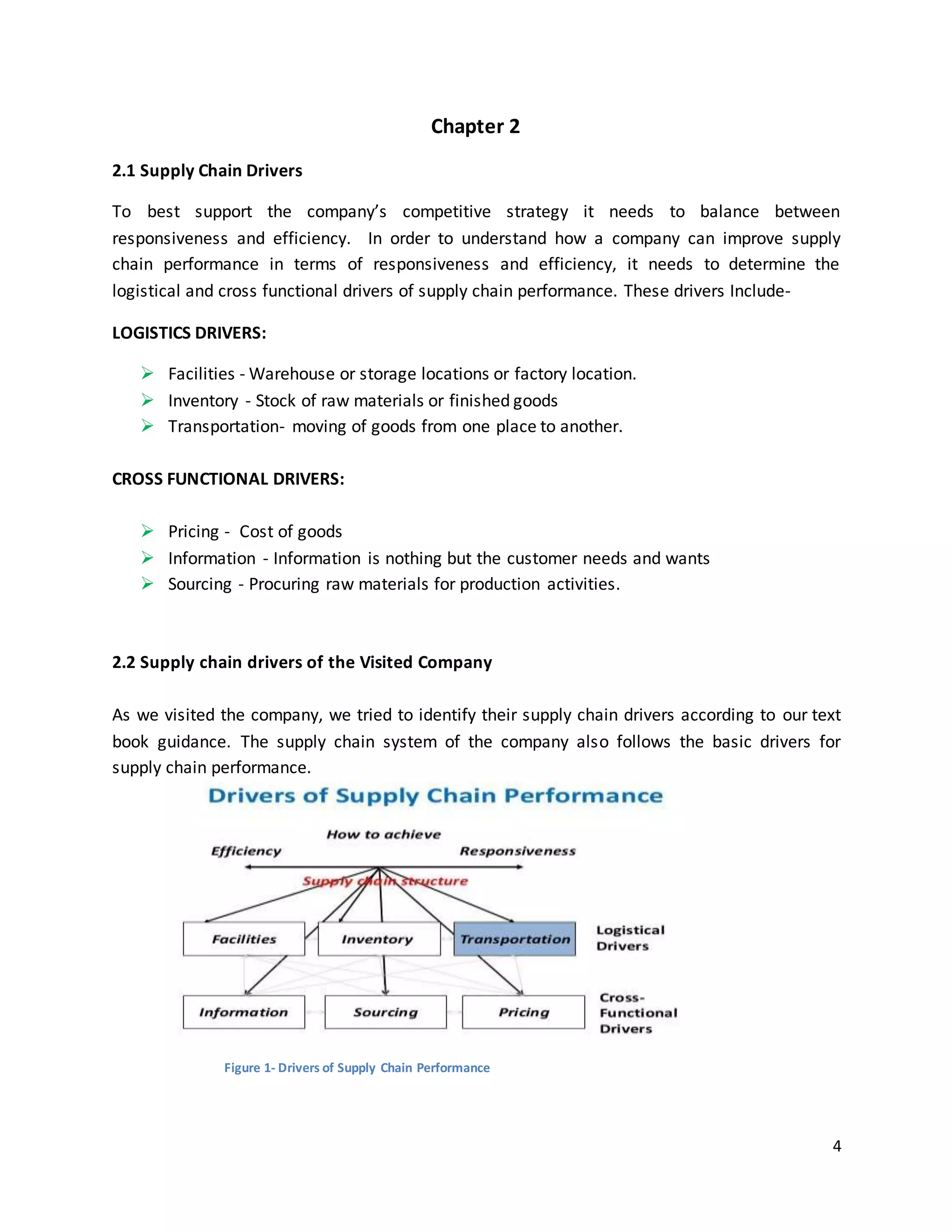
To best support the company’s competitive strategy it needs to balance between
responsiveness and efficiency. In order to understand how a company can improve supply
chain performance in terms of responsiveness and efficiency, it needs to determine the
logistical and cross functional drivers of supply chain performance. These drivers Include-
LOGISTICS DRIVERS:
 Facilities - Warehouse or storage locations or factory location.
 Inventory - Stock of raw materials or finished goods
 Transportation- moving of goods from one place to another.
CROSS FUNCTIONAL DRIVERS:
 Pricing - Cost of goods
 Information - Information is nothing but the customer needs and wants
 Sourcing - Procuring raw materials for production activities.
2.2 Supply chain drivers of the Visited Company
As we visited the company, we tried to identify their supply chain drivers according to our text
book guidance. The supply chain system of the company also follows the basic drivers for
supply chain performance.
Figure 1- Drivers of Supply Chain Performance
5
How the company uses these drivers to achieve cost efficiency and responsive are stated
bellow-
 Facilities: Rajnigandha Melamine has its production site and storage sites in Becharam
Deori, Chawkbazar. It has three storage sites in adjacent areas. All these sites are near from
the production site. Due to only one production facility and closer storage sites in one area
the company can gain economies of scale by centralization. As the demand for melamine
products somewhat predictable and it moves in a mid-pace so the company prefers to be
more cost efficient rather than be responsive.
Some facility related attributes of the company are –
 Flexibility in production capacity focusing on products.
 Positive externalities due to same kind firms doing business in the same area.
 Inventory: Inventory includes all the raw material, work in process and finished goods
within a supply chain. Inventory is the mismatch between the supply and demand but this
mismatch is intentional for the Rajnigandha Melamine ltd. It is more economical for the
company to produce in larger quantities to store more inventories in anticipation of future
demand.
A short list of the company’s inventory list are given bellow
Raw Materials
Molding Powder 5500 Sacks
Shining Powder 500 sacks
Work in process
Producing units 600 unit per hour
Monthly produced
units
18000 units
Ending inventory
Yearly ending
inventory
2,00,000 units
Table 1- Inventory List of Rajnigandha Ltd.
Rajnigandha Melamine Company uses molding power and shining power for producing
melamine products. These powders are used as raw materials. They produce 600 units of
6
pcs in every hour. They run 24 hour production process. The annual production is around
50,56,000 pieces. The companies ending inventory remains as 2,00,000 pcs.
Inventory related aspects of the company are –
 Achieving customer satisfaction by ensuring the availability of the products whenever
customer orders.
 The storage of the inventories adjacent area gives the chance for cost efficiency.
 They replenish their raw material inventories when the stock comes down to 500 sacks of
molding powder.
 Transportation: Transportation system moves the products between the different stages
of the supply chain.
In the case of our company transportation plays a big role. As the raw materials for the
melamine production are imported from China or Taiwan the company has to use sea carriage
shipments. Sea carriage is the most cost efficient transportation medium.
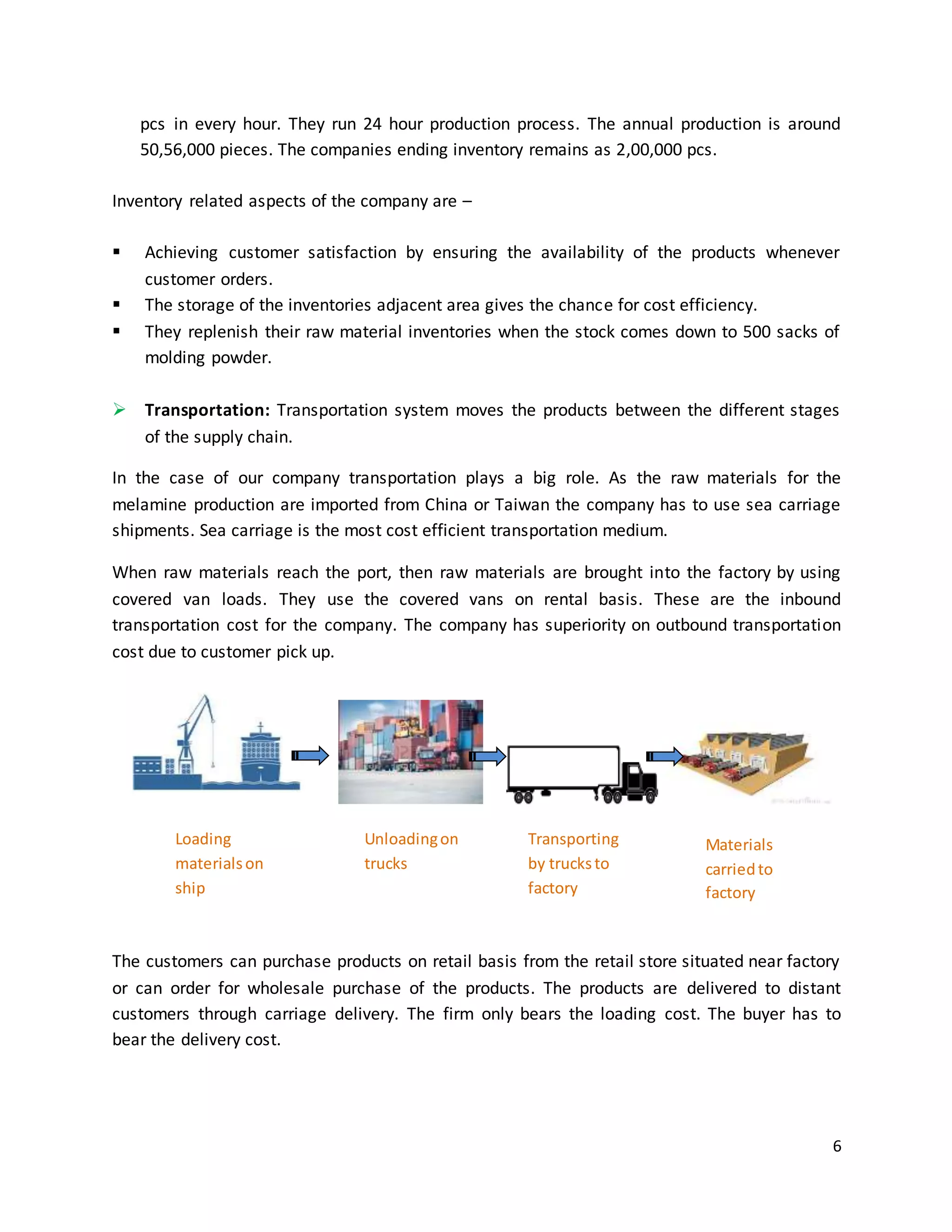
When raw materials reach the port, then raw materials are brought into the factory by using
covered van loads. They use the covered vans on rental basis. These are the inbound
transportation cost for the company. The company has superiority on outbound transportation
cost due to customer pick up.
The customers can purchase products on retail basis from the retail store situated near factory
or can order for wholesale purchase of the products. The products are delivered to distant
customers through carriage delivery. The firm only bears the loading cost. The buyer has to
bear the delivery cost.
Loading
materialson
ship
Unloadingon
trucks
Transporting
by trucksto
factory
Materials
carriedto
factory
7
 Information:
Information consists of data and analysis concerning facilities, inventory, transportation, costs,
prices and customers throughout the supply chain. Good information system can help to utilize
the supply chain assets and coordination of supply chain flows to increase responsiveness and
reduce costs.
The information system of this company seems less strong that it should be. The company uses
the marketing manager’s advice and information to anticipate the demand for the products.
Information related aspects of the company are –
 The company uses the marketing manager’s advice and information to anticipate the
demand for the products.
 The company uses the push process for the procurement and production and pull for
customer order.
 Sourcing:
Sourcing is the choice of who will perform a particular supply chain activity such as production,
storage, transportation or the management. These decisions determine what functions
Rajnigandha performs and what functions the firm outsources. Managers decide whether each
task will be performed by a responsive or efficient source and whether the source will be
internal or outsourced.
Rajnigandha imports the raw materials from abroad rather than buying from home country due
to cost efficiency.
Some attributes of sourcing of the company are –
 The company has decided to import raw materials from low cost countries.
 The production will be done in house.
 The supplier will be evaluated on their cost efficiency and quality.
 Pricing:
Price determines how much firm will charge for the goods and services that it makes available
in the supply chain. Pricing affects the behavior of the buyer of the goods or service.
8
Rajnigandha focuses on cost leadership. They compare the price of other competing company
products and settles a price from their products. Setting the low price products create a
demand sensitivity for the product. Pricing plays a significant role in the company’s competitive
strategies.
Pricing aspects of the company are —
 Rajnigandha melamine tries to provide products at the cheapest rate.
 Some times to get customers the company make sales on credit.
 Some the company uses tricks to increase the sale.
Chapter 3
Supply Chain Process Cycle
Rajnigandha Melamine ltd follows make-to-stock theory in the production line. So it has less
opportunity for customization and its products can be called ‘functional product’ which do not
change much over time, have low profit margins, stable predictable demand and long life
cycles. If we assume the supply chain of Rajnigandha in cycles as shown in figure below, we can
divide the process into 3 parts: customer order cycle, replenishment and manufacturing cycle
and procurement cycle. The processes in the supply chain can break up into pull processes and
push processes.
Figure 2: Cycle View and Push-Pull Processes of Rajnigandha's Supply
Chain
Pull
Processes
Push
Processes
Customer Order Cycle
Replenishmentand
ManufacturingCycle
ProcurementCycle
Customer
Order
Arrives
9
Rajnigandha ltd executes all the processes in customer order cycle after the customer order
arrives. All processes in the customer order cycle are thus pull processes. The order is fulfilled
from the finished goods inventories that are produced in anticipation of customer orders. This
phase is reactive process because this company reacts to customer demand. The purpose of
replenishment and manufacturing cycle is to make sure product availability when a customer
order arrives. This cycle is push processes because replenishment and production are
performed in anticipation of customer demand. In reality, raw material such as moulding
compound is often purchased months before customer demand is expected. Manufacturing of
tableware begins 1 to 2 months before the point of sale. Procurement is thus push processes.
The push-pull view of supply chain helps the company to take strategic decision such as
purchase of raw materials and manufacturing decision.
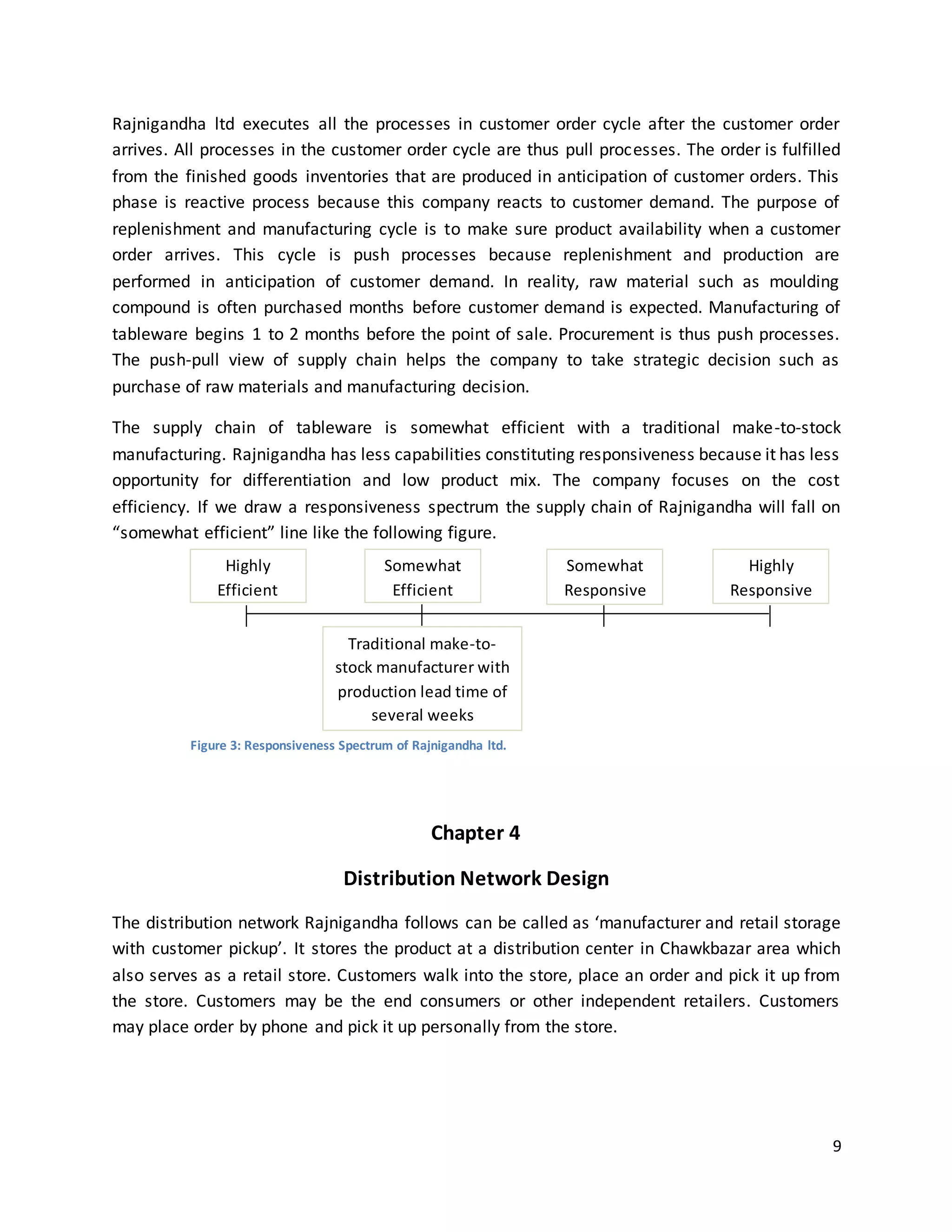
The supply chain of tableware is somewhat efficient with a traditional make-to-stock
manufacturing. Rajnigandha has less capabilities constituting responsiveness because it has less
opportunity for differentiation and low product mix. The company focuses on the cost
efficiency. If we draw a responsiveness spectrum the supply chain of Rajnigandha will fall on
“somewhat efficient” line like the following figure.
Chapter 4
Distribution Network Design
The distribution network Rajnigandha follows can be called as ‘manufacturer and retail storage
with customer pickup’. It stores the product at a distribution center in Chawkbazar area which
also serves as a retail store. Customers walk into the store, place an order and pick it up from
the store. Customers may be the end consumers or other independent retailers. Customers
may place order by phone and pick it up personally from the store.
Highly
Efficient
Somewhat
Efficient
Somewhat
Responsive
Highly
Responsive
Traditional make-to-
stock manufacturer with
production lead time of
several weeks
Figure 3: Responsiveness Spectrum of Rajnigandha ltd.
10
Performance characteristics of Rajnigandha’s distribution network are as follows next.
Table 2- Performance Characteristics of Rajnigandha melamine Ltd.
Cost Factors Performance
Inventory Inventory cost is very high for Rajnigandha Ltd. It has a 3 story
warehouse which costs 240,000 per year.
Transportation Transportation cost is very low. Customers pick up products from
store. In case of high volume sale Rajnigandha only gives cost of
loading on vehicle. On small volume sale customers carry the cost.
Facilities and
handling
Facility costs are:-
o Factory: 450,000 tk per year. It includes factory site and
storage site for raw materials.
o Distribution Center: 120,000 tk per year plus tk 6,000 tax.
o Warehouse: 240,000 per year.
Information As customers walk into the store and place order no information
structure is required. In case of phone order, salespeople answer the
phone and receive the order. Information also flows from
independent retailer to the manufacturer.
Service Factors Performance
Response time Same-day pickup
Product variety Product variety is low.
Product availability Product is available every time.
Returnability Returnability easy. Customers just bring the product in the store.
Consumers
Independent
Retailers
Distribution
Center
Factory
Figure 4- Distribution Network Design
11
Chapter 5
Selective Control of Inventory
Rajnigandha always keeps 500 sacks of moulding compound as safety stock. It does not keep
high safety stock for all raw materials. To avoid stockout cost it keeps safety stock but not very
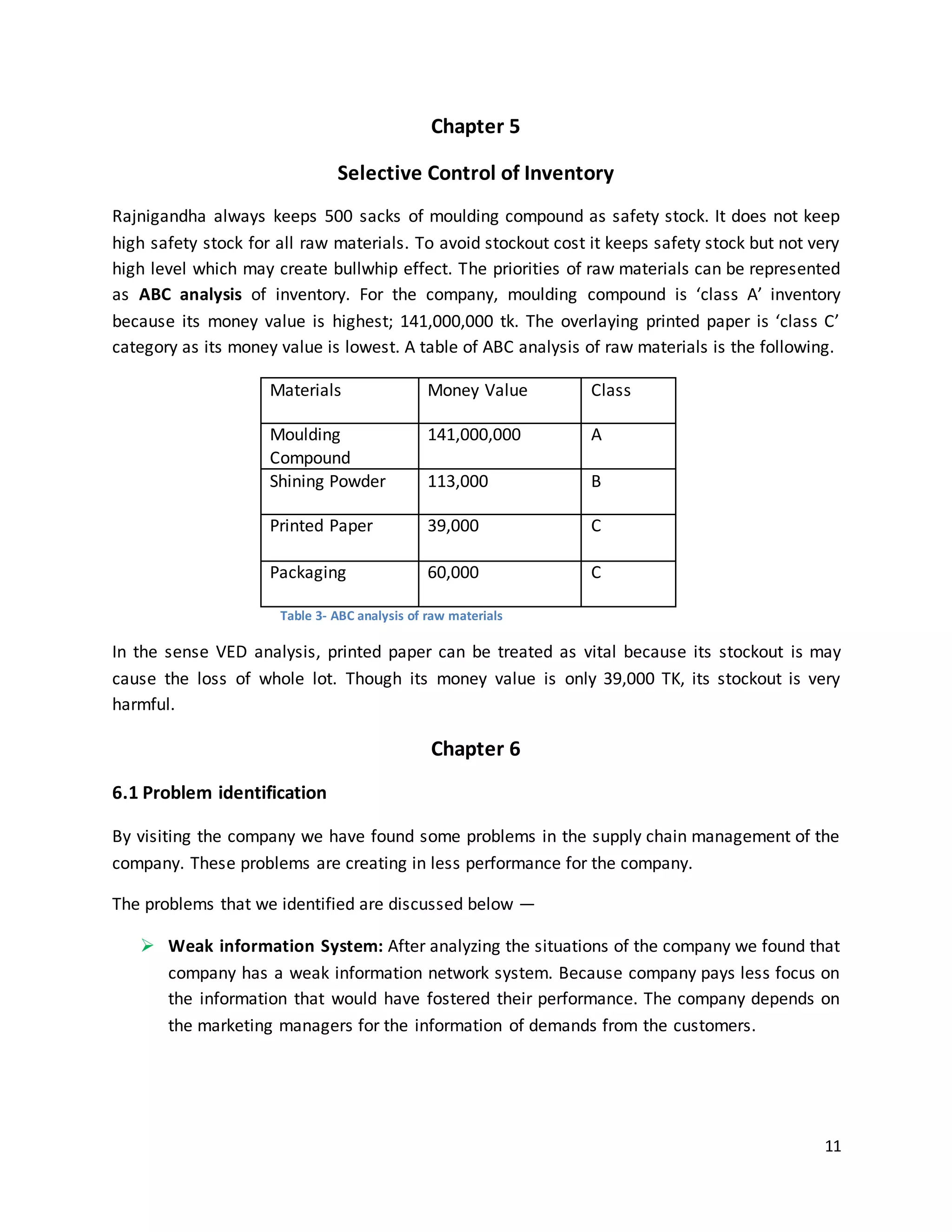
high level which may create bullwhip effect. The priorities of raw materials can be represented
as ABC analysis of inventory. For the company, moulding compound is ‘class A’ inventory
because its money value is highest; 141,000,000 tk. The overlaying printed paper is ‘class C’
category as its money value is lowest. A table of ABC analysis of raw materials is the following.
Materials Money Value Class
Moulding
Compound
141,000,000 A
Shining Powder 113,000 B
Printed Paper 39,000 C
Packaging 60,000 C
Table 3- ABC analysis of raw materials
In the sense VED analysis, printed paper can be treated as vital because its stockout is may
cause the loss of whole lot. Though its money value is only 39,000 TK, its stockout is very
harmful.
Chapter 6
6.1 Problem identification
By visiting the company we have found some problems in the supply chain management of the
company. These problems are creating in less performance for the company.
The problems that we identified are discussed below —
 Weak information System: After analyzing the situations of the company we found that
company has a weak information network system. Because company pays less focus on
the information that would have fostered their performance. The company depends on
the marketing managers for the information of demands from the customers.
12
 Less interaction with customers: Another problem of the company is less interactions
with the customers. They are less able to get feedbacks from the customers about the
changing nature of their choices.
 Research & Development: The company is lagging in some aspects from their
competitors due to less focus new product design and developments. They are focusing
more in complying with the competing companies rather overlapping them.
 Sales related problem: Sale related problem of the company is that they sale much
products on credit, it gives rise bad debt which creates problem for the company.
 Faulty product: Though the fault rate in product design is relevantly less but there are
some problems with the colour of the products. If they offer 6 types colour designs for
the product it is found that 4 type colour has demand in the market, so they need to
focus more on the accuracy of the product designs.
6.2 Recommendation
After analyzing all the aspects of the company we have to come to some recommendations that
will help the company to increase their performance. And we believe that the company has
more potential for business if they follow the recommendations.
 Collaboration with the supply chain partners.
 Integrating the Information network System: The Company needs to integrate all the
suppliers, labor force, marketing executives and customer information in a network that
would help them to response in any opportunity or challenges.
 Creating a Customer base: To interact with the customer the company needs create a
customer base. By which customers can easily express their demands, interests and any
complaints or feedback regarding the service of the products.
 Utilization of the resources: The Company can emphasize on the utilization of the
resources like machine and labors. The company has 7 machine but they are using only
3 machine. If they can increase the demand for the products they may utilize the
remaining machines.
13
 Managing the account receivable:As we know that much of the sales are on account,
the company should more emphasize on the collection of the account receivables and
on the trusted buyers.

Assingment on supply chain process of a melamine company

  • 1.
    1 Executive Summery Rajnigandha MelamineLtd produces melamine tableware as make-to-stock philosophy. It stocks its finished goods inventory in own warehouse sells the products from an outlet. Customers are the end consumers and independent retailers. This distribution network we call ‘manufacturer and retail storage with customer pickup’. Rajnigandha sources its raw materials from China and Taiwan uses independent transport agency for inbound transportation. Raw materials are stored in the factory which minimizes inventory cost. The company focuses on efficiency not on responsiveness. Customers get the facility of same day pickup but not much differentiation. This company’s success depends on how they collaborate with its suppliers and customers. What Kind of Products is Melamine?  Functional kind of product.  Demand is uncertain. Main rivalry is the ceramic products.  Volume of SKUs is high.  Demand is same throughout the year except for the Eid-season.
  • 2.
    2 Chapter 1 1.1 Introduction RajnigandhaMelamine Ltd was established in 1991 in Chawkbazar, Dhaka. It was first established with a view to produce plastic products. From 2001 they started to produce melamine tableware’s. They produce more than 130 items and more than 1000 models including melamine bowl, plate, condiment dish, serving tray, stewing pot, lunch box and teacup. Company Profile  Business Name : Rajnigandha Melamine Ltd.  Business type : Manufacturer, Distributor & Retailer  Year of Established : 1991  Total Employee Number : 65  Business Address : 123 Becharam Deori, Chawkbazar, Dhaka 1.2 Company Overview: Rajnigandha Melamine strongly believes that beautiful living starts at dining table and a leading tableware manufacture, we are well conscious that everything on the table is equally important, not only the food but also the art of table setting and of course the tableware. Rajnigandha Melamine being one of the manufacturers of melamine tableware in Bangladesh has always been utilizing the latest manufacturing technique and knowledge for innovative designs of the highest quality. They have been unveiling beautiful melamine tableware since 2001, which is an extensive line of high quality tableware. Beautiful colors, remarkable durability and shiny smooth glaze surface are spectacularly integrated in the quality control system of Rajnigandha Melamine. They assure that their wide range of products and styles that are not only durable and safe, functional and beautiful for customers home and business as well. Their goal is to generate excitement among their customers by delivering superior quality and innovative design products at cheapest prices.
  • 3.
    3 1.3 Vision: Their visionis to crop the major customer in the local market. They will be the most reliable company in the market by cost. In the high competitive market they offer in lower cost and high inventory. 1.4 Mission:  Conducting their business in a safe, environmentally sustainable and economically optimum manner  Manufacturing and supplying their products that satisfy the needs of their customers  Employing a diverse, innovative and results-oriented team motivated to deliver excellence. 1.5 Objectives:  Maximum output without producing faulty products.  Generating more revenue by satisfying customer needs. 1.6 Strategy: The company follows the cost leadership strategy as well as be responsive to the customer orders by giving many varieties and availability. They follow the FIFO (first in first out) strategy. They sell their ending inventory on account or in discount rate. 1.7 Basic Operation:  Import raw materials directly from China or Taiwan. They order more or less 6 times in a year having a replenishment cycle of 2 months.  They operate three machines at the same time.  They produce around 50,56,000 pieces product in a year. From this product in every year there are 200,000 products are found to be as remaining inventory.  They bear the resident and food cost of the labor.  Take order and send product to the customer. They provide the labor cost but transportation cost is bearded by the customers. Sometime customers come in their retail house.
  • 4.
    4 Chapter 2 2.1 SupplyChain Drivers To best support the company’s competitive strategy it needs to balance between responsiveness and efficiency. In order to understand how a company can improve supply chain performance in terms of responsiveness and efficiency, it needs to determine the logistical and cross functional drivers of supply chain performance. These drivers Include- LOGISTICS DRIVERS:  Facilities - Warehouse or storage locations or factory location.  Inventory - Stock of raw materials or finished goods  Transportation- moving of goods from one place to another. CROSS FUNCTIONAL DRIVERS:  Pricing - Cost of goods  Information - Information is nothing but the customer needs and wants  Sourcing - Procuring raw materials for production activities. 2.2 Supply chain drivers of the Visited Company As we visited the company, we tried to identify their supply chain drivers according to our text book guidance. The supply chain system of the company also follows the basic drivers for supply chain performance. Figure 1- Drivers of Supply Chain Performance
  • 5.
    5 How the companyuses these drivers to achieve cost efficiency and responsive are stated bellow-  Facilities: Rajnigandha Melamine has its production site and storage sites in Becharam Deori, Chawkbazar. It has three storage sites in adjacent areas. All these sites are near from the production site. Due to only one production facility and closer storage sites in one area the company can gain economies of scale by centralization. As the demand for melamine products somewhat predictable and it moves in a mid-pace so the company prefers to be more cost efficient rather than be responsive. Some facility related attributes of the company are –  Flexibility in production capacity focusing on products.  Positive externalities due to same kind firms doing business in the same area.  Inventory: Inventory includes all the raw material, work in process and finished goods within a supply chain. Inventory is the mismatch between the supply and demand but this mismatch is intentional for the Rajnigandha Melamine ltd. It is more economical for the company to produce in larger quantities to store more inventories in anticipation of future demand. A short list of the company’s inventory list are given bellow Raw Materials Molding Powder 5500 Sacks Shining Powder 500 sacks Work in process Producing units 600 unit per hour Monthly produced units 18000 units Ending inventory Yearly ending inventory 2,00,000 units Table 1- Inventory List of Rajnigandha Ltd. Rajnigandha Melamine Company uses molding power and shining power for producing melamine products. These powders are used as raw materials. They produce 600 units of
  • 6.
    6 pcs in everyhour. They run 24 hour production process. The annual production is around 50,56,000 pieces. The companies ending inventory remains as 2,00,000 pcs. Inventory related aspects of the company are –  Achieving customer satisfaction by ensuring the availability of the products whenever customer orders.  The storage of the inventories adjacent area gives the chance for cost efficiency.  They replenish their raw material inventories when the stock comes down to 500 sacks of molding powder.  Transportation: Transportation system moves the products between the different stages of the supply chain. In the case of our company transportation plays a big role. As the raw materials for the melamine production are imported from China or Taiwan the company has to use sea carriage shipments. Sea carriage is the most cost efficient transportation medium. When raw materials reach the port, then raw materials are brought into the factory by using covered van loads. They use the covered vans on rental basis. These are the inbound transportation cost for the company. The company has superiority on outbound transportation cost due to customer pick up. The customers can purchase products on retail basis from the retail store situated near factory or can order for wholesale purchase of the products. The products are delivered to distant customers through carriage delivery. The firm only bears the loading cost. The buyer has to bear the delivery cost. Loading materialson ship Unloadingon trucks Transporting by trucksto factory Materials carriedto factory
  • 7.
    7  Information: Information consistsof data and analysis concerning facilities, inventory, transportation, costs, prices and customers throughout the supply chain. Good information system can help to utilize the supply chain assets and coordination of supply chain flows to increase responsiveness and reduce costs. The information system of this company seems less strong that it should be. The company uses the marketing manager’s advice and information to anticipate the demand for the products. Information related aspects of the company are –  The company uses the marketing manager’s advice and information to anticipate the demand for the products.  The company uses the push process for the procurement and production and pull for customer order.  Sourcing: Sourcing is the choice of who will perform a particular supply chain activity such as production, storage, transportation or the management. These decisions determine what functions Rajnigandha performs and what functions the firm outsources. Managers decide whether each task will be performed by a responsive or efficient source and whether the source will be internal or outsourced. Rajnigandha imports the raw materials from abroad rather than buying from home country due to cost efficiency. Some attributes of sourcing of the company are –  The company has decided to import raw materials from low cost countries.  The production will be done in house.  The supplier will be evaluated on their cost efficiency and quality.  Pricing: Price determines how much firm will charge for the goods and services that it makes available in the supply chain. Pricing affects the behavior of the buyer of the goods or service.
  • 8.
    8 Rajnigandha focuses oncost leadership. They compare the price of other competing company products and settles a price from their products. Setting the low price products create a demand sensitivity for the product. Pricing plays a significant role in the company’s competitive strategies. Pricing aspects of the company are —  Rajnigandha melamine tries to provide products at the cheapest rate.  Some times to get customers the company make sales on credit.  Some the company uses tricks to increase the sale. Chapter 3 Supply Chain Process Cycle Rajnigandha Melamine ltd follows make-to-stock theory in the production line. So it has less opportunity for customization and its products can be called ‘functional product’ which do not change much over time, have low profit margins, stable predictable demand and long life cycles. If we assume the supply chain of Rajnigandha in cycles as shown in figure below, we can divide the process into 3 parts: customer order cycle, replenishment and manufacturing cycle and procurement cycle. The processes in the supply chain can break up into pull processes and push processes. Figure 2: Cycle View and Push-Pull Processes of Rajnigandha's Supply Chain Pull Processes Push Processes Customer Order Cycle Replenishmentand ManufacturingCycle ProcurementCycle Customer Order Arrives
  • 9.
    9 Rajnigandha ltd executesall the processes in customer order cycle after the customer order arrives. All processes in the customer order cycle are thus pull processes. The order is fulfilled from the finished goods inventories that are produced in anticipation of customer orders. This phase is reactive process because this company reacts to customer demand. The purpose of replenishment and manufacturing cycle is to make sure product availability when a customer order arrives. This cycle is push processes because replenishment and production are performed in anticipation of customer demand. In reality, raw material such as moulding compound is often purchased months before customer demand is expected. Manufacturing of tableware begins 1 to 2 months before the point of sale. Procurement is thus push processes. The push-pull view of supply chain helps the company to take strategic decision such as purchase of raw materials and manufacturing decision. The supply chain of tableware is somewhat efficient with a traditional make-to-stock manufacturing. Rajnigandha has less capabilities constituting responsiveness because it has less opportunity for differentiation and low product mix. The company focuses on the cost efficiency. If we draw a responsiveness spectrum the supply chain of Rajnigandha will fall on “somewhat efficient” line like the following figure. Chapter 4 Distribution Network Design The distribution network Rajnigandha follows can be called as ‘manufacturer and retail storage with customer pickup’. It stores the product at a distribution center in Chawkbazar area which also serves as a retail store. Customers walk into the store, place an order and pick it up from the store. Customers may be the end consumers or other independent retailers. Customers may place order by phone and pick it up personally from the store. Highly Efficient Somewhat Efficient Somewhat Responsive Highly Responsive Traditional make-to- stock manufacturer with production lead time of several weeks Figure 3: Responsiveness Spectrum of Rajnigandha ltd.
  • 10.
    10 Performance characteristics ofRajnigandha’s distribution network are as follows next. Table 2- Performance Characteristics of Rajnigandha melamine Ltd. Cost Factors Performance Inventory Inventory cost is very high for Rajnigandha Ltd. It has a 3 story warehouse which costs 240,000 per year. Transportation Transportation cost is very low. Customers pick up products from store. In case of high volume sale Rajnigandha only gives cost of loading on vehicle. On small volume sale customers carry the cost. Facilities and handling Facility costs are:- o Factory: 450,000 tk per year. It includes factory site and storage site for raw materials. o Distribution Center: 120,000 tk per year plus tk 6,000 tax. o Warehouse: 240,000 per year. Information As customers walk into the store and place order no information structure is required. In case of phone order, salespeople answer the phone and receive the order. Information also flows from independent retailer to the manufacturer. Service Factors Performance Response time Same-day pickup Product variety Product variety is low. Product availability Product is available every time. Returnability Returnability easy. Customers just bring the product in the store. Consumers Independent Retailers Distribution Center Factory Figure 4- Distribution Network Design
  • 11.
    11 Chapter 5 Selective Controlof Inventory Rajnigandha always keeps 500 sacks of moulding compound as safety stock. It does not keep high safety stock for all raw materials. To avoid stockout cost it keeps safety stock but not very high level which may create bullwhip effect. The priorities of raw materials can be represented as ABC analysis of inventory. For the company, moulding compound is ‘class A’ inventory because its money value is highest; 141,000,000 tk. The overlaying printed paper is ‘class C’ category as its money value is lowest. A table of ABC analysis of raw materials is the following. Materials Money Value Class Moulding Compound 141,000,000 A Shining Powder 113,000 B Printed Paper 39,000 C Packaging 60,000 C Table 3- ABC analysis of raw materials In the sense VED analysis, printed paper can be treated as vital because its stockout is may cause the loss of whole lot. Though its money value is only 39,000 TK, its stockout is very harmful. Chapter 6 6.1 Problem identification By visiting the company we have found some problems in the supply chain management of the company. These problems are creating in less performance for the company. The problems that we identified are discussed below —  Weak information System: After analyzing the situations of the company we found that company has a weak information network system. Because company pays less focus on the information that would have fostered their performance. The company depends on the marketing managers for the information of demands from the customers.

  • 12.
    12  Less interactionwith customers: Another problem of the company is less interactions with the customers. They are less able to get feedbacks from the customers about the changing nature of their choices.  Research & Development: The company is lagging in some aspects from their competitors due to less focus new product design and developments. They are focusing more in complying with the competing companies rather overlapping them.  Sales related problem: Sale related problem of the company is that they sale much products on credit, it gives rise bad debt which creates problem for the company.  Faulty product: Though the fault rate in product design is relevantly less but there are some problems with the colour of the products. If they offer 6 types colour designs for the product it is found that 4 type colour has demand in the market, so they need to focus more on the accuracy of the product designs. 6.2 Recommendation After analyzing all the aspects of the company we have to come to some recommendations that will help the company to increase their performance. And we believe that the company has more potential for business if they follow the recommendations.  Collaboration with the supply chain partners.  Integrating the Information network System: The Company needs to integrate all the suppliers, labor force, marketing executives and customer information in a network that would help them to response in any opportunity or challenges.  Creating a Customer base: To interact with the customer the company needs create a customer base. By which customers can easily express their demands, interests and any complaints or feedback regarding the service of the products.  Utilization of the resources: The Company can emphasize on the utilization of the resources like machine and labors. The company has 7 machine but they are using only 3 machine. If they can increase the demand for the products they may utilize the remaining machines.
  • 13.
    13  Managing theaccount receivable:As we know that much of the sales are on account, the company should more emphasize on the collection of the account receivables and on the trusted buyers.