Name: Nasrin akter borsha
ID:182-15-2133
Section: PC(A) Course code: CSE323
|
Operating-System
Structures
ASSIGNMENT
An operating system is system softwarethat manages computer hardware,
softwareresources, and provides common services for computer programs.
Various Types of OS:
 Batch OS, Time Sharing OS, Distributed OS, Network OS (LAN),
Real time OS.
Operating-System Structures
Operating System Services: Almostall operating systemshaveanuser interface.
Has I/O operation. Programs needs file to read/write to run, delete data. It can
execute program . It can detect errors . It has strong security system and many
resource allocations here.
System Calls: System-callinterface maintains a table indexed according to given
numbers.Herethe userswillnotknowabout it butneed to obey API as byAPI Most
details of OS interface hidden.
UNIX: The UNIX OS consists of two separable parts;
1. Systems programs: Itworksbelow thesystem-callinterface and
above the physicalhardware to consists of everything.
2. The kernel: Provides the file system, CPUscheduling, memory
management, and other operating-systemfunctions; a large number
of functions for one level.
Layered Approach: Operating systemhas two layers. The bottom layer called
layer0 that is the hardware; the highest called layer N is the user interface.
Microkernel System Structure: MicrokernelSystemStructure Communication
takes place between user modules using messagepassing. Ithas somebenefits
because it is easier to extend a microkernel and to portthe operating systemto
new architectures. Itis morereliable and more secure.
Modules: Mostmodern operating systems implement loadable kernel modules.
Ituses object-oriented approach and core component is separate. Each is
loadable as needed within the kernel and more flexible and Linux, Solaris, etc.
Applications
Application Framework
Android runtime
Core Libraries
Dalvik
virtual machine
Libraries
Linux kernel
SQLite openGL
surface
manager
webkit libc
media
framework
Hybrid Systems: Hybrid combines multiple approaches to address performance,
security, usability needs. Fromthem;
Linux and Solaris kernels in kernel address space, so monolithic, plus modular for
dynamic loading of functionality and Windows mostly monolithic, plus
microkernelfor different subsystempersonalities.
iOS: Apple mobile OS for iPhone, iPad it is Structured on Mac OS X, does not run
OS X applications natively. Cocoa Touch Objective-CAPI for developing apps.
Media services layer for graphics, audio, video
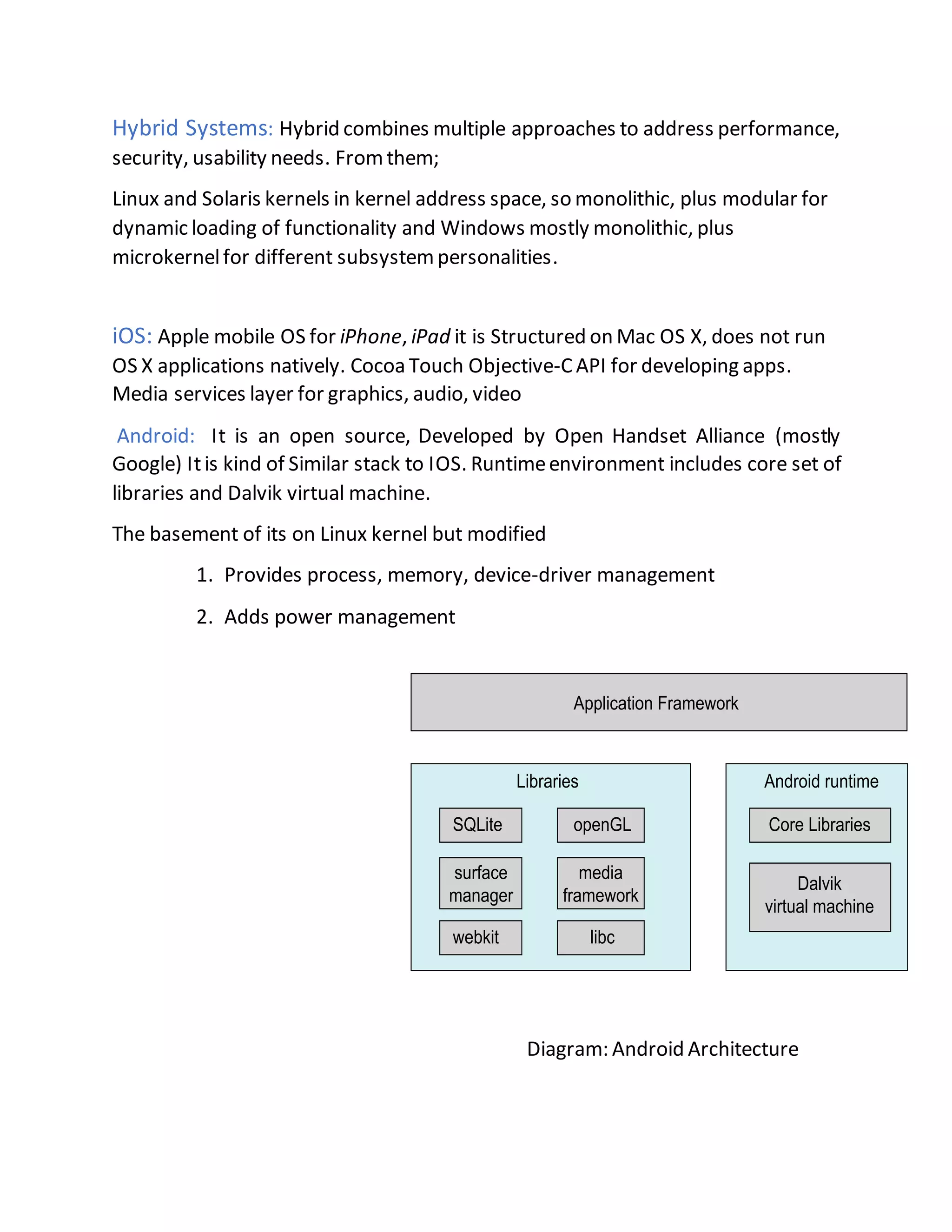
Android: It is an open source, Developed by Open Handset Alliance (mostly
Google) Itis kind of Similar stack to IOS. Runtimeenvironment includes core set of
libraries and Dalvik virtual machine.
The basement of its on Linux kernel but modified
1. Provides process, memory, device-driver management
2. Adds power management
Diagram: Android Architecture

Operating system

  • 1.
    Name: Nasrin akterborsha ID:182-15-2133 Section: PC(A) Course code: CSE323 | Operating-System Structures ASSIGNMENT
  • 2.
    An operating systemis system softwarethat manages computer hardware, softwareresources, and provides common services for computer programs. Various Types of OS:  Batch OS, Time Sharing OS, Distributed OS, Network OS (LAN), Real time OS. Operating-System Structures Operating System Services: Almostall operating systemshaveanuser interface. Has I/O operation. Programs needs file to read/write to run, delete data. It can execute program . It can detect errors . It has strong security system and many resource allocations here. System Calls: System-callinterface maintains a table indexed according to given numbers.Herethe userswillnotknowabout it butneed to obey API as byAPI Most details of OS interface hidden. UNIX: The UNIX OS consists of two separable parts; 1. Systems programs: Itworksbelow thesystem-callinterface and above the physicalhardware to consists of everything. 2. The kernel: Provides the file system, CPUscheduling, memory management, and other operating-systemfunctions; a large number of functions for one level. Layered Approach: Operating systemhas two layers. The bottom layer called layer0 that is the hardware; the highest called layer N is the user interface. Microkernel System Structure: MicrokernelSystemStructure Communication takes place between user modules using messagepassing. Ithas somebenefits because it is easier to extend a microkernel and to portthe operating systemto new architectures. Itis morereliable and more secure. Modules: Mostmodern operating systems implement loadable kernel modules. Ituses object-oriented approach and core component is separate. Each is loadable as needed within the kernel and more flexible and Linux, Solaris, etc.
  • 3.
    Applications Application Framework Android runtime CoreLibraries Dalvik virtual machine Libraries Linux kernel SQLite openGL surface manager webkit libc media framework Hybrid Systems: Hybrid combines multiple approaches to address performance, security, usability needs. Fromthem; Linux and Solaris kernels in kernel address space, so monolithic, plus modular for dynamic loading of functionality and Windows mostly monolithic, plus microkernelfor different subsystempersonalities. iOS: Apple mobile OS for iPhone, iPad it is Structured on Mac OS X, does not run OS X applications natively. Cocoa Touch Objective-CAPI for developing apps. Media services layer for graphics, audio, video Android: It is an open source, Developed by Open Handset Alliance (mostly Google) Itis kind of Similar stack to IOS. Runtimeenvironment includes core set of libraries and Dalvik virtual machine. The basement of its on Linux kernel but modified 1. Provides process, memory, device-driver management 2. Adds power management Diagram: Android Architecture