us .org
dsi
© Copyright 2025. United States Data Science Institute. All Rights Reserved
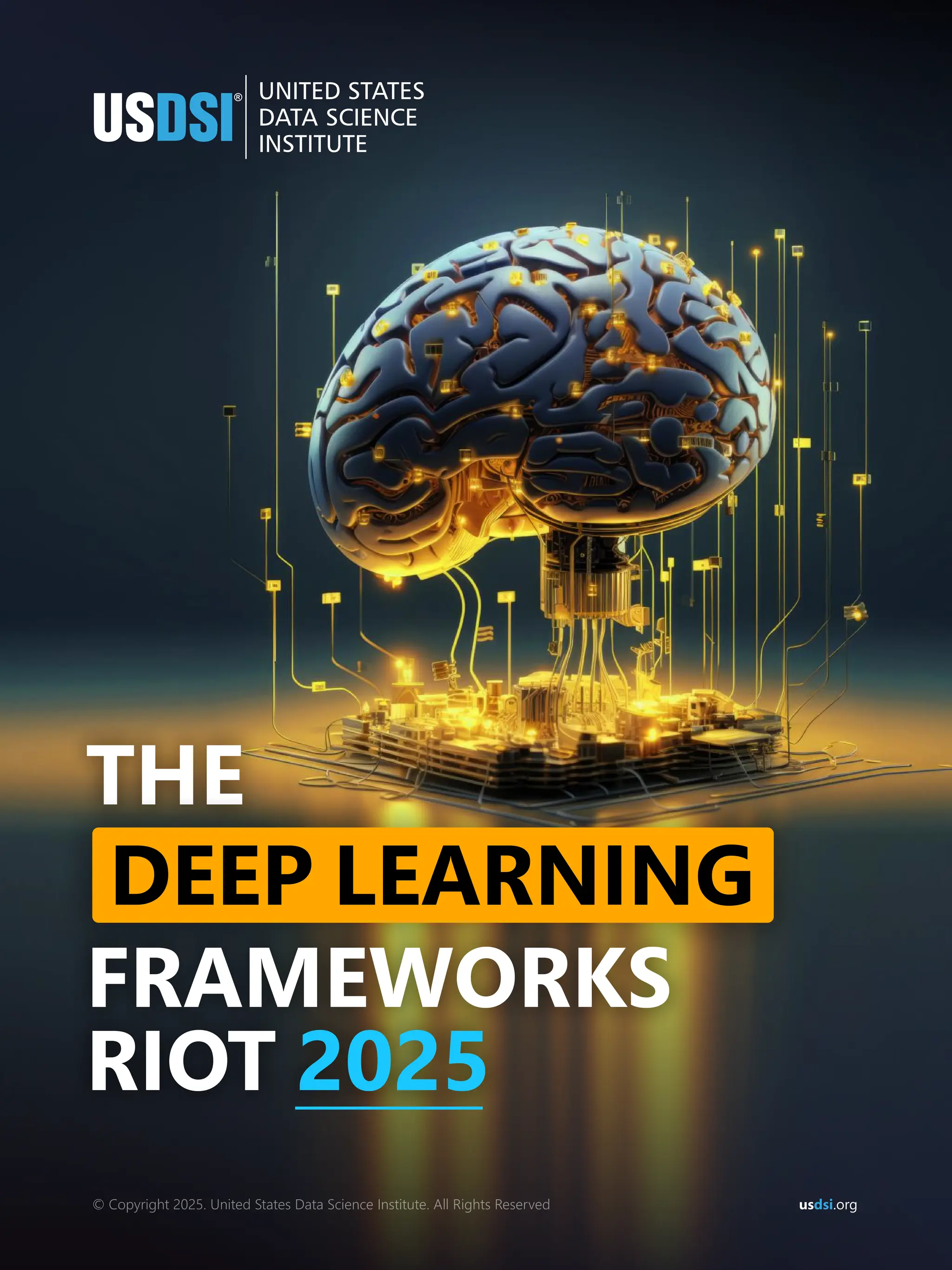
THE
FRAMEWORKS
RIOT 2025
DEEP LEARNING
© Copyright 2025. United States Data Science Institute. All Rights Reserved us org
dsi.
Witnessing the developments in open-source Deep learning platforms has been a fascinating trail of
developments; while powering your understanding in the way it drives the organizational systems.
As an integral yet powerful subset of machine learning, deep learning has demonstrated its nuanced
efficiency in leveraging large datasets to produce highly accurate models.
“Prediction is the
essence of intelligence”
Yann LeCun,
French American Computer Scientist & Godfather of Deep Learning
Witnessing the developments in open-source Deep learning platforms has been a fascinating trail of
developments; while powering your understanding in the way it drives the organizational systems.
As an integral yet powerful subset of machine learning, deep learning has demonstrated its nuanced
efficiency in leveraging large datasets to produce highly accurate models.
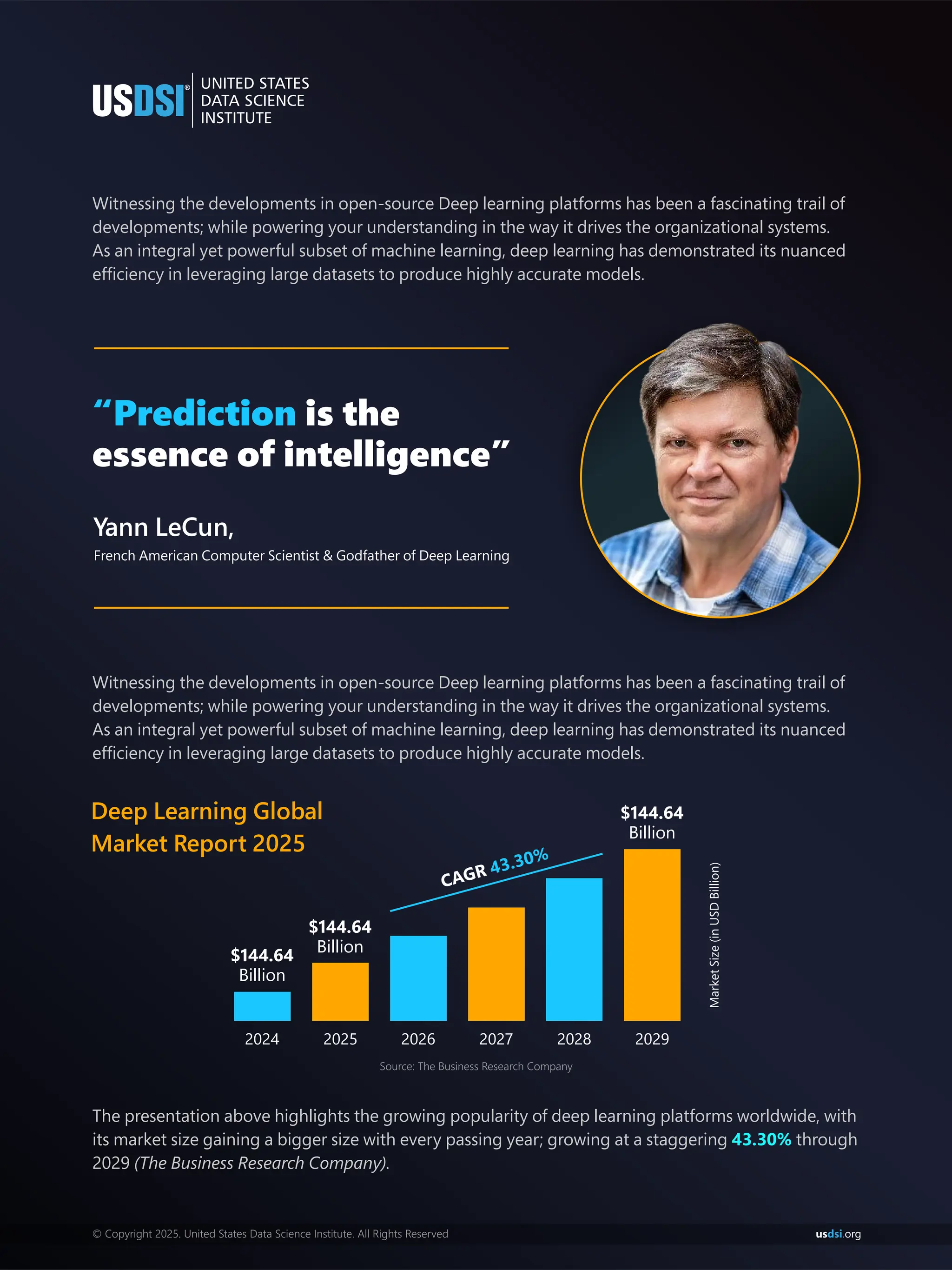
The presentation above highlights the growing popularity of deep learning platforms worldwide, with
its market size gaining a bigger size with every passing year; growing at a staggering through
43.30%
2029 (The Business Research Company).
2024 2025 2026 2027 2028 2029
$144.64
Billion
$144.64
Billion
$144.64
Billion
Market
Size
(in
USD
Billion)
Deep Learning Global
Market Report 2025
Source: The Business Research Company
© Copyright 2025. United States Data Science Institute. All Rights Reserved us org
dsi.
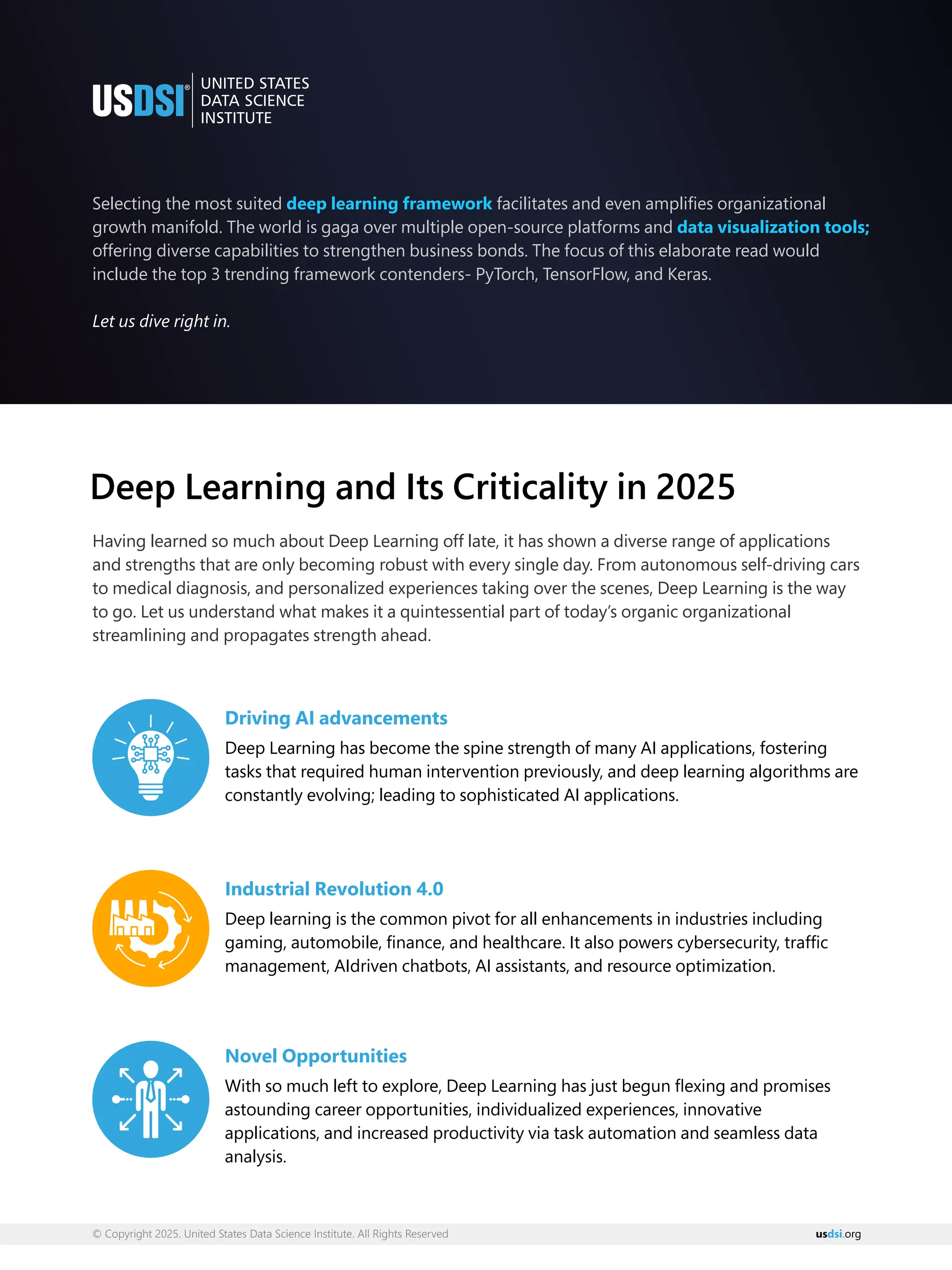
Selecting the most suited facilitates and even amplifies organizational
deep learning framework
growth manifold. The world is gaga over multiple open-source platforms and data visualization tools;
offering diverse capabilities to strengthen business bonds. The focus of this elaborate read would
include the top 3 trending framework contenders- PyTorch, TensorFlow, and Keras.
Let us dive right in.
Deep Learning and Its Criticality in 2025
Having learned so much about Deep Learning off late, it has shown a diverse range of applications
and strengths that are only becoming robust with every single day. From autonomous self-driving cars
to medical diagnosis, and personalized experiences taking over the scenes, Deep Learning is the way
to go. Let us understand what makes it a quintessential part of today’s organic organizational
streamlining and propagates strength ahead.
Driving AI advancements
Deep Learning has become the spine strength of many AI applications, fostering
tasks that required human intervention previously, and deep learning algorithms are
constantly evolving; leading to sophisticated AI applications.
Industrial Revolution 4.0
Deep learning is the common pivot for all enhancements in industries including
gaming, automobile, finance, and healthcare. It also powers cybersecurity, traffic
management, AIdriven chatbots, AI assistants, and resource optimization.
Novel Opportunities
With so much left to explore, Deep Learning has just begun flexing and promises
astounding career opportunities, individualized experiences, innovative
applications, and increased productivity via task automation and seamless data
analysis.
© Copyright 2025. United States Data Science Institute. All Rights Reserved us org
dsi.
Popular Deep Learning Platforms for 2025
The deep learning landscape is constantly evolving; basis current trends and expert analysis, here are
the top deep learning platforms that are expected to remain relevant in 2025:
1. TensorFlow:
Deep Learning has become the spine strength of many AI applications, fostering
tasks that required human intervention previously, and deep learning algorithms
are constantly evolving; leading to sophisticated AI applications.
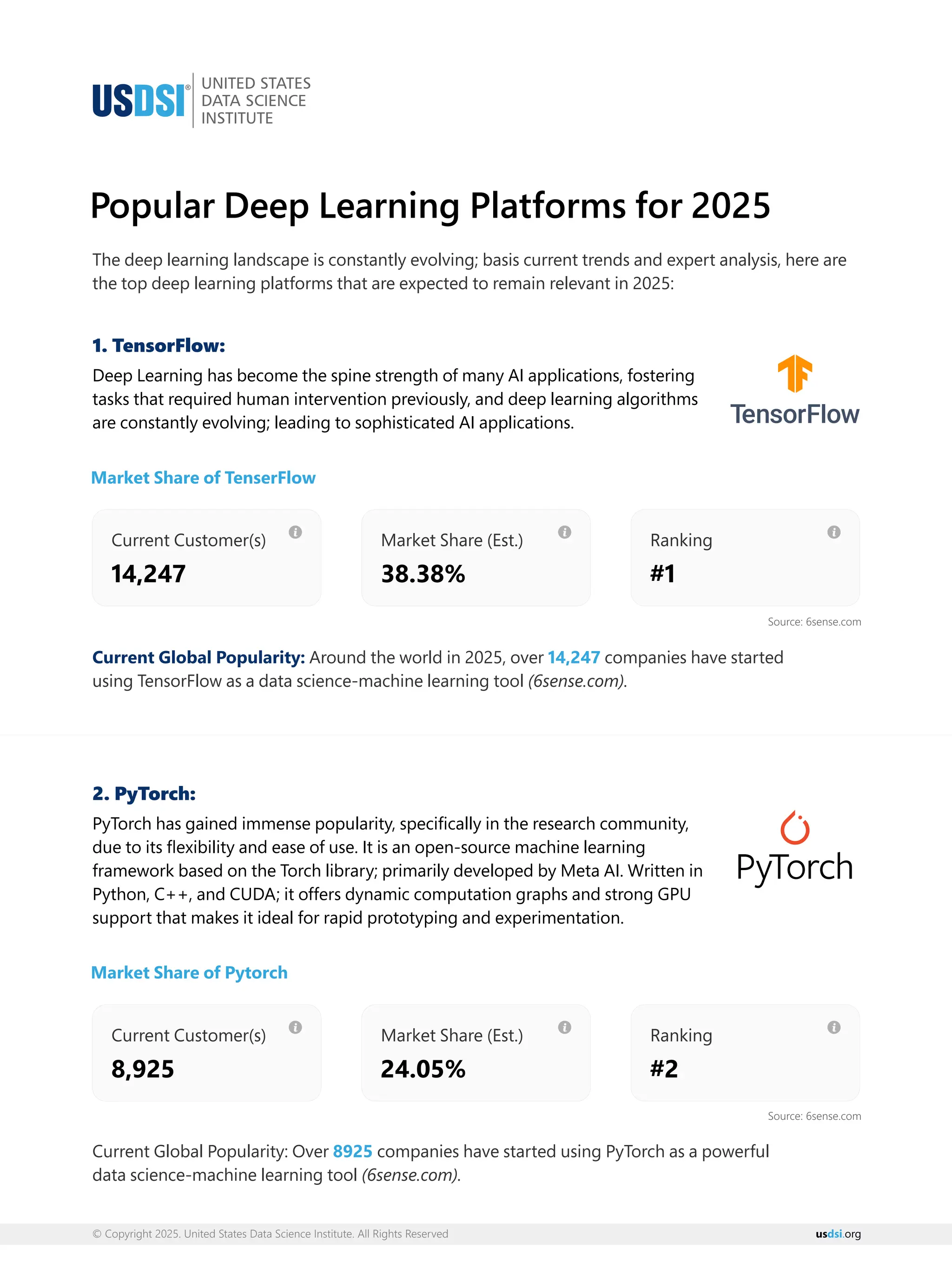
Current Global Popularity: Around the world in 2025, over companies have started
14,247
using TensorFlow as a data science-machine learning tool (6sense.com).
2. PyTorch:
PyTorch has gained immense popularity, specifically in the research community,
due to its flexibility and ease of use. It is an open-source machine learning
framework based on the Torch library; primarily developed by Meta AI. Written in
Python, C++, and CUDA; it offers dynamic computation graphs and strong GPU
support that makes it ideal for rapid prototyping and experimentation.
Current Global Popularity: Over companies have started using PyTorch as a powerful
8925
data science-machine learning tool (6sense.com).
Current Customer(s)
14,247
Market Share (Est.)
38.38%
Ranking
#1
Current Customer(s)
8,925
Market Share (Est.)
24.05%
Ranking
#2
Market Share of TenserFlow
Market Share of Pytorch
Source: 6sense.com
Source: 6sense.com
© Copyright 2025. United States Data Science Institute. All Rights Reserved us org
dsi.
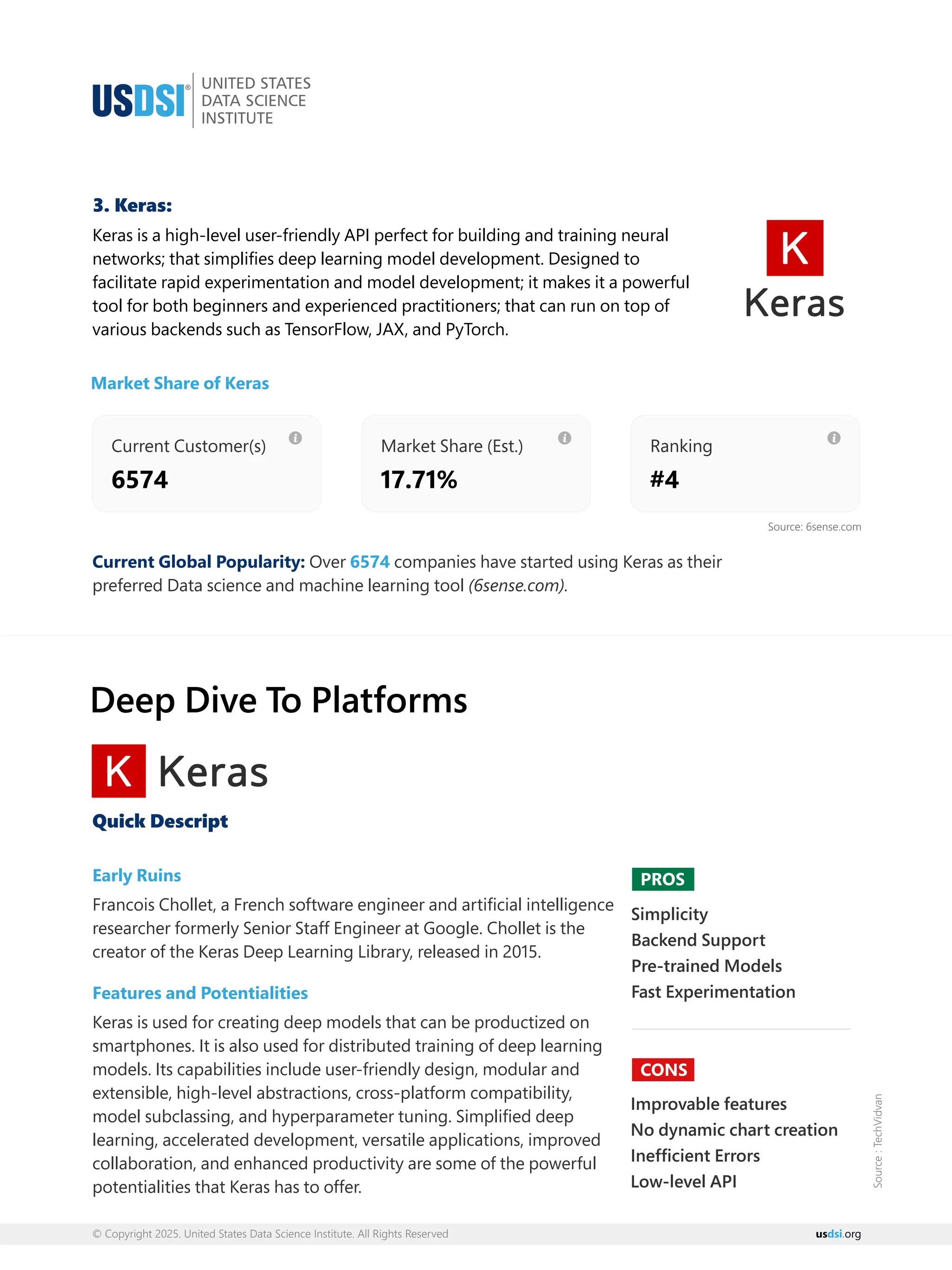
3. Keras:
Keras is a high-level user-friendly API perfect for building and training neural
networks; that simplifies deep learning model development. Designed to
facilitate rapid experimentation and model development; it makes it a powerful
tool for both beginners and experienced practitioners; that can run on top of
various backends such as TensorFlow, JAX, and PyTorch.
Current Customer(s)
6574
Market Share (Est.)
17.71%
Ranking
#4
Market Share of Keras
Source: 6sense.com
Current Global Popularity: Over companies have started using Keras as their
6574
preferred Data science and machine learning tool (6sense.com).
Deep Dive To Platforms
Quick Descript
Early Ruins
Francois Chollet, a French software engineer and artificial intelligence
researcher formerly Senior Staff Engineer at Google. Chollet is the
creator of the Keras Deep Learning Library, released in 2015.
Features and Potentialities
Keras is used for creating deep models that can be productized on
smartphones. It is also used for distributed training of deep learning
models. Its capabilities include user-friendly design, modular and
extensible, high-level abstractions, cross-platform compatibility,
model subclassing, and hyperparameter tuning. Simplified deep
learning, accelerated development, versatile applications, improved
collaboration, and enhanced productivity are some of the powerful
potentialities that Keras has to offer.
Simplicity
Backend Support
Pre-trained Models
Fast Experimentation
Improvable features
No dynamic chart creation
Inefficient Errors
Low-level API
PROS
CONS
Source
:
TechVidvan
Quick Descript
Early Ruins
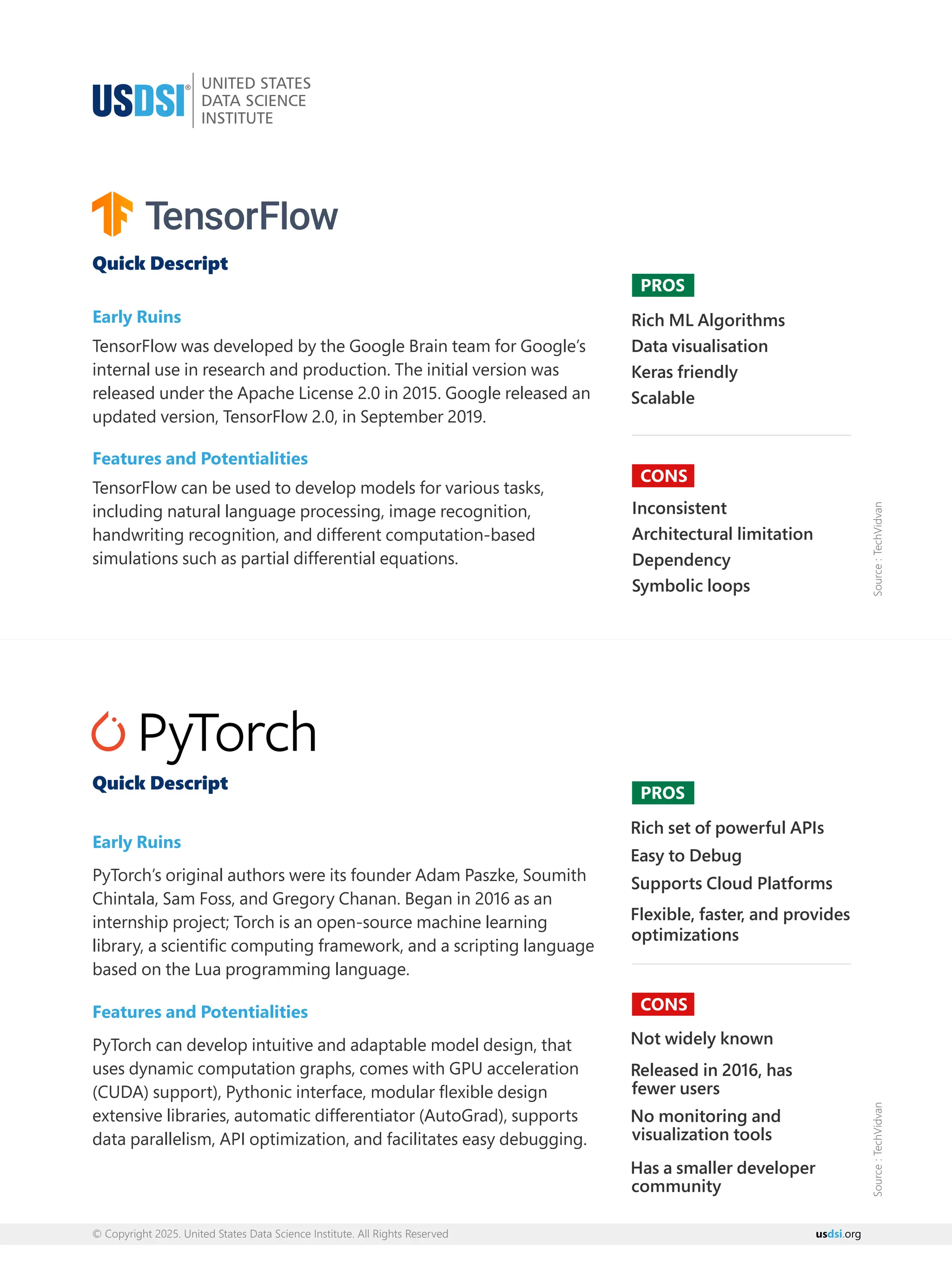
TensorFlow was developed by the Google Brain team for Google’s
internal use in research and production. The initial version was
released under the Apache License 2.0 in 2015. Google released an
updated version, TensorFlow 2.0, in September 2019.
Features and Potentialities
TensorFlow can be used to develop models for various tasks,
including natural language processing, image recognition,
handwriting recognition, and different computation-based
simulations such as partial differential equations.
Rich ML Algorithms
Data visualisation
Keras friendly
Scalable
Inconsistent
Architectural limitation
Dependency
Symbolic loops
PROS
CONS
Source
:
TechVidvan
Quick Descript
Early Ruins
PyTorch’s original authors were its founder Adam Paszke, Soumith
Chintala, Sam Foss, and Gregory Chanan. Began in 2016 as an
internship project; Torch is an open-source machine learning
library, a scientific computing framework, and a scripting language
based on the Lua programming language.
Features and Potentialities
PyTorch can develop intuitive and adaptable model design, that
uses dynamic computation graphs, comes with GPU acceleration
(CUDA) support), Pythonic interface, modular flexible design
extensive libraries, automatic differentiator (AutoGrad), supports
data parallelism, API optimization, and facilitates easy debugging.
Flexible, faster, and provides
Rich set of powerful APIs
Easy to Debug
Supports Cloud Platforms
optimizations
Not widely known
Released in 2016, has
fewer users
No monitoring and
visualization tools
Has a smaller developer
community
PROS
CONS
Source
:
TechVidvan
© Copyright 2025. United States Data Science Institute. All Rights Reserved us org
dsi.
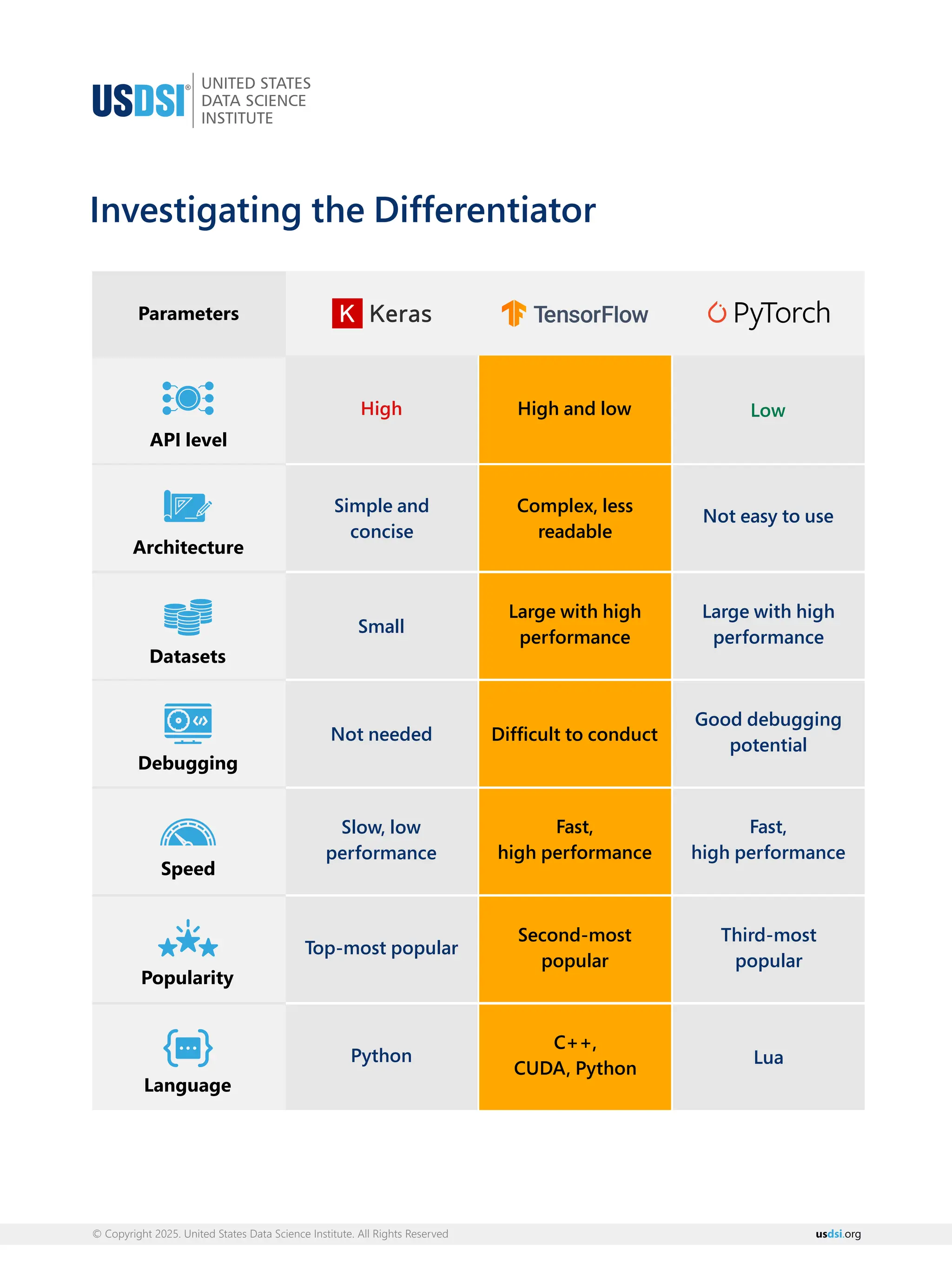
Investigating the Differentiator
Parameters
API level
Architecture
Datasets
Debugging
Speed
Popularity
Language
Not easy to use
Large with high
performance
Good debugging
potential
Third-most
popular
Lua
Fast,
high performance
Low
Complex, less
readable
C++,
CUDA, Python
Second-most
popular
Fast,
high performance
Difficult to conduct
Large with high
performance
High and low
Simple and
concise
Small
Not needed
Slow, low
performance
Top-most popular
Python
High
© Copyright 2025. United States Data Science Institute. All Rights Reserved us org
dsi.
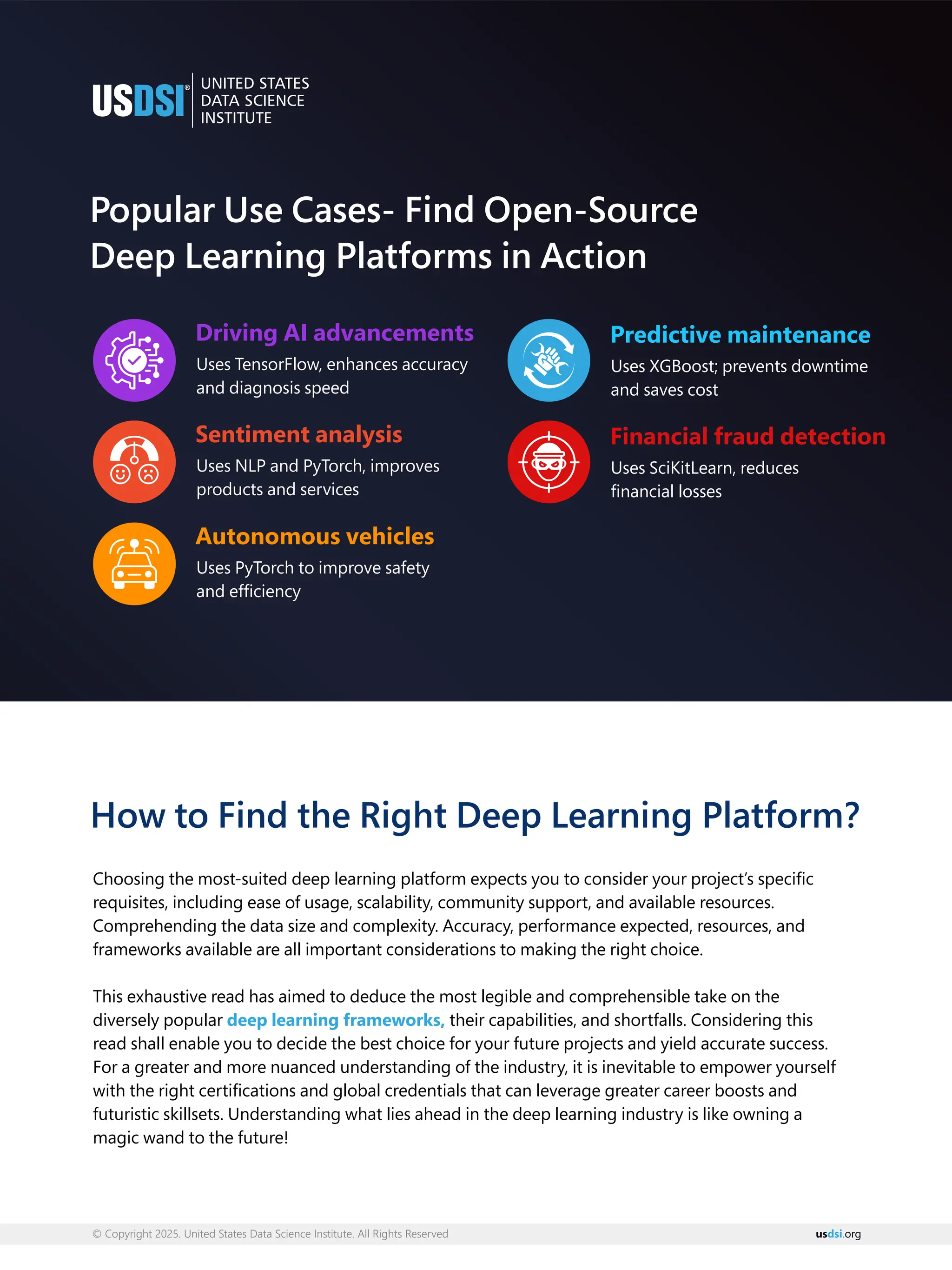
Popular Use Cases- Find Open-Source
Deep Learning Platforms in Action
Driving AI advancements
Uses TensorFlow, enhances accuracy
and diagnosis speed
Sentiment analysis
Uses NLP and PyTorch, improves
products and services
Autonomous vehicles
Uses PyTorch to improve safety
and efficiency
How to Find the Right Deep Learning Platform?
Choosing the most-suited deep learning platform expects you to consider your project’s specific
requisites, including ease of usage, scalability, community support, and available resources.
Comprehending the data size and complexity. Accuracy, performance expected, resources, and
frameworks available are all important considerations to making the right choice.
This exhaustive read has aimed to deduce the most legible and comprehensible take on the
diversely popular their capabilities, and shortfalls. Considering this
deep learning frameworks,
read shall enable you to decide the best choice for your future projects and yield accurate success.
For a greater and more nuanced understanding of the industry, it is inevitable to empower yourself
with the right certifications and global credentials that can leverage greater career boosts and
futuristic skillsets. Understanding what lies ahead in the deep learning industry is like owning a
magic wand to the future!
Predictive maintenance
Uses XGBoost; prevents downtime
and saves cost
Financial fraud detection
Uses SciKitLearn, reduces
financial losses
© Copyright 2025. United States Data Science Institute. All Rights Reserved us org
dsi.
You May Also Like:
Storytelling with Data:
Transforming Raw Information
into Narrative Symphonies
Future Of Data Science:
10 Predictions You Should
Know
Data Science:
Unlocking Careers
for the Future
Data Science
vs.
Decision Science
Data Science Skills Vs. Tools:
What Matters the most for
Data Scientists
Master Data-Driven
Decision-Making in
2024
Discover More Discover More Discover More
Factsheet:
Data Science Career
2025
Top 5
Must-know Data
Science Frameworks
Discover More Discover More
© Copyright 2025. United States Data Science Institute. All Rights Reserved us org
dsi.
LOCATIONS
info@ | www.
usdsi.org usdsi.org
Arizona
1345 E. Chandler BLVD.,
Suite 111-D Phoenix,
AZ 85048,
info.az@usdsi.org
Connecticut
Connecticut 680 E Main Street
#699 Stamford, CT 06901
,
info.ct@usdsi.org
Illinois
1 East Erie St, Suite 525
Chicago, IL 60611
info.il@usdsi.org
Singapore
No 7 Temasek Boulevard#12-07
Suntec Tower One, Singapore, 038987
Singapore, info.sg@usdsi.org
United Kingdom
29 Whitmore Road, Whitnash
Learmington Spa, Warwickshire,
United Kingdom CV312JQ
info.uk@usdsi.org
© Copyright 2025. United States Data Science Institute. All Rights Reserved.
REGISTER NOW
DOWNLOAD
TO UNDERSTAND
3 POPULAR
DEEP LEARNING
FRAMEWORKS WITH

The Deep Learning Frameworks You Should Know | 2025

  • 1.
    us .org dsi © Copyright2025. United States Data Science Institute. All Rights Reserved THE FRAMEWORKS RIOT 2025 DEEP LEARNING
  • 2.
    © Copyright 2025.United States Data Science Institute. All Rights Reserved us org dsi. Witnessing the developments in open-source Deep learning platforms has been a fascinating trail of developments; while powering your understanding in the way it drives the organizational systems. As an integral yet powerful subset of machine learning, deep learning has demonstrated its nuanced efficiency in leveraging large datasets to produce highly accurate models. “Prediction is the essence of intelligence” Yann LeCun, French American Computer Scientist & Godfather of Deep Learning Witnessing the developments in open-source Deep learning platforms has been a fascinating trail of developments; while powering your understanding in the way it drives the organizational systems. As an integral yet powerful subset of machine learning, deep learning has demonstrated its nuanced efficiency in leveraging large datasets to produce highly accurate models. The presentation above highlights the growing popularity of deep learning platforms worldwide, with its market size gaining a bigger size with every passing year; growing at a staggering through 43.30% 2029 (The Business Research Company). 2024 2025 2026 2027 2028 2029 $144.64 Billion $144.64 Billion $144.64 Billion Market Size (in USD Billion) Deep Learning Global Market Report 2025 Source: The Business Research Company
  • 3.
    © Copyright 2025.United States Data Science Institute. All Rights Reserved us org dsi. Selecting the most suited facilitates and even amplifies organizational deep learning framework growth manifold. The world is gaga over multiple open-source platforms and data visualization tools; offering diverse capabilities to strengthen business bonds. The focus of this elaborate read would include the top 3 trending framework contenders- PyTorch, TensorFlow, and Keras. Let us dive right in. Deep Learning and Its Criticality in 2025 Having learned so much about Deep Learning off late, it has shown a diverse range of applications and strengths that are only becoming robust with every single day. From autonomous self-driving cars to medical diagnosis, and personalized experiences taking over the scenes, Deep Learning is the way to go. Let us understand what makes it a quintessential part of today’s organic organizational streamlining and propagates strength ahead. Driving AI advancements Deep Learning has become the spine strength of many AI applications, fostering tasks that required human intervention previously, and deep learning algorithms are constantly evolving; leading to sophisticated AI applications. Industrial Revolution 4.0 Deep learning is the common pivot for all enhancements in industries including gaming, automobile, finance, and healthcare. It also powers cybersecurity, traffic management, AIdriven chatbots, AI assistants, and resource optimization. Novel Opportunities With so much left to explore, Deep Learning has just begun flexing and promises astounding career opportunities, individualized experiences, innovative applications, and increased productivity via task automation and seamless data analysis.
  • 4.
    © Copyright 2025.United States Data Science Institute. All Rights Reserved us org dsi. Popular Deep Learning Platforms for 2025 The deep learning landscape is constantly evolving; basis current trends and expert analysis, here are the top deep learning platforms that are expected to remain relevant in 2025: 1. TensorFlow: Deep Learning has become the spine strength of many AI applications, fostering tasks that required human intervention previously, and deep learning algorithms are constantly evolving; leading to sophisticated AI applications. Current Global Popularity: Around the world in 2025, over companies have started 14,247 using TensorFlow as a data science-machine learning tool (6sense.com). 2. PyTorch: PyTorch has gained immense popularity, specifically in the research community, due to its flexibility and ease of use. It is an open-source machine learning framework based on the Torch library; primarily developed by Meta AI. Written in Python, C++, and CUDA; it offers dynamic computation graphs and strong GPU support that makes it ideal for rapid prototyping and experimentation. Current Global Popularity: Over companies have started using PyTorch as a powerful 8925 data science-machine learning tool (6sense.com). Current Customer(s) 14,247 Market Share (Est.) 38.38% Ranking #1 Current Customer(s) 8,925 Market Share (Est.) 24.05% Ranking #2 Market Share of TenserFlow Market Share of Pytorch Source: 6sense.com Source: 6sense.com
  • 5.
    © Copyright 2025.United States Data Science Institute. All Rights Reserved us org dsi. 3. Keras: Keras is a high-level user-friendly API perfect for building and training neural networks; that simplifies deep learning model development. Designed to facilitate rapid experimentation and model development; it makes it a powerful tool for both beginners and experienced practitioners; that can run on top of various backends such as TensorFlow, JAX, and PyTorch. Current Customer(s) 6574 Market Share (Est.) 17.71% Ranking #4 Market Share of Keras Source: 6sense.com Current Global Popularity: Over companies have started using Keras as their 6574 preferred Data science and machine learning tool (6sense.com). Deep Dive To Platforms Quick Descript Early Ruins Francois Chollet, a French software engineer and artificial intelligence researcher formerly Senior Staff Engineer at Google. Chollet is the creator of the Keras Deep Learning Library, released in 2015. Features and Potentialities Keras is used for creating deep models that can be productized on smartphones. It is also used for distributed training of deep learning models. Its capabilities include user-friendly design, modular and extensible, high-level abstractions, cross-platform compatibility, model subclassing, and hyperparameter tuning. Simplified deep learning, accelerated development, versatile applications, improved collaboration, and enhanced productivity are some of the powerful potentialities that Keras has to offer. Simplicity Backend Support Pre-trained Models Fast Experimentation Improvable features No dynamic chart creation Inefficient Errors Low-level API PROS CONS Source : TechVidvan
  • 6.
    Quick Descript Early Ruins TensorFlowwas developed by the Google Brain team for Google’s internal use in research and production. The initial version was released under the Apache License 2.0 in 2015. Google released an updated version, TensorFlow 2.0, in September 2019. Features and Potentialities TensorFlow can be used to develop models for various tasks, including natural language processing, image recognition, handwriting recognition, and different computation-based simulations such as partial differential equations. Rich ML Algorithms Data visualisation Keras friendly Scalable Inconsistent Architectural limitation Dependency Symbolic loops PROS CONS Source : TechVidvan Quick Descript Early Ruins PyTorch’s original authors were its founder Adam Paszke, Soumith Chintala, Sam Foss, and Gregory Chanan. Began in 2016 as an internship project; Torch is an open-source machine learning library, a scientific computing framework, and a scripting language based on the Lua programming language. Features and Potentialities PyTorch can develop intuitive and adaptable model design, that uses dynamic computation graphs, comes with GPU acceleration (CUDA) support), Pythonic interface, modular flexible design extensive libraries, automatic differentiator (AutoGrad), supports data parallelism, API optimization, and facilitates easy debugging. Flexible, faster, and provides Rich set of powerful APIs Easy to Debug Supports Cloud Platforms optimizations Not widely known Released in 2016, has fewer users No monitoring and visualization tools Has a smaller developer community PROS CONS Source : TechVidvan © Copyright 2025. United States Data Science Institute. All Rights Reserved us org dsi.
  • 7.
    Investigating the Differentiator Parameters APIlevel Architecture Datasets Debugging Speed Popularity Language Not easy to use Large with high performance Good debugging potential Third-most popular Lua Fast, high performance Low Complex, less readable C++, CUDA, Python Second-most popular Fast, high performance Difficult to conduct Large with high performance High and low Simple and concise Small Not needed Slow, low performance Top-most popular Python High © Copyright 2025. United States Data Science Institute. All Rights Reserved us org dsi.
  • 8.
    Popular Use Cases-Find Open-Source Deep Learning Platforms in Action Driving AI advancements Uses TensorFlow, enhances accuracy and diagnosis speed Sentiment analysis Uses NLP and PyTorch, improves products and services Autonomous vehicles Uses PyTorch to improve safety and efficiency How to Find the Right Deep Learning Platform? Choosing the most-suited deep learning platform expects you to consider your project’s specific requisites, including ease of usage, scalability, community support, and available resources. Comprehending the data size and complexity. Accuracy, performance expected, resources, and frameworks available are all important considerations to making the right choice. This exhaustive read has aimed to deduce the most legible and comprehensible take on the diversely popular their capabilities, and shortfalls. Considering this deep learning frameworks, read shall enable you to decide the best choice for your future projects and yield accurate success. For a greater and more nuanced understanding of the industry, it is inevitable to empower yourself with the right certifications and global credentials that can leverage greater career boosts and futuristic skillsets. Understanding what lies ahead in the deep learning industry is like owning a magic wand to the future! Predictive maintenance Uses XGBoost; prevents downtime and saves cost Financial fraud detection Uses SciKitLearn, reduces financial losses © Copyright 2025. United States Data Science Institute. All Rights Reserved us org dsi.
  • 9.
    You May AlsoLike: Storytelling with Data: Transforming Raw Information into Narrative Symphonies Future Of Data Science: 10 Predictions You Should Know Data Science: Unlocking Careers for the Future Data Science vs. Decision Science Data Science Skills Vs. Tools: What Matters the most for Data Scientists Master Data-Driven Decision-Making in 2024 Discover More Discover More Discover More Discover More Discover More Discover More Factsheet: Data Science Career 2025 Top 5 Must-know Data Science Frameworks Discover More Discover More © Copyright 2025. United States Data Science Institute. All Rights Reserved us org dsi.
  • 10.
    LOCATIONS info@ | www. usdsi.orgusdsi.org Arizona 1345 E. Chandler BLVD., Suite 111-D Phoenix, AZ 85048, info.az@usdsi.org Connecticut Connecticut 680 E Main Street #699 Stamford, CT 06901 , info.ct@usdsi.org Illinois 1 East Erie St, Suite 525 Chicago, IL 60611 info.il@usdsi.org Singapore No 7 Temasek Boulevard#12-07 Suntec Tower One, Singapore, 038987 Singapore, info.sg@usdsi.org United Kingdom 29 Whitmore Road, Whitnash Learmington Spa, Warwickshire, United Kingdom CV312JQ info.uk@usdsi.org © Copyright 2025. United States Data Science Institute. All Rights Reserved. REGISTER NOW DOWNLOAD TO UNDERSTAND 3 POPULAR DEEP LEARNING FRAMEWORKS WITH