
SimScale – Browser-based CAE.
An online simulation platform in the cloud - including OpenFOAM.

SimScale GmbH
Lichtenbergstraße 8
85748 Garching bei München
+49 (0) 160 97383156 1
www.simscale.de
Outline

1) Who are we?
2) The concept behind SimScale
3) Feature overview
a) Pre-processing
b) OpenFOAM solvers
c) Visualization and Post-processing
4) Enabling users
5) Cloud and collaboration

© SimScale GmbH, 2014 – www.simscale.de

2
1. Who are we?
The team behind SimScale.

●

●

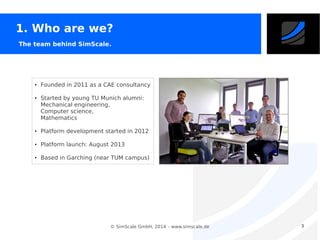
Founded in 2011 as a CAE consultancy
Started by young TU Munich alumni:
Mechanical engineering,
Computer science,
Mathematics

●

Platform development started in 2012

●

Platform launch: August 2013

●

Based in Garching (near TUM campus)

© SimScale GmbH, 2014 – www.simscale.de

3
The idea
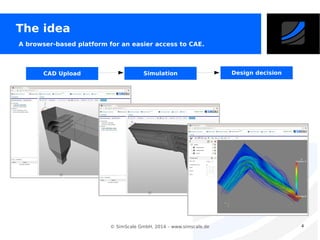
A browser-based platform for an easier access to CAE.

CAD Upload

Simulation

© SimScale GmbH, 2014 – www.simscale.de

Design decision

4
2. The Concept
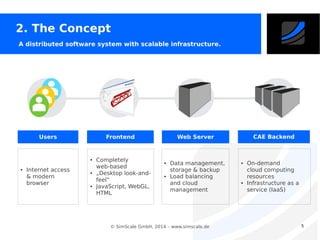
A distributed software system with scalable infrastructure.

Users

Frontend

●

●

Internet access
& modern
browser

●

●

Completely
web-based
„Desktop look-andfeel“
JavaScript, WebGL,
HTML

CAE Backend

Web Server

●

●

Data management,
storage & backup
Load balancing
and cloud
management

© SimScale GmbH, 2014 – www.simscale.de

●

●

On-demand
cloud computing
resources
Infrastructure as a
service (IaaS)

5
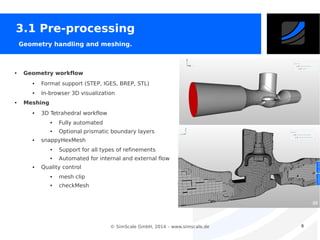
3.1 Pre-processing
Geometry handling and meshing.

●

Geometry workflow
●

●

●

Format support (STEP, IGES, BREP, STL)
In-browser 3D visualization

Meshing
●

3D Tetrahedral workflow
●

●

●

Fully automated
Optional prismatic boundary layers

snappyHexMesh
●

●

●

Support for all types of refinements
Automated for internal and external flow

Quality control
●

mesh clip

●

checkMesh

© SimScale GmbH, 2014 – www.simscale.de

6
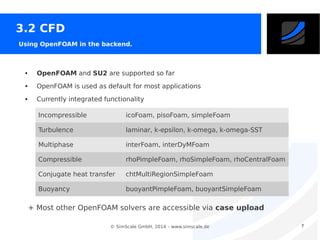
3.2 CFD
Using OpenFOAM in the backend.

●

OpenFOAM and SU2 are supported so far

●

OpenFOAM is used as default for most applications

●

Currently integrated functionality
Incompressible

icoFoam, pisoFoam, simpleFoam

Turbulence

laminar, k-epsilon, k-omega, k-omega-SST

Multiphase

interFoam, interDyMFoam

Compressible

rhoPimpleFoam, rhoSimpleFoam, rhoCentralFoam

Conjugate heat transfer

chtMultiRegionSimpleFoam

Buoyancy

buoyantPimpleFoam, buoyantSimpleFoam

+ Most other OpenFOAM solvers are accessible via case upload
© SimScale GmbH, 2014 – www.simscale.de

7
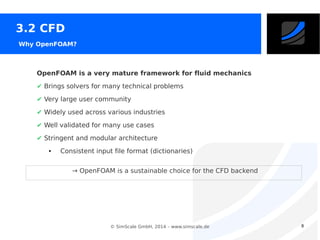
3.2 CFD
Why OpenFOAM?

OpenFOAM is a very mature framework for fluid mechanics
✔ Brings solvers for many technical problems
✔ Very large user community
✔ Widely used across various industries
✔ Well validated for many use cases
✔ Stringent and modular architecture
●

Consistent input file format (dictionaries)
→ OpenFOAM is a sustainable choice for the CFD backend

© SimScale GmbH, 2014 – www.simscale.de

8
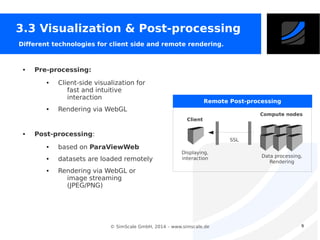
3.3 Visualization & Post-processing
Different technologies for client side and remote rendering.

●

Pre-processing:
●

●

Client-side visualization for
fast and intuitive
interaction

Remote Post-processing

Rendering via WebGL

Compute nodes

Client
●

Post-processing:
●

●

●

SSL

based on ParaViewWeb
datasets are loaded remotely

Displaying,
interaction

Data processing,
Rendering

Rendering via WebGL or
image streaming
(JPEG/PNG)

© SimScale GmbH, 2014 – www.simscale.de

9
4. Enabling users
How can the access to OpenFOAM be simplified?

●

The learning curve for OpenFOAM is somewhat steep

●

OpenFOAM provides features which are very powerful but hard to use
●

Multi regions (conjugate heat transfer)

●

AMI

●

snappyHexMesh (≳ 70 settings for a simple mesh)

What can be done?
→ GUI & 3D interaction (e.g. for boundary condition creation)
→ Best-practice settings where applicable
→ Automated features
→ Library projects as template

© SimScale GmbH, 2014 – www.simscale.de

10
5. Collaboration
New perspectives by using cloud computing.

●

Central data management in the cloud
→ Data is accessible
●

from anywhere

●

at any time

●

by different users

●

Project sharing & public links

●

Project library

●

Advanced features for collaboration
●

●

Interactive, real-time work
on the same project
Interactive post-processing

© SimScale GmbH, 2014 – www.simscale.de

11
6. Backend
Infrastructure as a Service (IaaS) ensures scalability.

●

●

●

●

SimScale owns almost no
computing resources
Computing jobs (meshing / solving)
are prepared on the server and
sent to the cloud provider.
The user can specify the hardware
on which the computation will be
carried out
Completely scalable, however slower
due to multi tenancy and
virtualization

●

EC2
Specs

●
●
●
●

Standard Instances up to 16 cores
Arbitrary connection possible
GPU acceleration possible
10 Gigabit Ethernet, No Infiniband
Virtualization & Multi Tenancy
effects → Speed down

© SimScale GmbH, 2014 – www.simscale.de

12
Thank you.

© SimAcc Engineering, 2012 – www.simucloud.de
©SimScale, 2014 – www.simscale.de

13

openFoam Hangout on Air #2 - Cloud Simulation, presentation by SimScale

  • 1.
    SimScale – Browser-basedCAE. An online simulation platform in the cloud - including OpenFOAM. SimScale GmbH Lichtenbergstraße 8 85748 Garching bei München +49 (0) 160 97383156 1 www.simscale.de
  • 2.
    Outline 1) Who arewe? 2) The concept behind SimScale 3) Feature overview a) Pre-processing b) OpenFOAM solvers c) Visualization and Post-processing 4) Enabling users 5) Cloud and collaboration © SimScale GmbH, 2014 – www.simscale.de 2
  • 3.
    1. Who arewe? The team behind SimScale. ● ● Founded in 2011 as a CAE consultancy Started by young TU Munich alumni: Mechanical engineering, Computer science, Mathematics ● Platform development started in 2012 ● Platform launch: August 2013 ● Based in Garching (near TUM campus) © SimScale GmbH, 2014 – www.simscale.de 3
  • 4.
    The idea A browser-basedplatform for an easier access to CAE. CAD Upload Simulation © SimScale GmbH, 2014 – www.simscale.de Design decision 4
  • 5.
    2. The Concept Adistributed software system with scalable infrastructure. Users Frontend ● ● Internet access & modern browser ● ● Completely web-based „Desktop look-andfeel“ JavaScript, WebGL, HTML CAE Backend Web Server ● ● Data management, storage & backup Load balancing and cloud management © SimScale GmbH, 2014 – www.simscale.de ● ● On-demand cloud computing resources Infrastructure as a service (IaaS) 5
  • 6.
    3.1 Pre-processing Geometry handlingand meshing. ● Geometry workflow ● ● ● Format support (STEP, IGES, BREP, STL) In-browser 3D visualization Meshing ● 3D Tetrahedral workflow ● ● ● Fully automated Optional prismatic boundary layers snappyHexMesh ● ● ● Support for all types of refinements Automated for internal and external flow Quality control ● mesh clip ● checkMesh © SimScale GmbH, 2014 – www.simscale.de 6
  • 7.
    3.2 CFD Using OpenFOAMin the backend. ● OpenFOAM and SU2 are supported so far ● OpenFOAM is used as default for most applications ● Currently integrated functionality Incompressible icoFoam, pisoFoam, simpleFoam Turbulence laminar, k-epsilon, k-omega, k-omega-SST Multiphase interFoam, interDyMFoam Compressible rhoPimpleFoam, rhoSimpleFoam, rhoCentralFoam Conjugate heat transfer chtMultiRegionSimpleFoam Buoyancy buoyantPimpleFoam, buoyantSimpleFoam + Most other OpenFOAM solvers are accessible via case upload © SimScale GmbH, 2014 – www.simscale.de 7
  • 8.
    3.2 CFD Why OpenFOAM? OpenFOAMis a very mature framework for fluid mechanics ✔ Brings solvers for many technical problems ✔ Very large user community ✔ Widely used across various industries ✔ Well validated for many use cases ✔ Stringent and modular architecture ● Consistent input file format (dictionaries) → OpenFOAM is a sustainable choice for the CFD backend © SimScale GmbH, 2014 – www.simscale.de 8
  • 9.
    3.3 Visualization &Post-processing Different technologies for client side and remote rendering. ● Pre-processing: ● ● Client-side visualization for fast and intuitive interaction Remote Post-processing Rendering via WebGL Compute nodes Client ● Post-processing: ● ● ● SSL based on ParaViewWeb datasets are loaded remotely Displaying, interaction Data processing, Rendering Rendering via WebGL or image streaming (JPEG/PNG) © SimScale GmbH, 2014 – www.simscale.de 9
  • 10.
    4. Enabling users Howcan the access to OpenFOAM be simplified? ● The learning curve for OpenFOAM is somewhat steep ● OpenFOAM provides features which are very powerful but hard to use ● Multi regions (conjugate heat transfer) ● AMI ● snappyHexMesh (≳ 70 settings for a simple mesh) What can be done? → GUI & 3D interaction (e.g. for boundary condition creation) → Best-practice settings where applicable → Automated features → Library projects as template © SimScale GmbH, 2014 – www.simscale.de 10
  • 11.
    5. Collaboration New perspectivesby using cloud computing. ● Central data management in the cloud → Data is accessible ● from anywhere ● at any time ● by different users ● Project sharing & public links ● Project library ● Advanced features for collaboration ● ● Interactive, real-time work on the same project Interactive post-processing © SimScale GmbH, 2014 – www.simscale.de 11
  • 12.
    6. Backend Infrastructure asa Service (IaaS) ensures scalability. ● ● ● ● SimScale owns almost no computing resources Computing jobs (meshing / solving) are prepared on the server and sent to the cloud provider. The user can specify the hardware on which the computation will be carried out Completely scalable, however slower due to multi tenancy and virtualization ● EC2 Specs ● ● ● ● Standard Instances up to 16 cores Arbitrary connection possible GPU acceleration possible 10 Gigabit Ethernet, No Infiniband Virtualization & Multi Tenancy effects → Speed down © SimScale GmbH, 2014 – www.simscale.de 12
  • 13.
    Thank you. © SimAccEngineering, 2012 – www.simucloud.de ©SimScale, 2014 – www.simscale.de 13