HORIZON 2020
OPEN ACCESS MANDATE
“Webinar for project coordinators and researchers on Open Access to publications in H2020”
Tuesday, October 25, 2016 at 12.00 CEST
{eloy}, {pedroprincipe}@sdum.uminho.pt
Eloy
Rodrigues
UNIVERSITY OF
MINHO
Pedro
Príncipe
UNIVERSITY OF
MINHO
HORIZON 2020
OPEN ACCESS MANDATE
Webinar for project coordinators and researchers on Open Access to publications in H2020
Eloy Rodrigues & Pedro Príncipe
University of Minho
OpenAIRE Helpdesk & Training managers
Agenda
1.OA in H2020: summary of requirements
2.OA in H2020: Practical implementation
3.OpenAIRE support services and tools
3
DEFAULT
Open Access is the
for research results in H2020
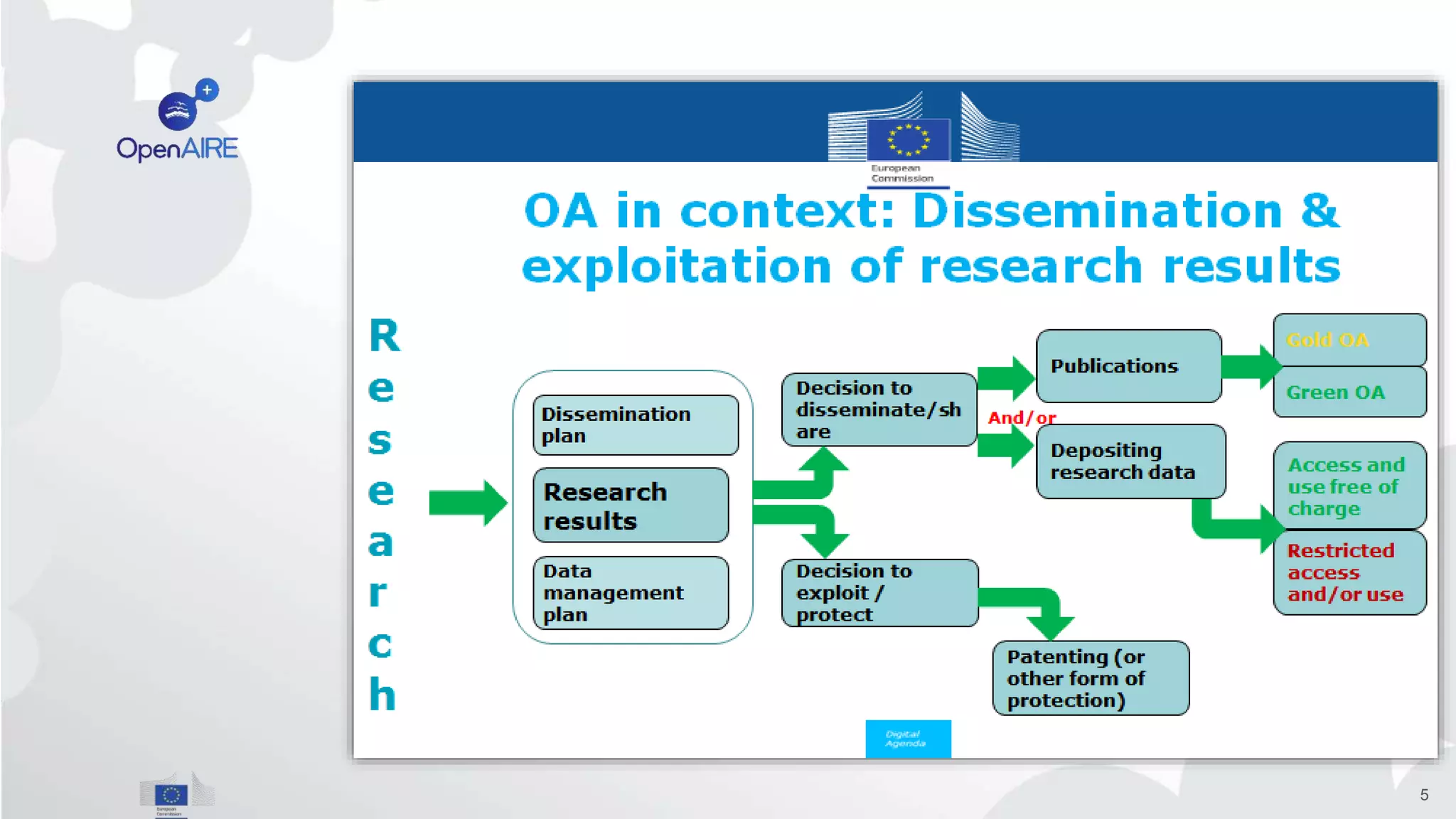
5
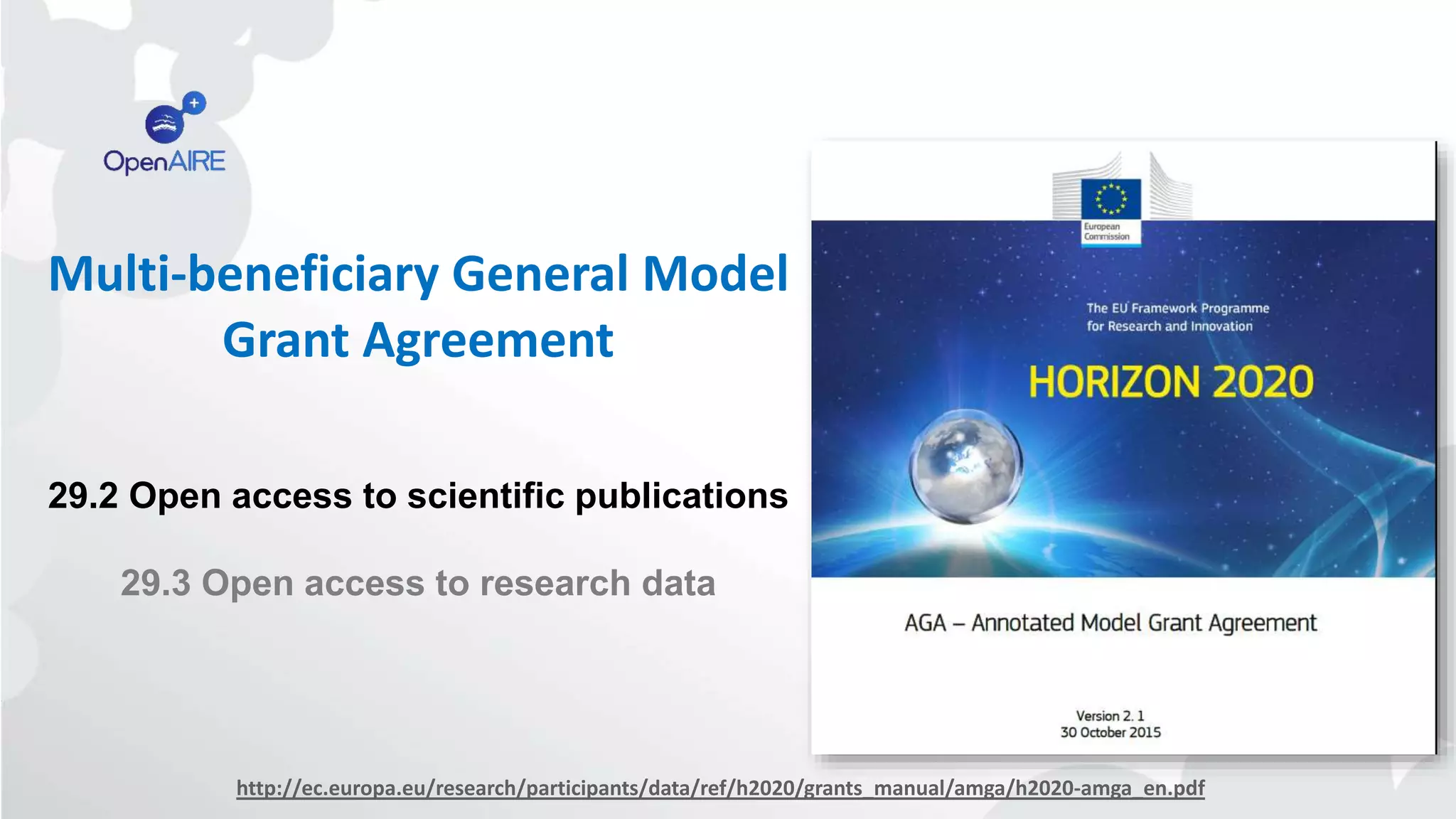
Multi-beneficiary General Model
Grant Agreement
29.2 Open access to scientific publications
29.3 Open access to research data
http://ec.europa.eu/research/participants/data/ref/h2020/grants_manual/amga/h2020-amga_en.pdf
Grant Agreement: § 29.2 Open access to
scientific publications
Each beneficiary must ensure open access (free of charge, online access for any user) to
all peer-reviewed scientific publications relating to its results.
In particular, it must:
(a) as soon as possible and at the latest on publication, deposit a machine-readable
electronic copy of the published version or final peer-reviewed manuscript accepted
for publication in a repository for scientific publications;
Moreover, the beneficiary must aim to deposit at the same time the research data
needed to validate the results presented in the deposited scientific publications.
(b) ensure open access to the deposited publication — via the repository — at the latest:
(i) on publication, if an electronic version is available for free via the publisher, or
(ii) within six months of publication (twelve months for publications in the social
sciences and humanities) in any other case.
(c) ensure open access — via the repository — to the bibliographic metadata that identify
the deposited publication.
The bibliographic metadata must be in a standard format and must include all of the following:
- the terms ["European Union (EU)" and "Horizon 2020"]["Euratom" and Euratom research and training programme 2014-2018"];
- the name of the action, acronym and grant number;
- the publication date, and length of embargo period if applicable, and
- a persistent identifier.
OA in H2020:
summary of requirements
1
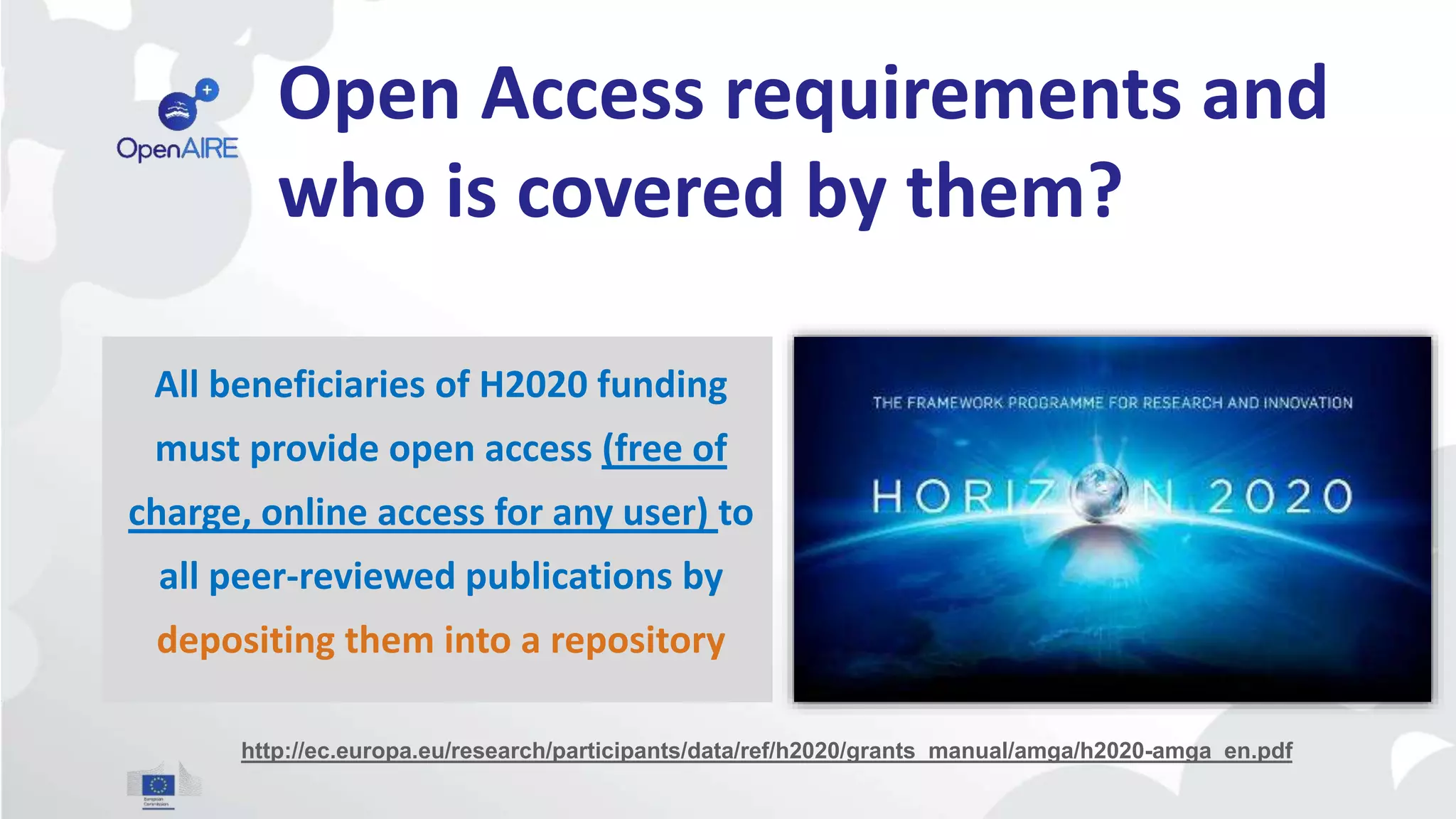
Open Access requirements and
who is covered by them?
All beneficiaries of H2020 funding
must provide open access (free of
charge, online access for any user) to
all peer-reviewed publications by
depositing them into a repository
http://ec.europa.eu/research/participants/data/ref/h2020/grants_manual/amga/h2020-amga_en.pdf
In other words...
Authors are free to choose between the two main and non-exclusive
routes toward Open Access
• Self-archiving (‚green‘ open access): the published article or the final peer
reviewed manuscript is uploaded in an online repository – access is often
delayed (‚embargo period‘)
• Open access publishing (‚gold‘ open access): the article is immediately in open
access mode, through the publisher. The associated costs are covered by the
author/institution/funder.
The article must always be deposited in a repository,
even if the gold route has been choosen.
Where to deposit?
• Institutional repository
OR
• Disciplinary repository (arXiv, Europe
PubMed Central, etc.)
OR
• Zenodo (www.zenodo.org) if none of the
above is available. EC-cofunded,
multidisciplinary repository, for
publications and data.
Remarks:
• Finding a repository via registries: ROAR
http://roar.eprints.org/, OpenDOAR
http://www.opendoar.org/ or via OpenAIRE
(more details later)
• A list of publications on the project website is
not sufficient.
• How to bring all publications together?
• OpenAIRE-compatibility to enable the
harvesting of metadata (more details later)
where what when
What to deposit?
• The final peer-reviewed manuscript, accepted for publication, including
all modifications from the peer-review process
OR
• A machine-readable copy of the published version (usually a PDF
document)
In principle this applies to all kinds of publications,
but emphasis is on peer-reviewed journal articles.
where what when
When to deposit?
• Each beneficiary must deposit as soon as
possible and at the latest on publication.
where what when
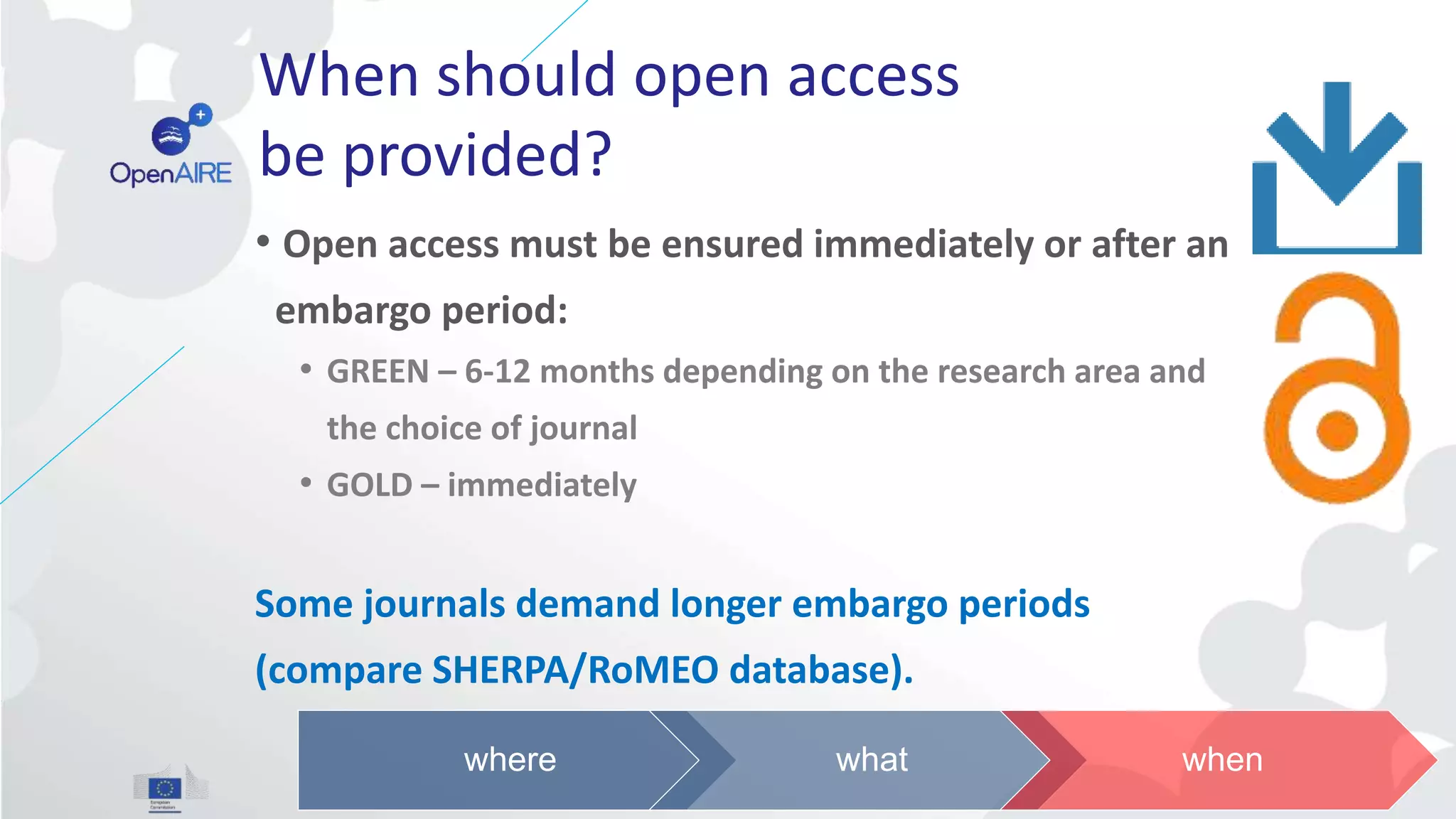
When should open access
be provided?
• Open access must be ensured immediately or after an
embargo period:
• GREEN – 6-12 months depending on the research area and
the choice of journal
• GOLD – immediately
Some journals demand longer embargo periods
(compare SHERPA/RoMEO database).
where what when
Practical
implementation
2
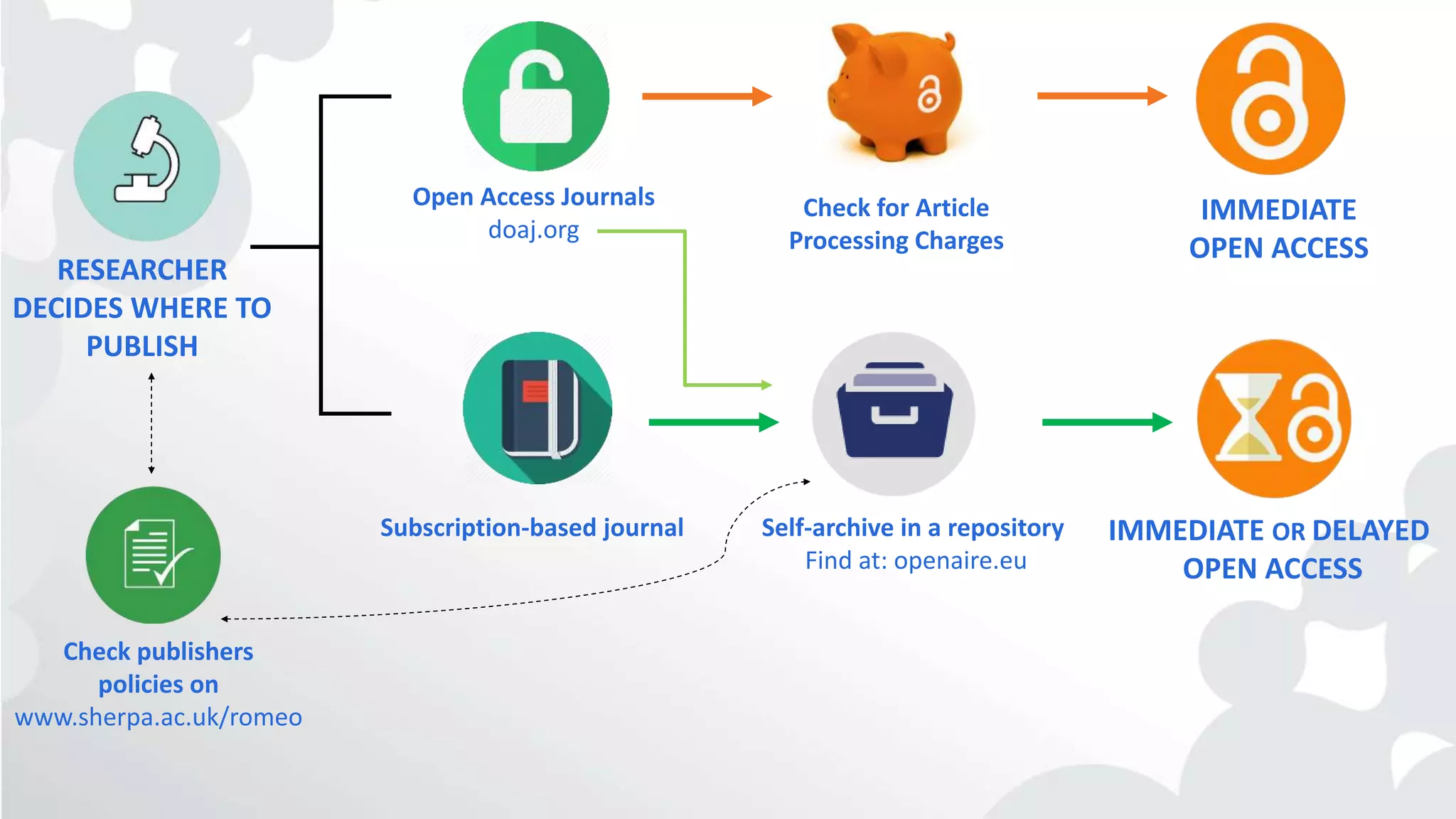
RESEARCHER
DECIDES WHERE TO
PUBLISH
Check publishers
policies on
www.sherpa.ac.uk/romeo
Open Access Journals
doaj.org
Check for Article
Processing Charges
Subscription-based journal Self-archive in a repository
Find at: openaire.eu
IMMEDIATE
OPEN ACCESS
IMMEDIATE OR DELAYED
OPEN ACCESS
Metadata requirements on
repository deposition
Beneficiaries must ensure immediate open access to the
bibliographic metadata that identify the deposited publication
in a standard format and must include all of the following:
• the terms ["European Union (EU)" and "Horizon 2020"]["Euratom"
and Euratom research and training programme 2014-2018"];
• the name of the action, acronym and grant number;
• the publication date, and length of embargo period if applicable, and
• a persistent identifier.
Are Article Processing Charges (APCs)
supported?
Yes
• For open access publishing, researchers can publish in open access
journals, or in journals that sell subscriptions and also offer the
possibility of making individual articles openly accessible (hybrid
journals).
• Where the case, the Article Processing Charges (APCs) incurred by
beneficiaries are eligible for reimbursement during the duration of
the action.
Publication costs
Dissemination costs, e.g. for publishing in open access journals/books, are
eligible costs if incurred during the project period.
What budget to consider in proposals?
APC = Article Processing Charges
Budget for Publications = Average APC x number of publications
Method 1: Average APC based on list of journals used by the consortium (look up prices at
publisher website and/or consult librarian)
Method 2: Average APC based on general market figures (see next slide)
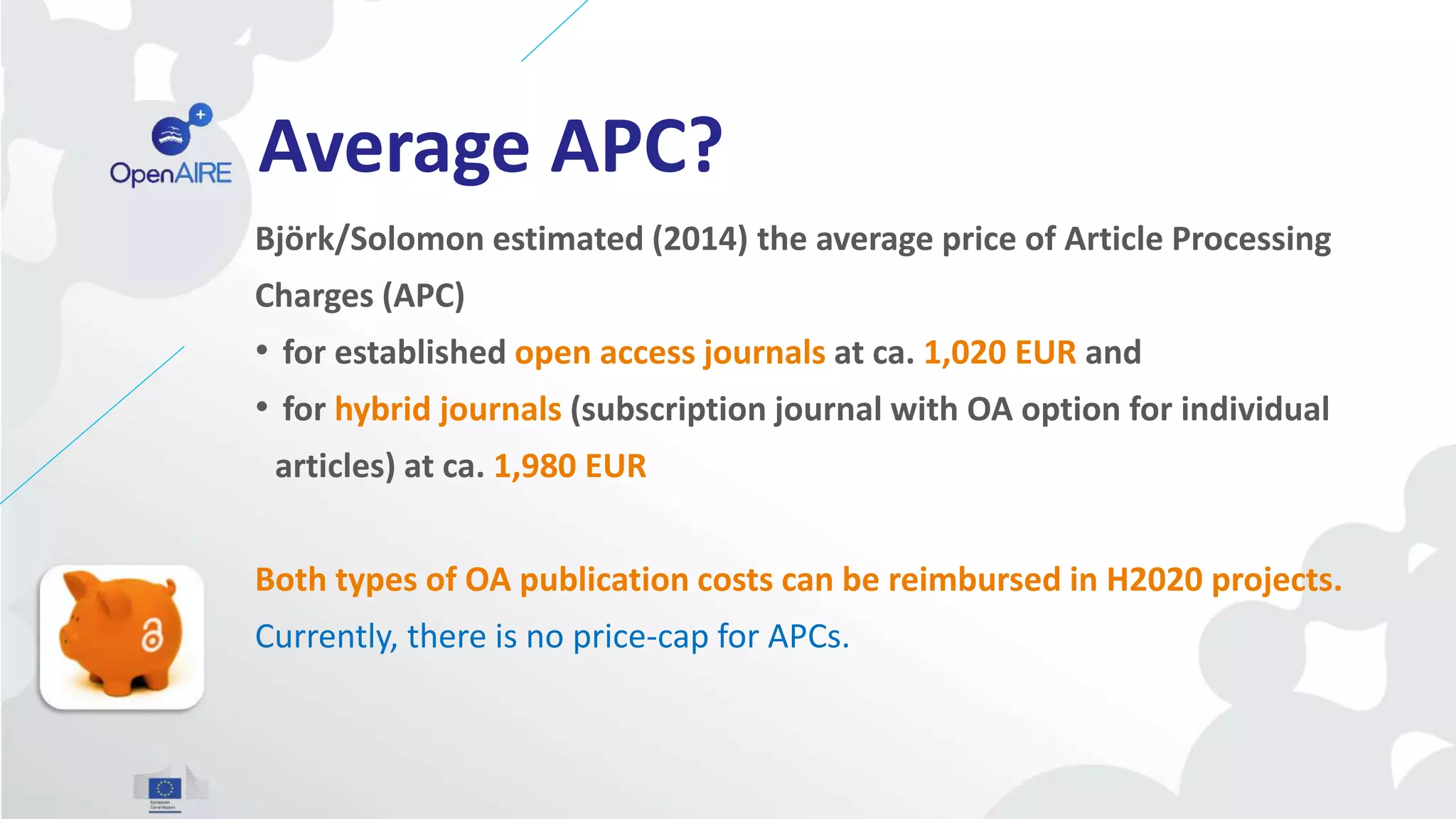
Average APC?
Björk/Solomon estimated (2014) the average price of Article Processing
Charges (APC)
• for established open access journals at ca. 1,020 EUR and
• for hybrid journals (subscription journal with OA option for individual
articles) at ca. 1,980 EUR
Both types of OA publication costs can be reimbursed in H2020 projects.
Currently, there is no price-cap for APCs.
What are projects expected to do?
• DURING PROPOSAL WRITING PHASE
• Outline of dissemination and exploitation strategy, including OA >> impact section of the
proposal (how will results be shared, data be managed and shared?)
• Include resources for publication costs (what journals, how many publications, what does it cost
on average?)
• Combine GREEN/GOLD strategies to achieve maximum of OA
• DURING THE PROJECT
• Additional provisions in the Consortium Agreement? (where to deposit, who is responsible)
• Implementation of the dissemination strategy, report at reviews and update
• What issues occur and how can they be solved? (publisher embargos, repositories for specific
material, etc.)
• AFTER THE PROJECT END
• Are there publications foreseen after the ending of the project (ie which will not be covered by
the budget) – for post-FP7 project publications there is a gold OA pilot in H2020
• Who takes care of deposit in repositories after the project end?
Projects have to start planning early on
Some issues to consider
1. Publishing all articles in APC based gold OA is not probably the
right solution, as this can lead to a substantial amount of the
overall project budget.
Therefore, a mixed strategy of GREEN/GOLD open access is highly
recommended.
2. The growing open access market comes with some challenges
• Lots of new journals/publishers, some of questionable quality (‚predatory
journals‘, http://scholarlyoa.com/publishers/)
Some caution is needed when publishing, this holds for all
journals. Consult ‚white lists‘ such as DOAJ.
What are the consequences for non-
compliance with OA requirements?
If a beneficiary breaches any of its
obligations, the grant may be reduced
(Article 43) and it may also lead to any
of the other measures described
in Chapter 6 of the General Model
Grant Agreement.
http://ec.europa.eu/research/participants/data/ref/h2020/mga/gga/h2020-mga-gga-multi_en.pdf
24
OpenAIRE
3
OPEN ACCESS
OpenAIRE implements the
EC requirements
& SUPPORTS THE OPEN DATA PILOT
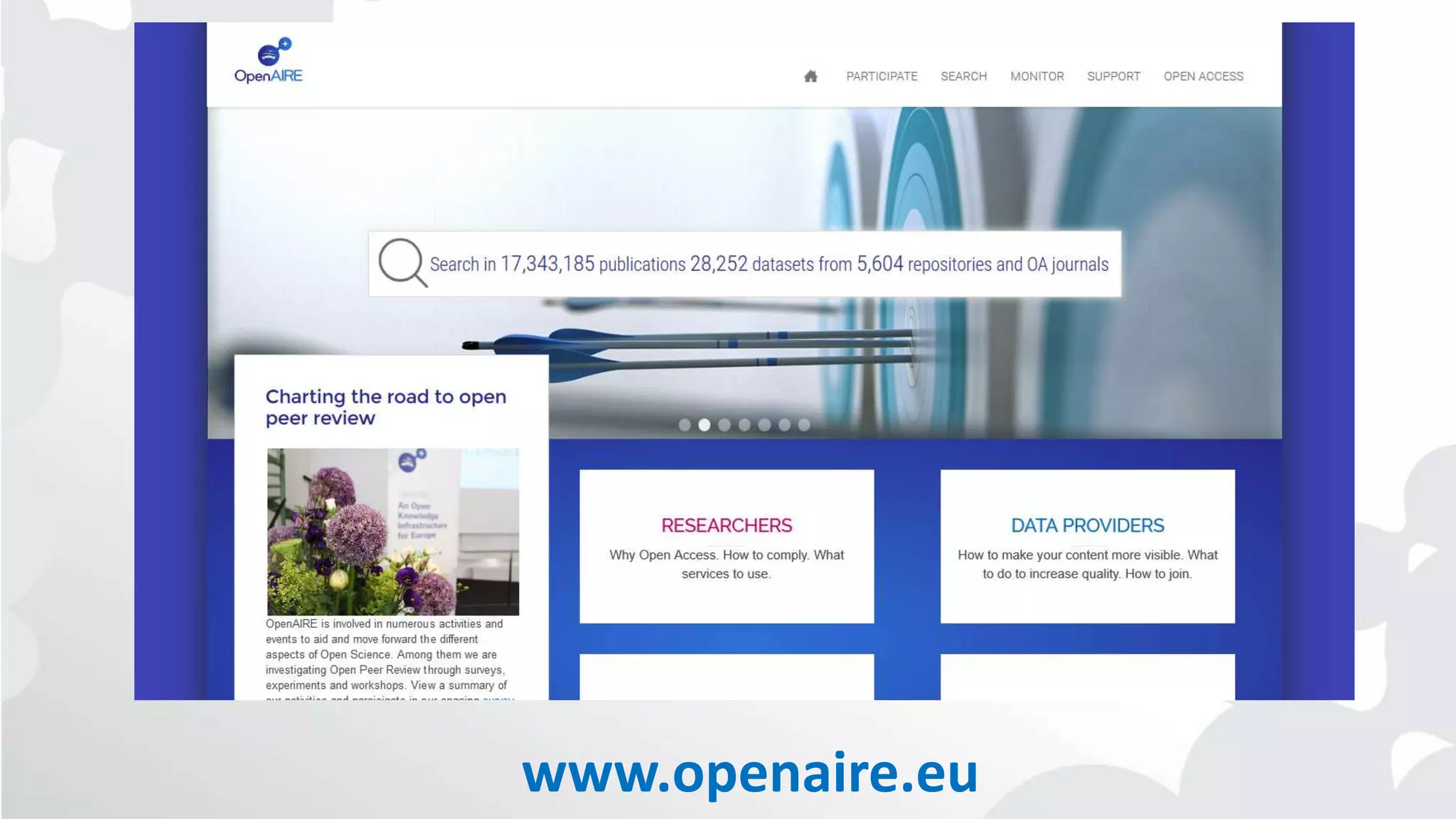
www.openaire.eu
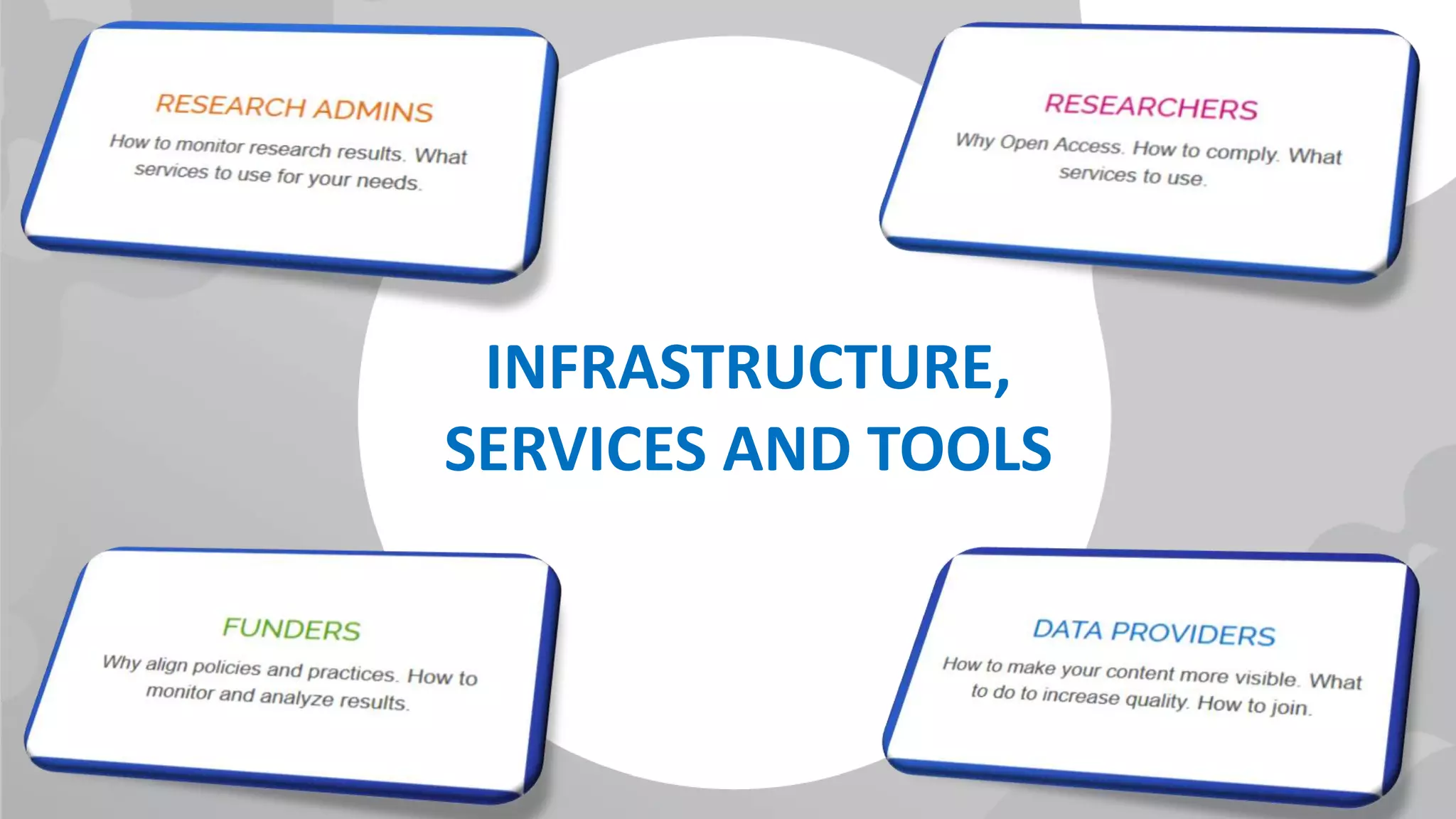
INFRASTRUCTURE,
SERVICES AND TOOLS
SHARE, DEPOSIT AND PUBLISH IN OA
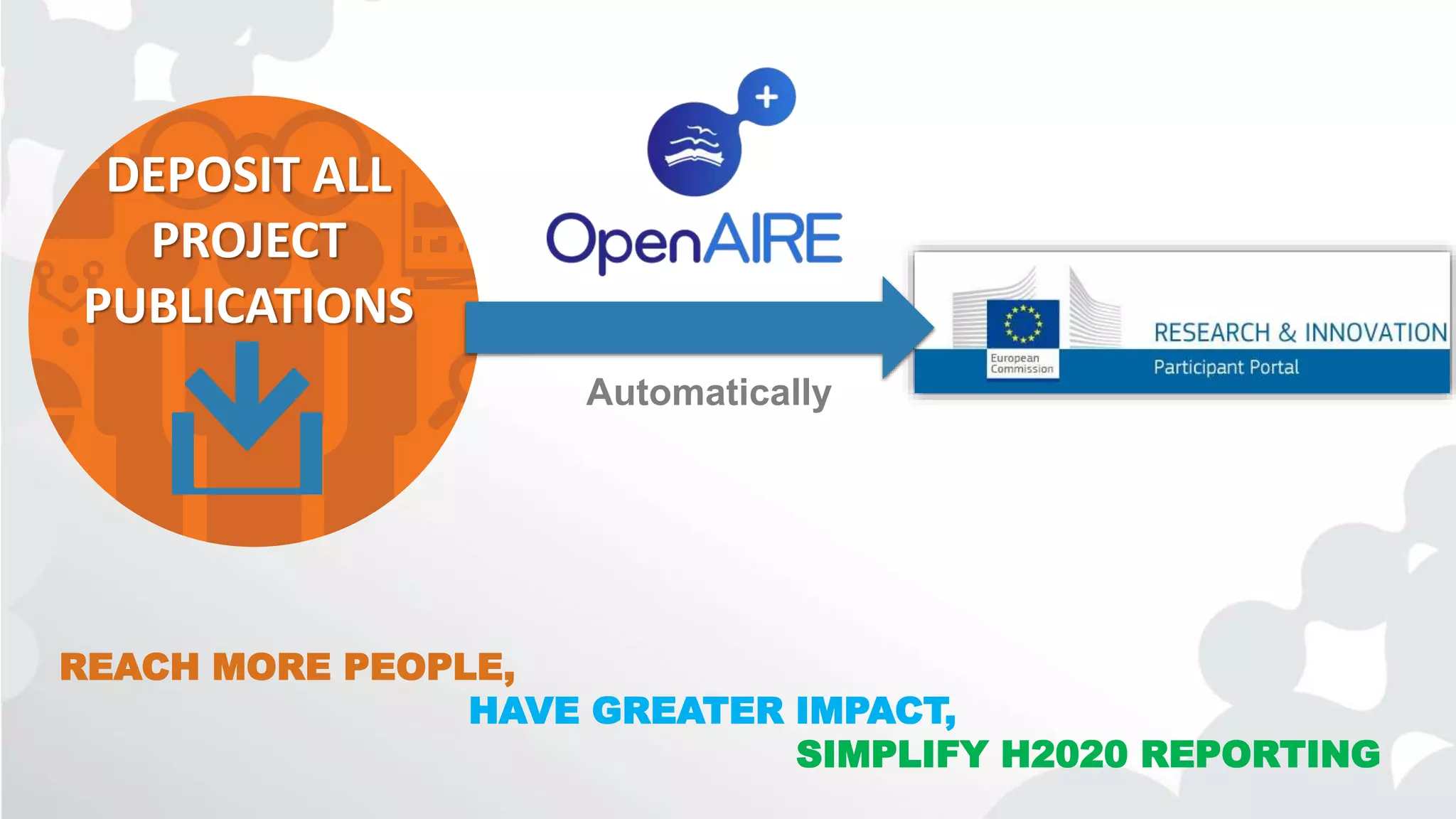
DEPOSIT ALL
PROJECT
PUBLICATIONS
Automatically
REACH MORE PEOPLE,
HAVE GREATER IMPACT,
SIMPLIFY H2020 REPORTING
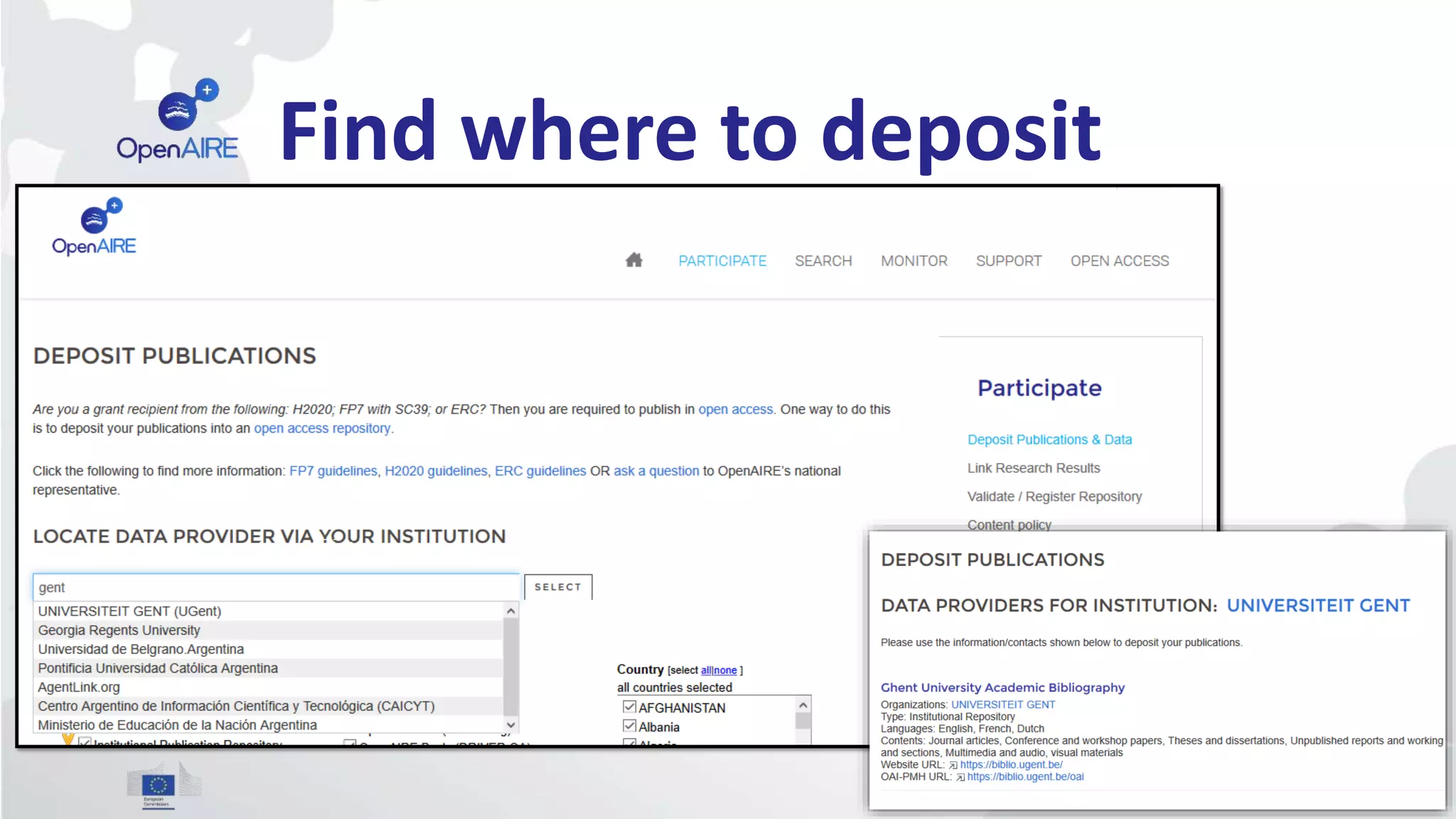
LOCATE AN APPROPRIATED REPOSITORY
Deposit once!
Via OpenAIRE
31
Find where to deposit
32
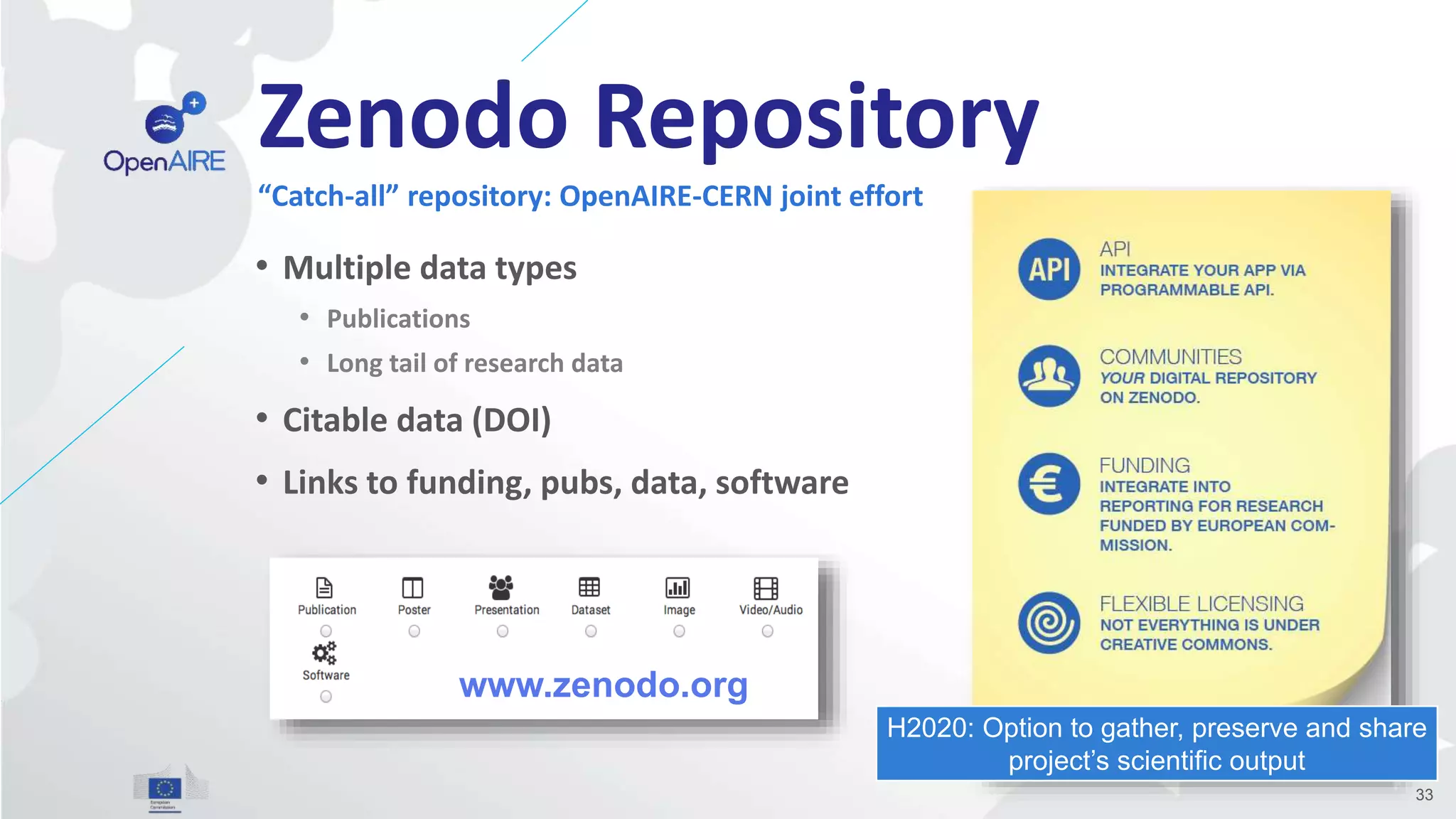
Zenodo Repository
• Multiple data types
• Publications
• Long tail of research data
• Citable data (DOI)
• Links to funding, pubs, data, software
“Catch-all” repository: OpenAIRE-CERN joint effort
33
www.zenodo.org
H2020: Option to gather, preserve and share
project’s scientific output
PROJECT FUNDING IN THE PUBLICATION
OR DATASET METADATA RECORD
Acknowledge
34
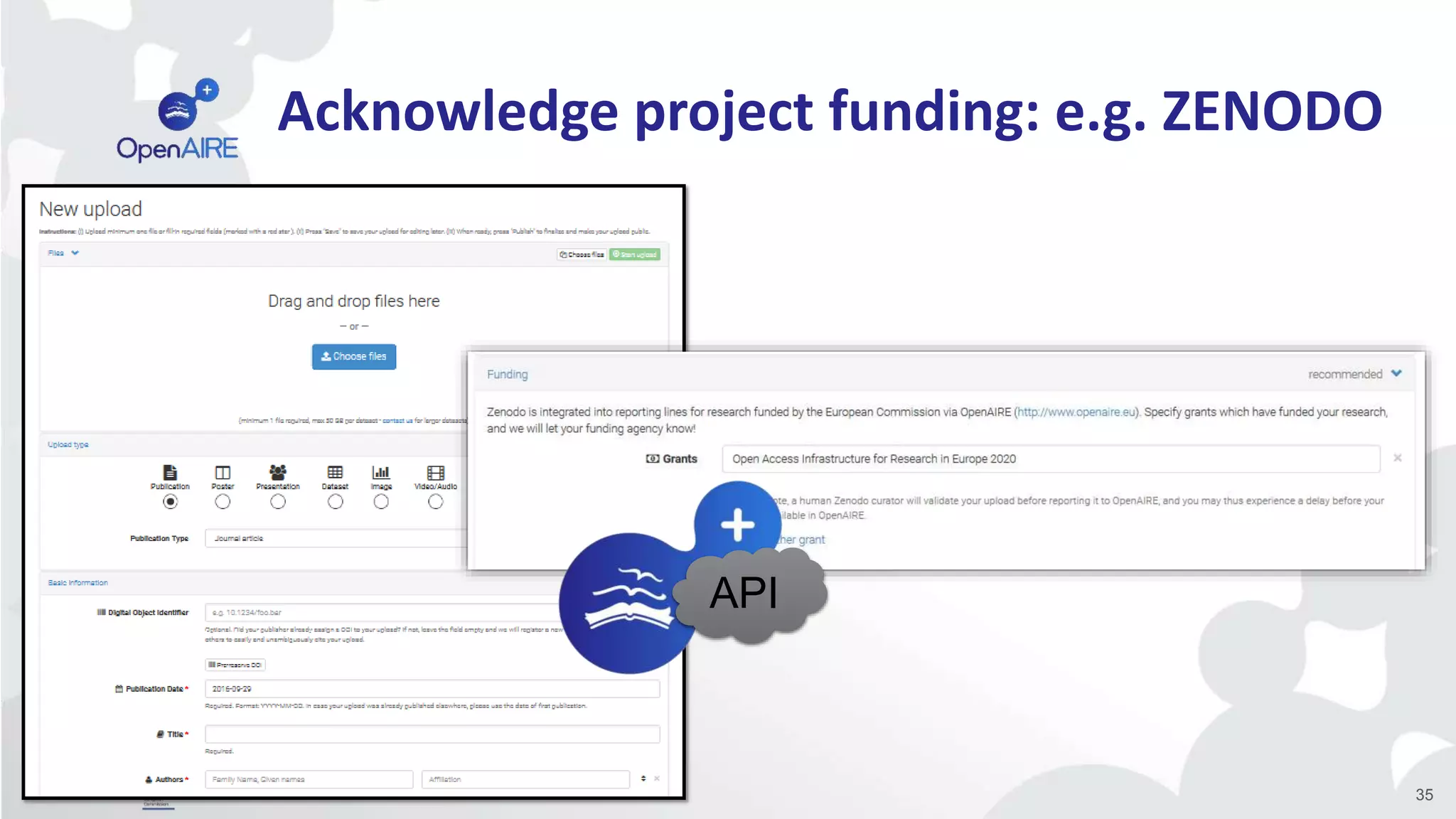
Acknowledge project funding: e.g. ZENODO
35
API
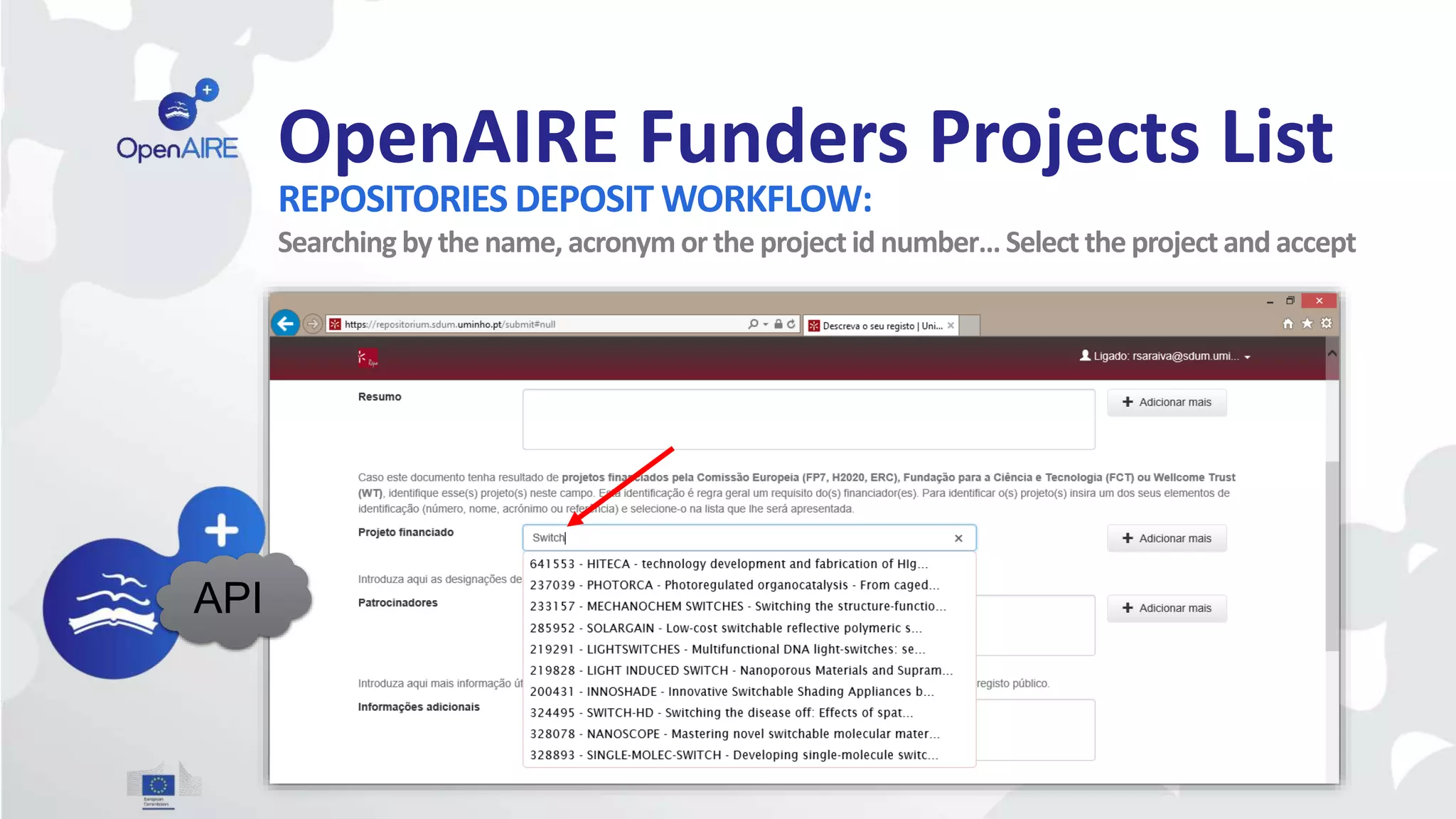
REPOSITORIES DEPOSIT WORKFLOW:
Searching by the name, acronym or the project id number… Select the project and accept
OpenAIRE Funders Projects List
API
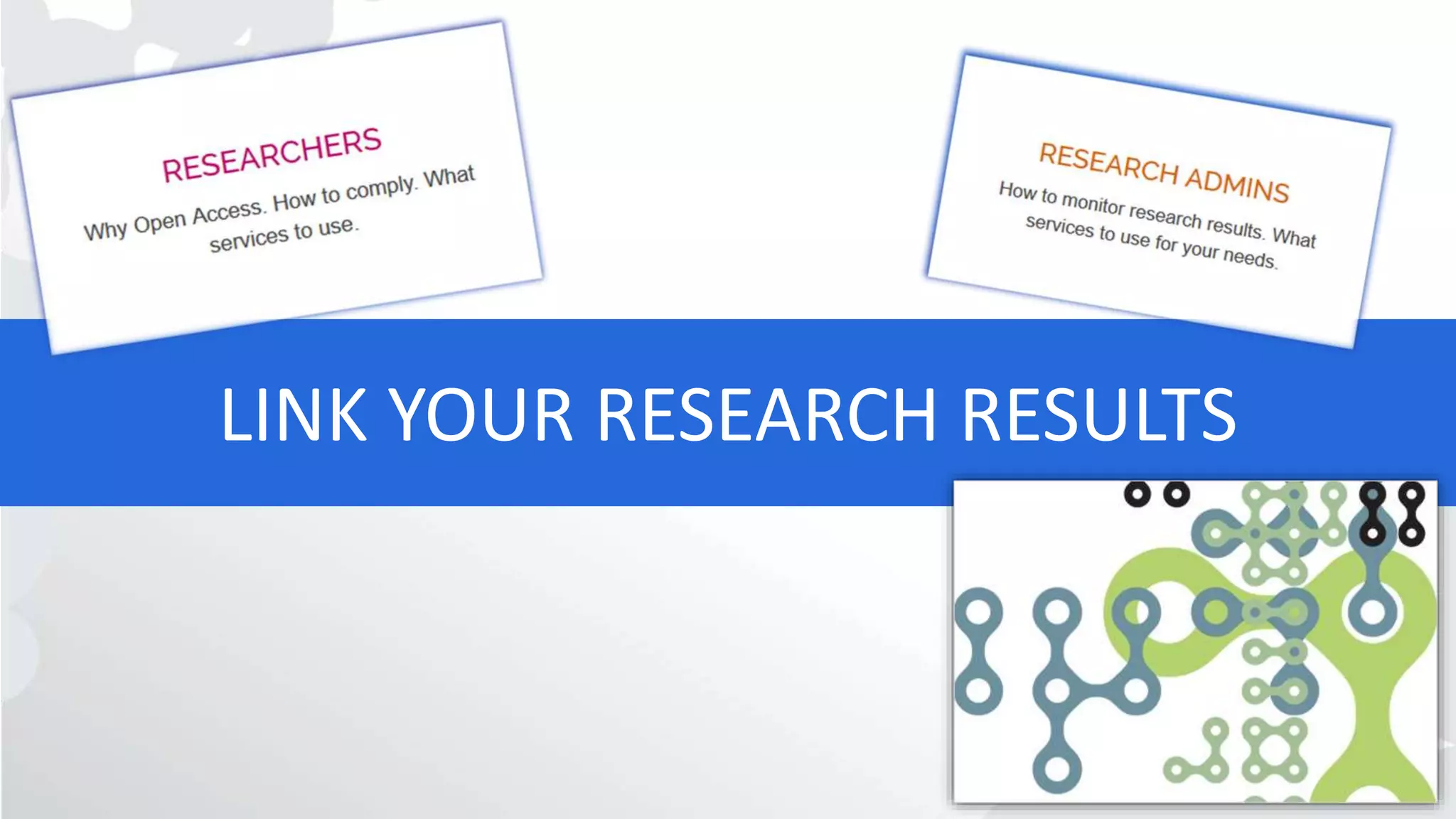
LINK YOUR RESEARCH RESULTS
USE OUR LINKING SERVICES AFTERWARDS AND
ASSOCIATE YOUR RESEARCH RESULTS
When you publish or deposit in OA
make sure you use a fully OpenAIRE
compatible repository. If you don't…
38
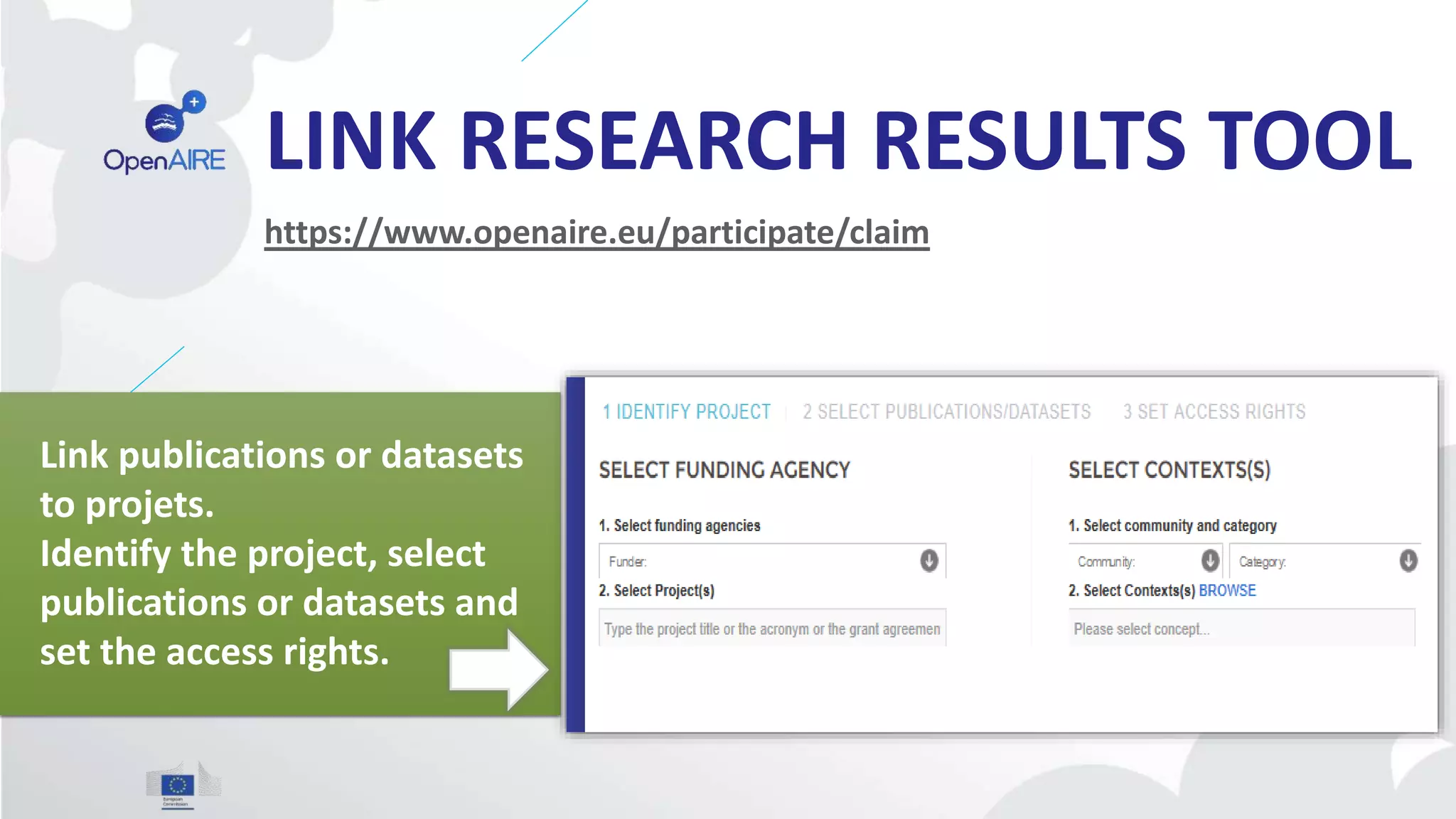
LINK RESEARCH RESULTS TOOL
https://www.openaire.eu/participate/claim
Link publications or datasets
to projets.
Identify the project, select
publications or datasets and
set the access rights.
GATHER OUTPUTS, VIEW PROGRESS AND REPORT
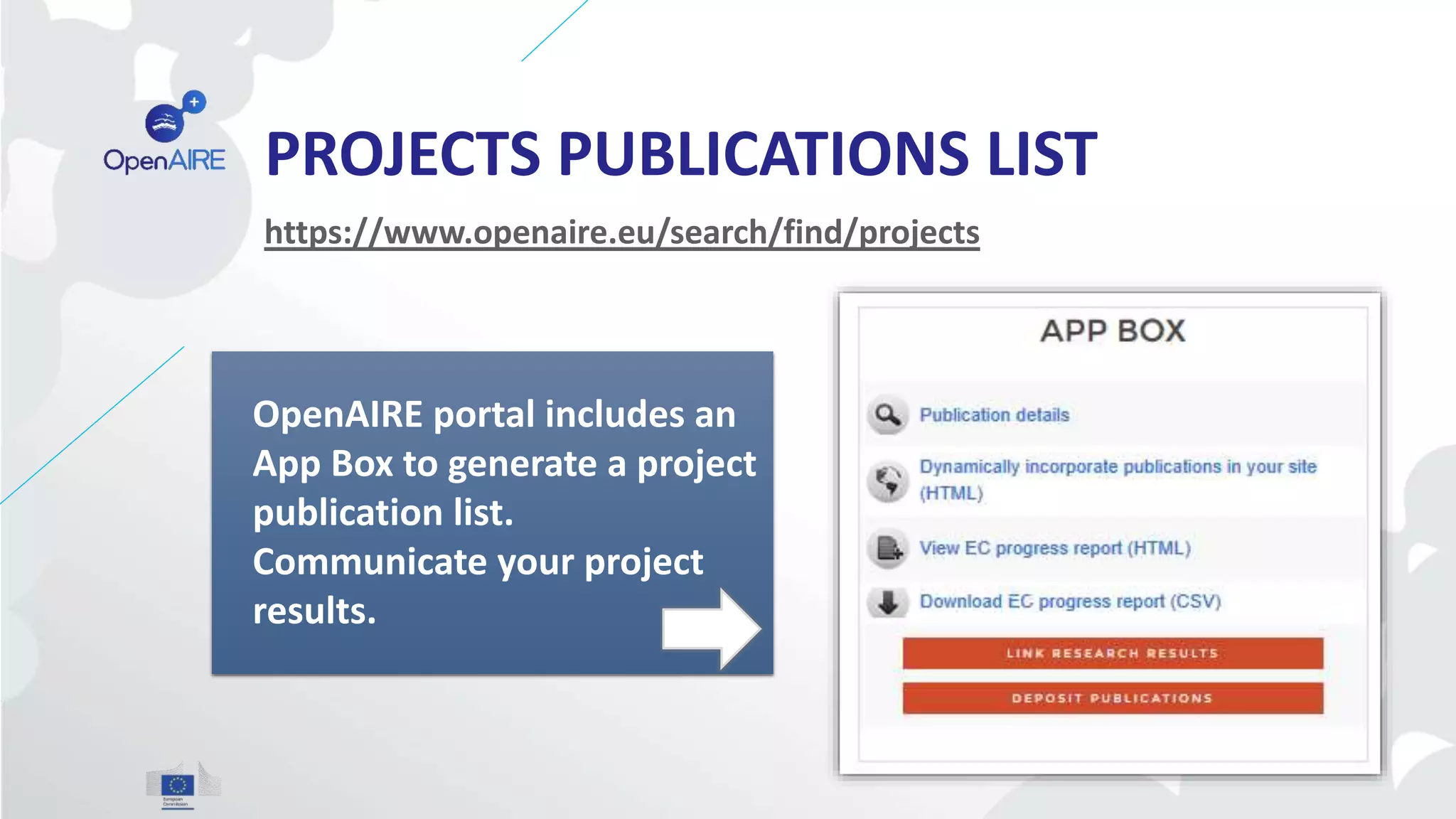
PROJECTS PUBLICATIONS LIST
https://www.openaire.eu/search/find/projects
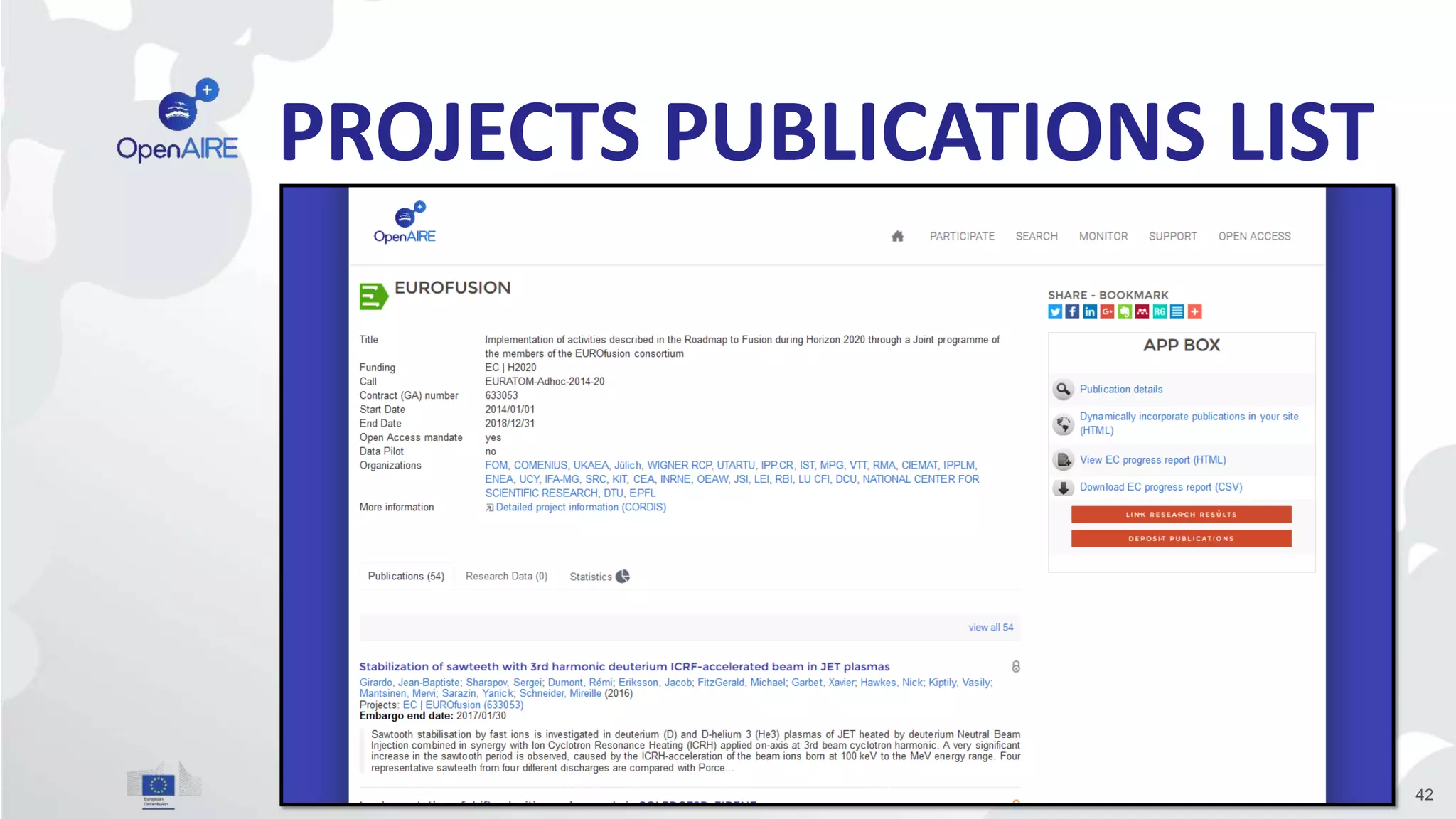
OpenAIRE portal includes an
App Box to generate a project
publication list.
Communicate your project
results.
PROJECTS PUBLICATIONS LIST
42
MONITOR AND REPORTING
YOUR PUBLICATIONS WILL BE REPORTED
AUTOMATICALLY TO THE EC'S PARTICIPANT
PORTAL AT REPORTING TIME.
Once you deposit in a fully
OpenAIRE compliant repository
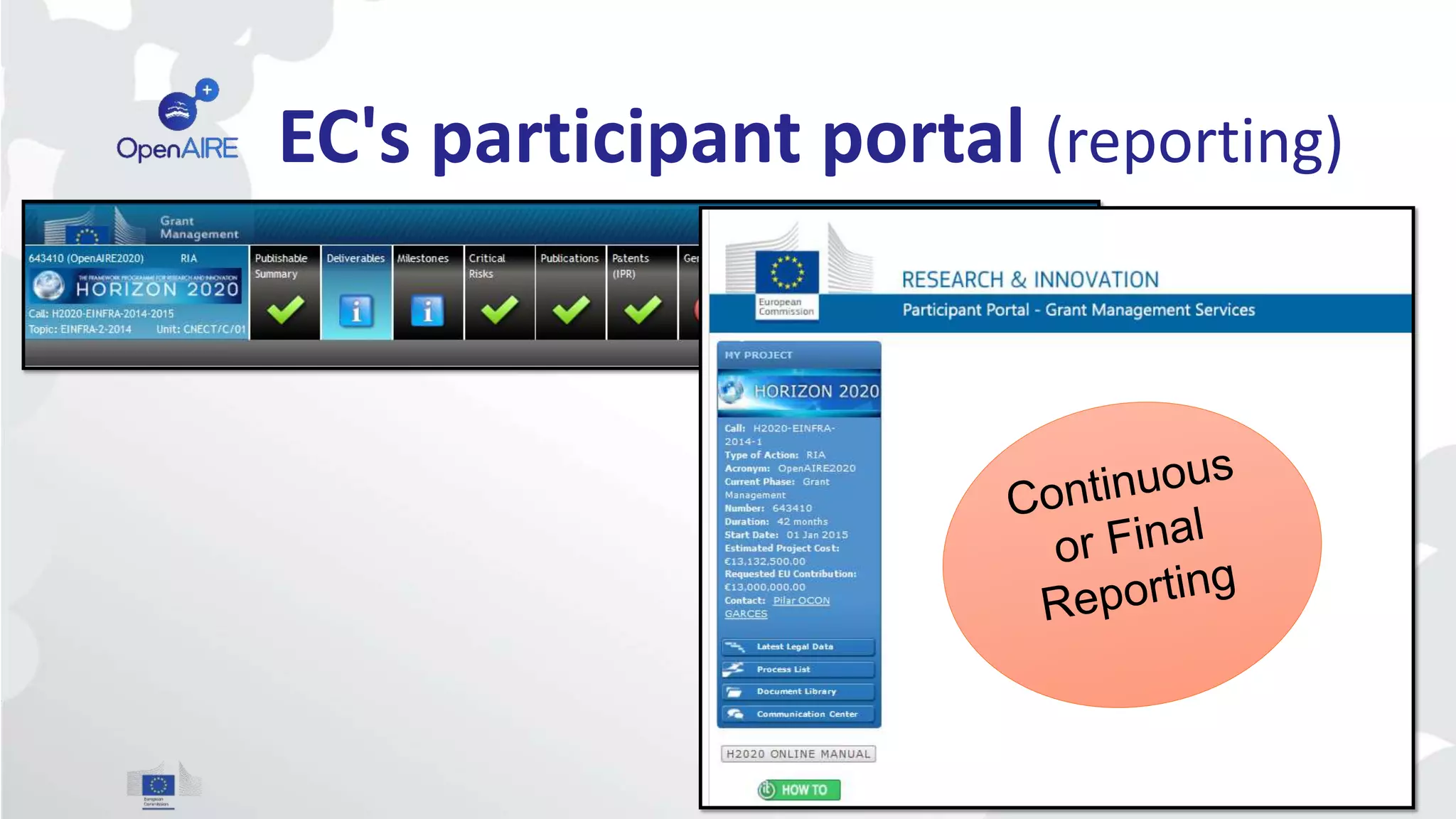
EC's participant portal (reporting)
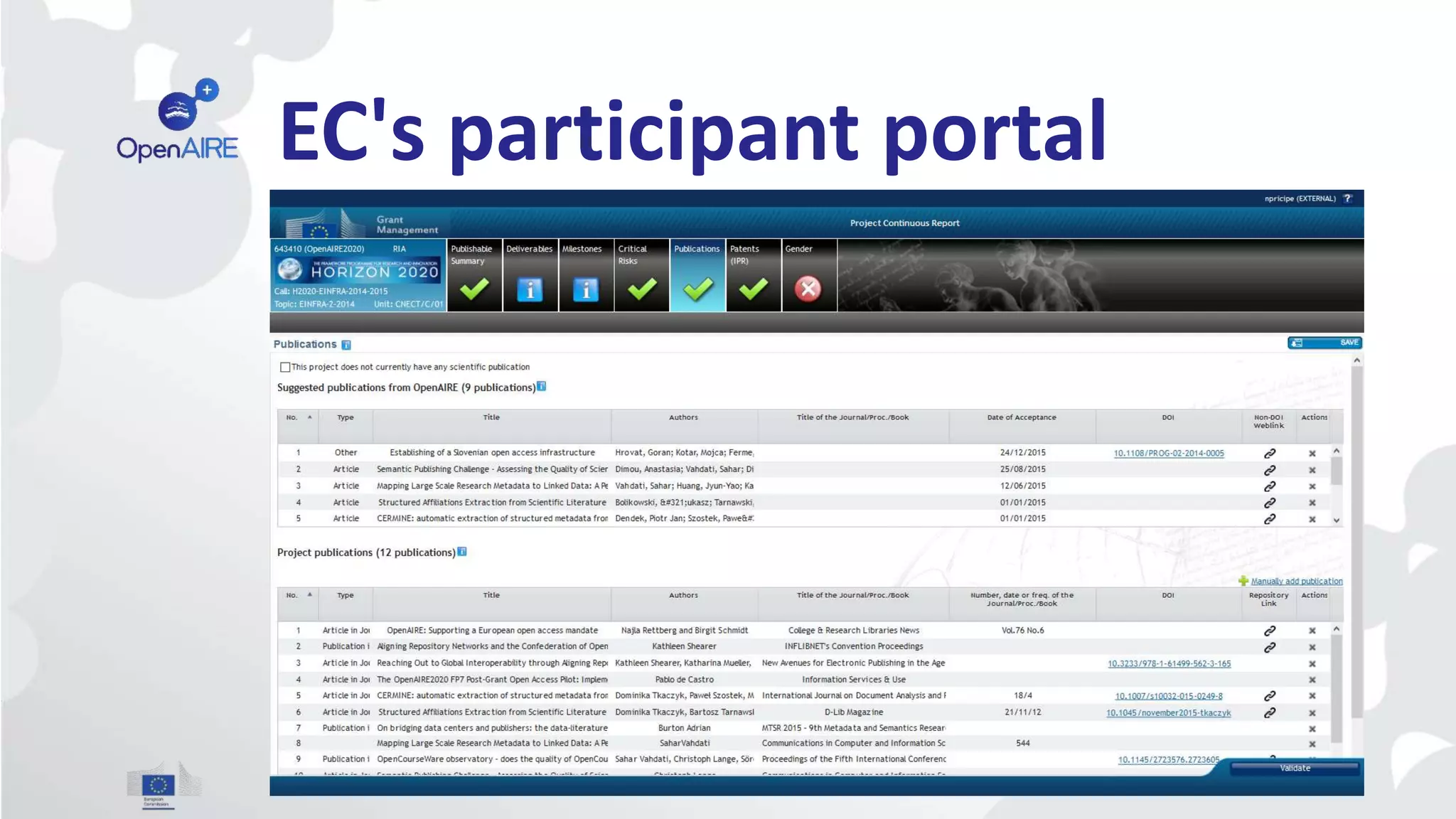
EC's participant portal
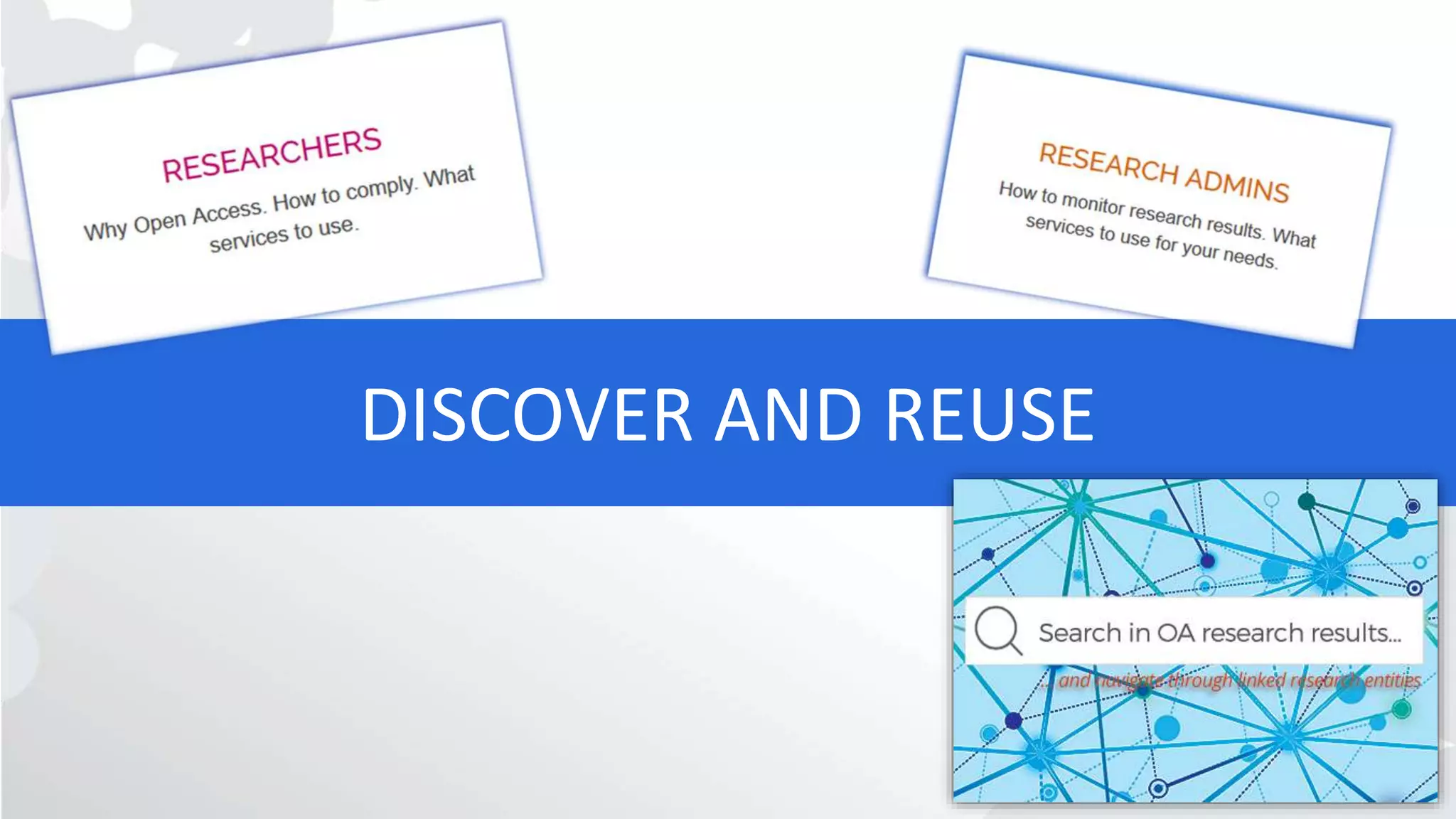
DISCOVER AND REUSE
DISCOVERY/ACCESS
SERVICE
Public (all)
48
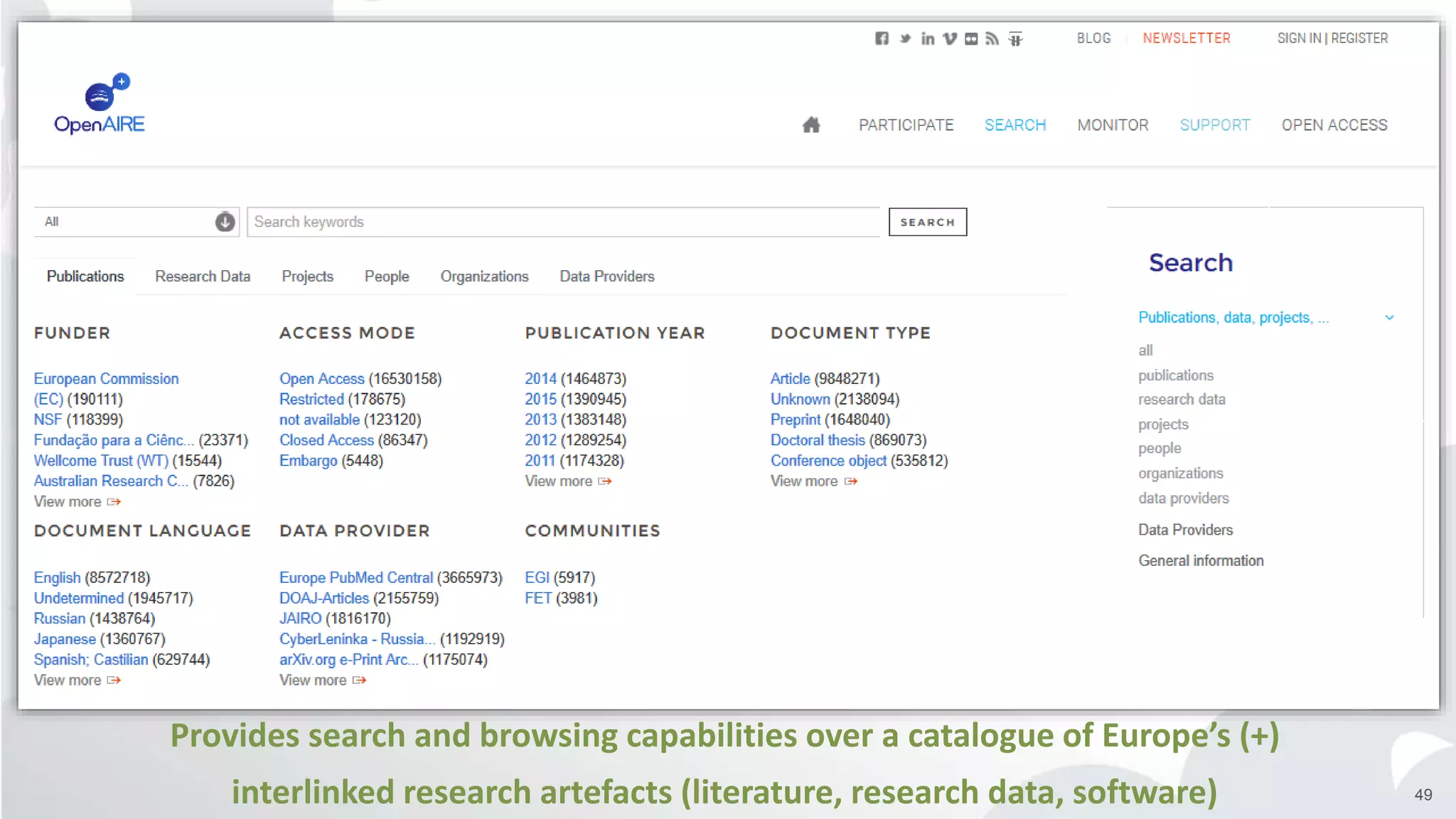
Provides search and browsing capabilities over a catalogue of
Europe’s (+) interlinked research artefacts (literature, research data,
software)
49
Provides search and browsing capabilities over a catalogue of Europe’s (+)
interlinked research artefacts (literature, research data, software)
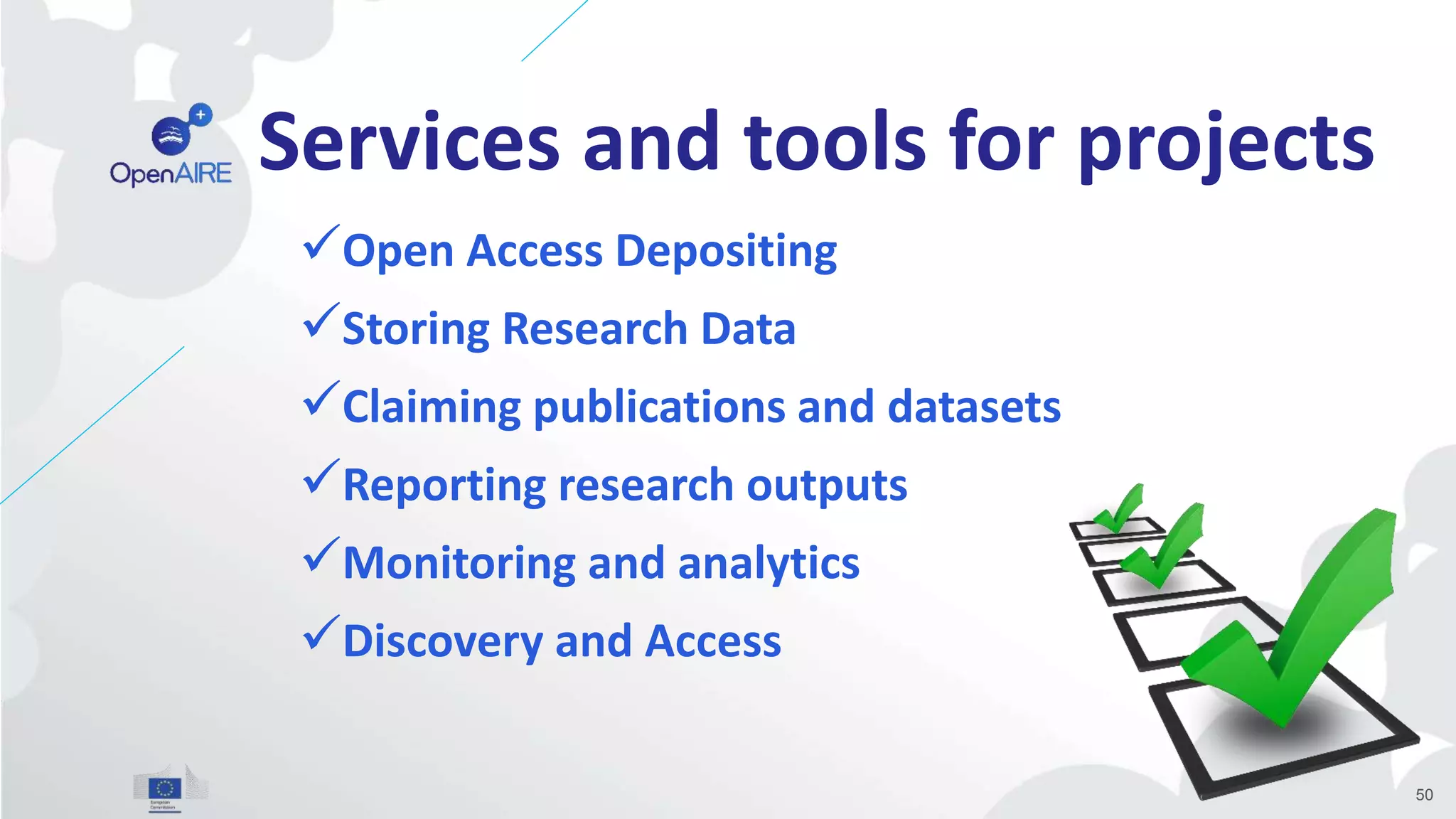
Services and tools for projects
Open Access Depositing
Storing Research Data
Claiming publications and datasets
Reporting research outputs
Monitoring and analytics
Discovery and Access
50
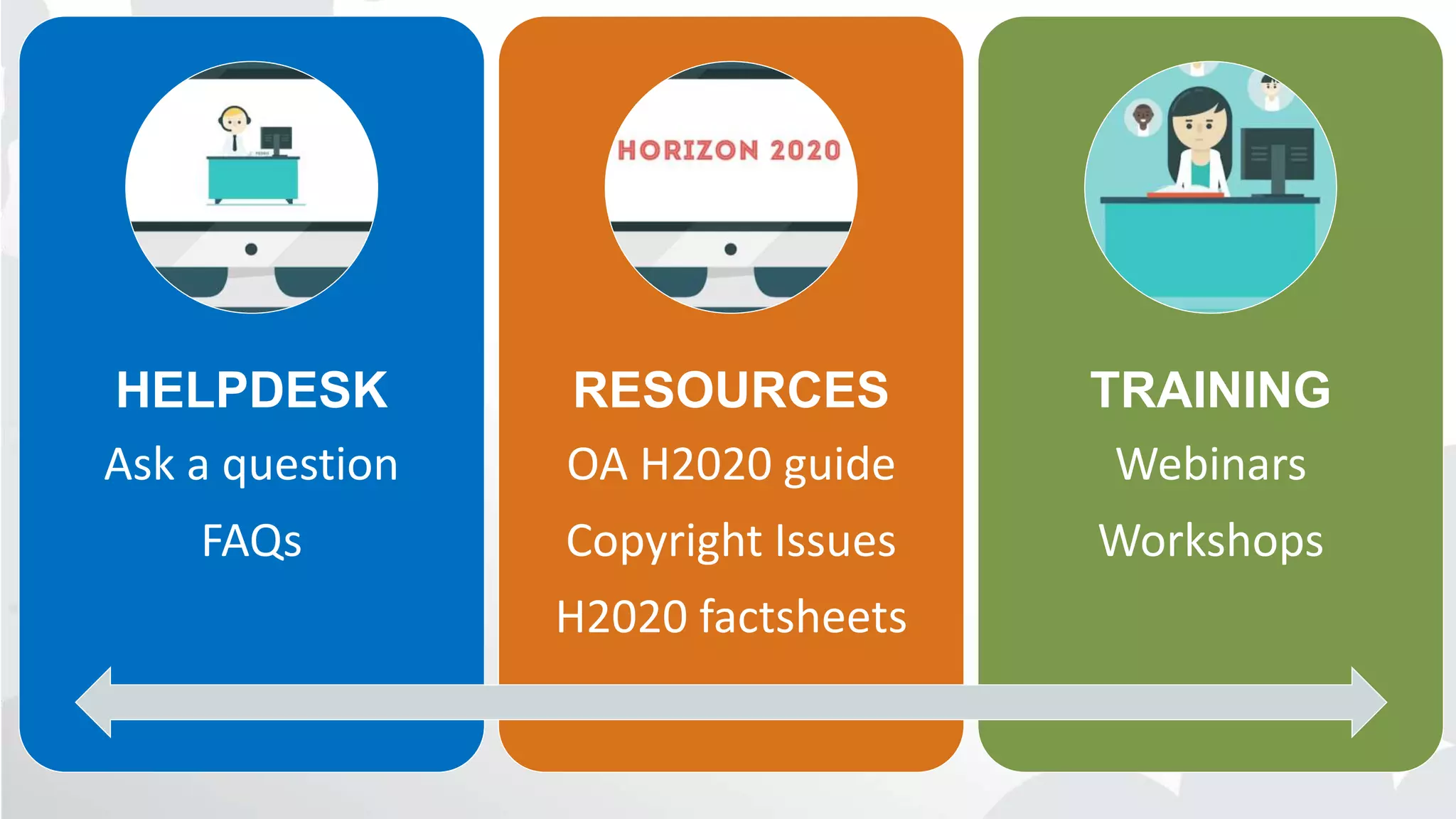
HELPDESK
Ask a question
FAQs
RESOURCES
OA H2020 guide
Copyright Issues
H2020 factsheets
TRAINING
Webinars
Workshops
www.openaire.eu
@openaire_eu
facebook.com/groups/openaire
linkedin.com/groups/OpenAIRE-3893548
Thanks!
info@openaire.eu | eloy@sdum.uminho.pt | pedroprincipe@sdum.uminho.pt
52
Eloy Rodrigues & Pedro Principe

OpenAIRE webinar on Open Access in H2020 (OAW2016)

  • 1.
    HORIZON 2020 OPEN ACCESSMANDATE “Webinar for project coordinators and researchers on Open Access to publications in H2020” Tuesday, October 25, 2016 at 12.00 CEST {eloy}, {pedroprincipe}@sdum.uminho.pt Eloy Rodrigues UNIVERSITY OF MINHO Pedro Príncipe UNIVERSITY OF MINHO
  • 2.
    HORIZON 2020 OPEN ACCESSMANDATE Webinar for project coordinators and researchers on Open Access to publications in H2020 Eloy Rodrigues & Pedro Príncipe University of Minho OpenAIRE Helpdesk & Training managers
  • 3.
    Agenda 1.OA in H2020:summary of requirements 2.OA in H2020: Practical implementation 3.OpenAIRE support services and tools 3
  • 4.
    DEFAULT Open Access isthe for research results in H2020
  • 5.
  • 6.
    Multi-beneficiary General Model GrantAgreement 29.2 Open access to scientific publications 29.3 Open access to research data http://ec.europa.eu/research/participants/data/ref/h2020/grants_manual/amga/h2020-amga_en.pdf
  • 7.
    Grant Agreement: §29.2 Open access to scientific publications Each beneficiary must ensure open access (free of charge, online access for any user) to all peer-reviewed scientific publications relating to its results. In particular, it must: (a) as soon as possible and at the latest on publication, deposit a machine-readable electronic copy of the published version or final peer-reviewed manuscript accepted for publication in a repository for scientific publications; Moreover, the beneficiary must aim to deposit at the same time the research data needed to validate the results presented in the deposited scientific publications. (b) ensure open access to the deposited publication — via the repository — at the latest: (i) on publication, if an electronic version is available for free via the publisher, or (ii) within six months of publication (twelve months for publications in the social sciences and humanities) in any other case. (c) ensure open access — via the repository — to the bibliographic metadata that identify the deposited publication. The bibliographic metadata must be in a standard format and must include all of the following: - the terms ["European Union (EU)" and "Horizon 2020"]["Euratom" and Euratom research and training programme 2014-2018"]; - the name of the action, acronym and grant number; - the publication date, and length of embargo period if applicable, and - a persistent identifier.
  • 8.
    OA in H2020: summaryof requirements 1
  • 9.
    Open Access requirementsand who is covered by them? All beneficiaries of H2020 funding must provide open access (free of charge, online access for any user) to all peer-reviewed publications by depositing them into a repository http://ec.europa.eu/research/participants/data/ref/h2020/grants_manual/amga/h2020-amga_en.pdf
  • 10.
    In other words... Authorsare free to choose between the two main and non-exclusive routes toward Open Access • Self-archiving (‚green‘ open access): the published article or the final peer reviewed manuscript is uploaded in an online repository – access is often delayed (‚embargo period‘) • Open access publishing (‚gold‘ open access): the article is immediately in open access mode, through the publisher. The associated costs are covered by the author/institution/funder. The article must always be deposited in a repository, even if the gold route has been choosen.
  • 11.
    Where to deposit? •Institutional repository OR • Disciplinary repository (arXiv, Europe PubMed Central, etc.) OR • Zenodo (www.zenodo.org) if none of the above is available. EC-cofunded, multidisciplinary repository, for publications and data. Remarks: • Finding a repository via registries: ROAR http://roar.eprints.org/, OpenDOAR http://www.opendoar.org/ or via OpenAIRE (more details later) • A list of publications on the project website is not sufficient. • How to bring all publications together? • OpenAIRE-compatibility to enable the harvesting of metadata (more details later) where what when
  • 12.
    What to deposit? •The final peer-reviewed manuscript, accepted for publication, including all modifications from the peer-review process OR • A machine-readable copy of the published version (usually a PDF document) In principle this applies to all kinds of publications, but emphasis is on peer-reviewed journal articles. where what when
  • 13.
    When to deposit? •Each beneficiary must deposit as soon as possible and at the latest on publication. where what when
  • 14.
    When should openaccess be provided? • Open access must be ensured immediately or after an embargo period: • GREEN – 6-12 months depending on the research area and the choice of journal • GOLD – immediately Some journals demand longer embargo periods (compare SHERPA/RoMEO database). where what when
  • 15.
  • 16.
    RESEARCHER DECIDES WHERE TO PUBLISH Checkpublishers policies on www.sherpa.ac.uk/romeo Open Access Journals doaj.org Check for Article Processing Charges Subscription-based journal Self-archive in a repository Find at: openaire.eu IMMEDIATE OPEN ACCESS IMMEDIATE OR DELAYED OPEN ACCESS
  • 17.
    Metadata requirements on repositorydeposition Beneficiaries must ensure immediate open access to the bibliographic metadata that identify the deposited publication in a standard format and must include all of the following: • the terms ["European Union (EU)" and "Horizon 2020"]["Euratom" and Euratom research and training programme 2014-2018"]; • the name of the action, acronym and grant number; • the publication date, and length of embargo period if applicable, and • a persistent identifier.
  • 18.
    Are Article ProcessingCharges (APCs) supported? Yes • For open access publishing, researchers can publish in open access journals, or in journals that sell subscriptions and also offer the possibility of making individual articles openly accessible (hybrid journals). • Where the case, the Article Processing Charges (APCs) incurred by beneficiaries are eligible for reimbursement during the duration of the action.
  • 19.
    Publication costs Dissemination costs,e.g. for publishing in open access journals/books, are eligible costs if incurred during the project period. What budget to consider in proposals? APC = Article Processing Charges Budget for Publications = Average APC x number of publications Method 1: Average APC based on list of journals used by the consortium (look up prices at publisher website and/or consult librarian) Method 2: Average APC based on general market figures (see next slide)
  • 20.
    Average APC? Björk/Solomon estimated(2014) the average price of Article Processing Charges (APC) • for established open access journals at ca. 1,020 EUR and • for hybrid journals (subscription journal with OA option for individual articles) at ca. 1,980 EUR Both types of OA publication costs can be reimbursed in H2020 projects. Currently, there is no price-cap for APCs.
  • 21.
    What are projectsexpected to do? • DURING PROPOSAL WRITING PHASE • Outline of dissemination and exploitation strategy, including OA >> impact section of the proposal (how will results be shared, data be managed and shared?) • Include resources for publication costs (what journals, how many publications, what does it cost on average?) • Combine GREEN/GOLD strategies to achieve maximum of OA • DURING THE PROJECT • Additional provisions in the Consortium Agreement? (where to deposit, who is responsible) • Implementation of the dissemination strategy, report at reviews and update • What issues occur and how can they be solved? (publisher embargos, repositories for specific material, etc.) • AFTER THE PROJECT END • Are there publications foreseen after the ending of the project (ie which will not be covered by the budget) – for post-FP7 project publications there is a gold OA pilot in H2020 • Who takes care of deposit in repositories after the project end? Projects have to start planning early on
  • 22.
    Some issues toconsider 1. Publishing all articles in APC based gold OA is not probably the right solution, as this can lead to a substantial amount of the overall project budget. Therefore, a mixed strategy of GREEN/GOLD open access is highly recommended. 2. The growing open access market comes with some challenges • Lots of new journals/publishers, some of questionable quality (‚predatory journals‘, http://scholarlyoa.com/publishers/) Some caution is needed when publishing, this holds for all journals. Consult ‚white lists‘ such as DOAJ.
  • 23.
    What are theconsequences for non- compliance with OA requirements? If a beneficiary breaches any of its obligations, the grant may be reduced (Article 43) and it may also lead to any of the other measures described in Chapter 6 of the General Model Grant Agreement. http://ec.europa.eu/research/participants/data/ref/h2020/mga/gga/h2020-mga-gga-multi_en.pdf
  • 24.
  • 25.
  • 26.
    OPEN ACCESS OpenAIRE implementsthe EC requirements & SUPPORTS THE OPEN DATA PILOT
  • 27.
  • 28.
  • 29.
    SHARE, DEPOSIT ANDPUBLISH IN OA
  • 30.
    DEPOSIT ALL PROJECT PUBLICATIONS Automatically REACH MOREPEOPLE, HAVE GREATER IMPACT, SIMPLIFY H2020 REPORTING
  • 31.
    LOCATE AN APPROPRIATEDREPOSITORY Deposit once! Via OpenAIRE 31
  • 32.
    Find where todeposit 32
  • 33.
    Zenodo Repository • Multipledata types • Publications • Long tail of research data • Citable data (DOI) • Links to funding, pubs, data, software “Catch-all” repository: OpenAIRE-CERN joint effort 33 www.zenodo.org H2020: Option to gather, preserve and share project’s scientific output
  • 34.
    PROJECT FUNDING INTHE PUBLICATION OR DATASET METADATA RECORD Acknowledge 34
  • 35.
    Acknowledge project funding:e.g. ZENODO 35 API
  • 36.
    REPOSITORIES DEPOSIT WORKFLOW: Searchingby the name, acronym or the project id number… Select the project and accept OpenAIRE Funders Projects List API
  • 37.
  • 38.
    USE OUR LINKINGSERVICES AFTERWARDS AND ASSOCIATE YOUR RESEARCH RESULTS When you publish or deposit in OA make sure you use a fully OpenAIRE compatible repository. If you don't… 38
  • 39.
    LINK RESEARCH RESULTSTOOL https://www.openaire.eu/participate/claim Link publications or datasets to projets. Identify the project, select publications or datasets and set the access rights.
  • 40.
    GATHER OUTPUTS, VIEWPROGRESS AND REPORT
  • 41.
    PROJECTS PUBLICATIONS LIST https://www.openaire.eu/search/find/projects OpenAIREportal includes an App Box to generate a project publication list. Communicate your project results.
  • 42.
  • 43.
  • 44.
    YOUR PUBLICATIONS WILLBE REPORTED AUTOMATICALLY TO THE EC'S PARTICIPANT PORTAL AT REPORTING TIME. Once you deposit in a fully OpenAIRE compliant repository
  • 45.
  • 46.
  • 47.
  • 48.
    DISCOVERY/ACCESS SERVICE Public (all) 48 Provides searchand browsing capabilities over a catalogue of Europe’s (+) interlinked research artefacts (literature, research data, software)
  • 49.
    49 Provides search andbrowsing capabilities over a catalogue of Europe’s (+) interlinked research artefacts (literature, research data, software)
  • 50.
    Services and toolsfor projects Open Access Depositing Storing Research Data Claiming publications and datasets Reporting research outputs Monitoring and analytics Discovery and Access 50
  • 51.
    HELPDESK Ask a question FAQs RESOURCES OAH2020 guide Copyright Issues H2020 factsheets TRAINING Webinars Workshops
  • 52.

Editor's Notes

  • #5 As you may know…
  • #32 Approach: deposit once – easy for researchers/research managers – and openaire will offer services.
  • #33 If a researcher isn’t sure where to deposit , OPenAIRE can help.
  • #34 If you dont have an appropriated repository use Zenodo - the catch-all repository hosted by CERN, is linked to OpenIARE and can be used to deposit research publications and data. Zenodo is of course harvested by the openaire portal
  • #35 This is stated in the AO H2020 mandate, OpenAIRE is helping to make it easy.
  • #36 Example: zenodo
  • #37 Example: Uminho repositor.
  • #39 Alternative: claim a Publications and link it to the project info.
  • #46 Also to be used by participants portal reporting tool   For publications accessible via OpenAIRE, references to these publications (with link to the project ID) are displayed automatically in the reporting section of the Participant Portal for the project.  Simply check if the references are directly linked to the work performed within the project. If so, tick these publications as relevant and they will then be included in the table of publications when the report is generated. links and federates existing repositories. As such it provides access to publications that have been deposited in all repositories that are technically interoperable with OpenAIRE ("OpenAIRE compliant") http://ec.europa.eu/research/participants/docs/h2020-funding-guide/grants/grant-management/reports/periodic-reports_en.htm
  • #47 Also to be used by participants portal reporting tool   For publications accessible via OpenAIRE, references to these publications (with link to the project ID) are displayed automatically in the reporting section of the Participant Portal for the project.  Simply check if the references are directly linked to the work performed within the project. If so, tick these publications as relevant and they will then be included in the table of publications when the report is generated. links and federates existing repositories. As such it provides access to publications that have been deposited in all repositories that are technically interoperable with OpenAIRE ("OpenAIRE compliant") http://ec.europa.eu/research/participants/docs/h2020-funding-guide/grants/grant-management/reports/periodic-reports_en.htm
  • #52 OpenAIRE supports the various Open Access policies in the European Research Area. OpenAIRE offers a variety of resources and support info materials, and if you still have questions – helpdesk.