Open Science in
Horizon 2020
Eloy Rodrigues – eloy@sdum.uminho.pt
February 22nd 2018, Lisboa
Agenda
1. Introduction to Open Science and policy context
2. Open Access in H2020
1. Summary of requirements
2. Practical implementation
3. OpenAIRE support services and tools
3. Open Research Data in H2020
INTRODUCTION TO OPEN
SCIENCE AND POLICY CONTEXT
1
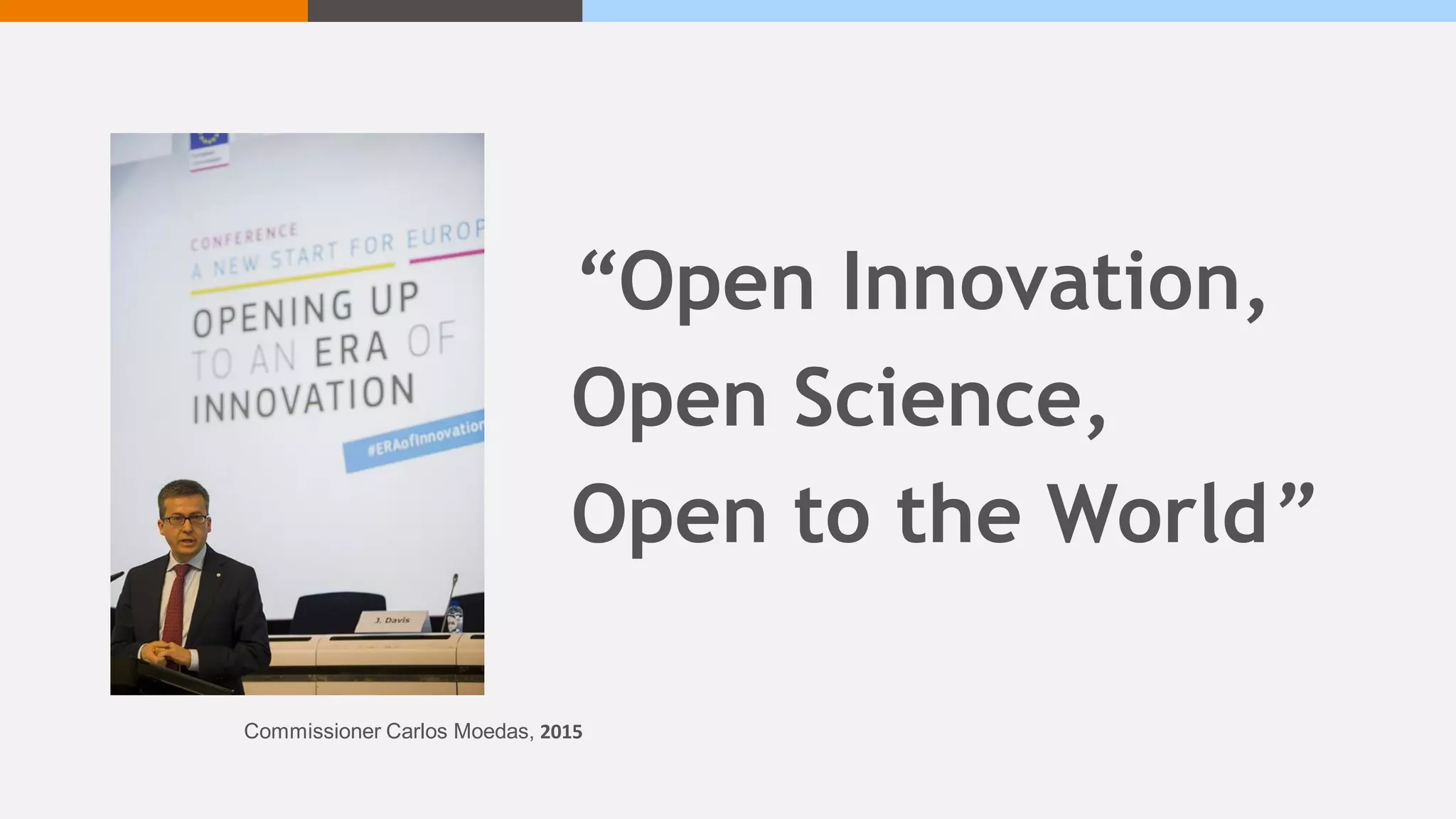
“Open Innovation,
Open Science,
Open to the World”
Commissioner Carlos Moedas, 2015
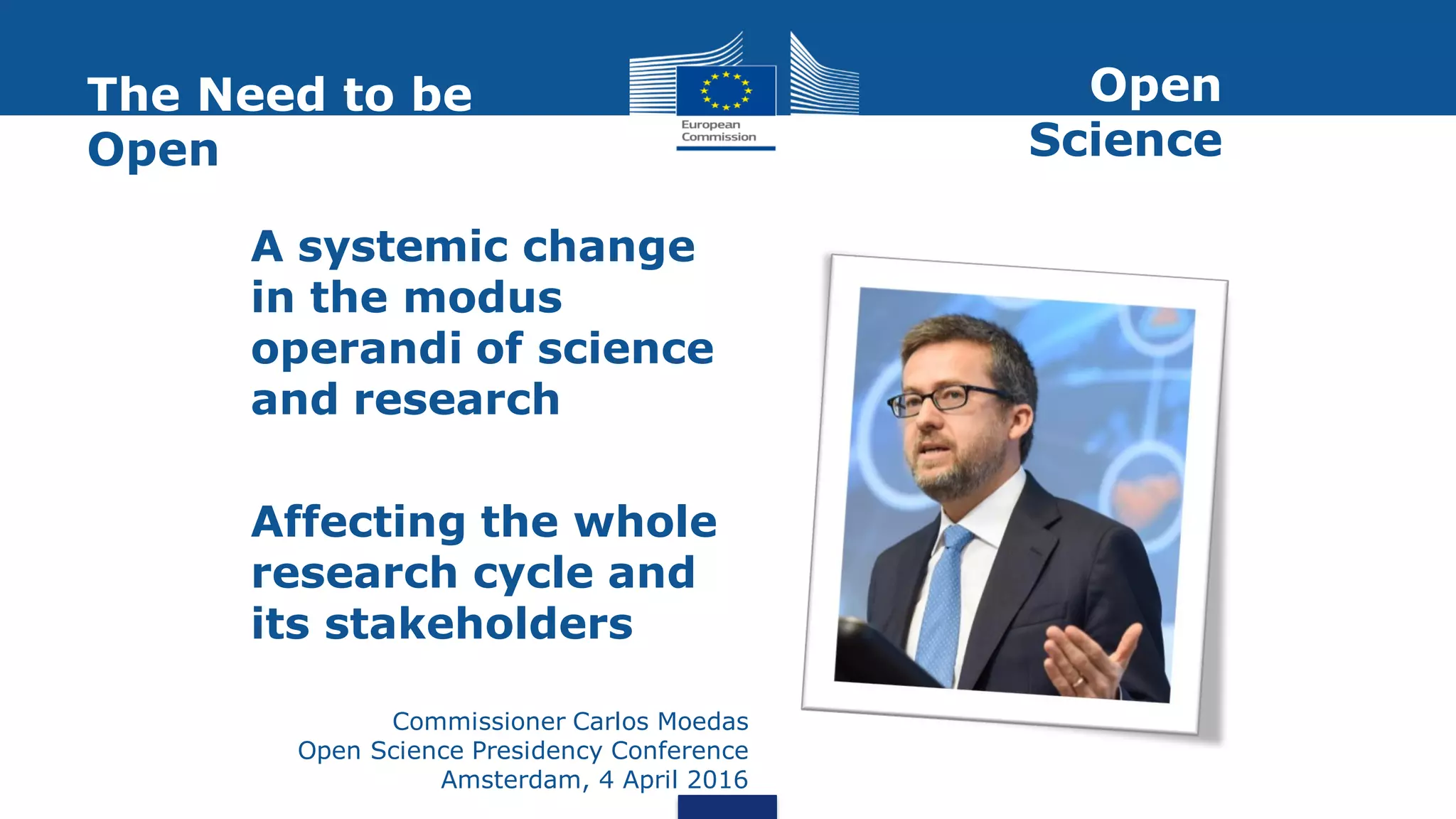
A systemic change
in the modus
operandi of science
and research
Affecting the whole
research cycle and
its stakeholders
Commissioner Carlos Moedas
Open Science Presidency Conference
Amsterdam, 4 April 2016
The Need to be
Open
Open
Science
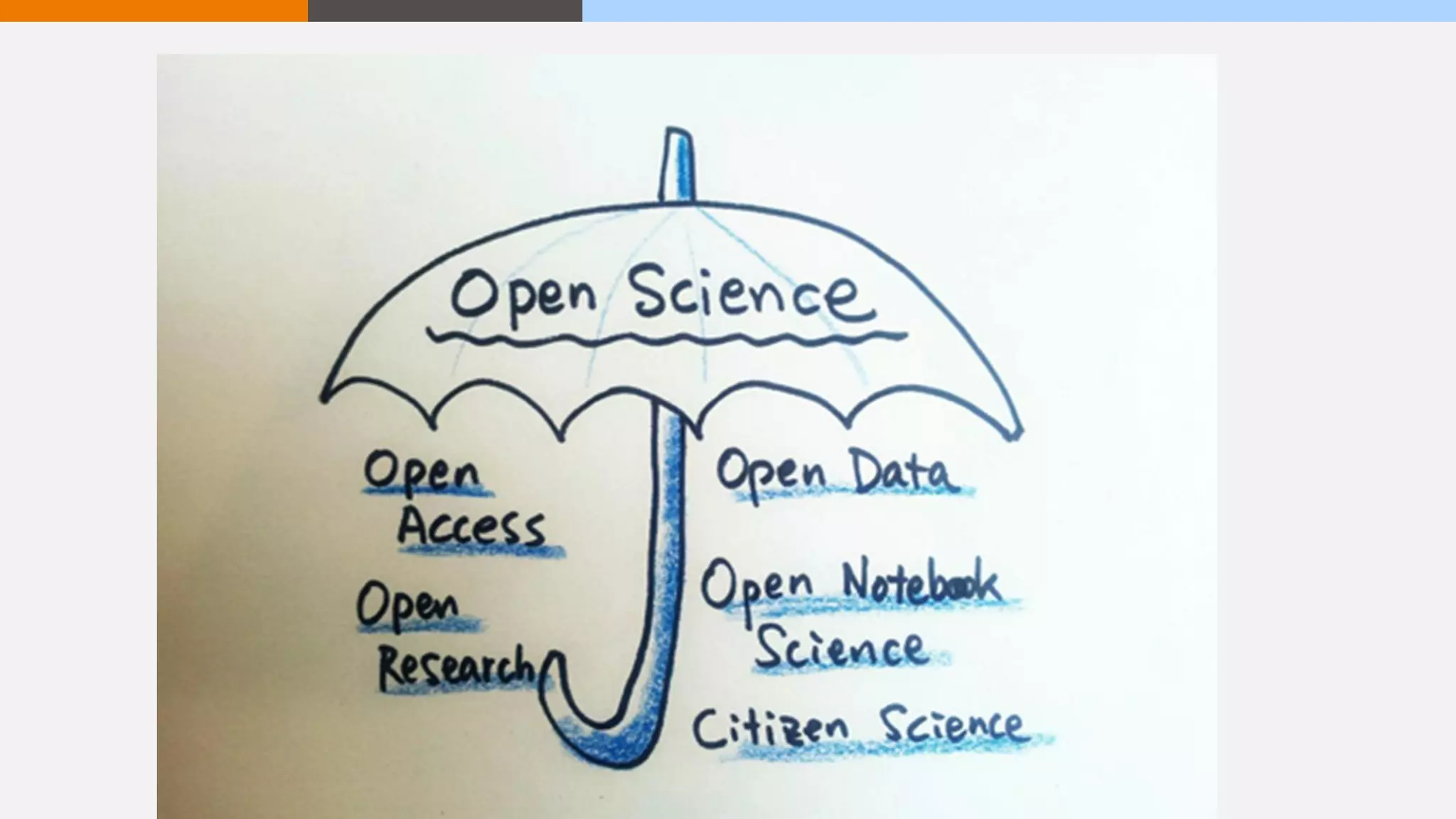
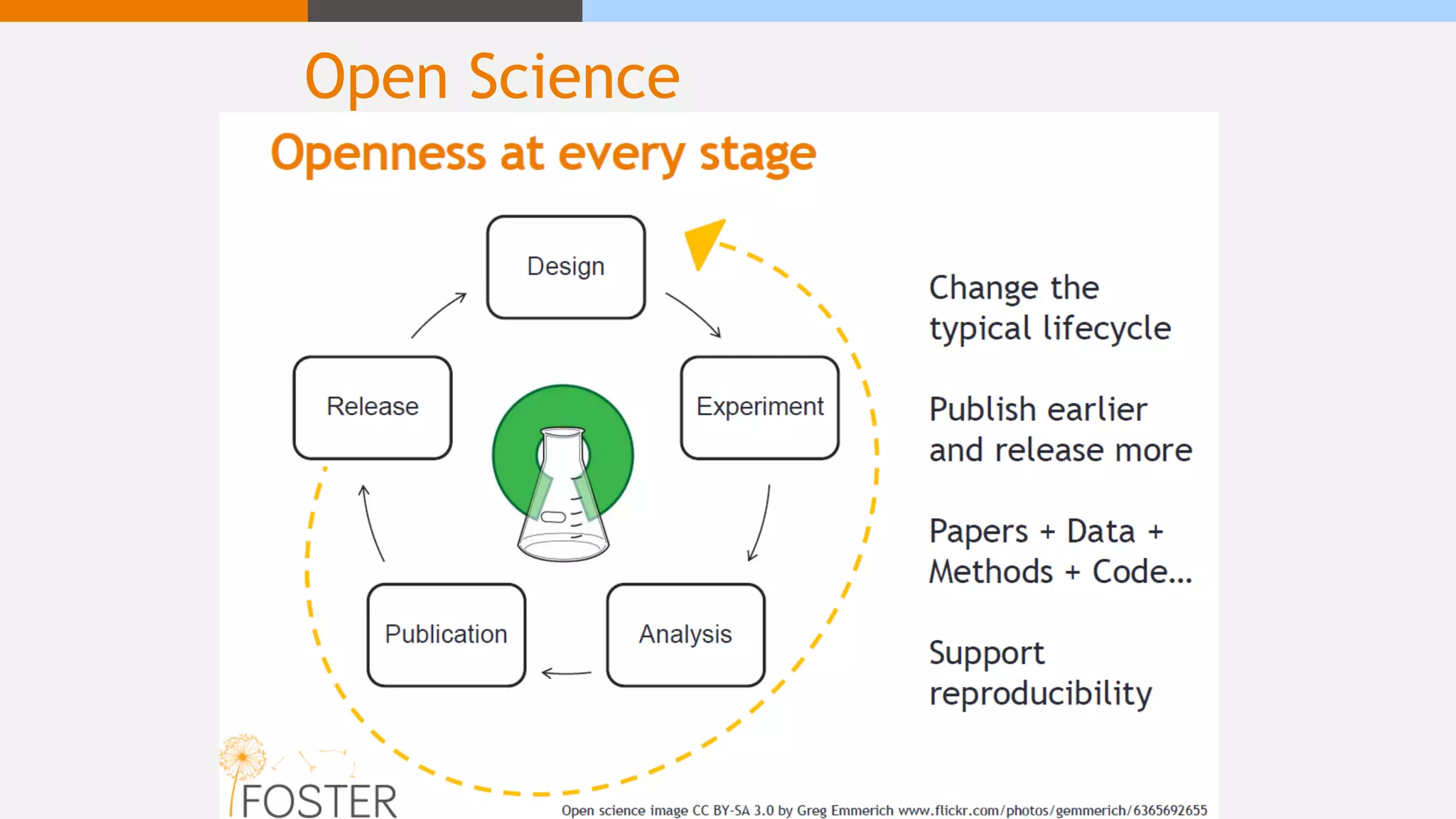
Open Science
OPEN SCIENCE : WHY?
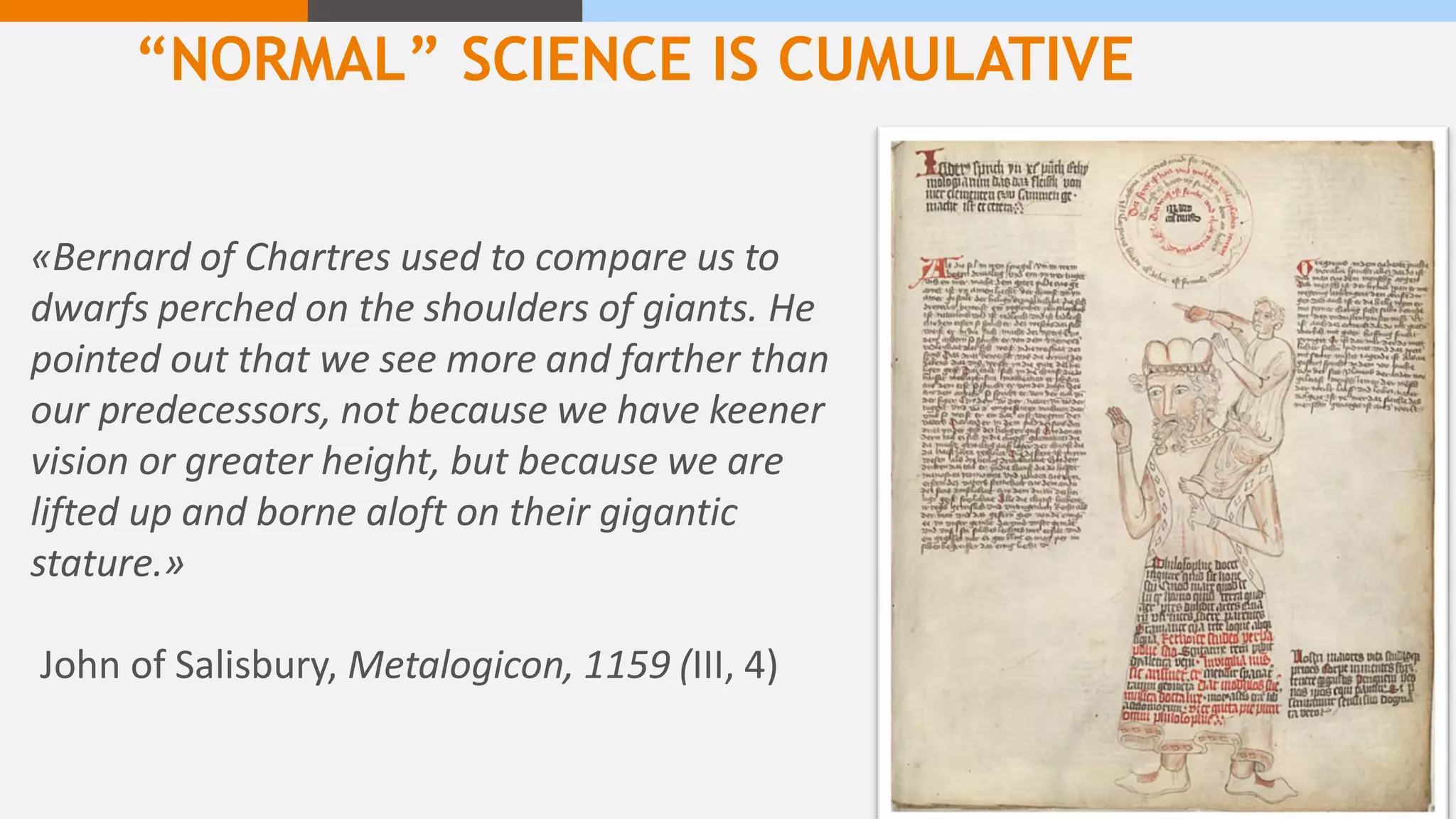
“NORMAL” SCIENCE IS CUMULATIVE
«Bernard of Chartres used to compare us to
dwarfs perched on the shoulders of giants. He
pointed out that we see more and farther than
our predecessors, not because we have keener
vision or greater height, but because we are
lifted up and borne aloft on their gigantic
stature.»
John of Salisbury, Metalogicon, 1159 (III, 4)
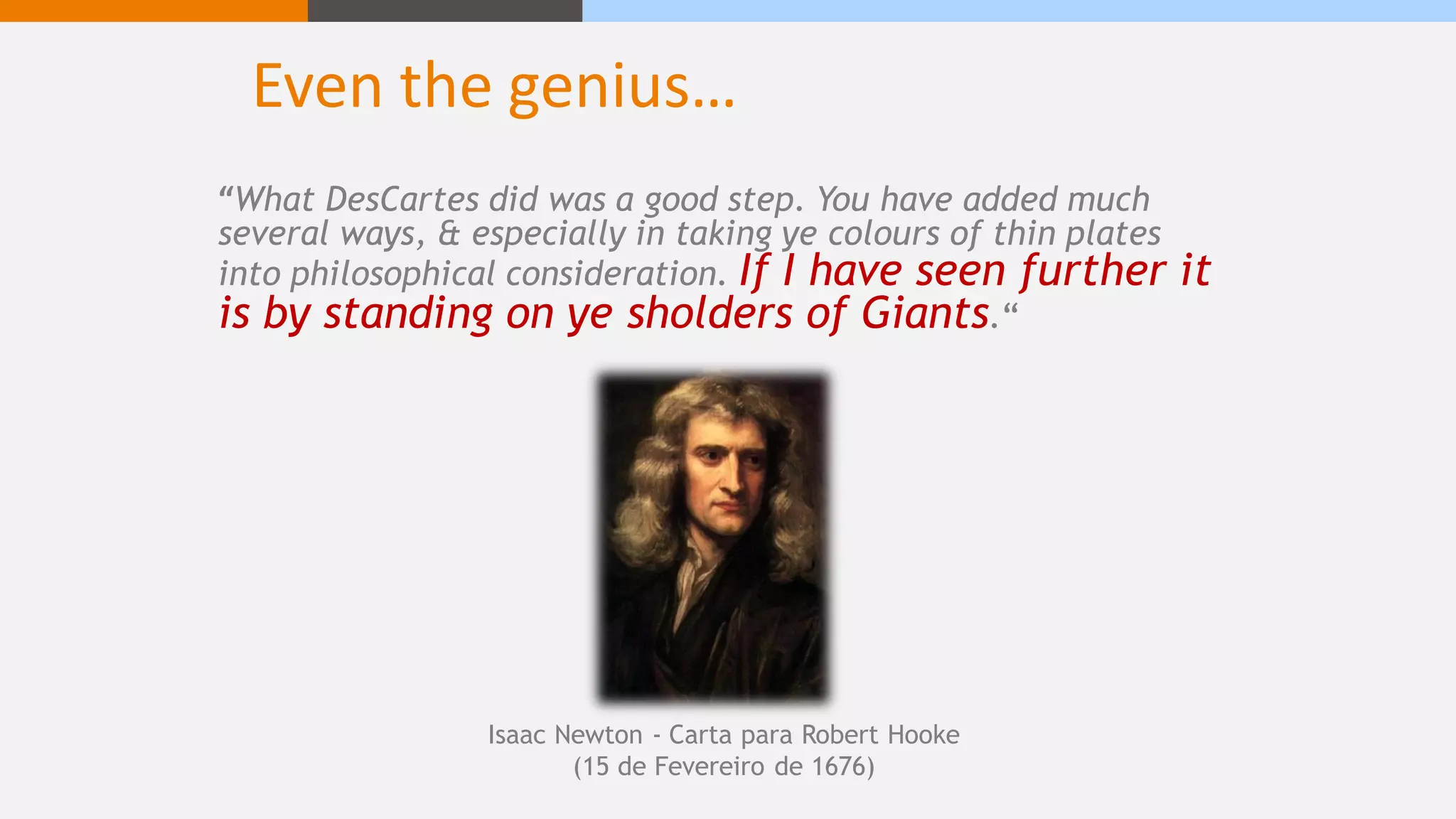
Even the genius…
“What DesCartes did was a good step. You have added much
several ways, & especially in taking ye colours of thin plates
into philosophical consideration. If I have seen further it
is by standing on ye sholders of Giants.“
Isaac Newton - Carta para Robert Hooke
(15 de Fevereiro de 1676)
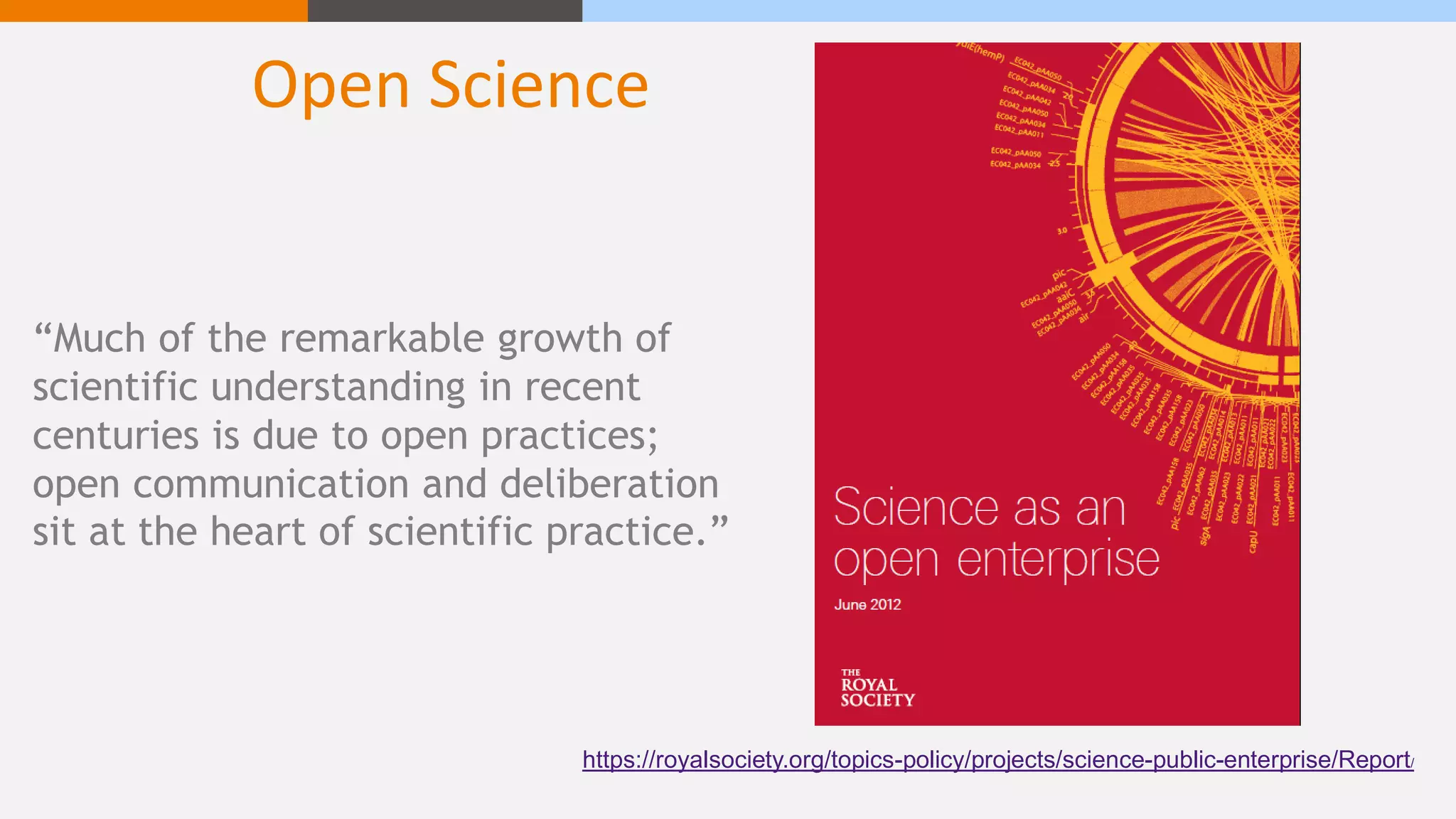
“Much of the remarkable growth of
scientific understanding in recent
centuries is due to open practices;
open communication and deliberation
sit at the heart of scientific practice.”
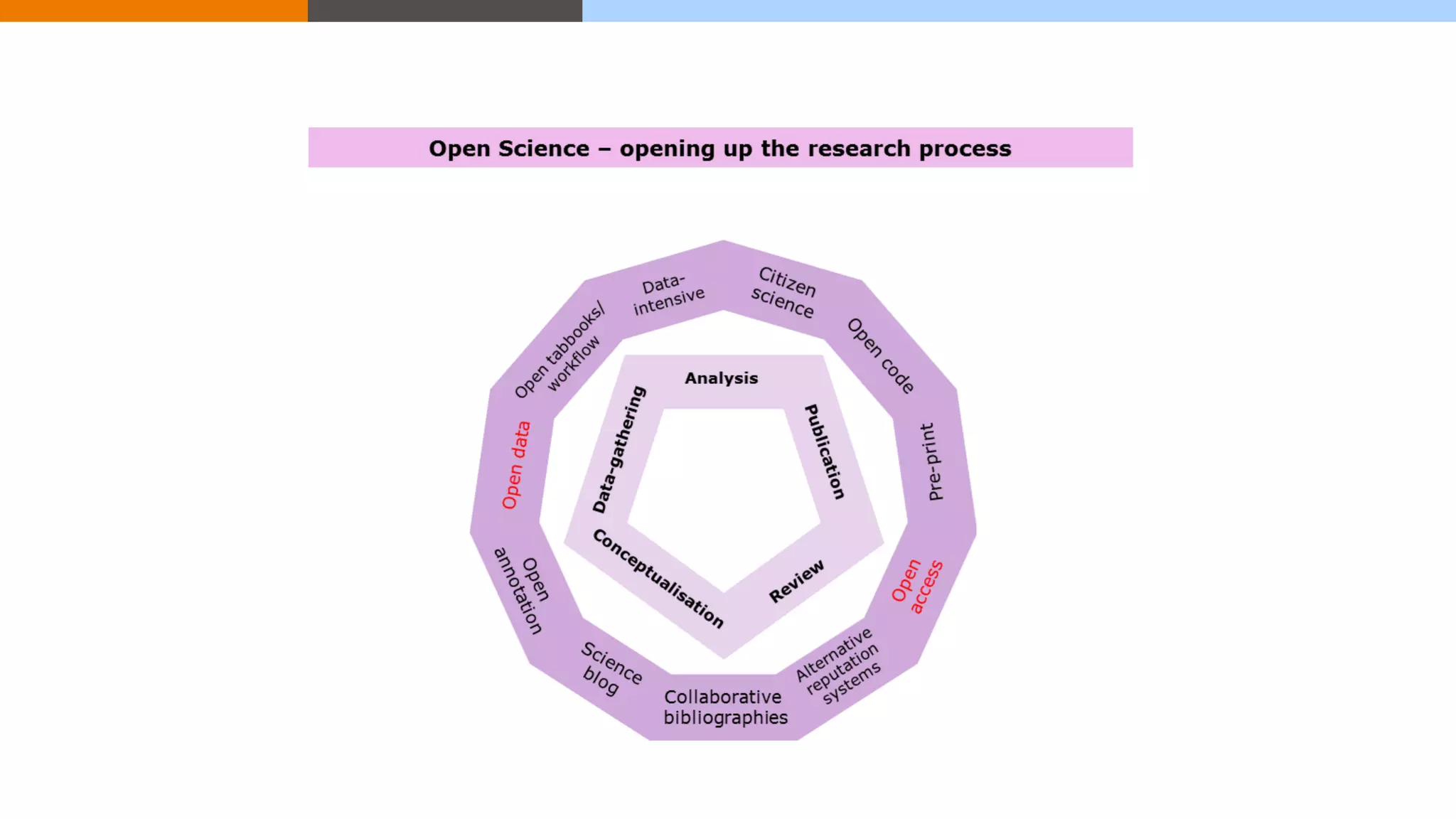
Open Science
https://royalsociety.org/topics-policy/projects/science-public-enterprise/Report/
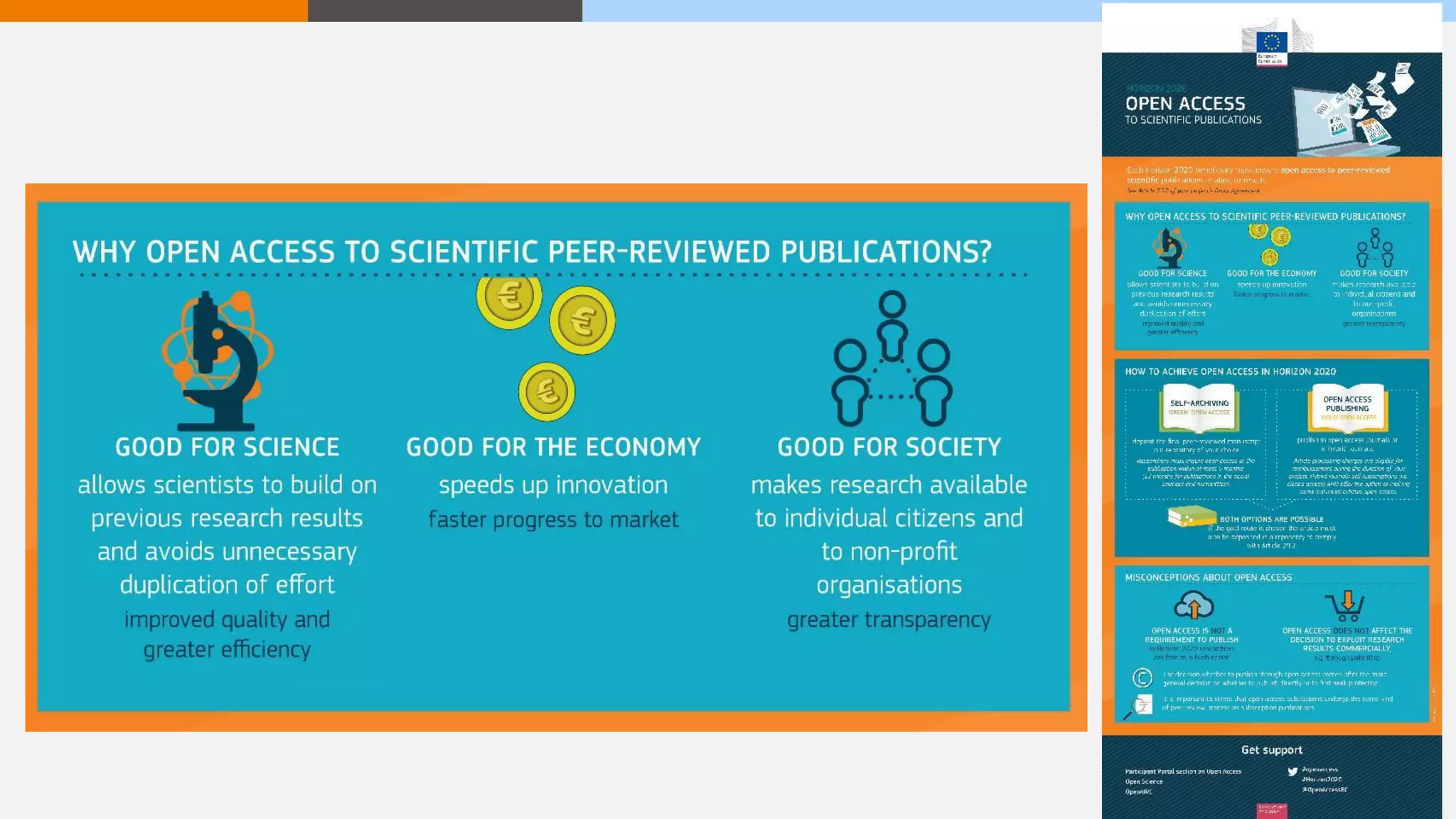
Open Science : Why?
To make science more efficient,
transparent, trustable and
reproducible.
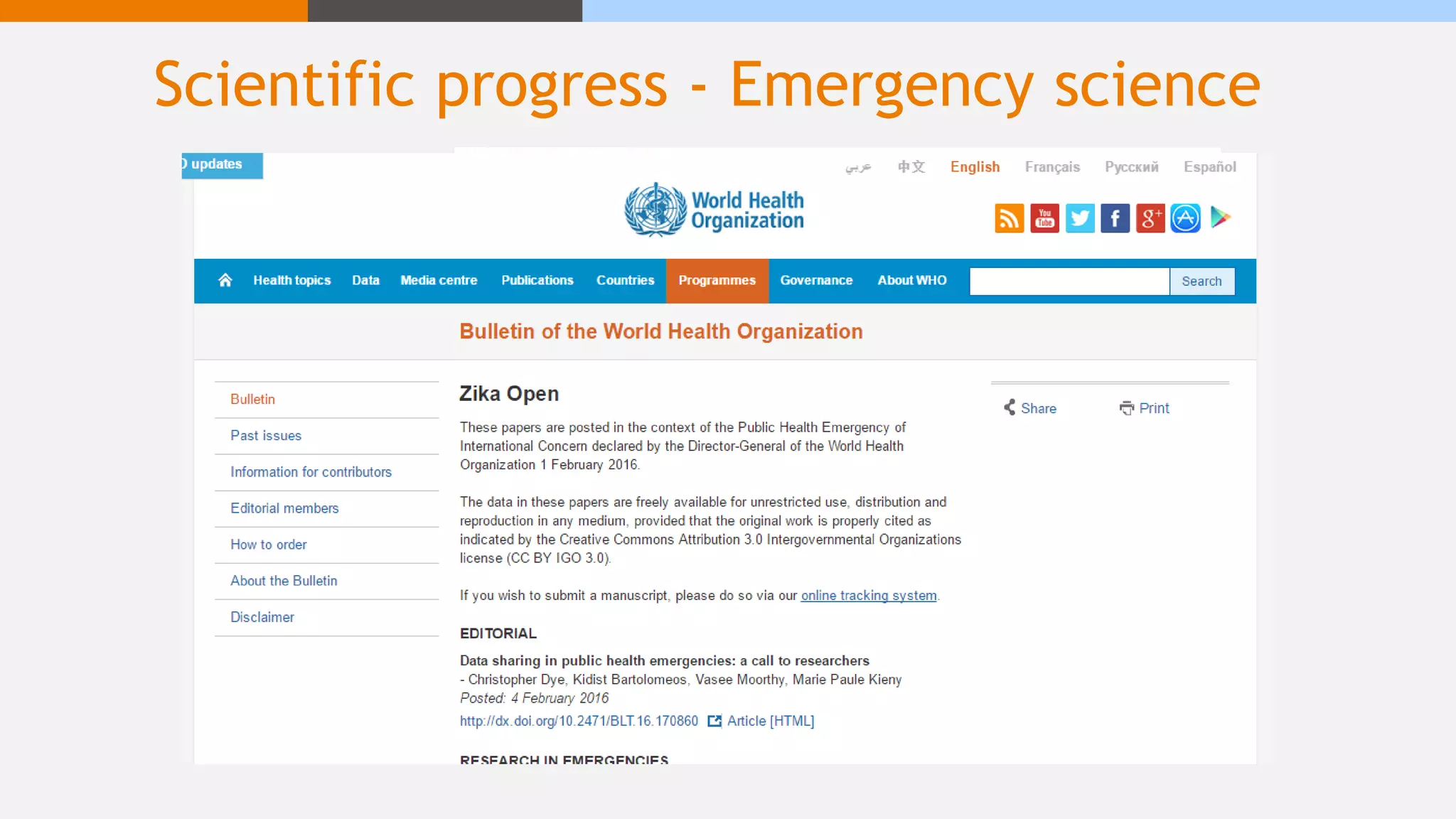
Scientific progress - Emergency science
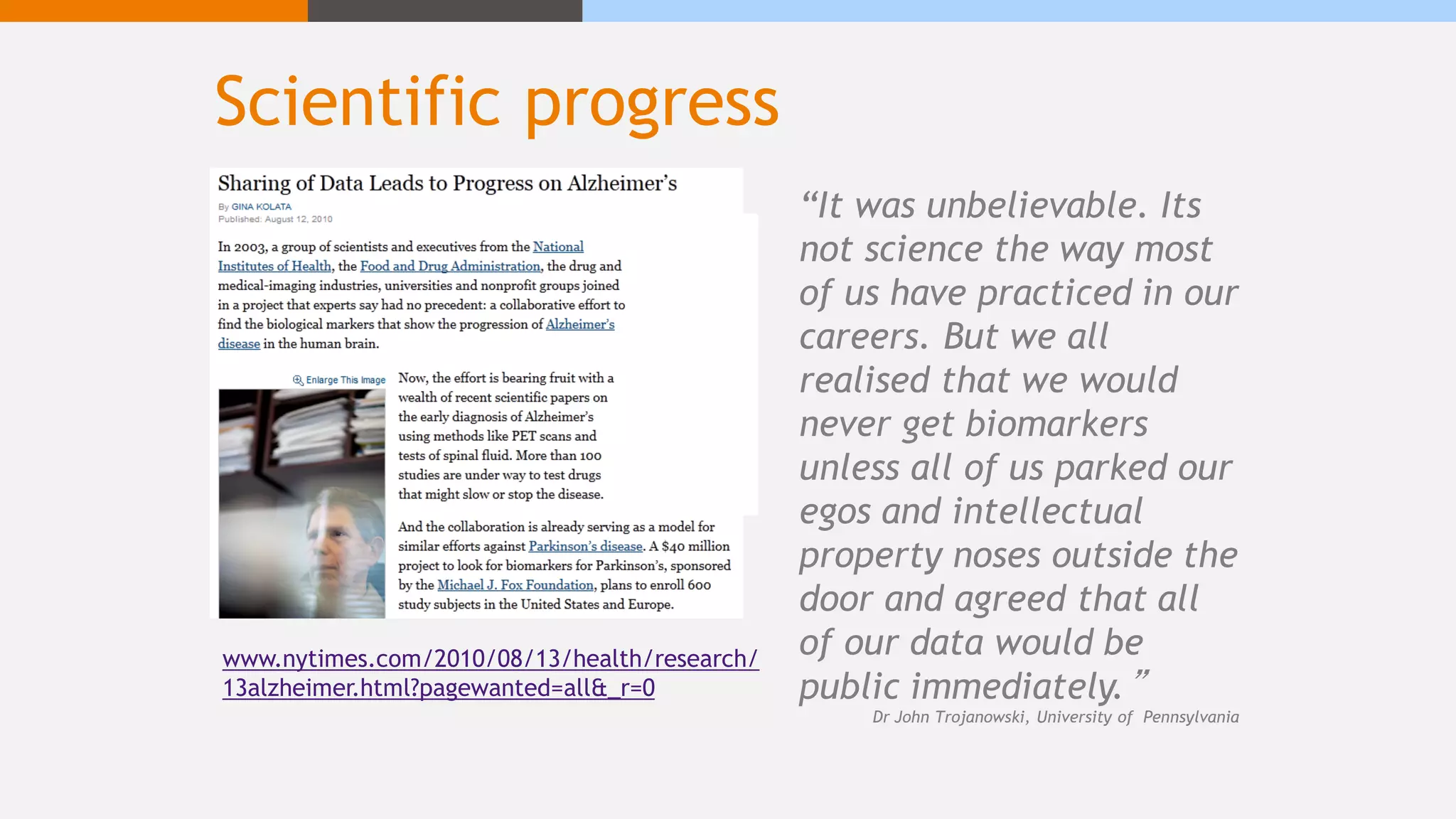
Scientific progress
www.nytimes.com/2010/08/13/health/research/
13alzheimer.html?pagewanted=all&_r=0
“It was unbelievable. Its
not science the way most
of us have practiced in our
careers. But we all
realised that we would
never get biomarkers
unless all of us parked our
egos and intellectual
property noses outside the
door and agreed that all
of our data would be
public immediately.”
Dr John Trojanowski, University of Pennsylvania
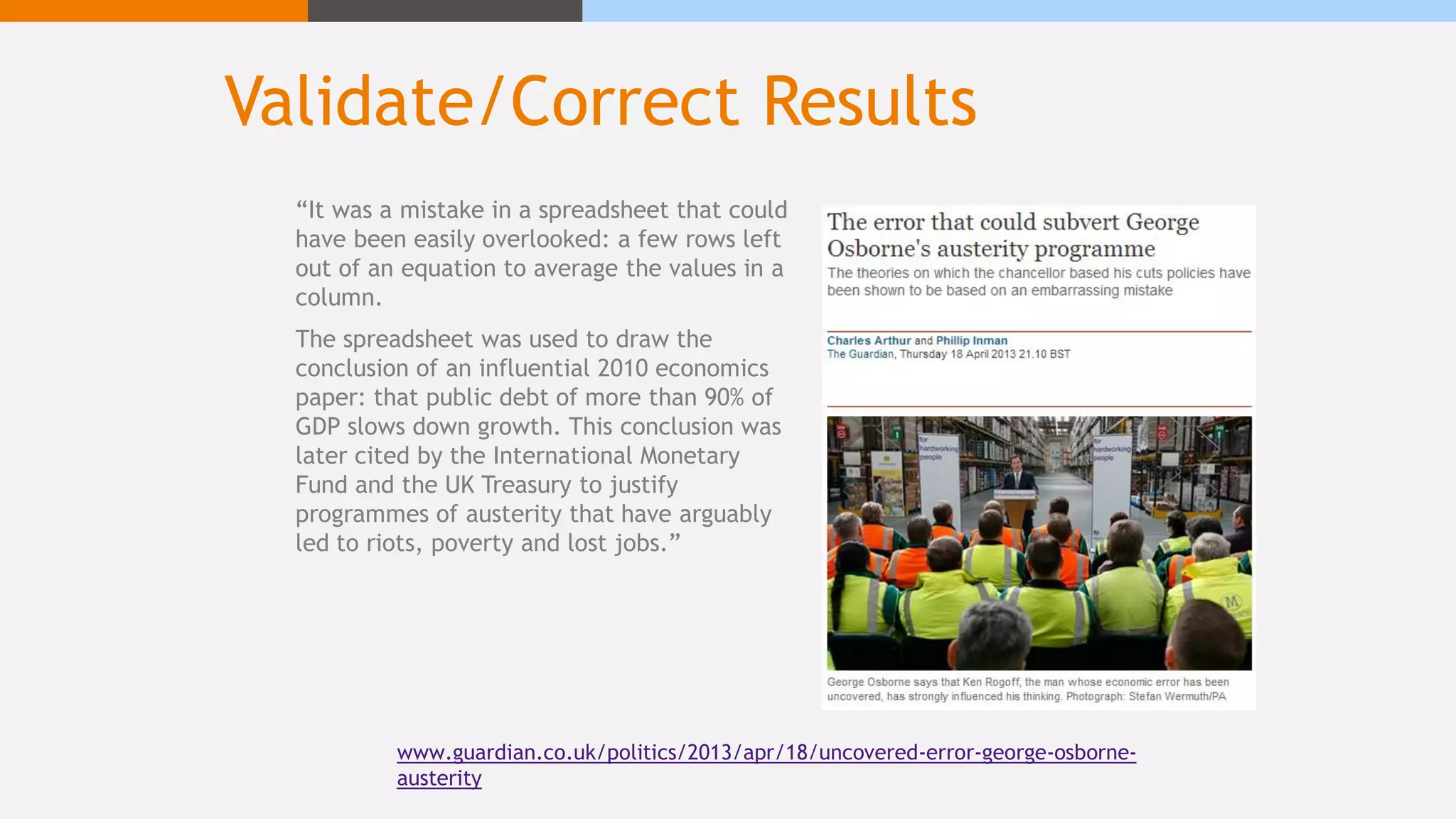
Validate/Correct Results
www.guardian.co.uk/politics/2013/apr/18/uncovered-error-george-osborne-
austerity
“It was a mistake in a spreadsheet that could
have been easily overlooked: a few rows left
out of an equation to average the values in a
column.
The spreadsheet was used to draw the
conclusion of an influential 2010 economics
paper: that public debt of more than 90% of
GDP slows down growth. This conclusion was
later cited by the International Monetary
Fund and the UK Treasury to justify
programmes of austerity that have arguably
led to riots, poverty and lost jobs.”
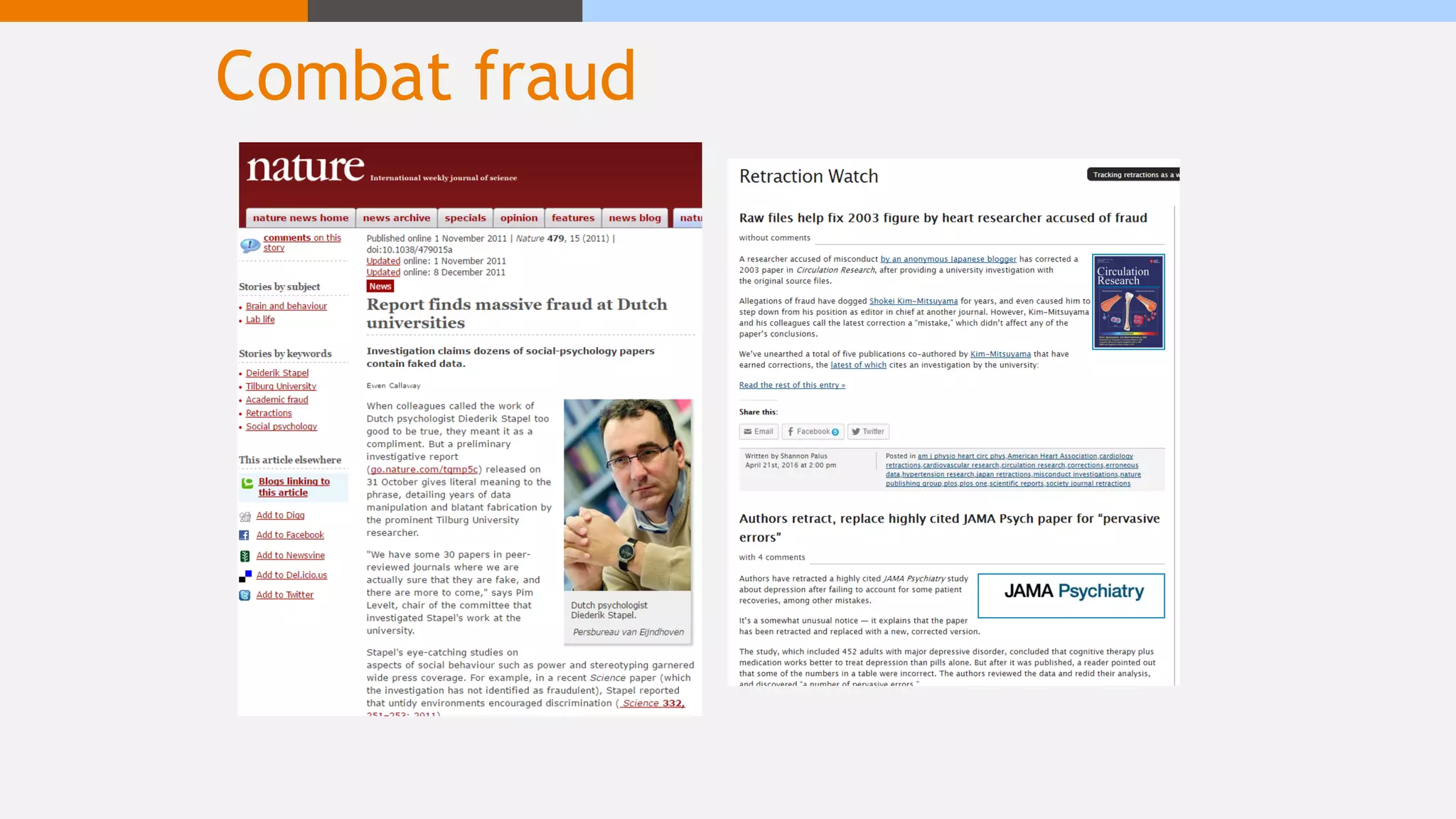
Combat fraud
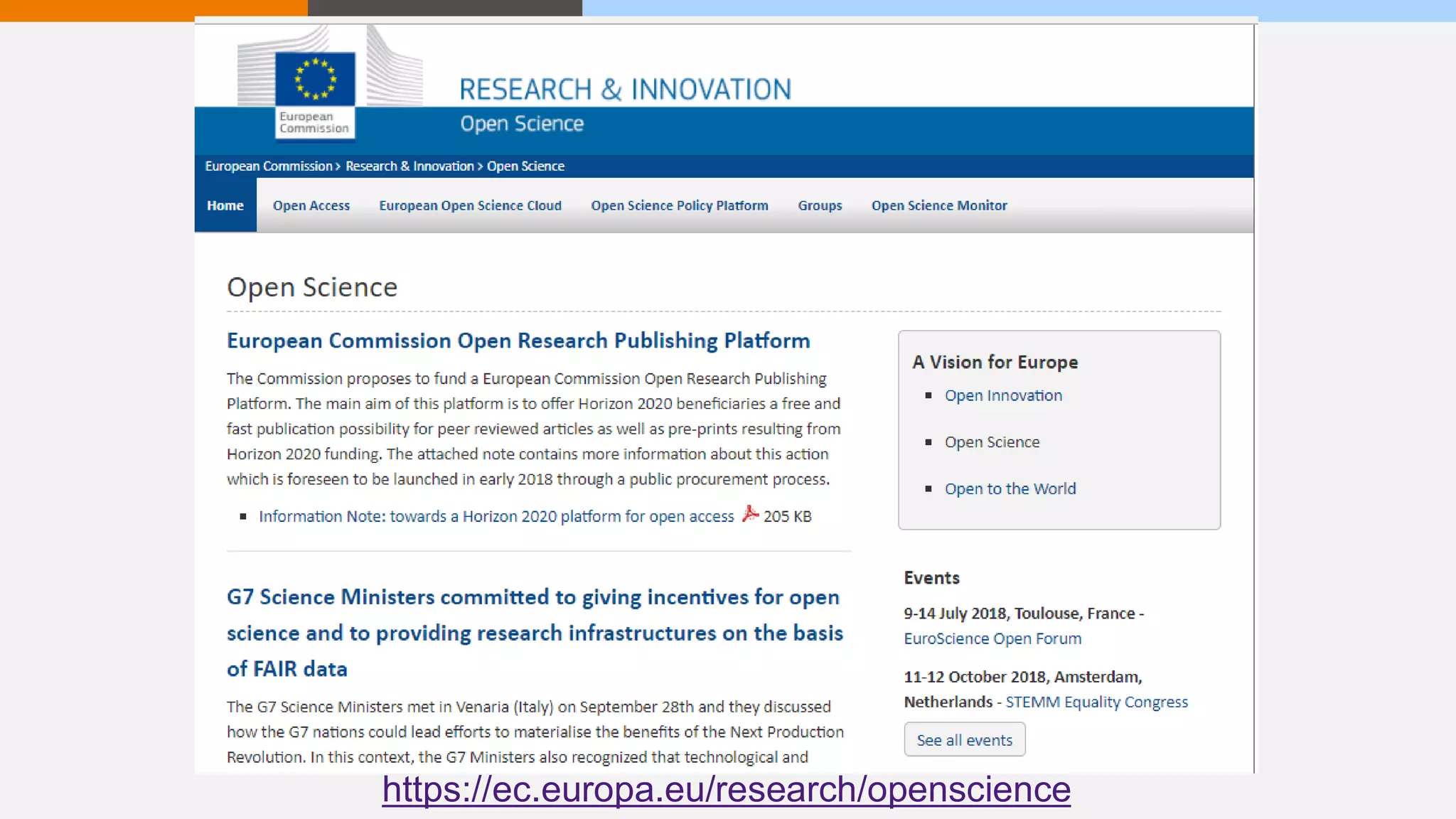
https://ec.europa.eu/research/openscience
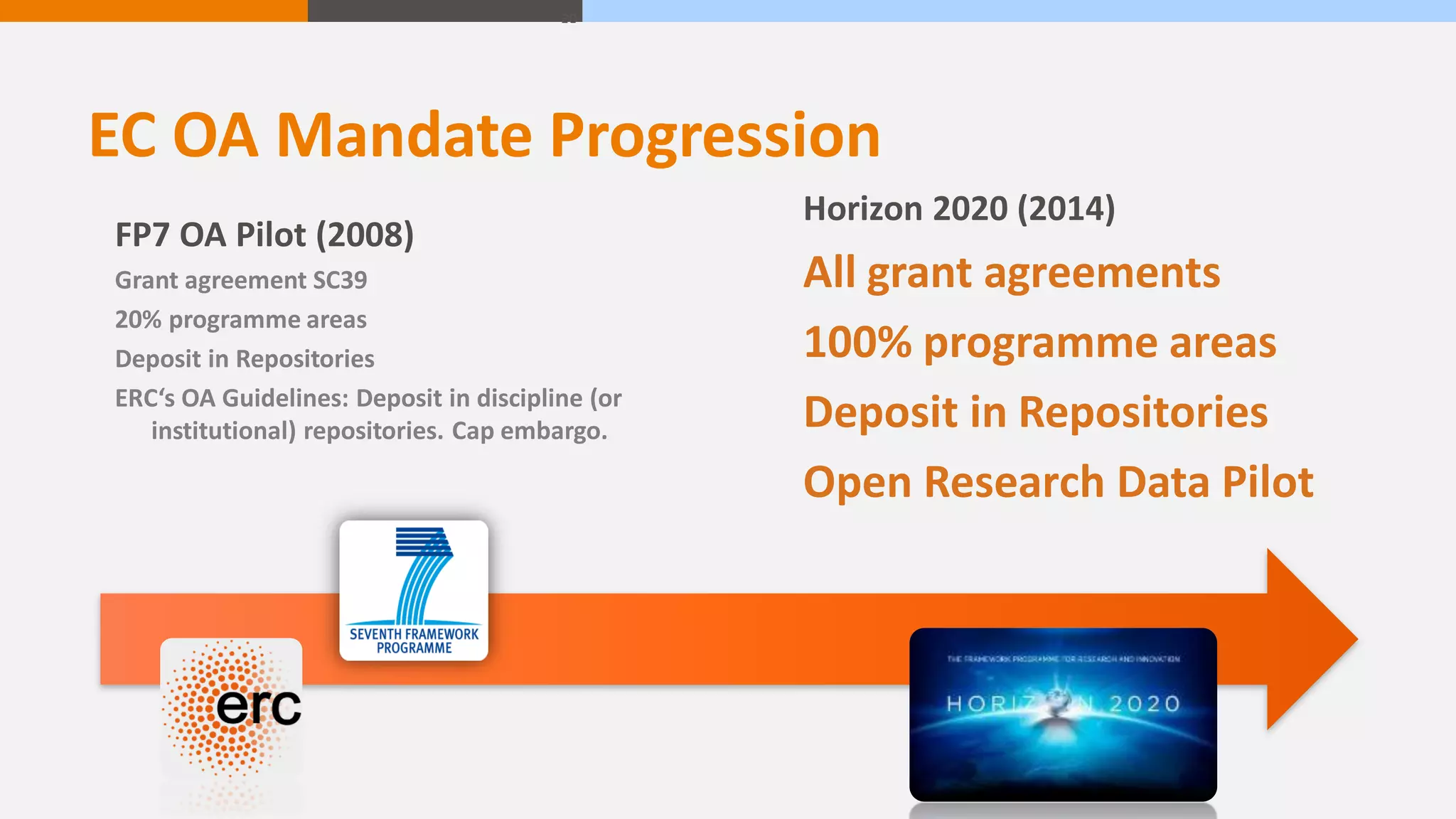
EC OA Mandate Progression
20
FP7 OA Pilot (2008)
Grant agreement SC39
20% programme areas
Deposit in Repositories
ERC‘s OA Guidelines: Deposit in discipline (or
institutional) repositories. Cap embargo.
Horizon 2020 (2014)
All grant agreements
100% programme areas
Deposit in Repositories
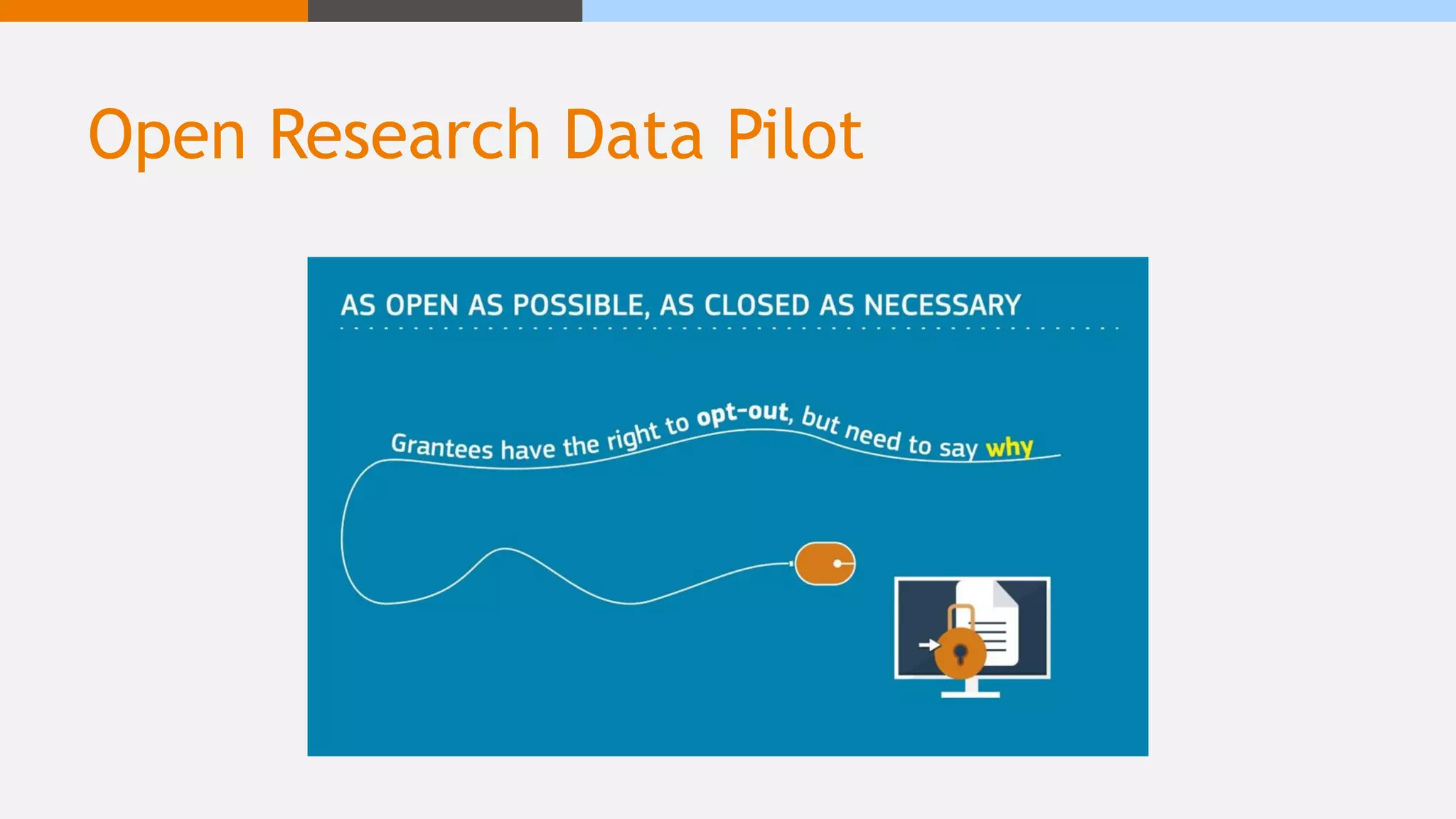
Open Research Data Pilot
OPEN ACCESS IN H2020
2
DEFAULT
Open Access is the
for research results in H2020
Multi-beneficiary General Model
Grant Agreement
29.2 Open access to scientific publications
29.3 Open access to research data
http://ec.europa.eu/research/participants/data/ref/h2020/mga/gga/h2020-mga-gga-multi_en.pdf
Grant Agreement: § 29.2 Open
access to scientific publications
Each beneficiary must ensure open access (free of charge, online access for any user) to
all peer-reviewed scientific publications relating to its results.
In particular, it must:
(a) as soon as possible and at the latest on publication, deposit a machine-readable
electronic copy of the published version or final peer-reviewed manuscript accepted
for publication in a repository for scientific publications;
Moreover, the beneficiary must aim to deposit at the same time the research data
needed to validate the results presented in the deposited scientific publications.
(b) ensure open access to the deposited publication — via the repository — at the latest:
(i) on publication, if an electronic version is available for free via the publisher, or
(ii) within six months of publication (twelve months for publications in the social
sciences and humanities) in any other case.
(c) ensure open access — via the repository — to the bibliographic metadata that identify
the deposited publication.
The bibliographic metadata must be in a standard format and must include all of the following:
- the terms ["European Union (EU)" and "Horizon 2020"]["Euratom" and Euratom research and training programme 2014-
2018"];
- the name of the action, acronym and grant number;
- the publication date, and length of embargo period if applicable, and
- a persistent identifier.
OA in H2020:
summary of requirements
Open Access requirements
and who is covered by them?
All beneficiaries of H2020
funding must provide open
access (free of charge, online
access for any user) to all peer-
reviewed publications by
depositing them into a
repository
http://ec.europa.eu/research/participants/data/ref/h2020/grants_manual/amga/h2020-amga_en.pdf
www.openaire.eu/h2020openaccess
In other words...
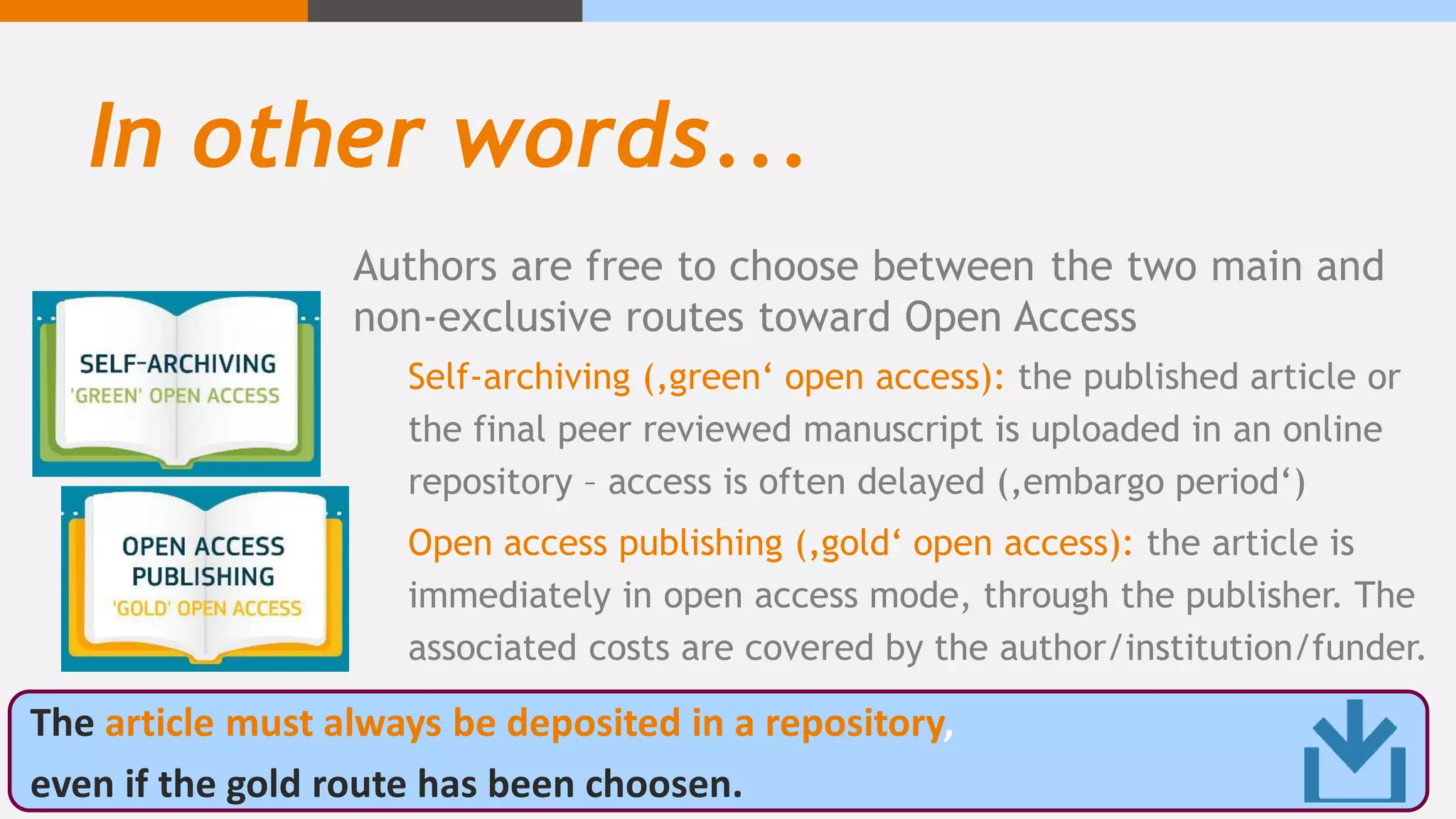
Authors are free to choose between the two main and
non-exclusive routes toward Open Access
Self-archiving (‚green‘ open access): the published article or
the final peer reviewed manuscript is uploaded in an online
repository – access is often delayed (‚embargo period‘)
Open access publishing (‚gold‘ open access): the article is
immediately in open access mode, through the publisher. The
associated costs are covered by the author/institution/funder.
The article must always be deposited in a repository,
even if the gold route has been choosen.
Where to deposit?
Institutional repository
OR
Disciplinary repository (arXiv,
Europe PubMed Central, etc.)
OR
Zenodo (www.zenodo.org) if
none of the above is available.
EC-cofunded, multidisciplinary
repository, for publications and data.
Remarks:
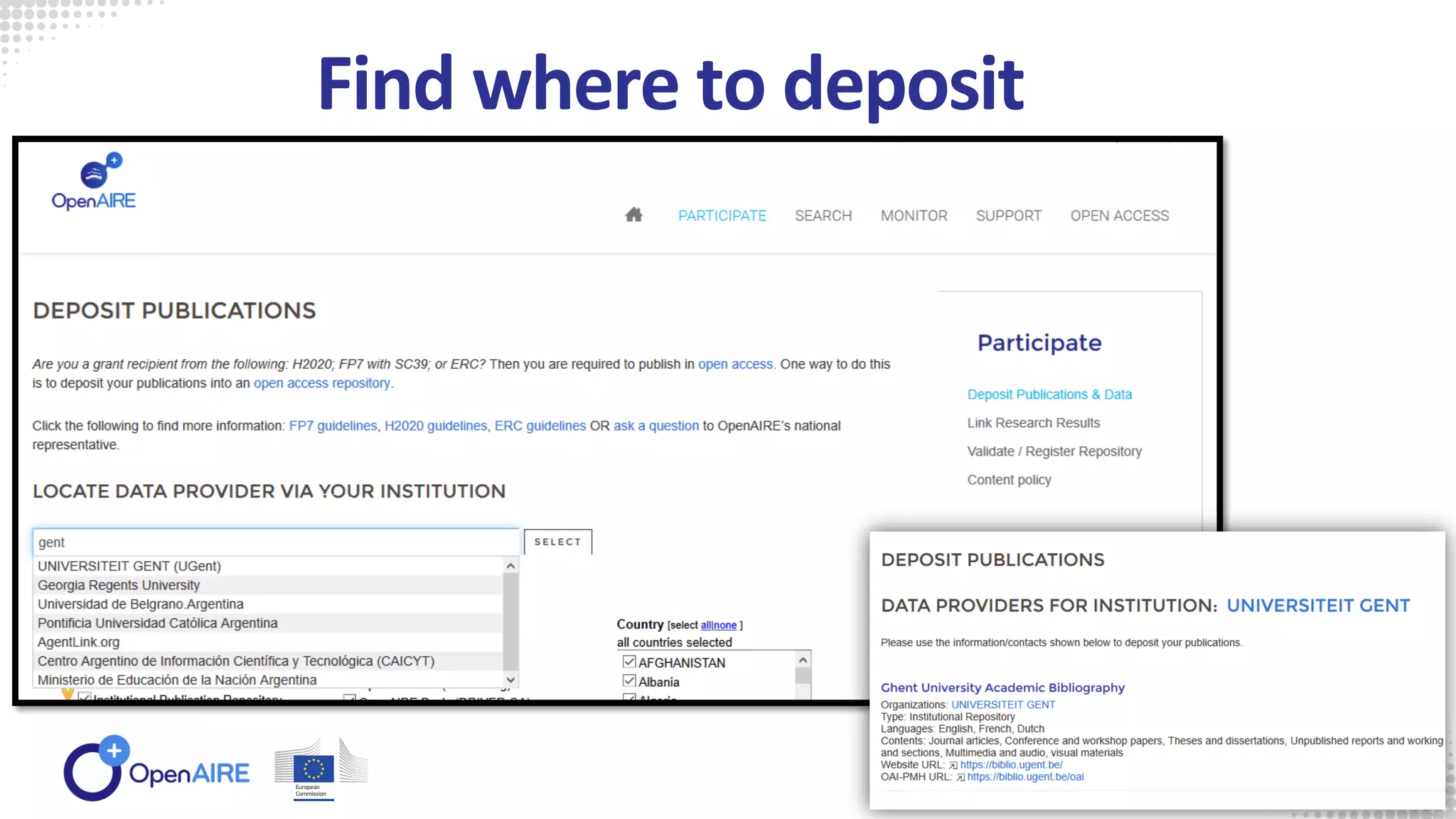
Finding a repository via registries:
ROAR http://roar.eprints.org,
OpenDOAR http://www.opendoar.org
or via OpenAIRE www.openaire.eu
A list of publications on the project
website is not sufficient.
How to bring all publications together?
OpenAIRE-compatibility to enable the
harvesting of metadata (more details
later)
where what when
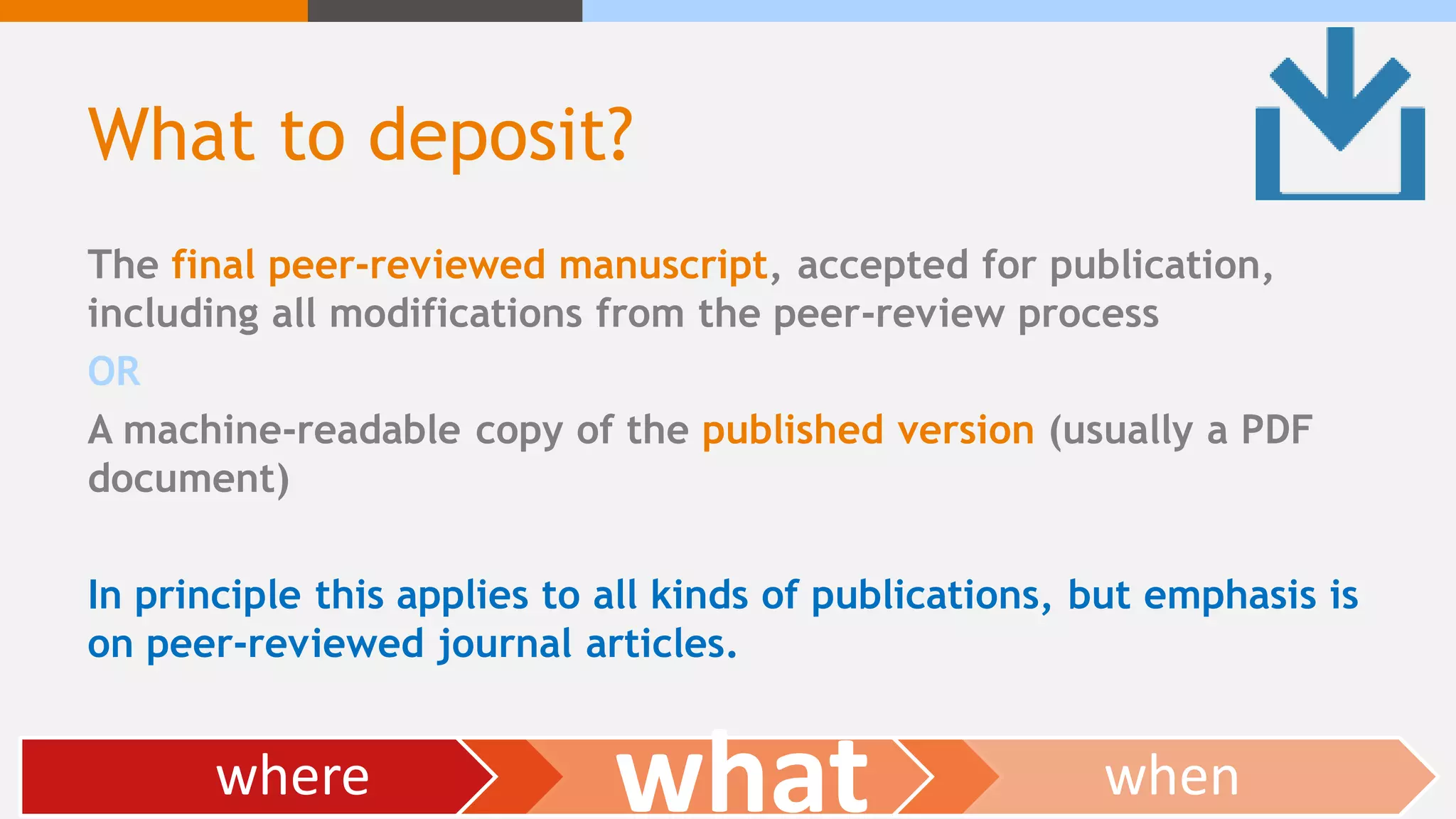
What to deposit?
The final peer-reviewed manuscript, accepted for publication,
including all modifications from the peer-review process
OR
A machine-readable copy of the published version (usually a PDF
document)
In principle this applies to all kinds of publications, but emphasis is
on peer-reviewed journal articles.
where what when
When to deposit?
Each beneficiary must deposit as soon as
possible and at the latest on publication.
where what when
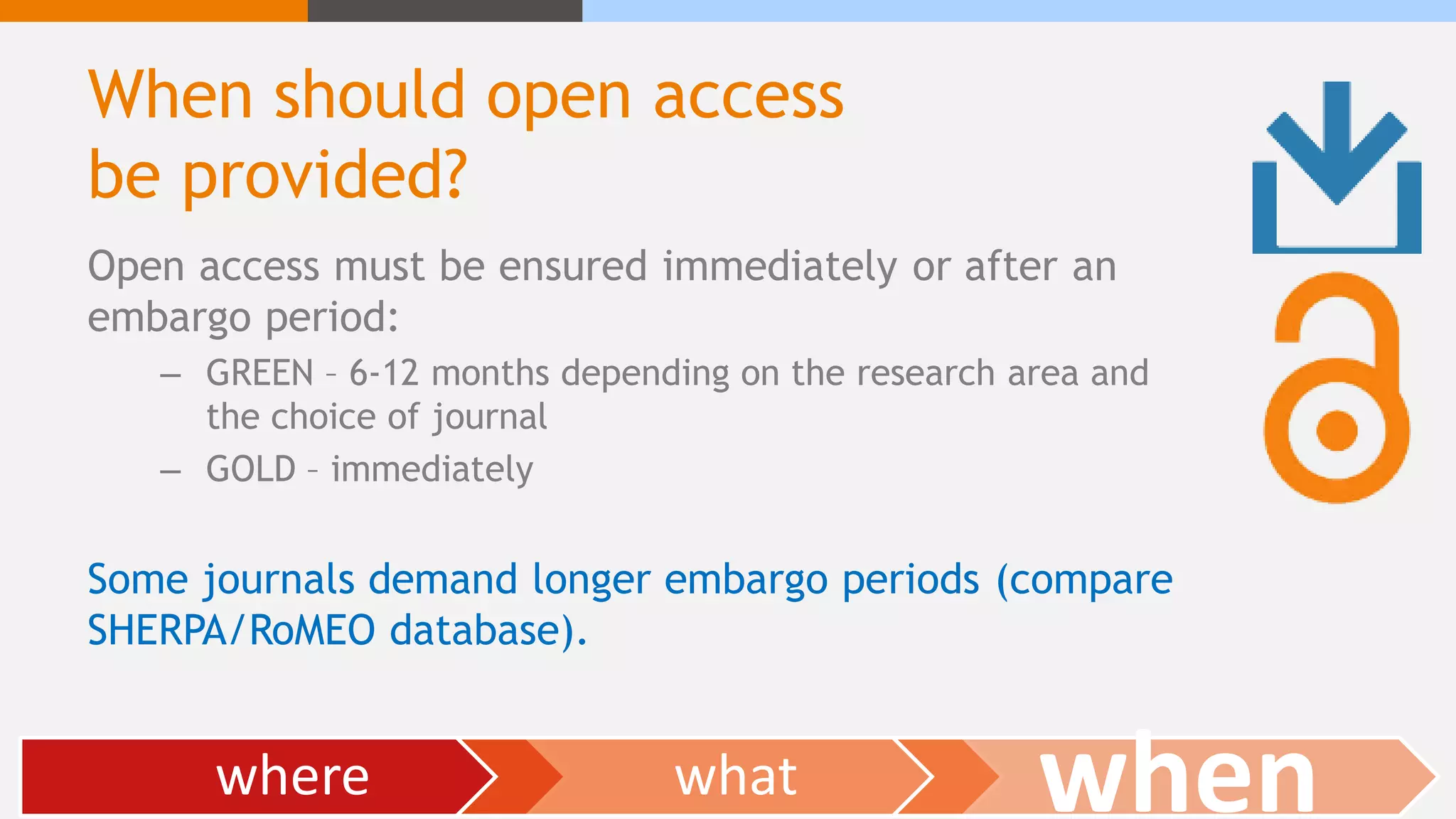
When should open access
be provided?
Open access must be ensured immediately or after an
embargo period:
– GREEN – 6-12 months depending on the research area and
the choice of journal
– GOLD – immediately
Some journals demand longer embargo periods (compare
SHERPA/RoMEO database).
where what when
OA in H2020:
summary of requirements
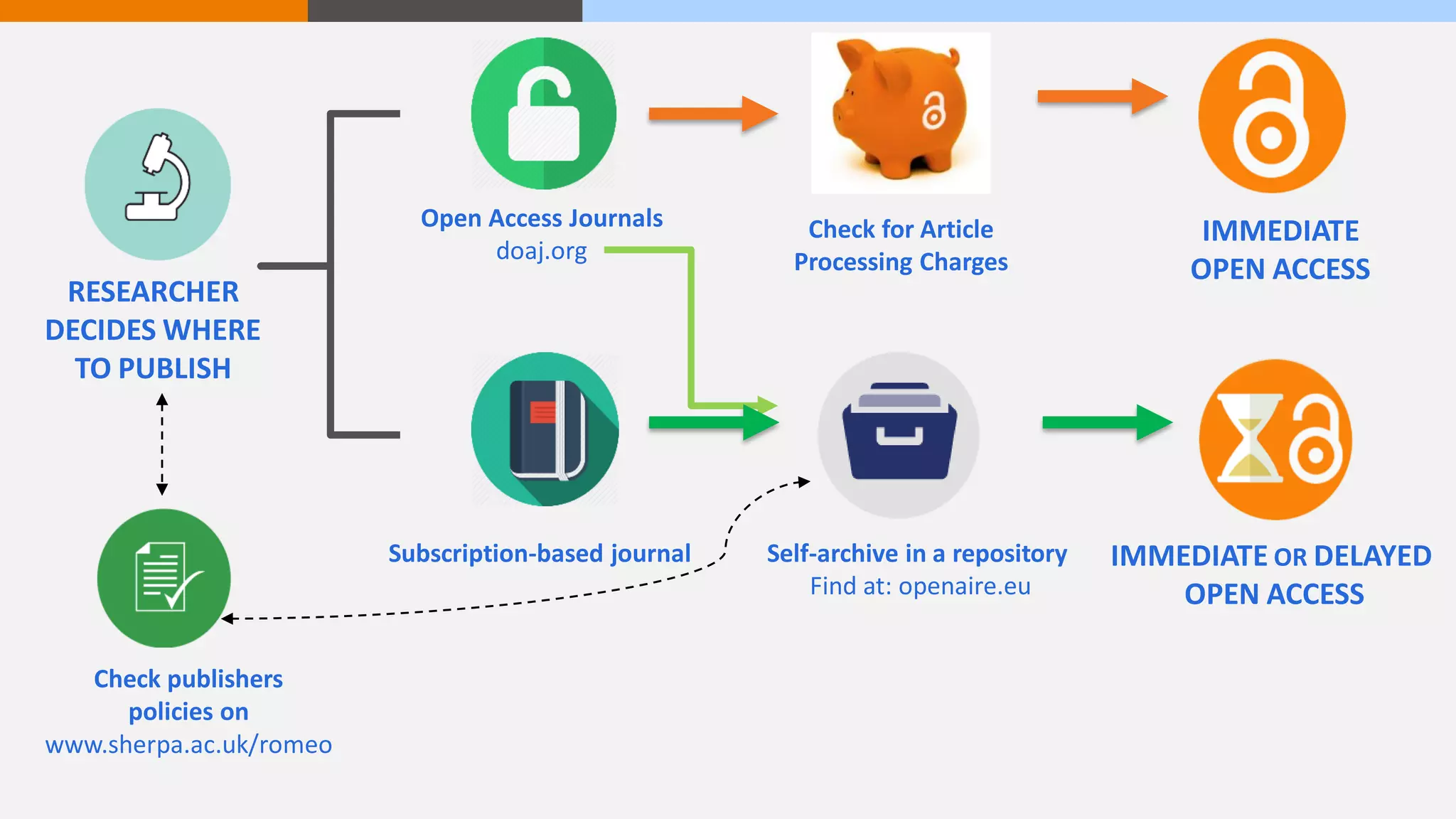
RESEARCHER
DECIDES WHERE
TO PUBLISH
Check publishers
policies on
www.sherpa.ac.uk/romeo
Open Access Journals
doaj.org
Check for Article
Processing Charges
Subscription-based journal Self-archive in a repository
Find at: openaire.eu
IMMEDIATE
OPEN ACCESS
IMMEDIATE OR DELAYED
OPEN ACCESS
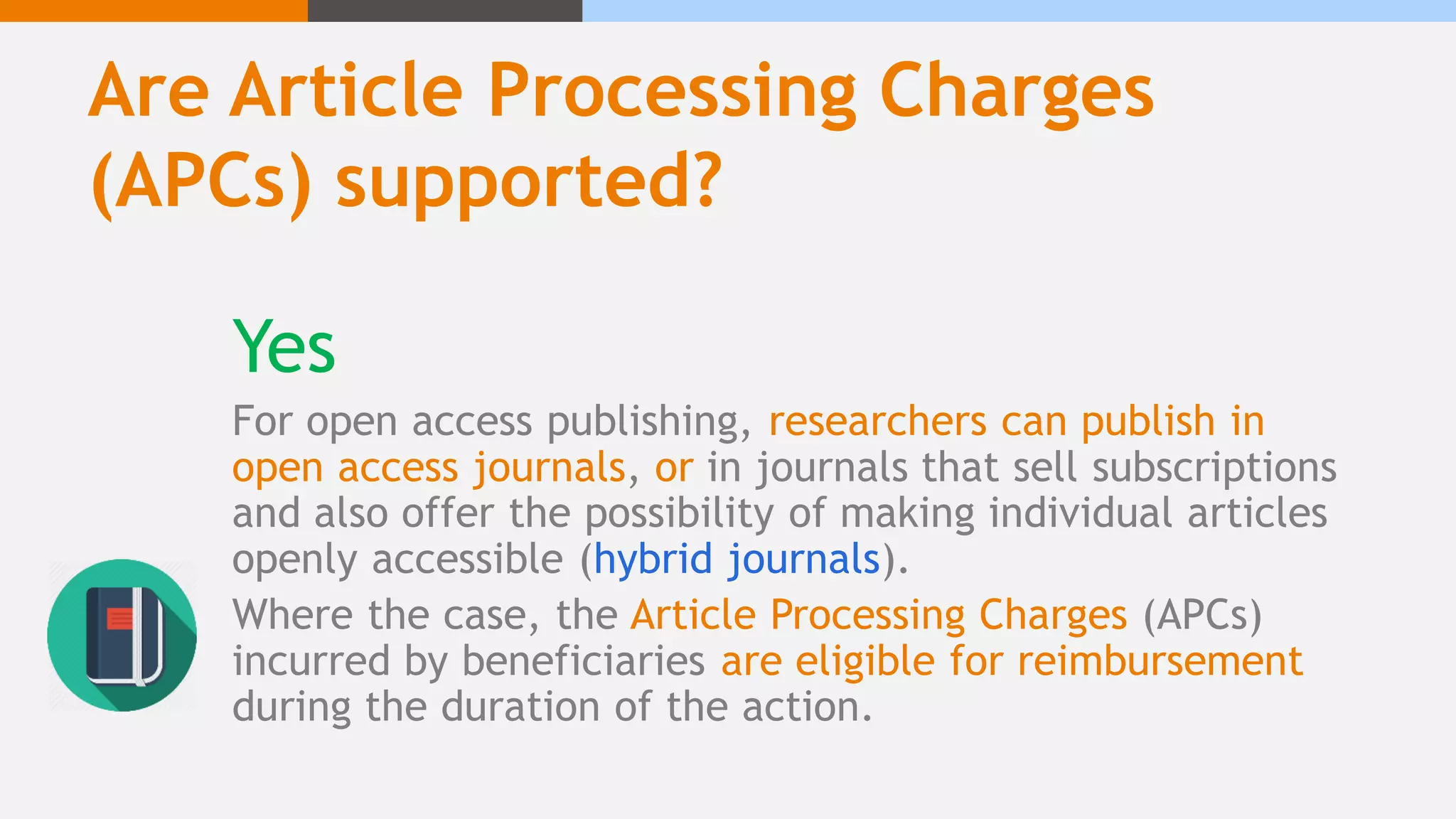
Are Article Processing Charges
(APCs) supported?
Yes
For open access publishing, researchers can publish in
open access journals, or in journals that sell subscriptions
and also offer the possibility of making individual articles
openly accessible (hybrid journals).
Where the case, the Article Processing Charges (APCs)
incurred by beneficiaries are eligible for reimbursement
during the duration of the action.
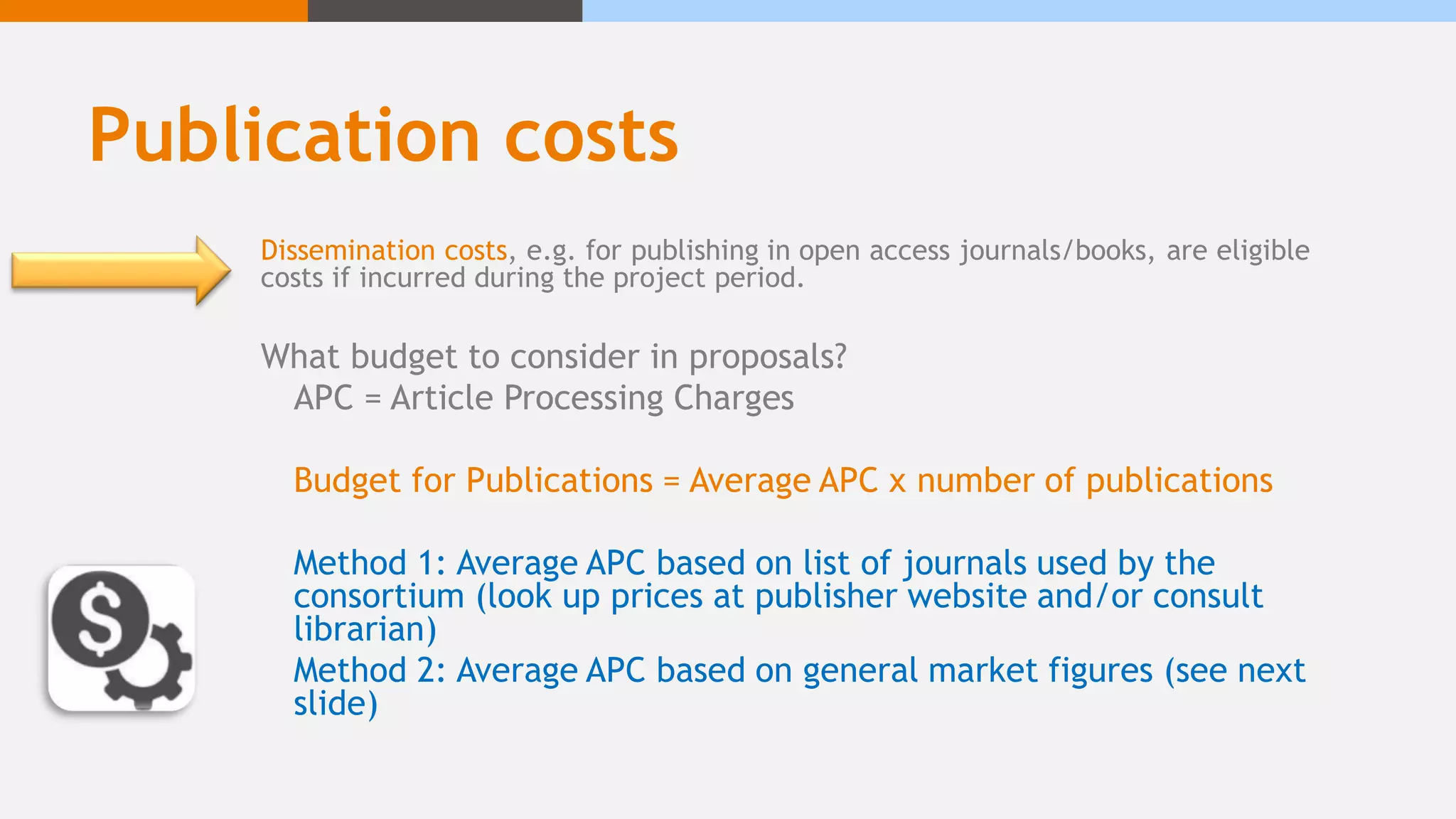
Publication costs
Dissemination costs, e.g. for publishing in open access journals/books, are eligible
costs if incurred during the project period.
What budget to consider in proposals?
APC = Article Processing Charges
Budget for Publications = Average APC x number of publications
Method 1: Average APC based on list of journals used by the
consortium (look up prices at publisher website and/or consult
librarian)
Method 2: Average APC based on general market figures (see next
slide)
Average APC?
Björk/Solomon estimated (2014) the average price
of Article Processing Charges (APC)
for established open access journals at ca. 1,020
EUR and
for hybrid journals (subscription journal with OA
option for individual articles) at ca. 1,980 EUR
Average APC?
At the moment OpenAPC provides cost data on 44,407 open
access journal articles contributed by 117 institutions
for fully open access journals the average payment was
1,479 €
for hybrid journals (subscription journal with OA option for
individual articles) the average fee is 2,493 €
Both types of OA publication costs can be reimbursed in
H2020 projects.
Currently, there is no price-cap for APCs.
https://github.com/OpenAPC/openapc-de
What are projects expected to do?
DURING PROPOSAL WRITING PHASE
- Outline of dissemination and exploitation strategy, including OA >> impact section of the proposal
(how will results be shared, data be managed and shared?)
- Include resources for publication costs (what journals, how many publications, what does it cost
on average?)
- Combine GREEN/GOLD strategies to achieve maximum of OA
DURING THE PROJECT
- Additional provisions in the Consortium Agreement - where to deposit, who is responsible.
- Implementation of the dissemination strategy, report at reviews and update
- What issues occur and how can they be solved? (publisher embargos, repositories for specific
material, etc.)
AFTER THE PROJECT END
- Are there publications foreseen after the ending of the project (ie which will not be covered by
the budget) – for post-FP7 project publications there is a pilot.
- Who takes care of deposit in repositories after the project end?
Projects have to start planning early on
Some issues to consider
1. Publishing all articles in APC based gold OA is not
probably the right solution, as this can lead to a
substantial amount of the overall project budget.
Therefore, a mixed strategy of GREEN/GOLD open
access is highly recommended.
2. The growing open access market comes with some
challenges
• Lots of new journals/publishers, some of questionable quality (‚predatory
journals‘, http://scholarlyoa.com/publishers/)
Some caution is needed when publishing, this holds for all journals.
Consult ‚white lists‘ such as DOAJ.
What are the consequences for non-
compliance with OA requirements?
If a beneficiary breaches any of its
obligations, the grant may be reduced
(Article 43) and it may also lead to any of
the other measures described in Chapter
6 of the General Model Grant Agreement.
http://ec.europa.eu/research/participants/data/ref/h2020/mga/gga/h2020-mga-gga-multi_en.pdf
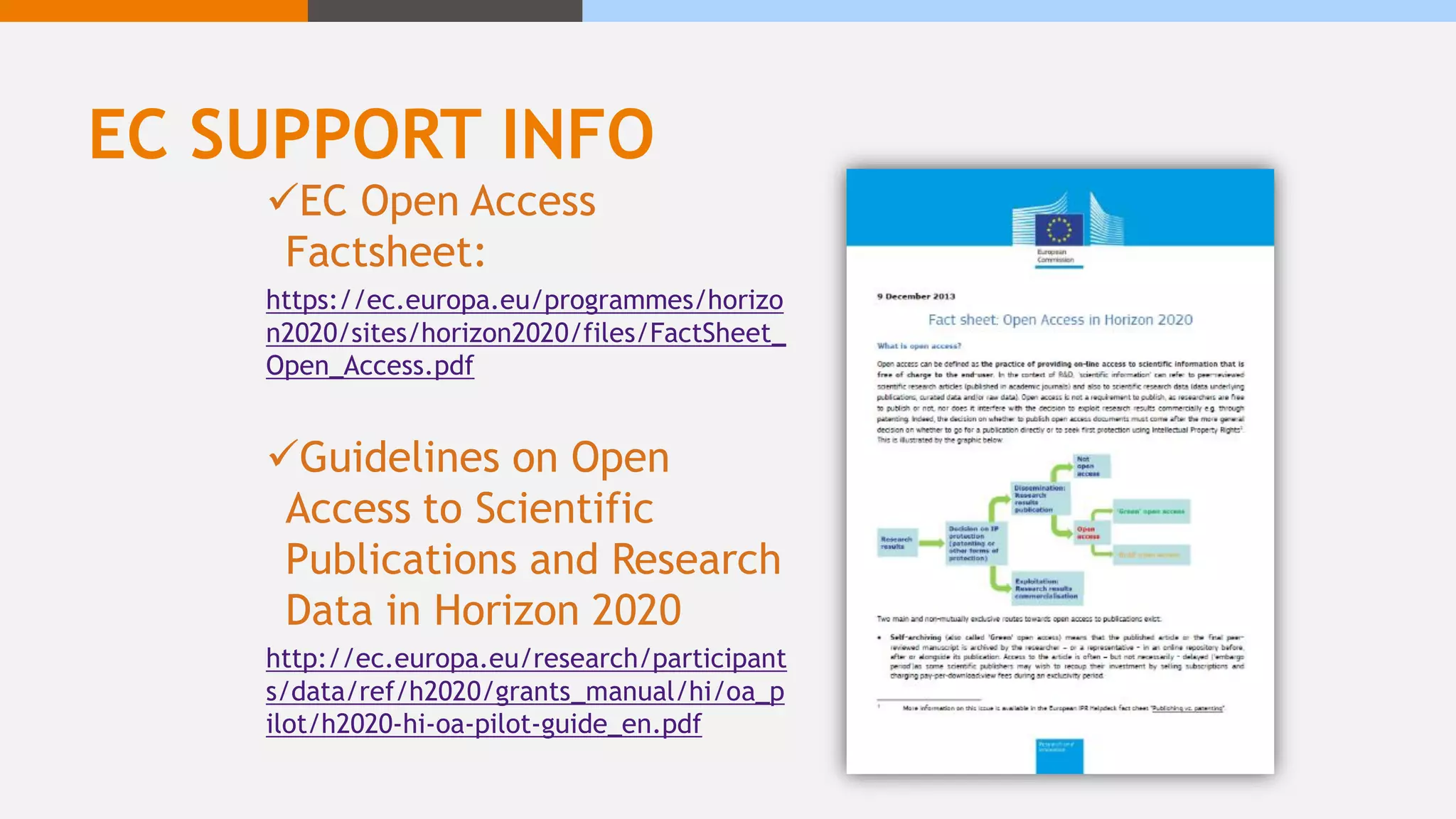
EC SUPPORT INFO
EC Open Access
Factsheet:
https://ec.europa.eu/programmes/horizo
n2020/sites/horizon2020/files/FactSheet_
Open_Access.pdf
Guidelines on Open
Access to Scientific
Publications and Research
Data in Horizon 2020
http://ec.europa.eu/research/participant
s/data/ref/h2020/grants_manual/hi/oa_p
ilot/h2020-hi-oa-pilot-guide_en.pdf
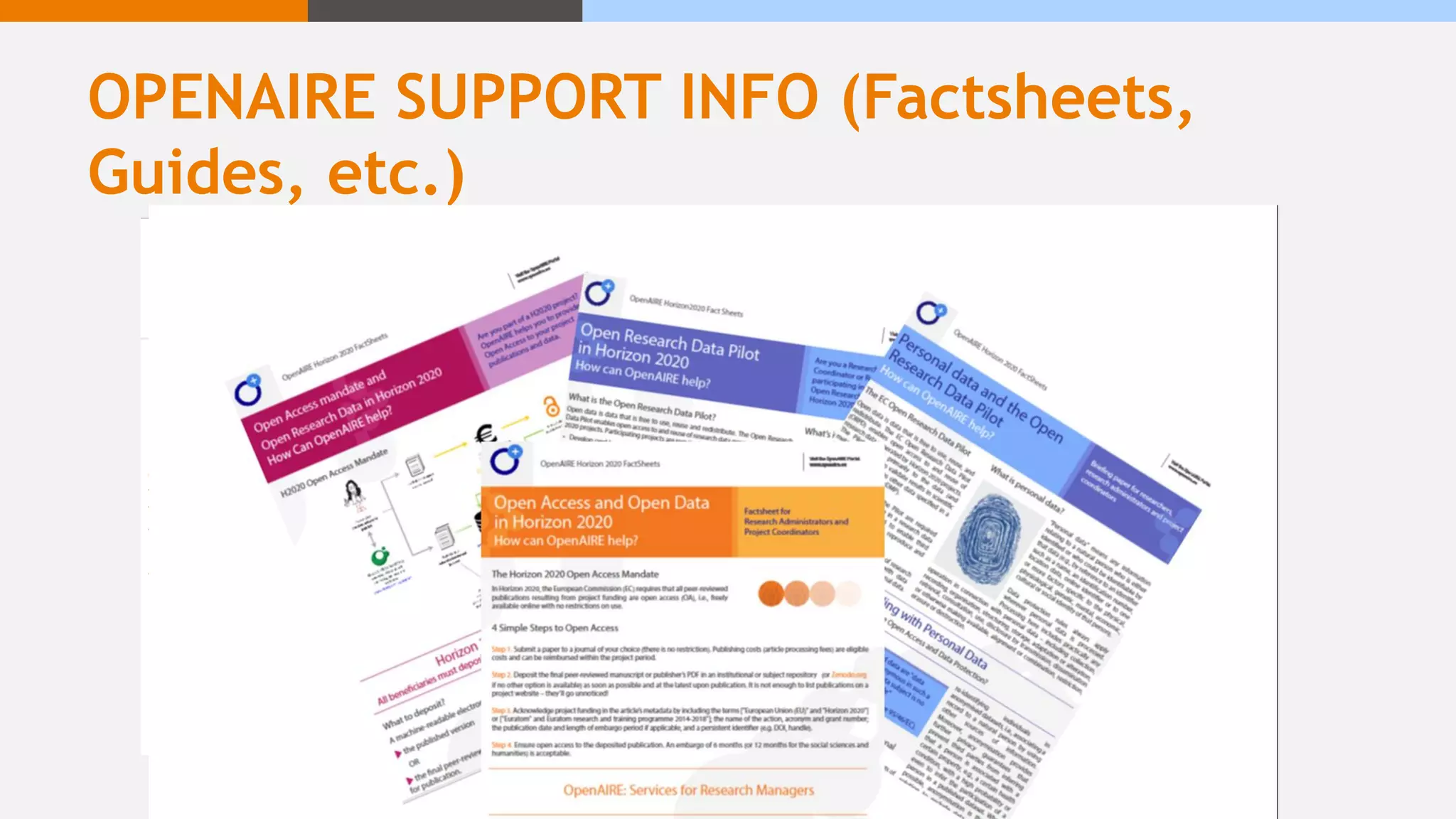
OPENAIRE SUPPORT INFO (Factsheets,
Guides, etc.)
https://www.openaire.eu/h2020openaccess/#
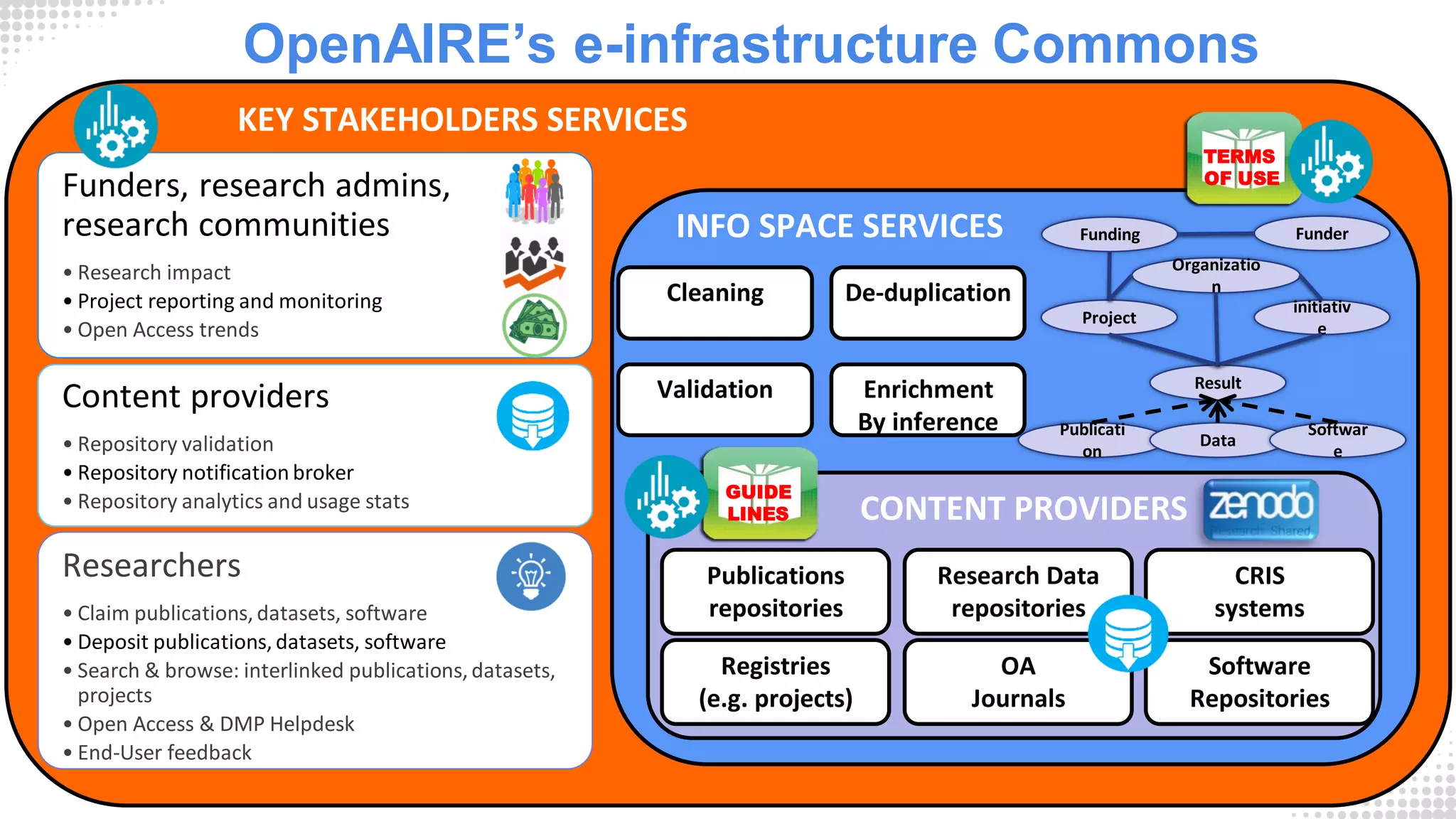
OpenAIRE’s e-infrastructure Commons
Publications
repositories
Research Data
repositories
CRIS
systems
Registries
(e.g. projects)
OA
Journals
Software
Repositories
Validation
Cleaning De-duplication
Enrichment
By inference
Funders, research admins,
research communities
• Research impact
• Project reporting and monitoring
• Open Access trends
Content providers
• Repository validation
• Repository notification broker
• Repository analytics and usage stats
Researchers
• Claim publications, datasets, software
• Deposit publications, datasets, software
• Search & browse: interlinked publications, datasets,
projects
• Open Access & DMP Helpdesk
• End-User feedback
CONTENT PROVIDERS
INFO SPACE SERVICES
KEY STAKEHOLDERS SERVICES
Project
initiativ
e
FunderFunding
Result
Publicati
on
Data
Softwar
e
Organizatio
n
GUIDE
LINES
TERMS
OF USE
Share, deposit and
publish in OA
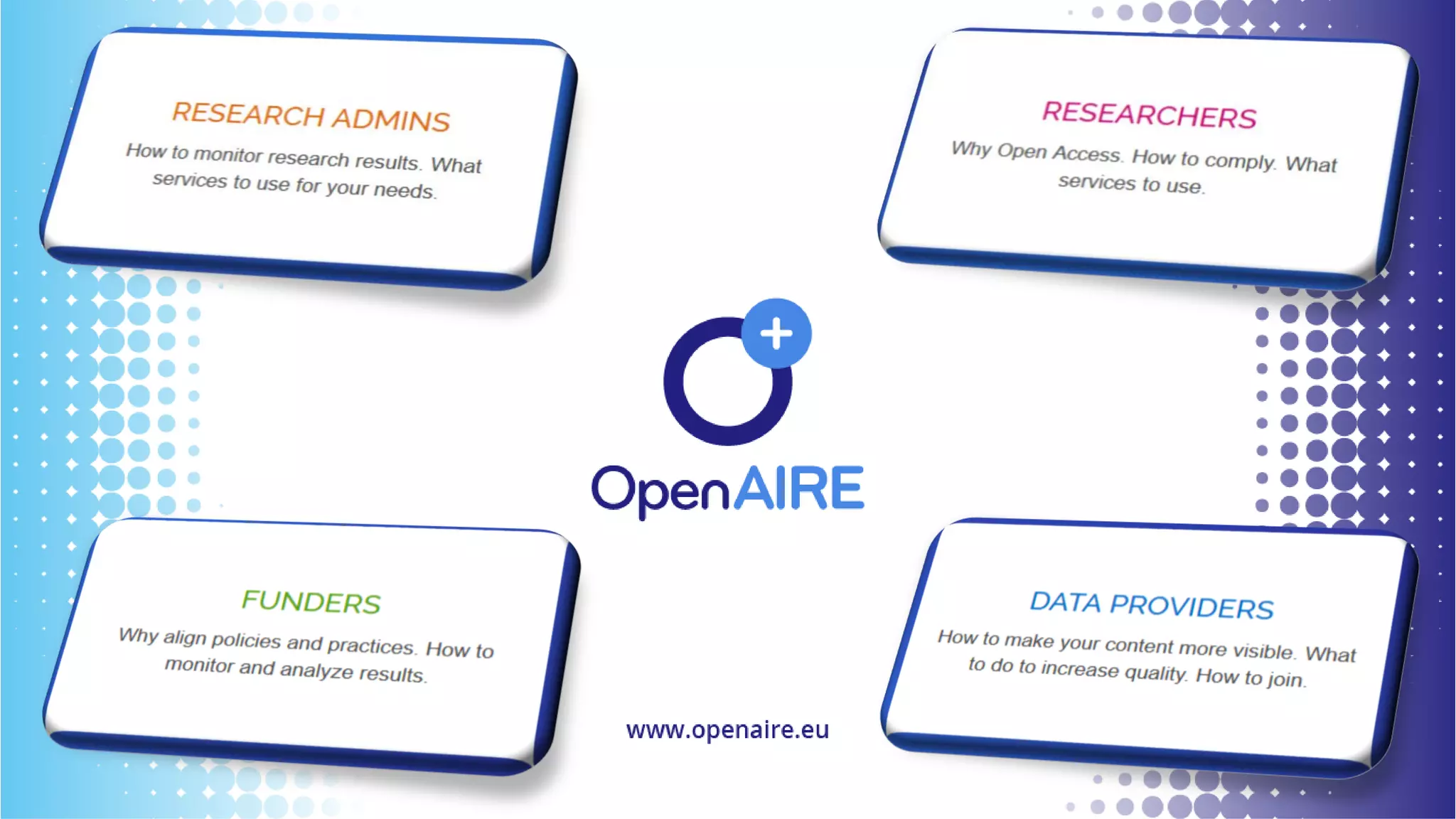
WhyOpenScience.Howtocomply.
Whatservicestouse.
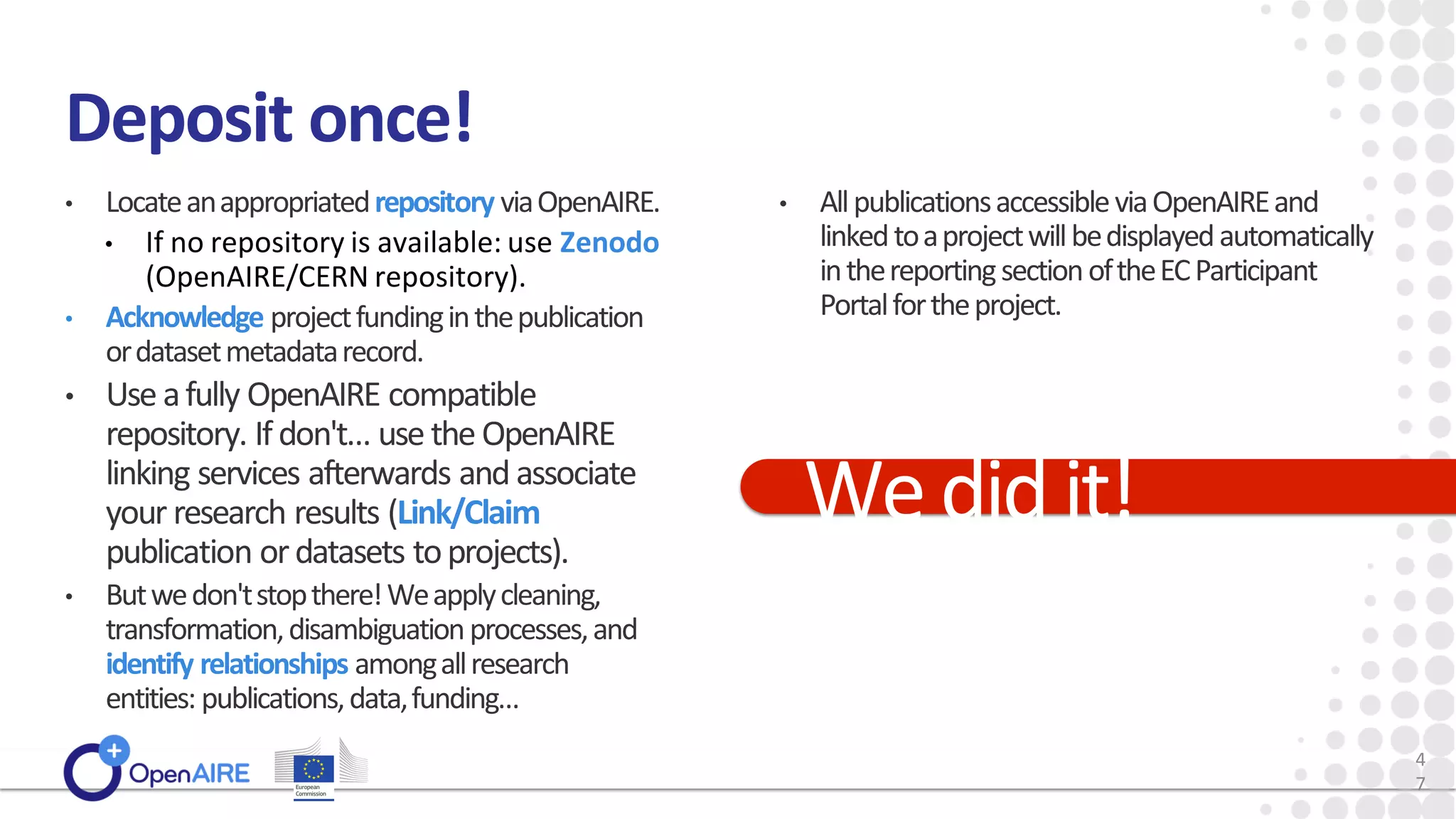
Deposit once!
• Locateanappropriatedrepository viaOpenAIRE.
• If no repository is available: use Zenodo
(OpenAIRE/CERN repository).
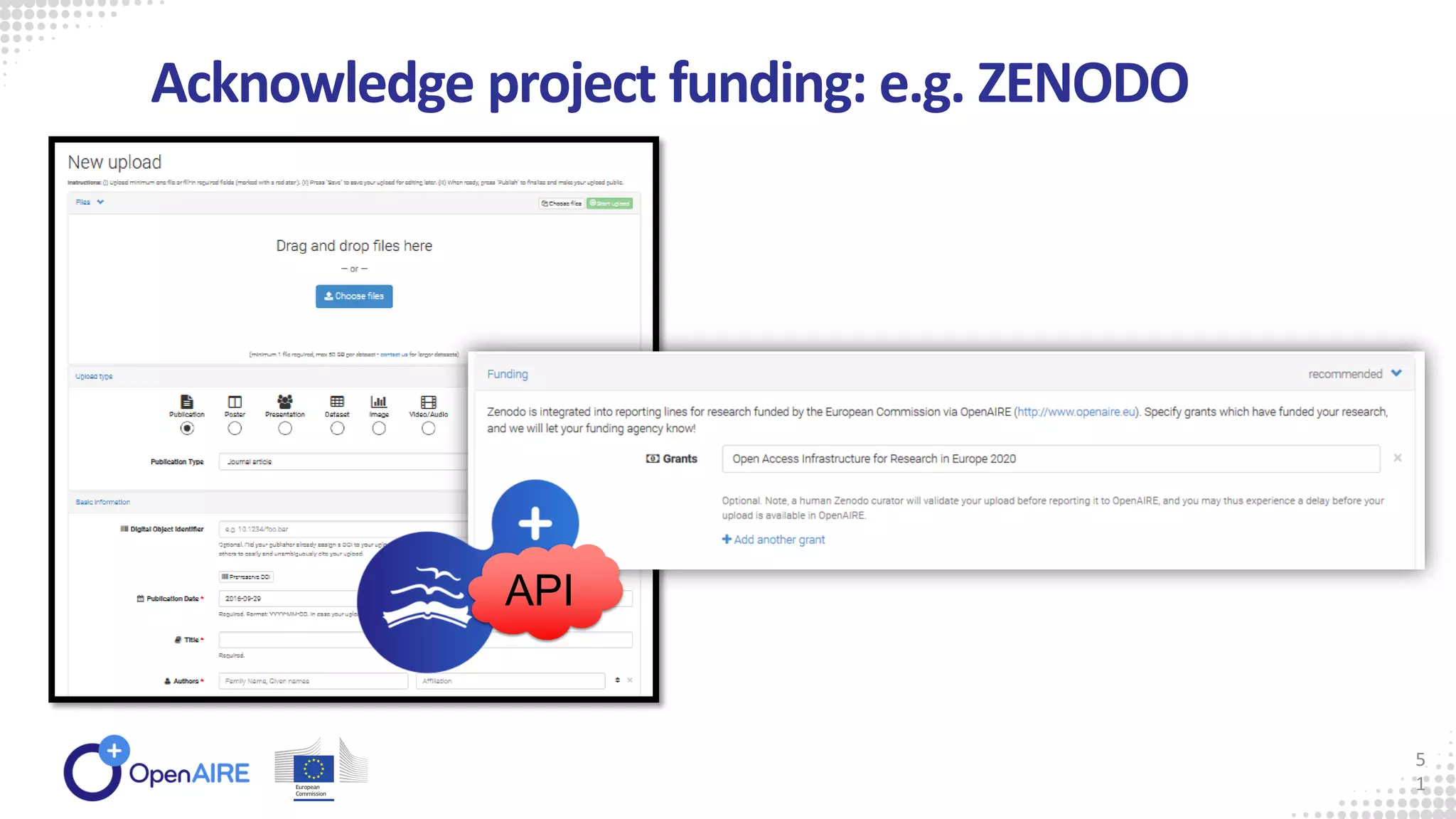
• Acknowledge projectfundinginthepublication
ordatasetmetadatarecord.
• Use afully OpenAIRE compatible
repository. Ifdon't… use the OpenAIRE
linking services afterwards and associate
your research results (Link/Claim
publication ordatasets toprojects).
• Butwedon'tstopthere!Weapplycleaning,
transformation,disambiguationprocesses,and
identify relationships amongallresearch
entities: publications,data,funding…
• AllpublicationsaccessibleviaOpenAIREand
linkedtoaprojectwillbedisplayedautomatically
inthereportingsectionoftheECParticipant
Portalfortheproject.
Wedidit!
4
7
Find where to deposit
4
8
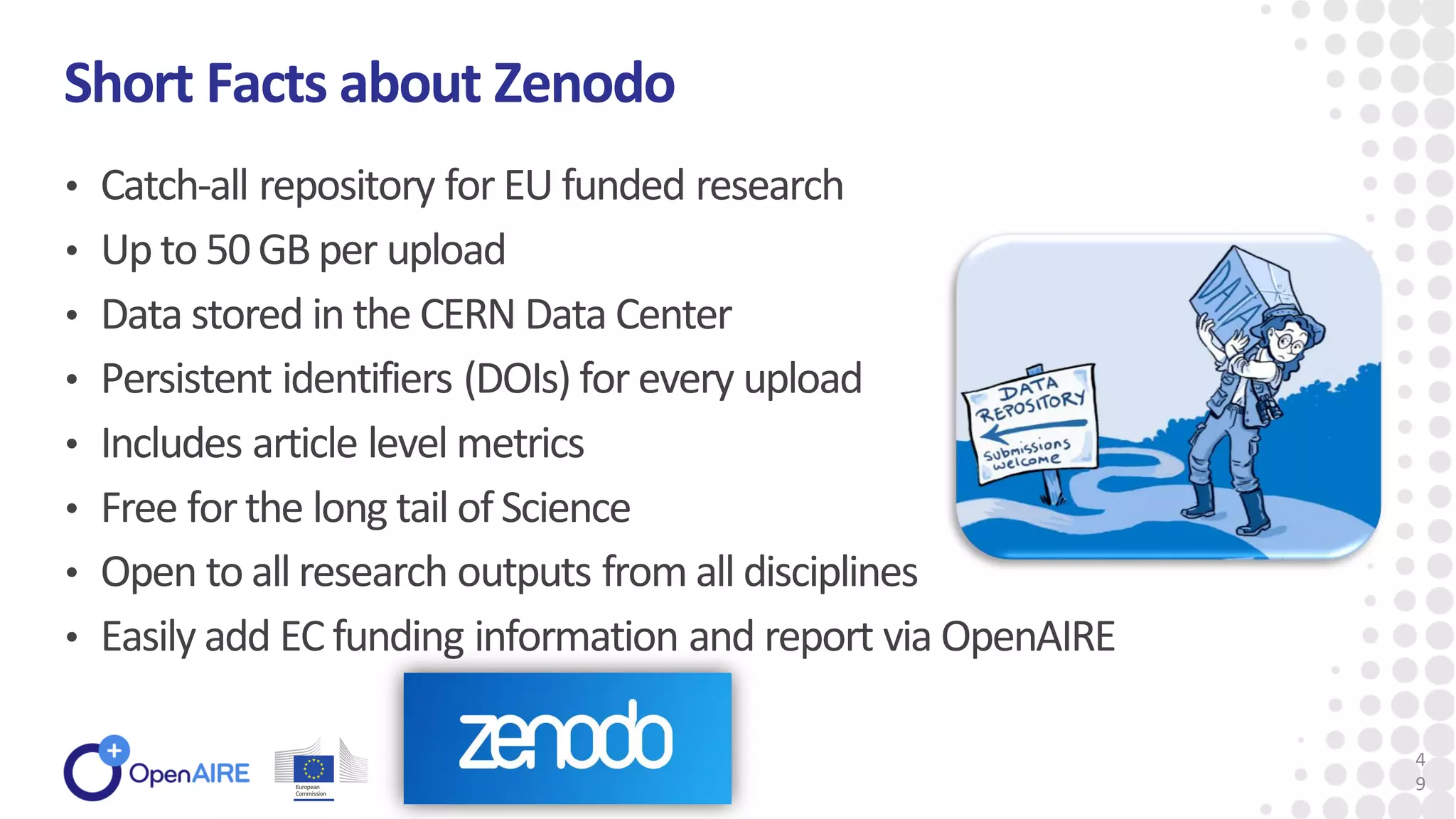
• Catch-all repository for EU funded research
• Up to 50GB per upload
• Data stored in the CERN Data Center
• Persistent identifiers (DOIs) for every upload
• Includes article level metrics
• Free for the long tail of Science
• Open to all research outputs from all disciplines
• Easily add EC funding information and report via OpenAIRE
Short Facts about Zenodo
4
9
PROJECT FUNDING IN THE PUBLICATION
OR DATASET METADATA RECORD
Acknowledge
50
Acknowledge project funding: e.g. ZENODO
5
1
API
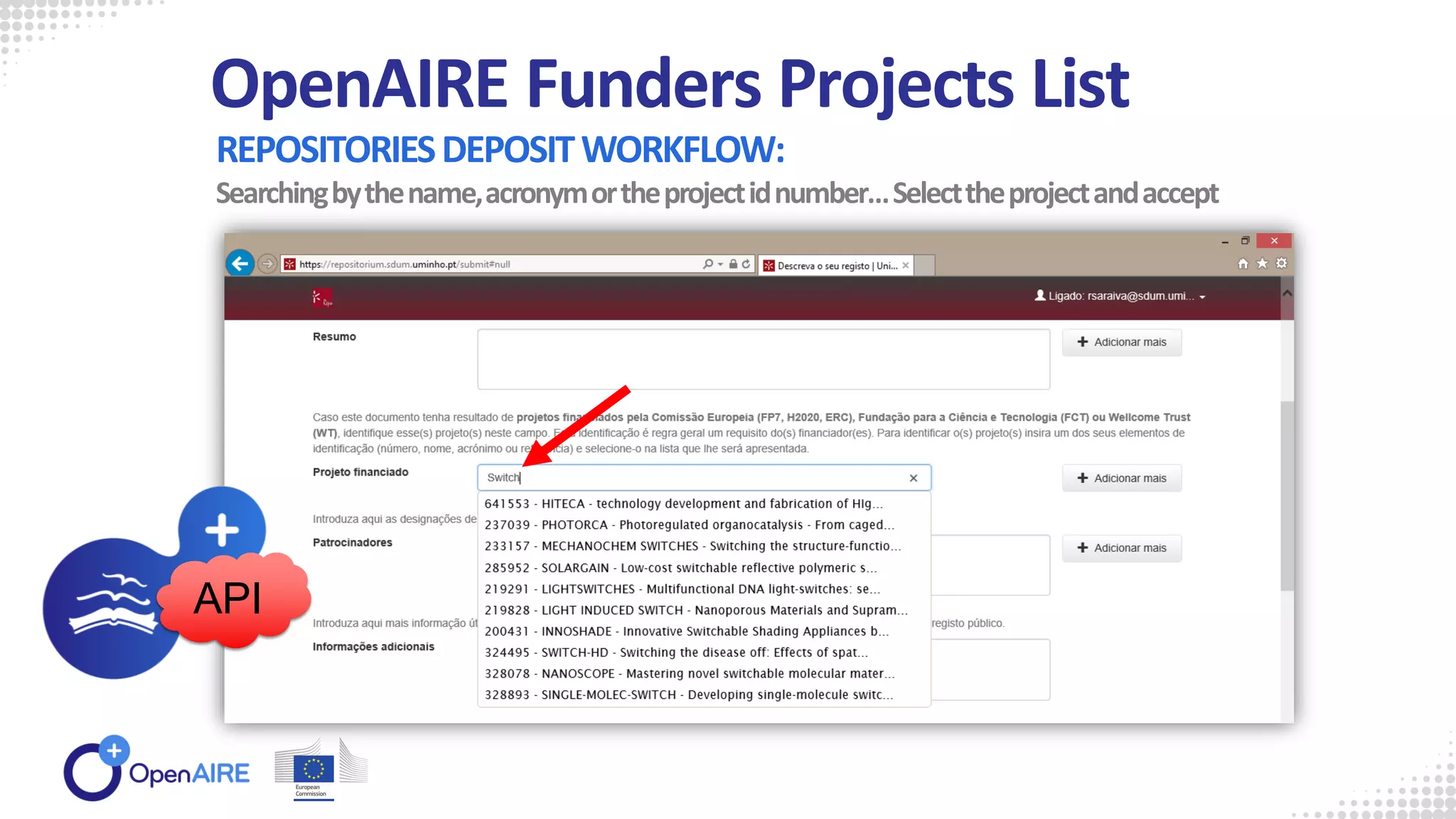
REPOSITORIESDEPOSITWORKFLOW:
Searchingbythename,acronymortheprojectidnumber…Selecttheprojectandaccept
OpenAIRE Funders Projects List
API
Discover, Access
andReuse
ForallOpenAIREstakeholders…
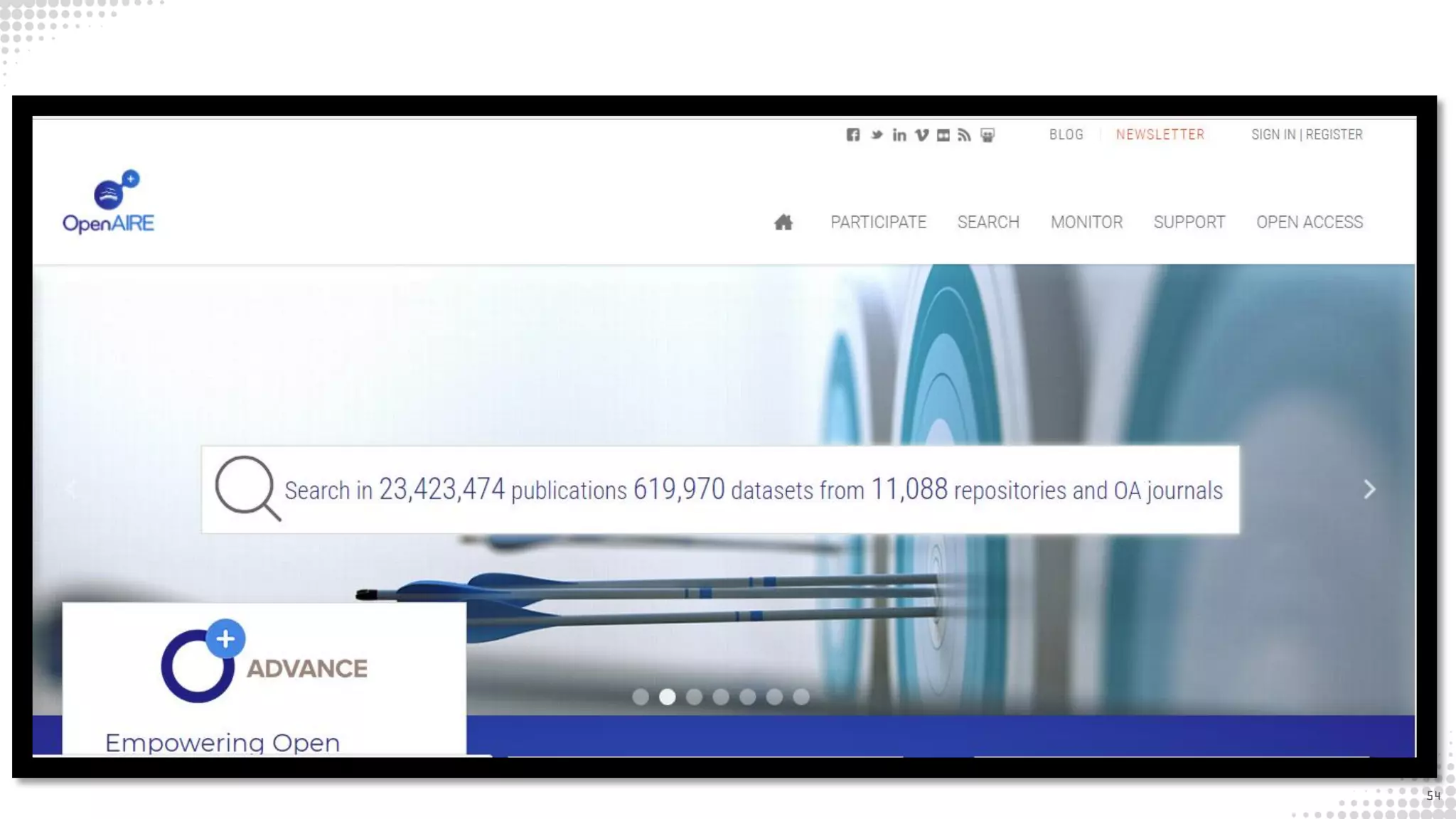
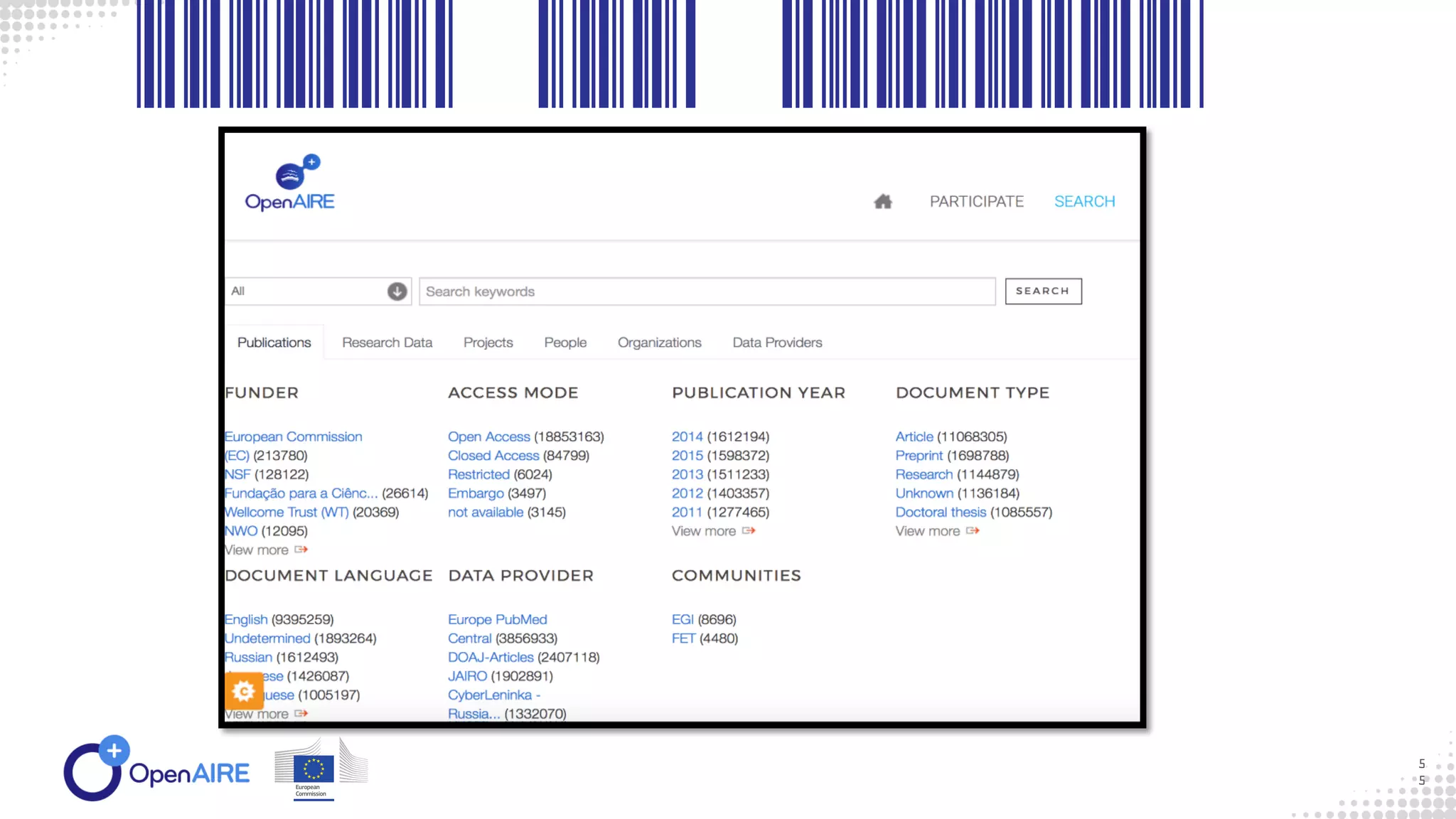
54
Search all entities
5
5
Link yourresearch
results
Servicesforresearchers,project
coordinatorsandresearchmanagers
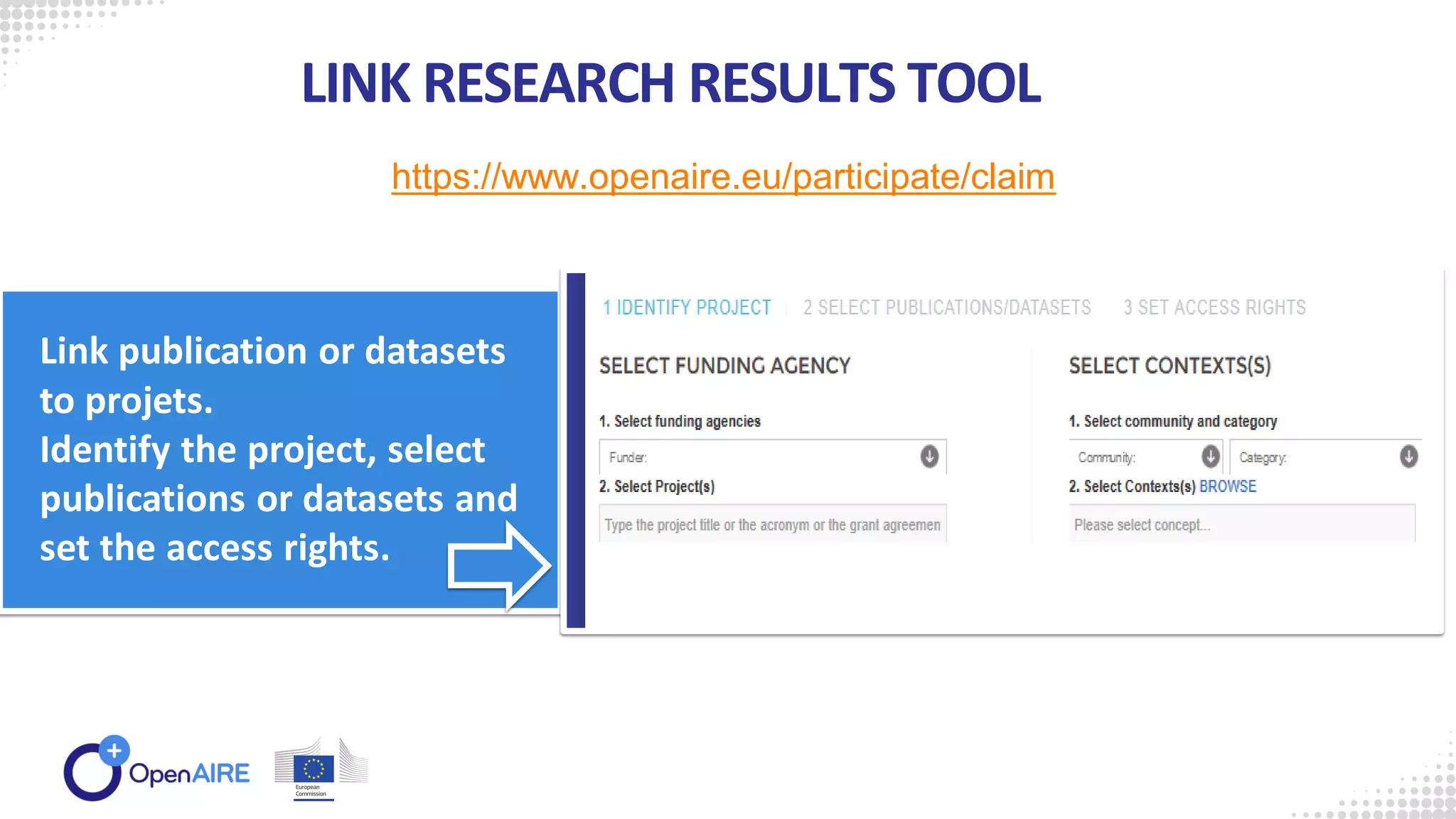
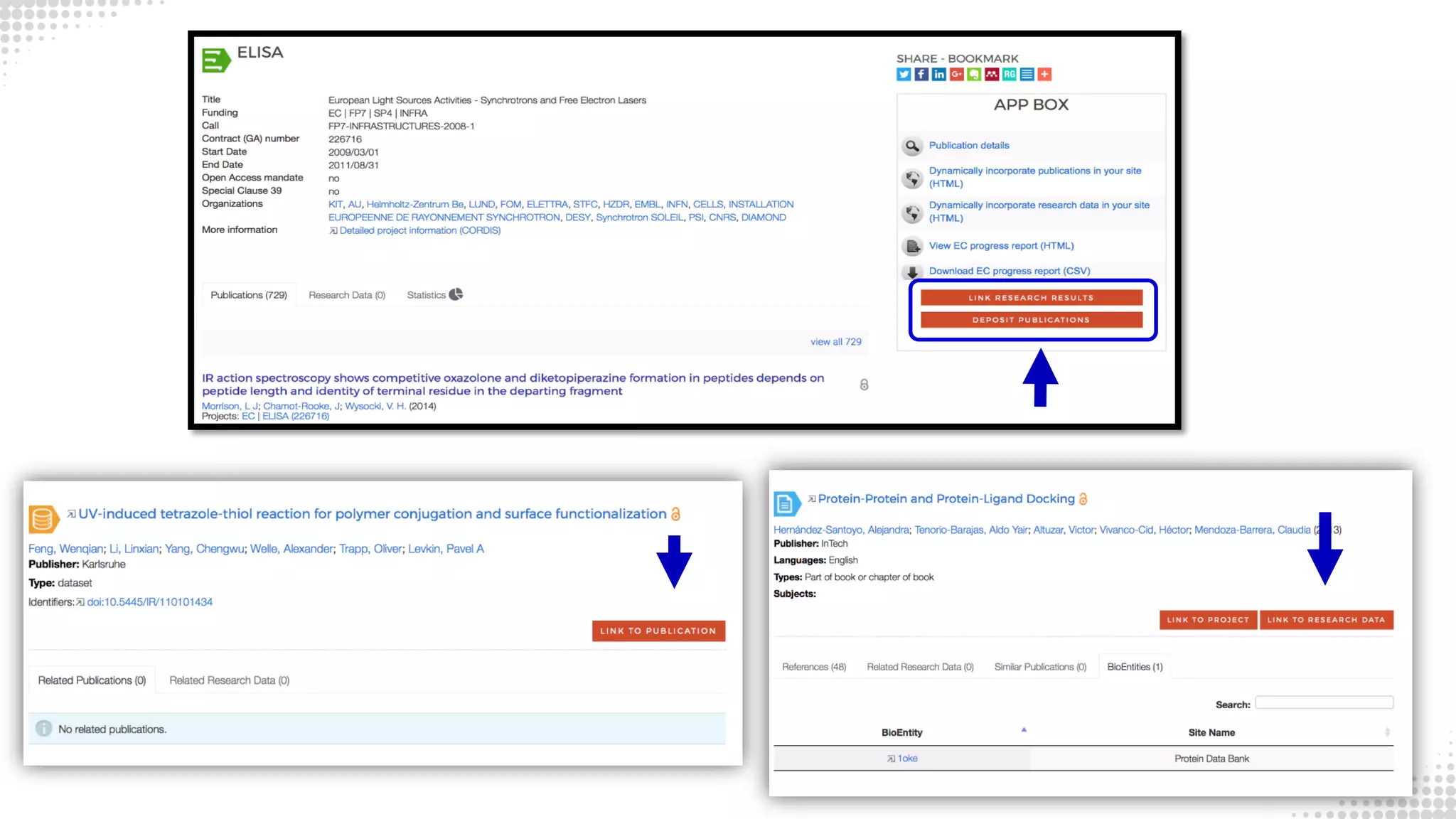
LINK RESEARCH RESULTS TOOL
Link publication or datasets
to projets.
Identify the project, select
publications or datasets and
set the access rights.
https://www.openaire.eu/participate/claim
Gatheroutputs.
View progressand
report. Monitor.
Servicesforresearchers,project
coordinatorsandresearchmanagers
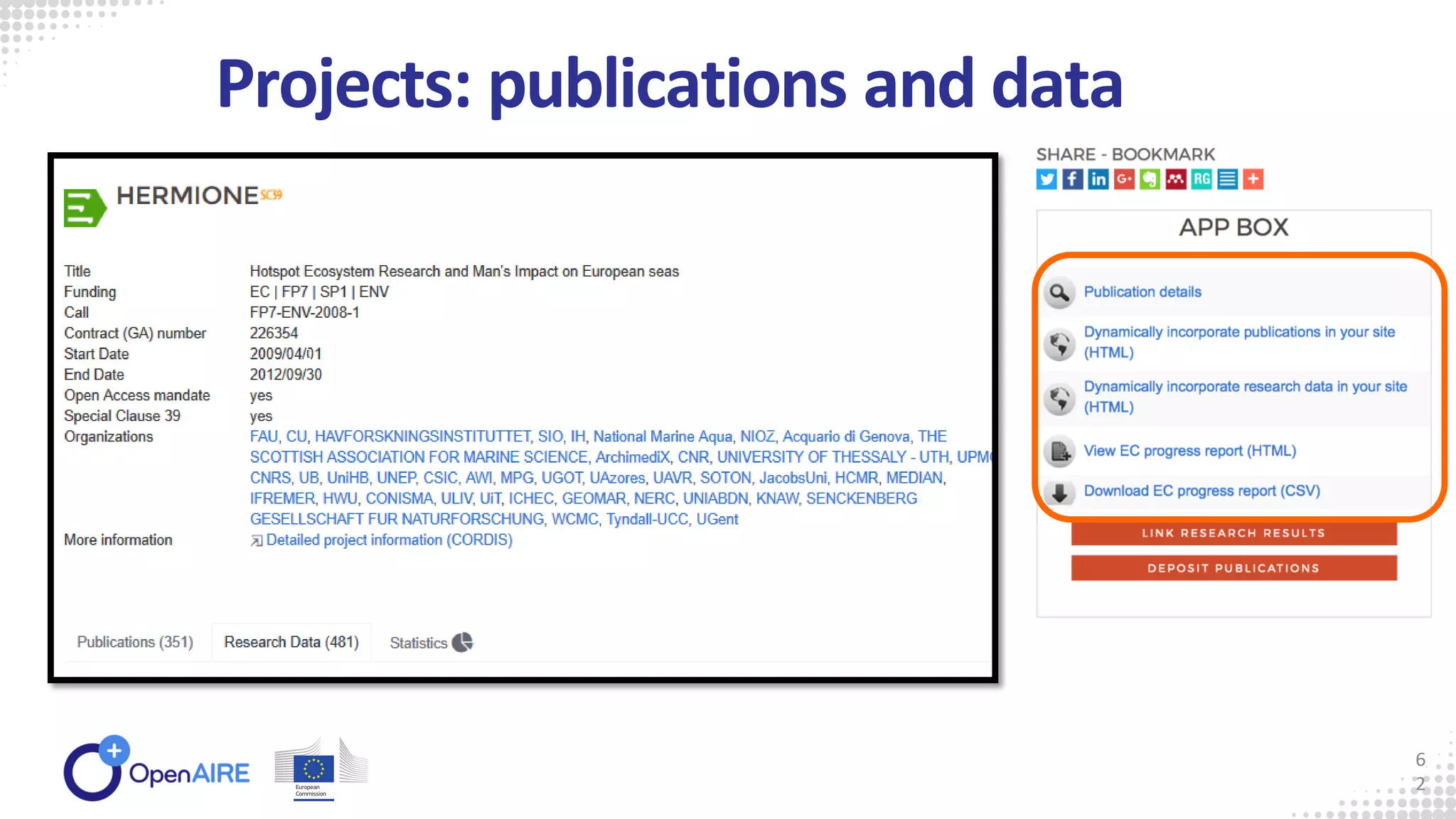
Projects: publications and data
6
2
PROJECT
PUBLICATIONS
AND DATASETS
Automatically
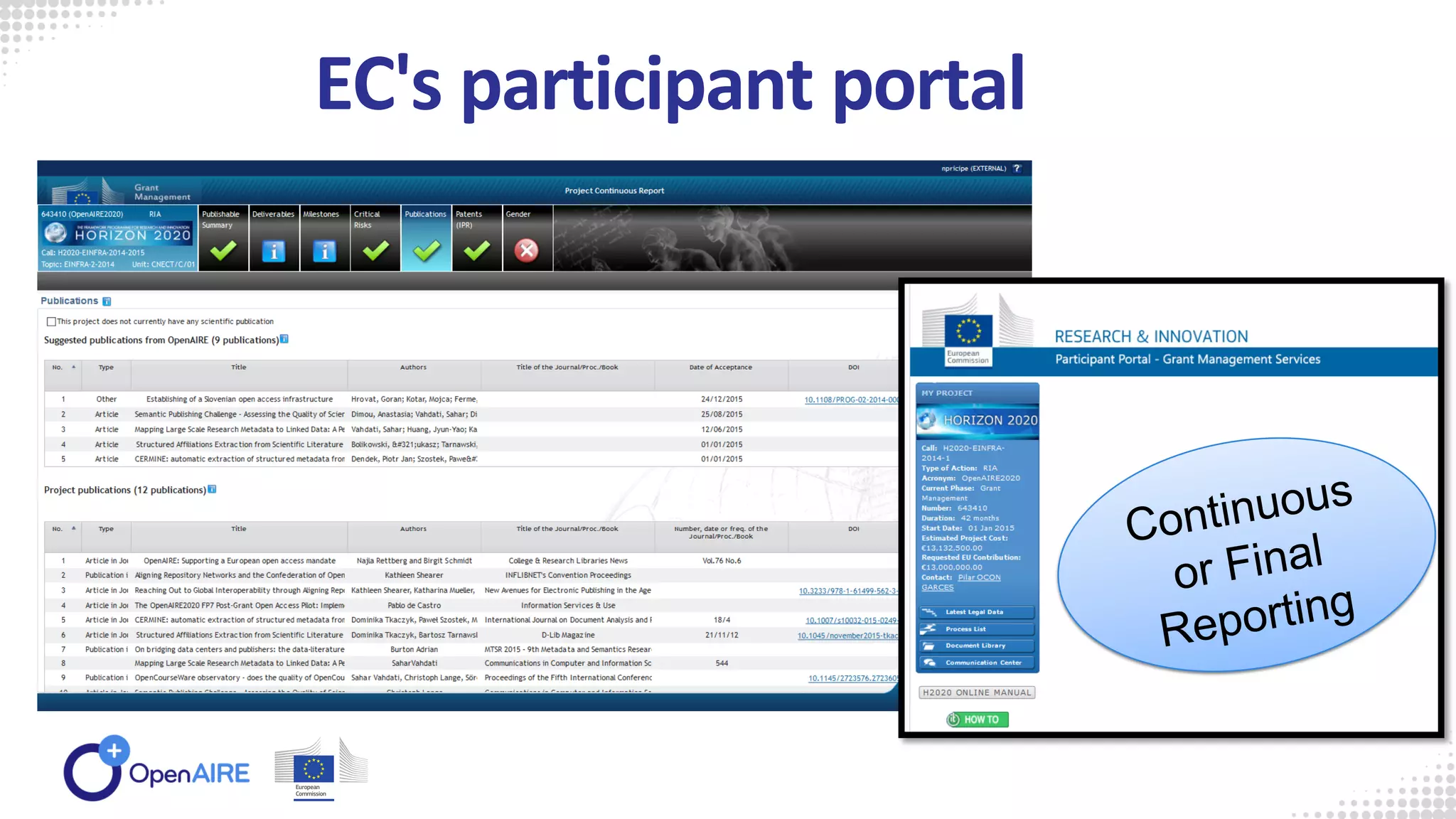
EC's participant portal
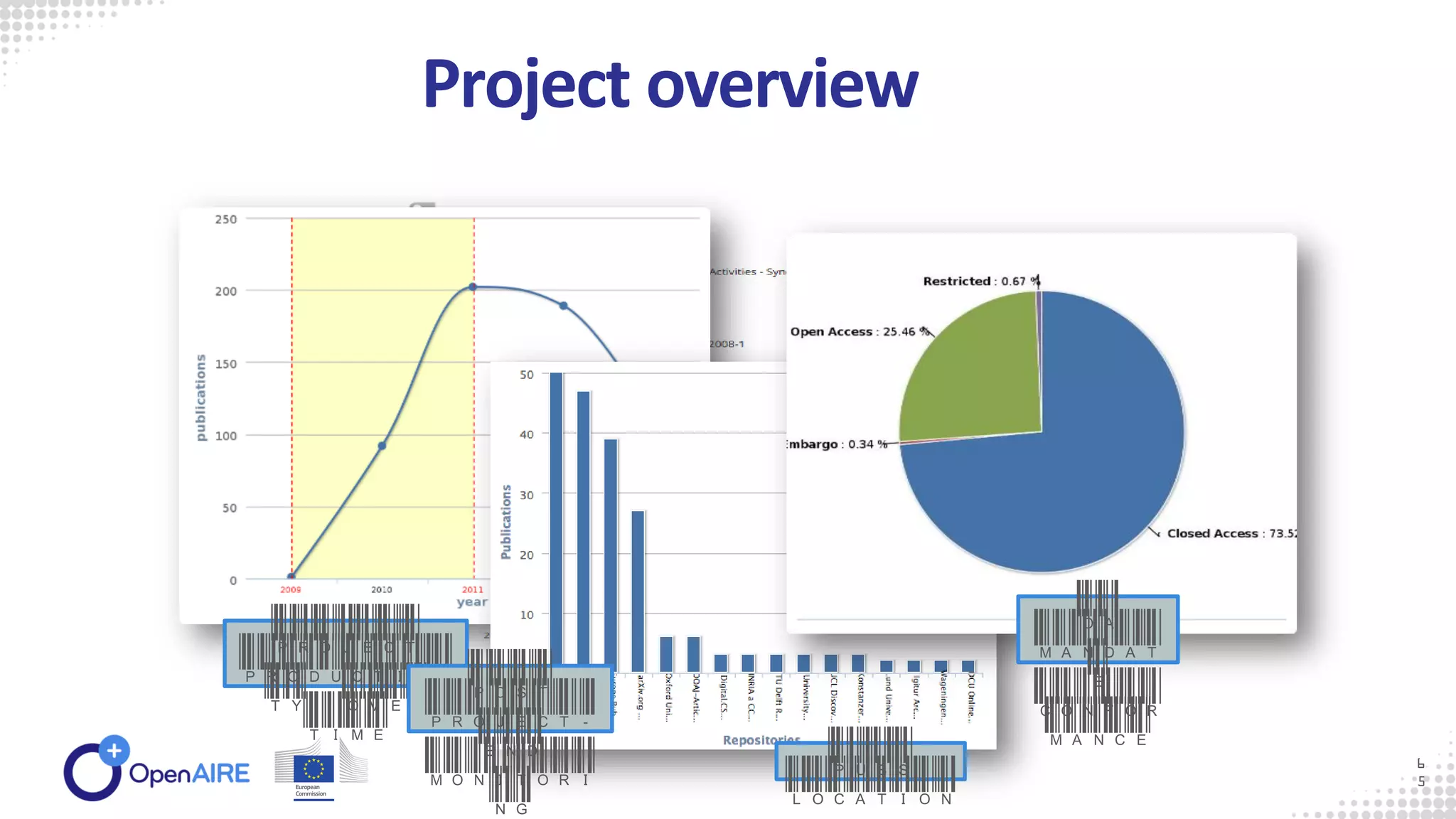
Project overview
6
5
Project
productivi
ty over
time
Post
project-
end
monitori
ng
Pubs
location
OA
mandat
e
confor
mance
Questions?

Open Science in Horizon 2020

  • 1.
    Open Science in Horizon2020 Eloy Rodrigues – eloy@sdum.uminho.pt February 22nd 2018, Lisboa
  • 2.
    Agenda 1. Introduction toOpen Science and policy context 2. Open Access in H2020 1. Summary of requirements 2. Practical implementation 3. OpenAIRE support services and tools 3. Open Research Data in H2020
  • 3.
    INTRODUCTION TO OPEN SCIENCEAND POLICY CONTEXT 1
  • 4.
    “Open Innovation, Open Science, Opento the World” Commissioner Carlos Moedas, 2015
  • 5.
    A systemic change inthe modus operandi of science and research Affecting the whole research cycle and its stakeholders Commissioner Carlos Moedas Open Science Presidency Conference Amsterdam, 4 April 2016 The Need to be Open Open Science
  • 7.
  • 9.
  • 10.
    “NORMAL” SCIENCE ISCUMULATIVE «Bernard of Chartres used to compare us to dwarfs perched on the shoulders of giants. He pointed out that we see more and farther than our predecessors, not because we have keener vision or greater height, but because we are lifted up and borne aloft on their gigantic stature.» John of Salisbury, Metalogicon, 1159 (III, 4)
  • 11.
    Even the genius… “WhatDesCartes did was a good step. You have added much several ways, & especially in taking ye colours of thin plates into philosophical consideration. If I have seen further it is by standing on ye sholders of Giants.“ Isaac Newton - Carta para Robert Hooke (15 de Fevereiro de 1676)
  • 12.
    “Much of theremarkable growth of scientific understanding in recent centuries is due to open practices; open communication and deliberation sit at the heart of scientific practice.” Open Science https://royalsociety.org/topics-policy/projects/science-public-enterprise/Report/
  • 13.
    Open Science :Why? To make science more efficient, transparent, trustable and reproducible.
  • 14.
    Scientific progress -Emergency science
  • 15.
    Scientific progress www.nytimes.com/2010/08/13/health/research/ 13alzheimer.html?pagewanted=all&_r=0 “It wasunbelievable. Its not science the way most of us have practiced in our careers. But we all realised that we would never get biomarkers unless all of us parked our egos and intellectual property noses outside the door and agreed that all of our data would be public immediately.” Dr John Trojanowski, University of Pennsylvania
  • 16.
    Validate/Correct Results www.guardian.co.uk/politics/2013/apr/18/uncovered-error-george-osborne- austerity “It wasa mistake in a spreadsheet that could have been easily overlooked: a few rows left out of an equation to average the values in a column. The spreadsheet was used to draw the conclusion of an influential 2010 economics paper: that public debt of more than 90% of GDP slows down growth. This conclusion was later cited by the International Monetary Fund and the UK Treasury to justify programmes of austerity that have arguably led to riots, poverty and lost jobs.”
  • 17.
  • 19.
  • 20.
    EC OA MandateProgression 20 FP7 OA Pilot (2008) Grant agreement SC39 20% programme areas Deposit in Repositories ERC‘s OA Guidelines: Deposit in discipline (or institutional) repositories. Cap embargo. Horizon 2020 (2014) All grant agreements 100% programme areas Deposit in Repositories Open Research Data Pilot
  • 21.
  • 22.
  • 23.
    DEFAULT Open Access isthe for research results in H2020
  • 24.
    Multi-beneficiary General Model GrantAgreement 29.2 Open access to scientific publications 29.3 Open access to research data http://ec.europa.eu/research/participants/data/ref/h2020/mga/gga/h2020-mga-gga-multi_en.pdf
  • 25.
    Grant Agreement: §29.2 Open access to scientific publications Each beneficiary must ensure open access (free of charge, online access for any user) to all peer-reviewed scientific publications relating to its results. In particular, it must: (a) as soon as possible and at the latest on publication, deposit a machine-readable electronic copy of the published version or final peer-reviewed manuscript accepted for publication in a repository for scientific publications; Moreover, the beneficiary must aim to deposit at the same time the research data needed to validate the results presented in the deposited scientific publications. (b) ensure open access to the deposited publication — via the repository — at the latest: (i) on publication, if an electronic version is available for free via the publisher, or (ii) within six months of publication (twelve months for publications in the social sciences and humanities) in any other case. (c) ensure open access — via the repository — to the bibliographic metadata that identify the deposited publication. The bibliographic metadata must be in a standard format and must include all of the following: - the terms ["European Union (EU)" and "Horizon 2020"]["Euratom" and Euratom research and training programme 2014- 2018"]; - the name of the action, acronym and grant number; - the publication date, and length of embargo period if applicable, and - a persistent identifier.
  • 26.
    OA in H2020: summaryof requirements
  • 27.
    Open Access requirements andwho is covered by them? All beneficiaries of H2020 funding must provide open access (free of charge, online access for any user) to all peer- reviewed publications by depositing them into a repository http://ec.europa.eu/research/participants/data/ref/h2020/grants_manual/amga/h2020-amga_en.pdf www.openaire.eu/h2020openaccess
  • 28.
    In other words... Authorsare free to choose between the two main and non-exclusive routes toward Open Access Self-archiving (‚green‘ open access): the published article or the final peer reviewed manuscript is uploaded in an online repository – access is often delayed (‚embargo period‘) Open access publishing (‚gold‘ open access): the article is immediately in open access mode, through the publisher. The associated costs are covered by the author/institution/funder. The article must always be deposited in a repository, even if the gold route has been choosen.
  • 29.
    Where to deposit? Institutionalrepository OR Disciplinary repository (arXiv, Europe PubMed Central, etc.) OR Zenodo (www.zenodo.org) if none of the above is available. EC-cofunded, multidisciplinary repository, for publications and data. Remarks: Finding a repository via registries: ROAR http://roar.eprints.org, OpenDOAR http://www.opendoar.org or via OpenAIRE www.openaire.eu A list of publications on the project website is not sufficient. How to bring all publications together? OpenAIRE-compatibility to enable the harvesting of metadata (more details later) where what when
  • 30.
    What to deposit? Thefinal peer-reviewed manuscript, accepted for publication, including all modifications from the peer-review process OR A machine-readable copy of the published version (usually a PDF document) In principle this applies to all kinds of publications, but emphasis is on peer-reviewed journal articles. where what when
  • 31.
    When to deposit? Eachbeneficiary must deposit as soon as possible and at the latest on publication. where what when
  • 32.
    When should openaccess be provided? Open access must be ensured immediately or after an embargo period: – GREEN – 6-12 months depending on the research area and the choice of journal – GOLD – immediately Some journals demand longer embargo periods (compare SHERPA/RoMEO database). where what when
  • 33.
    OA in H2020: summaryof requirements
  • 34.
    RESEARCHER DECIDES WHERE TO PUBLISH Checkpublishers policies on www.sherpa.ac.uk/romeo Open Access Journals doaj.org Check for Article Processing Charges Subscription-based journal Self-archive in a repository Find at: openaire.eu IMMEDIATE OPEN ACCESS IMMEDIATE OR DELAYED OPEN ACCESS
  • 35.
    Are Article ProcessingCharges (APCs) supported? Yes For open access publishing, researchers can publish in open access journals, or in journals that sell subscriptions and also offer the possibility of making individual articles openly accessible (hybrid journals). Where the case, the Article Processing Charges (APCs) incurred by beneficiaries are eligible for reimbursement during the duration of the action.
  • 36.
    Publication costs Dissemination costs,e.g. for publishing in open access journals/books, are eligible costs if incurred during the project period. What budget to consider in proposals? APC = Article Processing Charges Budget for Publications = Average APC x number of publications Method 1: Average APC based on list of journals used by the consortium (look up prices at publisher website and/or consult librarian) Method 2: Average APC based on general market figures (see next slide)
  • 37.
    Average APC? Björk/Solomon estimated(2014) the average price of Article Processing Charges (APC) for established open access journals at ca. 1,020 EUR and for hybrid journals (subscription journal with OA option for individual articles) at ca. 1,980 EUR
  • 38.
    Average APC? At themoment OpenAPC provides cost data on 44,407 open access journal articles contributed by 117 institutions for fully open access journals the average payment was 1,479 € for hybrid journals (subscription journal with OA option for individual articles) the average fee is 2,493 € Both types of OA publication costs can be reimbursed in H2020 projects. Currently, there is no price-cap for APCs. https://github.com/OpenAPC/openapc-de
  • 39.
    What are projectsexpected to do? DURING PROPOSAL WRITING PHASE - Outline of dissemination and exploitation strategy, including OA >> impact section of the proposal (how will results be shared, data be managed and shared?) - Include resources for publication costs (what journals, how many publications, what does it cost on average?) - Combine GREEN/GOLD strategies to achieve maximum of OA DURING THE PROJECT - Additional provisions in the Consortium Agreement - where to deposit, who is responsible. - Implementation of the dissemination strategy, report at reviews and update - What issues occur and how can they be solved? (publisher embargos, repositories for specific material, etc.) AFTER THE PROJECT END - Are there publications foreseen after the ending of the project (ie which will not be covered by the budget) – for post-FP7 project publications there is a pilot. - Who takes care of deposit in repositories after the project end? Projects have to start planning early on
  • 40.
    Some issues toconsider 1. Publishing all articles in APC based gold OA is not probably the right solution, as this can lead to a substantial amount of the overall project budget. Therefore, a mixed strategy of GREEN/GOLD open access is highly recommended. 2. The growing open access market comes with some challenges • Lots of new journals/publishers, some of questionable quality (‚predatory journals‘, http://scholarlyoa.com/publishers/) Some caution is needed when publishing, this holds for all journals. Consult ‚white lists‘ such as DOAJ.
  • 41.
    What are theconsequences for non- compliance with OA requirements? If a beneficiary breaches any of its obligations, the grant may be reduced (Article 43) and it may also lead to any of the other measures described in Chapter 6 of the General Model Grant Agreement. http://ec.europa.eu/research/participants/data/ref/h2020/mga/gga/h2020-mga-gga-multi_en.pdf
  • 42.
    EC SUPPORT INFO ECOpen Access Factsheet: https://ec.europa.eu/programmes/horizo n2020/sites/horizon2020/files/FactSheet_ Open_Access.pdf Guidelines on Open Access to Scientific Publications and Research Data in Horizon 2020 http://ec.europa.eu/research/participant s/data/ref/h2020/grants_manual/hi/oa_p ilot/h2020-hi-oa-pilot-guide_en.pdf
  • 43.
    OPENAIRE SUPPORT INFO(Factsheets, Guides, etc.) https://www.openaire.eu/h2020openaccess/#
  • 45.
    OpenAIRE’s e-infrastructure Commons Publications repositories ResearchData repositories CRIS systems Registries (e.g. projects) OA Journals Software Repositories Validation Cleaning De-duplication Enrichment By inference Funders, research admins, research communities • Research impact • Project reporting and monitoring • Open Access trends Content providers • Repository validation • Repository notification broker • Repository analytics and usage stats Researchers • Claim publications, datasets, software • Deposit publications, datasets, software • Search & browse: interlinked publications, datasets, projects • Open Access & DMP Helpdesk • End-User feedback CONTENT PROVIDERS INFO SPACE SERVICES KEY STAKEHOLDERS SERVICES Project initiativ e FunderFunding Result Publicati on Data Softwar e Organizatio n GUIDE LINES TERMS OF USE
  • 46.
    Share, deposit and publishin OA WhyOpenScience.Howtocomply. Whatservicestouse.
  • 47.
    Deposit once! • LocateanappropriatedrepositoryviaOpenAIRE. • If no repository is available: use Zenodo (OpenAIRE/CERN repository). • Acknowledge projectfundinginthepublication ordatasetmetadatarecord. • Use afully OpenAIRE compatible repository. Ifdon't… use the OpenAIRE linking services afterwards and associate your research results (Link/Claim publication ordatasets toprojects). • Butwedon'tstopthere!Weapplycleaning, transformation,disambiguationprocesses,and identify relationships amongallresearch entities: publications,data,funding… • AllpublicationsaccessibleviaOpenAIREand linkedtoaprojectwillbedisplayedautomatically inthereportingsectionoftheECParticipant Portalfortheproject. Wedidit! 4 7
  • 48.
    Find where todeposit 4 8
  • 49.
    • Catch-all repositoryfor EU funded research • Up to 50GB per upload • Data stored in the CERN Data Center • Persistent identifiers (DOIs) for every upload • Includes article level metrics • Free for the long tail of Science • Open to all research outputs from all disciplines • Easily add EC funding information and report via OpenAIRE Short Facts about Zenodo 4 9
  • 50.
    PROJECT FUNDING INTHE PUBLICATION OR DATASET METADATA RECORD Acknowledge 50
  • 51.
    Acknowledge project funding:e.g. ZENODO 5 1 API
  • 52.
  • 53.
  • 54.
  • 55.
  • 58.
  • 59.
    LINK RESEARCH RESULTSTOOL Link publication or datasets to projets. Identify the project, select publications or datasets and set the access rights. https://www.openaire.eu/participate/claim
  • 61.
  • 62.
  • 63.
  • 64.
  • 65.
  • 66.