



Open Web standards and classification:  Foundations for a hybrid approach UDC Seminar: Classification at a Crossroads The Hague, 30 October 2009 Dan Brickley,  Vrije University Amsterdam
Enough about me: Confession - not a librarian.  (not a classification expert either) Accidental technologist - Subject Gateways, eLib, SOSIG & DESIRE Web technologies for ‘knowledge sharing’ Semantic Web standards: RDF, SKOS, OWL
Principles not Technology Foundations for a hybrid approach? introduction - historical ‘Web’ view. principles: obvious, idealistic, and inevitable. some examples from TV & today. practical suggestions for using Web...
 
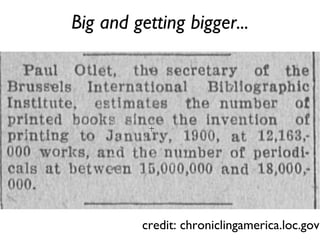
credit: chroniclingamerica.loc.gov Big and getting bigger...
1000 small answers tools, datasets, strategies, techniques individual pieces are fragmented, isolated closed datasets, software systems most classification work today is hidden from most of humanity
Back to basics origins of the Web origins of subject classification (deceptively?) simple suggestions
 
Need for hybrid models: 1000,000,000,000 pages; 7,000,000,000 people Information reproducing fast than we are! Beware false oppositions: tags ‘vs’ KOS automation ‘vs’ cataloguing ontology ‘vs’ classification Web 2.0 ‘vs’ tradition
‘ Hybrid’ means sharing New combinations of tools and data Using standards (W3C SKOS, ISO, ...) Letting data flow between systems
Varieties of knowledge ‘ Bibliographic facts’, disciplinary views. Classifications and thesauri; linked. Increasing quantities of base factual data. Maps, biographies, Wikipedia, Data.gov, ... Ontologies can model books or the world. We seem to need both...
Hybrid models human classification mixed with automatic professional schemes mixed with user tags thing-oriented ontologies mixed with discipline-oriented subject classifications
Common aspects much innovation underway in each area each combines different datasets and systems
The Proposal: A fundamental strategy for faster innovation PUT OUR DATA IN THE WEB (SO OTHERS FIND IT & USE IT & IMPROVE IT)
Once again. We need to put our data in the Web. In public. Downloadable. Linkable.  Using standard formats.  Enthusiastically! loudly! and soon!
What kind of data? Thesauri, classification systems, KOS. Controlled lists of names and named entities. Autoclass configs. Tag cloud linkage. Mappings. Translations. Local improvements. Anything someone else might build on.
Business Models there will be no “Netscape moment” for us a gentle, peaceful decline in usage Open Data communities are exploring many license and funding options - MusicBrainz, Wikipedia, Data.gov, data.gov.uk, OpenStreetMap, .... No magic answer, but the Web is inevitable
Interlude:  Television
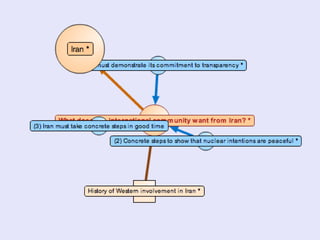
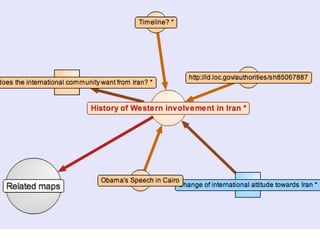
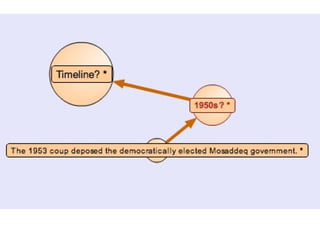
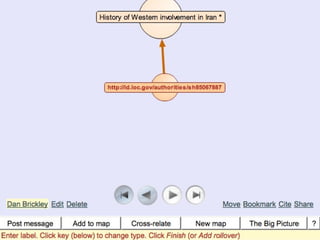
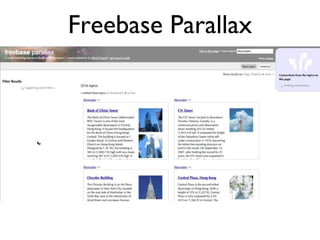
Classification & TV Inspirations: Douglas Adams’  Hyperland BBC and the ‘London Classification’  Obama, Iran, CNN & Debategraph Freebase Parallax ‘sets and relationships’
 
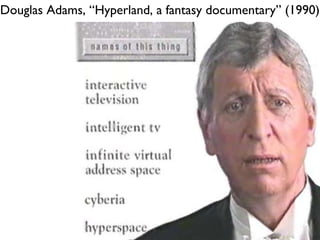
Douglas Adams, “Hyperland, a fantasy documentary” (1990)
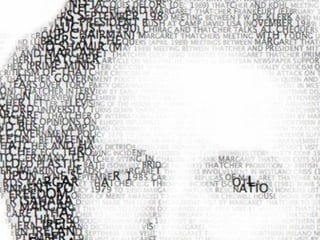
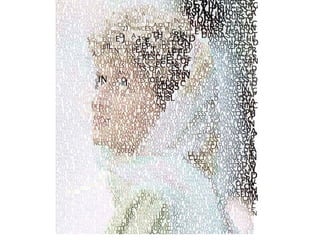
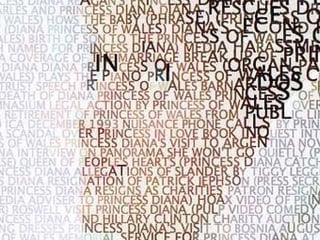
BBC Lonclass An adapted UDC, used since 1960s Used internally to catalogue BBC materials A cultural heritage artifact in its own right
 
 
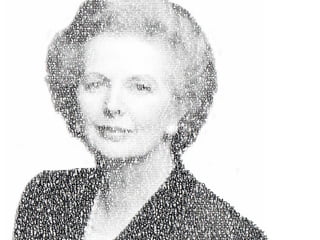
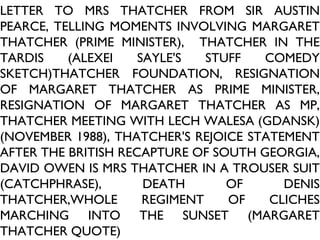
LETTER TO MRS THATCHER FROM SIR AUSTIN PEARCE, TELLING MOMENTS INVOLVING MARGARET THATCHER (PRIME MINISTER),  THATCHER IN THE TARDIS (ALEXEI SAYLE'S STUFF COMEDY SKETCH)THATCHER FOUNDATION, RESIGNATION OF MARGARET THATCHER AS PRIME MINISTER, RESIGNATION OF MARGARET THATCHER AS MP, THATCHER MEETING WITH LECH WALESA (GDANSK) (NOVEMBER 1988), THATCHER'S REJOICE STATEMENT AFTER THE BRITISH RECAPTURE OF SOUTH GEORGIA, DAVID OWEN IS MRS THATCHER IN A TROUSER SUIT (CATCHPHRASE), DEATH OF DENIS THATCHER,WHOLE REGIMENT OF CLICHES MARCHING INTO THE SUNSET (MARGARET THATCHER QUOTE)


Examples R672:32.007(47)YELTSIN:342.518.1THATCHER “TWO SHOTS OF MARGARET THATCHER AND BORIS YELTSIN” [BRITISH AEROSPACE].007.11PEARCE:656.881:342.518.1THATCHER “LETTER TO MRS THATCHER FROM SIR AUSTIN PEARCE” 656.881:301.162.721:32.007THATCHER:654.192.731TV-AM “MARGARET THATCHER'S LETTER OF APOLOGY TO TV AM”
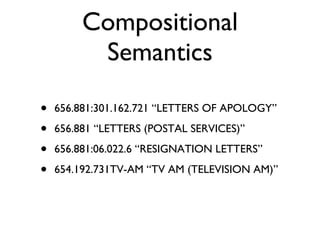
Compositional Semantics 656.881:301.162.721 “LETTERS OF APOLOGY” 656.881 “LETTERS (POSTAL SERVICES)” 656.881:06.022.6 “RESIGNATION LETTERS” 654.192.731TV-AM “TV AM (TELEVISION AM)”
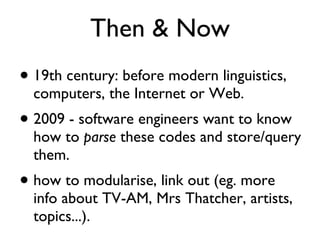
Then & Now 19th century: before modern linguistics, computers, the Internet or Web. 2009 - software engineers want to know how to  parse  these codes and store/query them. how to modularise, link out (eg. more info about TV-AM, Mrs Thatcher, artists, topics...).
 
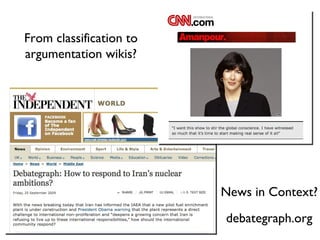
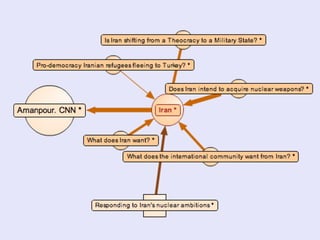
From classification to argumentation wikis? News in Context? debategraph.org


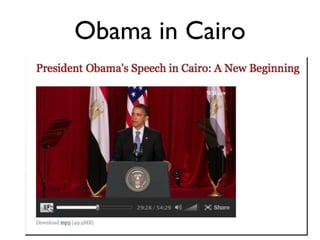
Obama in Cairo
 
 
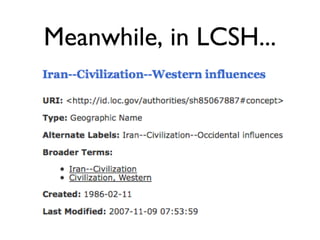
Meanwhile, in LCSH...
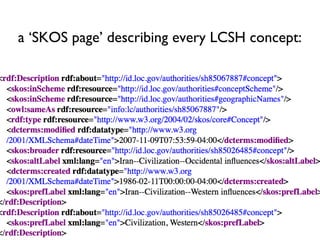
a ‘SKOS page’ describing every LCSH concept:
 
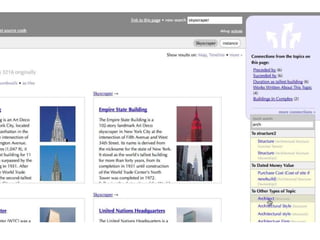
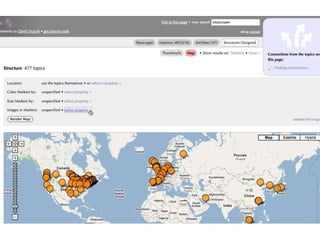
Freebase Parallax
 
 
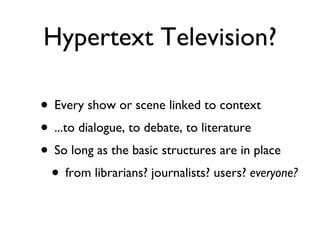
Hypertext Television? Every show or scene linked to context ...to dialogue, to debate, to literature So long as the basic structures are in place from librarians? journalists? users?  everyone?
( End of TV intermission )
LCSH is in the Web http://id.loc.gov/authorities/sh85067887# concept All of LCSH, officially, in modern machine formats, is part of the public Web.
Not just LCSH AGROVOC, RAMEAU, Wikipedia in SKOS Dewey.info and UDC experimentation A dozen or more thesauri in SKOS Described and shared in the Web...
Developer perspective Imagine you are a 20 year old programmer. You don’t even remember before the Web, never mind the Mundaneum.  You’re asked to make a useful, usable site from data full of UDC or DDC codes - numbers and punctuation. Help!!! You’re told it’s “some library thing...”. How can you write software to handle it? Who will help? Whose work can you build on? What linked datasets can you exploit?
Ted Nelson, transliterature.org “ Tekkies think that electronic documents and the World Wide Web are something completely new and that they own it, exactly the way every generation of teenagers thinks they've invented sex and it's their secret. But it's not new and they don't own it.  Word processing and the World Wide Web are not intrinsically new.  They are literature. What is literature?  Literature is (among other things) the study and design of documents, their structure and connections.  Therefore today's electronic documents are literature, electronic literature, and the question is what electronic literature people really need.”
 
Not just coders... Interface designers Information Retrieval experts Information Architects Data mining researchers Ontologists Other people like you
UDC - an invisible Web? A huge community of practice links libraries across Europe and the World Dozens of systems, datasets, mappings, enrichments Seminars are a great way to share experiences .... and the Web is a great way to share and link data.
In 5 years time... What data and tools can we show the developers who make Firefox (35% European web users use it) Or Drupal 7 (which powers 1000s of sites) Or OpenOffice (where docs are written) Or Google?
Warning signs Q: Why don’t you show labels on the codes? A: Because we’d have to buy a license.
For discussion The road to relevance in the modern Web is through developers, designers and content creators. Without them, we’ll drown in data. Without our data, they won’t know how to help ... or realise that they want to?
 
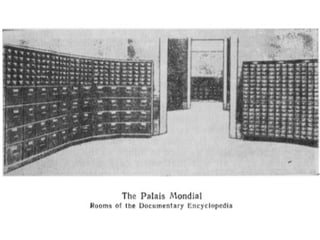
Acknowledgements & Links: http://www.w3.org/Illustrations/LetsShare.ai  graphic design by Robert Cailliau Lonclass visuals generated by Max Froumentin's Textorizer -  http://lapin-bleu.net/software/textorizer/ 'Palais Mondial, Rooms of the Documentary Encylopedia' from W. Boyd Rayward, "The Universe of Information - The work of Paul Otlet for documentation and international organisation" (FID 520), Moscow : Published for International Federation for Documentation (FID) by All-Union Institute for Scientific and Technical Information (VINITI), 1975. p.237.  http://people.lis.illinois.edu/~wrayward/otlet/PAUL_OTLET_REFLECTIONS_ON_BIOG.HTM Paul Otlet estimates on number of printed books, from Shiner gazette. (Shiner, Tex.), August 31, 1904. via  http://chroniclingamerica.loc.gov/lccn/sn86090270/1904-08-31/ed-1/seq-7/ Google Blog, "We knew the web was big..." 25 July 2008,  http://googleblog.blogspot.com/2008/07/we-knew-web-was-big.html Debategraph project,  http://www.debategraph.org / Ted Nelson - Transliterature, A Humanist Design.  http://transliterature.org/ Douglas Adams, 'Hyperland' (BBC2 TV documentary, 1990), featuring Tom Baker.  http://www.imdb.com/title/tt0188677/   http://en.wikipedia.org/wiki/Hyperland LCSH in the Web,  http://id.loc.gov/authorities/  see  http://en.scientificcommons.org/ed_summers  for design discussions, Ed Summers et al.; and thanks to Ed for discussions  Freebase Parallax by David Huynh,  http://www.freebase.com/labs/parallax/ Many thanks to my NoTube, VU and FOAF collaborators for ideas and brainstorming on Hypertext TV scenarios; in particular regarding UDC/Lonclass at the BBC, Vicky Buser, Libby Miller, Patrick Sinclair, Brendan Quinn, Yves Raimond and others have been exploring these issues; at VU this work is in collaboration with Guus Schreiber, Lora Aroyo, Antoine Isaac, Ronald Siebes and Chris van Aart; also many thanks to Aida Slavi ć  for help understanding the nature and structure of UDC.

Describing Everything - Open Web standards and classification

  • 1.
    Open Web standardsand classification: Foundations for a hybrid approach UDC Seminar: Classification at a Crossroads The Hague, 30 October 2009 Dan Brickley, Vrije University Amsterdam
  • 2.
    Enough about me:Confession - not a librarian. (not a classification expert either) Accidental technologist - Subject Gateways, eLib, SOSIG & DESIRE Web technologies for ‘knowledge sharing’ Semantic Web standards: RDF, SKOS, OWL
  • 3.
    Principles not TechnologyFoundations for a hybrid approach? introduction - historical ‘Web’ view. principles: obvious, idealistic, and inevitable. some examples from TV & today. practical suggestions for using Web...
  • 4.
  • 5.
  • 6.
    1000 small answerstools, datasets, strategies, techniques individual pieces are fragmented, isolated closed datasets, software systems most classification work today is hidden from most of humanity
  • 7.
    Back to basicsorigins of the Web origins of subject classification (deceptively?) simple suggestions
  • 8.
  • 9.
    Need for hybridmodels: 1000,000,000,000 pages; 7,000,000,000 people Information reproducing fast than we are! Beware false oppositions: tags ‘vs’ KOS automation ‘vs’ cataloguing ontology ‘vs’ classification Web 2.0 ‘vs’ tradition
  • 10.
    ‘ Hybrid’ meanssharing New combinations of tools and data Using standards (W3C SKOS, ISO, ...) Letting data flow between systems
  • 11.
    Varieties of knowledge‘ Bibliographic facts’, disciplinary views. Classifications and thesauri; linked. Increasing quantities of base factual data. Maps, biographies, Wikipedia, Data.gov, ... Ontologies can model books or the world. We seem to need both...
  • 12.
    Hybrid models humanclassification mixed with automatic professional schemes mixed with user tags thing-oriented ontologies mixed with discipline-oriented subject classifications
  • 13.
    Common aspects muchinnovation underway in each area each combines different datasets and systems
  • 14.
    The Proposal: Afundamental strategy for faster innovation PUT OUR DATA IN THE WEB (SO OTHERS FIND IT & USE IT & IMPROVE IT)
  • 15.
    Once again. Weneed to put our data in the Web. In public. Downloadable. Linkable. Using standard formats. Enthusiastically! loudly! and soon!
  • 16.
    What kind ofdata? Thesauri, classification systems, KOS. Controlled lists of names and named entities. Autoclass configs. Tag cloud linkage. Mappings. Translations. Local improvements. Anything someone else might build on.
  • 17.
    Business Models therewill be no “Netscape moment” for us a gentle, peaceful decline in usage Open Data communities are exploring many license and funding options - MusicBrainz, Wikipedia, Data.gov, data.gov.uk, OpenStreetMap, .... No magic answer, but the Web is inevitable
  • 18.
  • 19.
    Classification & TVInspirations: Douglas Adams’ Hyperland BBC and the ‘London Classification’ Obama, Iran, CNN & Debategraph Freebase Parallax ‘sets and relationships’
  • 20.
  • 21.
    Douglas Adams, “Hyperland,a fantasy documentary” (1990)
  • 22.
    BBC Lonclass Anadapted UDC, used since 1960s Used internally to catalogue BBC materials A cultural heritage artifact in its own right
  • 23.
  • 24.
  • 25.
    LETTER TO MRSTHATCHER FROM SIR AUSTIN PEARCE, TELLING MOMENTS INVOLVING MARGARET THATCHER (PRIME MINISTER), THATCHER IN THE TARDIS (ALEXEI SAYLE'S STUFF COMEDY SKETCH)THATCHER FOUNDATION, RESIGNATION OF MARGARET THATCHER AS PRIME MINISTER, RESIGNATION OF MARGARET THATCHER AS MP, THATCHER MEETING WITH LECH WALESA (GDANSK) (NOVEMBER 1988), THATCHER'S REJOICE STATEMENT AFTER THE BRITISH RECAPTURE OF SOUTH GEORGIA, DAVID OWEN IS MRS THATCHER IN A TROUSER SUIT (CATCHPHRASE), DEATH OF DENIS THATCHER,WHOLE REGIMENT OF CLICHES MARCHING INTO THE SUNSET (MARGARET THATCHER QUOTE)
  • 26.
  • 27.
  • 28.
  • 29.
  • 30.
  • 31.
  • 32.
    Examples R672:32.007(47)YELTSIN:342.518.1THATCHER “TWOSHOTS OF MARGARET THATCHER AND BORIS YELTSIN” [BRITISH AEROSPACE].007.11PEARCE:656.881:342.518.1THATCHER “LETTER TO MRS THATCHER FROM SIR AUSTIN PEARCE” 656.881:301.162.721:32.007THATCHER:654.192.731TV-AM “MARGARET THATCHER'S LETTER OF APOLOGY TO TV AM”
  • 33.
    Compositional Semantics 656.881:301.162.721“LETTERS OF APOLOGY” 656.881 “LETTERS (POSTAL SERVICES)” 656.881:06.022.6 “RESIGNATION LETTERS” 654.192.731TV-AM “TV AM (TELEVISION AM)”
  • 34.
    Then & Now19th century: before modern linguistics, computers, the Internet or Web. 2009 - software engineers want to know how to parse these codes and store/query them. how to modularise, link out (eg. more info about TV-AM, Mrs Thatcher, artists, topics...).
  • 35.
  • 36.
    From classification toargumentation wikis? News in Context? debategraph.org
  • 37.
  • 38.
  • 39.
  • 40.
  • 41.
  • 42.
  • 43.
  • 44.
    a ‘SKOS page’describing every LCSH concept:
  • 45.
  • 46.
  • 47.
  • 48.
  • 49.
    Hypertext Television? Everyshow or scene linked to context ...to dialogue, to debate, to literature So long as the basic structures are in place from librarians? journalists? users? everyone?
  • 50.
    ( End ofTV intermission )
  • 51.
    LCSH is inthe Web http://id.loc.gov/authorities/sh85067887# concept All of LCSH, officially, in modern machine formats, is part of the public Web.
  • 52.
    Not just LCSHAGROVOC, RAMEAU, Wikipedia in SKOS Dewey.info and UDC experimentation A dozen or more thesauri in SKOS Described and shared in the Web...
  • 53.
    Developer perspective Imagineyou are a 20 year old programmer. You don’t even remember before the Web, never mind the Mundaneum. You’re asked to make a useful, usable site from data full of UDC or DDC codes - numbers and punctuation. Help!!! You’re told it’s “some library thing...”. How can you write software to handle it? Who will help? Whose work can you build on? What linked datasets can you exploit?
  • 54.
    Ted Nelson, transliterature.org“ Tekkies think that electronic documents and the World Wide Web are something completely new and that they own it, exactly the way every generation of teenagers thinks they've invented sex and it's their secret. But it's not new and they don't own it.  Word processing and the World Wide Web are not intrinsically new.  They are literature. What is literature?  Literature is (among other things) the study and design of documents, their structure and connections.  Therefore today's electronic documents are literature, electronic literature, and the question is what electronic literature people really need.”
  • 55.
  • 56.
    Not just coders...Interface designers Information Retrieval experts Information Architects Data mining researchers Ontologists Other people like you
  • 57.
    UDC - aninvisible Web? A huge community of practice links libraries across Europe and the World Dozens of systems, datasets, mappings, enrichments Seminars are a great way to share experiences .... and the Web is a great way to share and link data.
  • 58.
    In 5 yearstime... What data and tools can we show the developers who make Firefox (35% European web users use it) Or Drupal 7 (which powers 1000s of sites) Or OpenOffice (where docs are written) Or Google?
  • 59.
    Warning signs Q:Why don’t you show labels on the codes? A: Because we’d have to buy a license.
  • 60.
    For discussion Theroad to relevance in the modern Web is through developers, designers and content creators. Without them, we’ll drown in data. Without our data, they won’t know how to help ... or realise that they want to?
  • 61.
  • 62.
    Acknowledgements & Links:http://www.w3.org/Illustrations/LetsShare.ai graphic design by Robert Cailliau Lonclass visuals generated by Max Froumentin's Textorizer - http://lapin-bleu.net/software/textorizer/ 'Palais Mondial, Rooms of the Documentary Encylopedia' from W. Boyd Rayward, "The Universe of Information - The work of Paul Otlet for documentation and international organisation" (FID 520), Moscow : Published for International Federation for Documentation (FID) by All-Union Institute for Scientific and Technical Information (VINITI), 1975. p.237. http://people.lis.illinois.edu/~wrayward/otlet/PAUL_OTLET_REFLECTIONS_ON_BIOG.HTM Paul Otlet estimates on number of printed books, from Shiner gazette. (Shiner, Tex.), August 31, 1904. via http://chroniclingamerica.loc.gov/lccn/sn86090270/1904-08-31/ed-1/seq-7/ Google Blog, "We knew the web was big..." 25 July 2008, http://googleblog.blogspot.com/2008/07/we-knew-web-was-big.html Debategraph project, http://www.debategraph.org / Ted Nelson - Transliterature, A Humanist Design. http://transliterature.org/ Douglas Adams, 'Hyperland' (BBC2 TV documentary, 1990), featuring Tom Baker. http://www.imdb.com/title/tt0188677/ http://en.wikipedia.org/wiki/Hyperland LCSH in the Web, http://id.loc.gov/authorities/ see http://en.scientificcommons.org/ed_summers for design discussions, Ed Summers et al.; and thanks to Ed for discussions Freebase Parallax by David Huynh, http://www.freebase.com/labs/parallax/ Many thanks to my NoTube, VU and FOAF collaborators for ideas and brainstorming on Hypertext TV scenarios; in particular regarding UDC/Lonclass at the BBC, Vicky Buser, Libby Miller, Patrick Sinclair, Brendan Quinn, Yves Raimond and others have been exploring these issues; at VU this work is in collaboration with Guus Schreiber, Lora Aroyo, Antoine Isaac, Ronald Siebes and Chris van Aart; also many thanks to Aida Slavi ć for help understanding the nature and structure of UDC.