Open Source in robotics
and its business
Víctor Mayoral Vilches
CTO and Founder, Erle Robotics
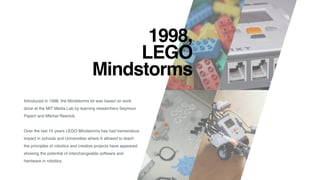
1998, 

LEGO
Mindstorms
Introduced in 1998, the Mindstorms kit was based on work
done at the MIT Media Lab by learning researchers Seymour
Papert and Mitchel Resnick.
Over the last 15 years LEGO Mindstorms has had tremendous
impact in schools and Universities where It allowed to teach
the principles of robotics and creative projects have appeared
showing the potential of interchangeable software and
hardware in robotics.
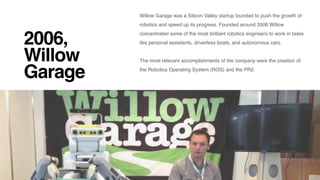
2006, 

Willow
Garage
Willow Garage was a Silicon Valley startup founded to push the growth of
robotics and speed up its progress. Founded around 2006 Willow
concentrated some of the most brilliant robotics engineers to work in tasks
like personal assistants, driverless boats, and autonomous cars.

The most relevant accomplishments of the company were the creation of
the Robotics Operating System (ROS) and the PR2.
“Willow is to robotics what
Bell Labs and Xerox Parc were
for the personal computer
industry.”
http://www.willowgarage.com/pages/about-us/history
2nd
generation
roboticists
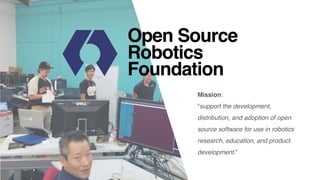
Open Source
Robotics
Foundation
Mission: 

“support the development,
distribution, and adoption of open
source software for use in robotics
research, education, and product
development.”
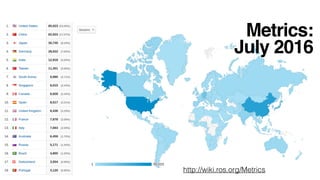
http://wiki.ros.org/Metrics
Metrics:

July 2016
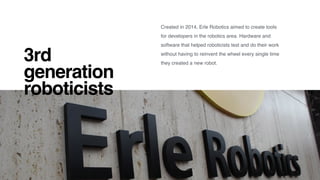
3rd
generation
roboticists
Created in 2014, Erle Robotics aimed to create tools
for developers in the robotics area. Hardware and
software that helped roboticists test and do their work
without having to reinvent the wheel every single time
they created a new robot.
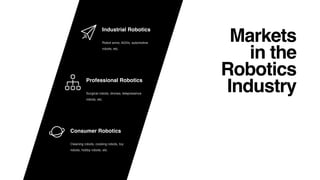
Markets
in the
Robotics
Industry
Industrial Robotics
Robot arms, AGVs, automotive
robots, etc.
Professional Robotics
Surgical robots, drones, telepresence
robots, etc.
Consumer Robotics
Cleaning robots, cooking robots, toy
robots, hobby robots, etc.
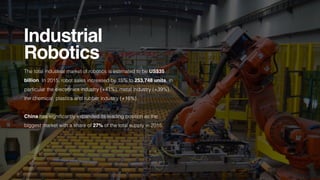
Industrial
Robotics
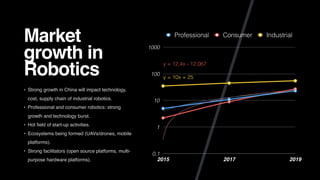
The total industrial market of robotics is estimated to be US$35
billion. In 2015, robot sales increased by 15% to 253,748 units, in
particular the electronics industry (+41%), metal industry (+39%),
the chemical, plastics and rubber industry (+16%).
China has significantly expanded its leading position as the
biggest market with a share of 27% of the total supply in 2015.
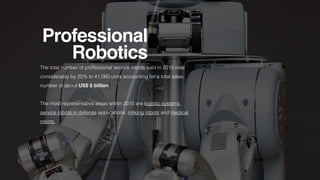
Professional
Robotics
The total number of professional service robots sold in 2015 rose
considerably by 25% to 41,060 units accounting for a total sales
number of about US$ 5 billion.


The most representative areas within 2015 are logistic systems,
service robots in defense applications, milking robots and medical
robots.
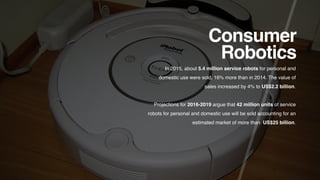
Consumer
Robotics
In 2015, about 5.4 million service robots for personal and
domestic use were sold, 16% more than in 2014. The value of
sales increased by 4% to US$2.2 billion.
Projections for 2016-2019 argue that 42 million units of service
robots for personal and domestic use will be sold accounting for an
estimated market of more than US$25 billion.
Market
growth in
Robotics
• Strong growth in China will impact technology,
cost, supply chain of industrial robotics.
• Professional and consumer robotics: strong
growth and technology burst.
• Hot field of start-up activities.
• Ecosystems being formed (UAVs/drones, mobile
platforms).
• Strong facilitators (open source platforms, multi-
purpose hardware platforms).
0,1
1
10
100
1000
2015 2017 2019
y = 10x + 25
y = 12,4x - 12,067
y = 9x - 5
Professional Consumer Industrial
Smartphones
1991 2003 2015 2019
Servers
Super-

computers
Desktop

computers
Linux
adoption in
several tech
niches
Embedded

systems
Robotics
The 

Erle
Robotics
path
Empowering
ROS
Hardware
Why?
“Most of the time is spent dealing with the hardware/
software interfaces and little is put into behavior
development or real-world scenarios.”
Right time?
Robotics
Fast
Track
Program
(RFT)
Hardware
Robot
Operating
System
A standardized software and hardware
infrastructure to easily create reusable and
reconfigurable robot hardware parts.
Using H-ROS, building robots is about placing H-ROS-compatible
components together to build new robot configurations. The
interesting fact about this is that constructing robots is not any
more restricted to a few high technical skills but it's extended to a
great majority with a general understanding of the different H-
ROS parts and its use.
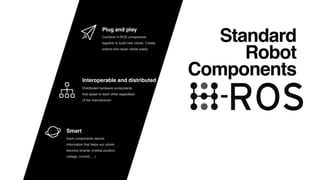
Standard
Robot
Components
Plug and play
Combine H-ROS components
together to build new robots. Create,
extend and repair robots easily.
Interoperable and distributed
Distributed hardware components
that speak to each other regardless
of the manufacturer.
Smart
Each components reports
information that helps our robots
become smarter (inertial position,
voltage, current, …)
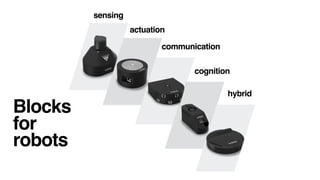
sensing
actuation
communication
cognition
hybrid
Blocks
for
robots
Call for
manufacturers
In Europe,
robotics has a
positive net
effect on
labour
demand
Automation reduces production cost, reduced product
costs reduce prices, reduced product prices increase
demand for products, increased product demand
increases employment.
Download ZEW-Study: http://ftp.zew.de/pub/zew-docs/
gutachten/Robotics_Employment_2016.pdf
Thank You
Backup
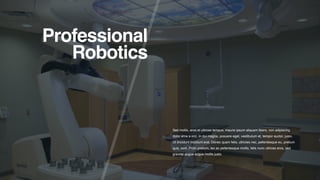
Professional
Robotics
Sed mollis, eros et ultrices tempus, mauris ipsum aliquam libero, non adipiscing
dolor urna a orci. In dui magna, posuere eget, vestibulum et, tempor auctor, justo.
Ut tincidunt tincidunt erat. Donec quam felis, ultricies nec, pellentesque eu, pretium
quis, sem. Proin pretium, leo ac pellentesque mollis, felis nunc ultrices eros, sed
gravida augue augue mollis justo.
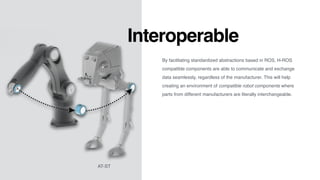
Interoperable
By facilitating standardized abstractions based in ROS, H-ROS
compatible components are able to communicate and exchange
data seamlessly, regardless of the manufacturer. This will help
creating an environment of compatible robot components where
parts from different manufacturers are literally interchangeable.
AT-ST
Simple.
Easy.
Powerful.
Power over Ethernet (PoE), IEEE 802.3at-2009 (also
known as PoE+). Particularly, mode B which delivers
power on the spare pairs of 100BASE-TX.
This configuration provides 25.5 W of power to each H-
ROS part connected through PoE using the RJ45
connector.
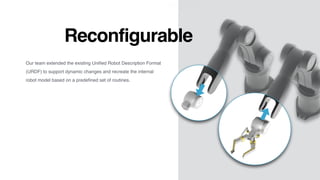
Reconfigurable
Our team extended the existing Unified Robot Description Format
(URDF) to support dynamic changes and recreate the internal
robot model based on a predefined set of routines.
Built

with

ROS

2.0
The future framework for robot application
development. Following from ROS, ROS 2.0 will
define the next decade in robotics by providing
solutions for problems like teams of multiple
robots, small embedded platforms, real-time
systems, non-ideal networks or production
environments.
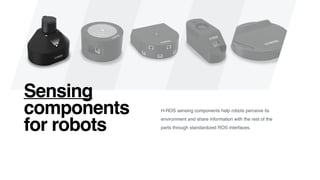
Sensing
components
for robots
H-ROS sensing components help robots perceive its
environment and share information with the rest of the
parts through standardized ROS interfaces.
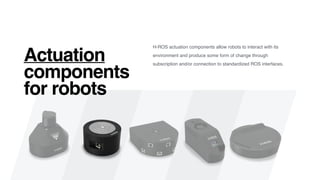
H-ROS actuation components allow robots to interact with its
environment and produce some form of change through
subscription and/or connection to standardized ROS interfaces.
Actuation
components
for robots
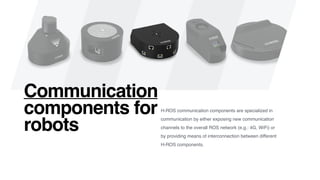
H-ROS communication components are specialized in
communication by either exposing new communication
channels to the overall ROS network (e.g.: 4G, WiFi) or
by providing means of interconnection between different
H-ROS components.
Communication
components for
robots
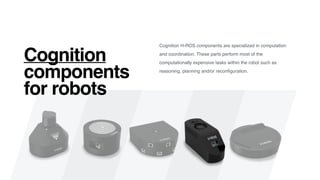
Cognition H-ROS components are specialized in computation
and coordination. These parts perform most of the
computationally expensive tasks within the robot such as
reasoning, planning and/or reconfiguration.
Cognition
components
for robots
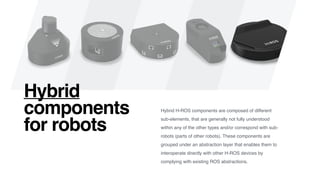
Hybrid H-ROS components are composed of different
sub-elements, that are generally not fully understood
within any of the other types and/or correspond with sub-
robots (parts of other robots). These components are
grouped under an abstraction layer that enables them to
interoperate directly with other H-ROS devices by
complying with existing ROS abstractions.
Hybrid
components
for robots
Hardware
Robot
Operating
System

Open Source in robotics and its business - LibreCon 2016

  • 1.
    Open Source inrobotics and its business Víctor Mayoral Vilches CTO and Founder, Erle Robotics
  • 2.
    1998, 
 LEGO Mindstorms Introduced in1998, the Mindstorms kit was based on work done at the MIT Media Lab by learning researchers Seymour Papert and Mitchel Resnick. Over the last 15 years LEGO Mindstorms has had tremendous impact in schools and Universities where It allowed to teach the principles of robotics and creative projects have appeared showing the potential of interchangeable software and hardware in robotics.
  • 4.
    2006, 
 Willow Garage Willow Garagewas a Silicon Valley startup founded to push the growth of robotics and speed up its progress. Founded around 2006 Willow concentrated some of the most brilliant robotics engineers to work in tasks like personal assistants, driverless boats, and autonomous cars.
 The most relevant accomplishments of the company were the creation of the Robotics Operating System (ROS) and the PR2.
  • 5.
    “Willow is torobotics what Bell Labs and Xerox Parc were for the personal computer industry.”
  • 6.
  • 7.
    Open Source Robotics Foundation Mission: 
 “supportthe development, distribution, and adoption of open source software for use in robotics research, education, and product development.”
  • 8.
  • 9.
    3rd generation roboticists Created in 2014,Erle Robotics aimed to create tools for developers in the robotics area. Hardware and software that helped roboticists test and do their work without having to reinvent the wheel every single time they created a new robot.
  • 10.
    Markets in the Robotics Industry Industrial Robotics Robotarms, AGVs, automotive robots, etc. Professional Robotics Surgical robots, drones, telepresence robots, etc. Consumer Robotics Cleaning robots, cooking robots, toy robots, hobby robots, etc.
  • 11.
    Industrial Robotics The total industrialmarket of robotics is estimated to be US$35 billion. In 2015, robot sales increased by 15% to 253,748 units, in particular the electronics industry (+41%), metal industry (+39%), the chemical, plastics and rubber industry (+16%). China has significantly expanded its leading position as the biggest market with a share of 27% of the total supply in 2015.
  • 12.
    Professional Robotics The total numberof professional service robots sold in 2015 rose considerably by 25% to 41,060 units accounting for a total sales number of about US$ 5 billion. 
 The most representative areas within 2015 are logistic systems, service robots in defense applications, milking robots and medical robots.
  • 13.
    Consumer Robotics In 2015, about5.4 million service robots for personal and domestic use were sold, 16% more than in 2014. The value of sales increased by 4% to US$2.2 billion. Projections for 2016-2019 argue that 42 million units of service robots for personal and domestic use will be sold accounting for an estimated market of more than US$25 billion.
  • 14.
    Market growth in Robotics • Stronggrowth in China will impact technology, cost, supply chain of industrial robotics. • Professional and consumer robotics: strong growth and technology burst. • Hot field of start-up activities. • Ecosystems being formed (UAVs/drones, mobile platforms). • Strong facilitators (open source platforms, multi- purpose hardware platforms). 0,1 1 10 100 1000 2015 2017 2019 y = 10x + 25 y = 12,4x - 12,067 y = 9x - 5 Professional Consumer Industrial
  • 15.
    Smartphones 1991 2003 20152019 Servers Super-
 computers Desktop
 computers Linux adoption in several tech niches Embedded
 systems Robotics
  • 16.
  • 17.
  • 18.
    Why? “Most of thetime is spent dealing with the hardware/ software interfaces and little is put into behavior development or real-world scenarios.”
  • 19.
  • 20.
  • 21.
    Hardware Robot Operating System A standardized softwareand hardware infrastructure to easily create reusable and reconfigurable robot hardware parts. Using H-ROS, building robots is about placing H-ROS-compatible components together to build new robot configurations. The interesting fact about this is that constructing robots is not any more restricted to a few high technical skills but it's extended to a great majority with a general understanding of the different H- ROS parts and its use.
  • 22.
    Standard Robot Components Plug and play CombineH-ROS components together to build new robots. Create, extend and repair robots easily. Interoperable and distributed Distributed hardware components that speak to each other regardless of the manufacturer. Smart Each components reports information that helps our robots become smarter (inertial position, voltage, current, …)
  • 23.
  • 24.
  • 25.
    In Europe, robotics hasa positive net effect on labour demand Automation reduces production cost, reduced product costs reduce prices, reduced product prices increase demand for products, increased product demand increases employment. Download ZEW-Study: http://ftp.zew.de/pub/zew-docs/ gutachten/Robotics_Employment_2016.pdf
  • 26.
  • 27.
  • 28.
    Professional Robotics Sed mollis, eroset ultrices tempus, mauris ipsum aliquam libero, non adipiscing dolor urna a orci. In dui magna, posuere eget, vestibulum et, tempor auctor, justo. Ut tincidunt tincidunt erat. Donec quam felis, ultricies nec, pellentesque eu, pretium quis, sem. Proin pretium, leo ac pellentesque mollis, felis nunc ultrices eros, sed gravida augue augue mollis justo.
  • 29.
    Interoperable By facilitating standardizedabstractions based in ROS, H-ROS compatible components are able to communicate and exchange data seamlessly, regardless of the manufacturer. This will help creating an environment of compatible robot components where parts from different manufacturers are literally interchangeable. AT-ST
  • 30.
    Simple. Easy. Powerful. Power over Ethernet(PoE), IEEE 802.3at-2009 (also known as PoE+). Particularly, mode B which delivers power on the spare pairs of 100BASE-TX. This configuration provides 25.5 W of power to each H- ROS part connected through PoE using the RJ45 connector.
  • 31.
    Reconfigurable Our team extendedthe existing Unified Robot Description Format (URDF) to support dynamic changes and recreate the internal robot model based on a predefined set of routines.
  • 32.
    Built
 with
 ROS
 2.0 The future frameworkfor robot application development. Following from ROS, ROS 2.0 will define the next decade in robotics by providing solutions for problems like teams of multiple robots, small embedded platforms, real-time systems, non-ideal networks or production environments.
  • 33.
    Sensing components for robots H-ROS sensingcomponents help robots perceive its environment and share information with the rest of the parts through standardized ROS interfaces.
  • 34.
    H-ROS actuation componentsallow robots to interact with its environment and produce some form of change through subscription and/or connection to standardized ROS interfaces. Actuation components for robots
  • 35.
    H-ROS communication componentsare specialized in communication by either exposing new communication channels to the overall ROS network (e.g.: 4G, WiFi) or by providing means of interconnection between different H-ROS components. Communication components for robots
  • 36.
    Cognition H-ROS componentsare specialized in computation and coordination. These parts perform most of the computationally expensive tasks within the robot such as reasoning, planning and/or reconfiguration. Cognition components for robots
  • 37.
    Hybrid H-ROS componentsare composed of different sub-elements, that are generally not fully understood within any of the other types and/or correspond with sub- robots (parts of other robots). These components are grouped under an abstraction layer that enables them to interoperate directly with other H-ROS devices by complying with existing ROS abstractions. Hybrid components for robots
  • 38.