Banking 4.0
Banking in the Fourth Industrial Revolution (Industry 4.0)
2
The Fourth Industrial
Revolution is coming
and very few are ready
3
The Fourth Industrial Revolution is coming
Powered by Internet of Things applied to the industry,
combined with other technologies like BigData, Machine
Learning and 3D printing.
Source: Forschungsunion, acatech, Abschlussbericht Arbeitskreis Industrie 4.0
Industrial
Internet of Things
4
Internet of Things is at the center of the
revolution
“In the next 10 years, the Internet of Things (IoT)
revolution will dramatically alter manufacturing, energy,
agriculture, transportation and other industrial sectors
of the economy which, together, account for nearly
two-thirds of the global gross domestic product (GDP).”
“It will also fundamentally transform how people will
work through new interactions between humans and
machines.”
Source: World Economic Forum,
”Industrial Internet of Things: Unleashing the Potential of Connected Products and Services”
5
Not everything is wearables
Consumer applications have
all the media hype and visibility,
such as fitness monitors and
self-driving cars.
Source: McKinsey, “The Internet of Things:
Mapping the value beyond the hype”
But industrial application of IoT
in B2B use cases can generate
nearly 70 percent of potential
value enabled by IoT.
6
Towards a fully networked society
With an adoption rate five times faster
than electricity and telephony
6 devices for
each
Smartphone
Where everything is connected, not just consumer devices
7
IoT will change the whole society ...
Source: Texas Instruments, ”The Internet of Things: Opportunities & Challenges”
8
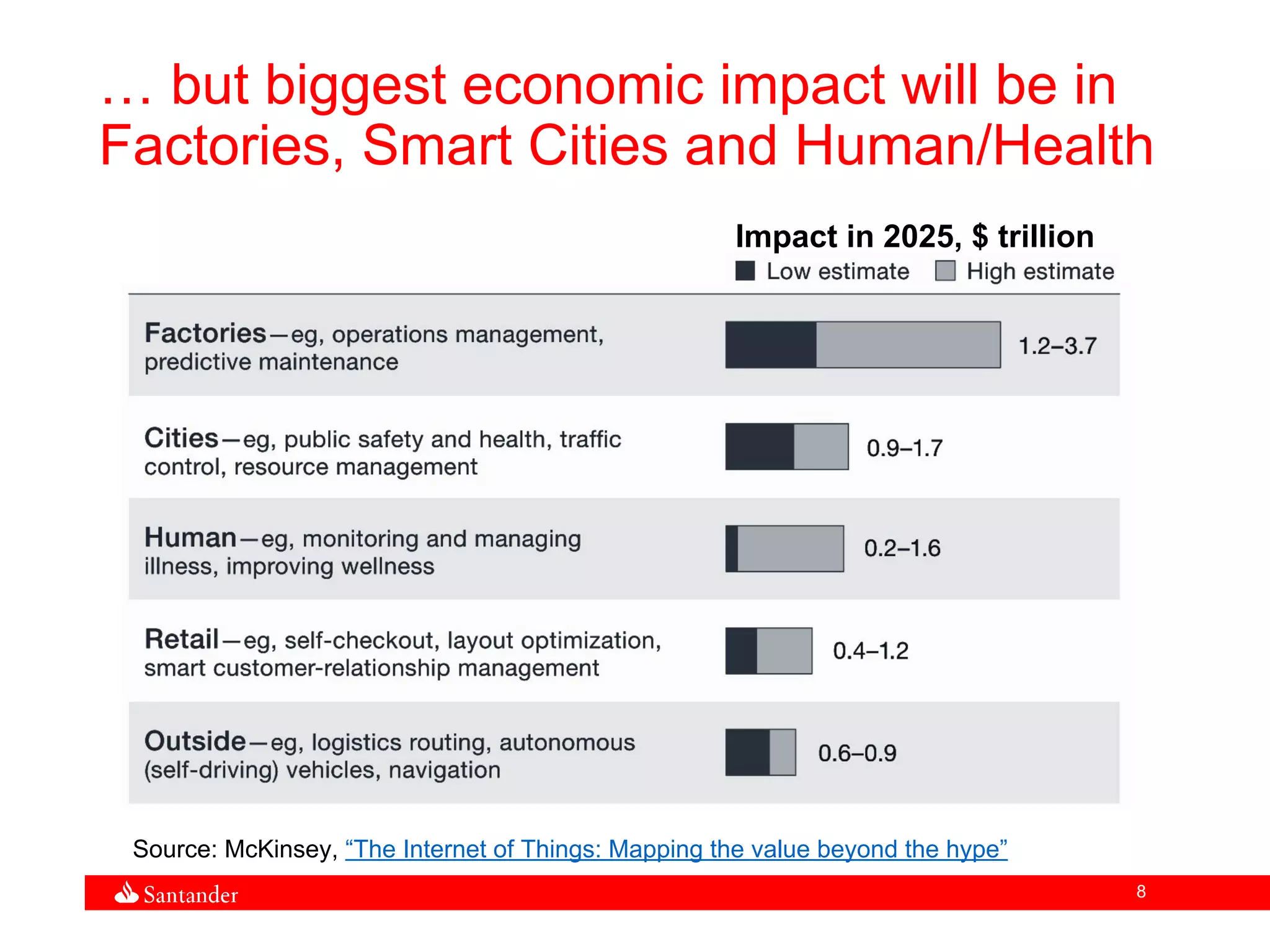
… but biggest economic impact will be in
Factories, Smart Cities and Human/Health
Source: McKinsey, “The Internet of Things: Mapping the value beyond the hype”
Impact in 2025, $ trillion
9
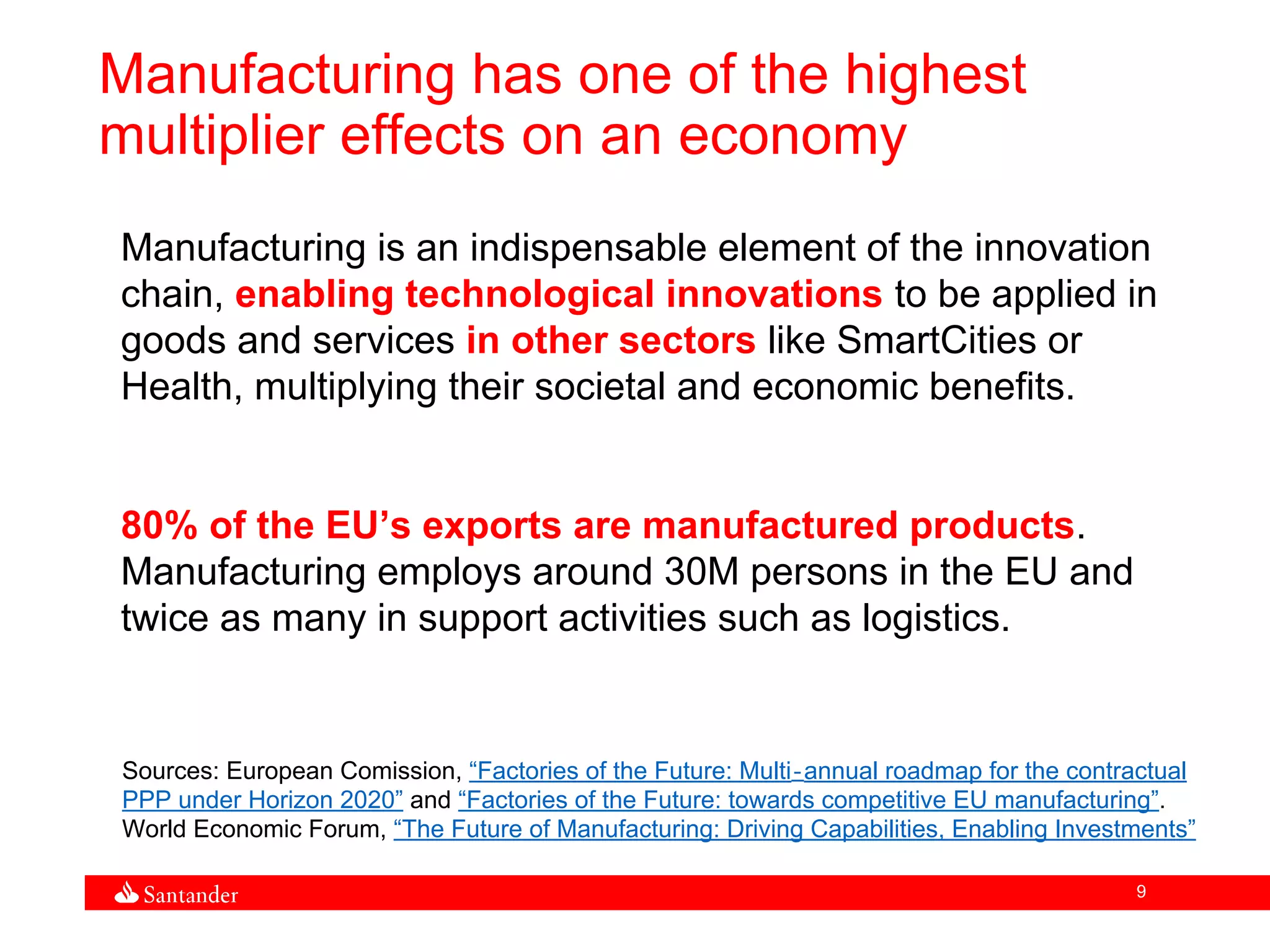
Manufacturing has one of the highest
multiplier effects on an economy
Manufacturing is an indispensable element of the innovation
chain, enabling technological innovations to be applied in
goods and services in other sectors like SmartCities or
Health, multiplying their societal and economic benefits.
80% of the EU’s exports are manufactured products.
Manufacturing employs around 30M persons in the EU and
twice as many in support activities such as logistics.
Sources: European Comission, “Factories of the Future: Multi‐annual roadmap for the contractual
PPP under Horizon 2020” and “Factories of the Future: towards competitive EU manufacturing”.
World Economic Forum, “The Future of Manufacturing: Driving Capabilities, Enabling Investments”
10
Industry 4.0
And beyond
11
Industry 4.0 ecosystem
Suppliers
Factory
Logistics Logistics Retailer
Final
product
Customer
Social network
dataExtended Manufacturing Process
Material flow
Product
usage
Smart
products
Adaptive
logistics
Finance
flows in
real-time
Predictive
maintenance
Product
tracking
New
business
models
Platform
An ecosystem of partners
provide advanced services
to all participants.
Smart
Services
All machines
with sensors,
connected to a
cloud platform
12
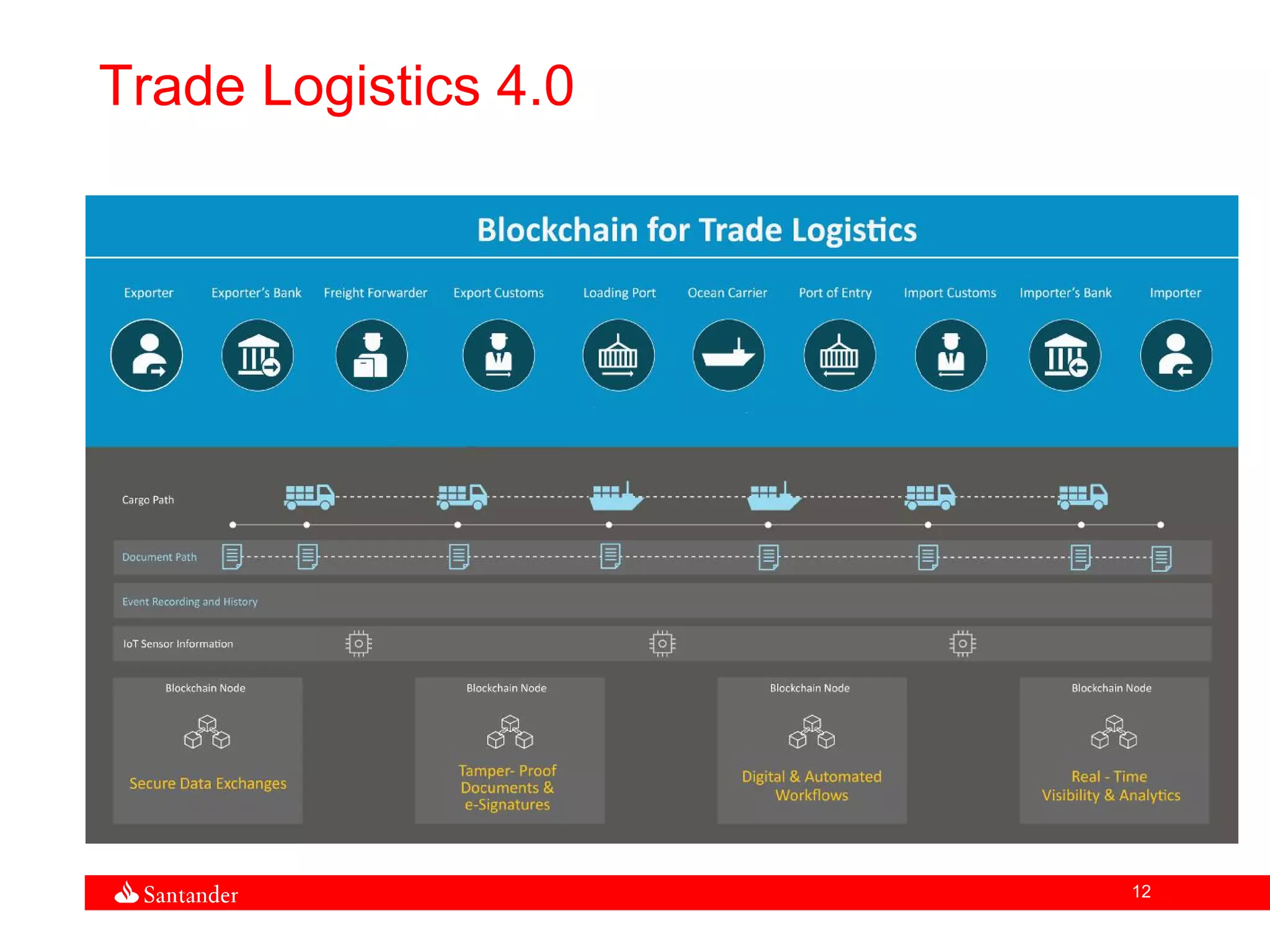
Trade Logistics 4.0
13
Some challenges in
Industry 4.0
Which may be opportunities for banks
14
Industry 4.0 ecosystem
Suppliers
Factory
Logistics Logistics Retailer
Final
product
Customer
Social network
dataExtended Manufacturing Process
Material flow
Product
usage
Smart
products
Adaptive
logistics
Finance
flows in
real-time
Predictive
maintenance
Product
tracking
New
business
models
Platform
An ecosystem of partners
provide advanced services
to all participants.
Smart
Services
All machines
with sensors,
connected to a
cloud platform
15
A lot of sensors, actuators and extended
communications require a lot of investment
Some companies have already invested in sensors and comms, but
for most SMEs they still have to invest a lot.
Everything is connected to a
shared platform: the factory,
suppliers, logistics providers
and retailers, and also the
customer products.
This allows to have a real-time
holistic view of the
manufacturing process.
16
Risk of lack of integration
If each participant implements its own solution, they are not
integrated and it is difficult to perform global optimization and
provision of services.
17
All entities participating in the value chain
are connected to a common platform
It may not be a traditional “Data Lake”, but instead a virtual
decentralized infrastructure, like the Industrial Data Space.
Or the MIT Enigma.
It aggregates data from all
participants:
● Supports new data value
chains
● Linking providers and data
users
● Supports the development
of new value added data
services.
18
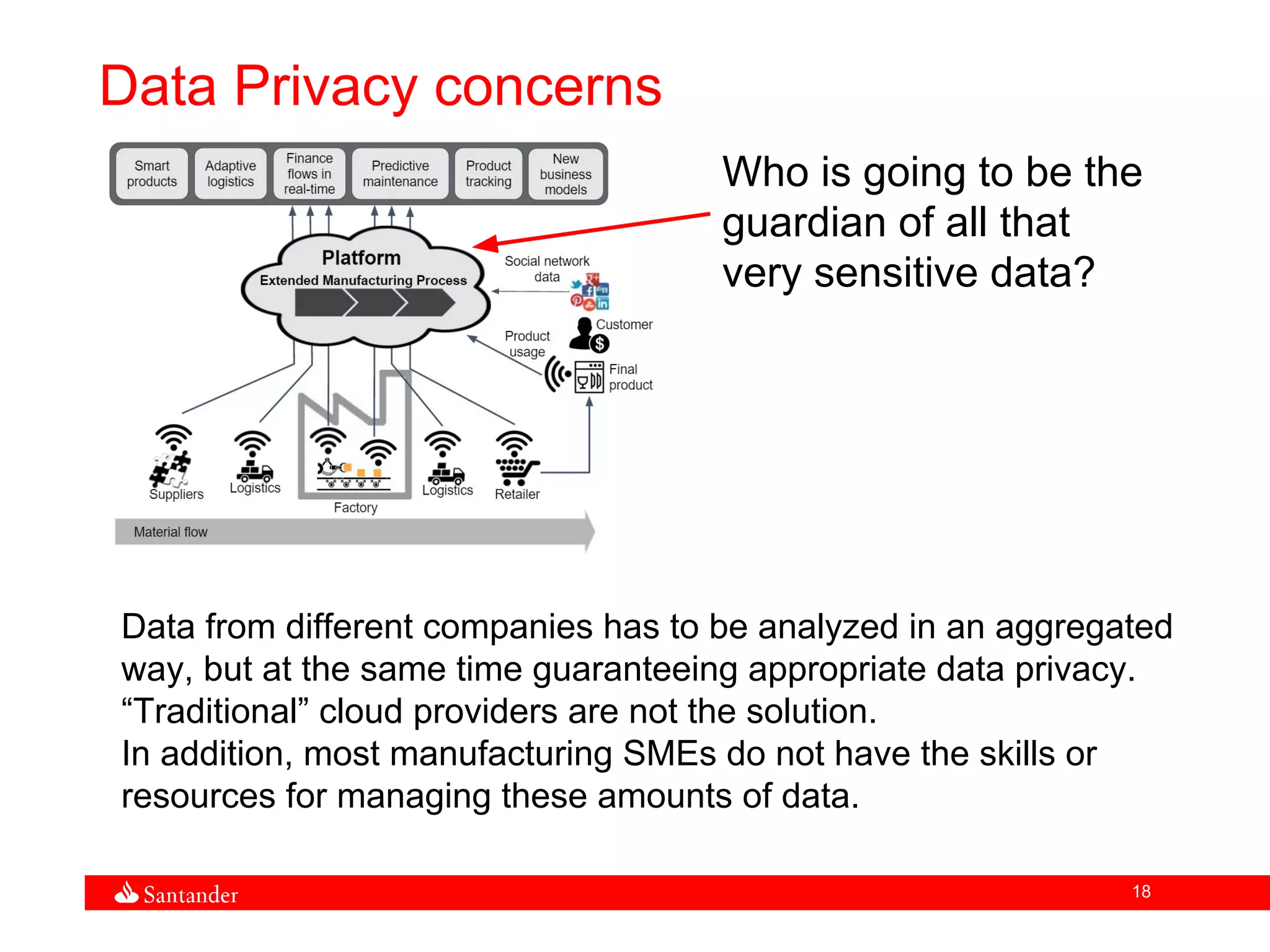
Data Privacy concerns
Data from different companies has to be analyzed in an aggregated
way, but at the same time guaranteeing appropriate data privacy.
“Traditional” cloud providers are not the solution.
In addition, most manufacturing SMEs do not have the skills or
resources for managing these amounts of data.
Who is going to be the
guardian of all that
very sensitive data?
19
Data Privacy is one of the main challenges
Source: Altimeter Group, “Consumer Perceptions of Privacy in the Internet of Things” (2015)
Consumers’ top privacy concerns with IoT are data selling, storage,
access, and the ability to be identified individually.
Q: Rate your level of privacy concerns across each of the following ways companies interact with your data
Age groups
20
But banks are (still) well positioned
Which type of company do you trust most with
securely managing your data on your behalf?
Despite the reputational damage
from the financial crisis, banks
hold a fundamentally trusted
position in society, as the
stewards of assets and
commerce.
While the public gives low ratings
to the industry as a whole on
matters of trust*, their opinions
about the banks they actually
do business with are far more
favorable**.
Sources:
*Edelman, “2016 Edelman Trust Barometer”
**Accenture, “2015 North America Consumer Digital Banking Survey - Banking Shaped by the
Customer”
Bank
Payments
provider
Mobile network
Online retailer
Consumer technologyBroadband internet
Social media
21
Conventional Manufacturing Value Chain
Factory Retailer CustomerSuppliers
$$ $$ $$
Material Material MaterialMaterial
flow
Monetary
value flow
Problems:
● Each participant knows only about the previous entity (its
own supplier) and the next one (its own customer).
● Not all participants know about the “real customer”, the one
who is going to pay for the whole manufacturing chain.
22
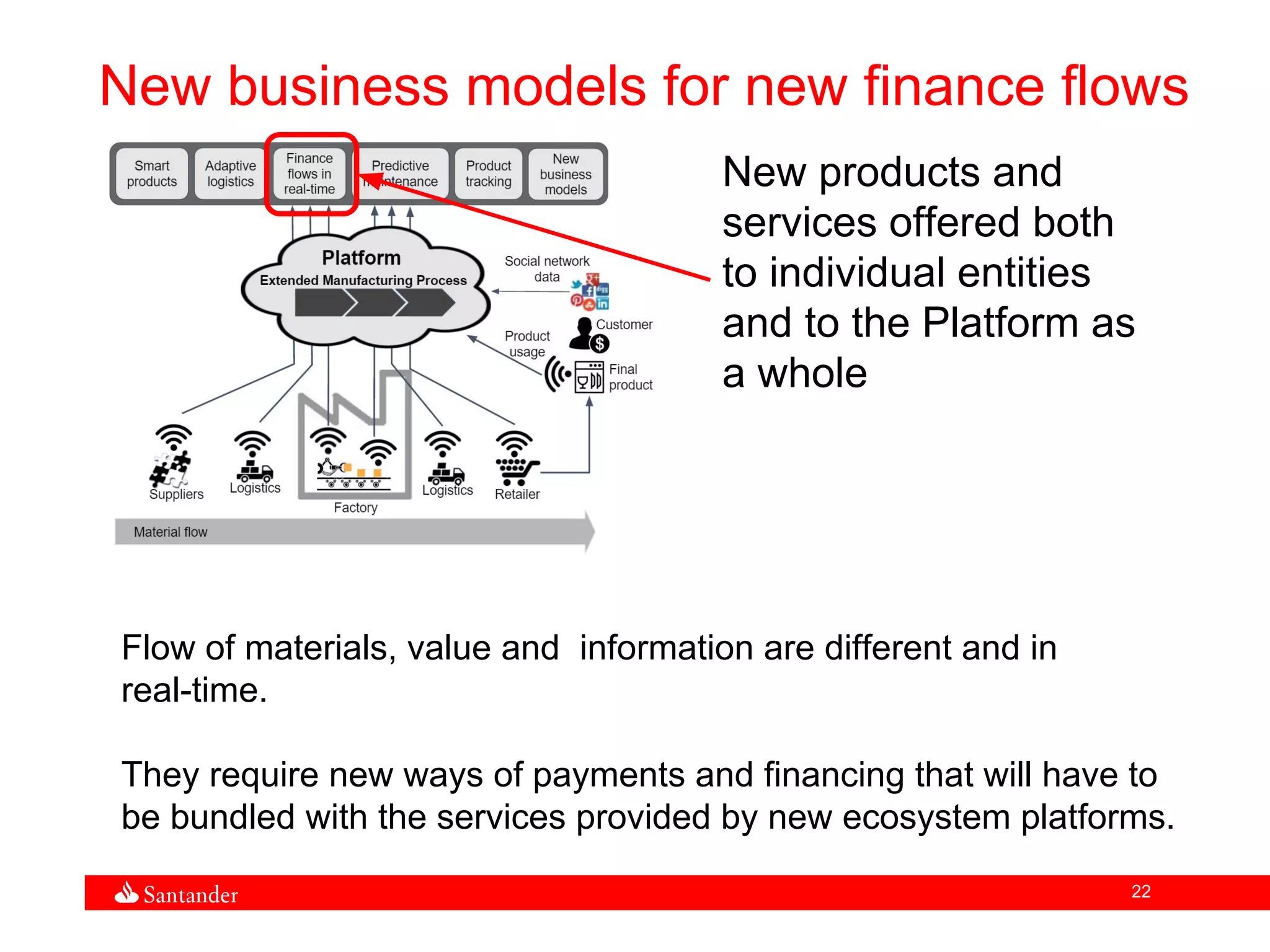
New business models for new finance flows
Flow of materials, value and information are different and in
real-time.
They require new ways of payments and financing that will have to
be bundled with the services provided by new ecosystem platforms.
New products and
services offered both
to individual entities
and to the Platform as
a whole
23
Autonomous, pull economy
Highly automated, flexible production and fulfilment networks
Continuous
demand-sensing
Monetary flows
24
Conclusion
The Fourth Industrial Revolution is coming
World 4.0 will radically alter the flows of value among
the participants in the new economy, and will require
new ways of payments and financing.
The challenge for banks is to determine new business
models beyond the purely financial services, and new
partnerships, as the world economy evolves first to an
outcome-based economy and eventually to a
pull-based economy.
“Our mission is to help people and businesses prosper”
Nuestra misión es contribuir al progreso de
las personas y de las empresas.
Nuestra cultura se basa en la creencia de
que todo lo que hacemos debe ser
Gracias

Banking 4.0 - LibreCon 2016

  • 1.
    Banking 4.0 Banking inthe Fourth Industrial Revolution (Industry 4.0)
  • 2.
    2 The Fourth Industrial Revolutionis coming and very few are ready
  • 3.
    3 The Fourth IndustrialRevolution is coming Powered by Internet of Things applied to the industry, combined with other technologies like BigData, Machine Learning and 3D printing. Source: Forschungsunion, acatech, Abschlussbericht Arbeitskreis Industrie 4.0 Industrial Internet of Things
  • 4.
    4 Internet of Thingsis at the center of the revolution “In the next 10 years, the Internet of Things (IoT) revolution will dramatically alter manufacturing, energy, agriculture, transportation and other industrial sectors of the economy which, together, account for nearly two-thirds of the global gross domestic product (GDP).” “It will also fundamentally transform how people will work through new interactions between humans and machines.” Source: World Economic Forum, ”Industrial Internet of Things: Unleashing the Potential of Connected Products and Services”
  • 5.
    5 Not everything iswearables Consumer applications have all the media hype and visibility, such as fitness monitors and self-driving cars. Source: McKinsey, “The Internet of Things: Mapping the value beyond the hype” But industrial application of IoT in B2B use cases can generate nearly 70 percent of potential value enabled by IoT.
  • 6.
    6 Towards a fullynetworked society With an adoption rate five times faster than electricity and telephony 6 devices for each Smartphone Where everything is connected, not just consumer devices
  • 7.
    7 IoT will changethe whole society ... Source: Texas Instruments, ”The Internet of Things: Opportunities & Challenges”
  • 8.
    8 … but biggesteconomic impact will be in Factories, Smart Cities and Human/Health Source: McKinsey, “The Internet of Things: Mapping the value beyond the hype” Impact in 2025, $ trillion
  • 9.
    9 Manufacturing has oneof the highest multiplier effects on an economy Manufacturing is an indispensable element of the innovation chain, enabling technological innovations to be applied in goods and services in other sectors like SmartCities or Health, multiplying their societal and economic benefits. 80% of the EU’s exports are manufactured products. Manufacturing employs around 30M persons in the EU and twice as many in support activities such as logistics. Sources: European Comission, “Factories of the Future: Multi‐annual roadmap for the contractual PPP under Horizon 2020” and “Factories of the Future: towards competitive EU manufacturing”. World Economic Forum, “The Future of Manufacturing: Driving Capabilities, Enabling Investments”
  • 10.
  • 11.
    11 Industry 4.0 ecosystem Suppliers Factory LogisticsLogistics Retailer Final product Customer Social network dataExtended Manufacturing Process Material flow Product usage Smart products Adaptive logistics Finance flows in real-time Predictive maintenance Product tracking New business models Platform An ecosystem of partners provide advanced services to all participants. Smart Services All machines with sensors, connected to a cloud platform
  • 12.
  • 13.
    13 Some challenges in Industry4.0 Which may be opportunities for banks
  • 14.
    14 Industry 4.0 ecosystem Suppliers Factory LogisticsLogistics Retailer Final product Customer Social network dataExtended Manufacturing Process Material flow Product usage Smart products Adaptive logistics Finance flows in real-time Predictive maintenance Product tracking New business models Platform An ecosystem of partners provide advanced services to all participants. Smart Services All machines with sensors, connected to a cloud platform
  • 15.
    15 A lot ofsensors, actuators and extended communications require a lot of investment Some companies have already invested in sensors and comms, but for most SMEs they still have to invest a lot. Everything is connected to a shared platform: the factory, suppliers, logistics providers and retailers, and also the customer products. This allows to have a real-time holistic view of the manufacturing process.
  • 16.
    16 Risk of lackof integration If each participant implements its own solution, they are not integrated and it is difficult to perform global optimization and provision of services.
  • 17.
    17 All entities participatingin the value chain are connected to a common platform It may not be a traditional “Data Lake”, but instead a virtual decentralized infrastructure, like the Industrial Data Space. Or the MIT Enigma. It aggregates data from all participants: ● Supports new data value chains ● Linking providers and data users ● Supports the development of new value added data services.
  • 18.
    18 Data Privacy concerns Datafrom different companies has to be analyzed in an aggregated way, but at the same time guaranteeing appropriate data privacy. “Traditional” cloud providers are not the solution. In addition, most manufacturing SMEs do not have the skills or resources for managing these amounts of data. Who is going to be the guardian of all that very sensitive data?
  • 19.
    19 Data Privacy isone of the main challenges Source: Altimeter Group, “Consumer Perceptions of Privacy in the Internet of Things” (2015) Consumers’ top privacy concerns with IoT are data selling, storage, access, and the ability to be identified individually. Q: Rate your level of privacy concerns across each of the following ways companies interact with your data Age groups
  • 20.
    20 But banks are(still) well positioned Which type of company do you trust most with securely managing your data on your behalf? Despite the reputational damage from the financial crisis, banks hold a fundamentally trusted position in society, as the stewards of assets and commerce. While the public gives low ratings to the industry as a whole on matters of trust*, their opinions about the banks they actually do business with are far more favorable**. Sources: *Edelman, “2016 Edelman Trust Barometer” **Accenture, “2015 North America Consumer Digital Banking Survey - Banking Shaped by the Customer” Bank Payments provider Mobile network Online retailer Consumer technologyBroadband internet Social media
  • 21.
    21 Conventional Manufacturing ValueChain Factory Retailer CustomerSuppliers $$ $$ $$ Material Material MaterialMaterial flow Monetary value flow Problems: ● Each participant knows only about the previous entity (its own supplier) and the next one (its own customer). ● Not all participants know about the “real customer”, the one who is going to pay for the whole manufacturing chain.
  • 22.
    22 New business modelsfor new finance flows Flow of materials, value and information are different and in real-time. They require new ways of payments and financing that will have to be bundled with the services provided by new ecosystem platforms. New products and services offered both to individual entities and to the Platform as a whole
  • 23.
    23 Autonomous, pull economy Highlyautomated, flexible production and fulfilment networks Continuous demand-sensing Monetary flows
  • 24.
    24 Conclusion The Fourth IndustrialRevolution is coming World 4.0 will radically alter the flows of value among the participants in the new economy, and will require new ways of payments and financing. The challenge for banks is to determine new business models beyond the purely financial services, and new partnerships, as the world economy evolves first to an outcome-based economy and eventually to a pull-based economy. “Our mission is to help people and businesses prosper”
  • 25.
    Nuestra misión escontribuir al progreso de las personas y de las empresas. Nuestra cultura se basa en la creencia de que todo lo que hacemos debe ser Gracias