Building On Other’s Creative Expression Copyright Crash Course
The Public Domain and Orphan Works Public Domain-  the status of a literary work or an invention whose copyright or patent has expired or that never had such protection.  Orphan Works-  is a copyrighted work for which the copyright owner cannot be contacted.
Tools for Identification to Digitalize Orphan Works  Google  is gathering information that is already online and is not identified as orphan works. UT   is using library catalogs and publishing to share results of discoveries.
Libraries Undertaking Efforts for Digitalization Libraries are developing best practices to define reasonable searches for copyright owners of different types of works. There are drawbacks for posting orphan works, such as harsh penalties for infringement. Even so, libraries are taking chances that with a reasonable search, they can reduce the risk to an acceptable level and display the work with a special notice.
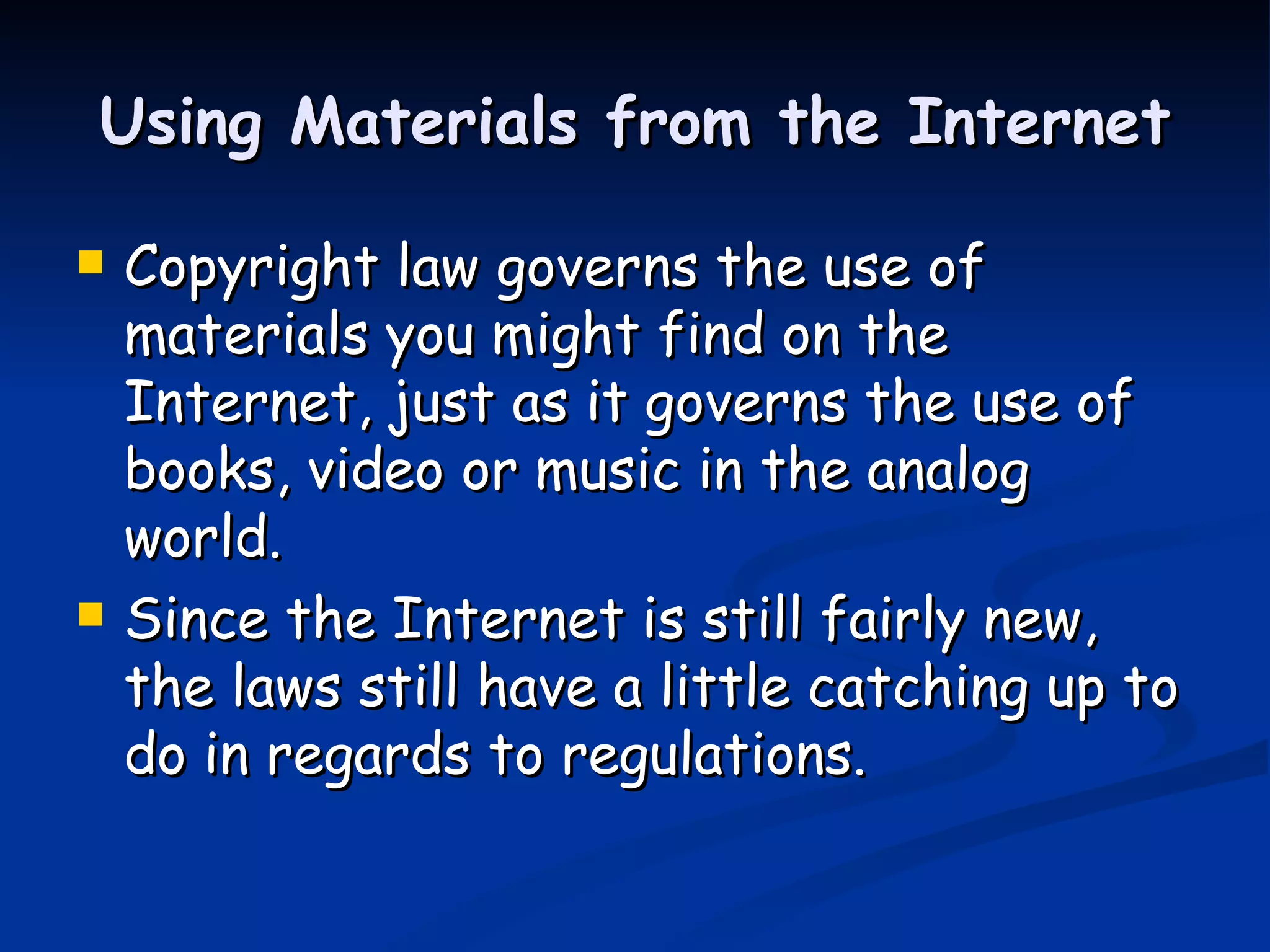
Using Materials from the Internet Copyright law governs the use of materials you might find on the Internet, just as it governs the use of books, video or music in the analog world.  Since the Internet is still fairly new, the laws still have a little catching up to do in regards to regulations.
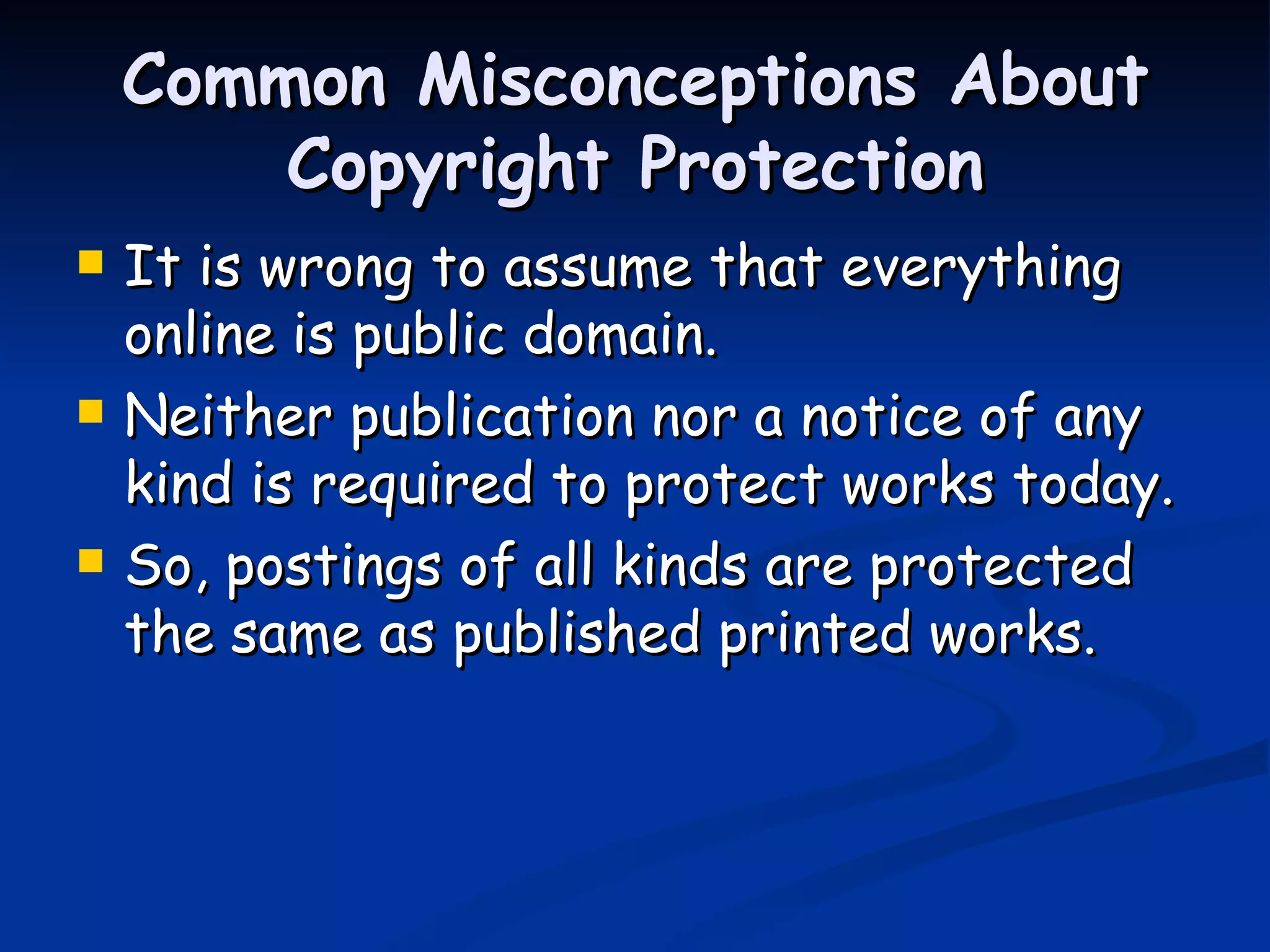
Common Misconceptions About Copyright Protection It is wrong to assume that everything online is public domain. Neither publication nor a notice of any kind is required to protect works today.  So, postings of all kinds are protected the same as published printed works.
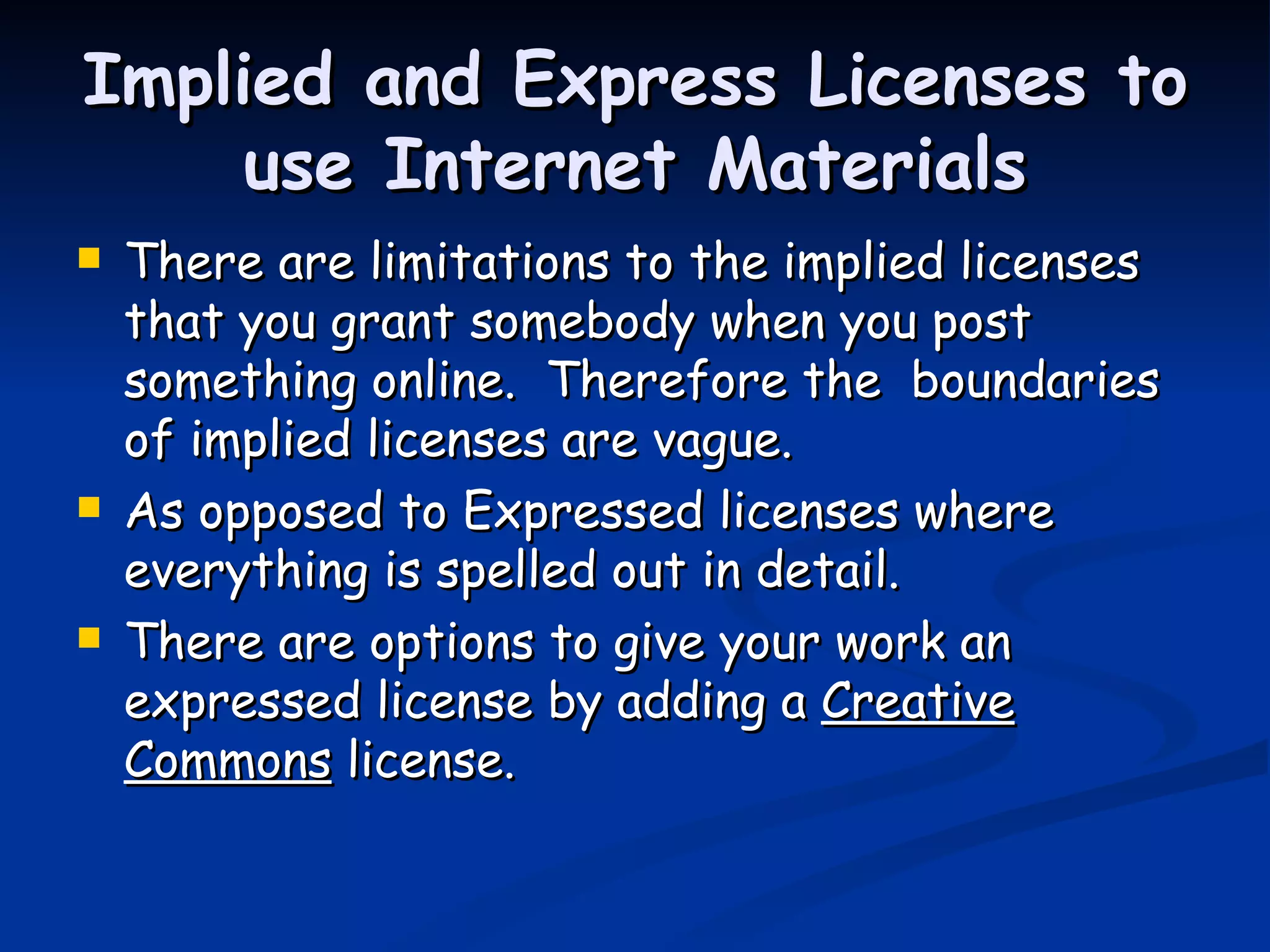
Implied and Express Licenses to use Internet Materials There are limitations to the implied licenses that you grant somebody when you post something online.  Therefore the  boundaries of implied licenses are vague.  As opposed to Expressed licenses where everything is spelled out in detail. There are options to give your work an expressed license by adding a  Creative   Commons  license.
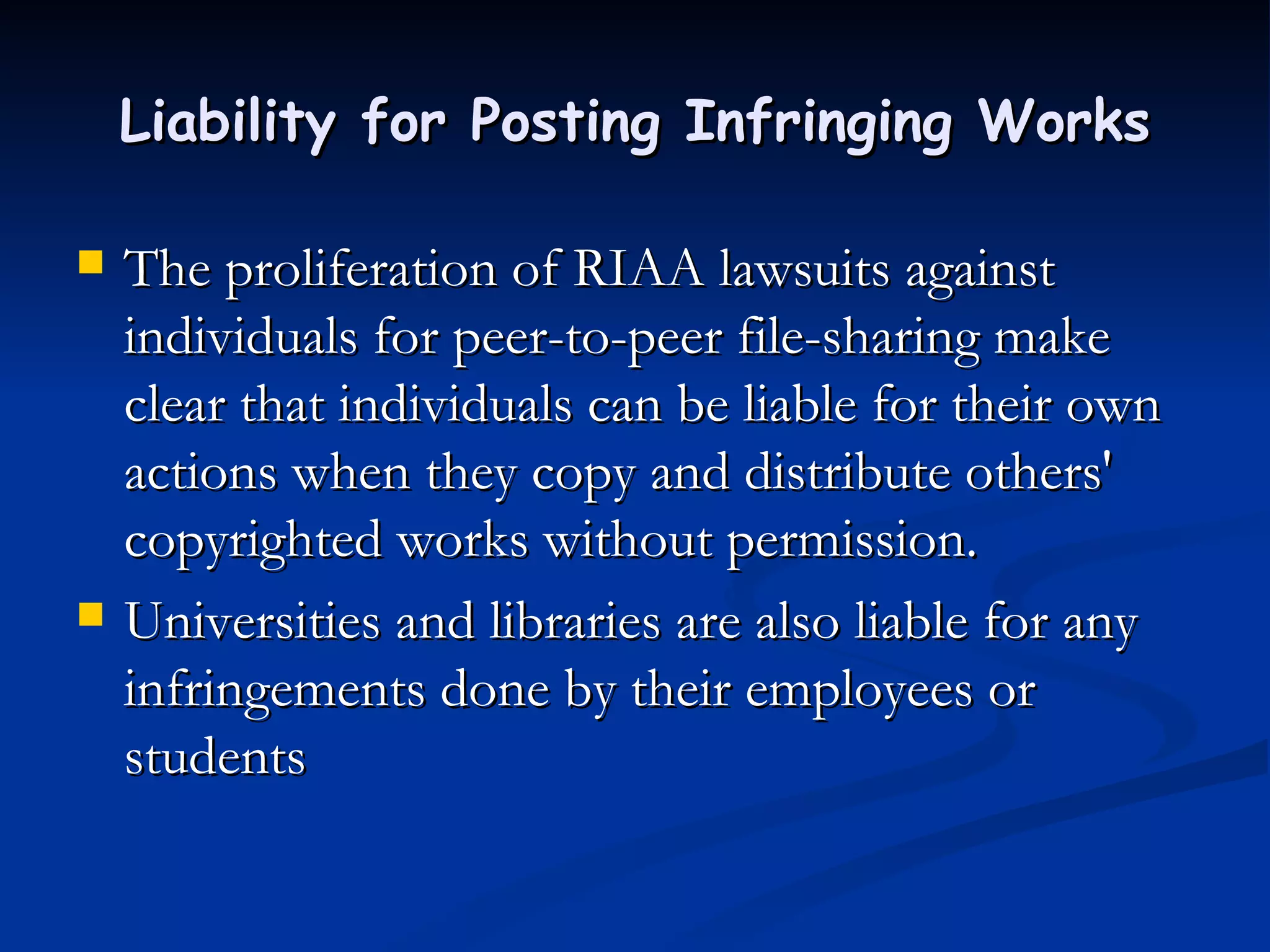
Liability for Posting Infringing Works The proliferation of RIAA lawsuits against individuals for peer-to-peer file-sharing make clear that individuals can be liable for their own actions when they copy and distribute others' copyrighted works without permission.  Universities and libraries are also liable for any infringements done by their employees or students
What is Fair Use? Fair use , a limitation and exception to the exclusive right granted by copyright law to the author of a creative work, is a doctrine in United States copyright law that allows limited use of copyrighted material without acquiring permission from the rights holders.
The Role of Fair Use It used to be safe to say that reasonable analog educational, research and scholarly uses were fair uses. But this appears to be changing. Those same activities in the digital world are being challenged, mostly because copyright owners have gone to such lengths to make the rights we need to carry out those activities easy to obtain and reasonably priced through collective licensing (the Copyright Clearance Center, in particular).
Individual Liability for Infringement The penalties for infringement are very harsh. Willful infringement means that you knew you were infringing and did it anyway.  Penalties are less sever for ignorance of the law. The good faith fair use defense protects people who believe what they did was fair use.
The Four Fair Use Factors What is the character of the use? What is the nature of the work to be used? How much of the work will you see? What effect would this use have on the market for the original or the permissions if the use were widespread?
The TEACH Act Copyright law provides educators with a  separate set of rights in addition to fair use, to display and perform others' works  in the classroom .  Until recently, however, when the classroom was remote, the law's generous terms for face-to-face teaching in Section 110(1) shrank dramatically in Section 110(2) -- some would say to the vanishing point!
Works Cited http://copyright.lib.utexas.edu/

Gcain's copyright ppt

  • 1.
    Building On Other’sCreative Expression Copyright Crash Course
  • 2.
    The Public Domainand Orphan Works Public Domain- the status of a literary work or an invention whose copyright or patent has expired or that never had such protection. Orphan Works- is a copyrighted work for which the copyright owner cannot be contacted.
  • 3.
    Tools for Identificationto Digitalize Orphan Works Google is gathering information that is already online and is not identified as orphan works. UT is using library catalogs and publishing to share results of discoveries.
  • 4.
    Libraries Undertaking Effortsfor Digitalization Libraries are developing best practices to define reasonable searches for copyright owners of different types of works. There are drawbacks for posting orphan works, such as harsh penalties for infringement. Even so, libraries are taking chances that with a reasonable search, they can reduce the risk to an acceptable level and display the work with a special notice.
  • 5.
    Using Materials fromthe Internet Copyright law governs the use of materials you might find on the Internet, just as it governs the use of books, video or music in the analog world. Since the Internet is still fairly new, the laws still have a little catching up to do in regards to regulations.
  • 6.
    Common Misconceptions AboutCopyright Protection It is wrong to assume that everything online is public domain. Neither publication nor a notice of any kind is required to protect works today. So, postings of all kinds are protected the same as published printed works.
  • 7.
    Implied and ExpressLicenses to use Internet Materials There are limitations to the implied licenses that you grant somebody when you post something online. Therefore the boundaries of implied licenses are vague. As opposed to Expressed licenses where everything is spelled out in detail. There are options to give your work an expressed license by adding a Creative Commons license.
  • 8.
    Liability for PostingInfringing Works The proliferation of RIAA lawsuits against individuals for peer-to-peer file-sharing make clear that individuals can be liable for their own actions when they copy and distribute others' copyrighted works without permission. Universities and libraries are also liable for any infringements done by their employees or students
  • 9.
    What is FairUse? Fair use , a limitation and exception to the exclusive right granted by copyright law to the author of a creative work, is a doctrine in United States copyright law that allows limited use of copyrighted material without acquiring permission from the rights holders.
  • 10.
    The Role ofFair Use It used to be safe to say that reasonable analog educational, research and scholarly uses were fair uses. But this appears to be changing. Those same activities in the digital world are being challenged, mostly because copyright owners have gone to such lengths to make the rights we need to carry out those activities easy to obtain and reasonably priced through collective licensing (the Copyright Clearance Center, in particular).
  • 11.
    Individual Liability forInfringement The penalties for infringement are very harsh. Willful infringement means that you knew you were infringing and did it anyway. Penalties are less sever for ignorance of the law. The good faith fair use defense protects people who believe what they did was fair use.
  • 12.
    The Four FairUse Factors What is the character of the use? What is the nature of the work to be used? How much of the work will you see? What effect would this use have on the market for the original or the permissions if the use were widespread?
  • 13.
    The TEACH ActCopyright law provides educators with a separate set of rights in addition to fair use, to display and perform others' works in the classroom . Until recently, however, when the classroom was remote, the law's generous terms for face-to-face teaching in Section 110(1) shrank dramatically in Section 110(2) -- some would say to the vanishing point!
  • 14.